
 English
 Español
 中文
中文 हिन्दी
 Français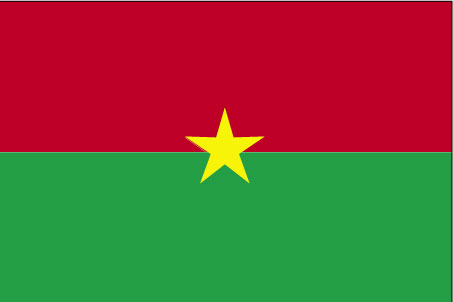
Burkina Faso
Declare Your Relationship to Burkina Faso
CountryReports Community
- Studying0
- From Burkina Faso0
- Burkina Faso heritage0
- Visited0
- Want to visit0
Customs and Culture
Customs and Culture
Cultural Attributes
Burkinabe respect the older generations. The majority of the population are farmers raising enough crops to meet their own needs.

Land of the Griots and Golden Earth
Get More Customs and Culture
6 more cultural topics for members
Social Customs & Etiquette · Diet · Family · Dating Customs · Recreation · Student Life
Holidays
Republic Day
12/11Independence
Dates of Interest
- December 11th
What foods should I expect in BurkinaFaso?
Millet, sorghum and grains are staples, with the main dish being tô or fufu, a porridge made from millet flour. Chickens and guinea fowl are the main meats.
Good to know
- Tô or fufu, a millet-flour porridge, is the primary food
- Chicken and guinea fowl are the common meats
How do people dress in BurkinaFaso?
Rural women wear a long cotton skirt wrapped at the waist, increasingly with a top added, while rural men wear a cotton shirt and pants; urban people wear used Western-style clothing.
Good to know
- Rural men wear cotton shirts and pants
- Urban dress is Western-style
What is family life like in BurkinaFaso?
Descent generally passes through the father (though some southwestern ethnic groups pass goods through the female line), and families feel responsible for the well-being of others in the village, who are usually relatives.
Good to know
- A funeral marks an elder's transition from living to watching ancestor
- Burials happen soon after death due to the hot climate, but funerals may be delayed for months until relatives can attend
- Among the Mossi, marriage is usually arranged and the wife's family receives payments from the husband and his family
What do people do for fun in BurkinaFaso?
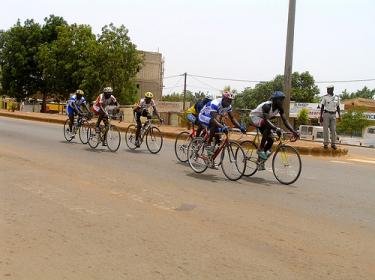
Soccer and bicycle racing are the most popular sports.
Good to know
- Soccer is a favorite pastime
- Bicycle racing is widely followed
What should I know before visiting BurkinaFaso?
Burkinabe respect older generations, and the majority of the population are farmers raising enough crops to meet their own needs.
Do
- Show respect toward older generations
Last updated: 2026-07-12 · Sources: CountryReports
Photos of Burkina Faso
Photos of Burkina Faso


Travel and Tourism
Travel and Tourism
- Travel Alert Status
- Level 4: Do Not Travel
- Currency
- 605.7
- Time Difference
- UTC 0 (5 hours ahead of Washington, DC, during Standard Time)
- Climate
- Burkina Faso's climate is sunny, hot, dry, and dusty. The hot season is from mid-February to June, when maximum temperatures exceed 104°F in the shade. The rainy season typically lasts from June to September. The first rains, called the mango rains, usually begin in May/June and provide some relief from the heat and dust. Annual rainfall ranges from about 10 inches in the extreme north to nearly 40 inches in the south. Temperatures begin to moderate in late September/early October as the rainy season winds down. Mid-November to mid-February is the cool season with high temperatures in the 80s and lows in the 60s. The Harmattan, a hot, dust-laden wind from the Sahara, often blows in January and February, leading to reduced visibility and temporarily unpleasant living conditions.
- Airports
- 33
- Recommended Vaccinations
- How important is it to do your research about vaccinations? It might just save your life! Make yourself aware of the different types of vaccinations and which ones you may need to travel to your destination. Schedule an appointment with your doctor at least four to six weeks before you travel to ensure you receive all important shots. Be sure that you and your family are up to date on your routine vaccinations. Which vaccinations you need will depend on a number of factors including your destination, whether you will be spending time in rural areas, the season of the year you are traveling, your age, health status, and previous immunizations.
Read the full travel guide — health, safety, vaccinations, disease risk, sanitation, and transit details.
View full travel guideRecipes
Recipes
History
History
Historical Eras
Mossi Kingdoms
1400 – 1896
The Mossi people established a series of powerful, centralized kingdoms — most notably Ouagadougou and Yatenga — that dominated the region of present-day Burkina Faso for nearly five centuries. These states were governed by sacred kings called Mogho Naabas and maintained remarkable political continuity, resisting incorporation into neighboring empires such as Mali and Songhai. Trade, cavalry warfare, and elaborate court hierarchies defined Mossi civilization throughout this era.
French Colonial Rule
1896 – 1960
French forces claimed the region in 1896, but sustained Mossi resistance ended only with the fall of Ouagadougou in 1901. The colony of Upper Volta was formally created in 1919, then dissolved and partitioned among neighboring territories in 1932 before being reconstituted within its present boundaries in 1947. France governed largely through existing Mossi authorities, and Upper Volta became a self-governing republic within the French Community in 1958.
First Republic & Early Coups
1960 – 1983
Upper Volta achieved independence on August 5, 1960, with Maurice Yaméogo as its first president, but he quickly banned opposition parties and was ousted in 1966 by Lt. Col. Sangoulé Lamizana, inaugurating an era of alternating military and civilian rule. Lamizana governed through the 1970s until Colonel Saye Zerbo toppled him in 1980, only to be overthrown himself in 1982 by Maj. Jean-Baptiste Ouédraogo. Political instability, union opposition, and factional military rivalries defined these two decades.
Sankara Revolution
1983 – 1987
Captain Thomas Sankara seized power in a coup on August 4, 1983, launching an ambitious Marxist-inspired revolutionary program aimed at economic self-sufficiency, women's emancipation, anti-corruption, and mass mobilization. In 1984 he renamed the country Burkina Faso — "land of honorable people" — and introduced a new flag and anthem as symbols of the break with the colonial past. Sankara became a celebrated pan-African figure, but his austere policies generated opposition and he was assassinated on October 15, 1987, in a coup led by his former ally Blaise Compaoré.
Compaoré Era
1987 – 2014
Blaise Compaoré came to power pledging to "rectify" the revolution but swiftly reversed most of Sankara's policies, liberalizing the economy and consolidating personal authority. Multiparty elections were introduced in the early 1990s, yet Compaoré dominated every subsequent electoral cycle and amended the constitution to extend his tenure, including a controversial third term in 2005. His 27-year rule ended abruptly in October 2014 when mass popular protests forced him into exile after he attempted to remove presidential term limits entirely.
Instability & Insurgency
2014 – present
Following Compaoré's fall, transitional governance gave way to elected president Roch Marc Christian Kaboré in 2015, but mounting jihadist insurgency linked to al-Qaeda and Islamic State affiliates destabilized large swaths of the country's north and east. Two military coups in 2022 — the first bringing Lieutenant-Colonel Paul-Henri Sandaogo Damiba to power and the second installing Captain Ibrahim Traoré — reflected the government's failure to contain the security crisis. Millions of civilians have been internally displaced, making Burkina Faso one of the world's most acute humanitarian emergencies.
Overview
Until the end of the 19th century, the history of Burkina Faso was dominated by the empire-building Mossi. The French arrived and claimed the area in 1896, but Mossi resistance ended only with the capture of their capital Ouagadougou in 1901. The colony of Upper Volta was established in 1919, but it was dismembered and reconstituted several times until the present borders were recognized in 1947.
Timeline of Key Events
1400
Mossi States
Mossi states were built up by peoples migrating from the north of modern Ghana
1896
kingdom of Ouagadougou
The French set up a protectorate over the kingdom of Ouagadougou
1904
kingdom of Ouagadougou
The kingdom of Ouagadougou becames part of the colony of Haut-Sénégal-Niger
1919
French West Africa
The kingdom of Ouagadougou is made into a separate constituent territory of French West Africa
1932
French Sudan
Land divided up in between the French Sudan and Côte d’ Ivoire
1947
Upper Volta
The land is reconstituted as the separate territory of Upper Volta.
1958
Upper Volta Self Governing Republic
Upper Volta becames a self-governing republic within the French community.
Read the full history profile — narrative overview, defining eras, and the complete timeline in one place.
View expanded historyInteresting Facts
Interesting Facts
Burkina Faso consistently produces silk purses from sows' ears
See every fact — trivia, oddities, and curious tidbits gathered from across the country.
View all interesting factsGeography and Environment
Geography and Environment
- Terrain
- mostly flat to dissected, undulating plains; hills in west and southeast
- Climate
- Burkina Faso’s climate is sunny, hot, dry, and dusty. The hot season is from mid-February to June, when maximum temperatures exceed 104° F in the shade. The rainy season typically lasts from June to September. The first rains, called the mango rains, usually begin in May/June and provide some relief from the heat and dust. Annual rainfall ranges from about 10 inches in the extreme north to nearly 40 inches in the south. Temperatures begin to moderate in late September/early October as the rainy season winds down. Mid-November to mid-February is the cool season — with high temperatures in the 80s and lows in the 60s. The Harmattan, a hot, dust-laden wind from the Sahara, often blows in January and February, leading to reduced visibility and temporarily unpleasant living conditions
- Natural Hazards
- recurring droughts
- Current Environmental Issues
- recent droughts and desertification severely affecting agricultural activities, population distribution, and the economy; overgrazing; soil degradation; deforestation
Read the full geography and environment profile — terrain, climate, natural resources, hazards, land use, and international agreements.
View full geographyPeople & Demographics
People & Demographics
Religion
Languages Spoken
French (official), native African languages belonging to the Sudanic family spoken by 90% of the population
- French
Population
- Population
- 22,674,514
- Population in Major Urban Areas
- OUAGADOUGOU (capital) 2.053 million
- Nationality Noun
- Burkinabe (singular and plural)
- Ethnic Groups
- Mossi over 40%, Gurunsi, Senufo, Lobi, Bobo, Mande, Fulani
Education
- Literacy Definition
- Age 15 and over can read and write
Health Information
- Life Expectancy at Birth
- Life expectancy at birth in Burkina Faso stands at approximately 62 years overall, with women living slightly longer than men — around 63 years for females compared to roughly 61 years for males. While these figures reflect meaningful progress over recent decades, they remain well below the global average of around 73 years, highlighting the ongoing health and development challenges facing this landlocked West African nation. Several interconnected factors contribute to the relatively low life expectancy. Burkina Faso has one of the highest rates of child and infant mortality in the world, which significantly pulls down the overall average. Many children under five remain vulnerable to preventable diseases such as malaria, diarrheal illnesses, and acute respiratory infections. Malaria alone accounts for a substantial proportion of deaths across all age groups and continues to strain the country's health system. Access to quality healthcare is limited, particularly in rural areas where the majority of the population lives. There is a severe shortage of trained medical professionals, functional health facilities, and essential medicines. Poor sanitation, limited access to clean drinking water, and widespread food insecurity further undermine the health of the general population. Maternal mortality is another critical concern. Burkina Faso's maternal mortality rate is among the highest globally, reflecting inadequate access to skilled birth attendants, prenatal care, and emergency obstetric services. Compounding these health challenges is the deteriorating security situation in recent years, as armed conflict and displacement have disrupted healthcare delivery and pushed communities away from existing services in many regions. Despite these obstacles, life expectancy in Burkina Faso has improved significantly since the 1960s, when it hovered around 35 to 40 years. This progress reflects gains in vaccination coverage, expansion of community health centers, and targeted interventions against major infectious diseases. International health organizations and government programs continue to work toward further improvements, with a particular focus on reducing child mortality and improving maternal health outcomes.
- Major Infectious Diseases — degree of risk
- Very high
Life Expectancy
- Life Expectancy at Birth
- Life expectancy at birth in Burkina Faso stands at approximately 62 years overall, with women living slightly longer than men — around 63 years for females compared to roughly 61 years for males. While these figures reflect meaningful progress over recent decades, they remain well below the global average of around 73 years, highlighting the ongoing health and development challenges facing this landlocked West African nation. Several interconnected factors contribute to the relatively low life expectancy. Burkina Faso has one of the highest rates of child and infant mortality in the world, which significantly pulls down the overall average. Many children under five remain vulnerable to preventable diseases such as malaria, diarrheal illnesses, and acute respiratory infections. Malaria alone accounts for a substantial proportion of deaths across all age groups and continues to strain the country's health system. Access to quality healthcare is limited, particularly in rural areas where the majority of the population lives. There is a severe shortage of trained medical professionals, functional health facilities, and essential medicines. Poor sanitation, limited access to clean drinking water, and widespread food insecurity further undermine the health of the general population. Maternal mortality is another critical concern. Burkina Faso's maternal mortality rate is among the highest globally, reflecting inadequate access to skilled birth attendants, prenatal care, and emergency obstetric services. Compounding these health challenges is the deteriorating security situation in recent years, as armed conflict and displacement have disrupted healthcare delivery and pushed communities away from existing services in many regions. Despite these obstacles, life expectancy in Burkina Faso has improved significantly since the 1960s, when it hovered around 35 to 40 years. This progress reflects gains in vaccination coverage, expansion of community health centers, and targeted interventions against major infectious diseases. International health organizations and government programs continue to work toward further improvements, with a particular focus on reducing child mortality and improving maternal health outcomes.
Read the full people and society profile — demographics, health, education, religion, languages, and notable people.
View full people and societyGovernment & Politics
Government & Politics
Country Identity
- Country Name
- BurkinaFaso
- Former Name
- Upper Volta, Republic of Upper Volta
Government Structure
- Government Type
- parliamentary republic
- Legal System
- based on French civil law system and customary law
- Executive Branch
- chief of state: Transitional President Captain Ibrahim TRAORE (since 2 October 2022), following a military coup; TRAORE leads the Alliance for Salvation and Restoration (MPSR2) junta that seized power from transitional leader Paul-Henri Sandaogo DAMIBA, who had himself taken power in a January 2022 coup ousting elected President Roch Marc Christian KABORE head of government: Prime Minister Jean-Baptiste OUEDRAOGO (since January 2023), appointed by Captain TRAORE to oversee civilian governance functions under the military-led transitional government cabinet: Transitional Council serves in an advisory and legislative capacity; a Council of Ministers is appointed by the transitional president elections: Prior to the military coups of 2022, the president was elected by popular vote for a five-year term; the constitution allowed for one presidential re-election; democratic elections have been suspended under the current transitional military government, with a return to civilian rule tentatively targeted for mid-2024, though the timeline has faced repeated delays election results: The last democratic presidential election was held in November 2020, in which Roch Marc Christian KABORE was reelected with approximately 57.9% of the popular vote; KABORE was subsequently deposed in a military coup in January 2022
- Legislative Branch
- Burkina Faso's legislature was unicameral, consisting of a National Assembly (Assemblée Nationale) with 127 seats, whose members were elected by popular vote to serve five-year terms. However, following the military coup of September 2022, the National Assembly was dissolved by the junta leader Captain Ibrahim Traoré and the Patriotic Movement for Safeguard and Restoration (MPSR). Legislative authority was subsequently suspended and transferred to a transitional body, the Alliance for Peace and Refoundation, pending an eventual return to civilian rule. Prior to the coup, the last legislative elections were held on November 22, 2020, in which the Congress for Democracy and Progress (CDP) and other parties competed, with President Roch Marc Christian Kaboré's People's Movement for Progress (MPP) winning a majority of seats. The transitional government has not established a firm timeline for restoring democratic elections, and the country remains under military governance as of the most recent reporting period.
- Judicial Branch
- Supreme Court; Appeals Court
- Suffrage
- universal
- Constitution
- 2 June 1991 approved by referendum; 11 June 1991 formally adopted; ammended April 2000
- Independence
- 5 August 1960 (from France)
- National Holiday
- Republic Day, 11 December (1958)
Capital City
- Capital Name
- Ouagadougou
- Capital - geographic coordinate
- 12 22 N, 1 31 W
- Capital Time Difference
- UTC 0 (5 hours ahead of Washington, DC, during Standard Time)
Ouagadougou is a Francophone spelling of the native name "Wogodogo," meaning "where people get honor and respect"
Military
Branches: Army, Air Force of Burkina Faso (Force Aerienne de Burkina Faso, FABF), National Gendarmerie
Embassy / Diplomatic Mission
U.S. Embassy Ouagadougou
Avenue Sembene Ousmane, Secteur 15, Ouaga 2000
Ouagadougou, Burkina Faso
Telephone: 226 50 49 53 00
Facsimile: 226 50 49 56 23
Read the full government profile — flag symbolism, national anthem, and other national symbols.
View full government detailsEconomy
Economy
Burkina Faso is one of the poorest countries in the world, a landlocked Sahelian nation with limited natural resources, fragile soils, and a highly unequal distribution of income.
Snapshot
- Currency Name and Code
- Communaute Financiere Africaine francs (XOF)
- GDP — official exchange rate
- $5,405,000,000 (USD)
- GDP Real Growth Rate
- 5.9%
- Gini Index
- 48.2
News & Weather
News & Weather
Current Weather
Latest News
Burkina Faso's Traore cautions against comparisons as new Thomas Sankara - TRT Afrika
TRT Afrika · 16h ago
Burkina Faso records over $6 billion worth of gold through official channels in six months - Business Insider Africa
Business Insider Africa · 6h ago
Update on the Political Transition in Burkina Faso and Niger - Amani Africa
Amani Africa · 1d ago
Why Traore has opened a new front with Burkina Faso’s Muslim community - Al Jazeera
Al Jazeera · 4d ago
Burkina Faso ruler declares 'battle' against Muslim scholars - The New Arab
The New Arab · 2d ago
Burkina Faso’s army accused of preventing civilians from leaving jihadist-besieged towns - The New Humanitarian
The New Humanitarian · 21d ago
A Sample Grant Proposal on “Strengthening Agricultural Cooperatives in Burkina Faso” - fundsforNGOs
fundsforNGOs · 6h ago
NWSL's Washington Spirit sign Burkina Faso defender Alimata Bélem from Eibar - ESPN
ESPN · 5d ago
News via Google News
Climate Overview
Burkina Faso's climate is sunny, hot, dry, and dusty. The hot season is from mid-February to June, when maximum temperatures exceed 104°F in the shade. The rainy season typically lasts from June to September. The first rains, called the mango rains, usually begin in May/June and provide some relief from the heat and dust. Annual rainfall ranges from about 10 inches in the extreme north to nearly 40 inches in the south. Temperatures begin to moderate in late September/early October as the rainy season winds down. Mid-November to mid-February is the cool season with high temperatures in the 80s and lows in the 60s. The Harmattan, a hot, dust-laden wind from the Sahara, often blows in January and February, leading to reduced visibility and temporarily unpleasant living conditions.
Videos
Videos
1 curated YouTube videos.
Source: YouTube
Frequently Asked Questions
Frequently Asked Questions
What is the population of Burkina Faso?
What foods should I expect in BurkinaFaso?
How do people dress in BurkinaFaso?
What is family life like in BurkinaFaso?
What do people do for fun in BurkinaFaso?
What should I know before visiting BurkinaFaso?
What is the capital of Burkina Faso?
Where is Burkina Faso located?
What countries border Burkina Faso?
What is the predominant religion in Burkina Faso?
What currency does Burkina Faso use?
What languages are spoken in Burkina Faso?
What is the geography and terrain of Burkina Faso like?
What is Burkina Faso known for?
Last reviewed 2026