
 English
 Español
 中文
中文 हिन्दी
 Français
Hungary
Magyarorszag
Declare Your Relationship to Hungary
CountryReports Community
- Studying0
- From Hungary0
- Hungary heritage0
- Visited0
- Want to visit0
Customs and Culture
Customs and Culture
Cultural Attributes
People earnestly wish to become part of an integrated Europe. Accompanying pride in their heritage and past achievements, however, is a historical tendency for pessimism.
Even if one's neighbors are worse off, a Hungarian will express doubt about his or her own future or condition. Hungarians value independence, a strong and stable family, education, security (be it a job, home or social benefits), property (a home, a garden, and a car) access to or ownership of summer cottages and travel outside of Hungary. People admire professionals but do not generally admire the wealthy.

Land of the Danube's Splendor
Get More Customs and Culture
6 more cultural topics for members
Social Customs & Etiquette · Diet · Family · Dating Customs · Recreation · Student Life
Holidays
Saint Stephen's Day
8/20Religious
Birthdate - Erich Weiss (Harry Houdini)
3/24Birthday
Birthdate - Erich Weiss (Harry Houdini, world’s greatest escape artist, was born in Budapest, Hungary.
Birthdate - Béla Bartók
3/25Birthday
Béla Bartók Nagyszentmiklós, Hungarian composer and pianist was born in Austria-Hungary. [now Sânnicolau Mare, Romania]
Birthdate - Joseph Pulitzer
4/10Birthday
Birthdate - Joseph Pulitzer, journalist, founder of the Pulitzer prizes, was born in Makó, Hungary.
Birth date - Franz Liszt
10/22Birthday
Birth date - Franz Liszt, Hungarian composer, was born in Doborján, Austria-Hungary (now Raiding, Burgenland, Austria) on Oct. 22, 1811.
Christmas
12/25Christmas
Christmas in Hungary is the greatest festival of the year. Christmas celebrations begin on December 6 and lasts until the New Year. Called Szent-este and pronounced ‘shunt-uh-stay,’ the literal meaning of Christmas in Hungary is Holy Evening.
Hungarians spend the eve of Christmas with their family and decorate the tree with Szaaloncukor, special Hungarian candies made of chocolate wrapped in marzipan then wrapped in foil and hung on the tree. Other decorations include bon-bons, glass balls, wood or straw figurines, candles and lights. Hungarians sing Christmas Carols around the tree. Children open the presents which are under the tree before dinner.
There are two occasions when Hungarians can exchange presents. Christmas celebrations start on December 6 when Mikulas, pronounced ‘Mee-coo-lash’ ( Santa Claus) visits Hungary accompanied by Krampusz, pronounced ‘kromm-puhs’ (the devil). Children leave their shoes or boots on the windowsill for him to fill. Mikulas wears bishop’s robes and has a miter on his head and is holding a staff. He has a sack full of toys and gifts on his other hand. There is no Mrs. Claus in Hungary and instead, Mikulas is accompanied by the Devil, who has dry twigs in his hand to hit naughty children. Mikulas usually stuffs the children’s boots with goodies like walnuts, tangerines, candies, apples, dates and chocolate.
Hungarian Christmas preparations include decorating candles with red and gold ribbons and giving children advent calendars with some candies for every day before Christmas. Most people do not go to Christmas parties for the holidays, but rather stay home and spend time with their families.
One Hungarian tradition is the ‘Betlehem Play’ where groups of boys go from house to house and perform a play about the holy family for their audience. Songs and poems usually accompany their wonderful costumes.
Christmas dinner, served on December 24th, Christmas Eve, usually consists of fish, cabbage and a Beigli( a type of poppy bread). After the Christmas meal, many people go to church for Midnight Mass. The highlight of Christmas, the Nativity scene is shown at the Mass where children and adults perform a play enhanced by songs, puppetry and musical instruments.
Upon returning home, children are not allowed in their houses until a bell is rung. They then enter a darkened room with candles and sparklers. Everyone then sings carols around the tree and exchanges presents. Having already received presents from Mikulas on December 6, the presents opened on Christmas Eve are thought to come from the Three Kings.
The day after, which is Christmas Day, people go and visit their relatives. There is also a special Hungarian Holiday meal which consists of a roasted turkey, lentils, fish and poppyseed strudel.
Dates of Interest
- December 25th
Christmas in Hungary is the greatest festival of the year. Christmas celebrations begin on December 6 and lasts until the New Year. Called Szent-este and pronounced ‘shunt-uh-stay,’ the literal meaning of Christmas in Hungary is Holy Evening. Hungarians spend the eve of Christmas with their family and decorate the tree with Szaaloncukor, special Hungarian candies made of chocolate wrapped in marzipan then wrapped in foil and hung on the tree. Other decorations include bon-bons, glass balls, wood or straw figurines, candles and lights. Hungarians sing Christmas Carols around the tree. Children open the presents which are under the tree before dinner. There are two occasions when Hungarians can exchange presents. Christmas celebrations start on December 6 when Mikulas, pronounced ‘Mee-coo-lash’ ( Santa Claus) visits Hungary accompanied by Krampusz, pronounced ‘kromm-puhs’ (the devil). Children
How do people greet each other in Hungary?
People often introduce themselves by their surname first, and first names are reserved for friends and relatives. Close women friends may hug and kiss each other lightly on the cheek.
Do
- Introduce yourself with your surname first
- Use first names only with friends and relatives
Good to know
- Adults may address younger people by first name
What are dining customs like in Hungary?
Meals feature famous dishes like goulash and generous use of paprika, with pork and chicken as the most common meats. Lunch is the main meal in rural areas, while dinner is the main meal in urban areas.
Don’t
- Don't leave food on your plate — it is considered impolite
Good to know
- Breakfast may be light (rolls and a drink) or heartier with eggs, salami, cheese, yogurt and hot peppers
- Try goulash, a stew of meat, potatoes, onion and paprika
- Kindli, a cookie, is served during Purim by Hungarian Jews
How does visiting and hospitality work in Hungary?
Most visits are arranged in advance where possible, though close relatives and friends may drop by unannounced. First-time visits by acquaintances are usually short.
Do
- Arrange visits in advance when possible
- Keep first-time visits with acquaintances brief
What should I wear in Hungary?
Clothing generally follows that of other Western European countries, with conservative suits worn for business. Traditional costumes appear only at special cultural events in urban cities.
Do
- Wear conservative suits for business
What is family life like in Hungary?
An average Hungarian family consists of three people, with the father in a dominant role and both parents usually working. Adult children often live with their parents until married, and the elderly are typically cared for by their children.
Good to know
- Men share some household responsibilities but traditionally take on outdoor chores
- Urban newlyweds tend to be older than couples outside major cities
What do Hungarians do for recreation?
Soccer is the most popular sport and water polo is also popular, with many cities offering indoor and outdoor pools. Hungarians like to relax during leisure hours and vacation trips are extremely popular.
Good to know
- Many people have access to summer cottages for weekend vacations
Last updated: 2026-07-12 · Sources: CountryReports
Photos of Hungary
Photos of Hungary
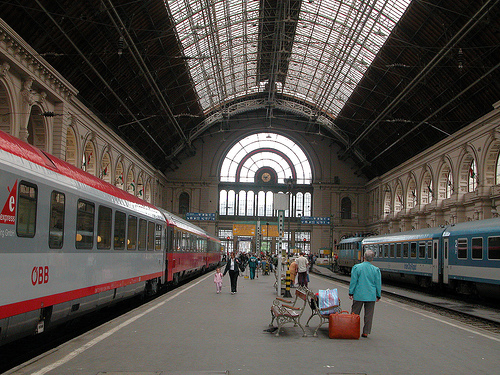
Train station in Budapest, Hungary
Chain bridge, Budapest
Buda Castle, Budapest
Hotel Gellert Pool, Budapest
Buda Castle, Budapest
Local market in Budapest
Castle Hill, Budapest
Fisherman’s Bastion, Budapest
Houses of Parliament, Budpapest
Incline rail to old city, Budapest, Hungary
Budapest, Hungary
Budapest, Hungary


Travel and Tourism
Travel and Tourism
- Travel Alert Status
- Level 1: Exercise Normal Precautions
- Currency
- forint (HUF)
- Time Difference
- UTC+1 (6 hours ahead of Washington, DC, during Standard Time)
- Climate
- Temperate; cold, cloudy, humid winters; warm summers
- Airports
- 43
Read the full travel guide — health, safety, vaccinations, disease risk, sanitation, and transit details.
View full travel guideRecipes
Recipes
Kindli (Hungarian Cookie For Purim)
Side Dish
Main Dish
Gulyásleves (Goulash Soup)
Side Dish
Hungarian Stuffed Red Bell Peppers
Side Dish
Uborka Saláta (Cucumber Salad)
Side Dish
Meggyleves (Morello Cherry Soup)
Side Dish
Kindli (Hungarian Cookie For Purim)
Soup
Gesztenye Krémleves (Cream of Chestnut Soup)
Dessert
PremiumAlmás Rétes (Apple Strudel)
History
History
Historical Eras
Magyar Conquest & Árpáds
896 – 1301
The Magyar tribes, led by Árpád, settled the Carpathian Basin in 896, founding the Hungarian state. King Stephen I (997–1038) Christianized the kingdom and established a centralized monarchy, earning papal recognition. The Árpád dynasty presided over medieval Hungary's rise, though the Mongol invasion of 1241 devastated the population and reshaped the kingdom's political structure before the dynasty died out in 1301.
Medieval Kingdom
1301 – 1526
Following the Árpád line's extinction, Hungary passed through the Angevin and later Jagiellonian dynasties, reaching a cultural and military peak under King Matthias Corvinus (1458–1490), who patronized Renaissance arts and maintained the formidable Black Army. Hungary stood as a major Central European power and a bulwark against Ottoman expansion, though political fragmentation after Matthias's death left the kingdom vulnerable to the catastrophic Ottoman defeat at Mohács in 1526.
Ottoman Partition & Habsburg Rule
1526 – 1711
After Mohács, Hungary was divided into three zones: Ottoman-controlled central Hungary, the Habsburg-administered Royal Hungary in the northwest, and the semi-autonomous Principality of Transylvania. The Ottomans' presence accelerated the spread of Protestantism, while Habsburg rulers sought to re-Catholicize and Germanize the population. A prolonged series of anti-Habsburg uprisings, culminating in the Rákóczi War of Independence (1703–1711), failed to dislodge Habsburg authority but preserved Hungarian national consciousness.
Reform, Revolution & Dual Monarchy
1711 – 1918
The eighteenth and early nineteenth centuries saw Habsburg-controlled Hungary experience economic stagnation and ethnic suppression, sparking a national reform movement led by figures such as István Széchenyi and Lajos Kossuth. The Revolution of 1848–1849 briefly dethroned Habsburg authority before being crushed with Russian assistance. The Compromise of 1867 created the Austro-Hungarian Dual Monarchy, granting Hungary significant autonomy until the empire's collapse at the end of World War I.
Interwar Period & WWII
1918 – 1945
The Treaty of Trianon (1920) stripped Hungary of roughly two-thirds of its territory and one-third of its ethnic Magyar population, generating an irredentist nationalism that dominated interwar politics under Regent Miklós Horthy. Seeking to recover lost lands, Hungary allied with Nazi Germany, regaining some territories via the Vienna Awards of 1938–1940. Germany occupied Hungary directly in March 1944, accelerating the deportation of Hungarian Jews; Soviet forces liberated and then occupied the country by early 1945.
Communist Rule & Transition
1945 – 1990
Soviet occupation enabled the Hungarian Communist Party under Mátyás Rákosi to eliminate political rivals and establish a Stalinist state by 1949. Popular resentment erupted in the Revolution of October 1956, which Soviet forces brutally suppressed, installing János Kádár as leader. Kádár gradually introduced market-oriented reforms known as 'Goulash Communism,' making Hungary the most liberal Soviet-bloc economy, until the regime peacefully ceded power following free multiparty elections in 1990.
Democratic Hungary
1990 – present
Post-communist Hungary rapidly privatized its economy and reoriented its foreign policy westward, joining NATO in 1999 and the European Union in 2004. The early democratic period was marked by political alternation between center-right and socialist governments, while the global financial crisis of 2008 deepened economic instability. Viktor Orbán and his Fidesz party, dominant since 2010, have reshaped Hungary's constitutional order and stoked tensions with EU institutions over rule-of-law concerns.
Overview
Refugee writing a letter, Esztergom, 1916
Timeline of Key Events
896
Under the leadership of Árpád, the Hungarian tribes settled in the Carpathian Basin.
Under the leadership of Árpád, the Hungarian tribes settled in the Carpathian Basin. They drove out part of the residents and absorbed the other part.
997 – 1038
King Stephen of the Árpád dynasty ruled the country.
King Stephen of the Árpád dynasty ruled the country.
1241
The Mongolian Tatars devastated the country.
The Mongolian Tatars devastated the country. Their presence, which lasted a year, halted development for at least a century. After the warfare with the Hungarians, the Tatars did not continue towards the west.
1458 – 1490
King Matthias reigned
The rule of King Matthias. Cultural life of a European standard flourished in his palaces at Buda and Visegrád. For a few decades, Hungary lived on a West European standard.
1526
Ottoman Turks defeat forces of Hungarian king at Battle of Mohacs.
Ottoman Turks defeat forces of Hungarian king at Battle of Mohacs. The beginning of 150 years of Turkish occupation.
1541
Hungary was divided into three parts.
Hungary was divided into three parts. The Habsburg governed the western part of the country, the central area was ruled by the Turks, and the south-east Transylvanian principality (today part of Roumania) for a long time was the citadel of Hungarian culture.
1703 – 1711
Hungarian War, led by the Prince of Transylvania, against the Habsburgs failed.
Hungarian War, led by the Prince of Transylvania, against the Habsburgs failed.
Read the full history profile — narrative overview, defining eras, and the complete timeline in one place.
View expanded historyInteresting Facts
Interesting Facts
Hungary had the world's worst inflation rate set in June 1946.
Almost 5 million Hungarians live outside Hungary. Over 160,000 Hungarians have made Canada their home. Well-known Hungarian-Canadians include John Polanyi, winner of the 1986 Nobel Prize in chemistry; Peter Munk, head of the construction and development firm Trizec; and Dora Pedery-Hunt, sculptor and member of the Order of Canada.
During the 15th century reign of Matthias Corvinus, Buda became a great centre for learning. The splendour of the Hungarian court was renowned throughout Europe.
Hot springs in Hungary are used for central heating in homes and for agriculture and industry.
See every fact — trivia, oddities, and curious tidbits gathered from across the country.
View all interesting factsGeography and Environment
Geography and Environment
- Terrain
- mostly flat to rolling plains; hills and low mountains on the Slovakian border
- Climate
- temperate; cold, cloudy, humid winters; warm summers
- Current Environmental Issues
- the upgrading of Hungary's standards in waste management, energy efficiency, and air, soil, and water pollution with environmental requirements for EU accession will require large investments
Read the full geography and environment profile — terrain, climate, natural resources, hazards, land use, and international agreements.
View full geographyPeople & Demographics
People & Demographics
Religion
Languages Spoken
Hungarian 98.2%, other 1.8%
- Hungarian
- Magyar
Population
- Population
- 9,589,870
- Population in Major Urban Areas
- BUDAPEST (capital) 1.737 million
- Nationality Noun
- Hungarian(s)
- Ethnic Groups
- Hungarian 89.9%, Roma 4%, German 2.6%, Serb 2%, Slovak 0.8%, Romanian 0.7%
Education
- Literacy Definition
- age 15 and over can read and write
Health Information
- Life Expectancy at Birth
- Life expectancy at birth in Hungary stands at approximately 76 years overall, with notable differences between men and women. Hungarian women can expect to live to around 79–80 years, while men have a considerably shorter average lifespan of approximately 73–74 years. This gender gap of roughly six to seven years is one of the more pronounced disparities in the European Union and reflects longstanding differences in lifestyle factors, healthcare engagement, and occupational risks between Hungarian men and women. Hungary's overall life expectancy falls somewhat below the EU average, which hovers closer to 81 years. This gap has been a persistent challenge for the country, rooted in several interconnected public health concerns. Cardiovascular disease remains the leading cause of death among Hungarians, accounting for a substantial proportion of mortality. High rates of smoking, alcohol consumption, obesity, and relatively low rates of physical activity contribute significantly to this burden. Diet also plays a role, as traditional Hungarian cuisine tends to be rich in animal fats and salt, factors associated with increased risk of heart disease and stroke. Additionally, Hungary has historically had elevated rates of certain cancers, including colorectal and lung cancer, both of which are closely linked to lifestyle choices. In recent decades, Hungary has made incremental progress in improving life expectancy. The post-communist transition period of the 1990s saw a temporary decline in health outcomes due to economic hardship and social stress, but gradual improvements in healthcare infrastructure, access to modern treatments, and public health campaigns have helped push life expectancy upward over the long term. The Hungarian government has implemented various national health programs targeting cardiovascular disease prevention, smoking cessation, and cancer screening, aiming to narrow the gap with wealthier EU neighbors such as Sweden, Spain, and Italy, where life expectancy can reach 83 years or beyond. Continued investment in preventive care and addressing socioeconomic inequalities in health access remain central goals for improving population health outcomes in the coming decades.
- Major Infectious Diseases — degree of risk
- Intermediate
Life Expectancy
- Life Expectancy at Birth
- Life expectancy at birth in Hungary stands at approximately 76 years overall, with notable differences between men and women. Hungarian women can expect to live to around 79–80 years, while men have a considerably shorter average lifespan of approximately 73–74 years. This gender gap of roughly six to seven years is one of the more pronounced disparities in the European Union and reflects longstanding differences in lifestyle factors, healthcare engagement, and occupational risks between Hungarian men and women. Hungary's overall life expectancy falls somewhat below the EU average, which hovers closer to 81 years. This gap has been a persistent challenge for the country, rooted in several interconnected public health concerns. Cardiovascular disease remains the leading cause of death among Hungarians, accounting for a substantial proportion of mortality. High rates of smoking, alcohol consumption, obesity, and relatively low rates of physical activity contribute significantly to this burden. Diet also plays a role, as traditional Hungarian cuisine tends to be rich in animal fats and salt, factors associated with increased risk of heart disease and stroke. Additionally, Hungary has historically had elevated rates of certain cancers, including colorectal and lung cancer, both of which are closely linked to lifestyle choices. In recent decades, Hungary has made incremental progress in improving life expectancy. The post-communist transition period of the 1990s saw a temporary decline in health outcomes due to economic hardship and social stress, but gradual improvements in healthcare infrastructure, access to modern treatments, and public health campaigns have helped push life expectancy upward over the long term. The Hungarian government has implemented various national health programs targeting cardiovascular disease prevention, smoking cessation, and cancer screening, aiming to narrow the gap with wealthier EU neighbors such as Sweden, Spain, and Italy, where life expectancy can reach 83 years or beyond. Continued investment in preventive care and addressing socioeconomic inequalities in health access remain central goals for improving population health outcomes in the coming decades.
Read the full people and society profile — demographics, health, education, religion, languages, and notable people.
View full people and societyGovernment & Politics
Government & Politics
Country Identity
- Country Name
- Hungary
- Full Country Name
- Republic of Hungary
- Local - Long
- Magyar Koztarsasag
- Local - Short
- Magyarorszag
Government Structure
- Government Type
- parliamentary democracy
- Legal System
- rule of law based on Western model
- Executive Branch
- chief of state: President Tamas SULYOK (since 5 March 2024) head of government: Prime Minister Viktor ORBAN (since 29 May 2010, reappointed most recently on 24 May 2022) cabinet: Council of Ministers elected by the National Assembly on the recommendation of the president elections: president elected by the National Assembly for a five-year term; election last held on 26 February 2024 (next to be held in 2029); prime minister elected by the National Assembly on the recommendation of the president; election last held 24 May 2022 election results: Tamas SULYOK elected president without opposition following the resignation of Katalin NOVAK; Viktor ORBAN elected prime minister following the April 2022 legislative elections in which his Fidesz-KDNP alliance won a fourth consecutive supermajority note: to be elected, the president must win two-thirds of the legislative vote in the first two rounds or a simple majority in the third round; the president serves a largely ceremonial role, with executive power resting primarily with the prime minister
- Legislative Branch
- unicameral National Assembly or Orszaggyules (199 seats; members are elected by popular vote under a mixed system combining single-member constituencies and party list proportional representation to serve four-year terms) elections: last held 3 April 2022 (next to be held in April 2026) election results: percent of vote by party - Fidesz-KDNP 54.13%, United for Hungary opposition alliance 34.44%, Mi Hazank 5.88%, other 5.55%; seats by party - Fidesz-KDNP 135, United for Hungary 57, Mi Hazank 6, Democratic Coalition 1
- Judicial Branch
- Constitutional Court (judges are elected by the National Assembly for nine-year terms)
- Suffrage
- 18 years of age; universal
- Constitution
- 18 August 1949, effective 20 August 1949, revised 19 April 1972; 18 October 1989 revision ensured legal rights for individuals and constitutional checks on the authority of the prime minister and also established the principle of parliamentary oversight; 1997 amendment streamlined the judicial system
- Independence
- 1001 (unification by King Stephen I)
- National Holiday
- Saint Stephen's Day, 20 August
Capital City
- Capital Name
- Budapest
- Capital - geographic coordinate
- 47 30 N, 19 05 E
- Capital Time Difference
- UTC+1 (6 hours ahead of Washington, DC, during Standard Time)
The Hungarian capital city was formed in 1873 from the merger of three cities on opposite banks of the Danube: Buda and Obuda (Old Buda) on the western shore and Pest on the eastern; the origins of the original names are obscure, but according to the second century A.D. geographer, Ptolemy, the settlement that would become Pest was called "Pession" in ancient times; "Buda" may derive from either a Slavic or Turkic personal name
Military
Branches: Hungarian Defense Forces: Land Forces, Hungarian Air Force (Magyar Legiero, ML)
Embassy / Diplomatic Mission
The U.S. Embassy in Budapest
Szabadság tér 12
H-1054 Budapest
Main Telephone: (36)(1) 475-4400
U.S. Citizen Services Telephone: (36)(1) 475-4164
After-hours emergency calls -- for U.S. citizens only: (36)(1) 475-4400.
Fax (36)(1) 475-4188 or (36)(1) 475-4113
Email: acs.budapest@state.gov
Read the full government profile — flag symbolism, national anthem, and other national symbols.
View full government detailsEconomy
Economy
Hungary has completed its transition from a centrally planned to a market economy and joined the European Union in May 2004.
Snapshot
- Currency Name and Code
- Forint (HUF)
- GDP — official exchange rate
- $106,400,000,000 (USD)
- GDP Real Growth Rate
- 1.5%
- Gini Index
- 24.4
News & Weather
News & Weather
Current Weather
Latest News
Hungarian Grand Prix result: Lando Norris wins from Max Verstappen with Kimi Antonelli third - BBC
BBC · 1d ago
They Gave MAGA a Safe Haven. Now They’re in Retreat. - Politico
Politico · 2d ago
New Hungarian Premier’s Rush to Undo Orban System Dents Support - Bloomberg.com
Bloomberg.com · 3h ago
Verstappen doesn't understand how he finished second in Hungary after car struggles - RACER - Racing News
RACER - Racing News · 3h ago
George Russell's anti-stall issue at start of Hungarian GP explained: 'Revving all over the place' - ESPN
ESPN · 20h ago
Oscar Piastri swore at his McLaren crew in frustration in Hungary, but any Formula One revival is up to him - The Guardian
The Guardian · 9h ago
Ferrari meltdown: How the best chassis in F1 flunked a podium finish in Hungary - Motorsport.com
Motorsport.com · 8h ago
How much time has Aston Martin gained with its F1 Hungarian GP update? - Autosport
Autosport · 1d ago
News via Google News
Climate Overview
Temperate; cold, cloudy, humid winters; warm summers
Videos
Videos
1 curated YouTube videos.
Source: YouTube
Frequently Asked Questions
Frequently Asked Questions
What is the population of Hungary?
How do people greet each other in Hungary?
What are dining customs like in Hungary?
How does visiting and hospitality work in Hungary?
What should I wear in Hungary?
What is family life like in Hungary?
What do Hungarians do for recreation?
What is the capital of Hungary?
Where is Hungary located?
What countries border Hungary?
What religion is practiced in Hungary?
What is the currency of Hungary?
What language is spoken in Hungary?
What is the geography of Hungary like?
What is Hungary known for?
Last reviewed 2026