
 English
 Español
 中文
中文 हिन्दी
 Français
Lithuania
Lietuva
Declare Your Relationship to Lithuania
CountryReports Community
- Studying2
- From Lithuania1
- Lithuania heritage2
- Visited3
- Want to visit2
Customs and Culture
Customs and Culture
Cultural Attributes
Lithuanians are often reserved and sincere. Lithuanians are proud of their heritage but not of the Soviet period.

Amber's Cradle, Freedom's Spirit
Get More Customs and Culture
5 more cultural topics for members
Social Customs & Etiquette · Diet · Family · Dating Customs · Recreation
Holidays
Independence Day
2/16Independence Day
16 February 1918 is the date Lithuania declared its independence from Soviet Russia and established its statehood; 11 March 1990 is the date it declared its independence from the Soviet Union
Christmas
12/25Christmas
Dates of Interest
- December 25th
February 16, 1918 is the date Lithuania declared its independence from Soviet Russia and established its statehood; 11 March 1990 is the date it declared its independence from the Soviet Union
How do people greet each other in Lithuania?
The most common greeting is a handshake with direct eye contact and a smile. Lithuanian belongs to the Baltic group of languages and uses the Latin alphabet, with special marks above or below some letters to indicate pronunciation.
Do
- Shake hands with direct eye contact and a smile
What are dining and eating customs like in Lithuania?
Table manners are Continental style, and guests are expected to be punctual. Meals feature hearty dishes such as soups, stews, and pork with potatoes and vegetables.
Do
- Be punctual as a guest
- Hold your fork in the left hand and knife in the right
- Keep your napkin on the table
- Cross your knife and fork on your plate to show you are still eating
Don’t
- Don't place your napkin on your lap
Good to know
- When finished, place your knife and fork across your plate with prongs facing down and handles to the right
- Try traditional specialties like cepelinai (potato dumplings), saltibarsciai (cold beet soup), and smoked eel
- Cold beetroot soup is served in summer and hot beetroot soup in winter
What social etiquette should I know in Lithuania?
Lithuanians tend to be reserved and sincere, proud of their heritage but not of the Soviet period. Drinking vodka (for men only) is common during most social visits.
Good to know
- Be aware that Lithuanians are not proud of the Soviet period
How should I dress in Lithuania?
Western-style clothing is worn day to day, while traditional costume is reserved for festivals.
Good to know
- The traditional women's costume is a colorful woven skirt, embroidered blouse, vest, and a headpiece with ribbons
Are there gestures I should avoid in Lithuania?
Lithuanians generally do not touch each other while speaking, and certain gestures are considered impolite.
Don’t
- Don't talk with your hands in your pockets
- Don't touch others while speaking
- Don't point with your index finger
Good to know
- Use your whole hand, or explain rather than point
What is family life like in Lithuania?
Elders are treated with respect, and parents often live with their adult children to help raise grandchildren. Many Lithuanians live in apartments and keep a small country cottage.
Good to know
- Lithuanians tend to marry in their early twenties
- Young children are expected to obey their parents
What do Lithuanians do for recreation?
Basketball is the most popular sport, and families spend weekends and vacations at self-built cottages known as "sodyba" where they garden, collect berries, and pick mushrooms.
Good to know
- Nearly every cottage has an indoor or outdoor sauna
- Aukstaitija National Park attracts cross-country skiers in winter and canoeists in summer
- Bird-watchers frequent the west coast, especially the town of Vente on the Curonian Lagoon
- Ice fishing is popular on the frozen Curonian Lagoon in winter
Last updated: 2026-07-12 · Sources: CountryReports
Photos of Lithuania
Photos of Lithuania
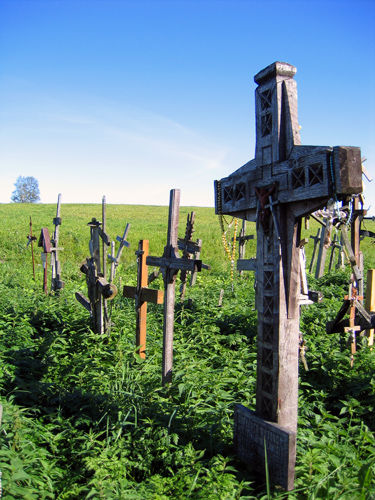
Hills of Crosses, Lithuania. September 2004
Hills of Crosses, Lithuania. September 2004
Hills of Crosses, Lithuania. September 2004
Women at country bus stop.
Woman at a country bus stop.
Trees grows on a rooftop in Vilnius, Lithuania
Curonian Spit, Lithuania
Christmas tree in Kaunas city hall
Vilnius at Christmas
Zepeliny - This is National food of Lithuania


Travel and Tourism
Travel and Tourism
- Travel Alert Status
- Level 1: Exercise Normal Precautions
- Currency
- litas (LTL)
- Time Difference
- UTC+2 (7 hours ahead of Washington, DC, during Standard Time)
- Climate
- Lithuania's climate is moderate. Summer brings average temperatures of 65°F (afternoon highs in the 70s and 80s) and plentiful rain. July is the warmest month. Summer days are long, with only a few hours of darkness. Winters tend to be cold, damp, and overcast. Temperatures average about 30°F, and days are very short. Average annual precipitation amounts to about 26 inches.
- Airports
- 102
Read the full travel guide — health, safety, vaccinations, disease risk, sanitation, and transit details.
View full travel guideRecipes
Recipes
Cottage Cheese Potato Pancakes
Main Dish
Main Dish
Saltibarsciai (Cold Beet Soup)
Main Dish
Cepelinai (Meat Cooked Inside a Ball of Potato Dough, Served With a Special Sauce)
Main Dish
Cottage Cheese Potato Pancakes
Side Dish
Kugelis (Baked Potato Pudding)
Dessert
Spanguoliu Kisielius (Cranberry pudding)
Dessert
Saltanosiai (Cold noses--Blueberry Dumplings)
Main Dish
PremiumCottage Cheese Potato Pancakes
History
History
Historical Eras
Baltic Origins
3000 BCE – 1230
Proto-Baltic peoples migrated to the eastern Baltic region around 3000 BCE, establishing amber-trading cultures known to the Romans. Over millennia, distinct ethnic groups emerged, including Lithuanians, Latvians, and Old Prussians. By the early medieval period, Lithuanian tribes were under increasing pressure from Slavic neighbors to the east and the crusading Teutonic Knights to the west.
Grand Duchy of Lithuania
1230 – 1569
Duke Mindaugas united the Lithuanian tribes around 1230 and was crowned king in 1253, founding the Lithuanian state. Under the Gediminas dynasty, the Grand Duchy expanded dramatically, stretching from the Baltic to the Black Sea. Grand Duke Jogaila's 1386 union with Poland and the decisive defeat of the Teutonic Knights at Tannenberg in 1410 marked the height of Lithuanian power and its full integration into Latin Christendom.
Polish-Lithuanian Commonwealth
1569 – 1795
The Union of Lublin in 1569 merged Lithuania and Poland into a single federated state, with its capital at Kraków. Polish nobility and the Catholic Church came to dominate Lithuanian political and cultural life, gradually marginalizing the Lithuanian language and native institutions. The Commonwealth weakened over the eighteenth century under external pressure, ending with the final partition of 1795 when Russia, Prussia, and Austria divided its territories.
Russian Imperial Rule
1795 – 1918
Following annexation by the Russian Empire, Lithuania was administered as a tsarist province and subjected to intense Russification, including bans on Lithuanian-language publications in Latin script and suppression of the Roman Catholic Church. Polish-led insurrections in 1831 and 1863 failed to restore independence. A Lithuanian national awakening in the 1880s revived cultural consciousness and laid the groundwork for independence movements that would bear fruit after World War I.
First Independence
1918 – 1940
Lithuania declared independence on February 16, 1918, and successfully defended it in wars against Soviet Russia, Germany, and Poland between 1918 and 1920. The interwar republic undertook significant land reform and recovered the Klaipėda (Memel) region in 1923, though Vilnius remained under Polish control until 1939. A military coup in 1926 installed an authoritarian government under Antanas Smetona, which governed until the Soviet occupation in June 1940.
Soviet Era & Independence
1940 – present
Soviet annexation in 1940, Nazi occupation from 1941 to 1944, and renewed Soviet rule devastated Lithuania, including the near-total destruction of its Jewish community during the Holocaust. On March 11, 1990, Lithuania became the first Soviet republic to declare restored independence, recognized internationally in September 1991. The country subsequently transitioned to a market economy and democratic governance, joining both NATO and the European Union in 2004.
Overview
Early History
Timeline of Key Events
2500 BCE – 1500 BCE
Finno-Ugric and proto-Baltic tribes settle on Baltic shores.
Finno-Ugric and proto-Baltic tribes settle on Baltic shores.
1 – 100
Early Baltic peoples experience rapid cultural progress.
Early Baltic peoples experience rapid cultural progress and expansion of trade with Roman Empire and Germanic tribes.
701 – 1200
Scandinavian Vikings and Slavic tribes engage in trade and war with Baltic peoples.
Scandinavian Vikings and, subsequently, Slavic tribes engage in trade and war with Baltic peoples.
1253
Mindaugas crowned king of Lithuania.
Mindaugas crowned king of Lithuania.
1300
Grand Duke Gediminas expand Lithuania’s territories southward to Black Sea.
Grand Duke Gediminas and his descendants expand Lithuania’s territories southward to Black Sea.
1569
Lithuania unites with Poland, forming Polish-Lithuanian Commonwealth.
Lithuania unites with Poland, forming Polish-Lithuanian Commonwealth.
1710
Russian tsar Peter I (the Great) succeeds in wresting control of Estland and Livland.
Russian tsar Peter I (the Great) succeeds in wresting control of Estland and Livland (southern Estonia and northern Latvia) from Sweden.
Read the full history profile — narrative overview, defining eras, and the complete timeline in one place.
View expanded historyInteresting Facts
Interesting Facts
When a child loses a tooth they keep their tooth as a keepsake.
There are more than one million Lithuanians living in the United States, Canada, South America, the United Kingdom, Poland, Germany and Australia. More than 150,000 Lithuanians live in Russia and other Eastern European countries.
Amber, Lithuania's gold,” washes up on the Curonian Spit. Amber is formed from the resin of ancient trees that lived 40 to 55 million years ago. Over time, the resin hardens into golden or red translucent deposits, some of which contain insects that were trapped in the resin when it hardened. Amber is used to make jewellery.
Lithuanian forests play an important part in regional folk tales. During times of war, the forests were a safe haven for those in danger. The oak tree was worshipped during pre-Christian times and today represents longevity and strength. Lithuanians often plant oak trees to mark important occasions.
See every fact — trivia, oddities, and curious tidbits gathered from across the country.
View all interesting factsGeography and Environment
Geography and Environment
- Terrain
- lowland, many scattered small lakes, fertile soil
- Climate
- Lithuania's climate is moderate. Summer brings average temperatures of 65°F (afternoon highs in the 70s and 80s) and plentiful rain. July is the warmest month. Summer days are long, with only a few hours of darkness. Winters tend to be cold, damp, and overcast. Temperatures average about 30°F, and days are very short. Average annual precipitation amounts to about 26 inches.
- Natural Hazards
- NA
- Current Environmental Issues
- contamination of soil and groundwater with petroleum products and chemicals at military bases
Read the full geography and environment profile — terrain, climate, natural resources, hazards, land use, and international agreements.
View full geographyPeople & Demographics
People & Demographics
Religion
Languages Spoken
Lithuanian (official), Polish, Russian
- Lithuanian
- Polish
- Russian
Population
- Population
- 2,857,279
- Population in Major Urban Areas
- VILNIUS (capital) 546,000
- Nationality Noun
- Lithuanian(s)
- Ethnic Groups
- Lithuanian 80.6%, Russian 8.7%, Polish 7%, Belarusian 1.6%, other 2.1%
Education
- Literacy Definition
- age 15 and over can read and write
Health Information
- Life Expectancy at Birth
- Life expectancy at birth in Lithuania stands at approximately 76 years overall, with a notable gap between men and women. Lithuanian women have a life expectancy of around 80–81 years, while men average closer to 70–71 years — one of the wider gender gaps in the European Union. This disparity is largely attributed to higher rates of cardiovascular disease, alcohol consumption, and lower rates of preventive healthcare engagement among Lithuanian men. Lithuania's overall life expectancy has improved considerably since the country regained independence in 1990, when figures were significantly lower. The transition from a Soviet-era healthcare system to a modern, EU-aligned public health infrastructure has contributed to steady gains over the past three decades. Accession to the European Union in 2004 brought additional investment in healthcare reform, disease prevention programs, and improved access to medical technology. Despite this progress, Lithuania still lags behind the EU average life expectancy of roughly 81 years. Cardiovascular disease remains the leading cause of death, accounting for a disproportionately high share of mortality compared to Western European neighbors. Stroke, ischemic heart disease, and hypertension are particularly prevalent. Additionally, Lithuania has historically faced elevated rates of suicide, especially among middle-aged men, which has influenced overall life expectancy figures and prompted national mental health initiatives. Lifestyle factors also play a meaningful role. Smoking rates, heavy alcohol use, and dietary habits centered on high-fat, high-salt foods have been identified as contributors to premature mortality. The Lithuanian government, alongside EU public health agencies, has implemented campaigns to reduce tobacco use, promote physical activity, and improve nutritional awareness. Younger generations are beginning to benefit from improved living standards, better access to healthcare, and greater health literacy, suggesting that life expectancy figures are likely to continue rising in the coming decades. Urban residents, particularly those in Vilnius and Kaunas, tend to have access to more comprehensive medical services compared to those in rural regions, where healthcare infrastructure remains less developed.
- Major Infectious Diseases — degree of risk
- intermediate
Life Expectancy
- Life Expectancy at Birth
- Life expectancy at birth in Lithuania stands at approximately 76 years overall, with a notable gap between men and women. Lithuanian women have a life expectancy of around 80–81 years, while men average closer to 70–71 years — one of the wider gender gaps in the European Union. This disparity is largely attributed to higher rates of cardiovascular disease, alcohol consumption, and lower rates of preventive healthcare engagement among Lithuanian men. Lithuania's overall life expectancy has improved considerably since the country regained independence in 1990, when figures were significantly lower. The transition from a Soviet-era healthcare system to a modern, EU-aligned public health infrastructure has contributed to steady gains over the past three decades. Accession to the European Union in 2004 brought additional investment in healthcare reform, disease prevention programs, and improved access to medical technology. Despite this progress, Lithuania still lags behind the EU average life expectancy of roughly 81 years. Cardiovascular disease remains the leading cause of death, accounting for a disproportionately high share of mortality compared to Western European neighbors. Stroke, ischemic heart disease, and hypertension are particularly prevalent. Additionally, Lithuania has historically faced elevated rates of suicide, especially among middle-aged men, which has influenced overall life expectancy figures and prompted national mental health initiatives. Lifestyle factors also play a meaningful role. Smoking rates, heavy alcohol use, and dietary habits centered on high-fat, high-salt foods have been identified as contributors to premature mortality. The Lithuanian government, alongside EU public health agencies, has implemented campaigns to reduce tobacco use, promote physical activity, and improve nutritional awareness. Younger generations are beginning to benefit from improved living standards, better access to healthcare, and greater health literacy, suggesting that life expectancy figures are likely to continue rising in the coming decades. Urban residents, particularly those in Vilnius and Kaunas, tend to have access to more comprehensive medical services compared to those in rural regions, where healthcare infrastructure remains less developed.
Read the full people and society profile — demographics, health, education, religion, languages, and notable people.
View full people and societyGovernment & Politics
Government & Politics
Country Identity
- Country Name
- Lithuania
- Full Country Name
- Republic of Lithuania
- Local - Long
- Lietuvos Respublika
- Local - Short
- Lietuva
- Former Name
- Lithuanian Soviet Socialist Republic
Government Structure
- Government Type
- parliamentary democracy
- Legal System
- based on civil law system; legislative acts can be appealed to the constitutional court
- Executive Branch
- chief of state: President Gitanas NAUSĖDA (since 12 July 2019; reelected 26 May 2024) head of government: Prime Minister Gintautas PALUCKAS (since December 2024) cabinet: Council of Ministers appointed by the president on the nomination of the prime minister elections: president elected by popular vote for a five-year term; election last held 12 and 26 May 2024 (next to be held in 2029); prime minister appointed by the president on the approval of the Parliament (Seimas) election results: Gitanas NAUSĖDA reelected president; percent of vote in second round - Gitanas NAUSĖDA 74.6%, Ingrida ŠIMONYTĖ 24.0%
- Legislative Branch
- Unicameral Parliament or Seimas (141 seats; 71 members are directly elected in single-member constituencies by popular vote, and 70 are elected by proportional representation; members serve four-year terms) Elections: Last held on 13 and 27 October 2024 (next to be held in October 2028) Election results: Percent of vote by party - Social Democratic Party of Lithuania 19.8%, Homeland Union-Lithuanian Christian Democrats 18.0%, Democratic Union "In the Name of Lithuania" 15.1%, Lithuanian Green Party 7.0%, Union of Democrats for Lithuania 6.2%, Nemuno ausra 5.5%, Liberal Movement 5.2%, other 23.2%; seats by party - Social Democratic Party of Lithuania 52, Homeland Union-Lithuanian Christian Democrats 28, Democratic Union "In the Name of Lithuania" 20, Lithuanian Green Party 8, Union of Democrats for Lithuania 8, Nemuno ausra 6, Liberal Movement 6, other and independents 13
- Judicial Branch
- Constitutional Court; Supreme Court; Court of Appeal; judges for all courts appointed by the President
- Suffrage
- 18 years of age; universal
- Constitution
- adopted 25 October 1992
- Independence
- 11 March 1990 (independence declared from Soviet Union); 6 September 1991 (Soviet Union recognizes Lithuania's independence)
- National Holiday
- Independence Day, 16 February (1918); note - 16 February 1918 is the date Lithuania declared its independence from Soviet Russia and established its statehood; 11 March 1990 is the date it declared its independence from the Soviet Union
Capital City
- Capital Name
- Vilnius
- Capital - geographic coordinate
- 54 41 N, 25 19 E
- Capital Time Difference
- UTC+2 (7 hours ahead of Washington, DC, during Standard Time)
named after the Vilnia River, which flows into the Neris River at Vilnius; the river name derives from the Lithuanian word "vilnis" meaning "a surge"
Military
Branches: Lithuanian Armed Forces (Lietuvos Ginkluotosios Pajegos): Land Forces (Sausumos Pajegos), Naval Forces (Karines Juru Pajegos), Air Forces (Karines Oro Pajegos)
Embassy / Diplomatic Mission
U.S. Embassy Vilnius
Akmenu Gatve 6
Vilnius, Lithuania LT-03106.
Telephone: (370) (5) 266-5500
Facsimile (370) (5) 266-5590
Email: ConSec@state.gov
Read the full government profile — flag symbolism, national anthem, and other national symbols.
View full government detailsEconomy
Economy
Lithuania, once heavily dependent on trade with Russia, has transformed into one of the fastest-growing economies in the European Union.
Snapshot
- Currency Name and Code
- Euro (EUR)
- GDP — official exchange rate
- $23,500,000,000 (USD)
- GDP Real Growth Rate
- 2.4%
- Gini Index
- 31.9
News & Weather
News & Weather
Current Weather
Latest News
At 250, here’s what the U.S. can learn from Lithuania, a younger democracy aided by Chicagoans - WBEZ Chicago
WBEZ Chicago · 2d ago
Besides Obama, Chicago produced a second president, and he's about to turn 100 - Chicago Sun-Times
Chicago Sun-Times · 2d ago
Knicks NBA champion expected to join Lithuania national team - BasketNews.com
BasketNews.com · 7h ago
Hidden for 200 years, vast Baroque murals rediscovered in Vilnius’ St. John’s Church - EWTN News
EWTN News · 1d ago
Ignas Stombergas - Lithuania - Player Profile - FIBA U18 EuroBasket 2026 - FIBA Basketball
FIBA Basketball · 1d ago
Lithuania investigates case involving citizen suspected of spying for Russia - Ukrinform
Ukrinform · 2d ago
Naval Group Offers Latest MP-OPV Design for Lithuanian Navy - navalnews.com
navalnews.com · 3d ago
Medieval cemetery reveals migration into Europe’s last pagan state - HeritageDaily
HeritageDaily · 19h ago
News via Google News
Climate Overview
Lithuania's climate is moderate. Summer brings average temperatures of 65°F (afternoon highs in the 70s and 80s) and plentiful rain. July is the warmest month. Summer days are long, with only a few hours of darkness. Winters tend to be cold, damp, and overcast. Temperatures average about 30°F, and days are very short. Average annual precipitation amounts to about 26 inches.
Frequently Asked Questions
Frequently Asked Questions
What is the population of Lithuania?
How do people greet each other in Lithuania?
What are dining and eating customs like in Lithuania?
What social etiquette should I know in Lithuania?
How should I dress in Lithuania?
Are there gestures I should avoid in Lithuania?
What is family life like in Lithuania?
What do Lithuanians do for recreation?
What is the capital of Lithuania?
Where is Lithuania located?
What countries border Lithuania?
What is the predominant religion in Lithuania?
What currency is used in Lithuania?
What language is spoken in Lithuania?
What is the geography of Lithuania like?
What is Lithuania known for?
Last reviewed 2026