
 English
 Español
 中文
中文 हिन्दी
 Français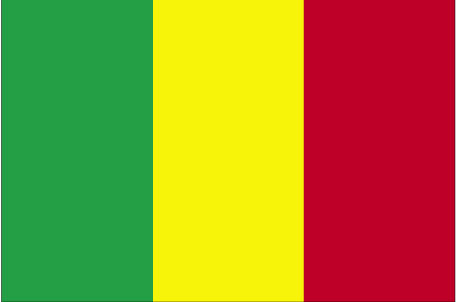
Mali
Mali
Declare Your Relationship to Mali
CountryReports Community
- Studying1
- From Mali0
- Mali heritage0
- Visited0
- Want to visit0
Customs and Culture
Customs and Culture
Cultural Attributes
Mali is a developing nation and faces the problems of developing nations. Droughts have destroyed much of the regions plant and animal life. Many people are uneducated and can not read or write. There are poor health conditions with only a few hundred doctors living in Mali. Malaria is a major cause of death among Mali's children.
The majority of the people are black Africans belonging to different ethnic groups. Most live in small rural villages in southern Mali and farm for a living. They can only raise enough food for their own survival. The typical farm tool is an old fashion hand tool. Many women use gourds to water the crops as their ancestors did. They grow cassava, corn, millet, rice, sorghum and yams. Some of the people herd cattle as well.

Land of Gold and Salt, Keeper of Timbuktu's Secrets
Get More Customs and Culture
5 more cultural topics for members
Social Customs & Etiquette · Diet · Family · Dating Customs · Recreation
Holidays
Independence Day
9/22Independence Day
Dates of Interest
- September 22nd
How do people greet each other in Mali?
When entering, a visitor gives a short greeting, while a stranger gives a longer one; the host and guest may hold right hands during the greeting. In Bambara, men and women give different set responses.
Do
- Give a short greeting on entering; a longer one if you're a stranger
- Hold right hands with the host during the greeting when appropriate
Good to know
- If you are a man, respond to greetings with "nba"; if a woman, respond with "nse"
- "I ni sogoma" means good morning; "I ni tilé" is used around noon; "I ni wula" is good afternoon until dusk
What are dining customs like in Mali?
In rural Mali, food (often sauce over millet) is served in a large shared bowl, and people sit around it and eat with their right hands. Common staples include cassava, corn, millet, rice, sorghum, and yams.
Do
- Eat from the shared bowl using your right hand
- Boil fresh milk before use
- Freeze freshly butchered beef and mutton from the open market before use
Good to know
- Bargaining is expected at the open-air market, where there are no fixed prices
- Bring meat tenderizers and marinades, as local beef is lean and often tough
What everyday etiquette should I know in Mali?
Right-hand use matters in social settings, such as during greetings and when eating from a shared bowl.
Do
- Use your right hand for greetings and eating
How should I dress in Mali?
Clothing is predominantly African in style; men may wear a zerebou (long tunic over pants) or a grand boubou for dressier occasions, and women wear a blouse and pagne, or a boubou over a pagne for formal occasions. Expatriates wear casual, lightweight, loose, summery Western clothing suited to the heat.
Do
- Choose cotton and cotton-blend fabrics for the heat
- Wear low-heeled, sturdy, comfortable shoes and sandals
- Bring lightweight hats for sun protection and an umbrella for the rainy season
Don’t
- Don't rely on suede, which is quickly damaged by dust, rain, and mud
- Avoid nylon stockings, which are uncomfortable in the heat
Good to know
- Clothing should be durable and washable, as it gets dusty in the dry season and muddy in the rains
- Pack some warm clothing in case of travel to cooler climates
What is family life like in Mali?
Malian law allows men to have more than one wife, and many have two, with a maximum of four. Each wife is entitled to her own house or apartment, and the man must provide for each equally.
Good to know
- When a man has more than one wife, the wives often share food preparation responsibilities
What do people do for recreation in Mali?
Soccer is the most important sport, and most young people enjoy listening to both international and African music.
Last updated: 2026-07-12 · Sources: CountryReports
Photos of Mali
Photos of Mali
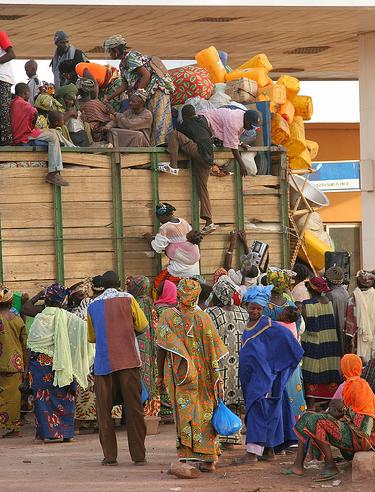
People getting a lift back home from the market in Mopti
Ist von meinem Kollegen, Mali
Mali -- Simple Figures in Wood Creche
Mali Creche -- Made from Recycled Cans
Young peul girl in Mali tattooing her mouth with needles and henna.
Riding on truck
Young Dogon men carrying straw which is used as animal feed.
Young girl at a water pump.
Group of children
Piroque on the Niger in Mali
Fulani settlemen in Mali
Monday market in Djenne, Mali


Travel and Tourism
Travel and Tourism
- Travel Alert Status
- Level 4: Do Not Travel
- Time Difference
- UTC 0 (5 hours ahead of Washington, DC, during Standard Time)
- Climate
- There are two primary seasons in West Africa. The dry period can be further divided into two distinct seasons, mild and hot, particularly in the savanna and Sahelian regions of Mali. The rainy season usually begins in June and continues into October. Almost all of the annual rainfall occurs during this time. As much as 60-80 inches of rain may fall in the southern savanna but rainfall is lower further north. Temperatures range from 70 to 100 degrees Fahrenheit (21-40°C). The cool season lasts from December to mid-February, when temperatures range from 60 degrees Fahrenheit at night to the mid-80s (about 28-34°C) during the day. The hot season starts in mid-February and goes into June. The air is dry, dusty, and very hot; temperatures often reach over 100 degrees (40°C) and clouds of dust hang in the air. This is the season of the harmattan, the dry, sandy wind that brings dust clouds southwards from the Sahara.
- Airports
- 27
Read the full travel guide — health, safety, vaccinations, disease risk, sanitation, and transit details.
View full travel guideRecipes
Recipes
History
History
Historical Eras
Ancient Empires
700 – 1591
West Africa's great Sahelian empires rose and fell across this long period. The Ghana Empire dominated trans-Saharan trade until 1075, succeeded by the Mali Empire under Sundiata Keita from 1230, which reached its zenith around 1325 with control of Timbuktu and Gao. The Songhai Empire then surpassed all predecessors under Askia Mohammad I before a Moroccan invasion destroyed it in 1591, leaving Timbuktu's renowned Islamic scholarship as the era's enduring legacy.
Pre-Colonial Period
1591 – 1880
Following Songhai's collapse, the western Sudan fragmented into smaller competing states and fell under the influence of Moroccan-backed pashas centered in Timbuktu. Tuareg and Fulani powers asserted themselves across the region during the 18th and 19th centuries, while Islamic reform movements, notably the Fulani jihads, reshaped political and religious authority. Long-distance trade along Niger River routes continued, though no single empire achieved the dominance of earlier centuries.
French Colonial Era
1880 – 1960
French military forces began penetrating the Soudan around 1880, meeting sustained resistance, most notably from the Malinke warrior Samory Touré, who was not defeated until 1898 after seven years of war. Administered as French Soudan within the Federation of French West Africa, the territory saw imposed indirect rule and appointed chiefs supplant traditional authorities. The 1956 Loi Cadre granted significant internal autonomy, and in January 1959 Soudan joined Senegal to form the Mali Federation, which achieved full independence on June 20, 1960.
Single-Party & Military Rule
1960 – 1991
After Senegal's secession dissolved the Mali Federation in August 1960, Modibo Keita proclaimed the Republic of Mali and quickly established a single-party socialist state, pursuing extensive nationalization before a deteriorating economy forced a course correction. A bloodless military coup on November 19, 1968 brought Lt. Moussa Traoré and the 14-member Military Committee for National Liberation to power. Traoré formalized one-party rule under the UDPM in 1976 and held power for over two decades, facing the Sahelian drought, a brief border war with Burkina Faso in 1985, and growing pro-democracy protests.
Democratic Transition
1991 – 2012
Mass protests and a military uprising ended Traoré's regime in March 1991, leading to a transitional government and Mali's first multiparty presidential election in 1992, which brought Alpha Konaré to power. Konaré pursued political and economic reform through two terms before stepping down constitutionally in 2002, succeeded by Amadou Toumani Touré — a model of democratic consolidation rare in the region. The period was nonetheless marked by recurring Tuareg rebellions in the north and persistent poverty, food insecurity, and locust crises.
Crisis & Instability
2012 – present
A Tuareg-led rebellion and jihadist insurgency in 2012 prompted a military coup that toppled Touré and allowed Islamist groups briefly to seize northern cities including Timbuktu and Gao. A French-led military intervention (Opération Serval) in 2013 drove back the insurgents, and elections partially restored civilian rule. Successive coups in 2020 and 2021 again interrupted democratic governance, and the country continues to grapple with jihadist violence, humanitarian displacement, and contested transitional authority.
Overview
Malians express great pride in their ancestry. Mali is the cultural
Timeline of Key Events
146 BCE – 31 BCE
Roman conquest of North Africa; Berbers’ southern migration begins.
Roman conquest of North Africa; Berbers’ southern migration begins.
1100
City of Tombouctou founded as a small trading center along the Niger River.
City of Tombouctou founded as a small trading center along the Niger River.
1230
Sundiata, a Mandinka prince, defeats the Susu and founds the kingdom of Mali.
Sundiata, a Mandinka prince, defeats the Susu and founds the kingdom of Mali.
1325
Mali captures Gao.
Mali captures Gao.
1336
Timbuktu becomes part of the Mali Empire.
Timbuktu becomes part of the Mali Empire, now at the height of its power, and starts its own era of prosperity.
1359
Mali divided by civil war.
Mali divided by civil war.
1433
Timbuktu captured and controlled by Berbers.
Timbuktu captured and controlled by Berbers.
Read the full history profile — narrative overview, defining eras, and the complete timeline in one place.
View expanded historyInteresting Facts
Interesting Facts
When a child loses a tooth they throw their tooth in the chicken coop. The next day they might find a big fat hen in the coop and their mother will make chicken soup.
Salt was such a valuable commodity that people would trade a pound of gold for a pound of salt. Mali is famous for its salt mines.
The ancient mosque in Timbuktu has a door which has never been opened. It is said that opening the door will signal the end of world.
See every fact — trivia, oddities, and curious tidbits gathered from across the country.
View all interesting factsGeography and Environment
Geography and Environment
- Terrain
- mostly flat to rolling northern plains covered by sand; savanna in south, rugged hills in northeast
- Climate
- There are two primary seasons in West Africa. The dry period can be further divided into two distinct seasons, mild and hot, particularly in the savanna and Sahelian regions of Mali. The rainy season usually begins in June and continues into October. Almost all of the annual rainfall occurs during this time. As much as 60-80 inches of rain may fall in the southern savanna but rainfall is lower further north. Temperatures range from 70 to 100 degrees Fahrenheit (21-40°C). The cool season lasts from December to mid-February, when temperatures range from 60 degrees Fahrenheit at night to the mid-80s (about 28-34°C) during the day. The hot season starts in mid-February and goes into June. The air is dry, dusty, and very hot; temperatures often reach over 100 degrees (40°C) and clouds of dust hang in the air. This is the season of the harmattan, the dry, sandy wind that brings dust clouds southwards from the Sahara.
- Natural Hazards
- hot, dust-laden harmattan haze common during dry seasons; recurring droughts; occasional Niger River flooding
- Current Environmental Issues
- deforestation; soil erosion; desertification; inadequate supplies of potable water; poaching
Read the full geography and environment profile — terrain, climate, natural resources, hazards, land use, and international agreements.
View full geographyPeople & Demographics
People & Demographics
Religion
Languages Spoken
French (official), Bambara 80%, numerous African languages
- French
Population
- Population
- 22,763,629
- Population in Major Urban Areas
- BAMAKO (capital) 2.037 million
- Nationality Noun
- Malian(s)
- Ethnic Groups
- Mande 50% (Bambara, Malinke, Soninke), Peul 17%, Voltaic 12%, Songhai 6%, Tuareg and Moor 10%, other 5%
Education
- Literacy Definition
- age 15 and over can read and write
Health Information
- Life Expectancy at Birth
- Life expectancy at birth in Mali is among the lowest in the world, reflecting the country's significant challenges in healthcare, nutrition, and infrastructure. As of recent estimates, the average life expectancy stands at approximately 59 to 60 years overall, with women typically outliving men by a small margin — women averaging around 61 years compared to roughly 58 years for men. Mali's low life expectancy is driven by a combination of factors deeply rooted in poverty and limited access to healthcare services. The country has one of the highest infant and child mortality rates globally, with many deaths occurring before age five due to preventable and treatable conditions such as malaria, diarrheal diseases, pneumonia, and malnutrition. Malaria alone remains a leading cause of illness and death, particularly among young children and pregnant women. Maternal mortality is also a critical concern. Mali has one of the highest maternal mortality ratios in the world, significantly pulling down overall life expectancy figures for women despite their biological longevity advantage. Many women in rural areas give birth without access to skilled medical attendants, contributing to dangerous complications during childbirth. The country's healthcare system is severely underfunded, with a shortage of trained medical professionals and facilities, especially outside the capital, Bamako. A large proportion of the population lives in remote rural areas where clinics and hospitals are difficult to reach. Ongoing political instability and armed conflict in the northern and central regions since 2012 have further disrupted healthcare delivery and displaced communities, worsening health outcomes. Despite these challenges, Mali has made measurable progress over recent decades. Life expectancy has risen from below 45 years in the 1970s, reflecting gradual improvements in vaccination coverage, oral rehydration therapy for diarrheal illness, and international health initiatives. Programs targeting malaria prevention through insecticide-treated bed nets and improved access to basic prenatal care have contributed to incremental gains. Continued investment in education, women's health, and rural healthcare infrastructure will be essential for sustaining and accelerating this progress in the years ahead.
- Major Infectious Diseases — degree of risk
- very high
Life Expectancy
- Life Expectancy at Birth
- Life expectancy at birth in Mali is among the lowest in the world, reflecting the country's significant challenges in healthcare, nutrition, and infrastructure. As of recent estimates, the average life expectancy stands at approximately 59 to 60 years overall, with women typically outliving men by a small margin — women averaging around 61 years compared to roughly 58 years for men. Mali's low life expectancy is driven by a combination of factors deeply rooted in poverty and limited access to healthcare services. The country has one of the highest infant and child mortality rates globally, with many deaths occurring before age five due to preventable and treatable conditions such as malaria, diarrheal diseases, pneumonia, and malnutrition. Malaria alone remains a leading cause of illness and death, particularly among young children and pregnant women. Maternal mortality is also a critical concern. Mali has one of the highest maternal mortality ratios in the world, significantly pulling down overall life expectancy figures for women despite their biological longevity advantage. Many women in rural areas give birth without access to skilled medical attendants, contributing to dangerous complications during childbirth. The country's healthcare system is severely underfunded, with a shortage of trained medical professionals and facilities, especially outside the capital, Bamako. A large proportion of the population lives in remote rural areas where clinics and hospitals are difficult to reach. Ongoing political instability and armed conflict in the northern and central regions since 2012 have further disrupted healthcare delivery and displaced communities, worsening health outcomes. Despite these challenges, Mali has made measurable progress over recent decades. Life expectancy has risen from below 45 years in the 1970s, reflecting gradual improvements in vaccination coverage, oral rehydration therapy for diarrheal illness, and international health initiatives. Programs targeting malaria prevention through insecticide-treated bed nets and improved access to basic prenatal care have contributed to incremental gains. Continued investment in education, women's health, and rural healthcare infrastructure will be essential for sustaining and accelerating this progress in the years ahead.
Read the full people and society profile — demographics, health, education, religion, languages, and notable people.
View full people and societyGovernment & Politics
Government & Politics
Country Identity
- Country Name
- Mali
- Full Country Name
- Republic of Mali
- Local - Long
- Republique de Mali
- Local - Short
- Mali
- Former Name
- French Sudan and Sudanese Republic
Government Structure
- Government Type
- republic
- Legal System
- based on French civil law system and customary law; judicial review of legislative acts in Constitutional Court (which was formally established on 9 March 1994); has not accepted compulsory ICJ jurisdiction
- Executive Branch
- chief of state: Transition President General Assimi GOITA (since 7 June 2021), following a military coup in May 2021 that ousted transitional President Bah N'DAW head of government: Prime Minister General Abdoulaye MAIGA (since 21 November 2022), appointed following the dismissal of Choguel Kokalla MAIGA cabinet: Council of Ministers appointed by the prime minister and approved by the transition president elections: Under the previous constitutional order, the president was elected by popular vote for a five-year term with a two-term limit, and the prime minister was appointed by the president. Mali has been under military-led transitional governance since the August 2020 coup. A new constitution was approved by referendum in June 2023, and a return to civilian rule has been repeatedly delayed; transitional authorities have indicated elections could be held in 2024 or later. election results: The most recent competitive presidential election was held in 2013, in which Ibrahim Boubacar KEITA won with approximately 77.6% of the vote in a runoff against Soumaila CISSE. KEITA was reelected in 2018 but was overthrown in a military coup in August 2020.
- Legislative Branch
- Mali's legislative branch has undergone significant changes following the military coups of 2021. The previously unicameral National Assembly (Assemblée Nationale), which had 147 seats with members elected by popular vote to serve five-year terms, was dissolved after the August 2020 coup and subsequent political transition. Under the transitional framework established following the May 2021 coup, a National Transitional Council (Conseil National de Transition, or CNT) was established to serve as the interim legislative body. The CNT comprises 147 members appointed from civilian and military representatives and assumed the legislative functions of the former National Assembly during the transition period. The last general elections for the National Assembly prior to the dissolution were held in March and April 2020, in which the Alliance for Democracy in Mali (ADEMA) and the Rally for Mali (RPM) were among the key competing parties. As of 2024, Mali remains under military-led transitional governance, and legislative elections have been repeatedly postponed. The transitional authorities have indicated intentions to restore civilian rule and hold elections, though no confirmed date for a return to an elected legislative body has been established.
- Judicial Branch
- Supreme Court or Cour Supreme
- Suffrage
- 18 years of age; universal
- Constitution
- adopted 12 January 1992
- Independence
- 22 September 1960 (from France)
- National Holiday
- Independence Day, 22 September (1960)
Capital City
- Capital Name
- Bamako
- Capital - geographic coordinate
- 12 39 N, 8 00 W
- Capital Time Difference
- UTC 0 (5 hours ahead of Washington, DC, during Standard Time)
the name in the Bambara language can mean either "crocodile tail" or "crocodile river" and three crocodiles appear on the city seal
Military
Branches: Malian Armed Forces: Army (Armee de Terre), Republic of Mali Air Force (Force Aerienne de la Republique du Mali, FARM), National Guard (Garde National du Mali)
Embassy / Diplomatic Mission
U.S. Embassy Bamako
ACI 2000, Rue 243 Porte 297, Bamako, Mali
Telephone: (223) 20 70 23 00
Consular Section: (223) 20 70 25 05
Emergency after-hours telephone: (223) 20 70 23 01 or 20 70 23 02
Facsimile: (223) 20 70 23 40.
Email address: consularbamako@state.gov
Read the full government profile — flag symbolism, national anthem, and other national symbols.
View full government detailsEconomy
Economy
Mali is among the poorest countries in the world, with roughly 65% of its land area desert or semi-desert and a highly unequal distribution of income. Economic activity is largely concentrated in the riverine area irrigated by the Niger River.
Snapshot
- Currency Name and Code
- CFA Franc BCEAO (XOF)
- GDP — official exchange rate
- $5,434,000,000 (USD)
- GDP Real Growth Rate
- 4.8%
- Gini Index
- 50.5
News & Weather
News & Weather
Current Weather
Latest News
Why Mali’s northern conflict has entered a dangerous new phase - Al Jazeera
Al Jazeera · 4h ago
Mali’s government does not rule out U.S. military intervention - The Washington Post
The Washington Post · 2d ago
Mali's gold output seen staying below 60 tons through 2029, ministry plan shows - Reuters
Reuters · 2d ago
Could this African nation become Trump's next terror target as jihadists close in on power? - Fox News
Fox News · 2d ago
Mali: The wall of officers keeping Assimi Goïta in power and at war - The Africa Report
The Africa Report · 20h ago
Indian-origin diamond businessman kidnapped in Mali, released after family pays 4 million euros - The Tribune
The Tribune · 16h ago
Russia’s Africa Corps Abandoned Malian Troops On Battlefield - Мілітарний
Мілітарний · 14h ago
He previously played for Wydad: tragic passing of former Mali star - Goal.com
Goal.com · 11h ago
News via Google News
Climate Overview
There are two primary seasons in West Africa. The dry period can be further divided into two distinct seasons, mild and hot, particularly in the savanna and Sahelian regions of Mali. The rainy season usually begins in June and continues into October. Almost all of the annual rainfall occurs during this time. As much as 60-80 inches of rain may fall in the southern savanna but rainfall is lower further north. Temperatures range from 70 to 100 degrees Fahrenheit (21-40°C). The cool season lasts from December to mid-February, when temperatures range from 60 degrees Fahrenheit at night to the mid-80s (about 28-34°C) during the day. The hot season starts in mid-February and goes into June. The air is dry, dusty, and very hot; temperatures often reach over 100 degrees (40°C) and clouds of dust hang in the air. This is the season of the harmattan, the dry, sandy wind that brings dust clouds southwards from the Sahara.
Frequently Asked Questions
Frequently Asked Questions
What is the population of Mali?
How do people greet each other in Mali?
What are dining customs like in Mali?
What everyday etiquette should I know in Mali?
How should I dress in Mali?
What is family life like in Mali?
What do people do for recreation in Mali?
What is the capital of Mali?
Where is Mali located?
What countries border Mali?
What is the predominant religion in Mali?
What currency does Mali use?
What language is spoken in Mali?
What is Mali's geography and terrain like?
What is Mali known for?
Last reviewed 2026