
 English
 Español
 中文
中文 हिन्दी
 Français
Wake Island
Declare Your Relationship to Wake Island
CountryReports Community
- Studying0
- From Wake Island0
- Wake Island heritage0
- Visited0
- Want to visit0
Customs and Culture
Customs and Culture
Cultural Attributes
Wake Island has virtually no permanent civilian population, which means it lacks the kind of evolving cultural traditions, languages, and social customs typically associated with inhabited territories. The island functions exclusively as a United States military installation and, for operational purposes, falls under the jurisdiction of the U.S. Air Force. Any individuals present on the island at a given time are military personnel, Department of Defense contractors, or authorized government employees, all of whom are there on temporary rotational assignments rather than as permanent residents. Because of this transient, institutional nature, the cultural atmosphere of Wake Island is defined almost entirely by American military culture. English is the sole language spoken on the island. Daily life follows military schedules, protocols, and customs, including uniformed dress codes, rank-based social structures, and organized routines common to U.S. overseas installations worldwide. The island does carry significant historical and commemorative weight that shapes how it is perceived and informally observed. Wake Island was the site of a fierce and pivotal battle in December 1941, when a small contingent of U.S. Marines, sailors, soldiers, and civilian contractors held off a Japanese invasion force for more than two weeks before the island fell. This battle is remembered with considerable reverence among military communities, and the island's history is part of the broader cultural identity of those stationed there. Memorials and historical markers acknowledge the sacrifices made during World War II. There are no indigenous cultural groups on Wake Island. The island was uninhabited when formally claimed by the United States in 1899. The small atoll offers no arable land, no fresh water sources, and an extremely remote location approximately 2,300 miles west of Honolulu, all of which precluded any sustained civilian settlement or independent cultural development throughout its history. As a result, Wake Island remains one of the few territories in the Pacific without a distinct local cultural identity of its own.

Crossroads of the Pacific
Social Customs & Etiquette
Wake Island is an unincorporated territory of the United States located in the central Pacific Ocean, administered by the U.S. Air Force. Because it functions primarily as a military installation with no permanent civilian population, the social customs and greeting practices found there differ significantly from those of a typical inhabited nation or territory.
Interactions on Wake Island occur almost entirely within a U.S. military and government contractor context. As a result, greetings follow standard American military and professional norms. Personnel typically greet one another with a handshake, a nod, or a verbal acknowledgment such as "hello" or "good morning." Military members may use rank-based salutations and address superior officers by their rank and last name, in keeping with U.S. Armed Forces protocol.
English is the sole language used on the island, and there is no indigenous civilian population with distinct cultural greeting traditions. Unlike many Pacific Island nations — where greetings may involve physical gestures of welcome such as the Hawaiian "aloha" or Marshallese customs of respect for elders — Wake Island has no such heritage of its own, given that it was uninhabited before modern American military presence.
Visitors to Wake Island are extremely limited. Access is tightly controlled and generally restricted to military personnel, government contractors, and occasional scientific or historical researchers who must obtain prior authorization. Those who do travel to Wake Island are expected to conform to U.S. government workplace and military courtesies throughout their stay.
In any correspondence or formal interaction related to Wake Island — such as with the U.S. Air Force Installation and Mission Support Center, which oversees the atoll — standard American professional greetings and written salutations apply. There are no special ceremonial, religious, or culturally specific greeting customs unique to Wake Island itself.
In essence, greeting practices on Wake Island mirror those of a professional American military environment, defined by rank, courtesy, and English-language communication rather than by any indigenous or regional Pacific cultural tradition.

Dating Customs
Wake Island is an unincorporated territory of the United States located in the central Pacific Ocean. Because it functions as a military installation under the jurisdiction of the United States Air Force, Wake Island has no permanent civilian population. As a result, the island has no indigenous culture, local customs, or established social traditions related to dating and marriage.
The individuals who reside on Wake Island at any given time are primarily United States military personnel, Department of Defense contractors, and a small number of support staff. These residents live and work on the island on temporary rotational assignments, typically lasting several months to a few years. Given this transient and professional environment, romantic relationships and family life are not a central feature of daily existence on the island.
Any personnel stationed at Wake Island who wish to marry would follow the legal processes and customs of the United States, as Wake Island falls entirely under U.S. federal jurisdiction. Marriages would generally need to be formalized off the island, either before deployment or during leave, in a U.S. state or another jurisdiction where civil marriage ceremonies can be legally conducted.
There are no local marriage traditions, ceremonial customs, or community-based courtship practices associated with Wake Island, as these would require a settled civilian population. Cultural practices related to dating and marriage among those stationed there reflect the diverse backgrounds of American military and contractor communities, which naturally vary widely from person to person.
For travelers or researchers interested in Pacific Island marriage traditions more broadly, nearby Micronesian nations and territories — such as the Marshall Islands or the Federated States of Micronesia — offer rich and well-documented cultural practices that stand in contrast to the purely administrative and military character of Wake Island.
Dates of Interest
- Untitled date
How do people communicate on Wake Island?
English is the sole language spoken on the island, and daily interactions follow American military customs and rank-based social structures.
Good to know
- Expect military protocols and formal, rank-conscious interactions
What social norms should I expect on Wake Island?
The island functions exclusively as a U.S. military installation under the U.S. Air Force, so daily life follows military schedules, protocols, and organized routines.
Do
- Follow military schedules and protocols
- Respect rank-based social structures
Good to know
- Everyone present is on temporary rotational assignment as military personnel, DoD contractors, or authorized government employees
- The cultural atmosphere is defined almost entirely by American military culture
What should I wear on Wake Island?
Uniformed dress codes apply, as is common to U.S. overseas military installations.
Do
- Adhere to military uniformed dress codes
What should I know before visiting Wake Island?
Wake Island has virtually no permanent civilian population and no distinct local culture; access is limited to military personnel, DoD contractors, and authorized government employees.
Good to know
- The island is extremely remote, approximately 2,300 miles west of Honolulu
- It has no arable land or fresh water sources
- Wake Island carries significant historical weight from the December 1941 battle, remembered with reverence in military communities
- Memorials and historical markers acknowledge WWII sacrifices
Last updated: 2026-07-12 · Sources: CountryReports
Photos of Wake Island
Photos of Wake Island

Travel and Tourism
Travel and Tourism
- Travel Alert Status
- Level 1: Exercise Normal Precautions
- Climate
- tropical
- Airports
- 1
Read the full travel guide — health, safety, vaccinations, disease risk, sanitation, and transit details.
View full travel guideHistory
History
Historical Eras
Pre-Annexation
1568 – 1899
Wake Island was first sighted by Spanish explorer Álvaro de Mendaña in 1568 and remained largely uninhabited and unclaimed for centuries. American Captain Charles Wilkes led a surveying expedition to the atoll in 1841. The island attracted little strategic interest until the dawn of the Pacific telegraph age.
US Annexation & Cable Era
1899 – 1941
The United States formally annexed Wake Island in 1899 following the Spanish-American War, establishing it as a relay station for the trans-Pacific telegraph cable. A significant air and naval base was constructed between 1940 and 1941 as tensions with Japan escalated, transforming the remote atoll into a strategically vital outpost in the central Pacific.
Japanese Occupation
1941 – 1945
Following the attack on Pearl Harbor, Japanese forces launched an assault on Wake Island in December 1941. A small but determined US Marine garrison repelled the initial invasion before falling to a larger Japanese force on December 23, 1941. Wake remained under Japanese occupation for the duration of World War II, during which captured American civilians were held and in some cases executed.
Postwar Military & Transit Hub
1945 – 1974
Following Japan's surrender, the United States reclaimed Wake Island and developed it as a critical refueling and stopover point for both military and commercial aircraft crossing the Pacific. The island served logistical functions during the Korean and Vietnam Wars. Pan American Airways operated regular transpacific flights through Wake, making it a notable waypoint in early commercial aviation.
Modern Military Outpost
1974 – present
Since 1974, Wake Island has operated primarily as a US military airstrip under the jurisdiction of the US Air Force, with commercial cargo carriers and emergency aircraft also using the facility. The island hosts no permanent civilian population, and over 700 aircraft landings occur annually. Wake continues to serve as a strategic mid-Pacific asset and is administered by the Office of the Secretary of the Interior.
Read the full history profile — narrative overview, defining eras, and the complete timeline in one place.
View expanded historyInteresting Facts
Interesting Facts
Wake Island is a U.S. commercial and military base under the jurisdiction of the Federal Aviation Agency.
See every fact — trivia, oddities, and curious tidbits gathered from across the country.
View all interesting factsGeography and Environment
Geography and Environment
- Terrain
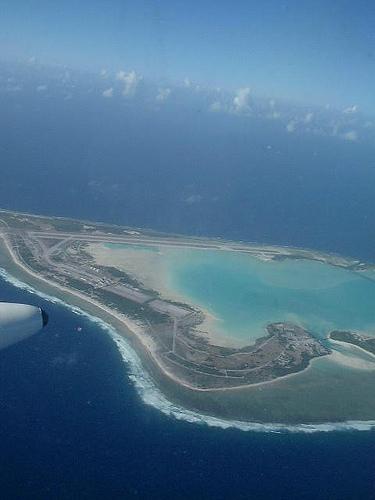
- atoll of three coral islands built up on an underwater volcano; central lagoon is former crater, islands are part of the rim
- Climate
- tropical
- Natural Hazards
- occasional typhoons
- Current Environmental Issues
- NA
Read the full geography and environment profile — terrain, climate, natural resources, hazards, land use, and international agreements.
View full geographyPeople & Demographics
People & Demographics
Population
- Population
- 0
- Nationality Noun
- American(s)
Health Information
- Life Expectancy at Birth
- Wake Island presents a unique case when discussing life expectancy at birth, as it is an unincorporated territory of the United States with no permanent civilian population. The island is administered by the U.S. Air Force and has historically been home to a small rotating contingent of military personnel and contract workers who maintain the airfield and associated facilities. Because no permanent residents live on Wake Island, standard demographic statistics such as life expectancy at birth are not calculated or reported for the territory. In the absence of a resident civilian population, Wake Island does not appear in global databases that track life expectancy figures, such as those maintained by the World Bank or the United Nations. These organizations compile life expectancy data based on birth and mortality records drawn from settled, civilian populations — criteria that Wake Island does not meet. The personnel stationed or temporarily assigned to Wake Island are predominantly American citizens or contractors, and their health outcomes would be reflected in broader United States statistics. The United States as a whole reports a life expectancy at birth of approximately 76 to 77 years as of recent estimates, a figure that represents the population from which Wake Island's transient workforce is largely drawn. Wake Island's significance is primarily strategic and logistical rather than demographic. The atoll serves as an emergency refueling stop for aircraft crossing the Pacific Ocean and supports limited military operations. Its lack of a permanent population means that questions typically relevant to travelers and students — such as healthcare infrastructure, infant mortality rates, and overall population health — are largely not applicable in the conventional sense. Visitors to Wake Island are restricted to authorized military and contractor personnel, further limiting any meaningful demographic analysis of the kind typically associated with inhabited territories.
Life Expectancy
- Life Expectancy at Birth
- Wake Island presents a unique case when discussing life expectancy at birth, as it is an unincorporated territory of the United States with no permanent civilian population. The island is administered by the U.S. Air Force and has historically been home to a small rotating contingent of military personnel and contract workers who maintain the airfield and associated facilities. Because no permanent residents live on Wake Island, standard demographic statistics such as life expectancy at birth are not calculated or reported for the territory. In the absence of a resident civilian population, Wake Island does not appear in global databases that track life expectancy figures, such as those maintained by the World Bank or the United Nations. These organizations compile life expectancy data based on birth and mortality records drawn from settled, civilian populations — criteria that Wake Island does not meet. The personnel stationed or temporarily assigned to Wake Island are predominantly American citizens or contractors, and their health outcomes would be reflected in broader United States statistics. The United States as a whole reports a life expectancy at birth of approximately 76 to 77 years as of recent estimates, a figure that represents the population from which Wake Island's transient workforce is largely drawn. Wake Island's significance is primarily strategic and logistical rather than demographic. The atoll serves as an emergency refueling stop for aircraft crossing the Pacific Ocean and supports limited military operations. Its lack of a permanent population means that questions typically relevant to travelers and students — such as healthcare infrastructure, infant mortality rates, and overall population health — are largely not applicable in the conventional sense. Visitors to Wake Island are restricted to authorized military and contractor personnel, further limiting any meaningful demographic analysis of the kind typically associated with inhabited territories.
Read the full people and society profile — demographics, health, education, religion, languages, and notable people.
View full people and societyGovernment & Politics
Government & Politics
Country Identity
- Country Name
- WakeIsland
Government Structure
- Legal System
- the laws of the US, where applicable, apply
- Executive Branch
- Wake Island is an unincorporated territory of the United States located in the central Pacific Ocean, and as such, it does not possess an independent executive branch of government. Instead, executive authority over the island is exercised through the United States federal government, with administrative oversight delegated to the Department of the Interior's Office of Insular Affairs. The island is administered jointly by the U.S. Air Force and the U.S. Army under the jurisdiction of the United States Indo-Pacific Command. Day-to-day administrative functions are managed by a designated military commander who serves as the senior official on the island. This individual is responsible for overseeing operations, personnel, and infrastructure on what is primarily a strategically important military installation. Because Wake Island has no permanent civilian population, there is no locally elected executive, no governor, and no municipal government structure. The island's residents consist entirely of U.S. military personnel and civilian contractors who support base operations, including those related to missile defense and air refueling missions. The legal framework governing Wake Island falls under U.S. federal law. Congress holds plenary authority over the territory pursuant to the Territory Clause of the U.S. Constitution (Article IV, Section 3). The President of the United States serves as the ultimate executive authority over the island, with the chain of command running through the Secretary of Defense and ultimately to the unified combatant commander responsible for the Pacific theater. The Department of the Interior maintains nominal civilian jurisdiction and works in coordination with the Department of Defense to address environmental, conservation, and land management issues on the atoll. Wake Island is also administered in part as a National Wildlife Refuge, adding another layer of federal oversight through the U.S. Fish and Wildlife Service. In summary, Wake Island's executive structure is entirely federally directed, reflecting its status as a strategically significant but non-self-governing U.S. possession with no indigenous permanent population or autonomous local governance.
- Legislative Branch
- Wake Island does not have a legislative branch in the traditional governmental sense. It is an unincorporated, unorganized territory of the United States, meaning it operates under direct federal jurisdiction rather than through a locally elected governing body or representative assembly. The island falls under the administrative authority of the United States Air Force, which manages day-to-day operations on behalf of the U.S. Department of Defense. The Department of the Interior holds nominal jurisdiction over Wake Island as an insular area, but the practical governance of the atoll is carried out through military command structures rather than civilian legislative institutions. Because Wake Island has no indigenous population and no permanent civilian residents, there is no electorate to represent and therefore no basis for establishing a local legislature. The small number of personnel present on the island at any given time consists primarily of U.S. military and contractor staff on temporary assignment, none of whom hold permanent residency tied to Wake Island. All laws applicable to Wake Island are those enacted by the United States Congress and, where relevant, regulations issued by federal agencies such as the Department of Defense and the Department of the Interior. The U.S. Congress technically holds plenary authority over all unincorporated territories under Article IV, Section 3 of the U.S. Constitution, which grants Congress the power to make rules and regulations governing U.S. territories and possessions. Residents of Wake Island — to the extent that any are present — are subject to U.S. federal law but do not have voting representation in Congress. Wake Island does not send a non-voting delegate to the House of Representatives, which further distinguishes it from other U.S. territories such as Guam or the U.S. Virgin Islands, which do have such representation. In essence, all legislative authority over Wake Island resides exclusively at the federal level in Washington, D.C.
Read the full government profile — flag symbolism, national anthem, and other national symbols.
View full government detailsEconomy
Economy
Economic activity on Wake Island is limited to providing services to U.S. military personnel and contractors stationed on the atoll. The island serves primarily as a strategic mid-Pacific airfield and emergency landing site, operated by the U.S. Air Force with logistical support handled by civilian contractors. There is no indigenous population, no commercial industry, and no agriculture. All food, fuel, and manufactured goods must be imported, typically by air or periodic sealift.
Snapshot
- Currency Name and Code
- US Dollar (USD)
Banknotes


Energy
- Oil Production
- 0 bbl/day
- Natural Gas Reserves
- 0 cu m
Communications
- Telephone System
- general assessment: satellite communications; 2 Defense Switched Network circuits off the Overseas Telephone System (OTS); located in the Hawaii area code - 808
- Internet Country Code
- N/A
News & Weather
News & Weather
Latest News
Battlefield 6 Season 4 Live: Tsuru Reef Debuts as Series’ Biggest Map, Wake Island Next - GamesReviews.com
GamesReviews.com · 1d ago
Another WWII outpost reemerges in the Pacific to support classified U.S. missions - The Air Current
The Air Current · 56d ago
Nature and People Win Thanks to Successful Restoration Collaboration on Wake Atoll - Island Conservation
Island Conservation · 102d ago
Battlefield 6 Season 4 trailer shows off naval warfare and Wake Island, teases Top Gun collab - GosuGamers
GosuGamers · 5d ago
Battlefield 6 Season 4: Naval Warfare launches July 21 with Wake Island, new map and sea combat - AltChar
AltChar · 13d ago
Navy to restart reconnaissance flights at Wake Island this summer - Task & Purpose
Task & Purpose · 43d ago
Navy plans to fly P-8 reconnaissance flights from remote Wake Island this year - stripes.com
stripes.com · 46d ago
Tsuru Reef, Wake Island, and Top Gun? Here's what's coming in Season 4 of Battlefield 6 - Gamereactor UK
Gamereactor UK · 10d ago
News via Google News
Climate Overview
tropical
Videos
Videos
1 curated YouTube videos.
Source: YouTube
Frequently Asked Questions
Frequently Asked Questions
How do people communicate on Wake Island?
What social norms should I expect on Wake Island?
What should I wear on Wake Island?
What should I know before visiting Wake Island?
Where is Wake Island located?
What ocean surrounds Wake Island?
What currency is used on Wake Island?
What is the administrative and governmental status of Wake Island?
What is the history of Wake Island during World War II?
What is Wake Island known for?
What is the terrain and size of Wake Island like?
What language is used on Wake Island?
Last reviewed 2026