
 English
 Español
 中文
中文 हिन्दी
 Français
Brunei
Declare Your Relationship to Brunei
CountryReports Community
- Studying1
- From Brunei0
- Brunei heritage0
- Visited0
- Want to visit0
Customs and Culture
Customs and Culture
About the People
Brunei's culture mainly derived from the Old Malay World, which encompassed the Malay Archipelago and from this stemmed what is known as the Malay Civilization
Cultural Attributes
Brunei's culture mainly derived from the Old Malay World, which encompassed the Malay Archipelago, and from this stemmed what is known as the Malay Civilization

Realm of the Golden Sultan
Diet
Brunei has a strong Muslim population and some of the eating customs follow Muslim culture. The right hand is used for eating and passing food, and food in all public eating places is prepared according to Muslim food rules and all eating places have to be certified as serving "halal" food. A typical breakfast might include rice porridge, rice with curry, laksa (noodles), roti (flat breads), toast, tea or coffee. Lunch might include rice and a side of vegetables, fish or meat, or murtabak (a meat-filled pastry). Dinner consists of rice and two or three side dishes and dessert, all served at the same time. Typical side dishes are soups made from vegetables, fish or meat while dessert is usually fresh fruit, or some sweet treat made from coconuts. Although fish is preferred, chicken is the second most commonly eaten meat. Typical foods include rice, fish, squash, banana, durian, rambutan, and eggplant.

Holidays
National Day
2/23Independence
1 January 1984 was the date of independence from the UK, 23 February 1984 was the date of independence from British protection. Parades are held at the Hassanal Bolkiah National Stadium before an enthusiastic crowd of up to 35,000 spectators. It is an extravaganza of colour, music and lively displays. The Sultan and other members of the royal family attend the celebrations.
Royal Brunei Armed Forces Day
5/31Other
The formation of the Royal Brunei Armed Forces is commemorated every year on May 31, and the event usually takes place at the Taman Haji Sir Omar Ali Saiffudden in the heart of the city.
It consists of a military parade and displays, such as a parachute show or battle demonstrations.
His Majesty the Sultan's Birthday
7/15Birthday
This is a joyous occasion during which the whole country celebrates with festivities. It usually starts when the people gather at the Taman Haji Sir Muda Omar Ali Saifuddien, in the centre of Bandar Seri Begawan.
The Sultan meets them and delivers the titah, speech, to mark the occasion. Following this is an investiture at the Istana Nurul Iman, and, for the next two weeks, a series of processions, parades and fireworks brighten the streets.
Chinese New Year
Other
The Chinese community celebrates this festival for two weeks. It begins with a traditional reunion dinner on the eve of the celebration, which all members of the family attend. Ang Pow or red packets are given to unmarried youngsters.
Christmas Day
12/25Christmas
Although not celebrated on a wide scale, Christmas Day is nevertheless a happy occasion well received by the nation. It centers around Bandar Seri Begawan and the Belait District, where the greatest concentration of Christian expatriates reside.
Dates of Interest
- December 25th
Although not celebrated on a wide scale, Christmas Day is nevertheless a happy occasion well received by the nation. It centers around Bandar Seri Begawan and the Belait District, where the greatest concentration of Christian expatriates resides.
What are the dining customs in Brunei?
Dining in Brunei follows Muslim customs, with food eaten and passed using the right hand and all public eating places serving certified halal food.
Do
- Use your right hand for eating and passing food
- Expect halal food at all public eating places
Good to know
- Breakfast may include rice porridge, rice with curry, laksa, roti, toast, tea or coffee
- Lunch might be rice with vegetables, fish or meat, or murtabak (meat-filled pastry)
- Dinner is rice with two or three side dishes and dessert served together
- Fish is preferred, with chicken the second most commonly eaten meat
What should I know about Brunei's culture before I go?
Brunei's culture derives mainly from the Old Malay World of the Malay Archipelago, forming what is known as the Malay Civilization, and has a strong Muslim population.
Good to know
- Typical foods include rice, fish, squash, banana, durian, rambutan, and eggplant
- Desserts are often fresh fruit or sweet treats made from coconuts
Last updated: 2026-07-12 · Sources: CountryReports
Photos of Brunei
Photos of Brunei


Travel and Tourism
Travel and Tourism
- Travel Alert Status
- Level 1: Exercise Normal Precautions
- Currency
- 1.386
- Time Difference
- UTC+8 (13 hours ahead of Washington, DC during Standard Time)
- Climate
- The country's landscape is mainly primary and secondary tropical rainforest with only a narrow coastal strip from Kuala Belait to Bandar Seri Begawan that is cultivated. The rainforest receives as much as 146 inches of rain in the interior, but only 108 inches a year is recorded on the coast. The two defined rainy seasons are from September to January (with December being the wettest month) and May to July. The climate is equatorial with uniform temperatures and high humidity.
- Airports
- 2
- Recommended Vaccinations
- How important is it to do your research about vaccinations? It might just save your life! Make yourself aware of the different types of vaccinations and which ones you may need to travel to your destination. Schedule an appointment with your doctor at least four to six weeks before you travel to ensure you receive all important shots. Be sure that you and your family are up to date on your routine vaccinations. Which vaccinations you need will depend on a number of factors including your destination, whether you will be spending time in rural areas, the season of the year you are traveling, your age, health status, and previous immunizations.
Read the full travel guide — health, safety, vaccinations, disease risk, sanitation, and transit details.
View full travel guideRecipes
Recipes
History
History
Historical Eras
Ancient Po-ni
700 – 1368
Chinese and Arabic records document an early trading kingdom at the mouth of the Brunei River as far back as the seventh or eighth century. Known to the Chinese as Po-ni, it fell under the influence of the Sumatran Srivijaya Empire and later the Javanese Majapahit Empire before reasserting its independence. This period laid the cultural and commercial foundations for the later Brunei Sultanate.
Brunei Sultanate Golden Age
1368 – 1619
The Brunei Sultanate rose to regional dominance, extending its authority over the whole of Borneo and into the Philippines. Sultan Bolkiah, the fifth ruler (1473–1521), led celebrated maritime campaigns and briefly captured Manila, while the ninth sultan, Hassan (1605–1619), formalized an elaborate royal court structure that persists in modified form today. This era represents the height of Bruneian political, cultural, and commercial power.
Decline & European Pressure
1619 – 1888
Internal succession disputes weakened the sultanate as European colonial powers disrupted traditional trade networks across Southeast Asia. British adventurer James Brooke arrived in 1839, suppressed a rebellion, and was rewarded with governance of Sarawak, gradually stripping Brunei of territory. By 1846 Brunei had ceded Labuan to Britain, reducing the sultanate to approximately its present size.
British Protectorate
1888 – 1941
In 1888 Brunei formally became a British protectorate, retaining internal autonomy while ceding control of foreign affairs to London. A Residential System introduced in 1906 placed a British Resident as executive adviser to the sultan on all matters except religion and custom. The discovery of significant oil deposits at Seria in 1929 transformed Brunei's economic prospects and drew renewed strategic interest from Britain.
Japanese Occupation & Decolonization
1941 – 1984
Japan occupied Brunei from 1941 to 1945, severely disrupting oil production and civilian life before Allied forces restored British administration. A 1959 constitution granted self-governance in internal affairs, though an armed uprising by the Parti Rakyat Brunei in 1962 led the sultan to abandon plans for a partially elected legislature. Brunei declined to join the Malaysian federation and on January 1, 1984, became a fully independent sovereign state.
Independent Brunei
1984 – present
Under Sultan Hassanal Bolkiah, the 29th ruler, independent Brunei has pursued a philosophy of Melayu Islam Beraja — Malay Islamic Monarchy — as its national ideology. Vast petroleum and natural gas revenues have sustained among the highest per capita incomes in the developing world and funded extensive public welfare provisions. Brunei joined ASEAN in 1984 and has maintained political stability under continued absolute monarchical rule.
Overview
The Brunei Empire had its golden age from the 15th to the 17th centuries, when its control extended over the entire island of Borneo and north into the Philippines. Brunei was particularly powerful under the fifth sultan, Bolkiah (1473-1521), who was famed for his sea exploits and even briefly captured Manila; and under the ninth sultan, Hassan (1605-19), who fully developed an elaborate Royal Court structure, elements of which remain today.
After Sultan Hassan, Brunei entered a period of decline due to internal battles over royal succession as well as the rising influences of European colonial powers in the region that, among other things, disrupted traditional trading patterns, destroying the economic base of Brunei and many other Southeast Asian sultanates. In 1839, the English adventurer James Brooke arrived in Borneo and helped the Sultan put down a rebellion. As a reward, he became governor and later "Rajah" of Sarawak in northwest Borneo and gradually expanded the territory under his control.
Meanwhile, the British North Borneo Company was expanding its control over territory in northeast Borneo. In 1888, Brunei became a protectorate of the British Government, retaining internal independence but with British control over external affairs. In 1906, Brunei accepted a further measure of British control when executive power was transferred to a British resident, who advised the ruler on all matters except those concerning local custom and religion.
In 1959, a new constitution was written declaring Brunei a self-governing state, while its foreign affairs, security, and defense remained the responsibility of the United Kingdom. An attempt in 1962 to introduce a partially elected legislative body with limited powers was abandoned after the opposition political party, Parti Rakyat Brunei, launched an armed uprising, which the government put down with the help of British forces. In the late 1950s and early 1960s, the government also resisted pressures to join neighboring Sabah and Sarawak in the newly formed Malaysia. The Sultan eventually decided that Brunei would remain an independent state.
In 1967, Sultan Omar abdicated in favor of his eldest son, Hassanal Bolkiah, who became the 29th ruler. The former Sultan remained as Defense Minister and assumed the royal title Seri Begawan. In 1970, the national capital, Brunei Town, was renamed Bandar Seri Begawan in his honor. The Seri Begawan died in 1986.
On January 4, 1979, Brunei and the United Kingdom signed a new treaty of friendship and cooperation. On January 1, 1984, Brunei Darussalam became a fully independent state.
Timeline of Key Events
1521
Brunei visited by Spanish navigator Juan Sebastian del Cano.
Brunei visited by Spanish navigator Juan Sebastian del Cano.
1841
Sultan of Brunei Omar Ali Saifuddin II rewards British army officer James Brooke.
Sultan of Brunei Omar Ali Saifuddin II rewards British army officer James Brooke for helping to quell a civil war by granting him control of Sarawak.
1846
Brunei reduced to its present size after ceding the island of Labuan to Britain.
Brunei reduced to its present size after ceding the island of Labuan to Britain.
1888
Brunei becomes a British protectorate.
Brunei becomes a British protectorate.
1941 – 1945
Japan occupies Brunei.
Japan occupies Brunei.
1984
Brunei becomes independent.
Brunei becomes independent.
1998
Sultan Bolkiah removes his younger brother, Prince Jefri Bolkiah.
Sultan Bolkiah removes his younger brother, Prince Jefri Bolkiah, as chief of Brunei Investment Agency over concerns about his stewardship of agency; Sultan Bolkiah’s eldest son, Prince Al-Muhtadee Billah, becomes heir apparent.
Read the full history profile — narrative overview, defining eras, and the complete timeline in one place.
View expanded historyInteresting Facts
Interesting Facts
This tiny oil-rich Islamic sultanate on the northwest coast of Borneo is known chiefly for the astounding wealth of its sultan, its tax-free, subsidised society, and the fact that (statistically at least) its population enjoy one of the highest per capita incomes on earth.
See every fact — trivia, oddities, and curious tidbits gathered from across the country.
View all interesting factsGeography and Environment
Geography and Environment
- Terrain
- flat coastal plain rises to mountains in east; hilly lowland in west
- Climate
- The country’s landscape is mainly primary and secondary tropical rainforest with only a narrow coastal strip from Kuala Belait to Bandar Seri Begawan that is cultivated. The rainforest receives as much as 146 inches of rain in the interior, but only 108 inches a year is recorded on the coast. The two defined rainy seasons are from September to January (with December being the wettest month) and May to July. The climate is equatorial with uniform temperatures and high humidity.
- Natural Hazards
- typhoons, earthquakes, and severe flooding are rare
- Current Environmental Issues
- seasonal smoke/haze resulting from forest fires in Indonesia
Read the full geography and environment profile — terrain, climate, natural resources, hazards, land use, and international agreements.
View full geographyPeople & Demographics
People & Demographics
Religion
Languages Spoken
Malay (official), English, Chinese
- English
- Malay
Population
- Population
- 395,027
- Population in Major Urban Areas
- BANDAR SERI BEGAWAN (capital) 241,000 Note: the boundaries of the capital city were expanded in 2007, greatly increasing the city area; the population of the capital increased tenfold
- Nationality Noun
- Bruneian(s)
- Ethnic Groups
- Malay 67%, Chinese 15%, indigenous 6%, other 12%
Education
- Literacy Definition
- Age 15 and over can read and write
Read the full people and society profile — demographics, health, education, religion, languages, and notable people.
View full people and societyGovernment & Politics
Government & Politics
Country Identity
- Country Name
- Brunei
- Full Country Name
- Negara Brunei Darussalam
Government Structure
- Government Type
- constitutional sultanate
- Legal System
- based on English common law; for Muslims, Islamic Shari'a law supersedes civil law in a number of areas
- Executive Branch
- chief of state: Sultan and Prime Minister Sir HASSANAL Bolkiah (since 5 October 1967); note - the monarch is both the chief of state and head of government head of government: Sultan and Prime Minister Sir HASSANAL Bolkiah (since 5 October 1967); note - the monarch is both the chief of state and head of government; Crown Prince Al-Muhtadee Billah has served as Senior Minister in the Prime Minister's Office since 2005 cabinet: Council of Cabinet Ministers appointed and presided over by the monarch; deals with executive matters; note - there is also a Religious Council (members appointed by the monarch) that advises on Islamic affairs, a Privy Council (members appointed by the monarch) that deals with constitutional matters, and the Council of Succession (members appointed by the monarch) that determines the succession to the throne if the need arises elections: none; the monarch is hereditary; Brunei is an absolute monarchy governed in accordance with a constitution and the principles of the Melayu Islam Beraja (Malay Islamic Monarchy) national philosophy
- Legislative Branch
- Legislative Council met on 25 September 2004 for first time in 20 years with 21 members appointed by the Sultan; passed constitutional amendments calling for a 45-seat council with 15 elected members; Sultan dissolved council on 1 September 2005 and appointed a new council with 29 members as of 2 September 2005 elections: last held in March 1962 (date of next election NA)
- Judicial Branch
- Supreme Court - chief justice and judges are sworn in by monarch for three-year terms; Judicial Committee of Privy Council in London is final court of appeal for civil cases; Shariah courts deal with Islamic laws (2006)
- Suffrage
- none
- Constitution
- 29 September 1959 (some provisions suspended under a State of Emergency since December 1962, others since independence on 1 January 1984)
- Independence
- 1 January 1984 (from UK)
- National Holiday
- National Day, 23 February (1984); note - 1 January 1984 was the date of independence from the UK, 23 February 1984 was the date of independence from British protection
Capital City
- Capital Name
- Bandar Seri Begawan
- Capital - geographic coordinate
- 4 53 N, 114 56 E
- Capital Time Difference
- UTC+8 (13 hours ahead of Washington, DC during Standard Time)
named in 1970 after Sultan Omar Ali SAIFUDDIEN III (1914-1986; "The Father of Independence") who adopted the title of "Seri Begawan" (approximate meaning "honored lord") upon his abdication in 1967; "bandar" in Malay means "town" or "city"; the capital had previously been called Bandar Brunei (Brunei Town)
Military
Branches: Royal Brunei Armed Forces: Royal Brunei Land Forces, Royal Brunei Navy, Royal Brunei Air Force (Tentera Udara Diraja Brunei)
Embassy / Diplomatic Mission
U.S. Embassy Bandar Seri Begawan
Simpang 336-52-16-9
Jalan Kebangsaan
Bandar Seri Begawan BC4115, Brunei Darussalam.
Mail from the United States can be sent to the Embassy's address:
U.S. Embassy, P.O. Box 2991, Bandar Seri Begawan BS8675, Negara Brunei Darussalam.
Telephone: 673-238-4616
After-hour emergency telephone: (673) 873-0691
Fax number: (673) 238-4606
Read the full government profile — flag symbolism, national anthem, and other national symbols.
View full government detailsEconomy
Economy
Brunei's small but wealthy economy blends foreign and domestic entrepreneurship, government regulation, extensive welfare provisions, and longstanding cultural traditions. Crude oil and natural gas remain the dominant industries, together accounting for approximately half of GDP and the vast majority of government revenue and export earnings. Per capita GDP is among the highest in Southeast Asia, and the country benefits from substantial returns on overseas investments that supplement domestic production. The government continues to provide free medical services and heavily subsidizes essential goods including rice, fuel, and housing.
Brunei's leadership remains mindful of the social pressures that come with deeper global economic integration, while actively pursuing international partnerships through forums such as APEC, ASEAN, and the Comprehensive and Progressive Agreement for Trans-Pacific Partnership, which Brunei ratified as a founding member. Economic diversification has become an urgent national priority, captured in the long-term development strategy known as Wawasan Brunei 2035, which aims to transform the country into a knowledge-based, highly skilled economy by that year. Key focus areas include expanding the financial services, halal food manufacturing, downstream petrochemicals, information and communications technology, and tourism sectors. Major investments such as the Hengyi Industries refinery and petrochemical complex on Pulau Muara Besar have helped broaden the industrial base, though they remain tied to the hydrocarbons value chain. Efforts are also ongoing to increase private sector participation, reduce dependence on public sector employment, and attract greater levels of foreign direct investment. While progress on diversification has been gradual and the economy contracted in several recent years due to fluctuating energy output and global price pressures, Brunei's considerable sovereign wealth reserves provide a stable financial cushion as the country works to broaden its economic base beyond hydrocarbons.
Snapshot
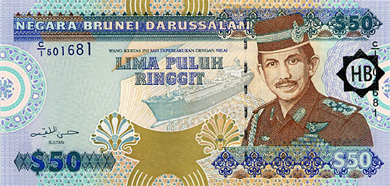
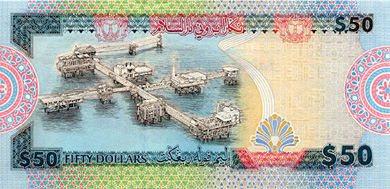
- Currency Name and Code
- Bruneian dollars (BND)
- GDP Real Growth Rate
- 1.7%
Banknotes
Budget & Public Finance
- Fiscal Year
- calendar year
- Annual Budget
- $4,815,000,000 (USD)
- Economic Aid
- $4,300,000 (USD)
Labor, Industry & Trade
- Labor Force by Occupation
- government 48%; production of oil; natural gas; services; and construction 42%; agriculture; forestry; and fishing 10%
- Industries
- petroleum, petroleum refining, liquefied natural gas, construction
- Agriculture Products
- rice, vegetables, fruits, chickens, water buffalo
- Export Commodities
- crude oil, natural gas, refined products
- Export Partners
- Japan 40%, South Korea 12.2%, Thailand 12%, Australia 9.1%, US 8.1%, China 6.4%, Singapore 5.6%
- Import Commodities
- machinery and transport equipment, manufactured goods, food, chemicals
- Import Partners
- Singapore 30.7%, Japan 21.5%, Malaysia 17.4%, UK 6.1%
Energy
- Oil Production
- 200,800 bbl/day
- Oil Consumption
- 10,770 bbl/day
- Oil Reserves
- 1,255,000,000 bbl/day
- Natural Gas Production
- 11,400,000,000 cu m
- Natural Gas Consumption
- 1,730,000,000 cu m
- Natural Gas Imports
- 0 cu m
- Natural Gas Exports
- 9,000,000,000 cu m
- Natural Gas Reserves
- 390,800,000,000 cu m
Communications
- Telephone System
- General Assessment: service throughout the country is good; international service is good to Southeast Asia, the Middle East, Western Europe, and the US Domestic: every service available International: country code - 673; landing point for the SEA-ME-WE-3 optical telecommunications submarine cable that provides links to Asia, the Middle East, and Europe; the Asia-America Gateway submarine cable network provides new links to Asia and the US; satellite earth stations - 2 Intelsat (1 Indian Ocean and 1 Pacific Ocean)
- Internet Country Code
- .bn
News & Weather
News & Weather
Current Weather
Latest News
Taliban Envoy, Brunei's Grand Mufti Discuss Religious and Bilateral Cooperation in Malaysia - thekabultribune.com
thekabultribune.com · 1h ago
The Sultan of Brunei turns 80: Inside His $16 billion fortune and record-breaking reign - HOLA
HOLA · 5d ago
Noble Secures $136M Drillship Contract for Brunei Operations - imarinenews.com
imarinenews.com · 1d ago
Brunei - World Population Review
World Population Review · 4d ago
U.S. Navy, Royal Brunei Armed Forces conduct CARAT Brunei 2026 Final Planning Conference - cpf.navy.mil
cpf.navy.mil · 19d ago
Visa waiver programs extended - Taipei Times
Taipei Times · 2d ago
Brunei Air Quality Index (AQI) and Air Pollution information | IQAir USA - IQAir
IQAir · 27d ago
Meeting with Sultan of Brunei Darussalam Hassanal Bolkiah - Президент России
Президент России · 34d ago
News via Google News
Climate Overview
The country's landscape is mainly primary and secondary tropical rainforest with only a narrow coastal strip from Kuala Belait to Bandar Seri Begawan that is cultivated. The rainforest receives as much as 146 inches of rain in the interior, but only 108 inches a year is recorded on the coast. The two defined rainy seasons are from September to January (with December being the wettest month) and May to July. The climate is equatorial with uniform temperatures and high humidity.
Videos
Videos
1 curated YouTube videos.
Source: YouTube
Frequently Asked Questions
Frequently Asked Questions
What is the population of Brunei?
What are the dining customs in Brunei?
What should I know about Brunei's culture before I go?
What is the capital of Brunei?
Where is Brunei located?
What countries border Brunei?
What is the main religion of Brunei?
What is the currency of Brunei?
What languages are spoken in Brunei?
What is Brunei known for?
What type of government does Brunei have?
Last reviewed 2026