
 English
 Español
 中文
中文 हिन्दी
 Français
Korea, South
Declare Your Relationship to Korea, South
CountryReports Community
- Studying7
- From Korea, South0
- Korea, South heritage4
- Visited7
- Want to visit4
Customs and Culture
Customs and Culture
About the People
The establishment of the Democratic People’s Republic of Korea (North Korea’s official name) brought about radical changes in the nature of traditional Korean society. The Confucian concept of filial piety and loyalty to one’s lineage has been largely supplanted by an intense nationalism that is described as both fiercely proud and excessively paranoid. The interests of the state have taken priority over the interests of the family. One should be aware of the pervasive influence of the chuch’e concept on the North Korean psyche. It colors every aspect of life, from popular music to political speeches and everyday conversation. Chuch’e gives people a reason to sacrifice, and it is what has convinced the people that they are better off than other nations.
North and South Koreans often use extreme modesty when speaking about themselves. Reluctance to accept high honors is the mark of a true Korean gentleman. Compliments are graciously denied. Success depends greatly on social contacts. Friends expect to rely on each other for just about anything. Koreans are quick to make friends and friendships are highly valued. South Koreans are proud of their country’s accomplishments, including the contributions of traditional Korean culture and the nation’s modern economic success.
Cultural Attributes
One should be aware of the pervasive influence of self-reliance on the Korean psyche. It impacts every aspect of Korean culture, from politics to music. Reliance provides a reason for personal sacrifice, and it is what has convinced the people that they are better off than other nations.
North and South Koreans often use extreme modesty when speaking about themselves. A reluctance to accept high honors is the mark of a true Korean gentleman. Compliments are graciously denied. Success depends greatly on social contacts. Friends expect to rely on each other for just about anything. Koreans are quick to make friends, and friendships are highly valued. South Koreans are proud of their country's accomplishments, including the contributions of traditional Korean culture and the nation's modern economic success.

The Spirit That Rises
Greetings, Gestures & Visiting
Greetings and introductions tend to be formal. Handshakes are common among men, but a bow is still most common. A younger or lower-status person always bows until the other offers a handshake or returns the bow. When Korean men do shake hands, the right hand is extended, often supported at the wrist by the left hand to show deference. The head is slightly bowed. When women meet, they usually extend both hands and grasp each other’s hands. Children always bow to adults and wave or bow among themselves.
There are several phrases used in greeting another person, but the most common is "Anyong haseyo" (literally, are you at peace?), which is used to ask, “How are you?” The Korean language has different levels of formality, so this and any other greeting will differ depending on the people involved. For example, "Anuong" is used with children, while "Anyong hashimnikka" is used for superiors. All mean the same thing, but the different endings indicate levels of respect. When greeting a superior, it is common to ask about health and parents. When greeting a subordinate, one often asks about their spouse or children.
It is not unusual to see men holding hands in public or walking down the street with an arm slung over a friend’s shoulder. This is an expression of friendship. Touching between strangers or casual acquaintances, however, especially between opposite sexes, is considered inappropriate. In most situations, good posture is maintained to show respect for the host or speaker. To sit in a relaxed manner is considered an insult. Care is taken not to expose the soles of the feet to another person while sitting.
Gifts are given and received with both hands. Hands are generally not used much in conversation. Hats are removed in buildings, as well as in the presence of an elder or superior. One never looks a superior directly in the eye.
During introductions, the more senior person offers to shake hands first, but the more junior person bows first. Men have priority in Korea; a man will walk through a door first, walk ahead of a woman, and women will help men on with their coats.
Shoes are removed before entering a home. When entering a conference or dining room, wait to be shown to the seat designated for you. Make a slight protest before going to your designated spot, as this demonstrates the trait of humility, which Koreans greatly appreciate.
Koreans do not commonly visit one another unannounced, and arranged social visits are infrequent. Generally, people visit relatives for the Lunar New Year or Parents’ Day, but not so often. A superior never visits a subordinate unless a particular business calls for it. Those invited are nearly always offered light refreshments consisting of a drink, fruit, crackers, cookies, or coffee. It is considered polite and a sign of respect for guests to take a gift to the hosts. The value of the gift is far less important than the gesture of giving it. Usually, a gift will be fruit, a beverage, or something from one’s home region.
Shoes and hats are removed indoors. In some cases, slippers are provided. Otherwise, people will only wear socks at home. Observing etiquette involves paying particular attention to the host and respecting their feelings. Showing respect for the family and state is of utmost importance for most visits. Koreans are very generous hosts. They view the care of a guest as basic good manners, so visitors are given the best the household has to offer if there are many guests; age or status determines who gets the best seat, the best cut of meat, and the most giant drink.
Traditional clothing is often worn for special occasions or holidays. Women frequently wear the "hanbok," a two-piece, long, colorful dress. Men wear pants with a loose robe or jacket. Clothing often depends on the event. In public, conservative dress is important. Bare feet are inappropriate.
Diet
Korean food is generally spicy. Kimch’i (a spicy pickled cabbage) and rice are the mainstays of the diet around which most other dishes revolve. Meals usually consist of a number of spicy vegetables, soup, fish, and kimch’i. Because of the lower economic level of North Korea, traditional Korean delicacies such as pulkogi (marinated beef) and kalbi (marinated short ribs) are not as common as in South Korea. A favorite food in North Korea is naengmyon, a cold noodle dish. The consumption of soybeans and corn is high, as is that of millet and wheat.
Families rarely have time to eat daily meals together. Fathers often leave early in the morning and return late at night. They commonly eat their meals at workplace cafeterias. Koreans consider eating while walking on the street ill-mannered and offensive, something only a child is allowed to indulge in. Except during lengthy dinner parties, conversation during meals is quite limited. Eating with the fingers is considered impolite, but slurping soup and noodles is accepted; in fact, it is a practical way to eat hot food at the rapid pace Koreans are used to. Spoons for soup and chopsticks for everything else are the most common utensils.
Kimch’i (pickled cabbage) and rice are the mainstays of the diet around which most other dishes revolve. Meals usually consist of a number of spicy vegetables, soup, fish, and kimch’i. The consumption of soybeans and corn is high, as is millet and wheat.

Family
The family remains an important part of Korean life. The government has constantly encouraged the population to love their family and their state, but obligations have been continually extended outward to embrace the larger society. Traditional Korean family devotion has been redirected away from the extended family.
For most families, the average monthly wage is enough to purchase daily necessities but not enough to pay for luxury or nonessential goods. Consumerism tends to be discouraged in favor of austerity in the North. However, workers can earn various supplies, benefits, and gifts from their employers or the government. Both parents usually work, and their children go to daycare. Daycare centers are sometimes located at the workplace.
Dating Customs
Western-style dating is now more common in the South, while parental consent for marriage is essential in both South and North Korea. The government has established minimum marriage ages (27 for men, 25 for women) to allow for the completion of military service and other obligations. Due to a shortage in the labor force, the government provides incentives for married couples to have large families.
Recreation
Koreans enjoy traditional sports like tae-kwon-do, a form of martial arts that originated in Korea 2000 years ago as an exercise in self-defense and ssirum. Ssirum began as a method of self-defense over 1500 years ago. The rules of Ssirum are simple. A competitor tries to grasp his opponent's belt or satba, and throw him to the ground, but if the wrestler's body touches the ground anywhere above the knee, the other person wins.
Holidays
Liberation Day
8/15Independence
Hangul Day
10/9Other
Hangul Day - on this day in 1446, King Sejong the Great promulgated the Korean alphabet, hangul.
Christmas
12/25Christmas
Called Santa Haraboji in South Korea, and pronounced ‘san-ta ha-ra-boh-jee,’ Santa Claus is also known as Santa Grandfather and is dressed in either a red or a blue suit. Children eagerly await his arrival on Christmas Eve, which is when an exchange of gifts occurs. During the holiday season several Santa Clauses are found in both red and blue outfits roaming around the South Korean sidewalks, wishing everybody sun takchuk ha, pronounced ‘soon tack chook huh’ or ‘Merry Christmas’ and offering cake and chocolates to passersby.
Christmas decorations are put up around the first or second week of December and taken down around the New Year or the last week of December. Christmas in Korea is celebrated by about fifty percent of the population, with the other fifty percent being Buddhist. Christmas festivities end on December 26, the day after Christmas, and preparations for the New Year celebrations begin.
There are no Christmas celebrations in Buddhist households, but in Christian households, there is a Christmas tree and presents that look the same way they do in other Western countries. House decorations consist of a hanging up traditional Korean lanterns, colorful paper chains and Christmas lights. In addition, regular Christmas parades take place in the South Korean streets.
Every December 11 since 1998, The Avaokitesvara waneum Buddhist Temple in South Korea has been honoring the birth of Jesus by lighting two Christmas Trees with a placard beside it which says “Congratulations on Jesus Birthday.” Everyone is invited to watch the tree-lighting ceremony.
On Christmas Eve, Christian churches hold the traditional Christmas Midnight Mass and another service for the next day. Baptismal services are also frequently held in Christian churches on Christmas day. South Koreans dress up in their Sunday best and attend Midnight Mass, which lasts for about an hour, followed with a Christmas dinner at home and then the opening of gifts.
Because only half the population celebrated Christmas, the festive air is not quite as elaborate as in Western countries, and Christmas is quite subdued.Being a public holiday, however, many department stores lavishly decorate their shop windows with traditional Christmas themes like snowflakes, pine trees, bells, Christmas balls and candy canes in order to attract more customers.
Gifts normally consist of money, or just one special gift to a close relative rather than the plethora of presents which characterize Western tradition. Aside from money, people give each other flowers, jewelry, shoes, bags, books and clothes. A Christmas tree is decorated in the traditional style and presents are placed underneath. Korean Christmas cards also are exchanged as well, with the phrase “Season’s Greetings” instead of “Merry Christmas” on the front. This is for the purpose of being able to attract a larger segment of the population.
Groups of young people organize caroling parties for Christmas in Korea. Beginning from the church, they will go around the homes of older church members and sing Christmas carols. Traditionally, carolers are invited into the homes for treats and hot drinks.
Several restaurants offer a special menu especially made for Christmas. This normally includes sweet potato noodles, rice cake soup, barbecued beef bulgogi and kimchi (spicy pickled cabbage). Restaurants are also decorated in red carpets and flowers in line with the festivities. In the homes, South Korean Christmas food consists of kimchi, hot peppers and bean paste. Some people celebrate Christmas with a Korean barbecue. Others make cakes, meat loaf and rice.
Dates of Interest
- October
One of Asia’s most significant film festivals, showcasing a wide range of international and Asian films. The festival includes screenings, panel discussions, and events with filmmakers and actors.
How do people greet each other in South Korea?
Greetings tend to be formal, and while handshakes are common among men, a bow remains most common, with the younger or lower-status person bowing first.
Do
- Have men extend the right hand, supported at the wrist by the left, with the head slightly bowed
- When women meet, extend both hands and grasp each other's hands
- Use 'Anyong haseyo' as the common greeting for 'How are you?'
- When greeting a superior, ask about their health and parents; with a subordinate, ask about spouse or children
Don’t
- Don't ignore levels of formality — use 'Anyong' with children and 'Anyong hashimnikka' for superiors
Good to know
- Children always bow to adults and wave or bow among themselves
- During introductions, the senior person offers to shake hands first, but the junior person bows first
What are the dining customs in South Korea?
Korean food is generally spicy, built around kimch'i and rice, and eaten with spoons for soup and chopsticks for everything else.
Do
- Use a spoon for soup and chopsticks for everything else
- Slurping soup and noodles is accepted and practical for eating hot food quickly
Don’t
- Don't eat with your fingers, as it is considered impolite
- Don't eat while walking on the street, which is seen as ill-mannered
- Don't expect much conversation during meals, except at lengthy dinner parties
What etiquette should I know when visiting a home in South Korea?
Koreans rarely visit unannounced and are very generous hosts who give guests the best the household has to offer; bringing a gift is a polite sign of respect.
Do
- Bring a gift such as fruit, a beverage, or something from your home region
- Give and receive gifts with both hands
- Remove shoes and hats indoors; wear provided slippers or socks
- Wait to be shown to your designated seat and make a slight protest to show humility
Good to know
- The value of a gift matters far less than the gesture of giving it
- Age or status determines who gets the best seat, cut of meat, and largest drink
What should I wear in South Korea?
Conservative dress is important in public, and clothing often depends on the event.
Do
- Dress conservatively in public
Don’t
- Don't go bare feet, which is inappropriate
Good to know
- Traditional clothing like the women's colorful two-piece 'hanbok' is worn for special occasions or holidays
What gestures and body language matter in South Korea?
Good posture shows respect, and physical space rules are strict, especially between strangers and opposite sexes.
Do
- Maintain good posture to show respect for the host or speaker
- Remove hats in buildings and before an elder or superior
Don’t
- Don't touch strangers or casual acquaintances, especially between opposite sexes
- Don't sit in a relaxed manner or expose the soles of your feet to another person
- Don't look a superior directly in the eye
Good to know
- Men holding hands or an arm over a friend's shoulder is an expression of friendship
- Hands are generally not used much in conversation
What is family life like in South Korea?
The family remains an important part of Korean life, though families rarely eat daily meals together and both parents usually work.
Good to know
- Both parents usually work while children attend daycare
- Western-style dating is now more common in the South, but parental consent for marriage is essential
What do people do for recreation in South Korea?
Koreans enjoy traditional sports such as tae-kwon-do and ssirum wrestling.
Good to know
- Tae-kwon-do is a Korean martial art originating 2000 years ago as self-defense
- In ssirum, a competitor grasps the opponent's belt (satba) and throws him; touching the ground above the knee means the other person wins
Last updated: 2026-07-12 · Sources: CountryReports
Photos of Korea, South
Photos of Korea, South


Travel and Tourism
Travel and Tourism
- Travel Alert Status
- Level 1: Exercise Normal Precautions
- Currency
- South Korean won (KRW)
- Time Difference
- UTC+9 (14 hours ahead of Washington, DC, during Standard Time)
- Climate
- Korea's climate is marked by four very distinct seasons. The winters are dry and cold, with snow usually appearing in January. The advent of the cherry blossoms heralds spring—a season that can also be somewhat unpredictable. A brief monsoon season and high temperatures combine to make city life rather humid in the summertime. Autumn is easily the best time of year in Korea, when both the cities and the countryside benefit from clear skies and vibrant fall foliage. Only 19% of the country is flat enough to be arable, and that land is farmed intensively. In addition, there has been a steady shift away from the farm and into urban areas. Two-thirds of Korea's population now live in its cities.
- Airports
- 102
Read the full travel guide — health, safety, vaccinations, disease risk, sanitation, and transit details.
View full travel guideRecipes
Recipes
History
History
Historical Eras
Ancient & Classical Korea
2333 BCE – 668
Rooted in the mythic founding by the god-king Tangun in 2333 BCE, early Korea developed through waves of settlers and the gradual rise of competing kingdoms — Goguryeo, Baekje, and Silla. Korea adopted Chinese characters, established legal codes, and became a crucial conduit for Buddhism and continental culture into Japan. The peninsula's three kingdoms engaged in sustained rivalry until Silla unified the peninsula in 668 CE.
Goryeo Dynasty
918 – 1392
The Goryeo dynasty, from which the name 'Korea' derives, presided over a celebrated age of artistic and intellectual achievement, including the production of the Tripitaka Koreana — over 80,000 carved wooden blocks of Buddhist scripture. Goryeo endured devastating Mongol invasions in the 13th century but maintained dynastic continuity through tributary submission. The era saw advances in celadon ceramics, printing technology, and bureaucratic governance.
Joseon Dynasty
1392 – 1897
General Yi Seonggye founded the Joseon dynasty in 1392, renaming the kingdom Joseon and establishing Neo-Confucianism as the state ideology. King Sejong's promulgation of the Hangul alphabet in 1446 stands as the era's defining cultural achievement. Though Korea repelled Japanese invasions under Admiral Yi Sun-sin in the 1590s and later endured Manchu incursions, Joseon's inward-looking policies earned it the label 'Hermit Kingdom' by the 19th century.
Colonial Period
1897 – 1945
Declining Joseon sovereignty accelerated as Japan defeated China in 1895 and Russia in 1905, eliminating rival powers on the peninsula. Japan formally annexed Korea in 1910, initiating 35 years of colonial rule marked by systematic suppression of the Korean language, cultural identity, and political autonomy. The March First Movement of 1919, a nationwide independence uprising, was violently suppressed but galvanized lasting nationalist resistance.
Division & Korean War
1945 – 1953
Japan's 1945 defeat led to Korea's division at the 38th parallel into Soviet and American occupation zones. The Republic of Korea was formally established on August 15, 1948, under President Syngman Rhee. On June 25, 1950, North Korean forces invaded the South, triggering a brutal three-year war in which US-led UN forces and later Chinese troops intervened; the armistice signed at Panmunjom on July 27, 1953 froze the peninsula's division without a formal peace treaty.
Authoritarian Growth & Democracy
1953 – 1993
Post-war South Korea endured decades of authoritarian rule — first under Syngman Rhee, then under Park Chung-hee following his 1961 coup, and later under Chun Doo-hwan after his 1979 seizure of power. Park's government engineered one of history's most rapid economic transformations, elevating South Korea into an industrial export powerhouse, while brutally curtailing political freedoms. The 1980 Gwangju massacre and sustained pro-democracy protests ultimately forced democratic concessions in 1987, culminating in Kim Young-sam's election as the first civilian president in 1992.
Democratic Modern Era
1993 – present
South Korea consolidated liberal democracy and weathered the 1997 Asian financial crisis with sweeping IMF-guided reforms, emerging as a high-income OECD economy and global leader in technology, shipbuilding, and popular culture. The historic inter-Korean summit of June 2000 between President Kim Dae-jung and North Korean leader Kim Jong-il signaled new diplomatic possibilities, earning Kim the Nobel Peace Prize. South Korea today stands as one of Asia's most dynamic democracies, balancing alliance commitments, inter-Korean tensions, and its influential cultural export — the globally resonant 'Korean Wave.'
Overview
With declining Chinese power and a weakened domestic posture at the end of the 19th century, Korea was open to Western and Japanese encroachment. In 1910, Japan began a 35-year period of colonial rule over Korea. As a result of Japan’s efforts to supplant the Korean language and aspects of Korean culture, memories of Japanese annexation still recall fierce animosity and resentment, especially among older Koreans. Nevertheless, import restrictions on Japanese movies, popular music, fashion, and the like have been lifted, and many Koreans, especially the younger generations, eagerly follow Japanese pop culture. Aspects of Korean culture, including television shows and movies, have also become popular in Japan.
Japan’s surrender to the Allied Powers in 1945, signaling the end of World War II, only further embroiled Korea in foreign rivalries. Division at the 38th parallel marked the beginning of Soviet and U.S. trusteeship over the North and South, respectively. On August 15, 1948 the Republic of Korea (R.O.K.) was established, with Syngman Rhee as the first President. On September 9, 1948 the Democratic People’s Republic of Korea (D.P.R.K.) was established under Kim Il Sung.
On June 25, 1950, North Korean forces invaded South Korea. Led by the U.S., a 16-member coalition undertook the first collective action under United Nations Command (UNC). Following China’s entry on behalf of North Korea later that year, a stalemate ensued for the final two years of the conflict. Armistice negotiations, initiated in July 1951, were ultimately concluded on July 27, 1953 at Panmunjom, in what is now the Demilitarized Zone (DMZ). The Armistice Agreement was signed by representatives of the Korean People’s Army, the Chinese People’s Volunteers, and the U.S.-led United Nations Command (UNC). Though the R.O.K. supported the UNC, it refused to sign the Armistice Agreement. A peace treaty has never been signed. The war left almost three million Koreans dead or wounded and millions of others homeless and separated from their families.
In the following decades, South Korea experienced political turmoil under autocratic leadership. President Syngman Rhee was forced to resign in April 1960 following a student-led uprising. The Second Republic under the leadership of Chang Myon ended after only one year, when Major General Park Chung-hee led a military coup. Park’s rule, which resulted in tremendous economic growth and development but increasingly restricted political freedoms, ended with his assassination in 1979. Subsequently, a powerful group of military officers, led by Lieutenant General Chun Doo-hwan, declared martial law and took power.
Throughout the Park and Chun eras, South Korea developed a vocal civil society that led to strong protests against authoritarian rule. Composed primarily of students and labor union activists, protest movements reached a climax after Chun’s 1979 coup and declaration of martial law. A confrontation in Gwangju in 1980 left at least 200 civilians dead. Thereafter, pro-democracy activities intensified even more, ultimately forcing political concessions by the government in 1987, including the restoration of direct presidential elections.
In 1987, Roh Tae-woo, a former general, was elected president, but additional democratic advances during his tenure resulted in the 1992 election of a long-time pro-democracy activist, Kim Young-sam. Kim became Korea’s first civilian elected president in 32 years. The 1997 presidential election and peaceful transition of power marked another step forward in Korea’s democratization when Kim Dae-jung, a life-long democracy and human rights activist, was elected from a major opposition party. The transition to an open, democratic system was further consolidated in 2002, when self-educated human rights lawyer, Roh Moo-hyun, won the presidential election on a "participatory government" platform. South Koreans voted for a new president in December 2007. Former business executive and Mayor of Seoul Lee Myung-bak’s 5-year term began with his inauguration on February 25, 2008.
Timeline of Key Events
3000 BCE
Early Korean civilization grows with waves of settlers from central Asia.
Early Korean civilization grows with waves of settlers from central Asia.
200
Korea’s emerging states develop laws and a new writing system that uses Chinese characters.
Korea’s emerging states develop laws and a new writing system that uses Chinese characters.
538 – 552
Introduction of Buddhism to Japan from Korea.
Introduction of Buddhism to Japan from Korea.
578
Prince Shotuku brought a family from Korea to Osaka and had them build a Buddhist temple.
Prince Shotuku brought a family from Korea to Osaka and had them build a Buddhist temple. The temple took 15 years to build and the Kongo family became established as the premier temple builders in Japan.
668
The Silla Dynasty brings together three existing kingdoms, and the arts flourish.
The Silla Dynasty brings together three existing kingdoms, and the arts flourish.
918 – 1392
During Korea’s Age of Enlightenment, the period of the Goryeo Dynasty,
During Korea’s Age of Enlightenment, the period of the Goryeo Dynasty, the Buddhist aristocracy commissioned many works of art to further the Buddhist ideal.
1162
Genghis Khan was born
Genghis Khan was born in the Hentiyn Nuruu mountains north of Ulan Bator. His given name was Temujin, “the ironsmith.” He seized control over 5 million square miles that covered China, Iran, Iraq, Burma, Vietnam, and most of Korea and Russia.
Read the full history profile — narrative overview, defining eras, and the complete timeline in one place.
View expanded historyInteresting Facts
Interesting Facts
The name Korea comes from the early dynasty name Koryo which means high mountains and clear water.
Located on the banks of the Han-gang River, Seoul is home to one-fourth of Korea's population.
Throughout history, Korea has resisted cultural and political domination from outside forces.
Koreans do not wear shoes in a home. It is polite to take off your shoes before you enter a home.
It is good manners to pass and receive objects with both hands. If you want to take someone's business card, put out your right hand to accept the card and place your left hand under the wrist. You should pass an object to someone in the same manner.
The husband is expected to hand over all or most of his salary to his wife, who manages the family finances.
See every fact — trivia, oddities, and curious tidbits gathered from across the country.
View all interesting factsGeography and Environment
Geography and Environment
- Terrain
- mostly hills and mountains; wide coastal plains in west and south
- Climate
- Korea's climate is marked by four very distinct seasons. The winters are dry and cold, with snow usually appearing in January. The advent of the cherry blossoms heralds spring—a season that can also be somewhat unpredictable. A brief monsoon season and high temperatures combine to make city life rather humid in the summertime. Autumn is easily the best time of year in Korea, when both the cities and the countryside benefit from clear skies and vibrant fall foliage. Only 19% of the country is flat enough to be arable, and that land is farmed intensively. In addition, there has been a steady shift away from the farm and into urban areas. Two-thirds of Korea's population now live in its cities.
- Natural Hazards
- occasional typhoons bring high winds and floods; low-level seismic activity common in southwest
- Current Environmental Issues
- air pollution in large cities; acid rain; water pollution from the discharge of sewage and industrial effluents; drift net fishing
Read the full geography and environment profile — terrain, climate, natural resources, hazards, land use, and international agreements.
View full geographyPeople & Demographics
People & Demographics
Religion
Languages Spoken
Korean
- Korean
Population
- Population
- 48,636,068
- Population in Major Urban Areas
- SEOUL (capital) 9.736 million; Busan (Pusan) 3.372 million; Incheon (Inch'on) 2.622 million; Daegu (Taegu) 2.447 million; Daejon (Taejon) 1.538 million; Gwangju (Kwangju) 1.503 million
- Nationality Noun
- Korean(s)
- Ethnic Groups
- homogeneous (except for about 20,000 Chinese)
- Language Note
- Korean is spoken in both North and South Korea and is written in a phonetic alphabet created and promulgated in the mid-15th century. While the alphabet is called Hangul in South Korea, it is known as Chosongul in North Korea. Although the Korean language is replete with words adapted from Chinese, the North Koreans, unlike the South Koreans, do not use Chinese characters with Chosongul in their newspapers and publications. They prefer to use only Chosongul, which is sufficient for most needs. There are also some differences in vocabulary between the North and the South, influenced somewhat by politics and also by the contact each country has had with other nations. Russian, Chinese, and English are taught as second languages in the schools.
Education
- Literacy Definition
- age 15 and over can read and write
Read the full people and society profile — demographics, health, education, religion, languages, and notable people.
View full people and societyGovernment & Politics
Government & Politics
Country Identity
- Country Name
- KoreaSouth
- Full Country Name
- Republic of Korea
- Local - Long
- Taehan-min'guk
Government Structure
- Government Type
- republic
- Legal System
- combines elements of continental European civil law systems, Anglo-American law, and Chinese classical thought
- Executive Branch
- chief of state: President YOON Suk-yeol (since 10 May 2022) head of government: Prime Minister HAN Duck-soo (since 21 May 2022); Deputy Prime Ministers CHOI Sang-mok (Economy and Finance) and LEE Ju-ho (Education) cabinet: State Council appointed by the president on the prime minister's recommendation elections: president elected by popular vote for a single five-year term; election last held 9 March 2022 (next to be held in March 2027); prime minister appointed by president with consent of National Assembly; deputy prime ministers appointed by president on prime minister's recommendation election results: results of the 9 March 2022 election - YOON Suk-yeol elected president; percent of vote - YOON Suk-yeol (PPP) 48.6%; LEE Jae-myung (DP) 47.8%; other 3.6%
- Legislative Branch
- unicameral National Assembly or Kukhoe (299 seats - members elected for four-year terms; 243 in single-seat constituencies, 56 by proportional representation) elections: last held 15 April 2004 (next to be held in April 2008; byelections held on 30 April 2005 and on 26 October 2005) election results: percent of vote by party - Uri 51%, GNP 41%, DLP 3%, DP 3%, others 2%; seats by party - Uri 144, GNP 127, DP 11, DLP 9, ULD 3, independents 5 note: percent of vote is for 2004 general election; seats by party reflect results of April and October 2005 byelections involving six and four seats respectively; MDP became DP in May 2005; United Liberal Democrats (ULD) merged with GNP in February 2006. (2006)
- Judicial Branch
- Supreme Court (justices appointed by president with consent of National Assembly); Constitutional Court (justices appointed by president based partly on nominations by National Assembly and Chief Justice of the court)
- Suffrage
- 20 years of age; universal
- Constitution
- 17-Jul-48
- Independence
- 15 August 1945 (from Japan)
- National Holiday
- Liberation Day, 15 August (1945)
Capital City
- Capital Name
- Seoul; note - Sejong, located some 120 km (75 mi) south of Seoul, serves as an administrative capital for segments of the South Korean Government
- Capital - geographic coordinate
- 37 33 N, 126 59 E
- Capital Time Difference
- UTC+9 (14 hours ahead of Washington, DC, during Standard Time)
the name originates from the Korean word meaning "capital city" and which is believed to be derived from Seorabeol, the name of the capital of the ancient Korean Kingdom of Silla
Military
Branches: Republic of Korea Army; Navy (includes Marine Corps); Air Force
Embassy / Diplomatic Mission
U.S. Embassy, Seoul, Republic of Korea
188 Sejong-daero, Jongno-gu, Seoul, Republic of Korea, 110-710
APO address is Unit 15550, APO, AP 96205-5550
Telephone: (82-2) 397-4114 (from a cell phone in the Republic of Korea: 02-397-4114)
Emergency after-hours telephone: 82-2-397-4114. If you have access to DSN, please call 721-4114.
Facsimile: (82-2) 397-4101.
Read the full government profile — flag symbolism, national anthem, and other national symbols.
View full government detailsEconomy
Economy
Since the early 1960s, South Korea has achieved a remarkable record of growth and integration into the high-tech modern world economy. Six decades ago, its GDP per capita was comparable to levels in the poorer countries of Africa and Asia. Today, South Korea is the world's 12th- to 14th-largest economy, with GDP per capita exceeding $33,000, more than 20 times that of North Korea and on par with several developed European economies. This success was achieved through a system of close government-business ties, including directed credit, import restrictions, sponsorship of specific industries, and a strong labor effort. The government promoted imports of raw materials and technology at the expense of consumer goods and encouraged savings and investment over consumption.
The Asian financial crisis of 1997-98 exposed longstanding weaknesses in South Korea's development model, including high debt-to-equity ratios, massive foreign borrowing, and an undisciplined financial sector. In response, the government undertook major structural reforms, restructuring the banking sector, increasing transparency, and opening markets to foreign investment. These reforms helped the economy recover quickly and laid the foundation for sustained growth in subsequent decades.
South Korea weathered the 2008 global financial crisis better than most advanced economies and continued to expand, driven by exports of semiconductors, automobiles, ships, petrochemicals, and consumer electronics. Major conglomerates known as chaebol — including Samsung, Hyundai, LG, and SK — remain central to the economy, although the government has pursued policies to support small and medium-sized enterprises and reduce concentration of economic power.
In recent years, growth has moderated as the economy has matured, with annual GDP growth typically ranging between 2% and 3%. The country has become a global leader in advanced manufacturing, information technology, and cultural exports, with the so-called "Korean Wave" boosting tourism and consumer brand recognition worldwide. Key challenges include a rapidly aging population, one of the world's lowest fertility rates, high household debt, persistent youth unemployment, and rising tensions in global trade and semiconductor supply chains. Energy dependence on imports and exposure to fluctuations in Chinese demand also remain significant concerns.
Snapshot
- Currency Name and Code
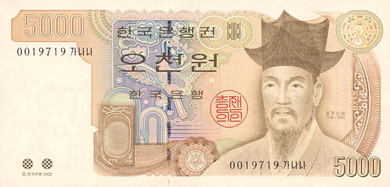
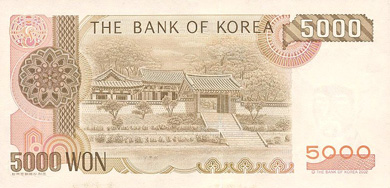
- Won (KRW)
- GDP — official exchange rate
- $801,200,000,000 (USD)
- GDP Real Growth Rate
- 3.9%
- Gini Index
- 35.8
Banknotes
Budget & Public Finance
- Fiscal Year
- calendar year
- Annual Budget
- $189,000,000,000 (USD)
- Public Debt (% of GDP)
- 30.1%
- External Debt
- $188,400,000,000 (USD)
- Investment (% of GDP)
- 28.9%
- Current Account Balance
- $14,320,000,000 (USD)
- Reserves of Foreign Exchange
- $2,147,483,647 (USD)
Labor, Industry & Trade
- Labor Force by Occupation
- services 69%; industry 21.5%; agriculture 9.5%
- Household Income — highest 10%
- 25%
- Industries
- electronics, telecommunications, automobile production, chemicals, shipbuilding, steel
- Agriculture Products
- rice, root crops, barley, vegetables, fruit; cattle, pigs, chickens, milk, eggs; fish
- Export Commodities
- Semiconductors, wireless telecommunications equipment, motor vehicles, computers, steel, ships, petrochemicals
- Export Partners
- US 20.4%, China 14.7%, Japan 9.4%, Hong Kong 6.3%, Taiwan 4.1%
- Import Commodities
- machinery, electronics and electronic equipment, oil, steel, transport equipment, organic chemicals, plastics
- Import Partners
- Japan 19.6%, US 15.2%, China 11.4%, Saudi Arabia 5%
Energy
- Oil Production
- 0 bbl/day
- Oil Consumption
- 2,061,000 bbl/day
- Oil Reserves
- 0 bbl/day
- Natural Gas Production
- 0 cu m
- Natural Gas Consumption
- 24,090,000,000 cu m
- Natural Gas Imports
- 21,110,000,000 cu m
- Natural Gas Exports
- 0 cu m
- Natural Gas Reserves
- 0 cu m
Communications
- Telephone System
- general assessment: excellent domestic and international services featuring rapid incorporation of new technologies domestic: fixed-line and mobile-cellular services widely available with a combined telephone subscribership of roughly 170 per 100 persons; rapid assimilation of a full range of telecommunications technologies leading to a boom in e-commerce international: country code - 82; numerous submarine cables provide links throughout Asia, Australia, the Middle East, Europe, and US; satellite earth stations - 66
- Internet Country Code
- .kr
News & Weather
News & Weather
Current Weather
Latest News
'I couldn't breathe': South Korea's frenzied stock trading exposes margin loan risks - Reuters
Reuters · 1d ago
Faced with inadequate US healthcare, Black women fly to South Korea: ‘It could save your life’ - The Guardian
The Guardian · 2d ago
Asian shares mostly gain and South Korea and Japan recover some losses from AI stock sell-offs - AP News
AP News · 3h ago
South Korea’s Early Exports Jump to July Record on AI-Led Gains - Bloomberg.com
Bloomberg.com · 7h ago
Video filmed in South Korea misrepresented as US military helicopters over Iran - Yahoo
Yahoo · 1h ago
Prince Harry’s Invictus Games heads to South Korea, as Asia hosts for first time - NewsNation
NewsNation · 4h ago
'Painfully slow' progress on U.S.-South Korea partnership on navy and shipbuilding: Analyst - CNBC
CNBC · 4h ago
South Korea President Urges Regulator Action On Leveraged Stock Funds - Barron's
Barron's · 2h ago
News via Google News
Climate Overview
Korea's climate is marked by four very distinct seasons. The winters are dry and cold, with snow usually appearing in January. The advent of the cherry blossoms heralds spring—a season that can also be somewhat unpredictable. A brief monsoon season and high temperatures combine to make city life rather humid in the summertime. Autumn is easily the best time of year in Korea, when both the cities and the countryside benefit from clear skies and vibrant fall foliage.
Only 19% of the country is flat enough to be arable, and that land is farmed intensively. In addition, there has been a steady shift away from the farm and into urban areas. Two-thirds of Korea's population now live in its cities.
Videos
Videos
1 curated YouTube videos.
Source: YouTube
Frequently Asked Questions
Frequently Asked Questions
What is the population of Korea, South?
How do people greet each other in South Korea?
What are the dining customs in South Korea?
What etiquette should I know when visiting a home in South Korea?
What should I wear in South Korea?
What gestures and body language matter in South Korea?
What is family life like in South Korea?
What do people do for recreation in South Korea?
What is the capital of South Korea?
Where is South Korea located?
What countries border South Korea?
What religions are practiced in South Korea?
What is the currency of South Korea?
What language is spoken in South Korea?
What is South Korea known for?
What is the historical origin of the name Korea?
Last reviewed 2026