
 English
 Español
 中文
中文 हिन्दी
 Français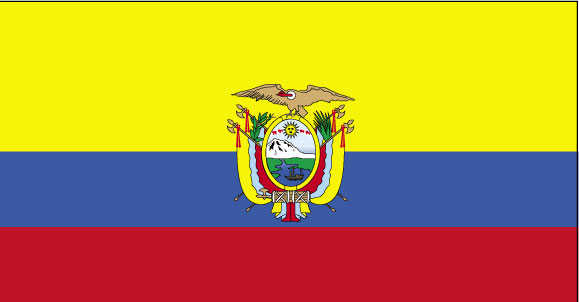
Ecuador
Ecuador
Declare Your Relationship to Ecuador
CountryReports Community
- Studying1
- From Ecuador2
- Ecuador heritage3
- Visited1
- Want to visit0
Customs and Culture
Customs and Culture
About the People
Ecuadorians are warm and hospital people who value family. People from the highlands “Serranos” are considered formal, conservative and reserve. Coastal people “Csotenos” are more open and liberal.
Cultural Attributes
Ecuadorians are a warm and hospital people who value family. People from the highlands "Serranos" who reside in the higher, rural part of the country generally behave in a more formal reserved way. Coastal people "Csotenos" are more open and liberal.

The World's Chocolate Capital
Greetings, Gestures & Visiting
Quichua is recognized as an important part of the Ecuadorian culture, but is not an official language. This language was derived from the Inca language. Even though Quichua is the first language for many indigenous communities in Ecuador, it is not taught as a separate language in most schools. Ecuadorians who live in the coastal areas tend to talk more quickly than those who live in the Sierra highlands. The North American response of saying no by grunting “uh-uh” may cause some confusion when talking to an Ecuadorian, because in Ecuador, “uh-uh” means yes.
It is common to shake hands when meeting someone and when saying goodbye. Ecuadorians may lift their chins to tell you to go "up the street" and lower their chins to say "down the street."
In Ecuador a bus driver may draw a circle in the air with an index finger to say “Sorry, the bus is full.” However, yawning, whistling, pointing or yelling a name to get someone's attention may be considered rude. Women who are close friends may kiss each other in greeting, while men will embrace.
Visits from family and friends are frequent in Ecuador. When families gather for a meal and conversation, visitors are always welcome. Even if unexpected guests arrive during a meal, they will be offered a full meal. As guests are leaving they may be offered a gift. In Ecuador it is considered polite to say hello and goodbye to every person at a party or a social gathering. Those who do not are seen as not placing enough value on relationships.
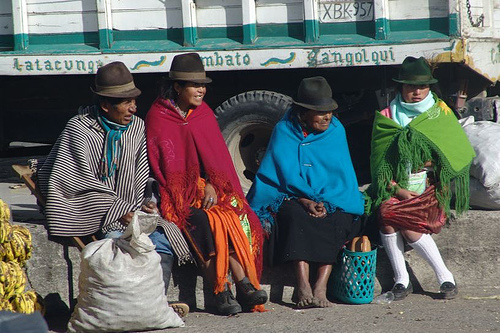
Clothing in rural areas is varied depending upon the region. People familiar with native dress can often tell roughly where a person is from based on what they wear. Western style of clothing is worn is worn in urban areas.
Many Otavalo men wear their hair in a Shimba (long braids). Their clothing of a blue poncho, a fedora, or felt hat, and white calf-length knickers.
Otavalo women dress in a white blouses, a blue skirt and shawl with layers of necklaces of predominantly gold beads, and red coral bracelets.
Mestizo women wear hand-woven cloth skirts and straw hats, the women also wear "serapes" (long shawls). Highland natives prefer to wear clothing of blue, brown, and black.
Diet
In Ecuador the most important meal of the day is the midday meal. The Serranos (people from the Sierra) like to eat meat, corn and potatoes, while Costeños (people from the coastal regions) prefer fish, rice and beans. Soup is served at both lunch and dinner and hot bread is a popular snack.
Ecuadorian dishes include seco de chivo (goat stew), patacones (green bananas fried in oil, mashed and refried) and humitas (sweet corn tamales). Ceviche is fish or seafood marinated in lime juice and seasoned with onion, tomatoes, chili and cilantro. It is sometimes served with cangil (popcorn). Ecuadorians boil their coffee until it is thick and strong. They also enjoy a hot drink called api, made from ground corn.
Ecuador produces many different kinds of fruit, including citrus fruits of all kinds, mangoes, papayas, melons, tamarinds, custard apples and passion fruit. Naranjilla is a fruit that is unique to South America. It looks like a crab apple but yields a delicious juice that is often served for breakfast. Ecuador is also famous for its bananas. The yellow variety that are exported are called guineos, but there are also miniature bananas called oritas, green cooking bananas called verdes and red bananas called magueños.
Special foods are served on holidays and during fiestas. On Good Friday a special fish soup is made with 12 grains that symbolize the 12 apostles. Every year, on All Souls' Day, most families share colada morada. This is a syrupy drink made from flour and fruits.
The Quichua tradition of dried meat or charqui, has given Americans the English word jerky.
In 1630 an Indian named Loja discovered that the sap from the quina tree (called quinine) could be used to treat people with malaria. This drug was used by British troops in India. Most people do not know that this drug is found in Ecuador and think it is from Asia.
In Ecuador, the most important meal of the day is the midday meal. The Serranos (people from the Sierra) like to eat meat, corn and potatoes, while Costeños (people from the coastal regions) prefer fish, rice and beans. Soup is served at both lunch and dinner.
Ecuadorian dishes include seco de chivo (goat stew), patacones (green bananas fried in oil, mashed and refried) and humitas (sweet corn tamales). Ceviche is fish or seafood marinated in lime juice and seasoned with onion, tomatoes, chili and cilantro. It is sometimes served with cangil (popcorn). Ecuadorians boil their coffee until it is thick and strong. They also enjoy a hot drink called api, made from ground corn.
Ecuador produces many different kinds of fruit, including citrus fruits of all kinds, mangoes, papayas, melons, tamarinds, custard apples and passion fruit. Naranjilla is a fruit that is unique to South America. It looks like a crab apple but yields a delicious juice that is often served for breakfast. Ecuador is also famous for its bananas. The yellow variety that are exported are called guineos, but there are also miniature bananas called oritas, green cooking bananas called verdes and red bananas called magueños.
Special foods are served on holidays and during fiestas. On Good Friday a special fish soup is made with 12 grains that symbolize the 12 apostles. Every year, on All Souls' Day, most families share colada morada. This is a syrupy drink made from flour and fruits.
The Quichua tradition of dried meat or charqui, has given Americans the English word jerky.
In 1630, an Indian named Loja discovered that the sap from the quina tree (called quinine) could be used to treat people with malaria. This drug was used by British troops in India. Most people do not know that this drug is found in Ecuador and think it is from Asia.

Family
Ecuadorians place great importance on the family. Older members of the family are treated with respect and kindness. A household is made up of a husband and a wife and their unmarried children, and sometimes members of the extended family. Aged parents often live with their youngest son and his wife. Traditionally, the youngest son stays in the parents' home with the expectation that he will take care of his parents in their old age.
Ecuadorians also form ties to unrelated people through the system of compadrazgo (godparents). Compadres are chosen by the parents of a child at the child's baptism. Compadres have financial obligations towards the children and are also expected to provide support and advice throughout the child's life. For example, a young couple may ask their godparents for advice if the marriage faces problems.
In Ecuador, women are generally responsible for care of the children and the household. Men take a less active role in child-rearing and housekeeping. In recent times, however, the roles of women and men are changing. For example, in urban families men may share household work if their wives are working outside the home.
Dating Customs
Teen aged Ecuadorians generally socialize in groups. Girls must ask for permission from their parents to go out alone with a boy. At 15, girls may have a quincera (party) celebrating a girl's passage into "womanhood". This includes a Catholic ceremony and a party with food, drinks and dancing. Dating usually begins after this phase in a young girl's life. Women usually marry by their early twenties. Most families want their children to finish school before they get married.
Although Ecuador is a Catholic country, common-law marriages are accepted as legal marriages.
Recreation
Futbol (soccer) is the favorite sport in Ecuador. Volleyball and track are also popular. Ecuadorian volleyball is played differently from the way it is played in North America. The ball is heavier and there are three players on each team.
Many Ecuadorians enjoy a game called pelota national. Two teams hit a small ball back and forth, and a third team stands between, trying to stop the ball. Pelota is less popular with young people but is still played by older people.
In Ecuador, young children play marbles, skipping rope and hopscotch. They also play a game called Rayuelz, which is a guessing game played in a small group. La Ronda is another popular game in which children create a sing-along. Taking turns, each child continues the song, which is completed when the last child has taken his or her turn.
Student Life
Ecuadorians in general eat three meals a day, breakfast being the lightest of the three. Breakfast usually consists of a breadlike pastry and a drink, often coffee for teenagers and adults. A common breakfast food is an empanadas, which is bread dough with cheese or meat rolled inside it and then baked. Empanadas also serve as a popular snack at anytime during the day.
School generally begins at 7:30 in the morning and is done at around 12:30 in the afternoon. Kids will usually walk or ride a public transportation bus to school, depending on how far from the school they live. Because they are not required to attend the school closest to their homes, they sometimes ride the bus 1.5 to 2 hours to and from the school in order to attend the one that they feel suits their needs best. The government provides breakfast at school for the students, such as a simple bowl of oatmeal. Lunch is also available at the school, consisting of tuna, rice, and something prepared by parents. Parents take turns preparing food for the lunch. For schools that do not have a food program, students return home to eat. A typical lunch at home might begin with a bean-and-potato soup, followed by a rice dish containing a fried egg, cheese, or chicken.
Children are required to wear a uniform to school. In fact, each year before school begins, each child must buy 3 uniform sets, 2 pair of shoes, a change for gym clothes, and various other school charges. This cost of approximately $200 per years can be very challenging or often even impossible for families who make only a few dollars each day. Sometimes children must take turns going to school every other year because of the cost of attending school. Other families pool their resources and send only one child out of five or more, which is very hard for those who get left behind. Furthermore, children who attend in small villages receive a vastly inadequate education—not because the teacher isn’t trying but rather because she may be poorly trained and have very sparse resources for a class that is too large. Schools in the poorer areas usually do not have enough desks or other basic classroom resources. Some will not even have adequate running water. There are many volunteer projects sponsored by international groups who are working to improve the educational facilities and system in Ecuador, but it is a very large problem that is not easily fixed.
Children are required to attend school from age 6 to 14; however, that requirement is enforced differently depending on local conditions. Three out of every four children in the cities will attend school through the 6th grade; in rural areas, only one out of every three will graduate from 6th grade. Unfortunately, only about half of all students enroll in secondary schools, and nearly one out of every five students will drop out of school between the ages of 12 and 17 in order to work. Classes are taught in Spanish, the national language. Subjects include math, science, history, geography, Spanish, English, music, technology (when resources allow), and physical education. Like many Latin American countries, the quality of education can vary widely throughout the country, with money being the most important influence. In communities with more money, the schools have better resources; in poor villages, the local school can struggle to even provide the most basic education.
Sports in Ecuador are usually organized by leagues rather than schools, so schools offer very few sports or similar extracurricular activities. On the other hand, private schools, especially for Americans and Europeans living in Ecuador, are very likely to provide clubs for the arts, media, and sports. In such schools, students can participate in musicals, band, choir, dance, handicrafts, chess, swimming, basketball, soccer, and many other activities. These schools are expensive and are simply not available to most of the Ecuadorian population.
Regardless of where they gather, young Ecuadorians are friendly and outgoing. They enjoy social experiences. Young children play marbles, skip rope, and play hopscotch. They also enjoy a guessing game called rayuelz. Soccer is the most popular sport in Ecuador. Volleyball and track are also favorites. Volleyball is played differently in Ecuador than in the United States. There are only three players on each team, and the ball is heavier. Tennis, basketball, volleyball, and track are also quite popular women’s sports. Families enjoy camping on weekends and holidays in the national parks. In the Andes mountains, mountain climbing is popular for all ages.
Families are very important to the social and economic lifestyle of Ecuador. Although children love to spend time with friends, the majority of their youthful evenings will be with family at home. Multiple generations will live together in the same home, eat together at meal times, watch TV together, and socialize together. Children are respectful of the older members of their family, and the elderly are included in all parts of the family’s activities. Men are very much the head of the Ecuadorian family, and women often do not enjoy as many rights or privileges as they do in the United States or Europe. This is especially true in middle- or lower-income families that are more likely to preserve the traditions of the past. Ecuador is the world’s largest exporter of bananas, so bananas are part of most typical meals, along with other wonderful fruits that grow plentifully throughout the country. For the wealthier families, pork is also a common part of many meals. A lot of food is fried, often in butter, vegetable oil, or pork fat. Starches form a large portion of the diet, as rice, potatoes, bread, noodles, and bananas are somehow included in most meals. Eggs, dairy products, and chicken supplement these staples. (Lunch and dinner are often very similar in the basic foods that are prepared.) In larger towns and cities, Chinese restaurants are quite common and provide a common place for families who have the money and desire to eat out.
Although 90% of adults in Ecuador are literate, government and education leaders alike agree that there is much the country can do to better prepare its children for the future. In recent years, educational budgets have increased to provide better technology for the students and increased incentives for the teachers. Perhaps because of the economic challenges that Ecuador faces, private schools have become a very important part of the educational fabric of the country: 65% of the education in the country is public, and 35% is private. Not all private schools are designed for the wealthy, however. Admittedly, some are, but many have also been founded by well-meaning individuals and groups who simply want to provide a better education for Ecuador’s children. Thus, international and national groups have created humanitarian opportunities for volunteers and dedicated teachers to teach in small villages in difficult circumstances in addition to creating upscale, technologically savvy schools focused on preparing the next generation of business and civic leaders for Ecuador. Ecuador has two main schedules for the school year: children in the highlands follow a traditional schedule of two months off during the summer. However, in the coastal regions, children attend from April through December, and have the rainy season of January through March off. If students are fortunate enough to be able to move on from the basic educational programs offered, the country has over 50 universities and 350 technical institutes available for further study. Approximately 1% of children from rural areas will attend a university, compared to 5% from the cities. Obviously, leaders of the country would like to improve that statistic as they move forward into an increasingly complex world.
Holidays
Independence Day
8/10Independence Day
independence of Quito
Christmas
12/25Christmas
The Christmas meal may include pernil (baked pork), chicken, pristiños (molasses pastries), canelazo (spiced hot liquor with cloves, cinnamon, and sugar), and anizado (anise-flavored brandy).
Gifts are opened on Christmas Eve.
Shortly into the new year families remove their images of the Christ Child from their Pesebres (Nativity Scenes) and carry them to church for a Mass, which is termed El Paso del Niño (The Step of the Child)
Dates of Interest
- November 3rd
Celebrated in Cuenca with parades, cultural events, and fireworks. The city hosts various activities, including art exhibitions, concerts, and traditional dances to mark its independence from Spain in 1820?.
How do people greet each other in Ecuador?
It is common to shake hands both when meeting and when saying goodbye, and Ecuadorians place great value on acknowledging everyone present.
Do
- Shake hands when meeting and leaving
- Say hello and goodbye to every person at a party or gathering
Don’t
- Don't skip greeting people at social gatherings, as this is seen as not valuing relationships
Good to know
- Women who are close friends may kiss in greeting, while men embrace
- Coastal Ecuadorians tend to speak more quickly than those in the Sierra highlands
- Quichua, derived from the Inca language, is an important part of the culture though not an official language
What are meals and food like in Ecuador?
The midday meal is the most important of the day, with soup served at both lunch and dinner, and dishes varying by region.
Do
- Try local dishes like seco de chivo (goat stew), patacones, humitas and ceviche
- Sample naranjilla juice, often served at breakfast
- Expect a full meal even if you arrive unexpectedly as a guest
Good to know
- Serranos favor meat, corn and potatoes; Costeños prefer fish, rice and beans
- Coffee is boiled until thick and strong; api is a hot drink made from ground corn
- Special foods appear on holidays: a 12-grain fish soup on Good Friday and colada morada on All Souls' Day
- Ecuador is famous for many banana varieties, including guineos, oritas, verdes and magueños
What should I know about visiting and hospitality?
Ecuadorians are warm and hospitable, and visits from family and friends are frequent and welcomed.
Do
- Accept the full meal offered even if you arrive during one
- Greet and say goodbye to everyone present
Good to know
- Guests may be offered a gift as they leave
- Highland Serranos tend to be more formal and reserved, while coastal Costeños are more open and liberal
How do people dress in Ecuador?
Western-style clothing is worn in urban areas, while rural dress varies by region and can indicate where a person is from.
Good to know
- Otavalo men may wear long braids (shimba), a blue poncho, a fedora or felt hat, and white calf-length knickers
- Otavalo women wear white blouses, a blue skirt and shawl, gold-bead necklaces and red coral bracelets
- Mestizo women wear hand-woven skirts, straw hats and serapes (long shawls)
- Highland natives prefer blue, brown and black clothing
What gestures should I be aware of in Ecuador?
Ecuadorians use distinctive gestures, and some actions common elsewhere may be considered rude.
Don’t
- Avoid yawning, whistling, pointing or yelling a name to get someone's attention, as these may be seen as rude
Good to know
- Lifting the chin means 'up the street'; lowering it means 'down the street'
- A bus driver drawing a circle in the air with an index finger means the bus is full
- Saying 'uh-uh' means yes in Ecuador, which can confuse North Americans
What is family life like in Ecuador?
Ecuadorians place great importance on family, and older members are treated with respect and kindness.
Good to know
- A household is a husband, wife and unmarried children, sometimes with extended family
- Aged parents often live with their youngest son, who is expected to care for them
- Compadres (godparents), chosen at a child's baptism, provide financial support, support and advice throughout life
- Women are generally responsible for children and the household, though roles are changing in urban families
- At 15, girls may celebrate a quinceañera marking their passage into womanhood
What do people do for fun in Ecuador?
Futbol (soccer) is the favorite sport, with volleyball and track also popular.
Good to know
- Ecuadorian volleyball uses a heavier ball and three players per team
- Pelota national is played by older people, less so by youth
- Children play marbles, skipping rope, hopscotch, the guessing game Rayuela, and the sing-along game La Ronda
Last updated: 2026-07-12 · Sources: CountryReports
Photos of Ecuador
Photos of Ecuador
Indigenous family at the market
Boats docked at the Galapagos Islands
Beachside chairs at the Galapagos Islands
Yellow Warbler, Galapagos Islands
Seals relax on the Galapagos Islands
Red Footed Booby Chick at the Galapagos Islands
Dolls at the Otavalo Market, Ecuador
Quito, Ecuador
Pigeons in Quito’s main square
Woman takes a break at the market
Crater Lake at Quilotoa, Ecuador
River near Banos, Ecuador


Travel and Tourism
Travel and Tourism
- Travel Alert Status
- Level 2: Exercise Increased Caution
- Currency
- 1
- Time Difference
- UTC-5 (same time as Washington, DC, during Standard Time) time zone note: Ecuador has two time zones, including the Galapagos Islands (UTC-6)
- Climate
- Because of variations in altitude, Ecuador has a variety of climates. The lowlands are generally hot and humid. Temperatures on the coast are moderated by the Humboldt Current to a range of 65°F to 90°F. Temperatures in the Sierra are generally cool, ranging from 35°F to 75°F. Due to the altitude and thin air, temperature in direct sunlight can reach 85°F at midday. In the evenings it can range from pleasantly cool to very chilly. The tallest mountains are always snowcapped, but it never snows in the inhabited altitudes, although it hails occasionally. During the Sierra dry season, from June through September, gusty winds are common. In Quito the temperature pattern rarely changes from day to day or month to month. Mornings are cool and crisp, and midday is agreeably warm, unless skies are overcast. Fog and mist may occur in the mornings or evenings as low-lying clouds spill over the sides of the valley. Since Quito is such a short distance from the Equator, sunrise and sunset vary only slightly from 6 a.m. and 6 p.m. Average annual rainfall in Quito is 50 inches, with 43 inches falling from October through May, and 7 inches from June through September. Relative humidity averages 75%. Occasional tremors are registered in the area; these may or may not be perceptible to residents. Earthquakes and volcanic eruptions are infrequent but do remain a possibility.
- Airports
- 205
Read the full travel guide — health, safety, vaccinations, disease risk, sanitation, and transit details.
View full travel guideRecipes
Recipes
Peach Tres Leches
Dessert
Appetizer
Puteria de Mariscos
Main Dish
Encocado
Main Dish
Seviche
Main Dish
Pollo en Salsa de Almendras (Chicken in Egg and Almond Sauce)
Main Dish
Fanesca (Spring Soup)
Main Dish
Braised and Pan-Fried Pork
Side Dish
PremiumEcuadorian Corn and Purple Potato Salad
Side Dish
PremiumLima Beans with Aji Chiles
Side Dish
PremiumSopa de Tomates Con Platanos (Tomato Soup with Bananas)
History
History
Historical Eras
Pre-Columbian Era
3500 BCE – 1534
Ecuador's earliest permanent settlements date to around 3500 BCE, with diverse cultures such as La Tolita, Valdivia, and Manteño developing sophisticated societies along the coast and in the Andes. Around 1400 CE, the Inca Empire expanded northward under Tupac Yupanqui and Huayna Capac, forcibly absorbing the Cañari and other peoples into the Tahuantinsuyu. These pre-Columbian traditions left lasting imprints on indigenous language, agriculture, and cultural identity still visible today.
Spanish Colonial Rule
1534 – 1822
Francisco Pizarro's landing in 1531 and the subsequent Spanish conquest dismantled Inca authority, and by 1534 Quito was founded as a colonial center under the Viceroyalty of Peru, later administered by the Audiencia de Quito. Three centuries of colonial rule imposed Spanish language, Catholic religion, and a rigid racial hierarchy that concentrated land and power among European elites. This period shaped enduring inequalities in land tenure and social structure that would define Ecuadorian society long after independence.
Independence & Early Republic
1822 – 1860
Ecuador's independence was effectively secured on May 24, 1822, when Antonio José de Sucre defeated royalist forces at the Battle of Pichincha. The territory briefly joined Simón Bolívar's Gran Colombia before becoming the fully sovereign Republic of Ecuador in 1830 under its first president, Juan José Flores. The early republic was marked by intense regional rivalry between Quito and Guayaquil, military caudillismo, and chronic political instability that would become a defining national pattern.
Liberal–Conservative Era
1860 – 1925
Gabriel García Moreno dominated mid-century politics with a theocratic conservatism that linked national identity to the Catholic Church, while the Liberal Revolution of 1895 under Eloy Alfaro wrested power toward the coastal commercial elite and ushered in secular reforms including civil marriage and public education. Ecuador's longest export boom, built on near-monopoly cacao production, generated unprecedented revenues but enriched a narrow oligarchy. The period closed with the military's Revolución Juliana of 1925, which ended Liberal dominance and sought to modernize the state.
Instability & Military Cycles
1925 – 1979
Between 1925 and 1948 alone, Ecuador cycled through 22 heads of state, reflecting extreme political fragility punctuated by dictatorships and coups. A banana boom brought relative prosperity and the country's longest stretch of constitutional rule from 1948 to 1961, but military interventions in 1963 and 1972 interrupted civilian governance. The discovery and exploitation of Amazonian oil from 1972 generated a dramatic economic boom, financed extensive foreign borrowing, and expanded the middle class, but the wealth also deepened regional tensions and fueled fiscal mismanagement.
Democratic Modern Era
1979 – present
Ecuador's return to elected civilian government under the 1979 Constitution marked the beginning of a fragile but persistent democratic order, though presidents continued to face congressional obstruction, economic crises, and occasional institutional ruptures. A final border conflict with Peru flared in 1995 and was permanently resolved by the Brasília Peace Accords of 1998, closing a territorial dispute that had shadowed the republic for decades. The early 21st century brought further upheaval, including the dollarization of the economy in 2000 and the long presidency of Rafael Correa (2007–2017), whose leftist policies reshaped the state's role in oil revenues and social spending.
Overview
Timeline of Key Events
3500 BCE – 500 BCE
The first permanent settlements are built in the area.
The first permanent settlements are built in the area.
1400
Incas from Peru invade what is now Ecuador and conquer the natives.
Incas from Peru invade what is now Ecuador and conquer the natives.
1526 – 1534
Spanish conquistadors overthrew the Incan Empire and Ecuador came under the rule of Spain.
Spanish conquistadors overthrew the Incan Empire and Ecuador came under the rule of Spain.
1531
Spanish led by Francisco Pizarro land on Ecuadoran coast.
Spanish led by Francisco Pizarro land on Ecuadoran coast en route to Peru, where they defeat the Incas.
1822
Spanish rule in Ecuador ended after the defeat of the Spaniards in the battle of Pichincha.
Spanish rule in Ecuador ended after the defeat of the Spaniards in the battle of Pichincha.
1830
Ecuador became an independent country.
Ecuador became an independent country.
1925 – 1948
Ecuador had 22 presidents or chiefs of state
Ecuador had 22 presidents or chiefs of state none of them served a complete term due to economic and social problems.
Read the full history profile — narrative overview, defining eras, and the complete timeline in one place.
View expanded historyInteresting Facts
Interesting Facts
The world's most active volcano is Sangay. Since 1937, it has erupted once every twenty four hours on average. It once erupted more than 400 times in a single day.
Abdalá Bucaram, president of Ecuador 1996-97, has performed as a pop singer and released albums of his music.
Maps sold in Ecuador show different boundaries from those sold in Peru. This is because of the long dispute between the countries as to who really owns the Amazon headwater area.
Although Ecuador is a Catholic country, common-law marriages are accepted as legal marriages.
In Ecuador it is considered polite to say hello and goodbye to every person at a party or a social gathering. Those who do not are seen as not placing enough value on relationships.
Ecuador is the world's largest exporter of bananas.
See every fact — trivia, oddities, and curious tidbits gathered from across the country.
View all interesting factsGeography and Environment
Geography and Environment
- Terrain
- coastal plain (costa), inter-Andean central highlands (sierra), and flat to rolling eastern jungle (oriente)
- Climate
- Because of variations in altitude, Ecuador has a variety of climates. The lowlands are generally hot and humid. Temperatures on the coast are moderated by the Humboldt Current to a range of 65º F to 90º F. Temperatures in the Sierra are generally cool, ranging from 35º F to 75º F. Due to the altitude and thin air, temperature in direct sunlight can reach 85º F at midday. In the evenings it can range from pleasantly cool to very chilly. The tallest mountains are always snowcapped, but it never snows in the inhabited altitudes, although it hails occasionally. During the Sierra dry season, from June through September, gusty winds are common. In Quito the temperature pattern rarely changes from day to day or month to month. Mornings are cool and crisp, and midday is agreeably warm, unless skies are overcast. Fog and mist may occur in the mornings or evenings as low-lying clouds spill over the sides of the valley. Since Quito is such a short distance from the Equator, sunrise and sunset vary only slightly from 6 a.m. and 6 p.m. Average annual rainfall in Quito is 50 inches, with 43 inches falling from October through May, and 7 inches from June through September. Relative humidity averages 75%. Occasional tremors are registered in the area; these may or may not be perceptible to residents. Earthquakes and volcanic eruptions are infrequent but do remain a possibility.
- Natural Hazards
- frequent earthquakes, landslides, volcanic activity; floods; periodic droughts
- Current Environmental Issues
- deforestation; soil erosion; desertification; water pollution; pollution from oil production wastes in ecologically sensitive areas of the Amazon Basin and Galapagos Islands
Read the full geography and environment profile — terrain, climate, natural resources, hazards, land use, and international agreements.
View full geographyPeople & Demographics
People & Demographics
Religion
Languages Spoken
Spanish (official), Amerindian languages (especially Quechua)
- Quechua
- Spanish
Population
- Population
- 14,790,608
- Population in Major Urban Areas
- Guayaquil 2.287 million; QUITO (capital) 1.622 million
- Nationality Noun
- Ecuadorian(s)
- Ethnic Groups
- mestizo (mixed Amerindian and white) 65%, Amerindian 25%, Spanish and others 7%, black 3%
Education
- Literacy Definition
- age 15 and over can read and write
Children are required to wear a uniform to school. In fact, each year before school begins, each child must buy 3 uniform sets, 2 pair of shoes, a change for gym clothes, and various other school charges. This cost of approximately $200 per years can be very challenging or often even impossible for families who make only a few dollars each day. Sometimes children must take turns going to school every other year because of the cost of attending school. Other families pool their resources and send only one child out of five or more, which is very hard for those who get left behind. Furthermore, children who attend in small villages receive a vastly inadequate education—not because the teacher isn’t trying but rather because she may be poorly trained and have very sparse resources for a class that is too large.
Schools in the poorer areas usually do not have enough desks or other basic classroom resources. Some will not even have adequate running water. There are many volunteer projects sponsored by international groups who are working to improve the educational facilities and system in Ecuador, but it is a very large problem that is not easily fixed.
Health Information
- Major Infectious Diseases — degree of risk
- high
Read the full people and society profile — demographics, health, education, religion, languages, and notable people.
View full people and societyGovernment & Politics
Government & Politics
Country Identity
- Country Name
- Ecuador
- Full Country Name
- Republic of Ecuador
- Local - Long
- Republica del Ecuador
- Local - Short
- Ecuador
Government Structure
- Government Type
- republic
- Legal System
- based on civil law system; has not accepted compulsory ICJ jurisdiction
- Executive Branch
- chief of state: President Daniel Noboa (since 23 November 2023); note - the president is both the chief of state and head of government head of government: President Daniel Noboa (since 23 November 2023) cabinet: Cabinet appointed by the president elections: the president and vice president are elected on the same ticket by popular vote for a four-year term (eligible for reelection after one term out of office); Noboa won a snap election held in October 2023 to complete the remainder of the term left vacant following the removal of President Guillermo Lasso, with the term running through May 2025; Noboa subsequently won the February 2025 general election, securing a full four-year term beginning May 2025
- Legislative Branch
- unicameral National Congress or Congreso Nacional (100 seats; members are popularly elected by province to serve four-year terms) elections: last held 20 October 2002 (next to be held October 2006) election results: percent of vote by party - NA; seats by party - PSC 25, ID 16, PRE 15, PRIAN 10, PSP 9, Pachakutik Movement 6, MPD 5, DP 4, PS-FA 3, independents 7; note - defections by members of National Congress are commonplace, resulting in frequent changes in the numbers of seats held by the various parties
- Judicial Branch
- Supreme Court or Corte Suprema (according to the Constitution, new justices are elected by the full Supreme Court; in December 2004, however, Congress successfully replaced the entire court via a simple-majority resolution)
- Suffrage
- 18 years of age; universal, compulsory for literate persons ages 18-65, optional for other eligible voters
- Constitution
- 10-Aug-98
- Independence
- 24 May 1822 (from Spain)
- National Holiday
- Independence Day (independence of Quito), 10 August (1809)
Capital City
- Capital Name
- Quito
- Capital - geographic coordinate
- 0 13 S, 78 30 W
- Capital Time Difference
- UTC-5 (same time as Washington, DC, during Standard Time) time zone note: Ecuador has two time zones, including the Galapagos Islands (UTC-6)
named after the Quitu, a Pre-Columbian indigenous people credited with founding the city; the name is also a combination of two Tsafiki words: quitso (meaning "center" or "half") + to or tu ("the world"); the combination roughly translates as "center of the world" and reflects the fact that native peoples recognized that at the two annual equinoxes, the overhead sun in that area (only about 20 km (12 mi) north of the equator) did not display any shade and thus must be in the middle of the world
Military
Branches: Ecuadorian Armed Forces: Ecuadorian Land Force (Fuerza Terrestre Ecuatoriana, FTE), Ecuadorian Navy (Fuerza Naval del Ecuador (FNE), includes Naval Infantry, Naval Aviation, Coast Guard), Ecuadorian Air Force (Fuerza Aerea Ecuatoriana, FAE)
Embassy / Diplomatic Mission
The U.S. Embassy in Quito
For visitors: Ave. Avigiras E12-170 y Ave. Eloy Alfaro; Quito, Ecuador
For local mail and package delivery: Ave. Guayacanes N52-205 y Ave. Avigiras; Quito, Ecuador Telephone during business hours (8:00 a.m. to 5:00 p.m.): (011) 593-2-398-5000
Emergency after-hours telephone: (011) 593-2-398-5000
Facsimile: (011) 593-2-398-5100
The American Citizen Services unit in Quito uses an online appointment system for passport services, notary services, and reports of birth abroad. For detailed information or to make an appointment, visit the Embassy’s American Citizen Services website. Walk-in service for emergencies, passport pick-up, or reports of death are available from 1:00 p.m. to 3:00 p.m., Monday through Thursday.
The U.S. Consulate General in Guayaquil
For visitors, local mail, and packages: 9 de Octubre y Garcia Moreno; Guayaquil, Ecuador
Telephone during business hours (8:00 a.m. to 5:00 p.m.): (011) 593-4-232-3570
Emergency after-hours telephone: (011) 593-4-232-1152
Facsimile: (011) 593-4-232-0904
The Galápagos Islands fall within the consular district of the U.S. Consulate General in Guayaquil.
The American Citizen Services unit in Guayaquil uses an online appointment system for passport services, notary services, and reports of birth abroad. For detailed information about services or to make an appointment, visit the Consulate’s American Citizen Services website. Walk-in service for those with questions regarding Social Security is available from 8:00 a.m. to 11:00 a.m., Monday through Thursday. All other walk-in service is available for emergencies only.
Read the full government profile — flag symbolism, national anthem, and other national symbols.
View full government detailsEconomy
Economy
Ecuador is substantially dependent on its petroleum resources, with oil historically accounting for roughly one-third of export earnings and a significant share of government revenue, though these figures fluctuate with global prices. As a result, swings in world oil prices have outsized effects on the domestic economy. In the late 1990s, Ecuador suffered its worst economic crisis in decades, as natural disasters and a sharp collapse in world petroleum prices drove the economy into free fall in 1999. Real GDP contracted by more than 6%, poverty worsened significantly, the banking system collapsed, and Ecuador defaulted on its external debt later that year. The currency depreciated by some 70% in 1999, and, on the brink of hyperinflation, the Mahuad government announced it would dollarize the economy. A coup ousted Mahuad in January 2000, and after a short-lived junta failed to gain military support, Vice President Gustavo Noboa assumed the presidency. In March 2000, Congress approved structural reforms that established the framework for the adoption of the US dollar as legal tender. Dollarization stabilized the economy, and growth returned in the years that followed.
Under President Rafael Correa (2007–2017), Ecuador benefited from elevated oil prices and expanded social spending, but also defaulted on roughly $3.2 billion in foreign debt in 2008 and increased borrowing from China. Following the collapse in oil prices and a devastating 2016 earthquake, growth stalled, and the country entered recession. Subsequent administrations under Lenín Moreno and Guillermo Lasso pursued fiscal consolidation, sought IMF financing agreements, and worked to attract foreign investment. President Daniel Noboa, who took office in November 2023, has faced major challenges including a severe energy crisis tied to drought-driven shortfalls in hydroelectric power, a sharp rise in organized crime and violence, and persistent fiscal pressures. Ecuador secured a new $4 billion Extended Fund Facility with the IMF in 2024 to support economic stabilization. The economy remains heavily reliant on oil exports, remittances, and agricultural products such as bananas, shrimp, and cocoa, while ongoing security challenges continue to weigh on investment and growth.
Snapshot
- Currency Name and Code
- US Dollar (USD)
- GDP — official exchange rate
- $30,700,000,000 (USD)
- GDP Real Growth Rate
- 3.9%
- Gini Index
- 42
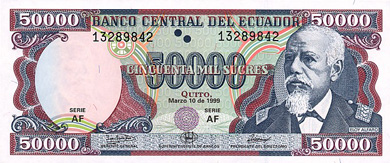
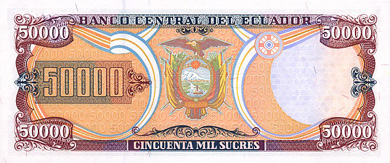
Banknotes
Budget & Public Finance
- Fiscal Year
- calendar year
- Annual Budget
- $8,153,000,000 (USD)
- Public Debt (% of GDP)
- 44.9%
- External Debt
- $18,290,000,000 (USD)
- Investment (% of GDP)
- 22%
- Economic Aid
- $120,000,000 (USD)
- Current Account Balance
- $58,000,000 (USD)
- Reserves of Foreign Exchange
- $2,147,000,000 (USD)
Labor, Industry & Trade
- Labor Force by Occupation
- agriculture 30%; industry 25%; services 45%
- Household Income — highest 10%
- 32%
- Industries
- petroleum, food processing, textiles, wood products, chemicals
- Agriculture Products
- bananas, coffee, cocoa, rice, potatoes, manioc (tapioca), plantains, sugarcane; cattle, sheep, pigs, beef, pork, dairy products; balsa wood; fish, shrimp
- Export Commodities
- petroleum, bananas, cut flowers, shrimp
- Export Partners
- US 40.3%, Colombia 5.8%, Germany 5.4%, South Korea 5.3%, Italy 4.6%
- Import Commodities
- consumer goods, industrial raw materials, capital goods
- Import Partners
- US 26.8%, Colombia 13.6%, Brazil 6.5%, Venezuela 5.7%, Japan 5.7%, Chile 4.2%
Energy
- Oil Production
- 493,200 bbl/day
- Oil Consumption
- 155,000 bbl/day
- Oil Reserves
- 4,512,000,000 bbl/day
- Natural Gas Production
- 50,000,000 cu m
- Natural Gas Consumption
- 50,000,000 cu m
- Natural Gas Imports
- 0 cu m
- Natural Gas Exports
- 0 cu m
- Natural Gas Reserves
- 9,769,000,000 cu m
Communications
- Telephone System
- general assessment: elementary fixed-line service, but increasingly sophisticated mobile-cellular network domestic: fixed-line services provided by multiple telecommunications operators; fixed-line teledensity stands at about 15 per 100 persons; mobile-cellular use has surged and subscribership has reached 100 per 100 persons international: country code - 593; landing points for the PAN-AM and South America-1 submarine cables that provide links to the west coast of South America, Panama, Colombia, Venezuela, and extending onward to Aruba and the US Virgin Islands in the Caribbean; satellite earth station - 1 Intelsat (Atlantic Ocean)
- Internet Country Code
- .ec
News & Weather
News & Weather
Current Weather
Latest News
US/Ecuador: Abuses Proliferate as Security Cooperation Deepens - Human Rights Watch
Human Rights Watch · 3h ago
A Dangerous Partnership: Abuses, Unanswered Questions, and US-Ecuador Security Cooperation | HRW - Human Rights Watch
Human Rights Watch · 3h ago
Applications open for Emergency Health and Nutrition Response (Ecuador) - fundsforNGOs
fundsforNGOs · 1d ago
Protesters Rally Outside Ecuador’s CNE to Reject Suspension of Amigo Movement - teleSUR English
teleSUR English · 2h ago
8 bodies found in plastic bags with note left at scene in narco-trafficking hotspot in Ecuador - CBS News
CBS News · 48d ago
The Amazon's 'lost city' has been widely misunderstood. This is its true story - BBC
BBC · 51d ago
Ecuador World Cup 2026 team guide - The Guardian
The Guardian · 49d ago
World Cup dark horses: Ecuador, Mexico, Japan, Norway and Senegal - The Athletic - The New York Times
The New York Times · 25d ago
News via Google News
Climate Overview
Because of variations in altitude, Ecuador has a variety of climates. The lowlands are generally hot and humid. Temperatures on the coast are moderated by the Humboldt Current to a range of 65°F to 90°F. Temperatures in the Sierra are generally cool, ranging from 35°F to 75°F. Due to the altitude and thin air, temperature in direct sunlight can reach 85°F at midday. In the evenings it can range from pleasantly cool to very chilly. The tallest mountains are always snowcapped, but it never snows in the inhabited altitudes, although it hails occasionally. During the Sierra dry season, from June through September, gusty winds are common.
In Quito the temperature pattern rarely changes from day to day or month to month. Mornings are cool and crisp, and midday is agreeably warm, unless skies are overcast. Fog and mist may occur in the mornings or evenings as low-lying clouds spill over the sides of the valley. Since Quito is such a short distance from the Equator, sunrise and sunset vary only slightly from 6 a.m. and 6 p.m. Average annual rainfall in Quito is 50 inches, with 43 inches falling from October through May, and 7 inches from June through September. Relative humidity averages 75%. Occasional tremors are registered in the area; these may or may not be perceptible to residents. Earthquakes and volcanic eruptions are infrequent but do remain a possibility.
Videos
Videos
1 curated YouTube videos.
Source: YouTube
Frequently Asked Questions
Frequently Asked Questions
What is the population of Ecuador?
How do people greet each other in Ecuador?
What are meals and food like in Ecuador?
What should I know about visiting and hospitality?
How do people dress in Ecuador?
What gestures should I be aware of in Ecuador?
What is family life like in Ecuador?
What do people do for fun in Ecuador?
What is the capital of Ecuador?
Where is Ecuador located?
What countries border Ecuador?
What is the primary religion in Ecuador?
What currency is used in Ecuador?
What language is spoken in Ecuador?
What is Ecuador known for?
What is the geography of Ecuador like?
Last reviewed 2026