
 English
 Español
 中文
中文 हिन्दी
 Français
New Caledonia
Nouvelle-Caledonie
Declare Your Relationship to New Caledonia
CountryReports Community
- Studying1
- From New Caledonia0
- New Caledonia heritage0
- Visited0
- Want to visit0
Customs and Culture
Customs and Culture
About the People
New Caledonia is an overseas territory of France. Melanesians are about 40 percent of the population with Europeans are just under 40 percent. Nickel mining has help raise the standard of living in New Caledonia but it has also scared the countryside. Farmers raise their own food and sell small amounts of coffee and copra (dried meat, or kernel, of the coconut) for export.
Cultural Attributes
New Caledonia is an overseas territory of France. Melanesians are about 40 percent of the population with Europeans are just under 40 percent. Nickel mining has help raise the standard of living in New Caledonia but it has also scared the countryside. Farmers raise their own food and sell small amounts of coffee and copra (dried meat, or kernel, of the coconut) for export.

Land of Nickel and Melanesian Roots

Holidays
Bastille Day
7/14Other
Dates of Interest
- July 14th
How do people in New Caledonia make a living?
New Caledonia's economy combines nickel mining with small-scale farming, where farmers raise their own food and sell modest amounts of coffee and copra for export.
Good to know
- Nickel mining has raised the standard of living but has scarred the countryside
- Copra is the dried meat, or kernel, of the coconut
What should travelers know before visiting New Caledonia?
New Caledonia is an overseas territory of France with a population that is about 40 percent Melanesian and just under 40 percent European.
Good to know
- Expect a French overseas territory with strong Melanesian and European populations
Last updated: 2026-07-12 · Sources: CountryReports
Photos of New Caledonia
Photos of New Caledonia

Travel and Tourism
Travel and Tourism
- Travel Alert Status
- Level 1: Exercise Normal Precautions
- Currency
- Comptoirs Francais du Pacifique franc (XPF); note - may adopt the euro in 2003
- Time Difference
- UTC+11 (16 hours ahead of Washington, DC during Standard Time)
- Climate
- tropical; modified by southeast trade winds; hot, humid
- Airports
- 25
Read the full travel guide — health, safety, vaccinations, disease risk, sanitation, and transit details.
View full travel guideHistory
History
Historical Eras
Kanak Settlement
3000 BCE – 1774
Melanesian peoples, ancestors of the Kanak, settled New Caledonia approximately 3,000 years ago, developing complex chieftaincy systems, agricultural terracing, and rich ceremonial traditions. Their society was organized around clans and customary land rights that remain culturally significant today. This era represents millennia of autonomous indigenous civilization prior to any European contact.
Early Contact
1774 – 1853
Captain James Cook became the first European to sight New Caledonia in 1774, naming it for its resemblance to Scotland. The early 19th century brought British and American whalers, followed by Catholic and Protestant missionaries whose arrival profoundly disrupted Kanak culture — suppressing local practices, imposing Western dress, and introducing new customs such as cricket. France and Britain both established a presence during this period.
French Annexation
1853 – 1864
France formally annexed New Caledonia in 1853 under Napoleon III, asserting sovereignty over the main island and its dependencies. The colonial administration displaced Kanak communities from their lands, relocating them onto restricted reserves to make way for European settlers and later economic exploitation. This foundational colonial act set the conditions for a century of indigenous marginalization.
Penal Colony Era
1864 – 1897
For over three decades New Caledonia served as France's primary penal colony in the Pacific, receiving tens of thousands of convicts and political deportees, including Communards exiled after the 1871 Paris Commune. The convict labor economy shaped early European settlement patterns across the island. The closure of the penal colony in 1897 marked a transition toward a settler-colonial and resource-extraction economy centered on nickel mining.
Overseas Territory
1897 – 1985
New Caledonia was formally designated a French Overseas Territory in 1946, granting its population French citizenship. The postwar decades saw rapid expansion of the nickel industry, a large influx of metropolitan French and other immigrant populations, and the continued political and economic marginalization of the Kanak majority. Kanak political consciousness grew steadily through the 1970s, laying the groundwork for open confrontation.
Independence Struggle & Autonomy
1985 – present
The Front de Libération Nationale Kanak Socialiste (FLNKS), led by Jean-Marie Tjibaou, launched an organized independence movement beginning in 1985, demanding the creation of an independent state of Kanaky. Violent unrest culminated in the 1988 Ouvéa hostage crisis, prompting the Matignon Accords (1988) and later the Nouméa Accord (1998), which established a framework for progressive autonomy. New Caledonia remains on the UN decolonization list, with three independence referendums held between 2018 and 2021.
Overview
Timeline of Key Events
1698
New Caledonia was discovered by Captain Cook.
New Caledonia was discovered by Captain Cook.
1840
Arrival of British, American whalers.
Arrival of British, American whalers.
1864 – 1897
New Caledonia served as a penal colony.
New Caledonia served as a penal colony.
1946
New Caledonia proclaimed French Overseas Territory.
New Caledonia proclaimed French Overseas Territory.
Read the full history profile — narrative overview, defining eras, and the complete timeline in one place.
View expanded historyInteresting Facts
Interesting Facts
New Caledonia served as a penal colony for four decades after 1864.
See every fact — trivia, oddities, and curious tidbits gathered from across the country.
View all interesting factsGeography and Environment
Geography and Environment
- Terrain
- coastal plains with interior mountains
- Climate
- tropical; modified by southeast trade winds; hot, humid
- Natural Hazards
- cyclones, most frequent from November to March
- Current Environmental Issues
- erosion caused by mining exploitation and forest fires
Read the full geography and environment profile — terrain, climate, natural resources, hazards, land use, and international agreements.
View full geographyPeople & Demographics
People & Demographics
Religion
Languages Spoken
French (official), 33 Melanesian-Polynesian dialects
- French
- Melanesian-Polynesian
Population
- Population
- 229,993
- Population in Major Urban Areas
- NOUMEA (capital) 157,000
- Nationality Noun
- New Caledonian(s)
- Ethnic Groups
- Melanesian 42.5%, European 37.1%, Wallisian 8.4%, Polynesian 3.8%, Indonesian 3.6%, Vietnamese 1.6%, other 3%
Education
- Literacy Definition
- age 15 and over can read and write
Read the full people and society profile — demographics, health, education, religion, languages, and notable people.
View full people and societyGovernment & Politics
Government & Politics
Country Identity
- Country Name
- NewCaledonia
- Full Country Name
- Territory of New Caledonia and Dependencies
- Local - Long
- Territoire des Nouvelle-Caledonie et Dependances
- Local - Short
- Nouvelle-Caledonie
Government Structure
- Government Type
- NA
- Legal System
- the 1988 Matignon Accords grant substantial autonomy to the islands; formerly under French law
- Executive Branch
- chief of state: President of France Emmanuel MACRON (since 14 May 2017), represented by High Commissioner Louis LE FRANC (since 21 July 2021) head of government: President of the Government Louis MAPOU (since 8 July 2021) cabinet: Consultative Committee consists of members chosen from leading figures on the island to advise the High Commissioner; the Government of New Caledonia is a collegial body of 11 members elected by the Congress elections: French president elected by popular vote for a five-year term; high commissioner appointed by the French president on the advice of the French Ministry of Interior; president of the government elected by the members of the Territorial Congress; Louis MAPOU, leader of the Kanak and Socialist National Liberation Front (FLNKS), was elected president of the government in July 2021, becoming the first indigenous Kanak to hold the position
- Legislative Branch
- unicameral Territorial Congress or Congres Territorial (54 seats; members belong to the three Provincial Assemblies or Assemblees Provinciales elected by popular vote to serve five-year terms) elections: last held 9 May 2004 (next to be held NA 2009) election results: percent of vote by party - NA%; seats by party - RPCR-UMP 16, AE 16, UNI-FLNKS 8, UC 7, FN 4, others 3 note: New Caledonia currently holds 1 seat in the French Senate; between 2004 and 2010 New Caledonia will gain a second seat in the French Senate; elections last held 24 September 2001 (next to be held not later than September 2007); results - percent of vote by party - NA; seats by party - UMP 1; New Caledonia also elects 2 seats to the French National Assembly; elections last held 9 and 16 June 2002 (next to be held by June 2007); results - percent of vote by party - NA; seats by party - UMP 2
- Judicial Branch
- Court of Appeal or Cour d'Appel; County Courts; Joint Commerce Tribunal Court; Children's Court
- Suffrage
- 18 years of age; universal
- Constitution
- 28 September 1958 (French Constitution)
- Independence
- none (overseas territory of France); note - a referendum on independence was held in 1998 but did not pass; a new referendum is scheduled for 2014
- National Holiday
- Bastille Day, 14 July (1789)
Capital City
- Capital Name
- Noumea
- Capital - geographic coordinate
- 22 16 S, 166 27 E
- Capital Time Difference
- UTC+11 (16 hours ahead of Washington, DC during Standard Time)
established in 1854 as Port-de-France, the settlement was renamed Noumea in 1866, in order to avoid any confusion with Fort-de-France in Martinique; the New Caledonian language of Ndrumbea (also spelled Ndumbea, Dubea, and Drubea) spoken in the area gave its name to the capital city, Noumea, as well as to the neighboring town (suburb) of Dumbea
Military
Branches: no regular military forces; French military, police, and gendarmerie
Embassy / Diplomatic Mission
There is no U.S. Embassy or diplomatic post in New Caledonia. The U.S. Embassy in Fiji provides assistance for U.S. citizens in New Caledonia.
U.S. Embassy Suva
158 Princes Road, Suva, Fiji
(679) 331-4466
Emergency after-hours telephone: (679) 772-8049
Facsimile: (679) 330-2267
Read the full government profile — flag symbolism, national anthem, and other national symbols.
View full government detailsEconomy
Economy
New Caledonia holds approximately 20-30% of the world's known nickel resources, making mining the cornerstone of its economy. Only a small portion of the land is suitable for cultivation, and food accounts for roughly 20% of imports. Beyond nickel, substantial financial support from France—equivalent to about 15% of GDP—and tourism remain vital to economic stability. However, the territory has faced significant challenges in recent years, including a global downturn in nickel prices that has pushed several major nickel processing operations into financial distress, prompting emergency intervention from the French government. Civil unrest in 2024, sparked by disputes over voting rights and independence, caused considerable damage to infrastructure and businesses, further straining the economy and tourism sector. The medium-term outlook depends heavily on the restructuring of the nickel industry, restoration of political stability, and continued French financial support.
Snapshot
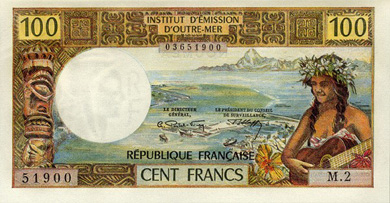
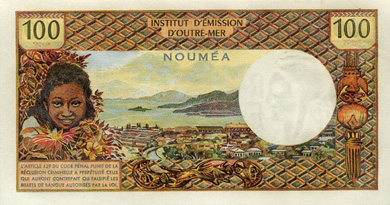
- Currency Name and Code
- CFP Franc (XPF)
Banknotes
Budget & Public Finance
- Fiscal Year
- calendar year
- Annual Budget
- $836,500,000 (USD)
- External Debt
- $79,000,000 (USD)
- Economic Aid
- $880,000,000 (USD)
Labor, Industry & Trade
- Labor Force by Occupation
- agriculture 7%; industry 23%; services 70%
- Industries
- nickel mining and smelting
- Agriculture Products
- vegetables; beef, deer, other livestock products
- Export Commodities
- ferronickels, nickel ore, fish
- Export Partners
- France 22.8%, Japan 21.2%, Spain 8.7%, Australia 7.6%, South Korea 6.3%, Italy 5.6%
- Import Commodities
- machinery and equipment, fuels, chemicals, foodstuffs
- Import Partners
- France 39.6%, Australia 12.8%, Singapore 9.9%, New Zealand 5.1%, US 4.4%
Energy
- Oil Production
- 0 bbl/day
- Oil Consumption
- 10,000 bbl/day
- Oil Reserves
- 0 bbl/day
- Natural Gas Production
- 0 cu m
- Natural Gas Consumption
- 0 cu m
- Natural Gas Imports
- 0 cu m
- Natural Gas Exports
- 0 cu m
- Natural Gas Reserves
- 0 cu m
Communications
- Telephone System
- general assessment: a submarine cable network connection between New Caledonia and Australia, completed in 2007, increased network capacity and improved high-speed connectivity and access to international networks domestic: combined fixed-line and mobile-cellular telephone subscribership exceeds 100 per 100 persons international: country code - 687; satellite earth station - 1 Intelsat (Pacific Ocean)
- Internet Country Code
- .nc
News & Weather
News & Weather
Current Weather
Latest News
New Caledonia loyalists emerge largest bloc after election, lack majority - Reuters
Reuters · 22d ago
The New Caledonia Congress Has a New, Pro-France President. What Now? - The Diplomat – Asia-Pacific
The Diplomat – Asia-Pacific · 6d ago
Surprise alliance hands anti-independence bloc control of New Caledonia Congress - RFI
RFI · 11d ago
New Caledonia’s Election Settles Little - 9DashLine
9DashLine · 3d ago
No outright winner in New Caledonia election - World Socialist Web Site
World Socialist Web Site · 15d ago
Anti-independence bloc leads New Caledonia poll but fall short of majority - Al Jazeera
Al Jazeera · 23d ago
Air quality in New Caledonia - IQAir
IQAir · 25d ago
New Caledonia heads to polls in vote delayed since 2024 - DW.com
DW.com · 23d ago
News via Google News
Climate Overview
tropical; modified by southeast trade winds; hot, humid
Frequently Asked Questions
Frequently Asked Questions
What is the population of New Caledonia?
How do people in New Caledonia make a living?
What should travelers know before visiting New Caledonia?
What is the capital of New Caledonia?
Where is New Caledonia located?
What are the ocean and sea borders of New Caledonia?
What is the predominant religion in New Caledonia?
What currency is used in New Caledonia?
What language is spoken in New Caledonia?
What is New Caledonia known for?
Last reviewed 2026