
 English
 Español
 中文
中文 हिन्दी
 Français
Dominica
Declare Your Relationship to Dominica
CountryReports Community
- Studying1
- From Dominica0
- Dominica heritage0
- Visited0
- Want to visit1
Customs and Culture
Customs and Culture
Cultural Attributes
Dominica's culture is a rich blend of African, Caribbean, and European influences, shaped by centuries of colonial history and the enduring presence of the indigenous Kalinago people. This small island nation in the Eastern Caribbean has cultivated a distinct identity that sets it apart from its neighbors, earning it a reputation as one of the most culturally authentic islands in the region. The Kalinago, also known as the Island Caribs, remain one of the few surviving indigenous populations in the Caribbean. Approximately 3,000 Kalinago people live in a designated territory on the island's northeastern coast, where they maintain traditional practices including basket weaving, canoe building, and the use of medicinal plants. Their territory is recognized by the Dominican government and serves as both a living community and a cultural heritage site that welcomes visitors. The majority of Dominicans are of African descent, a legacy of the transatlantic slave trade. This heritage is deeply expressed through music, food, and oral traditions. Creole, also known as Kwéyòl or Patois, is widely spoken alongside English and reflects the French colonial period that preceded British rule. Though English is the official language, Kwéyòl is used in everyday conversations, music, storytelling, and even some radio broadcasts. Carnival and the World Creole Music Festival are among the island's most celebrated cultural events. The World Creole Music Festival, held annually in October, draws performers and visitors from across the Caribbean, Africa, and North America, showcasing zouk, kompa, bouyon, and other Creole-influenced genres. Bouyon, a fast-paced fusion genre originating in Dominica, is considered the island's signature sound. Roman Catholicism is the dominant religion, practiced by roughly 60 percent of the population, though various Protestant denominations and a small Rastafari community also have a presence on the island. Religious festivals, particularly those tied to patron saints, remain important community gatherings. Dominican cuisine reflects this cultural layering, with dishes such as callaloo soup, saltfish, and mountain chicken — the local name for the giant ditch frog — occupying a central place in the national diet.

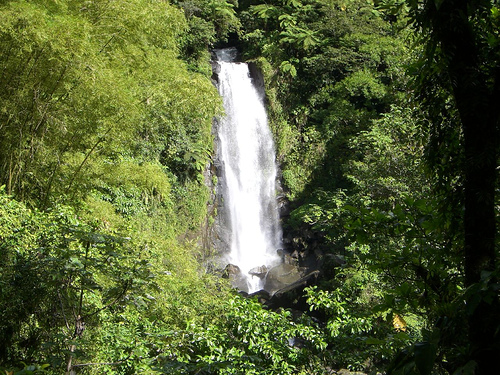
Nature's Island, Carib's Stronghold
Greetings, Gestures & Visiting
A common greeting is Cakafete which means how are you? Most people speak a French Dialect called Kwéyòl. Common Kwéyòl greetings include Sa ou fe (How are you?) Bon jou (Good Morning), Bon jou, Misyé (Good day, sir) or Byenvini (Welcome). Close friends, especially girls, stand close to one another and often walk with arms around each other's shoulders or waists.
Dominicans are reserved and place a high value on good manners.
Dominicans wear Western style clothing. On holidays women might wear a traditional costume. A bright colored jupe (skirt with lace petticotes), la wobe douilette (a wide blouse) and a madras hate called tete case.
Diet
Basic staples include fish, yams, cassava bread and other vegetables. ti-ti-ri is a white fish found in the rivers that is eaten fried with garlic and lime. Crapaud is a frog that the legs are eaten like chicken. Boija a coconut cornmeal bread, funchi a cornmeal, okra pudding and pumpkin soup are regional favorites. A popular drink is a sea-moss drink made from vanilla, algae and milk.

Family
Dominicans have formal marriages, common-law relationships (men and women living together) and visiting unions (man and women live apart). Women are the head of the household in common-law relationships and visiting unions.
Recreation
The most popular sports are cricket and football (soccer). Other sports include volleyball and squash. Men enjoy playing dominoes.
Holidays
Independence Day
11/3Independence Day
Dates of Interest
- November 3rd
How do people greet each other in Dominica?
A common greeting is Cakafete, meaning "how are you?", and most people speak a French dialect called Kwéyòl.
Do
- Try Kwéyòl greetings like "Bon jou" (Good Morning) or "Byenvini" (Welcome)
- Use "Sa ou fe" to ask how are you
- Say "Bon jou, Misyé" (Good day, sir)
Good to know
- Close friends, especially girls, stand close and often walk arm-in-arm around the shoulders or waist
What is the food like in Dominica?
Basic staples include fish, yams, cassava bread, and other vegetables, with many regional specialties.
Good to know
- Try ti-ti-ri, a white river fish eaten fried with garlic and lime
- Crapaud is a frog whose legs are eaten like chicken
- Regional favorites include boija (coconut cornmeal bread), funchi (cornmeal and okra pudding), and pumpkin soup
- A popular drink is a sea-moss drink made from vanilla, algae, and milk
What should I know about manners in Dominica?
Dominicans are reserved and place a high value on good manners.
Do
- Be polite and mind your manners
What should I wear in Dominica?
Dominicans wear Western-style clothing, with traditional costumes worn by women on holidays.
Good to know
- On holidays women might wear a bright jupe (skirt with lace petticoats), la wobe douilette (a wide blouse), and a madras hat called tet e case
What are families like in Dominica?
Dominicans have formal marriages, common-law relationships (couples living together), and visiting unions (partners living apart).
Good to know
- Women are the head of the household in common-law relationships and visiting unions
What do people do for fun in Dominica?
The most popular sports are cricket and football (soccer), along with volleyball and squash.
Good to know
- Men enjoy playing dominoes
Last updated: 2026-07-12 · Sources: CountryReports
Photos of Dominica
Photos of Dominica


Travel and Tourism
Travel and Tourism
- Travel Alert Status
- Level 1: Exercise Normal Precautions
- Currency
- 2.7
- Time Difference
- UTC-4 (1 hour ahead of Washington, DC, during Standard Time)
- Climate
- Tropical; moderated by northeast trade winds; heavy rainfall
- Airports
- 2
Read the full travel guide — health, safety, vaccinations, disease risk, sanitation, and transit details.
View full travel guideRecipes
Recipes
History
History
Historical Eras
Kalinago Dominance
1200 – 1635
Kalinago (Island Carib) people established dominance over Dominica after displacing earlier Arawak inhabitants around the 14th century. Columbus sighted the island in 1493, and though Spanish ships called periodically throughout the 16th century, fierce Kalinago resistance effectively prevented any European settlement for over a century, making Dominica the last Caribbean island to be colonized.
Colonial Rivalry
1635 – 1763
France claimed Dominica in 1635, and French missionaries became the island's first permanent European inhabitants, though Kalinago pressure remained intense. In 1660, Britain and France mutually agreed to abandon the island, yet both powers continued extracting timber. Dominica's position between the French islands of Martinique and Guadeloupe ultimately gave France the upper hand, and a French settler community took root before the mid-18th century.
British Colonial Rule
1763 – 1896
The 1763 Treaty of Paris transferred Dominica to Britain, which established a legislative assembly representing only the white population. A brief French occupation during the American Revolutionary War was reversed by the 1783 Treaty of Paris. The 1831 Brown Privilege Bill extended rights to free non-whites, and after emancipation in 1834, Dominica briefly became the only British Caribbean colony with a Black-controlled legislature, though planter-class pressure steadily eroded that democratic experiment.
Crown Colony Era
1896 – 1967
Britain re-established Crown Colony government in 1896, effectively disenfranchising the majority Black population. Post–World War I political consciousness spurred the Representative Government Association, which gained legislative seats through the 1920s and 1930s. Universal adult suffrage was introduced in 1951, and after the short-lived West Indies Federation dissolved, Dominica became an associated state of the United Kingdom in 1967, assuming control of its internal affairs.
Independence & Stabilization
1967 – 1995
Full independence as the Commonwealth of Dominica was granted on November 3, 1978, though economic underdevelopment and devastating hurricanes in 1979 and 1980 immediately tested the new nation. Political turmoil led to an interim government before the 1980 elections brought Eugenia Charles and the Dominica Freedom Party to power; Charles served 15 years as the Caribbean's first female prime minister and became the defining figure of Dominica's early independent era.
Modern Dominica
1995 – present
Dominica has navigated recurring economic challenges tied to the decline of its banana industry, most dramatically illustrated when Hurricane Dean destroyed 99 percent of the banana crop in 2007. The government has pursued economic diversification through ecotourism and a citizenship-by-investment program, while also grappling with the severe destruction wrought by Hurricane Maria in 2017. The island's roughly 3,000 Kalinago remain the sole surviving pre-Columbian community in the eastern Caribbean.
Overview
In 1635, France claimed Dominica. Shortly thereafter, French missionaries became the first European inhabitants of the island. Carib incursions continued, though, and in 1660, the French and British agreed that both Dominica and St. Vincent should be abandoned. Dominica was officially neutral for the next century, but the attraction of its resources remained; rival expeditions of British and French foresters were harvesting timber by the start of the 18th century.
Largely due to Dominica’s position between Martinique and Guadeloupe, France eventually became predominant, and a French settlement was established and grew. As part of the 1763 Treaty of Paris that ended the Seven Years’ War, the island became a British possession. In 1778, during the American Revolutionary War, the French mounted a successful invasion with the active cooperation of the population, which was largely French. The 1783 Treaty of Paris, which ended the war, returned the island to Britain. French invasions in 1795 and 1805 ended in failure.
In 1763, the British established a legislative assembly, representing only the white population. In 1831, reflecting a liberalization of official British racial attitudes, the Brown Privilege Bill conferred political and social rights on free nonwhites. Three Blacks were elected to the legislative assembly the following year. Following the abolition of slavery, in 1838 Dominica became the first and only British Caribbean colony to have a Black-controlled legislature in the 19th century. Most Black legislators were smallholders or merchants who held economic and social views diametrically opposed to the interests of the small, wealthy English planter class. Reacting to a perceived threat, the planters lobbied for more direct British rule.
In 1865, after much agitation and tension, the colonial office replaced the elective assembly with one comprised of one-half elected members and one-half appointed. Planters allied with colonial administrators outmaneuvered the elected legislators on numerous occasions. In 1871, Dominica became part of the Leeward Island Federation. The power of the Black population progressively eroded. Crown Colony government was re-established in 1896. All political rights for the vast majority of the population were effectively curtailed. Development aid, offered as compensation for disenfranchisement, proved to have a negligible effect.
Following World War I, an upsurge of political consciousness throughout the Caribbean led to the formation of the Representative Government Association. Marshaling public frustration with the lack of a voice in the governing of Dominica, this group won one-third of the popularly elected seats of the legislative assembly in 1924 and one-half in 1936. Shortly thereafter, Dominica was transferred from the Leeward Island Administration and was governed as part of the Windwards until 1958, when it joined the short-lived West Indies Federation.
After the federation dissolved, Dominica became an associated state of the United Kingdom in 1967 and formally took responsibility for its internal affairs. On November 3, 1978, the Commonwealth of Dominica was granted independence by the United Kingdom.
Independence did little to solve problems stemming from centuries of economic underdevelopment, and in mid-1979, political discontent led to the formation of an interim government. It was replaced after the 1980 elections by a government led by the Dominica Freedom Party under Prime Minister Eugenia Charles, the Caribbean’s first female prime minister. Chronic economic problems were compounded by the severe impact of hurricanes in 1979 and in 1980. By the end of the 1980s, the economy had made a healthy recovery, which weakened in the 1990s due to a decrease in banana prices.
In January 2000 elections, the Edison James United Workers Party (UWP) was defeated by the Dominican Labor Party (DLP), led by Roosevelt P. "Rosie" Douglas. Douglas died after only a few months in office and was replaced by Pierre Charles, who died in office in January 2004. Roosevelt Skerrit, also of the DLP, replaced Charles as Prime Minister.
Timeline of Key Events
1493
Christopher Columbus visits the island and names it Dominica (Sunday Island).
Christopher Columbus visits the island and names it Dominica (Sunday Island).
1635
France claims Dominica.
France claims Dominica, paving the way for French missionaries to colonise the island. However, resistance by the indigenous Carib Indians continues.
1660
Britain and France agree to abandon Dominica and St Vincent.
Britain and France agree to abandon Dominica and St Vincent.
1763
Britain gains possession of Dominica in accordance with the Treaty of Paris.
Britain gains possession of Dominica in accordance with the Treaty of Paris, which ended the Seven Years’ War. However, France continues to challenge this until 1805.
1834
Slavery abolished.
Slavery abolished.
1896
Britain re-establishes crown colony government over Dominica.
Britain re-establishes crown colony government over Dominica.
1951
Britain declares universal adult suffrage established in Dominica.
Britain declares universal adult suffrage established in Dominica.
Read the full history profile — narrative overview, defining eras, and the complete timeline in one place.
View expanded historyInteresting Facts
Interesting Facts
Christopher Columbus visited the island in 1493. As he landed on a Sunday, he called the island Dominica (Sunday Island).
Dominica gained its independence in 1978.
Two years after independence Mary Eugenia Charles became the first female Prime Minister in the Caribbean.
See every fact — trivia, oddities, and curious tidbits gathered from across the country.
View all interesting factsGeography and Environment
Geography and Environment
- Terrain
- rugged mountains of volcanic origin
- Climate
- tropical; moderated by northeast trade winds; heavy rainfall
- Natural Hazards
- flash floods are a constant threat; destructive hurricanes can be expected during the late summer months
- Current Environmental Issues
- NA
Read the full geography and environment profile — terrain, climate, natural resources, hazards, land use, and international agreements.
View full geographyPeople & Demographics
People & Demographics
Religion
Languages Spoken
English (official), French patois
- English
- French
- Kwéyòl
Population
- Population
- 72,813
- Population in Major Urban Areas
- ROSEAU (capital) 14,000
- Nationality Noun
- Dominican(s)
- Ethnic Groups
- Black, mixed black and European, European, Syrian, Carib Amerindian
Education
- Literacy Definition
- Age 15 and over has ever attended school
Read the full people and society profile — demographics, health, education, religion, languages, and notable people.
View full people and societyGovernment & Politics
Government & Politics
Country Identity
- Country Name
- Dominica
- Full Country Name
- Commonwealth of Dominica
Government Structure
- Government Type
- parliamentary democracy; republic within the Commonwealth
- Legal System
- based on English common law
- Executive Branch
- chief of state: President Sylvanie BURTON (since 2 October 2023) head of government: Prime Minister Roosevelt SKERRIT (since 8 January 2004); note - originally assumed post following the death of Prime Minister Pierre CHARLES cabinet: Cabinet appointed by the president on the advice of the prime minister elections: president elected by the House of Assembly for a five-year term; election last held 2 October 2023 (next to be held in 2028); prime minister appointed by the president election results: Sylvanie BURTON elected president; she became the first woman to hold the office in Dominica's history
- Legislative Branch
- unicameral House of Assembly (30 seats, 9 appointed senators, 21 elected by popular vote; members serve five-year terms) elections: last held 5 May 2005 (next to be held by 5 August 2010); note - tradition dictates that the election will be held within five years of the last election, but technically it is five years from the first seating of parliament (12 May 2005) plus a 90-day grace period election results: percent of vote by party - DLP 52.08%, UWP 43.6%, DFP 3.15%; seats by party - DLP 12, UWP 8, independent 1
- Judicial Branch
- Eastern Caribbean Supreme Court, consisting of the Court of Appeal and the High Court (located in Saint Lucia; one of the six judges must reside in Dominica and preside over the Court of Summary Jurisdiction)
- Suffrage
- 18 years of age; universal
- Constitution
- 3-Nov-78
- Independence
- 3 November 1978 (from UK)
- National Holiday
- Independence Day, 3 November (1978)
Capital City
- Capital Name
- Roseau
- Capital - geographic coordinate
- 15 18 N, 61 24 W
- Capital Time Difference
- UTC-4 (1 hour ahead of Washington, DC, during Standard Time)
The name is French for "reed"; the first settlement was named after the river reeds that grew in the area
Military
Branches: No regular military forces; Commonwealth of Dominica Police Force (includes Coast Guard)
Embassy / Diplomatic Mission
U.S. Embassy in Bridgetown
Wildey Business park
Wildey
St. Michael, Barbados
Telephone: (246) 227-4399
Emergency after-hours telephone: (246) 227-4000
Facsimile: (246) 431-0179
Email: BridgetownACS@state.gov
Hours of operation are 8:30 a.m. – 4:30 p.m. Monday through Friday, except Barbadian and U.S. holidays.
Read the full government profile — flag symbolism, national anthem, and other national symbols.
View full government detailsEconomy
Economy
Dominica's economy depends heavily on agriculture, tourism, and to a lesser extent, offshore financial services and citizenship-by-investment programs. Agriculture, once dominated by banana production, has diversified to include other crops such as coffee, cocoa, citrus fruits, and root vegetables, though the sector remains highly vulnerable to hurricanes, tropical storms, and shifting global commodity markets. The devastating impact of Hurricane Maria in 2017, which caused damages estimated at over 200% of GDP, underscored the country's exposure to climate-related shocks and prompted an ambitious national goal to become the world's first climate-resilient nation.
Tourism has grown substantially as the government continues to promote Dominica as the "Nature Island" and an ecotourism destination, capitalizing on its rainforests, hot springs, hiking trails, and dive sites. However, development is still constrained by the rugged coastline, limited sandy beaches, and the absence of an international airport, though construction of a new international airport at Wesley began in 2023 and is expected to transform connectivity once completed.
The Citizenship by Investment Program has become a significant source of government revenue, helping to finance reconstruction, social programs, and infrastructure projects including geothermal energy development. Dominica is investing heavily in renewable energy, particularly geothermal power from its volcanic resources, aiming to reduce dependence on imported fossil fuels and potentially export electricity to neighboring islands.
The economy returned to growth following the pandemic, with GDP expanding by approximately 4.7% in 2023, supported by tourism recovery and construction activity. Public debt remains elevated, and the government continues to work toward fiscal consolidation while balancing climate resilience investments and social spending priorities.
Snapshot
- Currency Name and Code
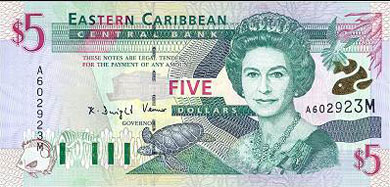
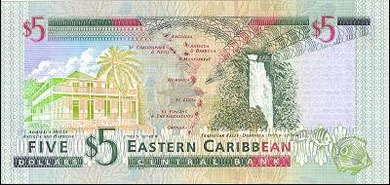
- East Caribbean dollars (XCD)
- GDP Real Growth Rate
- -1%
Banknotes
Budget & Public Finance
- Fiscal Year
- 1 July - 30 June
- Annual Budget
- $84,400,000 (USD)
- External Debt
- $161,500,000 (USD)
- Economic Aid
- $22,800,000 (USD)
Labor, Industry & Trade
- Labor Force by Occupation
- agriculture 40%; industry and commerce 32%; services 28%
- Industries
- soap, coconut oil, tourism, copra, furniture, cement blocks, shoes
- Agriculture Products
- bananas, citrus, mangoes, root crops, coconuts, cocoa; forest and fishery potential not exploited
- Export Commodities
- bananas, soap, bay oil, vegetables, grapefruit, oranges
- Export Partners
- UK 36.1%, Jamaica 16.4%, US 8.2%, Antigua and Barbuda 6.6%, Guyana 4.9%, Trinidad and Tobago 4.9%
- Import Commodities
- manufactured goods, machinery and equipment, food, chemicals
- Import Partners
- China 23.8%, US 23.8%, Trinidad and Tobago 11.9%, South Korea 7.6%, UK 7.1%, Japan 4.3%
Energy
- Oil Production
- 0 bbl/day
- Oil Consumption
- 800 bbl/day
- Oil Reserves
- 0 bbl/day
- Natural Gas Production
- 0 cu m
- Natural Gas Consumption
- 0 cu m
- Natural Gas Imports
- 0 cu m
- Natural Gas Exports
- 0 cu m
- Natural Gas Reserves
- 0 cu m
Communications
- Telephone System
- General Assessment: Fully automatic network Domestic: Fixed-line connections continued to decline slowly with the two active operators providing about 20 fixed-line connections per 100 persons; subscribership among the three mobile-cellular providers continued to increase with teledensity reaching 150 per 100 persons International: Country code - 1-767; landing points for the East Caribbean Fiber Optic System (ECFS) and the Global Caribbean Network (GCN) submarine cables providing connectivity to other islands in the eastern Caribbean extending from the British Virgin Islands to Trinidad; microwave radio relay and SHF radiotelephone links to Martinique and Guadeloupe; VHF and UHF radiotelephone links to Saint Lucia
- Internet Country Code
- .dm
News & Weather
News & Weather
Current Weather
Latest News
In Dominica, Raedian Felix Is Showing What's Possible - Special Olympics
Special Olympics · 1d ago
Students discover a different world in Dominica - SUNY Cortland
SUNY Cortland · 4d ago
Wang Yi Meets with Foreign Minister of Dominica Vince Henderson - mfa.gov.cn
mfa.gov.cn · 2d ago
How Dominica Captured My Heart: A Caribbean Adventure - Travel + Leisure
Travel + Leisure · 38d ago
Preview: Skrawl #3 - The SkrawlLordz Return with a New Anthology Featuring Contributions from Broken Frontier 'Six to Watch' Creators Olivia Sullivan and Dominica Claribelle - Broken Frontier
Broken Frontier · 12h ago
China's top diplomat meets foreign minister of Dominica - news.cgtn.com
news.cgtn.com · 2d ago
Dominica Sperm Whale Health Initiative - Florida Atlantic University
Florida Atlantic University · 137d ago
Turks and Caicos vs Dominica - Group Phase - FIBA AmeriCup 2029 Caribbean Pre-Qualifiers - FIBA Basketball
FIBA Basketball · 16d ago
News via Google News
Climate Overview
Tropical; moderated by northeast trade winds; heavy rainfall
Videos
Videos
1 curated YouTube videos.
Source: YouTube
Frequently Asked Questions
Frequently Asked Questions
What is the population of Dominica?
How do people greet each other in Dominica?
What is the food like in Dominica?
What should I know about manners in Dominica?
What should I wear in Dominica?
What are families like in Dominica?
What do people do for fun in Dominica?
What is the capital of Dominica?
Where is Dominica located?
What are Dominica's ocean and sea borders?
What is the predominant religion in Dominica?
What currency is used in Dominica?
What language is spoken in Dominica?
What is Dominica's geography and terrain like?
What is Dominica known for?
Last reviewed 2026