
 English
 Español
 中文
中文 हिन्दी
 Français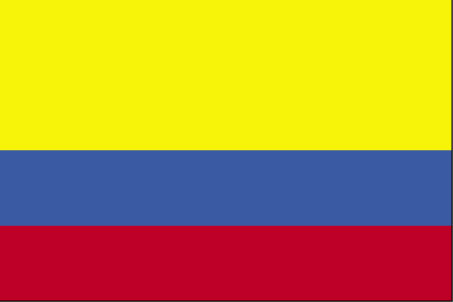
Colombia
Colombia
Declare Your Relationship to Colombia
CountryReports Community
- Studying3
- From Colombia4
- Colombia heritage4
- Visited2
- Want to visit2
Customs and Culture
Customs and Culture
About the People
Colombia's various regions and climate add to its culture by influencing the food, music and dance. Colombians are also known for their "rumbero" spirit, which is the ability to work hard and play hard. Colombians are forward-looking and confident of the future.
Cultural Attributes
Colombia's various regions and climates influence its culture through food, music, and dance. Colombians are also known for their "rumbero" spirit, which is the ability to work hard and play hard. They are forward-looking and confident of the future.

The World's Finest Coffee, The Warmest Hearts
Greetings, Gestures & Visiting
When entering or leaving a meeting or a home, men shake hands. An "abrazo" is reserved for close friends or relatives. Women kiss each other on the cheek if friends or it not a verbal greeting or handshake is used. Kissing on the cheek is usual among young people. Formal titles such as Senor or Senora are customary.
Colombians will use their hands expressively during the conversation, especially if it becomes heated. It is considered rude to back away or interrupt during a discussion. Eye contact and standing close are important while conversing. People may beckon each other with their palms down, the waving of fingers, or the entire hand. Smiling is important to indicate goodwill between parties. Colombian men open doors, and offer seats to women and older people.
People often sit on their verandas and chat with people who pass by. Friends and relatives visit without notice, especially in rural areas. However, one should make arrangements if they do not know who they are visiting. Colombian hosts are generous, offering refreshments such as coffee, fruit juice, or a soft drink. Dinner guests usually arrive up to thirty minutes late. Alcoholic beverages such as rum or beer are offered before and after dinner. Etiquette is valued. Visitors wait until they are guided to a chair by the host.
Colombian dress is both conservative and fashionable. In larger cities, men wear suits and ties. Women wear comfortable dresses, while youth in the cities dress casually.
Diet
Breakfast foods vary from region to region. They include juice, coffee, hot chocolate, fruit eggs, bread or changua (potato and egg soup). A mid-morning snack, merienda, may include empanadas concarne (meat turnovers) or bread and a drink. Lunch is the main meal for the day. Many businesses close so the family may gather for lunch. Supper is usually not till 7 or 8 PM. Staple foods include soup, rice, meat, potatoes, salad and beans. Favorite national dishes include arroz con pollo, (chicken with rice), frijoles con chicharron (pork and beans). A cornmeal pancake is called Arepa.
If one is offered more food, it is polite to refuse if it may be considered overindulging. It is considered polite to keep hands above the table. One should offer food to others before taking it for ones self.
Lunch is the main meal for the day. Many businesses close so the family may gather for lunch. Dinner is usually not served until 7 PM or 8 PM. Typical foods include rice, soup, meat , salad, potatoes and beans. Favorite national dishes include arroz con pollo, (chicken with rice), frijoles con chicharron (pork and beans). A cornmeal pancake is called Arepa.

Family
Family unity and support are highly valued in Colombia. Family members share their good fortune with other members of the family. Divorce is relatively uncommon, mainly due to the influence of the Catholic Church. The family unit usually consists of a mother, a father, and two to four children. Children traditionally live with their parents till they marry. Families support each other through their life spans. Urbanization is changing roles within the extended family. One-third of the workforce is now female.
Dating Customs
Dating begins around 14 or 15, depending on family customs and region. Going to movies, restaurants, and discos are popular activities. Sports and shopping at the mall are also attractive for youth. On the night before the wedding, the groom may hire a small band to serenade the bride. Marriage ceremonies generally follow Catholic traditions, with mass included. The reception will always involve music and dancing.
Recreation
Soccer is the most popular sport in Colombia. Many Colombian children play the game. Watching professional soccer is also a national pastime. Colombians are very passionate about their national team.
Bullfighting is also popular throughout Colombia, and most big cities have plaza de toros (bullrings). Horse, car, and bicycle racing are other spectator sports that draw thousands of fans.
A traditional form of entertainment for Colombians is tejo, a game that may have been played by the Chibchas in ancient times. The object is to throw a small metal disc at a gunpowder detonator lodged in a metal ring. Explosions and the number of discs in the ring determine the winners. A similar game is sapo, in which players must throw a small disc into a receptacle shaped like a metal frog.
Colombians love to dance. One of the most popular dances is called the bambuco. It has a complex series of steps with different names. Every year, there is a festival of bambuco dancing in Neiva. On the Caribbean coast, people dance to salsa and its variants, as well as the cumbia and the vallenato. On the Pacific coast, energetic dances called the berejú and patacoré are popular, danced to music that includes strong drumbeats. In the region of Los Llanos, the favorite dance is called the joropo.
Student Life
Children must leave early for school in Colombia, so getting ready in the morning is usually simple and fast. Breakfast may consist of fresh fruit or bread and a drink of fresh fruit juice. Unfortunately, because many Colombians, especially those in rural areas, are comparatively poor, many children arrive at school undernourished. As a result, more schools offer breakfast programs for their students, especially those with a proven economic need.
Depending on the local circumstances, kids usually walk or ride a public bus to school. They will catch their bus between 6:00 and 6:30 and arrive at school around 7:00. The roads in Colombia are often windy and mountainous, even within the cities. Students return home the same way they came. Schools will provide one meal daily or light snacks throughout the day. In either case, the food provides about one-third of the recommended daily nutrition. However, for poorer families, this school-provided food may be their primary source of nutrition each day.
Local governments run primary schools, whereas the national government supports secondary schools and universities. The Colombian government spends at least 10% of its budget on education by law. Colombia has one of the highest education expenditure rates in Latin America. Rural elementary schools tend to have one room and one teacher. Nearly 70% of those teachers had not received formal training to become teachers, and over half did not register as teachers. In rural schools, the teachers tended to focus on practical subjects to teach the children how to succeed as much as possible within the realities of their lives. Most schools have simple uniforms that children wear: dark skirts for girls, dark pants, and light shirts for boys.
Schools do not buy textbooks for their students; rather, parents buy them from local businesses, and after school, teachers or administrators tell them what books will be used. When a school chooses a textbook, it usually uses it in its classes for about three years. Although secondary schools have traditionally offered mostly academic subjects, the Ministry of Education is trying to move more towards a practical or vocational approach. Very few students will graduate and then go on to university studies, instead joining the workforce because they must help support their families. If the subjects studied in secondary schools are more focused on preparing students for jobs instead of academic studies, they seem to better help the students with the realities of their lives. Classes in Colombia are generally taught in Spanish. However, in small villages or rural areas where another language is spoken more frequently, the law requires that the schools teach in both the local language and Spanish. The second-most frequently studied language is English. In general, only the wealthier private schools teach other languages, such as French or German. Secondary schools are rare in rural areas. To address that problem, the government offers educational radio and television broadcasts. Where secondary schools are available, the courses now include practical training and agricultural education, so students are more prepared to get a good job upon completing high school.
Extracurricular activities in Colombian schools depends largely on the amount of money the school has. Some high schools have marching bands, Boy Scout troops, intramural and extramural sports teams, and student-run radio broadcast facilities. However, many other schools are unable to offer such activities.
Colombians love futbol (soccer), which is easily their favorite sport. However, they are also fond of basketball, volleyball, golf, tennis, and swimming. Coastal or river areas enjoy boating and fishing. Those in cattle-ranching areas participate in rodeos. And because of Colombia’s mountainous roads, some of the best-trained cyclists come from this country. Colombians are friendly and love to party. They mix play with their school and with their work. They are creative and social with one another. Unfortunately, so many families are poor that many children must work after school or drop out of school altogether in order to help support the family.
Colombian family life is influenced by three major things: the Catholic religion, the geographic layout of the land, and the economy. All three influences help families stay close together, including extended families. Catholic rituals, such as marriages or other events, often bring family members from miles around to visit together. Because of Colombia's mountainous nature, many small villages tend to keep families and friends close together rather than spread out in large cities. The relatively poor economy of much of the country means that children must work with their families to help the family survive. All of these add up to close family relationships. Thus, much of the evening is spent at home with family, either working, celebrating, or just plain socializing. Sports and other social activities are frequent with friends, and folk art and dancing are important parts of the native culture for Colombian children and their families. Evening meals are often traditional and comprise great varieties of fruits and vegetables. The conventional national stew can have as many as 20 types of vegetables in it. Along the coast, fish is a standard part of the diet and can be fried, grilled, or placed in a soup. Rice and red beans are famous in some parts of the country, as can be beef in the ranching areas of the country. Rice and some variety of potatoes are usually involved in nearly every meal. In short, much of the food is local, homegrown, and prepared according to various local Spanish, Amerindian, and African traditions.
Private organizations operate preschool and can start as early as four years old. Almost 92% are Catholic and are located in larger cities. Elementary school is free to all students, and children are required to attend school for nine years (five in elementary school, ages 6-10, and four more in secondary school, ages 11-14). For many, as we will see, only the first five years is likely. Most of the schools are operated by the Roman Catholic church, so courses in that religion are required study in all public schools. Protestant churches also run a number of schools, especially in Bogota. Elementary schools are maintained by local governments where possible. If there is not enough money locally to support the school, the national government will step in to provide needed financial support. The national government also supports secondary schools and universities. An increasing number of nonprofit and private organizations are working to improve education in Colombia as well. Keeping children in school can be challenging. Experts disagree on exact figures, but all agree that recent improvements have been helpful in improving education. In 1999, one study reported that 5.1 million students attended elementary school (88% attendance), and 3.5 million attended secondary schools (54% of the possible total number of students). Almost all secondary schools are in the larger cities, leaving children in rural areas with little chance to attend school after the age of 12. Nearly 650,000 students attended universities. Illiteracy had fallen to 3%. Another study for the same year, however, reported that more than 3.5 million children did not attend school (no age range was given), and 8% of the population over the age of 15 could not read. In 2003, 93% of the adult population was considered literate in the cities, but only 67% in rural areas. Furthermore, when children go to school, too many are undernourished and hungry, which makes learning very difficult. Schools that have been able to provide breakfast programs are seeing tremendous improvement in their students’ abilities. These breakfasts often provide up to 75% of the children’s daily nutrition and consist of foods like oatmeal, milk, fruit, eggs, and toast. Two basic school schedules are available for schools to choose from: the first begins in February with a four-week vacation in June and July and finishes in November; the second begins in September with a four-week vacation in December and finishes in June. Both schedules have 198 days of classroom instruction. The school day is usually six hours long, divided into two sessions. Each session has three 45-minute classes and a 45-minute break. Subjects include Spanish, arithmetic, social studies, aesthetic and manual training (such as art), natural science, physical education, and religious and moral training. The school system requires that children receive training in Roman Catholicism, and the remaining courses are not allowed to include teachings that contradict Roman Catholic principles.
Holidays
Independence Day
7/20Independence Day
Christmas
12/25Christmas
On Christmas eve a costume ball is held in many cities where people dress up in elaborate disguises and flock to the streets in the evening and try to recognize their friends. Upon recognizing a friend they are entitled to claim an Aguinaldos (gift) from the one recognized.
The Christmas dinner may include lechona (stuffed pork), fowls, salads, vegetables, tamales, ajiaco (soup with potatoes), natilla (corn based dessert), buñuelos (deep-fried pastries served with powdered sugar, cinnamon, and honey). In additional to attending Mass families exchange gifts and shoot fireworks at midnight. Those in the north may place gifts under the children’s bed early on Christmas morning.
From December 26 until New Year’s Day, most villages host a Sugar Cane Festival, which sports a carnival atmosphere.
Dates of Interest
- December 7th
Held annually, this event is one of the most important book fairs in the Spanish-speaking world, featuring authors, publishers, and literary events.
How do people greet each other in Colombia?
Men shake hands when entering or leaving a meeting or home, while women kiss each other on the cheek if they are friends; formal titles like Senor or Senora are customary.
Do
- Shake hands with men when arriving and leaving
- Use formal titles such as Senor or Senora
- Kiss on the cheek among young people and female friends
Good to know
- Reserve an "abrazo" (embrace) for close friends or relatives
What are the dining customs in Colombia?
Lunch is the main meal of the day, often bringing families together, while supper is not served until 7 or 8 PM. Politeness at the table is highly valued.
Do
- Keep your hands above the table
- Offer food to others before taking it for yourself
- Arrive up to thirty minutes late as a dinner guest
Don’t
- Don't accept more food if it may be seen as overindulging
Good to know
- Alcoholic drinks like rum or beer may be offered before and after dinner
- Staple foods include soup, rice, meat, potatoes, salad, and beans; try arroz con pollo, frijoles con chicharron, or arepa
What etiquette should I know when visiting a Colombian home?
Etiquette is valued, and Colombian hosts are generous, offering refreshments such as coffee, fruit juice, or a soft drink.
Do
- Wait until the host guides you to a chair
- Make arrangements ahead if you don't know who you're visiting
Good to know
- In rural areas, friends and relatives often visit without notice
- Hosts may offer coffee, fruit juice, or a soft drink
How should I dress in Colombia?
Colombian dress is both conservative and fashionable; in larger cities men wear suits and ties and women wear comfortable dresses.
Good to know
- Youth in the cities dress casually
What gestures and body language matter in Colombia?
Colombians use their hands expressively, maintain eye contact, and stand close while conversing; smiling signals goodwill.
Do
- Maintain eye contact and stand close when talking
- Smile to indicate goodwill
Don’t
- Don't back away or interrupt during a discussion
Good to know
- People may beckon with palms down, waving fingers, or the whole hand
- Men open doors and offer seats to women and older people
What is family life like in Colombia?
Family unity and support are highly valued, with families supporting each other throughout their lives and children traditionally living with parents until they marry.
Good to know
- The family unit usually consists of a mother, father, and two to four children
- Divorce is relatively uncommon, largely due to Catholic Church influence
- Urbanization is changing extended family roles, and one-third of the workforce is now female
What do Colombians do for recreation?
Soccer is the most popular sport and Colombians are passionate about their national team; dancing is also hugely popular.
Good to know
- Bullfighting is popular, with plaza de toros in most big cities
- Traditional games include tejo and sapo
- Popular dances include the bambuco, salsa, cumbia, vallenato, bereju, patacore, and joropo depending on the region
Last updated: 2026-07-12 · Sources: CountryReports
Photos of Colombia
Photos of Colombia


Travel and Tourism
Travel and Tourism
- Travel Alert Status
- Level 3: Reconsider Travel
- Currency
- 3051.1
- Time Difference
- UTC-5 (same time as Washington, DC, during Standard Time)
- Climate
- Colombia's climate varies with its different altitudes. Its three climatic zones are called: "hot country," "temperate country," and "cold country." Columbia is tropical along the coast and eastern plains; cooler in the highlands.
- Airports
- 862
Read the full travel guide — health, safety, vaccinations, disease risk, sanitation, and transit details.
View full travel guideRecipes
Recipes
Arequipe (Caramel Sauce)
Dessert
Main Dish
Sancocho de Gallina (Chicken and Vegetable Stew)
Main Dish
Empanadas Paisas (Meat-Filled Turnovers)
Main Dish
Antioquian Beans
Side Dish
Aji (Colombian Sauce)
Soup
Colombian Avocado Vichyssoise (Sopa De Aguacate Y Papas)
Dessert
Arequipe (Caramel Sauce)
History
History
Historical Eras
Pre-Columbian Era
1000 BCE – 1499
Dozens of distinct indigenous cultures inhabited present-day Colombia, most notably the Muisca, Tairona, Zenú, and Quimbaya peoples. The Muisca confederacy of the Andean highlands developed sophisticated goldworking, trade networks, and political organization. Monumental stone sculpture sites such as San Agustín reflect the complexity and diversity of pre-contact civilization across the region.
Spanish Conquest & Colony
1499 – 1810
Spanish conquistadors began exploring the Caribbean coast in 1499, with full conquest underway by the 1530s under figures such as Gonzalo Jiménez de Quesada. The colony of Nueva Granada was formalized, with Bogotá becoming the capital of its viceroyalty in 1718. A rigid racial hierarchy governed society, African enslaved labor was systematically introduced from 1550, and Spanish-born colonists held authority over native-born inhabitants of all backgrounds.
Independence & Gran Colombia
1810 – 1830
Napoleon's overthrow of the Spanish crown in 1810 ignited independence movements across Spanish America. Simón Bolívar led republican forces to a decisive victory at the Battle of Boyacá in 1819, securing Colombian independence and establishing the republic of Gran Colombia, which united present-day Colombia, Venezuela, Ecuador, and Panama. Internal regional rivalries and political disagreements caused Gran Colombia to collapse by 1830, leaving the independent Republic of New Granada.
Republican Consolidation
1830 – 1903
The newly independent nation struggled to build stable institutions as Liberal and Conservative elites competed bitterly for power throughout the nineteenth century. Slavery was formally abolished under the 1835 constitution and fully enacted by 1851. The catastrophic War of the Thousand Days (1899–1902) left over 100,000 dead and culminated in the secession of Panama in 1903, deeply shaping Colombia's national identity and political culture.
La Violencia & National Front
1903 – 1974
A period of relative stability under the Period of Reconciliation gave way to La Violencia (1948–1966), a savage partisan civil conflict that claimed an estimated 200,000 lives following the assassination of Liberal leader Jorge Eliécer Gaitán. General Gustavo Rojas Pinilla's brief dictatorship (1953–1957) prompted the rival parties to negotiate the National Front (1958–1974), a power-sharing arrangement that restored civilian rule but entrenched elite dominance and excluded broader democratic participation.
Conflict & Modern State
1974 – present
The post-National Front era saw the rise of Marxist guerrilla movements—chiefly the FARC and ELN—alongside powerful drug cartels whose violence peaked in the 1980s and 1990s under figures such as Pablo Escobar. Paramilitary forces further fragmented state authority over rural territory. Peace negotiations, Plan Colombia, and the 2016 FARC peace accord marked tentative steps toward resolution, while the state continued efforts to consolidate democratic governance and extend its reach across the country.
Overview
Timeline of Key Events
1525
Spain begins conquest of Colombia.
Spain begins conquest of Colombia.
1535
Spanish Colombian conquest begins.
Spanish Colombian conquest begins.
1550
African slaves were shipped to Colombia
African slaves were shipped to Colombia to work on Colombian plantations.
1564
The Spanish government appointed a president to govern the Colombian colony.
The Spanish government appointed a president to govern the Colombian colony.
1700
Spain combined Colombia with neighboring territories into one large colony.
Spain combined Colombia with neighboring territories into one large colony called the Viceroyalty of New Granada.
1718
Bogota becomes the capital of the Spanish vice-royalty of Nueva Granada
Bogota becomes the capital of the Spanish vice-royalty of Nueva Granada, which also rules Ecuador and Venezuela.
1810
The King of Spain is overthrown by Napoleon.
The King of Spain is overthrown by Napoleon.
Read the full history profile — narrative overview, defining eras, and the complete timeline in one place.
View expanded historyInteresting Facts
Interesting Facts
When a child loses a tooth they put their tooth under their pillow and wait for amouse called El Raton Miguelito to take the tooth and leave money in its place.
The wettest place on earth is Tutunendo, where an average of 463 inches of rain falls every year.
Colombia has changed its name several times. It has been called Virreynato de la Nueva Granada, Gran Colombia, República de Nueva Granada, Confederación Granadina, Estados Unidos de Nueva Granada and Estados Unidos de Colombia.
Colombia is the only country in South America with a coast on both the Pacific Ocean and the Caribbean Sea. The country has five main ports: Buenaventura and Tumaco on the Pacific and Cartagena, Barranquilla and Santa Marta on the Caribbean.
Simón Bolívar, known as El Libertador (the Liberator), accomplished a military conquest of about 5 million square kilometers. He had no formal training in military strategy. Experts are still mystified by how he won some battles.
All Colombian men over the age of eighteen must be available for military service.
See every fact — trivia, oddities, and curious tidbits gathered from across the country.
View all interesting factsGeography and Environment
Geography and Environment
- Terrain
- flat coastal lowlands, central highlands, high Andes Mountains, eastern lowland plains
- Climate
- Colombia’s climate varies with its different altitudes. Its three climatic zones are called: "hot country", "temperate country", and "cold country". Columbia is tropical along coast and eastern plains; cooler in highlands
- Natural Hazards
- highlands subject to volcanic eruptions; occasional earthquakes; periodic droughts
- Current Environmental Issues
- deforestation; soil and water quality damage from overuse of pesticides; air pollution, especially in Bogota, from vehicle emissions
Read the full geography and environment profile — terrain, climate, natural resources, hazards, land use, and international agreements.
View full geographyPeople & Demographics
People & Demographics
Religion
Languages Spoken
Spanish (official)
- Spanish
Population
- Population
- 44,205,293
- Population: Male/Female
- male: 24,206,371 female: 25,381,986
- Population Distribution
- the majority of people live in the north and west where agricultural opportunities and natural resources are found; the vast grasslands of the llanos to the south and east, which make up approximately 60% of the country, are sparsely populated
- Urban Population
- urban population: 82.4% of total population rate of urbanization: 1.01% annual rate of change
- Population in Major Urban Areas
- 11.508 million BOGOTA (capital), 4.102 million Medellin, 2.864 million Cali, 2.349 million Barranquilla, 1.381 million Bucaramanga, 1.088 million Cartagena
- Nationality Noun
- noun: Colombian(s) adjective: Colombian
- Ethnic Groups
- Mestizo and White 87.6%, Afro-Colombian (includes Mulatto, Raizal, and Palenquero) 6.8%, Indigenous 4.3%, unspecified 1.4%
- Language Note
- Spanish (official) 98.9%, indigenous 1%, Portuguese 0.1%; 65 indigenous languages exist
Demographic Profile
Colombia is in the midst of a demographic transition resulting from steady declines in its fertility, mortality, and population growth rates. The birth rate has fallen from more than 6 children per woman in the 1960s to just below replacement level today as a result of increased literacy, family planning services, and urbanization. However, income inequality is among the worst in the world, and almost one-third of the population lives below the poverty line.
Colombia experiences significant legal and illegal economic emigration and refugee outflows. Large-scale labor emigration dates to the 1960s; the United States and, until recently, Venezuela have been the main host countries. Emigration to Spain picked up in the 1990s because of its economic growth, but this flow has since diminished because of Spain’s ailing economy and high unemployment. Venezuela’s political and economic crisis since 2015 has prompted many Colombians to return home.
Forced displacement continues to be prevalent because of violence among guerrillas, paramilitary groups, and Colombian security forces. Afro-Colombian and indigenous populations are disproportionately affected. Even with the Colombian Government’s December 2016 peace agreement with the Revolutionary Armed Forces of Colombia (FARC), the risk of displacement remains as other rebel groups fill the void left by the FARC. As of April 2023, almost 6.9 million people were internally displaced in Colombia. This estimate may undercount actual numbers because many internally displaced persons are not registered. Historically, Colombia also has one of the world’s highest levels of forced disappearances. The Colombian Truth Commission estimated than nearly 122,000 people were the victims of forced disappearances during the countries five-decade-long armed conflict—including human rights activists, trade unionists, Afro-Colombians, indigenous people, and farmers in rural conflict zones.
Because of political violence and economic problems, Colombia received limited numbers of immigrants during the 19th and 20th centuries, mostly from the Middle East, Europe, and Japan. More recently, growth in the oil, mining, and manufacturing sectors has attracted increased labor migration; the primary source countries are Venezuela, the US, Mexico, and Argentina. Colombia has also become a transit area for illegal migrants from Africa, Asia, and the Caribbean – especially Haiti and Cuba – who are en route to the US or Canada. Between 2016 and October 2022, Colombia was host to the largest number of Venezuelan refugees and migrants, totaling almost 2.9 million. Ecuadorian migrants also go to Colombia, most of them attempting to transit the dense and dangerous jungles of the Darien Gap to enter Panama and head onward to the US.
Education
- Literacy Definition
- age 15 and over can read and write
Local governments run primary schools, whereas the national government supports secondary schools and universities. The Colombian government spends at least 10% of its budget on education by law. Colombia has one of the highest education expenditure rates in Latin America. Rural elementary schools tend to have one room and one teacher. Nearly 70% of those teachers had not received formal training to become teachers, and over half did not register as teachers. In rural schools, the teachers tended to focus on practical subjects to teach the children how to succeed as much as possible within the realities of their lives.
Most schools have simple uniforms that children wear: dark skirts for girls, dark pants, and light shirts for boys.
Health Information
- Life Expectancy at Birth
- total population: 74.9 years male: 71.3 years female: 78.7 years
- Major Infectious Diseases — degree of risk
- degree of risk: high food or waterborne diseases: bacterial diarrhea vectorborne diseases: dengue fever, malaria, and sexually transmitted diseases: hepatitis B
- Alcohol consumption per capita
- total: 4.09 liters of pure alcohol beer: 3.09 liters of pure alcohol wine: 0.06 liters of pure alcohol spirits: 0.92 liters of pure alcohol other alcohols: 0.02 liters of pure alcohol
- Tobacco Use
- total: 8.5% male: 12.4% female: 4.6%
- Infant Mortality Rate
- total: 11.7 deaths/1,000 live births male: 13.1 deaths/1,000 live births female: 10.2 deaths/1,000 live births
Life Expectancy
- Life Expectancy at Birth
- total population: 74.9 years male: 71.3 years female: 78.7 years
- Median Age
- total: 32.7 years male: 31.5 years female: 34 years
- Age Structure
- 0-14 years: 22.3% (male 5,643,995/female 5,394,147) 15-64 years: 66.5% (male 16,127,377/female 16,859,161) 65 years and over: 11.2% (male 2,434,999/female 3,128,678)
- Infant Mortality Rate
- total: 11.7 deaths/1,000 live births male: 13.1 deaths/1,000 live births female: 10.2 deaths/1,000 live births
Read the full people and society profile — demographics, health, education, religion, languages, and notable people.
View full people and societyGovernment & Politics
Government & Politics
Country Identity
- Country Name
- Colombia
- Full Country Name
- Republic of Colombia
- Local - Long
- Republica de Colombia
- Local - Short
- Colombia
Government Structure
- Government Type
- republic; executive branch dominates government structure
- Legal System
- based on Spanish law; a new criminal code modeled after US procedures was enacted in 1992-93; judicial review of executive and legislative acts; accepts compulsory ICJ jurisdiction, with reservations
- Executive Branch
- chief of state: President Gustavo PETRO Urrego (since 7 August 2022); Vice President Francia MARQUEZ Mina (since 7 August 2022); note - the president is both the chief of state and head of government head of government: President Gustavo PETRO Urrego (since 7 August 2022); Vice President Francia MARQUEZ Mina (since 7 August 2022); note - the president is both the chief of state and head of government cabinet: Cabinet appointed by the president, drawing from a broad coalition that includes members of the Pacto Historico alliance and other allied political movements elections: president and vice president elected by popular vote for a four-year term; a runoff is held if no candidate receives more than 50% of the vote in the first round; election last held on 29 May 2022, with a runoff on 19 June 2022 (next to be held in May 2026) election results: President Gustavo PETRO Urrego won the June 2022 runoff with approximately 50.4% of the vote, defeating Rodolfo HERNANDEZ Suarez; Vice President Francia MARQUEZ Mina was elected on the same ticket
- Legislative Branch
- bicameral Congress or Congreso consists of the Senate or Senado (102 seats; members are elected by popular vote to serve four-year terms) and the House of Representatives or Camara de Representantes (166 seats; members are elected by popular vote to serve four-year terms) elections: Senate - last held 10 March 2002 (next to be held in March 2006); House of Representatives - last held 10 March 2002 (next to be held in March 2006) election results: Senate - percent of vote by party - NA; seats by party - PL 28, PSC 13, independents and smaller parties (many aligned with conservatives) 61; House of Representatives - percent of vote by party - NA; seats by party - PL 54, PSC 21, independents and other parties 91
- Judicial Branch
- four roughly coequal, supreme judicial organs; Supreme Court of Justice or Corte Suprema de Justicia (highest court of criminal law; judges are selected by their peers from the nominees of the Superior Judicial Council for eight-year terms); Council of State (highest court of administrative law; judges are selected from the nominees of the Superior Judicial Council for eight-year terms); Constitutional Court (guards integrity and supremacy of the constitution; rules on constitutionality of laws, amendments to the constitution, and international treaties); Superior Judicial Council (administers and disciplines the civilian judiciary; resolves jurisdictional conflicts arising between other courts; members are elected by three sister courts and Congress for eight-year terms)
- Suffrage
- 18 years of age; universal
- Constitution
- 5-Jul-91
- Independence
- 20 July 1810 (from Spain)
- National Holiday
- Independence Day, 20 July (1810)
Capital City
- Capital Name
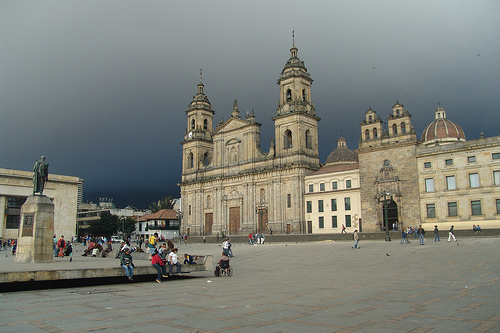
- Bogota
- Capital - geographic coordinate
- 4 36 N, 74 05 W
- Capital Time Difference
- UTC-5 (same time as Washington, DC, during Standard Time)
originally referred to as "Bacata," meaning "enclosure outside of the farm fields," by the indigenous Muisca
Military
Branches: National Army (Ejercito Nacional), Republic of Colombia Navy (Armada Republica de Colombia, ARC, includes Naval Aviation, Naval Infantry (Infanteria de Marina, IM), and Coast Guard), Colombian Air Force (Fuerza Aerea de Colombia, FAC)
Embassy / Diplomatic Mission
U.S. Embassy Bogota
Calle 24 Bis No. 48-50 Bogotá, D.C. Colombia.
Mailing address: Carrera 45 No. 24B-27 Bogotá, D.C. Colombia.
Telephone: (571) 275-2000
Emergency after-hours telephone: (571) 275-2701
Facsimile: (571) 275-4501.
U.S. Consular Agency Barranquilla
Calle 77B, No. 57-141, Piso 5, Centro Empresarial Las Americas, Barranquilla, Atlantico
Telephone: (575) 353-2001
Facsimile: (575) 353-5216
For hours and services, please visit the U.S. Embassy Bogota website.
Read the full government profile — flag symbolism, national anthem, and other national symbols.
View full government detailsEconomy
Economy
Colombia has the fourth-largest economy in Latin America and is classified as an upper-middle-income country. After contracting sharply during the COVID-19 pandemic, the economy rebounded strongly in 2021 and 2022 before slowing markedly in 2023 and 2024 as tighter monetary policy, weaker investment, and softer global demand weighed on activity. GDP growth is projected to recover gradually, supported by easing inflation, lower interest rates, and stronger private consumption.
The country's economic strengths include a diversified production base, prudent macroeconomic management, and a strong tradition of independent central banking. However, Colombia continues to face persistent challenges, including high informal employment, elevated poverty and inequality, regional disparities, and a heavy reliance on commodity exports such as oil, coal, and coffee. Falling oil production and the global energy transition pose long-term risks to fiscal revenues and the current account.
Under President Gustavo Petro, who took office in 2022, the government has pursued an ambitious reform agenda covering taxation, pensions, health, labor, and energy policy, while also seeking to gradually move the economy away from fossil fuels. These proposals have generated both domestic debate and uncertainty among investors. Fiscal consolidation remains a priority, with authorities working to comply with the country's fiscal rule and preserve its investment-grade standing with some rating agencies after losing it with others in 2021.
Trade ties remain anchored by the free trade agreement with the United States, Colombia's largest trading partner, alongside growing commercial relations with China, the European Union, and regional partners. Continued progress on security, infrastructure, energy transition, and productivity-enhancing reforms will be key to achieving more inclusive and sustainable long-term growth.
Snapshot
- Currency Name and Code
- Colombian pesos (COP)
- GDP — official exchange rate
- $9,773,000,000 (USD)
- GDP Real Growth Rate
- 5.1%
- Gini Index
- 53.8
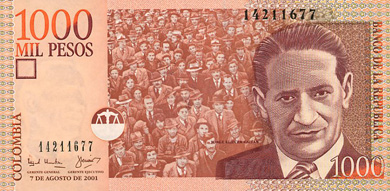
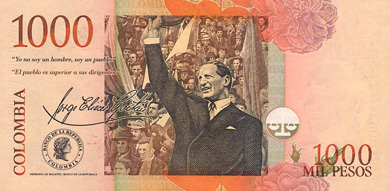
Banknotes
Budget & Public Finance
- Fiscal Year
- calendar year
- Annual Budget
- $48,770,000,000 (USD)
- Public Debt (% of GDP)
- 44.2%
- External Debt
- $37,060,000,000 (USD)
- Investment (% of GDP)
- 19.1%
- Current Account Balance
- $1,300,000,000 (USD)
- Reserves of Foreign Exchange
- $2,147,483,647 (USD)
Labor, Industry & Trade
- Labor Force by Occupation
- services 46%; agriculture 30%; industry 24%
- Household Income — highest 10%
- 34.3%
- Industries
- textiles, food processing, oil, clothing and footwear, beverages, chemicals, cement; gold, coal, emeralds
- Agriculture Products
- coffee, cut flowers, bananas, rice, tobacco, corn, sugarcane, cocoa beans, oilseed, vegetables; forest products; shrimp
- Export Commodities
- petroleum, coffee, coal, apparel, bananas, cut flowers
- Export Partners
- US 44.8%, Venezuela 9.4%, Ecuador 6.8%
- Import Commodities
- industrial equipment, transportation equipment, consumer goods, chemicals, paper products, fuels, electricity
- Import Partners
- US 32.7%, Venezuela 6.7%, Brazil 5.8%, Japan 5.3%, Mexico 5.1%, Germany 4.2%
Energy
- Oil Production
- 512,400 bbl/day
- Oil Consumption
- 270,000 bbl/day
- Oil Reserves
- 1,492,000,000 bbl/day
- Natural Gas Production
- 6,080,000,000 cu m
- Natural Gas Consumption
- 6,080,000,000 cu m
- Natural Gas Imports
- 0 cu m
- Natural Gas Exports
- 0 cu m
- Natural Gas Reserves
- 127,600,000,000 cu m
Communications
- Telephone System
- general assessment: modern system in many respects with a nationwide microwave radio relay system, a domestic satellite system with 41 earth stations, and a fiber-optic network linking 50 cities; telecommunications sector liberalized during the 1990s; multiple providers of both fixed-line and mobile-cellular services domestic: fixed-line connections stand at about 15 per 100 persons; mobile cellular telephone subscribership is about 100 per 100 persons; competition among cellular service providers is resulting in falling local and international calling rates and contributing to the steep decline in the market share of fixed line services international: country code - 57; multiple submarine cable systems provide links to the US, parts of the Caribbean, and Central and South America; satellite earth stations - 10 (6 Intelsat, 1 Inmarsat, 3 fully digitalized international switching centers)
- Internet Country Code
- .co
News & Weather
News & Weather
Current Weather
Latest News
Colombia and Slovenia recognized a Palestinian state. Now they’re moving embassies to Jlem - The Times of Israel
The Times of Israel · 2d ago
Colombia’s civil disobedience - The Economist
The Economist · 1d ago
Opinion | Colombia’s Answer to Donald Trump - WSJ
WSJ · 1d ago
Petro to give farewell speech amid Colombia transfer-of-power tensions - Al Jazeera
Al Jazeera · 17h ago
Colombia's Petro calls on supporters to defend economic reforms in his last presidential speech - AP News
AP News · 9h ago
Colombia's Ecopetrol says cyberattack stole data tied to 3,300 accounts - Reuters
Reuters · 3d ago
Colombian nationals arrested in Benz tied to violent L.A. carjacking - KTLA
KTLA · 1d ago
Colombia's president-elect says guerrillas plotting to assassinate him before inauguration - Ynetnews
Ynetnews · 4h ago
News via Google News
Climate Overview
Colombia's climate varies with its different altitudes. Its three climatic zones are called: "hot country," "temperate country," and "cold country." Columbia is tropical along the coast and eastern plains; cooler in the highlands.
Videos
Videos
1 curated YouTube videos.
Source: YouTube
Frequently Asked Questions
Frequently Asked Questions
What is the population of Colombia?
How do people greet each other in Colombia?
What are the dining customs in Colombia?
What etiquette should I know when visiting a Colombian home?
How should I dress in Colombia?
What gestures and body language matter in Colombia?
What is family life like in Colombia?
What do Colombians do for recreation?
What is the capital of Colombia?
Where is Colombia located?
What countries border Colombia?
What is the predominant religion in Colombia?
What is the currency of Colombia?
What language is spoken in Colombia?
What is Colombia known for?
What are some distinctive cultural traditions of Colombia?
Last reviewed 2026