
 English
 Español
 中文
中文 हिन्दी
 Français
Rwanda
Rwanda
Declare Your Relationship to Rwanda
CountryReports Community
- Studying1
- From Rwanda1
- Rwanda heritage0
- Visited0
- Want to visit0
Customs and Culture
Customs and Culture
About the People
Rwanda is the most densely populated country in Africa
Conditions in the city and the rural areas vary greatly. Many in rural areas people live in small houses with mud walls. They lack some of the items that are common in most cities such as electricity, running water and indoor plumbing. Rwandans are friendly, polite and helpful people.
Cultural Attributes
Conditions in the city and the rural areas vary greatly. Many in rural areas people live in small houses with mud walls. They lack some of the items that are common in most cities such as electricity, running water and indoor plumbing. Rwandans are friendly, polite and helpful people.

A Thousand Hills of Resilience
Greetings, Gestures & Visiting
Greetings are an essential part of Rwandan social life and it is the responsibility of the younger person to greet the older person and the women are required to greet the men first. In rural areas, one is expected to greet everyone who passes. In urban areas, this is not possible, but it is considered rude not to greet all friends and acquaintances. Formal greetings contain wishes such as “May you have many cows,” or “May you have children.” Some people use special Christian greetings such as “May Jesus be praised.” Other greetings are Muraho (Hello, it's been a while), Mwaramutse (Good morning) Mwiriwe (Good afternoon/evening). The initial greeting is usually followed by Amakuru? (How's the news?) Or, among close friends, Bite se? (How are things going?). The typical response is Ni meza (Fine) or Ni meza cyane (Very fine).
The warmest Rwanda greeting is similar to a hug Each person's left hand touches the other persons hip, The right hand reaches up to touch the other person's shoulder. This greeting is reserved for close friends and family.
Visiting relatives and friends is an important activity in Rwanda. People who do not regularly visit their relatives and friends are considered anti-social. On special occasions, visitors bring gifts. The guest always accepts; to refuse the offer would be a sign of disrespect.
Western style of clothing is typical but most of the clothing is used or of low quality.
Diet
The Rwandan diet consists mainly of sweet potatoes, beans, corn, peas, millet and fruit. A traditional breakfast consists of sweet potatoes and porridge, which is a mixture of sorghum, corn and millet, mixed with milk. In urban areas such as Kigali, people usually have bread and tea for breakfast. Rwandans add lots of milk and sugar to their tea. Lunch and dinner may consist of boiled beans, bananas, sweet potatoes or cassava. Umutsima (a dish of cassava and corn), isombe (cassava leaves with eggplant and spinach) and mizuzu (fried plantains) are common dishes. Dinner is the heaviest meal. Between meals, Rwandans often snack on fruits. Tropical fruits such as avocados, bananas, mangos and papaya are abundant in Rwanda. Roadside vendors in urban areas sell roasted corn and barbecued meat.
The typical evening meal for a child is likely to consist of a special maize meal sort of cake with bean sauce and there is likely to be a variation in this meal since it will be eaten every day and in almost every home in the Rwandan village. For those children who are not served lunch at school, the evening meal is more often than not the only meal of the day.
The Rwandan diet consists mainly of sweet potatoes, beans, corn, peas, millet and fruit. A traditional breakfast consists of sweet potatoes and porridge, which is a mixture of sorghum, corn and millet, mixed with milk. In urban areas such as Kigali, people usually have bread and tea for breakfast. Rwandans add lots of milk and sugar to their tea. Lunch and dinner may consist of boiled beans, bananas, sweet potatoes or cassava. Umutsima (a dish of cassava and corn), isombe (cassava leaves with eggplant and spinach) and mizuzu (fried plantains) are common dishes. Dinner is the heaviest meal. Between meals, Rwandans often snack on fruits. Tropical fruits such as avocados, bananas, mangos and papaya are abundant in Rwanda. Roadside vendors in urban areas sell roasted corn and barbecued meat.
The typical evening meal for a child is likely to consist of a special maize meal sort of cake with bean sauce and there is likely to be a variation in this meal since it will be eaten every day and in almost every home in the Rwandan village. For those children who are not served lunch at school, the evening meal is more often than not the only meal of the day.

Family
A rugo (traditional Rwandan homestead) consists of several beehive-shaped houses within a larger, fenced compound. The main family house is in the middle. Each house is made of woven branches and grasses, covered with clay. There is no running water, so women and children fetch water for the household every day. In cities, there is some Western-style housing, but most urban Rwandans live in small mud-walled houses with corrugated iron roofs.
The term inzu in Kinyarwanda can mean family, household or house. An inzu usually consists of a husband and wife, children and close relatives. A family without children is considered incomplete, and large families are common. People from several inzus who can trace their origins to a common male ancestor form a kinship unit called a umuryango. The oldest and most influential male in this group is the umukungu, the head of the umuryango.
It is expected that all Rwandans will marry. Only about one in 200 women reaches the age of 50 without marrying. Before a marriage can take place, the groom's family must pay a bride-price, usually a cow, to the bride's father. If the partners wish, a marriage can be dissolved, but the bride-price must be returned to the groom's family.
Recreation
Soccer is popular in Rwanda. children also compete in running and high jumping. Recreational wrestling is another favorite pastime. Some Rwandans who live near the lakes enjoy swimming. Rwandan children play games such as hide and seek, skipping and hopscotch.
Mancala is a traditional board game enjoyed by Rwandans. It is played with 48 dried peas and a specially made board, with two rows of six hollowed-out cups. Some boards have a cup at each end for keeping captured peas. At the beginning of the game, all the peas are distributed in the cups. In turn, each player picks up the peas in one cup and distributes them sequentially in the other cups. Players try to capture as many peas as possible during this process, but the rules of capture vary. Igisoro, a more complex version of the game, uses a table with 32 hollowed-out cups, in four rows of eight.
Student Life
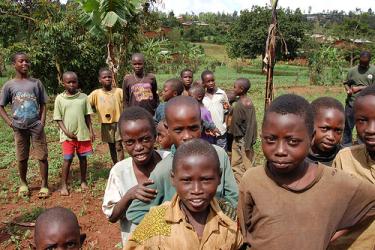
The life of the Rwandan child is different depending on whether they stay at home or at centers for children who are mainly orphaned. In theory, all Rwandan children, beginning at age seven, have access to six mandatory years of primary schooling. In a typical village, it is likely that a family is going to be polygamous with the man having several wives and many children. Most homes are built from packed earth and the roofs are thatched with straw. The house is likely to have two rooms and younger children will generally share their sleeping room, often sleeping on the floor with shared beddings. On a normal school day they children will wake up at around 5:30 am to prepare for school. The child will most likely have taken a bath the previous evening and so the morning will involve washing the face to make it clean. The older children will have to divide chores such as sweeping the house, preparing breakfast, milking the family cow and tethering the animals before they dash off to school, which is likely to be about 5 kilometers away on average. Breakfast is going to consist of a mug of sorghum porridge with or without sugar.
School is likely to begin anywhere between 7:30 and 8:00 am so most children will leave home at about 6:30 am since there is no organized school transport, for the long trek to school. On many occasions however, it is not surprising for more than half the children to come to school on an empty stomach since there may not be any food back at home. For some of them the only hope will be a school meal where that is made available. School dropout rates are high where meals are not offered in poor neighborhoods.
The heavy war that took place in Rwanda destroyed the schools infrastructure. Many describe schools as simply shells consisting of walls with gaping holes or doors and windows which do not have any grills or window panes. Many school buildings were also destroyed so it is not strange to find other children learning under trees. On average the teacher student ratio in many primary schools is about 1:80. When it comes to supplies needed to facilitate learning, the priority is basically pen and paper, with children sharing text books due to the scarcity in many rural schools. Most children will learn about computers in high school or college. There is however a lot of rehabilitation especially where infrastructure is involved thanks to assistance from the international community.
School normally begins at 8:00 am with a regular routine of cleaning up the compound by picking all the garbage before going for assembly where the teachers on duty will make announcements and do a routine check up for hygiene. The teacher will check for which children may not be in a semblance of uniform, did not cut their nails, or their hair is unkempt. These children may get a punishment, which involves receiving strokes of the cane. The regular lessons are 35 minutes long and subjects are taught either in French or in the local language for the elementary classes. There is usually a short break at 10:00 or 10:30 am of 10 to 30 minutes in length. There are likely to be no balls at the break so boys will fashion their own soccer balls using plastic bags which they bundle together by using twine. After a second session of classes children will break for lunch which takes about one hour. Many schools supply lunch which consists of plantain bananas and groundnut sauce. In the schools where this is not provided, most children will go without a meal as they wait for the afternoon lessons. Teachers usually have to do with the few supplies that are available and most of the time they improvise in order to have any teaching aids. The basic teaching materials the teacher will get are a few text books and they have to improvise ways in which they will be shared among the students. There is currently a great deal of emphasis from various organizations to jump start the education programs through provision of some basic salaries because teachers are de-motivated due to small and irregular payments. The afternoon session begins at 2:00 pm and will end at about 3:30 pm. For the children in the upper classes there will be one more period where some extra curricular activities are undertaken, but this is more often than not done once or twice a week. Extra curricular activities usually include dance, music, drama, debating or anything that the environment may allow. As soon as school is over, the children will begin the long trek home getting home as late as 5:30 pm. The first assignment for them at home is to pick up the water containers and rush to the river to replenish the water supply at home. It is during this trip to the river that most of them will take their bath and run back home with 20 liter water containers balanced on their heads. The older children will have the responsibility of bathing their younger siblings since their parents are likely to be busy working in the farm.
After getting back from the river there will be very little time for any playing because of the other household chores waiting for them, this may include cleaning up the compound before looking for supplies from the family garden to prepare for supper before darkness sets in. There is no electricity so any homework must be done before darkness sets in and for the lucky ones, there will be a kerosene lantern which will have to be shared as homework is done in a hurry.
After dinner is done, which is usually about 7:00 pm the children will do the dishes before embarking on homework for the older ones, the younger ones will jump to bed immediately. Homework must be done in a hurry because the kerosene lantern could run out of fuel. There is no supervision from parents to make sure that homework was done so it is mainly a solo exercise for every child who must do their homework. On a few occasions those who live with grandparents may share the evening with them in a story time session where a few family values are usually exchanged. Come 9:00 pm the whole village is dark and quiet because everyone has gone to sleep. One popular game among Rwandese children is called Gutera Urigiza. Gutera Uriziga is a fun outdoor game played by children of all ages requiring 4 or more players. All they require to play the game is usually 1 stick (approximately 1.5 metres/5 feet long) per player; 1 large hoop and it will take between one and two minutes per round. The aim of the game is to throw your stick through the hoop and accumulate the most points. To play Gutera Uriziga, one child is chosen as the leader. This leader is given the hoop. All players stand shoulder to shoulder in a straight line holding their sticks. The leader stands about 15 meters (50 feet) in front of the group but over to one side. The players get ready to throw their sticks. On the word 'Go' the leader rolls the hoop in front of the players. The players then try to throw their sticks through the rolling hoop. If the player is successful in throwing their stick through the hoop they receive one point. When players have ended the game the winner is the player with the most points. The size of the sticks and the distance thrown is usually adapted to suit the age of the children and the size of the hoop.
On the evenings when there may not be school work to be done, the children in the village will be found playing together and one of the major activities may include song and dance. Music is a vital tool used in strengthening family and social ties as well as educating the children in cultural values. Children will be singing, dancing and clapping. Some schools are using this cultural vehicle to spread news about the dangers of HIV/AIDS among school going children.
Holidays
Independence Day
7/1Independence Day
Dates of Interest
- July 1st
How do people greet each other in Rwanda?
Greetings are an essential part of Rwandan social life; younger people greet older people first, and women are expected to greet men first.
Do
- In rural areas, greet everyone who passes you
- In urban areas, greet all friends and acquaintances
- Use greetings like Muraho (Hello, it's been a while), Mwaramutse (Good morning) or Mwiriwe (Good afternoon/evening)
- Follow up with Amakuru? (How's the news?) or, among close friends, Bite se? (How are things going?)
Don’t
- Don't fail to greet friends and acquaintances — it is considered rude
Good to know
- Formal greetings include wishes like 'May you have many cows' or 'May you have children'
- Some people use Christian greetings such as 'May Jesus be praised'
- Typical responses are Ni meza (Fine) or Ni meza cyane (Very fine)
What is the food and eating like in Rwanda?
The Rwandan diet centers on sweet potatoes, beans, corn, peas, millet and fruit, with dinner as the heaviest meal.
Good to know
- Breakfast is traditionally sweet potatoes and porridge (sorghum, corn and millet mixed with milk); in cities like Kigali it's often bread and tea
- Rwandans add lots of milk and sugar to their tea
- Common dishes include umutsima (cassava and corn), isombe (cassava leaves with eggplant and spinach) and mizuzu (fried plantains)
- Roadside vendors in urban areas sell roasted corn and barbecued meat
What are the etiquette and hospitality customs in Rwanda?
Visiting relatives and friends is an important activity; those who don't visit regularly are considered anti-social.
Do
- On special occasions, bring gifts when visiting
- As a guest, always accept what is offered
Don’t
- Don't refuse an offer from a host — it is a sign of disrespect
How should I dress in Rwanda?
Western-style clothing is typical, though most clothing is used or of low quality.
Good to know
- Western dress is the norm
What gestures should I know in Rwanda?
The warmest Rwandan greeting resembles a hug, reserved for close friends and family.
Good to know
- In this greeting, each person's left hand touches the other's hip and the right hand reaches up to the other's shoulder
- Reserve this warm greeting for close friends and family
What is family life like in Rwanda?
Family is central; an inzu (family/household) usually includes a husband, wife, children and close relatives, and large families are common.
Good to know
- A family without children is considered incomplete
- A traditional homestead (rugo) has several beehive-shaped houses in a fenced compound, with the main family house in the middle
- Related families form a kinship unit called umuryango, headed by the oldest, most influential male (umukungu)
- It is expected that all Rwandans will marry; the groom's family pays a bride-price, usually a cow, to the bride's father
What do people do for fun in Rwanda?
Soccer is popular, along with running, high jumping, recreational wrestling, and swimming near the lakes.
Good to know
- Children play hide and seek, skipping and hopscotch
- Mancala is a traditional board game played with 48 dried peas on a board with two rows of six cups
- Igisoro is a more complex version using a table with 32 cups in four rows of eight
Last updated: 2026-07-12 · Sources: CountryReports
Photos of Rwanda
Photos of Rwanda


Travel and Tourism
Travel and Tourism
- Travel Alert Status
- Level 1: Exercise Normal Precautions
- Currency
- Rwandan franc (RWF)
- Time Difference
- UTC+2 (7 hours ahead of Washington, DC, during Standard Time)
- Climate
- Despite Rwanda’s location of only two degrees below the equator, the altitude provides a mild, temperate climate for most parts of the country. The average 24-hour temperature in Kigali is 73° F. The higher reaches above 14,700 feet might even experience frost and snow. Two rainy seasons generally occur from February through May, and from September through December; but variations do occur. The rains can be torrential, although brief, and sometimes are accompanied by strong winds and lightning. Annual rainfall averages 31 inches and is generally heavier in the western and northwestern mountains than in the eastern savanna. The long dry summer season from May to September turns the hills around Kigali a reddish ochre, fine dust is everywhere, and the grass dries up.
- Airports
- 9
Read the full travel guide — health, safety, vaccinations, disease risk, sanitation, and transit details.
View full travel guideRecipes
Recipes
Cassavas with Dried Beans- Side dish
Main Dish
Main Dish
Pinto Beans with Cassava
Main Dish
Chicken with Tomato Sauce
Main Dish
Ubugali — Cassava Porridge
Main Dish
Isombe
Side Dish
Banana with Green Split Peas
Bread
Amandazi — Fritters
Main Dish
PremiumCassavas with Dried Beans- Side dish
History
History
Historical Eras
Pre-colonial Kingdom
1400 – 1894
Tutsi pastoralists migrating from the Horn of Africa gradually established a centralized monarchy over the Hutu farming population, with a mwami (king) at its apex. The feudal ubuhake system bound Hutu cultivators to Tutsi lords in exchange for cattle and land use, creating a deeply stratified society. By the 19th century, the Rwandan kingdom was among the most organized and powerful polities in the Great Lakes region.
Colonial Era
1894 – 1962
German Count Von Goetzen's 1894 visit inaugurated European penetration; by 1899 the mwami accepted a German protectorate. Belgium seized control during World War I and governed Ruanda-Urundi under League of Nations and later UN mandates, institutionalizing Tutsi-Hutu divisions through measures such as the 1935 ethnic identity cards. Belgian reforms in the 1950s inadvertently catalyzed a 1959 Hutu revolt that toppled the Tutsi monarchy and drove over 160,000 Tutsis into exile.
First Republic
1962 – 1973
Rwanda gained full independence on July 1, 1962, with Grégoire Kayibanda of the PARMEHUTU party as its first elected president. The new government pursued social development and broad international recognition, establishing relations with 43 countries within a decade. However, persistent anti-Tutsi violence, government corruption, and regional factional rivalries steadily undermined the republic's democratic aspirations.
Habyarimana Regime
1973 – 1990
Major General Juvénal Habyarimana seized power in a bloodless coup on July 5, 1973, dissolving the National Assembly and banning political parties. His single-party National Revolutionary Movement for Development (MRND), formalized in 1975, promoted national unity while consolidating authoritarian rule and entrenching Hutu political dominance. Habyarimana was re-elected unopposed in 1983 and 1988, presiding over relative stability but mounting ethnic discrimination against Tutsis.
Civil War & Genocide
1990 – 1994
On October 1, 1990, the Rwandan Patriotic Front (RPF), composed largely of Tutsi exiles from Uganda, invaded northern Rwanda, igniting a civil war. Despite the 1993 Arusha Accords promising power-sharing, President Habyarimana's assassination on April 6, 1994, triggered a meticulously organized genocide in which approximately 800,000 Tutsis and moderate Hutus were killed in roughly 100 days before the RPF's military victory ended the slaughter in July.
Post-Genocide Rwanda
1994 – present
The RPF-led government of national unity faced the immense task of rebuilding a shattered society, repatriating millions of refugees, and pursuing justice through the gacaca community court system and the UN International Criminal Tribunal for Rwanda. Under President Paul Kagame, who formally took office in 2000, Rwanda achieved sustained economic growth, sweeping institutional reforms, and a strong emphasis on national identity over ethnicity. The country has emerged as a model of post-conflict reconstruction, though concerns about political freedoms and regional stability persist.
Overview
After World War I, the League of Nations mandated Rwanda and its southern neighbor, Burundi, to Belgium as the territory of Ruanda-Urundi. Following World War II, Ruanda-Urundi became a UN Trust Territory with Belgium as the administrative authority. Reforms instituted by the Belgians in the 1950s encouraged the growth of democratic political institutions but were resisted by the Tutsi traditionalists who saw in them a threat to Tutsi rule. An increasingly restive Hutu population, encouraged by the Belgian military, sparked a revolt in November 1959, resulting in the overthrow of the Tutsi monarchy. Two years later, the Party of the Hutu Emancipation Movement (PARMEHUTU) won an overwhelming victory in a UN-supervised referendum.
During the 1959 revolt and its aftermath, more than 160,000 Tutsis fled to neighboring countries. The PARMEHUTU government, formed as a result of the September 1961 election, was granted internal autonomy by Belgium on January 1, 1962. A June 1962 UN General Assembly resolution terminated the Belgian trusteeship and granted full independence to Rwanda (and Burundi) effective July 1, 1962.
Gregoire Kayibanda, leader of the PARMEHUTU Party, became Rwanda’s first elected president, leading a government chosen from the membership of the directly elected unicameral National Assembly. Peaceful negotiation of international problems, social and economic elevation of the masses, and integrated development of Rwanda were the ideals of the Kayibanda regime. Relations with 43 countries, including the United States, were established in the first 10 years. Despite the progress made, inefficiency and corruption began festering in government ministries in the mid-1960s. On July 5, 1973, the military took power under the leadership of Maj. Gen. Juvenal Habyarimana, who dissolved the National Assembly and the PARMEHUTU Party and abolished all political activity.
In 1975, President Habyarimana formed the National Revolutionary Movement for Development (MRND) whose goals were to promote peace, unity, and national development. The movement was organized from the "hillside" to the national level and included elected and appointed officials.
Under MRND aegis, Rwandans went to the polls in December 1978, overwhelmingly endorsed a new constitution, and confirmed President Habyarimana as president. President Habyarimana was re-elected in 1983 and again in 1988, when he was the sole candidate. Responding to public pressure for political reform, President Habyarimana announced in July 1990 his intention to transform Rwanda’s one-party state into a multi-party democracy.
On October 1, 1990, Rwandan exiles banded together as the Rwandan Patriotic Front (RPF) and invaded Rwanda from their base in Uganda. The rebel force, composed primarily of ethnic Tutsis, blamed the government for failing to democratize and resolve the problems of some 500,000 Tutsi refugees living in diaspora around the world. The war dragged on for almost 2 years until a cease-fire accord was signed July 12, 1992, in Arusha, Tanzania, fixing a timetable for an end to the fighting and political talks, leading to a peace accord and powersharing, and authorizing a neutral military observer group under the auspices of the Organization for African Unity. A cease-fire took effect July 31, 1992, and political talks began August 10, 1992.
On April 6, 1994, the airplane carrying President Habyarimana and the President of Burundi was shot down as it prepared to land at Kigali. Both presidents were killed. As though the shooting down was a signal, military and militia groups began rounding up and killing all Tutsis and political moderates, regardless of their ethnic background.
The prime minister and her 10 Belgian bodyguards were among the first victims. The killing swiftly spread from Kigali to all corners of the country; between April 6 and the beginning of July, a genocide of unprecedented swiftness left up t
Timeline of Key Events
1884
The Berlin Conference is held on the division of Africa between Europen Nations.
The Berlin Conference is held on the division of Africa between Europen Nations.
1899
Rwanda became a German colony.
Rwanda became a German colony.
1900
King Musinga receives the first group of European Catholic missionaries.
King Musinga receives the first group of European Catholic missionaries, known as the “White Fathers” or “Peres Blancs”.
1919
Rwanda became a mandate territory of the League of Nations under the administration of Belgium.
After the defeat of the Germans during WW1, subsequently in 1919 Rwanda became a mandate territory of the League of Nations under the administration of Belgium. The Germans and the Belgians administered Rwanda through a system of indirect rule. During this colonial era, a cash crop economy was introduced in Rwanda, and this was administered through harsh methods that further alienated the King and his chiefs from the rest of the population.
1923
Belgium granted League of Nations mandate to govern Ruanda-Urundi.
Belgium granted League of Nations mandate to govern Ruanda-Urundi, which it ruled indirectly through Tutsi kings.
1931
Belgium forces King Musinga to abdicate his throne.
Belgium forces King Musinga to abdicate his throne, who is then exiled to Kamembe (current prefecture of Cyangugu), near the Rwanda-DRC border. His son, king Rudahigwa Mutara II, succeeds him.
1935
The Belgian Colonial Administration issues identification that clearly categorized people.
The Belgian Colonial Administration issues, for the first time, identification that clearly categorized people as “Hutu”,“ Tutsi” and “Twa” on the basis of the number of heads of cattle they owned. Those with ten or more cows were categorized as “Tutsi”, while those with less were categorized as “Hutu”.
Read the full history profile — narrative overview, defining eras, and the complete timeline in one place.
View expanded historyInteresting Facts
Interesting Facts
Rwanda is Africa's most densely populated country. More than eight million people live in a country that is less than half the size of Nova Scotia. More than 90% of the population lives in rural areas.
The mwami (king) in Rwanda was considered a sacred being, whose power was of divine origin. A drum called kalinga, which was so sacred that it was never used, was a symbol of his authority.
Despite years of ethnic conflict, the Hutus and Tutsis share many cultural characteristics and family life is similar for both groups. Intermarriage over several generations has also blurred distinctions between Hutus and Tutsis.
In addition to the Hutu, Tutsi and Twa people, Rwanda has a small minority of Hima people. This is a nomadic group from the Nile Valley, who inhabit the northern and northeastern regions of Rwanda.
In the past, rich Tutsi women often wore heavy copper bracelets and anklets. Because of the weight of these ornaments, the women were unable to do much work. The ornaments distinguished affluent women from women who worked in the fields.
Pyrethrum, which grows in Rwanda, is a daisy-like flower used to make a natural insecticide. Its properties were discovered during the First World War, when a group of soldiers camped overnight in a field of pyrethrum. By morning, the lice that had infested the soldiers had all been killed.
See every fact — trivia, oddities, and curious tidbits gathered from across the country.
View all interesting factsGeography and Environment
Geography and Environment
- Terrain
- mostly grassy uplands and hills; relief is mountainous with altitude declining from west to east
- Climate
- Despite Rwanda’s location of only two degrees below the equator, the altitude provides a mild, temperate climate for most parts of the country. The average 24-hour temperature in Kigali is 73° F. The higher reaches above 14,700 feet might even experience frost and snow. Two rainy seasons generally occur from February through May, and from September through December; but variations do occur. The rains can be torrential, although brief, and sometimes are accompanied by strong winds and lightning. Annual rainfall averages 31 inches and is generally heavier in the western and northwestern mountains than in the eastern savanna. The long dry summer season from May to September turns the hills around Kigali a reddish ochre, fine dust is everywhere, and the grass dries up.
- Natural Hazards
- periodic droughts; the volcanic Virunga mountains are in the northwest along the border with Democratic Republic of the Congo
- Current Environmental Issues
- deforestation results from uncontrolled cutting of trees for fuel; overgrazing; soil exhaustion; soil erosion; widespread poaching
Read the full geography and environment profile — terrain, climate, natural resources, hazards, land use, and international agreements.
View full geographyPeople & Demographics
People & Demographics
Religion
Languages Spoken
Kinyarwanda (official) universal Bantu vernacular, French (official), English (official), Kiswahili (Swahili) used in commercial centers
- Bantu
- English
- French
- Kinyarwanda
- Swahili
Population
- Population
- 11,055,976
- Population in Major Urban Areas
- KIGALI (capital) 1.004 million
- Nationality Noun
- Rwandan(s)
- Ethnic Groups
- Hutu 84%, Tutsi 15%, Twa (Pygmoid) 1%
Education
- Literacy Definition
- age 15 and over can read and write
The heavy war that took place in Rwanda destroyed the schools infrastructure. Many describe schools as simply shells consisting of walls with gaping holes or doors and windows which do not have any grills or window panes. Many school buildings were also destroyed so it is not strange to find other children learning under trees. On average the teacher student ratio in many primary schools is about 1:80. When it comes to supplies needed to facilitate learning, the priority is basically pen and paper, with children sharing text books due to the scarcity in many rural schools. Most children will learn about computers in high school or college. There is however a lot of rehabilitation especially where infrastructure is involved thanks to assistance from the international community.
Health Information
- Major Infectious Diseases — degree of risk
- very high
Read the full people and society profile — demographics, health, education, religion, languages, and notable people.
View full people and societyGovernment & Politics
Government & Politics
Country Identity
- Country Name
- Rwanda
- Full Country Name
- Rwandese Republic
- Local - Long
- Republika y'u Rwanda
- Local - Short
- Rwanda
- Former Name
- Ruanda
Government Structure
- Government Type
- republic; presidential, multiparty system
- Legal System
- based on German and Belgian civil law systems and customary law; judicial review of legislative acts in the Supreme Court; has not accepted compulsory ICJ jurisdiction
- Executive Branch
- chief of state: President Paul KAGAME (since 22 April 2000) head of government: Prime Minister Edouard NGIRENTE (since 30 August 2017) cabinet: Council of Ministers appointed by the president elections: President elected by popular vote for a seven-year term; elections last held 4 August 2017 (next to be held in 2024) election results: Paul KAGAME reelected president; Paul KAGAME 98.79%, Philippe MPAYIMANA 0.72%, Frank HABINEZA 0.49%
- Legislative Branch
- bicameral Parliament consists of Senate (26 seats; 12 members elected local councils, 8 appointed by the president, 4 by the Political Organizations Forum, 2 represent institutions of higher learning, to serve eight-year terms) and Chamber of Deputies (80 seats; 53 members elected by popular vote, 24 women elected by local bodies, 3 selected by youth and disability organizations, to serve five-year terms) elections: Senate - last held NA, members appointed as part of the transitional government (next to be held in 2011); Chamber of Deputies - last held 29 September 2003 (next to be held in 2008) election results: seats by party under the 2003 Constitution - RPF 40, PSD 7, PL 6, additional 27 members indirectly elected
- Judicial Branch
- Supreme Court; High Courts of the Republic; Provincial Courts; District Courts; mediation committees
- Suffrage
- 18 years of age; universal adult
- Constitution
- on 5 May 1995, the Transitional National Assembly adopted as Fundamental Law the constitution of 18 June 1991, provisions of the 1993 Arusha peace accord, the July 1994 Declaration by the Rwanda Patriotic Front, and the November 1994 multiparty protocol of understanding
- Independence
- 1 July 1962 (from Belgium-administered UN trusteeship)
- National Holiday
- Independence Day, 1 July (1962)
Capital City
- Capital Name
- Kigali
- Capital - geographic coordinate
- 1 57 S, 30 03 E
- Capital Time Difference
- UTC+2 (7 hours ahead of Washington, DC, during Standard Time)
the city takes its name from nearby Mount Kigali; the name "Kigali" is composed of the Bantu prefix ki and the Rwandan gali meaning "broad" and likely refers to the broad, sprawling hill that has been dignified with the title of "mount"
Military
Branches: Rwanda Defense Force (RDF): Rwanda Army (Rwanda Land Force), Rwanda Air Force (Force Aerienne Rwandaise, FAR)
Embassy / Diplomatic Mission
U.S. Embassy Kigali
2657 Avenue de la Gendarmerie
Kigali, Rwanda
Telephone: 250 (252) 596-400
Facsimile: 250 (252) 596-591
Mailing address: B.P. 28, Kigali, Rwanda
Consular Section e-mail: consularkigali@state.gov.
American Citizen Services hours: Tuesdays from 8:00 - 12:00 and Fridays from 8:00 - 12:00 by appointment.
The Embassy is closed on U.S. and Rwandan holidays.
Read the full government profile — flag symbolism, national anthem, and other national symbols.
View full government detailsEconomy
Economy
Rwanda is a landlocked country in East Africa with a predominantly rural population, though the share engaged in agriculture has declined from roughly 90% in the early 2000s to about 56% today as the economy diversifies. It remains the most densely populated country in mainland Africa, with limited natural resources and a relatively small industrial base. Coffee and tea remain important traditional exports, but minerals—particularly tin, tungsten, and tantalum—along with tourism and business services have become major foreign exchange earners.
The 1994 genocide against the Tutsi devastated Rwanda's economy and population, but the country has since become one of Africa's fastest-growing economies. Real GDP growth has averaged around 7–8% annually over the past two decades, and the government's Vision 2050 strategy aims to transform Rwanda into an upper-middle-income country. Poverty rates have fallen significantly, though a large share of the population still lives below the national poverty line, and inequality remains a concern. Inflation has generally been kept under control, although global food and fuel price shocks in recent years have created pressure.
Rwanda has worked to diversify beyond traditional agriculture into horticulture, ICT, financial services, conference tourism, and high-value manufacturing, supported by significant investment in infrastructure, including the new Bugesera International Airport. Kigali has positioned itself as a regional business hub and consistently ranks among the top African countries for ease of doing business and governance. Nonetheless, challenges persist: food production does not always keep pace with demand, the country remains vulnerable to climate shocks, and dependence on imports contributes to persistent trade deficits.
Rwanda continues to receive substantial development assistance and benefited from HIPC and Multilateral Debt Relief Initiative programs in the 2000s. Public debt has risen in recent years due to infrastructure spending and the impact of the COVID-19 pandemic, prompting renewed engagement with the IMF through financing facilities aimed at supporting reform and resilience.
Snapshot
- Currency Name and Code
- Rwanda Franc (RWF)
- GDP — official exchange rate
- $1,817,000,000 (USD)
- GDP Real Growth Rate
- 5.2%
- Gini Index
- 28.9
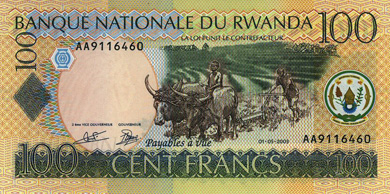
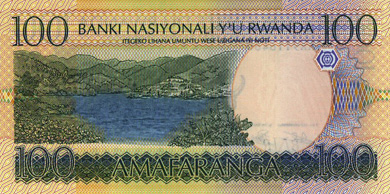
Banknotes
Budget & Public Finance
- Fiscal Year
- calendar year
- Annual Budget
- $584,600,000 (USD)
- External Debt
- $1,400,000,000 (USD)
- Investment (% of GDP)
- 18.6%
- Economic Aid
- $372,900,000 (USD)
- Current Account Balance
- -$79,000,000 (USD)
- Reserves of Foreign Exchange
- $300,000,000 (USD)
Labor, Industry & Trade
- Labor Force by Occupation
- agriculture 90%
- Household Income — highest 10%
- 24.2%
- Industries
- cement, agricultural products, small-scale beverages, soap, furniture, shoes, plastic goods, textiles, cigarettes
- Agriculture Products
- coffee, tea, pyrethrum (insecticide made from chrysanthemums), bananas, beans, sorghum, potatoes; livestock
- Export Commodities
- coffee, tea, hides, tin ore
- Export Partners
- Indonesia 37.5%, Hong Kong 6.9%, China 3.5%
- Import Commodities
- foodstuffs, machinery and equipment, steel, petroleum products, cement and construction material
- Import Partners
- Kenya 23.2%, Belgium 8.3%, Germany 6.6%
Energy
- Oil Production
- 0 bbl/day
- Oil Consumption
- 6,000 bbl/day
- Oil Reserves
- 0 bbl/day
- Natural Gas Production
- 0 cu m
- Natural Gas Consumption
- 0 cu m
- Natural Gas Imports
- 0 cu m
- Natural Gas Exports
- 0 cu m
- Natural Gas Reserves
- 56,630,000,000 cu m
Communications
- Telephone System
- general assessment: small, inadequate telephone system primarily serves business, education, and government domestic: the capital, Kigali, is connected to the centers of the provinces by microwave radio relay and, recently, by cellular telephone service; much of the network depends on wire and HF radiotelephone; combined fixed-line and mobile-cellular telephone density has increased and now exceeds 40 telephones per 100 persons international: country code - 250; international connections employ microwave radio relay to neighboring countries and satellite communications to more distant countries; satellite earth stations - 1 Intelsat (Indian Ocean) in Kigali (includes telex and telefax service)
- Internet Country Code
- .rw
News & Weather
News & Weather
Current Weather
Latest News
Bill Gates heads to Africa's cleanest country to learn about its health success story and discuss its $50 million plan - Business Insider Africa
Business Insider Africa · 9h ago
US-Africa Week Ahead: DRC’s Tshisekedi takes minerals fight with Rwanda to UN - The Africa Report
The Africa Report · 21h ago
Bill Gates on Africa’s Next Growth Story: Health, AI and Homegrown Innovation - CNBC Africa
CNBC Africa · 16h ago
France confirms 27-year sentence for Rwandan ex-doctor Eugene Rwamucyo - africanews.com
africanews.com · 15h ago
Rwandan genocide survivor relieved by arrest of man wanted in 1994 killings - CBC
CBC · 23h ago
Democratic Republic of Congo Overtakes Uganda, Kenya, Tanzania and Others in Africa Fueling Rwanda’s Tourism Through Record-Breaking Regional Travel Demand During the First Six Months of 2026 - Travel And Tour World
Travel And Tour World · 2d ago
UK wins court case over collapsed Rwanda asylum deal - BBC
BBC · 50d ago
‘Milestone’: Macron opens Paris monument honouring Rwanda genocide victims - Al Jazeera
Al Jazeera · 49d ago
News via Google News
Climate Overview
Despite Rwanda’s location of only two degrees below the equator, the altitude provides a mild, temperate climate for most parts of the country. The average 24-hour temperature in Kigali is 73° F. The higher reaches above 14,700 feet might even experience frost and snow.
Two rainy seasons generally occur from February through May, and from September through December; but variations do occur. The rains can be torrential, although brief, and sometimes are accompanied by strong winds and lightning. Annual rainfall averages 31 inches and is generally heavier in the western and northwestern mountains than in the eastern savanna.
The long dry summer season from May to September turns the hills around Kigali a reddish ochre, fine dust is everywhere, and the grass dries up.
Frequently Asked Questions
Frequently Asked Questions
What is the population of Rwanda?
How do people greet each other in Rwanda?
What is the food and eating like in Rwanda?
What are the etiquette and hospitality customs in Rwanda?
How should I dress in Rwanda?
What gestures should I know in Rwanda?
What is family life like in Rwanda?
What do people do for fun in Rwanda?
What is the capital of Rwanda?
Where is Rwanda located?
What countries border Rwanda?
What religion is practiced in Rwanda?
What is the currency of Rwanda?
What languages are spoken in Rwanda?
What is the geography of Rwanda like?
What is Rwanda known for?
Last reviewed 2026