
 English
 Español
 中文
中文 हिन्दी
 Français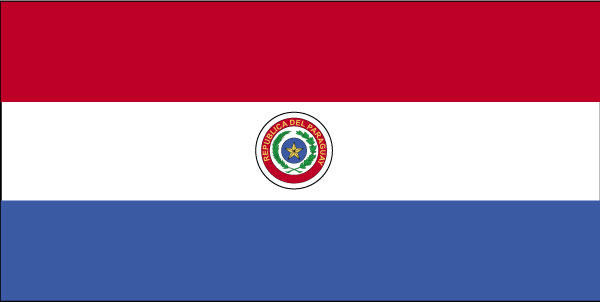
Paraguay
Paraguay
Declare Your Relationship to Paraguay
CountryReports Community
- Studying2
- From Paraguay0
- Paraguay heritage2
- Visited0
- Want to visit1
Customs and Culture
Customs and Culture
About the People
Paraguayans are deeply proud of their heritage. Paraguayan culture has been heavily shaped by its Spanish Colonial past creating a modern culture this is a unique blend of European and indigenous heritages. The system of social classes roughly follow the Spanish system. In general town people are considered to have higher status than country folk and people who have been married in the church may look down on those whose matrimony has been a less formal affair. Those who live in Asunción think of themselves as better than those who live in smaller towns
Cultural Attributes
Paraguayan culture has been heavily shaped by its Spanish Colonial past, creating a modern culture. This is a unique blend of European and indigenous heritages. Paraguayans are deeply proud of their heritage.
The system of social classes roughly follows the Spanish system. In general, town people are considered to have higher status than country folk, and people who have been married in the church may look down on those whose matrimony has been a less formal affair. Those who live in Asuncion think of themselves as better than those in smaller towns.

Land of Guaraní Spirit and Spanish Soul
Greetings, Gestures & Visiting
Common greetings in Paraguay include:
Handshakes: Handshakes are a common way to greet someone in Paraguay, particularly in formal or business settings. When shaking hands, making eye contact and offering a firm handshake is customary.
Cheek kisses: Cheek kissing is a standard greeting among friends and family in Paraguay. It's customary to exchange one or two kisses on the cheek, depending on the level of familiarity between the individuals. Generally, this involves touching cheeks and making a kissing sound without actual lip contact.
Verbal greetings: Verbal greetings are also important in Paraguay. Common greetings include "Hola" (hello), "Buenos días" (good morning), "Buenas tardes" (good afternoon), and "Buenas noches" (good evening/goodnight). Adding the person's title or surname, such as "Señor" or "Señora," shows respect.
Hugs: Close friends and family members may greet each other with hugs, especially if they haven't seen each other in a while.
"¿Cómo estás?": This phrase means "How are you?" and is often used as a friendly greeting. It's common for people to inquire about each other's well-being as part of the greeting.
"¿Cómo va?": Similar to "¿Cómo estás?", this phrase translates to "How's it going?" and is another casual way to greet someone.
The Guaraní have a secular, a secret, and a sacred language. All Guaraní speak the secular language. The male and female members speak the sacred language to receive divine messages and transmit them to the rest of the group. Religious leaders use the holy language.
Drinking maté is a social pastime and an important ritual shared among friends.
In urban areas, people wear Western or European styles of clothing. Rural women wear a shawl called a rebozo and a simple dress or a skirt and blouse. Men usually wear loose pants called bomachas, a shirt or jacket, a neck scarf, and a poncho.
Diet
The national dish is sopa paraguaya which is a corn bread with cheese and onions. Maise (corn) and cassava are a staple at most meals. Parrillada, grilled meat is a popular item at restaurants.

Family
Paraguayan women work hard doing housework, grinding corn, cooking food, mending clothes, and caring for their children. They also do the marketing and carry the water. Women are limited in their job opportunities outside the home. They can be needle workers, lace makers, laundresses, cigar makers, small storekeepers or cotton pickers to supplement family income.
In lower-income families, marriage is likely to be an informal affair with no church or civil ceremony. As a result, spouses may change frequently and easily. Marriages in which loyalty is not strongly asked of either partner often are dissolved, leaving the woman with the burden of raising the children.
Recreation
Futbol is the most popular sport and is played in every town, fields and at formal clubs. Basketball is the second most popular sport in Paraguay, Paraguayans enjoy hunting and fishing, both for sport and for food. Horseback riding , a necessity on the ranches has become a widely practiced pastime in the capitals and major towns.
Student Life
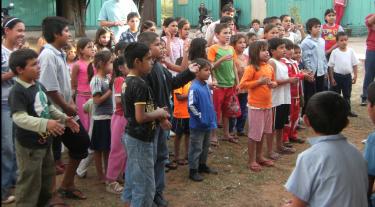
Mornings in Paraguay may differ from home to home, depending on which school session the children attend. Children arise early and have a light breakfast of local bread and perhaps a tea-like drink before heading off to work in the fields, sell goods on the street, or attend school for half the day.
Kids will either walk or ride public transportation buses to school, regardless of which school session they attend and then return home the same way. In some areas, bicycles may be the best way to get around, but walking remains most common. It is free and can get the kids everywhere, given enough time.
Most schools require a uniform. To make the most of the school buildings and facilities, some schools will begin at 7:30 and go until 11:30. A second session for other students will run from 1:30 until 5:30. Some schools will also offer a third session in the evening. Children only attend school four hours a day, and the multiple school sessions help them because they must often work most of the rest of the day, either on a farm in rural areas or selling goods on the streets in the cities. Children can make up most street vendors in the cities, which is quite a change from North American and European cultures. Most children go to school with only a notebook and a pencil. Textbooks are hard to come by, and teachers usually teach from a barely adequate blackboard. In Paraguay, the big meal of the day is usually at noon. Families return home for lunch and then take a little nap (siesta) after eating and returning to their day’s activities. This is becoming more difficult to do in large cities such as Asuncion, so the tradition is changing to a more American-like work and school schedule. Still, most of the country continues as it has for many, many years.
Paraguay has two official languages: Spanish and Guarani. Spanish is used in schools, government, and business, whereas Guarani is common for everyday conversations among family and friends. In schools with high Guarani-speaking populations, some classes and materials are available in that language. Primary education is Compulsory, but not every child attends, especially in rural areas. By the time young people reach secondary school, they often must give up their studies to work in the fields to supplement family incomes. To persuade parents of the relevance of education, the government offers technical and vocational education to young people. About 90 percent of the adult population can read and write. The school system is heavily influenced by the Catholic Church, which is the official state religion and operates nearly all private schools. There is little distinction between church and state education. However, other religions are permitted to worship in the country and operate schools if they so choose. In part because of this strong, centuries-long influence, the school system is quite centralized, with all schools conducting the same programs and teaching the same content. The core subjects covered in elementary schools include reading, writing, math, science, and history; additional subjects offered in many schools are Christian education, Spanish, Guarani, English, music, and computer skills. The average student-to-teacher ratio is 21 to 1. Unfortunately, many teachers in rural schools are not certified and are not as well educated as they should be.
Extracurricular activities in Paraguay are largely nonexistent. Children must join a community club if they want to participate in sports or other interests. Some private schools—especially for Americans living in the country—tend to offer more after-school activities than public schools so that the children will more readily fit into American schools when their families move back to the United States.
The youth of Paraguay love soccer, which is their favorite sport. Every town has a competitive soccer team for adult men, and the best teams compete with teams from Brazil, Uruguay, and Argentina. Young people enjoy supporting their favorite teams. They also enjoy basketball, volleyball, horse racing, and swimming. Children must often spend much of their time working to help support the family, but that does not prevent them from enjoying the time they can play games with their friends. Paraguayans are friendly and enjoy conversation as a sort of national pastime.
Social life in Paraguay centers on the family—and soccer! Parents are protective of their children, especially in the evenings. Children are expected to tell their parents whenever they leave home, explain where they are going and with whom, and give a close estimate of when they will be home. Girls are especially watched over and protected, so they will probably have stricter curfews and rules than their brothers. Godparents are also very important to the family structure in Paraguay. If the parents cannot fulfill their responsibilities, it is up to the godparents to step in and take over. Thus, it is common for children to visit their godparents in the evening to chat about their lives and what they are doing. For teenagers, family and godparents also significantly influence their political views since party loyalty is often the most essential factor in getting as good a job as possible, especially in rural areas. The wealthier people of Paraguay eat a lot of meat, especially beef. The rest of the population lives on a largely vegetarian diet made of cassava (sort of like a potato), corn, and beans. They also eat a lot of chili and a wide variety of vegetables. A typical meal is a porridge made of dried beans, peas, and peanuts. Paraguayans also enjoy baked corn souffle. Therefore, a common evening meal at home with family would often have one or more of these main dishes. Because the midday meal is the main meal for most of the country, the evening meal, usually around six or seven o’clock, is lighter. Families and communities are often poor, but they have simple but frequent celebrations where they gather and share friendships and family relations. Socializing does not revolve around expensive pastimes, and helping one another is a part of surviving well.
Education in Paraguay, like many Latin American countries, is difficult. Despite that, 80% of all children over five can read and write, and 92% of adults read and write. Schooling is free and required for children ages seven to fourteen. However, this rule is not strictly enforced, especially for children in rural areas. Many children never attend or will drop out in those areas to help their family attend to farming. The school year runs from March to October, with a two-week mid-winter (July) break. Because of the challenge of getting a good education in Paraguay wealthier families will often send their children to universities in Argentina or Brazil. Paraguay has two universities for those who can advance to that level (the National University and the Catholic University, but for those who do, the education is free—even at the universities. In the early 1970s, more than 95% of all rural students dropped out of school before finishing the required six years of education. Soon after, however, education began a slow but determined improvement. Recent studies show that the overall percentage of urban and rural children who finish six years of school has risen to nearly 40%. (For rural kids, only 25% finish elementary school.) Approximately one out of every four children will continue to secondary school, but only 1% will earn a university degree. One very encouraging fact is that young women make up half of all secondary school graduates, which reflects significant progress in education rights and possibilities for girls. Following six years in elementary school, secondary school is divided into two separate three-year segments: one focuses on the humanities and is intended to prepare students for university and professional studies, while the other is focused on more practical interests such as a program in agriculture, commerce, or industry. Graduation from either program brings the student a baccalaureate degree.
Holidays
Independence Day
5/14Independence Day
Christmas
12/25Christmas
The Christmas season begins with the Feast of the Immaculate Conception. Papa Noel (Father Christmas) is the one who brings gifts to the children.
Christmas dinner often features duck, lamb, chicken and turkey, beer and cider.
Dates of Interest
- September 30th
The city of Encarnación hosts one of Paraguay's most vibrant carnivals, featuring colorful parades, music, dancing, and elaborate costumes. The Encarnación Carnival typically takes place in February, attracting locals and tourists alike.
How do people greet each other in Paraguay?
Handshakes with eye contact are standard in formal settings, while cheek kisses and hugs are common among friends and family. Verbal greetings in Spanish are important and often include asking about someone's well-being.
Do
- Offer a firm handshake with eye contact in formal or business settings
- Exchange one or two cheek kisses with friends and family (touching cheeks and making a kissing sound)
- Use 'Hola', 'Buenos días', 'Buenas tardes', or 'Buenas noches' as appropriate
- Add a title like 'Señor' or 'Señora' to show respect
Good to know
- '¿Cómo estás?' (How are you?) and '¿Cómo va?' (How's it going?) are casual friendly greetings
- Close friends and family may greet with hugs, especially after time apart
What should I know about eating in Paraguay?
The national dish is sopa paraguaya, a corn bread with cheese and onions, and maize and cassava are staples at most meals. Grilled meat (parrillada) is a popular restaurant item.
Good to know
- Try sopa paraguaya, the national dish
- Look for parrillada (grilled meat) at restaurants
How should I dress in Paraguay?
In urban areas people wear Western or European styles of clothing, while rural attire is more traditional.
Good to know
- Rural women wear a shawl called a rebozo with a simple dress or skirt and blouse
- Rural men wear loose pants (bomachas), a shirt or jacket, a neck scarf, and a poncho
What is family life like in Paraguay?
Women carry a heavy domestic workload—housework, cooking, childcare, marketing, and carrying water—and have limited job opportunities outside the home. In lower-income families marriage is often informal, and spouses may change frequently.
Good to know
- Church marriage carries higher social status than informal unions
- Women's outside work is often limited to roles like needle work, lace making, laundry, cigar making, small storekeeping, or cotton picking
What do people do for fun in Paraguay?
Fútbol is the most popular sport, played everywhere from town fields to formal clubs, followed by basketball. Hunting, fishing, and horseback riding are also popular pastimes.
Good to know
- Fútbol is played in every town
- Horseback riding, once a ranch necessity, is now a widely practiced pastime in the capital and major towns
What should I know before visiting Paraguay?
Paraguayan culture is a proud blend of European and indigenous heritages shaped by its Spanish Colonial past, with a social class system roughly following the Spanish model.
Good to know
- Drinking maté is a social ritual shared among friends
- Town people are often considered higher status than country folk, and Asunción residents may see themselves as above those from smaller towns
- All Guaraní speak a secular language, with sacred and secret languages used in religious contexts
Last updated: 2026-07-12 · Sources: CountryReports
Photos of Paraguay
Photos of Paraguay


Travel and Tourism
Travel and Tourism
- Travel Alert Status
- Level 1: Exercise Normal Precautions
- Currency
- guarani (PYG)
- Time Difference
- UTC-4 (1 hour ahead of Washington, DC, during Standard Time)
- Climate
- Paraguay's climate is seasonal and subject to abrupt changes. It is subtropical, with summer and winter seasons opposite those in the United States. Winds are generally moderate, but high winds accompanied by thunder and electrical storms are common, especially in summer. The long, hot summer lasts from October through March, with January average maximum temperature 91ºF and mean temperature 81øF. Severe hot spells with very high humidity are common. Temperatures often exceed 100ºF during the day from December to February (the official record high temperature is 109ºF), with little relief at night. Winter extends from June through August. Cold snaps of 4 or 5 days with temperatures in the low 40s and high 30s are interspersed with several days in the upper 70s and low 80s. Frosts occur rarely. The official record low in Asuncion is 32ºF, although the damp air make it seem much colder. With frequent and abrupt changes, from winter to summer-like weather and back again (temperature changes of 20ºF-50ºF are common), Relative humidity ranges between 67% and 78% (monthly averages) year round and is particularly high in summer. Asuncion's average 59-inch annual rainfall is well distributed seasonally. Slightly greater amounts fall in hotter months. Torrential rains cause annual floods in riverside communities. The Chaco, which receives little rainfall, becomes semiarid in its westernmost reaches. During rainy periods, however, water covers large areas due to the impermeable clay subsoil.
- Airports
- 880
Read the full travel guide — health, safety, vaccinations, disease risk, sanitation, and transit details.
View full travel guideRecipes
Recipes
History
History
Historical Eras
Pre-Colonial Era
10000 BCE – 1537
Indigenous Guaraní peoples inhabited the region for millennia before European contact, organizing in semi-sedentary communities along river systems. Portuguese explorer Alejo García traversed the territory around 1525, becoming one of the first Europeans to encounter the Paraguayan interior. The Guaraní's social structures, language, and agricultural practices would profoundly shape the character of the colony that followed.
Colonial Period
1537 – 1811
Spanish settlers founded Asunción in 1537, establishing it as the administrative hub of the Río de la Plata region. Intermarriage between Spanish colonists and Guaraní women was actively encouraged, producing a predominantly mestizo society with a distinctive bilingual culture. The Jesuit missions, established from 1609 onward, created autonomous reductions that evangelized and organized tens of thousands of Guaraní until the order's expulsion in 1767.
Early Republic
1811 – 1865
Paraguay declared independence from Spain in 1811, becoming one of South America's earliest independent states. José Gaspar Rodríguez de Francia ruled as dictator for life from 1816 until his death in 1840, sealing the country's borders, dismantling the criollo elite, and instituting a form of state socialism to preserve sovereignty. His successors Carlos Antonio López and Francisco Solano López modernized the country's infrastructure and military while steering it toward catastrophic regional conflict.
War & Reconstruction
1865 – 1904
The War of the Triple Alliance (1865–1870) pitted Paraguay against Brazil, Argentina, and Uruguay, resulting in the death of roughly two-thirds of the male population and the loss of significant territory. President Francisco Solano López died in battle in 1870, ending the conflict, and subsequent peace treaties with Brazil (1872), Argentina (1876), and Uruguay (1882) formalized Paraguay's diminished borders. War hero General Bernardino Caballero founded the Colorado Party in 1874, which came to dominate Paraguayan politics for generations.
Chaco Era & Instability
1904 – 1954
The Liberal Party ousted the Colorados in 1904, ushering in decades of political turbulence marked by frequent coups and presidential turnover. The Chaco War (1932–1935) against Bolivia ended in a Paraguayan military victory that secured the vast Chaco Boreal region, delivering a rare moment of national pride. The postwar period nonetheless remained deeply unstable, culminating in a civil war in 1947 and the Colorado Party's return to power, setting the stage for authoritarian consolidation.
Stroessner Dictatorship
1954 – 1989
General Alfredo Stroessner seized power in 1954 and ruled Paraguay for 35 years, making his regime one of the longest-lasting dictatorships in Latin American history. His government maintained control through the Colorado Party apparatus, systematic repression, and close alliance with the United States during the Cold War. Stroessner was overthrown in a military coup led by General Andrés Rodríguez in February 1989, opening the path to democratic transition.
Democratic Era
1989 – present
Paraguay adopted a new democratic constitution in 1992 and has held regular presidential elections since 1989, though political instability, corruption, and Colorado Party dominance have repeatedly tested democratic consolidation. The country experienced its first peaceful transfer of power to an opposition candidate in 2008, when Fernando Lugo defeated the Colorados after six decades of uninterrupted rule. Paraguay continues to navigate challenges including land inequality, organized crime, and economic dependence on agriculture, particularly soybeans and hydroelectric exports.
Overview
Timeline of Key Events
1525
Portuguese explorer Alejo Garcia visits Paraguay.
Portuguese explorer Alejo Garcia visits Paraguay.
1537
Spanish settlers established the first successful colony in the Río de la Plata area at Asunción.
Spanish settlers established the first successful colony in the Río de la Plata area at Asunción.
1537
Spanish begin colonising the interior plains of Paraguay.
Spanish begin colonizing the interior plains of Paraguay.
1588
Members of the Roman Catholic Society of Jesus, known as Jesuits arrived in Paraguay.
Members of the Roman Catholic Society of Jesus, known as Jesuits arrived in Paraguay.
1609
Spanish Jesuits begin converting the local population to Roman Catholicism.
Spanish Jesuits begin converting the local population to Roman Catholicism.
1811
Paraguay declares its independence from Spain.
Paraguay declares its independence from Spain.
1865
Paraguay is reduced to half its population
Paraguay is reduced to half its population, looses 55,000 square miles, and is saddled with huge debt as a result of the War of the Triple Alliance where Brazil, Argentina and Uruguay fight against Paraguay.
Read the full history profile — narrative overview, defining eras, and the complete timeline in one place.
View expanded historyInteresting Facts
Interesting Facts
The Guarani are one of the indigenous groups which inhabited Paraguay before the arrival of Europeans. In August 2004 over four hundred and twenty people died in a fire at a shopping centre in Asuncion.
See every fact — trivia, oddities, and curious tidbits gathered from across the country.
View all interesting factsGeography and Environment
Geography and Environment
- Terrain
- grassy plains and wooded hills east of Rio Paraguay; Gran Chaco region west of Rio Paraguay mostly low, marshy plain near the river, and dry forest and thorny scrub elsewhere
- Climate
- Paraguay's climate is seasonal and subject to abrupt changes. It is subtropical, with summer and winter seasons opposite those in the United States. Winds are generally moderate, but high winds accompanied by thunder and electrical storms are common, especially in summer. The long, hot summer lasts from October through March, with January average maximum temperature 91ºF and mean temperature 81øF. Severe hot spells with very high humidity are common. Temperatures often exceed 100ºF during the day from December to February (the official record high temperature is 109ºF), with little relief at night. Winter extends from June through August. Cold snaps of 4 or 5 days with temperatures in the low 40s and high 30s are interspersed with several days in the upper 70s and low 80s. Frosts occur rarely. The official record low in Asuncion is 32ºF, although the damp air make it seem much colder. With frequent and abrupt changes, from winter to summer-like weather and back again (temperature changes of 20ºF-50ºF are common), Relative humidity ranges between 67% and 78% (monthly averages) year round and is particularly high in summer. Asuncion's average 59-inch annual rainfall is well distributed seasonally. Slightly greater amounts fall in hotter months. Torrential rains cause annual floods in riverside communities. The Chaco, which receives little rainfall, becomes semiarid in its westernmost reaches. During rainy periods, however, water covers large areas due to the impermeable clay subsoil.
- Natural Hazards
- local flooding in southeast (early September to June); poorly drained plains may become boggy (early October to June)
- Current Environmental Issues
- deforestation; water pollution; inadequate means for waste disposal present health risks for many urban residents; loss of wetlands
Read the full geography and environment profile — terrain, climate, natural resources, hazards, land use, and international agreements.
View full geographyPeople & Demographics
People & Demographics
Religion
Languages Spoken
Spanish (official), Guarani (official)
- Guarani
- Spanish
Population
- Population
- 6,375,830
- Population in Major Urban Areas
- ASUNCION (capital) 2.139 million
- Nationality Noun
- Paraguayan(s)
- Ethnic Groups
- mestizo (mixed Spanish and Amerindian) 95%
Education
- Literacy Definition
- age 15 and over can read and write
Most schools require a uniform. To make the most of the school buildings and facilities, some schools will begin at 7:30 and go until 11:30. A second session for other students will run from 1:30 until 5:30. Some schools will also offer a third session in the evening. Children only attend school four hours a day, and the multiple school sessions help them because they must often work most of the rest of the day, either on a farm in rural areas or selling goods on the streets in the cities. Children can make up most street vendors in the cities, which is quite a change from North American and European cultures.
Most children go to school with only a notebook and a pencil. Textbooks are hard to come by, and teachers usually teach from a barely adequate blackboard.
In Paraguay, the big meal of the day is usually at noon. Families return home for lunch and then take a little nap (siesta) after eating and returning to their day’s activities. This is becoming more difficult to do in large cities such as Asuncion, so the tradition is changing to a more American-like work and school schedule. Still, most of the country continues as it has for many, many years.
Health Information
- Major Infectious Diseases — degree of risk
- intermediate
Read the full people and society profile — demographics, health, education, religion, languages, and notable people.
View full people and societyGovernment & Politics
Government & Politics
Country Identity
- Country Name
- Paraguay
- Full Country Name
- Republic of Paraguay
- Local - Long
- Republica del Paraguay
- Local - Short
- Paraguay
Government Structure
- Government Type
- constitutional republic
- Legal System
- based on Argentine codes, Roman law, and French codes; judicial review of legislative acts in Supreme Court of Justice
- Executive Branch
- chief of state: President Santiago PEÑA Palacios (since 15 August 2023); Vice President Pedro ALLIANA (since 15 August 2023); note - the president is both the chief of state and head of government head of government: President Santiago PEÑA Palacios (since 15 August 2023); Vice President Pedro ALLIANA (since 15 August 2023); note - the president is both the chief of state and head of government cabinet: Council of Ministers nominated by the president elections: president and vice president elected on the same ticket by popular vote for five-year terms; election last held 30 April 2023 (next to be held in April 2028) election results: Santiago PEÑA Palacios elected president; percent of vote - Santiago PEÑA Palacios (ANR-Colorado Party) 42.7%, Efraín ALEGRE (GANAR Alliance) 27.5%, Paraguayo CUBAS (Cruzada Nacional) 22.9%, other 6.9%
- Legislative Branch
- bicameral Congress or Congreso consists of the Chamber of Senators or Camara de Senadores (45 seats; members are elected by popular vote to serve five-year terms) and the Chamber of Deputies or Camara de Diputados (80 seats; members are elected by popular vote to serve five-year terms) elections: Chamber of Senators - last held 27 April 2003 (next to be held April 2008); Chamber of Deputies - last held 27 April 2003 (next to be held April 2008) election results: Chamber of Senators - percent of vote by party - NA; seats by party - ANR 16, PLRA 12, UNACE 7, PQ 7, PPS 2, PEN 1; Chamber of Deputies - percent of vote by party - NA%; seats by party - ANR 37, PLRA 21, UNACE 10, PQ 10, PPS 2 note: as of January 2006, changes in party affiliation has led to the composition of the legislature as follows: Chamber of Senators - seats by party - ANR 18, PLRA 12, UNACE 5, PQ 7, PPS 2, PEN 1; Chamber of Deputies - seats by party - ANR 39, PLRA 21, UNACE 8, PQ 10, PPS 2
- Judicial Branch
- Supreme Court of Justice or Corte Suprema de Justicia (judges appointed on the proposal of the Council of Magistrates or Consejo de la Magistratura)
- Suffrage
- 18 years of age; universal and compulsory up to age 75
- Constitution
- promulgated 20 June 1992
- Independence
- 14 May 1811 (from Spain)
- National Holiday
- Independence Day, 14 May (1811) (observed 15 May annually)
Capital City
- Capital Name
- Asunción
- Capital - geographic coordinate
- 25 16 S, 57 40 W
- Capital Time Difference
- UTC-4 (1 hour ahead of Washington, DC, during Standard Time)
the name means "assumption" and derives from the original name given to the city at its founding in 1537, Nuestra Senora Santa Maria de la Asuncion (Our Lady Saint Mary of the Assumption)
Military
Branches: Armed Forces Command (Commando de las Fuerzas Militares): Army, National Navy (Armada Nacional, includes Marine Corps, Naval Aviation, and Coast Guard), Paraguayan Air Force (Fuerza Aerea Paraguay, FAP), Logistics Command, War Materiel Directorate
Embassy / Diplomatic Mission
U.S. Embassy Asuncion
1776 Mariscal Lopez Avenue, Asuncion, Paraguay.
Telephone: 595-21-213-715
Emergency after-hours telephone: 595-21-213-715 then press 0 to be connected to the Operator
Facsimile: 595-21-228-603
E-mail: ParaguayConsular@state.gov
Read the full government profile — flag symbolism, national anthem, and other national symbols.
View full government detailsEconomy
Economy
Paraguay has a market economy distinguished by a large informal sector, substantial agricultural production, and a sizable hydroelectric power industry. The informal sector includes both the reexport of imported consumer goods to neighboring countries and the activities of thousands of microenterprises and urban street vendors. Because of the importance of this sector, accurate economic measures are often difficult to obtain. A significant share of the population derives its livelihood from agriculture, frequently on a subsistence basis, while soybeans, beef, corn, and wheat dominate the country's export earnings.
Paraguay is one of the world's leading exporters of soybeans and beef, and it generates virtually all of its electricity from hydroelectric sources, notably the Itaipú and Yacyretá dams shared with Brazil and Argentina. The economy has shown considerable volatility, closely tied to weather conditions and global commodity prices. After a sharp contraction in 2019 and a further downturn in 2020 due to the COVID-19 pandemic, the economy rebounded and has since posted solid growth, with GDP expanding by roughly 4–5% in 2023 and continued growth projected in 2024, supported by strong agricultural output and stable macroeconomic management.
Despite this resilience, persistent challenges include high levels of informality, income inequality, poverty in rural areas, corruption, weak institutions, deficient infrastructure, and vulnerability to climate-related shocks. Structural reforms aimed at strengthening tax administration, improving governance, and diversifying the economy remain central to Paraguay's long-term development prospects.
Snapshot
- Currency Name and Code
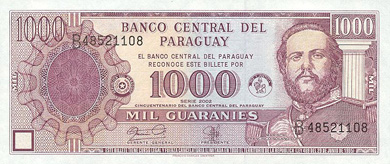
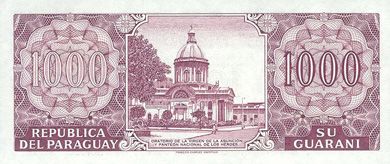
- Paraguayan Guarani (PYG)
- GDP — official exchange rate
- $7,281,000,000 (USD)
- GDP Real Growth Rate
- 2.7%
- Gini Index
- 86.8
Banknotes
Budget & Public Finance
- Fiscal Year
- calendar year
- Annual Budget
- $1,370,000,000 (USD)
- Public Debt (% of GDP)
- 36.1%
- External Debt
- $3,535,000,000 (USD)
- Investment (% of GDP)
- 20.1%
- Current Account Balance
- -$170,000,000 (USD)
- Reserves of Foreign Exchange
- $1,293,000,000 (USD)
Labor, Industry & Trade
- Labor Force by Occupation
- agriculture 45%
- Household Income — highest 10%
- 43.8%
- Industries
- sugar, cement, textiles, beverages, wood products, steel, metallurgic, electric power
- Agriculture Products
- cotton, sugarcane, soybeans, corn, wheat, tobacco, cassava (tapioca), fruits, vegetables; beef, pork, eggs, milk; timber
- Export Commodities
- soybeans, feed, cotton, meat, edible oils, electricity, wood, leather
- Export Partners
- Brazil 29.8%, Argentina 18%, Chile 5.5%, Bermuda 4%
- Import Commodities
- road vehicles, consumer goods, tobacco, petroleum products, electrical machinery
- Import Partners
- Brazil 28.9%, US 22.5%, Argentina 17.7%, Uruguay 4.7%, Hong Kong 4.3%, China 4.1%
Energy
- Oil Production
- 0 bbl/day
- Oil Consumption
- 25,000 bbl/day
- Oil Reserves
- 0 bbl/day
- Natural Gas Production
- 0 cu m
- Natural Gas Consumption
- 0 cu m
- Natural Gas Imports
- 0 cu m
- Natural Gas Exports
- 0 cu m
- Natural Gas Reserves
- 0 cu m
Communications
- Telephone System
- general assessment: the fixed-line market is a state monopoly and fixed-line telephone service is meager; principal switching center is in Asuncion domestic: deficiencies in provision of fixed-line service have resulted in a rapid expansion of mobile-cellular services fostered by competition among multiple providers international: country code - 595; satellite earth station - 1 Intelsat (Atlantic Ocean)
- Internet Country Code
- .py
News & Weather
News & Weather
Current Weather
Latest News
Micropep Submits Peptide Product for Approval in Brazil, Paraguay - AG INFORMATION NETWORK OF THE WEST
AG INFORMATION NETWORK OF THE WEST · 59m ago
Brazil, Argentina, Chile and Paraguay Sign Open Skies Agreement - Rus Tourism News
Rus Tourism News · 22h ago
Paraguay’s Celeste Amarilla Says Her Instagram Was Hacked Following Racist Comments About Mbappé - Forbes
Forbes · 12d ago
World Cup 2026: Paraguay attacker Julio Enciso injured in warm-up friendly - BBC
BBC · 45d ago
Thousands of tickets remain available for USA World Cup opener vs. Paraguay; Will it sell out? - The Athletic - The New York Times
The New York Times · 43d ago
This 'America the Beautiful' rendition before the France vs Paraguay match will give you goosebumps - Fox News
Fox News · 17d ago
French Open fines Paraguay's Vallejo $65K for sexist ump remark - ESPN
ESPN · 50d ago
World Cup 2026 Group D guide - fixtures, schedule, standings and odds for USA, Paraguay, Australia and Turkey - Sky Sports
Sky Sports · 25d ago
News via Google News
Climate Overview
Paraguay's climate is seasonal and subject to abrupt changes. It is subtropical, with summer and winter seasons opposite those in the United States. Winds are generally moderate, but high winds accompanied by thunder and electrical storms are common, especially in summer. The long, hot summer lasts from October through March, with January average maximum temperature 91ºF and mean temperature 81øF. Severe hot spells with very high humidity are common. Temperatures often exceed 100ºF during the day from December to February (the official record high temperature is 109ºF), with little relief at night.
Winter extends from June through August. Cold snaps of 4 or 5 days with temperatures in the low 40s and high 30s are interspersed with several days in the upper 70s and low 80s. Frosts occur rarely. The official record low in Asuncion is 32ºF, although the damp air make it seem much colder. With frequent and abrupt changes, from winter to summer-like weather and back again (temperature changes of 20ºF-50ºF are common), Relative humidity ranges between 67% and 78% (monthly averages) year round and is particularly high in summer.
Asuncion's average 59-inch annual rainfall is well distributed seasonally. Slightly greater amounts fall in hotter months. Torrential rains cause annual floods in riverside communities. The Chaco, which receives little rainfall, becomes semiarid in its westernmost reaches. During rainy periods, however, water covers large areas due to the impermeable clay subsoil.
Videos
Videos
1 curated YouTube videos.
Source: YouTube
Frequently Asked Questions
Frequently Asked Questions
What is the population of Paraguay?
How do people greet each other in Paraguay?
What should I know about eating in Paraguay?
How should I dress in Paraguay?
What is family life like in Paraguay?
What do people do for fun in Paraguay?
What should I know before visiting Paraguay?
What is the capital of Paraguay?
Where is Paraguay located?
What countries border Paraguay?
What is the main religion in Paraguay?
What is the currency of Paraguay?
What languages are spoken in Paraguay?
What is Paraguay known for?
Last reviewed 2026