
 English
 Español
 中文
中文 हिन्दी
 Français
Ethiopia
Ityop'iya
Declare Your Relationship to Ethiopia
CountryReports Community
- Studying1
- From Ethiopia2
- Ethiopia heritage1
- Visited1
- Want to visit1
Customs and Culture
Customs and Culture
About the People
All people of Ethiopia, whether Christian or Muslim, tend to be somewhat complacent and passive, enduring adversity with stoicism unknown in the Western world. They also tend to be quite formal in their dealings, not only with strangers, but with each other. A strong sense of individualism pervades the Ethiopian personality. Individuals are expected to stand up for their rights and desires. Genuine concern for others and courtesy are noticeable personality traits of Ethiopians. Ethiopians are proud of the fact that they escaped colonization in the 19th century when much of the rest of the continent was held by Europeans.
Cultural Attributes
All people of Ethiopia, whether Christian or Muslim, tend to be somewhat complacent and passive, enduring adversity with stoicism unknown in the Western world. They also tend to be quite formal in their dealings, not only with strangers, but with each other. A strong sense of individualism pervades the Ethiopian personality. Individuals are expected to stand up for their rights and desires. Genuine concern for others and courtesy are noticeable personality traits of Ethiopians. Ethiopians are proud of the fact that they escaped colonization in the 19th century when much of the rest of the continent was held by Europeans.

Land of Thirteen Months of Sunshine
Greetings, Gestures & Visiting
Like most Semitic peoples, the Amhara place great emphasis on formal but very courteous greetings to both friends and strangers. Shaking hands with one or both hands, though more gently than the Western handshake, is common between members of the same sex. Friends often embrace each other formally but warmly. Members of opposite sex do not greet each other physically.
Pointing is generally considered rude. One never uses the left-hand to give or receive items; the right-hand or both hands are used. It is an insult to refer to a person as Galla, a name once used for the Oromo people. Trilling the tongue is a way of showing excitement.
The Amharic home is a highly private and personal domain. Visits are not made without invitation. If one is going to a home for the first time, a small gift is in order. Visitors are expected to accept any refreshments or food offered. Conversation should avoid highly personal topics and is best kept casual.
In larger cities, most people wear Western-style clothing under the traditional white shamma (toga). Men in some ethnic groups wear turbans. Women generally wear dresses. Full native dress is still worn by many, particularly on holidays. Conservative dress is a must for visitors.
Diet
The Ethiopian diet includes lamb, goat, and fowl. Ethiopians do not usually eat pork, turkey, or ham. Common foods include injera, a fermented bread made of teff flour, and wat, a spicy stew made with beef or chicken. Strict religious dietary and fasting customs, especially for Muslims, also affect the menu. For the many people who have limited access to food, a daily diet consists of grains and relief supplies.
Amhara hosts take pride in offering guests the best meal they are capable of providing, whether at a public restaurant or in the home. Visitors are often given more food than they are able to eat. Leaving some food on the plate is polite because it indicates the host’s ability to more than adequately provide for guests. As is the custom in the Semitic world, food is eaten with the fingers of the right hand (never the left).
The Ethiopian diet includes lamb, goat, and fowl. Ethiopians do not usually eat pork, turkey, or ham. Common foods include injera, a fermented bread made of teff flour, and wat, a spicy stew made with beef or chicken. Strict religious dietary and fasting customs, especially for Muslims, also affect the menu. For the many people who have limited access to food, a daily diet consists of grains and relief supplies.

Family
The Amharic family is strongly patriarchal, a pattern typical throughout Ethiopia. Sons usually bring their brides to live with or near their father’s family, and three or more generations in the male line frequently live under one roof. Age is highly respected in Ethiopia, and the elderly are cared for by their children. Only a small percentage (6 percent) of the population is older than age 60. A woman’s duties and privileges are well-defined both within the home and elsewhere, and women often lead sheltered lives. Families are very private.
Dating Customs
Dating and marriage customs in Ethiopia remain deeply rooted in tradition, though practices vary considerably across the country's many ethnic groups and between urban and rural communities. Because marriage is viewed as the union of two families rather than just two individuals, arranged or family-guided marriages are still common, particularly in rural areas. Parents and extended family members often play a central role in selecting suitable partners, with considerations such as family background, social standing, and ethnic or religious compatibility carrying significant weight. While younger generations in cities like Addis Ababa have greater exposure to Western-style courtship and may have more personal input in choosing a partner, most Ethiopians still honor family involvement to some degree. Religious affiliation also shapes marriage customs, as Ethiopia has large Orthodox Christian and Muslim populations, each with their own distinct traditions and ceremonies.
Bride wealth, known locally as tilosh or similar terms depending on the region, remains a practiced custom in many communities. Marriages are generally expected to be lifelong commitments, and although divorce rates have risen somewhat in urban areas in recent years, divorce still carries social stigma in many parts of the country and remains less common than in Western societies.
Recreation
Ethiopians enjoy football (soccer) and it is the most popular sport. Long distance running is also popular. Traditional sports include stick fighting and wrestling. Women cheer the men and encourage them to be fierce. In the rural countryside children play with what ever they have making animals, dolls and balls of mud, sticks, tin cans and cloth. In the urban areas there are movie theaters and many bars and night clubs for dancing. A sport this is unique to the Tigray and Amhara is a cross-county field hockey.
Student Life
Ethiopian children wake up early. Some because they have chores, others because the whole family sleeps in a shared room and the hustle and bustle of the adults going to work or starting the cooking fires wakes them up and still others because there is so little entertainment in the house they just want to get up and out of bed. It’s usually with a big smile that they greet the sun and call out to one another Indemin aderk/adersh? - an inquiry as to how one spent the night and the answer Egziabher yimesgen!’ or “Lord be Praised” is an Ethiopian good morning. Next it’s a breakfast of flat corn or maize pancake called kitta and a few sips of tea. If there are cattle that need to be tended to or let out to graze, the child would need to have his breakfast, to go. The daughters will usually get up and help with the house chores. They will help get the fires going, clean the house, fetch water, gather firewood and help with the cooking.
Getting to school is a trip that can take as long as two hours. While the city children get to school on public or school buses, taxis or family cars, the rural children have no other choice but to walk. If along the way there is a main road the lucky few may get rides half or all the way. But there is a risk involved in this mode of transport: The traffic on these routes consists mostly of trucks transporting goods to and from the cities. The children usually have to climb into the back of these trucks, which are sometimes over laden with goods. It is too often that news is heard of dozens of children killed in traffic accidents. If it is the rainy season, then even this might not be possible.
In Ethiopia the modern school system was introduced during the reign of Emperor Menelik II in 1908, with the opening of Ecole Imperiale Menelik II (known today as Menelik II Secondary School). The majority of school expansion was limited to the major cities or towns. The Ethiopian civil war ended in 1991 with the overthrow of the Marxist Dergue regime. The school and education systems were in shambles and the statistics painted a grim picture. But after a slow start and some blunders the new government has made progress on almost all fronts of the education system. There has been a constant growth in the number of schools, teachers and the school materials and supplies. The average age of the primary schools in the rural areas is around 5 to 7 years. The schools are blocks of houses built with the basic necessities needed to function. It may or not have a boundary marked by a barbed wire fence. The roof is corrugated iron and the walls are made of cement blocks. Behind the main blocks there are rows of taps for drinking water and at least two toilets. If lucky, and connected to the power grid, the school may have a library with donated books and a computer or two in the lab. It is encouraging to see that the number of plasma televisions, making their way into almost all the schools for the past 5 years, has introduced the remotest students to the modern lessons beamed via satellites. It has made them go from the outdated information in the old books to the 21st century with one great leap.
Like the Ethiopian New Year, the school year starts on September 11th of every year. It goes on for 10 of the thirteen months, yes, Ethiopia has thirteen, not twelve months. Primary school starts at 8:00 a.m. every day, when the bell is rung and the children line up in front of the flag pole for the singing of the national anthem and the raising of the Ethiopian flag. In schools where uniforms are mandatory, a general check is made to see if anyone stands out or has improper attire. With the new curriculum introduced in the late 1990’s children go to school from 8:00 a.m. till 3:00 or 4:00 p.m. in the cities. In rural areas, because of the acute shortage of teachers, and because the children mostly live far away from their schools and also because rural schools cannot provide lunches for the children, they have to go home after one shift has ended. In the classroom of a rural primary school each class is 40 minutes long and consists of 3 classes each, with a 30 minute break. Morning classes end at 12:30 PM. The afternoon shift starts at 1:00 p.m. and ends at 5:30 p.m. There are, on average, 50 to 60 students to a class. These students sit three or four to a bench. As the teacher walks into the classroom all students stand up and shout their greetings- ‘Good morning, teacher’ to which the teacher answers ‘Good morning, students. Please, sit down.’ and the students take their places. Attendance is recorded at the start of each class and then it’s on to the lessons. The subjects taught in Ethiopian schools are English, Amharic (or whatever the native tongue of the children is), mathematics, social studies, art, music and physical education. In Ethiopia corporal punishment in schools, though illegal, is still acceptable, and children may be punished with the swat of a switch or by being made to kneel in a corner for the duration of the class. However, teachers are revered in the rural areas, and headmasters are the absolute authoritarians, and there isn’t much need for punishment. The thirst for knowledge makes it a taboo to go against such persons or their institutions. It is in the cities with that respect for teachers is slowly being eroded due to the effects of ‘modernization’ and corruption of traditional cultures. Most primary school students do not go on to get a secondary or higher education. The first reason is the fact that secondary schools are much rarer than primary schools or inaccessibly far away and the second is that families do not encourage their daughters to go on to higher education because they think it is a waste since she is nearing , or in some areas already are of, marriageable age.
After school, children are expected go straight home and help with the chores and with the farming. The cattle are watered and fed and if it’s planting, weeding or harvesting time the children lend a hand. But on summer vacations, during the two months’ wet season, the children, especially the boys, are free to do whatever they want. In a soccer-mad country every Ethiopian boy, sometimes even girls, must own a ball or two. Homemade balls are made out of plastic bags rolled into a sock. The more complicated ones are made out of rolled up plastic bags, bound with a length of string and then stitched over with patches of cloth. These are works of art that every child learns early on. The girls prefer more subtler games like Pepsi where a small ball is thrown to hit an opponent who keeps dodging the missile as they build a small tower of soda bottle caps. Alternatively they skip rope, play hide and seek, hopscotch or play house with dolls made from corn husks.
The day ends when the sun goes down. In rural areas street lights are very rare, with it being almost non-existent if the village is not on a major road or highway. With no place to go the family usually gathers around the hearth by dusk. While parents unwind over traditional coffee ceremonies or home-brewed beers like tella’ and meads like tej’, children are expected to settle into another part of the home, even if it’s one-roomed, and not participate in the adult conversations. In their part of the house, children do their homework, tell Teret (stories) and Inkokilish (riddles) to one another and wait for dinner time. Dinner, usually consisting of Ethiopian flat bread called injera and a stew called wot, is served and the whole family gathers around one platter to eat. With dinner over it’s time to go to sleep and as the fires burn out the family tucks into bed calling out Dehnaider/ideri meaning ‘Good night.’
To the average rural family, education is an escape from poverty. Any family that can send children to school does. Getting any kind of schooling is seen as the most important thing a family can give a child. Some families even send their children away to cities to work, as domestic laborers, and live with a distant relative who in return will pay for their education.
Holidays
National Day
5/28Independence
defeat of MENGISTU regime
Christmas
12/25Christmas
Christmas or Genna as it is called in Ethiopia is celebrated on January 7 and Timkat (Epiphany) is celebrated on January 19th. Genna actually refers to a national game similar to field hockey that is played only on Christmas Day.
Christmas dinner might consist of injera (flat sourdough bread) and dorowat (chicken stew).
On the eve of Timkat, a procession of worshipers follows a priest bearing a tabot (ark), a replica of the biblical ark of the Covenant, to a nearby body of water where celebrations take place all night amid feasting and dancing. On Timkat morning, priests bless the water by immersing a cross, after which celebrants often wash themselves to receive blessings.
During this time of year people make pilgrimages to 12 monolithic churches hewn from solid volcanic rock in the city of Lalibela. Legend contends that King Lalibela in the twelfth century enlisted the help of angels to build these structures which stand in two groups on either side of a gorge called the River Jordan.
Children receive simple gifts such as clothing only on Timkat.
Dates of Interest
- December 25th
Christmas or Genna as it is called in Ethiopia is celebrated on January 7 and Timkat (Epiphany) is celebrated on January 19th. Genna actually refers to a national game similar to field hockey that is played only on Christmas Day. Christmas dinner might consist of injera (flat sourdough bread) and dorowat (chicken stew). On the eve of Timkat, a procession of worshipers follows a priest bearing a tabot (ark), a replica of the biblical ark of the Covenant, to a nearby body of water where celebrations take place all night amid feasting and dancing. On Timkat morning, priests bless the water by immersing a cross, after which celebrants often wash themselves to receive blessings. During this time of year people make pilgrimages to 12 monolithic churches hewn from solid volcanic rock in the city of Lalibela. Legend contends that King Lalibela in the twelfth century enlist
How do people greet each other in Ethiopia?
Greetings are formal but very courteous with both friends and strangers; handshakes are common between members of the same sex, but opposite sexes do not greet physically.
Do
- Shake hands more gently than a Western handshake, using one or both hands, between the same sex
- Expect friends to embrace each other formally but warmly
Don’t
- Don't greet a member of the opposite sex physically
What are the dining customs in Ethiopia?
Hosts take pride in offering guests the best meal they can, often serving more food than you can eat; food is eaten with the fingers of the right hand.
Do
- Eat with the fingers of your right hand
- Leave some food on the plate, as it signals the host provided more than adequately
Don’t
- Never eat with the left hand
- Don't expect pork, turkey, or ham, which Ethiopians do not usually eat
Good to know
- Common foods include injera (fermented teff bread) and wat (a spicy stew with beef or chicken)
- The diet includes lamb, goat, and fowl
- Religious dietary and fasting customs, especially for Muslims, affect the menu
What etiquette should I know when visiting an Ethiopian home?
The Amharic home is highly private and personal; visits are made only by invitation and guests should accept any food or refreshments offered.
Do
- Wait for an invitation before visiting a home
- Bring a small gift if visiting a home for the first time
- Accept any refreshments or food offered
- Keep conversation casual
Don’t
- Don't visit a home without an invitation
- Don't bring up highly personal topics in conversation
How should I dress in Ethiopia?
Conservative dress is a must for visitors; in larger cities most people wear Western-style clothing under the traditional white shamma (toga).
Do
- Dress conservatively
Good to know
- Men in some ethnic groups wear turbans and women generally wear dresses
- Full native dress is still worn by many, particularly on holidays
Which gestures should I use or avoid in Ethiopia?
Pointing is considered rude, and the left hand is never used to give or receive items.
Do
- Use the right hand or both hands to give or receive items
- Note that trilling the tongue shows excitement
Don’t
- Don't point at people
- Don't use the left hand to give or receive items
- Don't refer to a person as Galla, an insulting name once used for the Oromo people
What is family life like in Ethiopia?
The Amharic family is strongly patriarchal, with three or more generations often living together, and age is highly respected.
Good to know
- Sons usually bring their brides to live with or near the father's family
- The elderly are cared for by their children
- Women's duties and privileges are well-defined and women often lead sheltered lives
- Families are very private
What do people do for recreation in Ethiopia?
Football (soccer) is the most popular sport, and long-distance running is also popular.
Good to know
- Traditional sports include stick fighting and wrestling
- A cross-country field hockey is unique to the Tigray and Amhara
- Urban areas have movie theaters, bars, and night clubs for dancing
- Rural children make toys from mud, sticks, tin cans, and cloth
Last updated: 2026-07-12 · Sources: CountryReports
Photos of Ethiopia
Photos of Ethiopia
Shepherds living in Simien National Park, Northern Ethiopia
Bet Giorgis church
Lalibela, Ethiopia
Men prepare to attend church
Man rests near Lalibela, Ethiopia
Women carry goods along the roadway.
Village in Ethiopia
People pose for a photo in Northern Ethiopia.
Lake Awasa boat fleet.
Rock formation in northern Ethiopia
Blue Nile Falls, Ethiopia
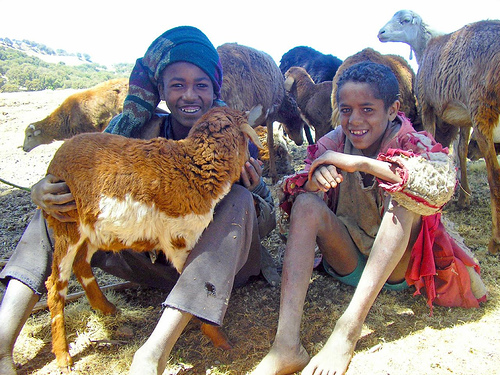
Young shephards of the Simien Mountains, Ethiopia


Travel and Tourism
Travel and Tourism
- Travel Alert Status
- Level 3: Reconsider Travel
- Currency
- 23.25
- Time Difference
- UTC+3 (8 hours ahead of Washington, DC, during Standard Time)
- Climate
- The climate varies from temperate in the highlands to hot in the lowlands. Addis Ababa's altitude is above 8,000 feet. Addis Ababa has two primary seasons: a dry season from October to February, and for the rest of the year, a rainy season, divided into "small rains" and "big rains." The small rains, February through April, are generally intermittent showers. The big rains, June through September or longer, usually bring heavy daily precipitation. The big rains are rarely continuous, and sunny mornings or afternoons can be expected on many days. Average annual rainfall in Addis Ababa is 50 inches. Daytime temperatures are fairly constant throughout the year. The dry season has bright, sunny days with moderate to cool temperatures; nights are chilly. The average daily temperature in Addis Ababa is 62.9°F. Daytime temperatures are rarely above 80°F. Sharp drops in temperature occur in late afternoon, sometimes making outside entertainment uncomfortable after 5 p.m. Night temperatures drop to the low 40”™s from November to January and are warmer in the period from February to May.
- Airports
- 82
Read the full travel guide — health, safety, vaccinations, disease risk, sanitation, and transit details.
View full travel guideRecipes
Recipes
Injera (Ethiopian Bread)
Bread
Main Dish
Ethiopian Spicy Braised Chicken
Main Dish
Amhari - Atklit, Tigre - Alz'e (Ethiopian Vegetable Bowl)
Main Dish
Doro Wat (Ethiopian Stew)
Side Dish
Berbere (Ethiopian Hot Spice Mixture)
Side Dish
Atar Allecha (Spiced Green Pea Puree)
Side Dish
Metin Shuro (Spiced vegetables)
Bread
PremiumInjera (Ethiopian Bread)
History
History
Historical Eras
Aksumite Kingdom
900 BCE – 940
Semitic-speaking migrants from Southwest Arabia laid the cultural and linguistic foundations of northern Ethiopian civilization in the first millennium BCE, leading to the rise of the Aksumite trading kingdom. At its height, Aksum dominated Red Sea commerce and extended its reach into Arabia. King Ezana's conversion to Christianity around 330 CE established the Ethiopian Orthodox Church, a defining institution of Ethiopian identity that has endured for nearly seventeen centuries.
Zagwe & Solomonic Era
940 – 1529
Following Aksum's decline, the Zagwe dynasty ruled from the northern highlands from roughly the twelfth to mid-thirteenth century, producing extraordinary rock-hewn churches at Lalibela that remain architectural masterpieces. The so-called Solomonic dynasty then reasserted power after 1270, consolidating a Christian highland empire centered on the Amhara and Tigray peoples. This era was marked by persistent religious rivalry with Muslim sultanates along the eastern lowlands and the Red Sea coast.
Conflict & Isolation
1529 – 1855
The Muslim commander Ahmad ibn Ibrahim al-Ghazi, known as Ahmad Gran, launched devastating invasions beginning in 1529 that overran much of the Christian kingdom before being repelled with Portuguese military assistance by 1543. Portuguese Jesuit attempts to impose Roman Catholicism subsequently provoked civil war and ended in the expulsion of Catholics by the 1630s. The Zemene Mesafint, or "Era of the Princes" (1769–1855), saw emperors reduced to figureheads while regional warlords competed for dominance.
Imperial Consolidation
1855 – 1936
Emperor Tewodros II unified the fragmented kingdom after 1855, beginning a century of determined imperial consolidation. Emperor Menelik II extended Ethiopian sovereignty southward, founded Addis Ababa as the capital in 1889, and decisively defeated Italian invasion forces at the Battle of Adwa in 1896, preserving Ethiopia as one of only two African states to resist European colonization. Haile Selassie's coronation in 1930 continued modernization efforts until Italy's second, successful invasion in 1936.
Haile Selassie & Revolution
1936 – 1991
After five years of Italian occupation, Haile Selassie was restored to power in 1941 with British assistance and steered Ethiopia into the United Nations era, making Addis Ababa a hub of pan-African diplomacy. Mounting famine, inequality, and military discontent culminated in the 1974 Marxist coup by the Derg junta, which deposed and later killed Selassie. The Derg's brutal rule, marked by the Red Terror campaigns and protracted wars in Eritrea and Tigray, ended with its military defeat in 1991.
Federal Democratic Era
1991 – present
The fall of the Derg brought the Ethiopian People's Revolutionary Democratic Front to power, which established an ethnically federated republic under a new constitution adopted in 1995. Eritrea achieved independence in 1993 following a referendum, and a devastating border war between the two nations erupted from 1998 to 2000. Abiy Ahmed's rise to prime minister in 2018 earned him the Nobel Peace Prize for reconciling with Eritrea, though his tenure has also been shadowed by the catastrophic Tigray civil war beginning in 2020.
Overview
Timeline of Key Events
330
Coptic Christianity introduced from Egypt.
Coptic Christianity introduced from Egypt.
850
Outsiders found coffee in the region of Ethiopia.
Outsiders found coffee in the region of Ethiopia called Kaffa, hence the name.
1530 – 1531
Muslim leader Ahmad Gran conquers much of Ethiopia.
Ahmad ibn Ibrahim leads Muslim Somalis in a holy war against Christian Ethiopia, destroying churches and shrines.
1818 – 1868
Lij Kasa conquers Amhara, Gojjam, Tigray and Shoa.
Lij Kasa conquers Amhara, Gojjam, Tigray and Shoa.
1855
Kasa becomes Emperor Tewodros II.
Ras Kassa had himself crowned as the emperor at Axum (Ethiopia) under the name, Tewodros, and constructed an army to reunite the provinces of Tigre, Amhara and Shoa.
1868
Tewodros defeated by a British expeditionary force and commits suicide to avoid capture.
Tewodros defeated by a British expeditionary force and commits suicide to avoid capture.
1872
Tigrayan chieftain becomes Yohannes IV.
Tigrayan chieftain becomes Yohannes IV.
Read the full history profile — narrative overview, defining eras, and the complete timeline in one place.
View expanded historyInteresting Facts
Interesting Facts
Ethiopia has the world's lowest GNP per capita at $100 per person.
The name Ethiopia come from a Greek word meaning “sunburned faces.”
The Greeks called all peoples south of Egypt Ethiopians because of their darker skin.
Ethiopia's former name is Abyssinia, a word of uncertain origin: some people believe it comes from an Arabic word meaning “mixed” - a reference to the country's many ethnic groups; others contend that the name belonged to an early Ethiopian tribe.
Coffee originated in Ethiopia. The word coffee comes from Kefa, the name of a province in southern Ethiopia.
Ethiopia is famous as the country of “13 months of sunshine.” The Ethiopian year is based on the Julian calendar, which has 12 months of 30 days each and a 13th month called Pagume, which has five days (or six in a leap year).
See every fact — trivia, oddities, and curious tidbits gathered from across the country.
View all interesting factsGeography and Environment
Geography and Environment
- Terrain
- high plateau with central mountain range divided by Great Rift Valley
- Climate
- The climate varies from temperate in the highlands to hot in the lowlands. Addis Ababa’s altitude is above 8,000 feet. Addis Ababa has two primary seasons: a dry season from October to February, and for the rest of the year, a rainy season, divided into "small rains" and "big rains." The small rains, February through April, are generally intermittent showers. The big rains, June through September or longer, usually bring heavy daily precipitation. The big rains are rarely continuous, and sunny mornings or afternoons can be expected on many days. Average annual rainfall in Addis Ababa is 50 inches. Daytime temperatures are fairly constant throughout the year. The dry season has bright, sunny days with moderate to cool temperatures; nights are chilly. The average daily temperature in Addis Ababa is 62.9ºF. Daytime temperatures are rarely above 80ºF. Sharp drops in temperature occur in late afternoon, sometimes making outside entertainment uncomfortable after 5 p.m. Night temperatures drop to the low 40’s from November to January and are warmer in the period from February to May.
- Natural Hazards
- geologically active Great Rift Valley susceptible to earthquakes, volcanic eruptions; frequent droughts
- Current Environmental Issues
- deforestation; overgrazing; soil erosion; desertification; water shortages in some areas from water-intensive farming and poor management
Read the full geography and environment profile — terrain, climate, natural resources, hazards, land use, and international agreements.
View full geographyPeople & Demographics
People & Demographics
Religion
Languages Spoken
Amharic, Tigrinya, Oromigna, Guaragigna, Somali, Arabic, other local languages, English
- Amharic
- Arabic
- Somalia
- Tigrinya
Population
- Population
- 88,013,491
- Population in Major Urban Areas
- ADDIS ABABA (capital) 2.979 million
- Nationality Noun
- Ethiopian(s)
- Ethnic Groups
- Oromo 40%, Amhara and Tigre 32%, Sidamo 9%, Shankella 6%, Somali 6%, Afar 4%, Gurage 2%, other 1%
- Language Note
- Amharic, a Semitic language related to Hebrew and Arabic is the official national language and is used in commerce and administration. Tigrinya is the most widely spoken daily language and Orominga is also used. The liturgical language (Geéz) of the Ethiopian Orthodox church has produced a large and vibrant literature of considerable importance. English is taught in most schools, making it the most widely understood foreign language. The Amharic alphabet has thirty-three(33) root letters or constants with seven(7) phonetics (vowels) or 231 symbols or letters. Additionally there are 40 characters that are use as combinations or shortenings of the 231 characters.
Education
- Literacy Definition
- Age 15 and over can read and write
In Ethiopia the modern school system was introduced during the reign of Emperor Menelik II in 1908, with the opening of Ecole Imperiale Menelik II (known today as Menelik II Secondary School). The majority of school expansion was limited to the major cities or towns. The Ethiopian civil war ended in 1991 with the overthrow of the Marxist Dergue regime. The school and education systems were in shambles and the statistics painted a grim picture.
But after a slow start and some blunders the new government has made progress on almost all fronts of the education system. There has been a constant growth in the number of schools, teachers and the school materials and supplies. The average age of the primary schools in the rural areas is around 5 to 7 years. The schools are blocks of houses built with the basic necessities needed to function. It may or not have a boundary marked by a barbed wire fence. The roof is corrugated iron and the walls are made of cement blocks. Behind the main blocks there are rows of taps for drinking water and at least two toilets. If lucky, and connected to the power grid, the school may have a library with donated books and a computer or two in the lab. It is encouraging to see that the number of plasma televisions, making their way into almost all the schools for the past 5 years, has introduced the remotest students to the modern lessons beamed via satellites. It has made them go from the outdated information in the old books to the 21st century with one great leap.
Health Information
- Major Infectious Diseases — degree of risk
- Very high
Read the full people and society profile — demographics, health, education, religion, languages, and notable people.
View full people and societyGovernment & Politics
Government & Politics
Country Identity
- Country Name
- Ethiopia
- Full Country Name
- Federal Democratic Republic of Ethiopia
- Local - Long
- Ityop'iya Federalawi Demokrasiyawi Ripeblik
- Local - Short
- Ityop'iya
- Former Name
- Abyssinia, Italian East Africa
Government Structure
- Government Type
- federal republic
- Legal System
- currently transitional mix of national and regional courts
- Executive Branch
- chief of state: President SAHLE-WORK Zewde (since 25 October 2018) head of government: Prime Minister ABIY Ahmed Ali (since 2 April 2018) cabinet: Council of Ministers as provided for in the December 1994 constitution; ministers are selected by the prime minister and approved by the House of People's Representatives elections: president elected by the House of People's Representatives for a six-year term; prime minister designated by the party in power following legislative elections election results: SAHLE-WORK Zewde elected president unanimously by the House of People's Representatives; she is the first woman to serve as head of state in Ethiopia and the only woman currently serving as a head of state in Africa
- Legislative Branch
- bicameral Parliament consists of the House of Federation or upper chamber (108 seats; members are chosen by state assemblies to serve five-year terms) and the House of People's Representatives or lower chamber (547 seats; members are directly elected by popular vote from single-member districts to serve five-year terms) elections: last held 15 May 2005 (next to be held in 2010) election results: percent of vote - NA%; seats by party - EPRDF 327, CUD 109, UEDF 52, SPDP 23, OFDM 11, BGPDUF 8, ANDP 8, independent 1, others 6, undeclared 2 note: irregularities at some polling stations necessitated the rescheduling of voting in certain constituencies
- Judicial Branch
- Federal Supreme Court (the president and vice president of the Federal Supreme Court are recommended by the prime minister and appointed by the House of People's Representatives; for other federal judges, the prime minister submits to the House of People's Representatives for appointment candidates selected by the Federal Judicial Administrative Council)
- Suffrage
- 18 years of age; universal
- Constitution
- ratified December 1994; effective 22 August 1995
- Independence
- oldest independent country in Africa and one of the oldest in the world - at least 2,000 years
- National Holiday
- National Day (defeat of MENGISTU regime), 28 May (1991)
Capital City
- Capital Name
- Addis Ababa
- Capital - geographic coordinate
- 9 02 N, 38 42 E
- Capital Time Difference
- UTC+3 (8 hours ahead of Washington, DC, during Standard Time)
The name in Amharic means "new flower" and was bestowed on the city in 1889, three years after its founding
Military
Branches: Ethiopian National Defense Force (ENDF): Ground Forces, Ethiopian Air Force (Ye Ityopya Ayer Hayl, ETAF)
Embassy / Diplomatic Mission
U.S. Embassy
Addis Ababa, Ethiopia
Telephone: 251- 11 130-6000
Emergency after-hours telephone: 011 130-6000
Facsimile: 251- 11 124-2435and 251- 11 124-2419
Read the full government profile — flag symbolism, national anthem, and other national symbols.
View full government detailsEconomy
Economy
Ethiopia has one of the largest and fastest-growing economies in Africa, with a gross domestic product of approximately 156 billion US dollars in 2023, ranking it among the top economies on the continent. For nearly two decades, the country posted annual growth rates averaging 9 to 10 percent, though growth has moderated to around 6 percent in recent years due to internal conflict, drought, and global economic pressures. Despite this expansion, Ethiopia remains a low-income country, with a per capita GDP of roughly 1,550 US dollars.
Agriculture is the backbone of the economy, accounting for about 32 percent of GDP and employing nearly two-thirds of the labor force. Coffee is the most important export commodity, with Ethiopia recognized as the birthplace of Arabica coffee and ranking as Africa's largest producer. Other major agricultural products include teff, sesame seeds, khat, cut flowers, livestock, and pulses. The services sector contributes around 40 percent of GDP, driven by transportation, telecommunications, and tourism, while industry, including construction and manufacturing, accounts for roughly 22 percent.
The Ethiopian government has pursued an ambitious development model centered on state-led investment in infrastructure, industrial parks, and energy. The Grand Ethiopian Renaissance Dam on the Blue Nile, which began generating electricity in 2022, is set to make Ethiopia a major regional power exporter once fully operational. Industrial parks dedicated to textiles, leather, and apparel have attracted foreign investment from China, Turkey, and India.
Significant challenges persist, including high inflation that exceeded 30 percent in 2022 and 2023, a shortage of foreign currency, mounting external debt, and the economic aftermath of the Tigray conflict. In 2024, Ethiopia floated its currency, the birr, as part of reforms tied to an International Monetary Fund program worth approximately 3.4 billion US dollars. The government is also gradually liberalizing previously state-dominated sectors such as telecommunications and banking. Remittances from the Ethiopian diaspora, estimated at over 5 billion US dollars annually, remain an important source of foreign exchange alongside exports and development assistance.
Snapshot
- Currency Name and Code
- birr (ETB)
- GDP — official exchange rate
- $8,819,000,000 (USD)
- GDP Real Growth Rate
- 8.9%
- Gini Index
- 30
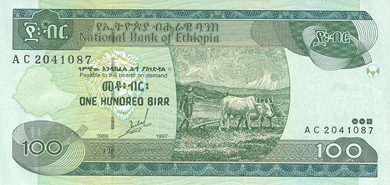
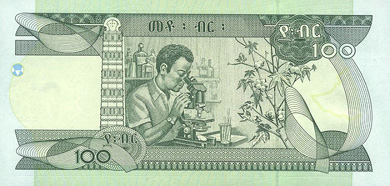
Banknotes
Budget & Public Finance
- Fiscal Year
- 8 July - 7 July
- Annual Budget
- $2,880,000,000 (USD)
- External Debt
- $2,900,000,000 (USD)
- Investment (% of GDP)
- 20.8%
- Economic Aid
- $308,000,000 (USD)
- Current Account Balance
- -$1,023,000,000 (USD)
- Reserves of Foreign Exchange
- $1,192,000,000 (USD)
Labor, Industry & Trade
- Labor Force by Occupation
- agriculture and animal husbandry 80%; government and services 12%; industry and construction 8%
- Household Income — highest 10%
- 33.7%
- Industries
- food processing, beverages, textiles, chemicals, metals processing, cement
- Agriculture Products
- cereals, pulses, coffee, oilseed, sugarcane, potatoes, qat; hides, cattle, sheep, goats
- Export Commodities
- coffee, qat, gold, leather products, live animals, oilseeds
- Export Partners
- UK 16.5%, Djibouti 11.1%, Germany 7.5%, Italy 7.3%, Japan 6.8%, Saudi Arabia 6.6%, US 4.5%
- Import Commodities
- food and live animals, petroleum and petroleum products, chemicals, machinery, motor vehicles, cereals, textiles
- Import Partners
- Saudi Arabia 27.9%, Switzerland 6.3%, China 5.9%, Italy 5.7%, India 4.6%, Germany 4%
Energy
- Oil Production
- 0 bbl/day
- Oil Consumption
- 27,000 bbl/day
- Oil Reserves
- 214,000 bbl/day
- Natural Gas Production
- 0 cu m
- Natural Gas Consumption
- 0 cu m
- Natural Gas Imports
- 0 cu m
- Natural Gas Exports
- 0 cu m
- Natural Gas Reserves
- 24,920,000,000 cu m
Communications
- Telephone System
- General assessment: Inadequate telephone system with the Ethio Telecom maintaining a monopoly over telecommunication services; open-wire, microwave radio relay; radio communication in the HF, VHF, and UHF frequencies; 2 domestic satellites provide the national trunk service Domestic: The number of fixed lines and mobile telephones is increasing from a small base; combined fixed and mobile-cellular teledensity is roughly 15 per 100 persons International: Country code - 251; open-wire to Sudan and Djibouti; microwave radio relay to Kenya and Djibouti; satellite earth stations - 3 Intelsat (1 Atlantic Ocean and 2 Pacific Ocean)
- Internet Country Code
- .et
News & Weather
News & Weather
Current Weather
Latest News
As Sudan’s war crosses borders and millions are made refugees, could Ethiopia’s plan solve ‘humanity’s migration issue’? - The Guardian
The Guardian · 4h ago
Sudan blames “temporary” Nile drop on Ethiopian dam cuts - Sudan Tribune
Sudan Tribune · 3d ago
Ethiopian Drill explodes on the streets of Addis Ababa - France 24
France 24 · 2d ago
The Genetic Architecture Of Adaptations To High Altitude In Ethiopia: The Amhara People As A Case Study - Analysis - Eurasia Review
Eurasia Review · 3d ago
Ethiopia goes electric following gas car ban - DW.com
DW.com · 49d ago
Ethiopian communities are using low-cost methods to restore eroded land - The Conversation
The Conversation · 49d ago
The Ruling Party Won Ethiopia’s Election. Here’s What to Know. - The New York Times
The New York Times · 29d ago
I've moved from Ethiopia to Shetland - and I've brought the coffee with me - BBC
BBC · 51d ago
News via Google News
Climate Overview
The climate varies from temperate in the highlands to hot in the lowlands.
Addis Ababa's altitude is above 8,000 feet. Addis Ababa has two primary seasons: a dry season from October to February, and for the rest of the year, a rainy season, divided into "small rains" and "big rains." The small rains, February through April, are generally intermittent showers. The big rains, June through September or longer, usually bring heavy daily precipitation. The big rains are rarely continuous, and sunny mornings or afternoons can be expected on many days. Average annual rainfall in Addis Ababa is 50 inches.
Daytime temperatures are fairly constant throughout the year. The dry season has bright, sunny days with moderate to cool temperatures; nights are chilly. The average daily temperature in Addis Ababa is 62.9°F. Daytime temperatures are rarely above 80°F. Sharp drops in temperature occur in late afternoon, sometimes making outside entertainment uncomfortable after 5 p.m. Night temperatures drop to the low 40”™s from November to January and are warmer in the period from February to May.
Videos
Videos
2 curated YouTube videos.
Source: YouTube
Source: YouTube
Frequently Asked Questions
Frequently Asked Questions
What is the population of Ethiopia?
How do people greet each other in Ethiopia?
What are the dining customs in Ethiopia?
What etiquette should I know when visiting an Ethiopian home?
How should I dress in Ethiopia?
Which gestures should I use or avoid in Ethiopia?
What is family life like in Ethiopia?
What do people do for recreation in Ethiopia?
What is the capital of Ethiopia?
Where is Ethiopia located?
What countries border Ethiopia?
What is the predominant religion in Ethiopia?
What currency does Ethiopia use?
What languages are spoken in Ethiopia?
What is Ethiopia's geography and terrain like?
What is Ethiopia known for?
Last reviewed 2026