
 English
 Español
 中文
中文 हिन्दी
 Français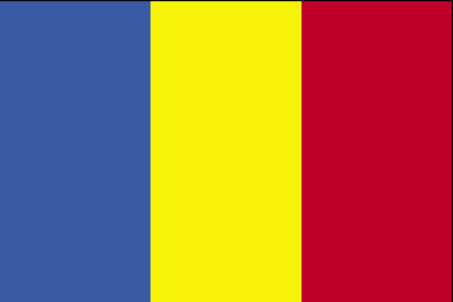
Chad
Tchad
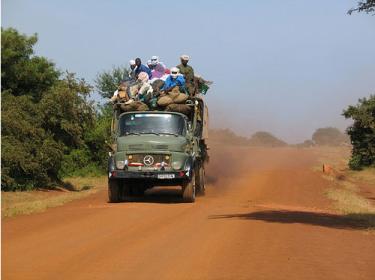
Declare Your Relationship to Chad
CountryReports Community
- Studying2
- From Chad0
- Chad heritage0
- Visited1
- Want to visit0
Customs and Culture
Customs and Culture
About the People
Because Chad is a former French colony and many of its citizens speak French. The people of Chad include more than a hundred distinct ethnic groups, each with its own language and customs. Families consider children to be insurance for their future and esteem those who have large families
Cultural Attributes
Because Chad is a former French colony and many of its citizens speak French. The people of Chad include more than a hundred distinct ethnic groups, each with its own language and customs. Families consider children to be insurance for their future and esteem those who have large families.

Land of the Shifting Lake
Greetings, Gestures & Visiting
Greetings are of great importance in Chad. They may be long and elaborate and require a ritualized response. The type of greeting depends on the age of the person addressed or the time of day. In some cultures in the south, it is considered impolite to look directly into the eyes of older people or people with authority. Some groups feel that watching people while they eat is disrespectful.
Chadians generally place great emphasis on clothing. Women often wear a loose top and a length of cloth (pagne) around the waist as a skirt. Men's casual clothes - which look like pajamas - are in the same distinctively 'African' designs, but most of the cloth is imported from the Netherlands.
The most authentic cloths are handmade, designed fabrics, such as woodblock prints and batiks and tie-dyed cloths. Dress is normally conservative and shorts are frowned upon, and the standards are usually tougher for women than men.
Diet
Chad has several geographical zones reflected in the diet like this: in the South, the diet is dominated by roots and tubers ( cassava, sweet potato, yam) and by white sorghum; in the Central South, the diet is based on sorghum ( red and white) and on rice; in the Central part, the diet is based on sorghum ( red and white) and millet; in the North the diet is based on millet and dates. Boule is a main staple made from millet and water. As a complement to the different sorghums and roots and tubers, which serve to prepare the staple paste, a sauce with vegetables, meat or fish is served. Cattle or camel rearing also dominates the country.
Fish abound in Chad's lakes and rivers. The most common fish is the Nile perch, called capitaine in Chad. Other fish include eel, tilapia and carp. Balbout (a mud-dwelling catfish) is caught at the beginning of the rainy season. Fish may be dried, salted or smoked before they are sold. Salanga (small dried or salted fish) and banda (larger smoked fish) are popular among Chadians and are exported to Cameroon and Nigeria.
Peanuts are a popular snack and are eaten raw or roasted. Other snacks include corn (roasted or boiled) and fangasou (fried donuts made of millet or wheat flour). Fangasou are also popular for breakfast. In some places, skewered roasted meats in a hot, spicy sauce are sold on the streets, accompanied by French bread. Carcaje is a sweet drink made from hibiscus leaves. It is often sold in markets in small plastic bags.
Okra is very popular in Chad and is used as the base of a sauce called gumbo.
The evening meal is the most important meal of the day. It is served on a large plate set in the middle of a mat. People gather around the plate and seat themselves on the ground. Generally, men and women eat separately.
In the south, however, people enjoy beer brewed from millet. It is called billi-billi when it is made from red millet and coshate when it is made from white millet. Spirits made from distilled millet alcohol are known as arki. Gala beer is also manufactured in Chad.
Chad has several geographical zones reflected in the diet like this: in the South, the diet is dominated by roots and tubers ( cassava, sweet potato, yam) and by white sorghum; in the Central South, the diet is based on sorghum ( red and white) and on rice; in the Central part, the diet is based on sorghum ( red and white) and millet; in the North the diet is based on millet and dates. Boule is a main staple made from millet and water. As a complement to the different sorghums and roots and tubers, which serve to prepare the staple paste, a sauce with vegetables, meat or fish is served. Cattle or camel rearing also dominates the country.
Fish abound in Chad's lakes and rivers. The most common fish is the Nile perch, called capitaine in Chad. Other fish include eel, tilapia and carp. Balbout (a mud-dwelling catfish) is caught at the beginning of the rainy season. Fish may be dried, salted or smoked before they are sold. Salanga (small dried or salted fish) and banda (larger smoked fish) are popular among Chadians and are exported to Cameroon and Nigeria.
Peanuts are a popular snack and are eaten raw or roasted. Other snacks include corn (roasted or boiled) and fangasou (fried donuts made of millet or wheat flour). Fangasou are also popular for breakfast. In some places, skewered roasted meats in a hot, spicy sauce are sold on the streets, accompanied by French bread. Carcaje is a sweet drink made from hibiscus leaves. It is often sold in markets in small plastic bags.
Okra is very popular in Chad and is used as the base of a sauce called gumbo.
The evening meal is the most important meal of the day. It is served on a large plate set in the middle of a mat. People gather around the plate and seat themselves on the ground. Generally, men and women eat separately.
In the south, however, people enjoy beer brewed from millet. It is called billi-billi when it is made from red millet and coshate when it is made from white millet. Spirits made from distilled millet alcohol are known as arki. Gala beer is also manufactured in Chad.
Kwanzaa is a special dish in Chad, eaten during the holidays.

Family
Gorane families are small, consisting of parents, children, and sometimes one or two other relatives. The clan is the most important unit of Gorane life. Each clan controls certain resources, such as palm groves or oases; members of other clans may not use these resources without permission. The Gorane tribes live in the Sahara desert in northern Chad.
A semi-nomadic Arab culture prevails in the Sahel region. Arabs make up one-third of the population. Their basic social unit is the kishimbet, a group related through the male line. The kishimbet is headed by an elder, known as the shaykh. Members of a kishimbet live near each other and follow the same routes during migration.
The basic social unit or clan of the Sara people is known variously as the "qir ka", "qin ka" or "qel ka", depending on the region. The members of each clan are the descendants of a common male ancestor.
The Sara have important initiation rites to mark the passage from childhood to adulthood, especially for boys. The best-known ritual is the Yondo, which takes place when a boy is 8 to 10 years old. He must pass an extended period in the bush in the company of elders and his fellow initiates, learning tribal secrets. Women are generally not allowed to witness Yondo.
Recreation
Soccer is the most popular sport in Chad. Basketball is widely played in the cities.
Children in Chad often build their own toys or play with everyday objects. They like to push wheels and tires around, often using sticks. Hide-and-seek is popular, and village boys sometimes carry slingshots, which they use to hunt small birds, such as guinea fowl. Girls play tap tap, a game much like hopscotch. Many people enjoy playing checkers or a board game played with seeds or small stones known as sidjé in Arabic or agra in Gorane.
Student Life
The day for the Chadian child begins at any time between 4:00 and 5:00 a.m. because many schools are usually far off from the villages. Apart from the local children there are also refugee children from neighboring Sudan’s Darfur in some areas who attend local schools. Depending on where they live, some may have to begin with the routine chores in the home before school. The older children or the mother prepares tea and ‘la boule’ - a traditional Chadian and Sudanese dish made of warm bread and sauce. After it is ready the younger children are awakened so that they could get ready for school. After quickly sipping tea, the children hurry to school. Classes begin usually at 7:00 a.m.
The trip to school is taken on foot and the distance to school will depend on where the child comes from and how far it is from their home. They sometimes can walk distances of up to 8 kilometers to reach the nearest school. Many schools are in great disrepair due to the fact that sometimes rebels attack and pull down school buildings. Once in school children begin classes which go on until 3:30 or 4:00 p.m. daily. The children who live in refugee camps usually have a longer break time of about one hour between 9:00 and 10:00 and they can run home briefly. The curriculum in most schools includes mathematics, environmental studies, geography, and Arabic. After the break, they will go back for another one or two hours and go back home until the next school day.
For the Chadian children who live in refugee camps as displaced from other countries or as the internally displaced, they can only get up to four years of education. Even with the little schooling they get, there still is a great problem because of a lack of facilities and resources. Materials are not sent in by anyone so the teachers, most of who are volunteers must try and improvise. The classrooms are inadequate. There is always very little financing from the poor Chadian government for education. On average you will find a class having close to 100 students per teacher. Very few children proceed to secondary education and the standards there are even worse than the primary sections. The greatest impediment to the education of children has been the disruption caused by the civil war which leads to a lack of security in conflict areas and becomes difficult for the government to post teachers and even for children themselves to attend school.
The primary school course begins at the age of six and is run for six years where children learn in what is basically the French Model of Education. There is very little if any emphasis on pre-primary education. The courses of study in primary school usually involve reading, writing, spelling, grammar, mathematics, history, geography, science as well as drawing. Even though six is the official age for starting primary school in some areas you will get children beginning up to the age of 12. It is suspected that only about 40% of school-age children manage to attend school. There are a smaller number of children who attend private schools but this could account for only about 2% of the population and mainly in the urban centers like the capital city, N’djamena. Most villages have only temporary grass shelters that serve as schools and which are usually not strong enough to stand for a long time. Thus there is always a need to rebuild them. The other challenge is that because they are made of grass or straw, they easily become fodder for animals, both domestic and wild and it is never surprising to find that animals got into a classroom at night and made a real mess out of the class. There are other times when children come to school and find animals asleep on the earthen floor of their classes. It is therefore also extremely hard for the children to maintain the cleanliness of their classes. You will find a great majority of children living in refugee camps, both those who are internally displaced as well as the refugee children from the neighboring Darfur in the Sudan. These children, therefore, find themselves reading under extremely difficult conditions. There is usually a lot of tension between villagers and refugees and this extends all the way to the few resources available to children.
There is almost always no homework or very little so when children get back home they will simply play or assist their parents in doing household chores. The setting of the sun marks the end of the day, and dinner will mainly be a dinner paste eaten with any kind of sauce that is available because there is no electricity. The fire from the hearth will also act as the light, and shortly after dinner, everyone will be asleep. When the rains come, the school program is disrupted because the children must assist their parents in sowing and the same thing applies when it is time to harvest millet. There may be times when children participate in village dances as well as celebrations. Young girls will have more disadvantages to attend school. You are likely to find her selling vegetables, flour, or even fruit in the market when the boys are in school and at other times she will be helping her mother with household chores, such as taking care of her younger brothers and sisters, cooking meals, cleaning the house and other chores depending on individual circumstances. The boys may be allowed to go to school and are more likely going to proceed with higher education, to prepare to join their fathers in whatever businesses they are doing. In the village when the boys are out of school they have the responsibility of shepherding the family goats and sheep, and when they become a little bit older they can help work on the family farm. Leisure activities are limited and boys will normally play football (soccer), jump rope, hopscotch, read, and those who can try to write. The rest of the time is spent doing family chores. The families are usually large with an average of close to ten children per family and there will always be relatives such as cousins, nephews, and nieces staying with the family. As long as it looks like a particular family is not struggling as much as the others, then all the relatives will bring their children to live with them.
Holidays
Independence Day
8/11Independence Day
Dates of Interest
- August 11th
How do people greet each other in Chad?
Greetings are very important in Chad and can be long, elaborate, and require a ritualized response, with the type of greeting depending on the person's age or the time of day.
Do
- Take time to exchange proper greetings
- Adjust your greeting to the person's age and the time of day
Good to know
- Chad has over a hundred ethnic groups, each with its own language and customs
- Many Chadians speak French, a legacy of French colonial rule
What are dining customs like in Chad?
The evening meal is the most important of the day, served on a large plate set on a mat where people gather and sit on the ground, with men and women generally eating separately.
Do
- Sit on the ground around the shared plate
- Try staples like boule (millet and water) with vegetable, meat, or fish sauce
- Sample local foods such as capitaine (Nile perch), gumbo (okra sauce), and street snacks like peanuts, roasted corn, and fangasou
Don’t
- Don't expect men and women to eat together
Good to know
- Carcaje is a sweet hibiscus drink often sold in small plastic bags
- In the south, people drink millet beer (billi-billi or coshate); distilled millet spirit is called arki, and Gala beer is made in Chad
What should I know about etiquette in Chad?
Respect for elders and people in authority is important, and some behaviors around eye contact and mealtimes are considered impolite.
Don’t
- In some southern cultures, don't look directly into the eyes of elders or people in authority
- Don't watch people while they eat, as some groups find it disrespectful
How should I dress in Chad?
Chadians place great emphasis on clothing and dress is normally conservative, with tougher standards for women than men.
Do
- Dress conservatively
Don’t
- Don't wear shorts, as they are frowned upon
Good to know
- Women often wear a loose top and a pagne (length of cloth) as a skirt
- Traditional fabrics include handmade woodblock prints, batiks, and tie-dyed cloths
What is family life like in Chad?
Families value having many children, and social organization varies by group, often built around clans or extended kin units led by elders.
Good to know
- Large families are esteemed and children are seen as future security
- Gorane families are small and organized around clans that control resources like oases and palm groves
- Arab groups organize around the kishimbet, headed by an elder called the shaykh
- The Sara mark the passage to adulthood with initiation rites like the Yondo for boys aged 8 to 10
What do people do for fun in Chad?
Soccer is the most popular sport, with basketball common in cities, while children play traditional games and adults enjoy board games.
Good to know
- Children build their own toys, push wheels and tires with sticks, and play hide-and-seek
- Girls play tap tap, a game similar to hopscotch
- Many enjoy checkers or a seed-and-stone board game called sidjé (Arabic) or agra (Gorane)
Last updated: 2026-07-12 · Sources: CountryReports
Photos of Chad
Photos of Chad


Travel and Tourism
Travel and Tourism
- Travel Alert Status
- Level 4: Do Not Travel
- Currency
- 605.7
- Time Difference
- UTC+1 (6 hours ahead of Washington, DC, during Standard Time)
- Climate
- The capital, N'Djamena, which is located in the Sahelian Zone, has a rainy season extending from June to October, characterized by sporadic, heavy rains and increased humidity with high temperatures in excess of 90°F. The remaining 8 months of the year are dry and generally hot, with a brief respite from November to February when daytime temperatures seldom exceed 90°F and lows at night descend to the 60s. Northeasterly winds off the desert, called the "harmattan," blow regularly during the dry season and envelop the town in a shroud of thick dust. April/May temperatures regularly exceed 110°F.
- Airports
- 50
- Recommended Vaccinations
- How important is it to do your research about vaccinations? It might just save your life! Make yourself aware of the different types of vaccinations and which ones you may need to travel to your destination. Schedule an appointment with your doctor at least four to six weeks before you travel to ensure you receive all important shots. Be sure that you and your family are up to date on your routine vaccinations. Which vaccinations you need will depend on a number of factors including your destination, whether you will be spending time in rural areas, the season of the year you are traveling, your age, health status, and previous immunizations.
Read the full travel guide — health, safety, vaccinations, disease risk, sanitation, and transit details.
View full travel guideRecipes
Recipes
History
History
Historical Eras
Ancient Kingdoms
700 – 1883
The Lake Chad basin gave rise to a succession of powerful Islamic states, most notably Kanem-Borno, Bagirmi, and Wadai, which dominated trans-Saharan trade routes and derived wealth from commerce and slave raiding. These kingdoms were defined by recurring cycles of expansion, internal factionalism, and competition with one another. By the nineteenth century, both Borno and Bagirmi were in political decline when external pressures intensified.
Conquest & Colonization
1883 – 1920
The Sudanese warlord Rabih al-Zubayr swept through the Lake Chad region between 1883 and 1893, dismantling existing kingdoms before France defeated his forces at the Battle of Kousséri in 1900. French forces then methodically subdued remaining resistance, completing the conquest of Chad by 1913. The territory was incorporated into French Equatorial Africa, with the Muslim north proving far harder to pacify than the agrarian south.
French Colonial Rule
1920 – 1960
Chad was formally constituted as a distinct colony within French Equatorial Africa in 1920 and became a French overseas territory in 1946. France invested minimally in Chad compared to other AEF territories, confining administrative and agricultural programs largely to the south while the nomadic north remained largely ungoverned. Post-World War II reforms introduced representative institutions and nascent party politics, laying groundwork for independence.
Independence & Civil War
1960 – 1990
Chad gained independence on August 11, 1960, under President François Tombalbaye, whose repressive, southerner-dominated government alienated northern and eastern populations and ignited the FROLINAT rebellion from 1966 onward. Tombalbaye was killed in a 1975 coup, inaugurating a prolonged period of military coups, factional warfare, and Libyan intervention, including the occupation of the Aouzou Strip from 1977. France intervened militarily in 1987 to expel Libyan forces, and Hissène Habré's government eventually gave way to Idriss Déby's rebel seizure of power in 1990.
Déby Era & Transition
1990 – 2021
Idriss Déby's seizure of power in 1990 ended the worst of the civil conflict; his government settled the Aouzou Strip dispute through the International Court of Justice in 1994 and oversaw a transition to multiparty elections in 1996–1997. Despite a democratic constitution, political power remained concentrated among a northern ethnic oligarchy, and a new rebellion erupted in the north in 1998 that periodically flared through the 2000s. Oil production began in 2003, bringing new revenue but also deepening governance tensions and regional instability, until Déby was killed on the battlefield in April 2021.
Transitional Military Rule
2021 – present
Following Idriss Déby's death in April 2021, his son Mahamat Idriss Déby assumed leadership of a Transitional Military Council, suspending the constitution and dissolving parliament. A national dialogue process launched in 2022 extended the transition period, and Mahamat Déby won a contested presidential election in May 2024. Chad continues to grapple with rebel movements, cross-border instability from Sudan and the Sahel, and the challenge of translating oil revenues into broad-based development.
Overview
Timeline of Key Events
1883 – 1893
Sudanese adventurer Rabih al-Zubayr conquers
Sudanese adventurer Rabih al-Zubayr conquers the kingdoms of Ouadai, Baguirmi and Kanem-Bornu, situated in what is now Chad.
1900
France defeats al-Zubayr’s army.
France defeats al-Zubayr’s army.
1913
French conquest of Chad completed.
French conquest of Chad completed; Chad becomes a colony within French Equatorial Africa.
1920
Chad was separated from Ubangi-Shari to form a 4th colony of French Equatorial Africa.
Chad was separated from Ubangi-Shari to form a 4th colony of French Equatorial Africa.
1934
French Equatorial Africa was transformed into a unified territory of France.
French Equatorial Africa was transformed into a unified territory of France. In 1946 it was re-divided into four separate overseas territories.
1946
Chad becomes a French overseas territory.
Chad becomes a French overseas territory with its own territorial parliament and representation in the French National Assembly.
1960
Chad became independent from France.
Chad became independent from France, but remained within the French community. Francois Tombalbaye became the 1st president.
Read the full history profile — narrative overview, defining eras, and the complete timeline in one place.
View expanded historyInteresting Facts
Interesting Facts
Chad is named after Lake Chad, which is the fourth largest lake in Africa and the seventh largest in the world. It is an extremely shallow lake that has no outlet to the sea and its shoreline changes every year as parts of it dry up.
The lungfish, Protopterus annectens, lives in Lake Chad's floodplains. It is able to survive buried in dried-up mud throughout the dry season, because it can breathe air through its lungs.
At the summit of the Tibesti mountain system stands the dormant volcano Emi Koussi, 3,414 meters above sea level. It is not only the highest point in Chad, but the highest point in the entire Sahara desert.
Chad australopithecine is a type of early hominid identified from the remains of a single body found in 1960 at Koro Toro in southeast Chad. The remains were found close by the teeth of an extinct elephant and are thought to be 200,000 to 500,000 years old.
Families consider children to be insurance for their future and esteem those who have large families. When people die without having had children, they are said to have “ died twice.”
Scarification, the ritual application of scars on the faces of tribal members, is practised by many groups in Chad. Lines and other symbols are made on the faces of young men to mark them permanently as members of a particular tribe. Such markings are perceived as visually pleasing.
See every fact — trivia, oddities, and curious tidbits gathered from across the country.
View all interesting factsGeography and Environment
Geography and Environment
- Terrain
- broad, arid plains in center, desert in north, mountains in northwest, lowlands in south
- Climate
- The capital, N’Djamena, which is located in the Sahelian Zone, has a rainy season extending from June to October, characterized by sporadic, heavy rains and increased humidity with high temperatures in excess of 90°F. The remaining 8 months of the year are dry and generally hot, with a brief respite from November to February when daytime temperatures seldom exceed 90ºF and lows at night descend to the 60s. Northeasterly winds off the desert, called the "harmattan," blow regularly during the dry season and envelop the town in a shroud of thick dust. April/May temperatures regularly exceed 110ºF.
- Natural Hazards
- hot, dry, dusty harmattan winds occur in north; periodic droughts; locust plagues
- Current Environmental Issues
- inadequate supplies of potable water; improper waste disposal in rural areas contributes to soil and water pollution; desertification
Read the full geography and environment profile — terrain, climate, natural resources, hazards, land use, and international agreements.
View full geographyPeople & Demographics
People & Demographics
Religion
Languages Spoken
French (official), Arabic (official), Sara (in the south), and more than 120 different languages and dialects
- Arabic
- French
Population
- Population
- 10,543,464
- Population: Male/Female
- male: 9,464,699 female: 9,628,896
- Population Distribution
- the population is unevenly distributed due to contrasts in climate and physical geography; the highest density is found in the southwest, particularly around Lake Chad and points south; the dry Saharan zone to the north is the least densely populated
- Urban Population
- urban population: 24.4% of total population rate of urbanization: 4.1% annual rate of change
- Population in Major Urban Areas
- 1.592 million N'DJAMENA (capital)
- Nationality Noun
- noun: Chadian(s) adjective: Chadian
- Ethnic Groups
- Sara (Ngambaye/Sara/Madjingaye/Mbaye) 30.5%, Kanembu/Bornu/Buduma 9.8%, Arab 9.7%, Wadai/Maba/Masalit/Mimi 7%, Gorane 5.8%, Masa/Musseye/Musgum 4.9%, Bulala/Medogo/Kuka 3.7%, Marba/Lele/Mesme 3.5%, Mundang 2.7%, Bidiyo/Migaama/Kenga/Dangleat 2.5%, Dadjo/Kibet/Muro 2.4%, Tupuri/Kera 2%, Gabri/Kabalaye/Nanchere/Somrai 2%, Fulani/Fulbe/Bodore 1.8%, Karo/Zime/Peve 1.3%, Baguirmi/Barma 1.2%, Zaghawa/Bideyat/Kobe 1.1%, Tama/Assongori/Mararit 1.1%, Mesmedje/Massalat/Kadjakse 0.8%, other Chadian ethnicities 3.4%, Chadians of foreign ethnicities 0.9%, foreign nationals 0.3%, unspecified 1.7%
- Language Note
- French (official), Arabic (official), Sara (in south), more than 120 different languages and dialects
Demographic Profile
Despite the start of oil production in 2003, around 40% of Chad’s population lived below the poverty line as of 2018. The population will continue to grow rapidly because of the country’s very high fertility rate and large youth cohort – more than 65% of the populace is under the age of 25 as of 2022 – although the mortality rate is high and life expectancy is low. Chad has the world’s second highest maternal mortality rate as of 2017. Among the primary risk factors are poverty, anemia, rural habitation, high fertility, poor education, and a lack of access to family planning and obstetric care. Impoverished, uneducated adolescents living in rural areas are most affected. To improve women’s reproductive health and reduce fertility, Chad will need to increase women’s educational attainment, job participation, and knowledge of and access to family planning. Less than a quarter of women are literate, less than 10% use contraceptives, and more than 40% undergo genital cutting.
As of December 2022, more than 403,000 refugees from Sudan and more than 120,000 from the Central African Republic strain Chad’s limited resources and create tensions in host communities. Thousands of new refugees fled to Chad in 2013 to escape worsening violence in the Darfur region of Sudan. The large refugee populations are hesitant to return to their home countries because of continued instability. Chad was relatively stable in 2012 in comparison to other states in the region, but past fighting between government forces and opposition groups and inter-communal violence have left more than 380,000 of its citizens displaced in the eastern part of the country as of 2022.
Education
- Literacy Definition
- age 15 and over can read and write French or Arabic
For the Chadian children who live in refugee camps as displaced from other countries or as the internally displaced, they can only get up to four years of education. Even with the little schooling they get, there still is a great problem because of a lack of facilities and resources. Materials are not sent in by anyone so the teachers, most of who are volunteers must try and improvise. The classrooms are inadequate. There is always very little financing from the poor Chadian government for education. On average you will find a class having close to 100 students per teacher. Very few children proceed to secondary education and the standards there are even worse than the primary sections.
The greatest impediment to the education of children has been the disruption caused by the civil war which leads to a lack of security in conflict areas and becomes difficult for the government to post teachers and even for children themselves to attend school.
Health Information
- Life Expectancy at Birth
- total population: 60 years male: 58.1 years female: 62 years
- Major Infectious Diseases — degree of risk
- degree of risk: very high food or waterborne diseases: bacterial and protozoal diarrhea, hepatitis A and E, and typhoid fever vectorborne diseases: malaria, dengue fever, and sexually transmitted diseases: hepatitis B (2024) water contact diseases: schistosomiasis animal contact diseases: rabies respiratory diseases: meningococcal meningitis note: on 31 August 2023, the US Centers for Disease Control and Prevention (CDC) issued a Travel Alert for polio in Africa; Chad is currently considered a high risk to travelers for circulating vaccine-derived polioviruses (cVDPV); vaccine-derived poliovirus (VDPV) is a strain of the weakened poliovirus that was initially included in oral polio vaccine (OPV) and that has changed over time and behaves more like the wild or naturally occurring virus; this means it can be spread more easily to people who are unvaccinated against polio and who come in contact with the stool or respiratory secretions, such as from a sneeze, of an “infected” person who received oral polio vaccine; the CDC recommends that before any international travel, anyone unvaccinated, incompletely vaccinated, or with an unknown polio vaccination status should complete the routine polio vaccine series; before travel to any high-risk destination, the CDC recommends that adults who previously completed the full, routine polio vaccine series receive a single, lifetime booster dose of polio vaccine
- Alcohol consumption per capita
- total: 0.55 liters of pure alcohol beer: 0.37 liters of pure alcohol wine: 0.01 liters of pure alcohol spirits: 0.01 liters of pure alcohol other alcohols: 0.16 liters of pure alcohol
- Tobacco Use
- total: 8.3% male: 13.8% female: 2.7%
- Child Marriage
- women married by age 15: 24.2% women married by age 18: 60.6% men married by age 18: 8.1%
- Infant Mortality Rate
- total: 62.5 deaths/1,000 live births male: 68.1 deaths/1,000 live births female: 56.7 deaths/1,000 live births
Life Expectancy
- Life Expectancy at Birth
- total population: 60 years male: 58.1 years female: 62 years
- Median Age
- total: 16.7 years male: 16.3 years female: 17.2 years
- Age Structure
- 0-14 years: 45.8% (male 4,428,132/female 4,323,398) 15-64 years: 51.7% (male 4,831,744/female 5,031,383) 65 years and over: 2.5% (male 204,823/female 274,115)
- Infant Mortality Rate
- total: 62.5 deaths/1,000 live births male: 68.1 deaths/1,000 live births female: 56.7 deaths/1,000 live births
Read the full people and society profile — demographics, health, education, religion, languages, and notable people.
View full people and societyGovernment & Politics
Government & Politics
Country Identity
- Country Name
- Chad
- Full Country Name
- Republic of Chad
- Local - Long
- Republique du Tchad
- Local - Short
- Tchad
Government Structure
- Government Type
- republic
- Legal System
- based on French civil law system and Chadian customary law; has not accepted compulsory ICJ jurisdiction
- Executive Branch
- chief of state: President Mahamat Idriss DEBY (since 20 April 2021); note: Mahamat Idriss DEBY assumed power following the death of his father, long-serving President Idriss DEBY, who died on 20 April 2021 from wounds sustained on the battlefield; Mahamat initially led a Transitional Military Council and was later confirmed as transitional president; he won the presidential election held on 6 May 2024, marking a transition toward constitutional governance head of government: Prime Minister Allamaye HALINA (since May 2024); note: the office of prime minister has undergone several changes during the transitional period cabinet: Council of Ministers, appointed by the president on the recommendation of the prime minister elections: president elected by popular vote to serve a five-year term; if no candidate receives at least 50% of the total vote, the two leading candidates proceed to a second round; presidential election last held on 6 May 2024; prime minister appointed by the president election results: Mahamat Idriss DEBY elected president in the 2024 election; percent of vote — Mahamat Idriss DEBY approximately 61%, Succès MASRA approximately 19%, other candidates sharing the remainder
- Legislative Branch
- bicameral according to constitution, consists of a National Assembly (155 seats; members elected by popular vote to serve four-year terms) and a Senate (not yet created and size unspecified, members to serve six-year terms, one-third of membership renewable every two years) elections: National Assembly - last held 21 April 2002 (next to be held in April 2007) election results: percent of vote by party - NA; seats by party - MPS 110, RDP 12, FAR 9, RNDP 5, URD 5, UNDR 3, other 11
- Judicial Branch
- Supreme Court; Court of Appeal; Criminal Courts; Magistrate Courts
- Suffrage
- 18 years of age; universal
- Constitution
- passed by referendum 31 March 1996
- Independence
- 11 August 1960 (from France)
- National Holiday
- Independence Day, 11 August (1960)
Capital City
- Capital Name
- N'Djamena
- Capital - geographic coordinate
- 12 06 N, 15 02 E
- Capital Time Difference
- UTC+1 (6 hours ahead of Washington, DC, during Standard Time)
name taken from the Arab name of a nearby village, Nijamina, meaning "place of rest"
Military
Branches: Chadian National Army (Armee Nationale du Tchad, ANT): Ground Forces (l'Armee de Terre, AdT), Chadian Air Force (l'Armee de l'Air Tchadienne, AAT), National Gendarmerie, National and Nomadic Guard of Chad (GNNT)
Embassy / Diplomatic Mission
U.S. Embassy in Chad
Avenue Felix Eboue
N’Djamena
Mailing Address BP 413 N’djamena Chad
Telephone: 235 2251-62-11, 2251-70-09, 2251-77-59, 2251-90-52, 2251-92-18, and 2251-92-33.
Emergency after-hours telephone: 235 6351-7800
Facsimile: 235 2251-56-54
Read the full government profile — flag symbolism, national anthem, and other national symbols.
View full government detailsEconomy
Economy
Chad's economy remains heavily dependent on agriculture and oil, with both sectors shaping its development trajectory. Roughly 80% of the population relies on subsistence farming, livestock raising, and fishing for their livelihoods. Cotton, livestock, sesame, and gum arabic remain important non-oil exports, but crude oil has dominated export earnings since production began in 2003 following the completion of the Chad-Cameroon pipeline.
Oil now accounts for the majority of government revenue and export receipts, making the economy highly vulnerable to global price fluctuations. The country was hit hard by the 2014-2016 oil price collapse, and more recent volatility has continued to strain public finances. In 2024, Chad reached agreements with creditors to restructure portions of its external debt, including obligations to Glencore, as part of efforts under the G20 Common Framework.
Chad's economy continues to be constrained by its landlocked geography, weak infrastructure, high energy costs, limited access to electricity, and persistent political and security instability, including spillover effects from conflicts in Sudan, Libya, and the Lake Chad Basin. The country remains one of the poorest in the world, ranking near the bottom of the UN Human Development Index, and depends heavily on foreign assistance and external investment.
Efforts to diversify the economy beyond oil—through agriculture, livestock, and mining—have made limited progress, though development partners continue to support reforms aimed at improving fiscal management, governance, and private sector growth.
Snapshot
- Currency Name and Code
- Cooperation Financiere en Afrique Centrale francs (XAF)
- GDP — official exchange rate
- $4,799,000,000 (USD)
- GDP Real Growth Rate
- 6%
Banknotes
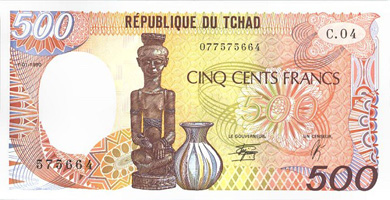
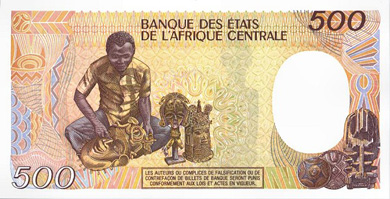
Budget & Public Finance
- Fiscal Year
- calendar year
- Annual Budget
- $653,000,000 (USD)
- External Debt
- $1,500,000,000 (USD)
- Investment (% of GDP)
- 7.2%
- Economic Aid
- $238,300,000 (USD)
- Current Account Balance
- $663,300,000 (USD)
- Reserves of Foreign Exchange
- $881,800,000 (USD)
Labor, Industry & Trade
- Labor Force by Occupation
- agriculture more than 80% (subsistence farming; herding; and fishing)
- Industries
- oil, cotton textiles, meatpacking, beer brewing, natron (sodium carbonate), soap, cigarettes, construction materials
- Agriculture Products
- cotton, sorghum, millet, peanuts, rice, potatoes, manioc (tapioca); cattle, sheep, goats, camels
- Export Commodities
- cotton, cattle, gum arabic
- Export Partners
- Portugal 30.3%, Germany 15.2%, US 9.1%, France 6.1%, Nigeria 6.1%, Spain 6.1%, Morocco 4.5%, Poland 4.5%
- Import Commodities
- machinery and transportation equipment, industrial goods, petroleum products, foodstuffs, textiles
- Import Partners
- France 31.5%, US 31.3%, Germany 5.6%, Nigeria 4.7%
Energy
- Oil Production
- 225,000 bbl/day
- Oil Consumption
- 1,450 bbl/day
- Oil Reserves
- 0 bbl/day
- Natural Gas Production
- 0 cu m
- Natural Gas Consumption
- 0 cu m
- Natural Gas Imports
- 0 cu m
- Natural Gas Exports
- 0 cu m
- Natural Gas Reserves
- 0 cu m
Communications
- Telephone System
- general assessment: an inadequate system of radiotelephone communication stations with high costs and low telephone density domestic: fixed-line connections for less than 1 per 100 persons coupled with a mobile-cellular subscribership base of only about 35 per 100 persons international: country code - 235; satellite earth station - 1 Intelsat (Atlantic Ocean)
- Internet Country Code
- .td
News & Weather
News & Weather
Current Weather
Latest News
Chad Tracy offers updates on several injured Red Sox pitchers - Boston.com
Boston.com · 3d ago
Kathynmarissa wins Diana Stakes at Saratoga - Times Union
Times Union · 2d ago
Boston Globe repeats Chad Smith counterfactual - Slipped Disc
Slipped Disc · 2d ago
Chad Gable’s redemption story has one major problem: Penta - Cageside Seats
Cageside Seats · 12h ago
Arizona Cardinals training camp roster preview: K Chad Ryland - USA Today
USA Today · 9h ago
WooSox homestand includes return of Chad Tracy, Hall of Fame ceremony - Worcester Telegram
Worcester Telegram · 17h ago
Chad Gable’s journey for redemption: WWE Playlist - WWE
WWE · 19h ago
Countdown to ECU Kickoff: No. 49 Chad Fairchild - 247Sports
247Sports · 2d ago
News via Google News
Climate Overview
The capital, N'Djamena, which is located in the Sahelian Zone, has a rainy season extending from June to October, characterized by sporadic, heavy rains and increased humidity with high temperatures in excess of 90°F. The remaining 8 months of the year are dry and generally hot, with a brief respite from November to February when daytime temperatures seldom exceed 90°F and lows at night descend to the 60s. Northeasterly winds off the desert, called the "harmattan," blow regularly during the dry season and envelop the town in a shroud of thick dust. April/May temperatures regularly exceed 110°F.
Videos
Videos
2 curated YouTube videos.
Source: YouTube
Source: YouTube
Frequently Asked Questions
Frequently Asked Questions
What is the population of Chad?
How do people greet each other in Chad?
What are dining customs like in Chad?
What should I know about etiquette in Chad?
How should I dress in Chad?
What is family life like in Chad?
What do people do for fun in Chad?
What is the capital of Chad?
Where is Chad located?
What countries border Chad?
What is the predominant religion in Chad?
What currency does Chad use?
What languages are spoken in Chad?
What is Chad's geography like?
What is Chad known for?
Last reviewed 2026