
 English
 Español
 中文
中文 हिन्दी
 Français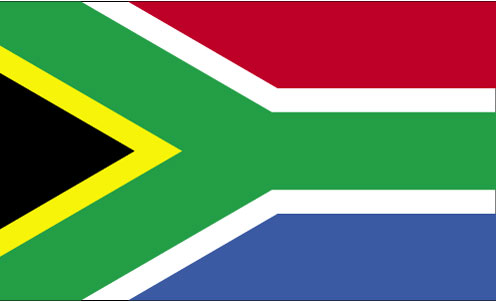
South Africa
Declare Your Relationship to South Africa
CountryReports Community
- Studying4
- From South Africa0
- South Africa heritage1
- Visited0
- Want to visit0
Customs and Culture
Customs and Culture
About the People
Today’s South Africa and the attitudes of its people are both changing rapidly. Blacks generally value education as the key to a better life. They express optimism about the future and are anxious to exercise their rights and obligations in the new system. Mixed-race South Africans also benefit from the multiracial system. One thing that seems to unite all peoples in South Africa is the common claim they have to the country as home.
Cultural Attributes
Today’s South Africa and the attitudes of its people are both changing rapidly. Blacks generally value education as the key to a better life. They express optimism about the future and are anxious to exercise their rights and obligations in the new system. Mixed-race South Africans also benefit from the multiracial system. One thing that seems to unite all peoples in South Africa is the common claim they have to the country as home.

The Rainbow Nation
Greetings, Gestures & Visiting
Because of ethnic diversity, many different greetings are used in South Africa. English greetings such as “Hello” and “Good morning” are frequently heard. Shaking hands is more common among whites, but is also used by other ethnic groups. It is generally impolite to use first names with strangers or older people. Titles are valued and are used for adults unless one has developed a closer relationship. It is polite to call an older black man Tata (father) or woman Mama (mother)
When yawning, one hand should cover the mouth. Spitting in public is inappropriate. Among some ethnic groups, it is not polite to gesture with the left hand. For many, receiving something with both hands cupped together is polite rather than just one hand. Indicating “two” or “peace” by forming a “V” with the index and middle fingers is very rude if the palm faces inward. Facing the palm outward is acceptable.
Visits are usually arranged in advance, but unannounced visits among relatives or friends are common. South Africans are generally hospitable to guests. Guests are usually served refreshments by their hosts. Among most people, dinner guests are not expected to bring a gift but will often bring something to drink.
Male South Africans may wear shorts with knee socks rather than pants. Women usually wear comfortable dresses or long pants. Western-style clothing, usually lightweight cotton, is most common. Some rural blacks retain traditional clothing habits for special purposes or everyday attire.
Diet
The South African diet is often determined by a person’s economic status. Beef, mutton, a variety of curries, green vegetables, pumpkins, and other foods are eaten. Staples include potatoes and rice. South Africa produces a great variety of food. Dinner, usually eaten after 6 pm, is the main meal.
The continental style of eating is generally observed by urban South Africans. In rural areas, people often eat with spoons or their fingers.
The South African diet is often determined by a person’s economic status. Beef, mutton, a variety of curries, green vegetables, pumpkins, and other foods are eaten. Staples include potatoes and rice. South Africa produces a great variety of food. The main meal of the day is dinner which is usually eaten after six pm.

Family
Family life among the white population is similar to that of middle-class Europeans. Families are usually small and generally enjoy a good standard of living. In black families, children are taught to respect their elders and obey their parents.
Recreation
Soccer, rugby, and cricket are the most popular sports in South Africa. South Africans also enjoy tennis, field hockey, squash, badminton, golf, surfing, sailing, running and cycling.
Other favorite recreational pastimes include music, dancing, and socializing. South Africans have a strong musical tradition and dance is considered an important component of recreation and of communicating with others.
Student Life
A school day for most kids begins with breakfast. Breakfast mainly consists of hot cooked cereal of cornmeal porridge sometimes with milk and sugar. Tea and coffee are also popular for breakfast.
Typically the location of schools is within walking distance, for those who live too far away to walk transportation is by public taxis and busses or in some cases trains. Some schools provide school buses.
Rural, township, and peri-urban state schools are usually provisioned to meet the bare minimum many are cash-strapped and they lack the basics of sanitation and water supply, and are most often targets of vandalism and crime. Parents contribute to the schools in the form of school fees. Private schools provide paths of excellence and offer education that is religion-based due to their originations from mission schools. There are some state-aided schools that are on par with some private institutions. The legislative process established the “Children’s Act” in 2008. The Children’s Act provides for the protection of children and a definition of basic human rights which include: 1. Children have rights to an equal, free, non-sexist, non-racial, and compulsory education that serves as a right and not as a privilege. 2. Children have the right to an education and to develop individual talents through informal and formal education. It is also a requirement that all teachers must be qualified and treat the children with respect, patience, and dignity. 3. Parent’s duties must include involvement in children's development and education and participation in children’s education at home and at school. 4. Children have rights to play sports that are free and adequate and to recreational facilities. 5. Children have the right to participate in the upgrading and evaluating of a curriculum that respects all cultures, traditions, and values of all children in South Africa. 6. Children have rights to education regarding issues of AIDS, sexuality, history, and background of South Africa and family life. 7. Children have rights to educational facilities that are adequate and transport to facilities must be provided for children in violent or difficult situations.
School life ranges from 13 years. The first education year which is grade 0 or the reception year as well as the last 3 years (termed "matric”) grades ten, eleven, and twelve are not compulsory. Primary schools offer the preschool grade 0 year but this year can be completed at a Nursery school. The 1996 South African Schools Act states that education is compulsory for South Africans from the age of 7 (grade 1) to the age of 15 or completion to grade 9. There are 3 bands of education recognized by South Africa's National Qualifications Framework (NQF), general training and education, further training and education, and Higher training and education. In 2006 Mathematics became compulsory. 2008 was the beginning of the National Senior Certificate examination, which offered seven subjects out of a choice of twenty-nine. Examinations are benchmarked against papers that are both international and national. The national curriculum statement is available in all of the 11 official languages as well as Braille, the Constitution grants parity to the eleven languages. In recent years there have been great advances towards new technology introductions in schools that were formerly disadvantaged. There are organizations that have worked towards the provision of computer access to state schools. An initiative has also been the creation of a program "FOCUS” in schools that specialize in particular curriculum areas such as (Engineering, Business & Commerce, and Arts and Culture) In state public schools, the ratio of scholars "learners" to ("educators") is 32.6 to 1, and private schools have one teacher for 17.5 scholars. The central government has a national school policy the provinces have to administer. Administrative responsibility lies with the provinces. Power is further devolved to the grassroots level via elected school governing bodies; it is not negotiable that no child can be excluded from a school on the basis of race or religion.
Giving children the opportunities of sports participation aids in learning skills of team work, healthy lifestyle and anger management therefore many township schools are open to activities after school such as basketball, softball, football (soccer), rugby, and cricket.
Holidays
Freedom Day
4/27Independence
Birth date - John Ronald Reul (J.R.R.) Tolkien
1/3Birthday
Birth date - John Ronald Reul (J.R.R.) Tolkien, English author of The Hobbit and The Lord of the Rings, was born on Jan. 3, 1892 in Bloemfontein, South Africa.
Christmas
12/25Christmas
Christmas is celebrated with outdoor activities including “Carols by Candlelight” a custom originating in Australia. Many native Africans observe a week-long carnival in costumes with gifts, singing, dancing and feasting.
Dates of Interest
- December 16th
Celebrated by the Hindu community, Diwali, also known as the Festival of Lights, involves the lighting of lamps and the exchange of sweets.
How do people greet each other in South Africa?
Because of ethnic diversity, many greetings are used, including English ones like "Hello" and "Good morning," and handshaking is common, especially among whites but also across other groups.
Do
- Use titles for adults until you develop a closer relationship
- Call an older black man Tata (father) or woman Mama (mother)
- Shake hands when greeting
Don’t
- Don't use first names with strangers or older people
What are the dining customs in South Africa?
Dinner, eaten after 6 pm, is the main meal, and dishes include beef, mutton, curries, green vegetables, pumpkins, with potatoes and rice as staples.
Do
- Follow the continental style of eating in urban areas
- In rural areas, eat with spoons or your fingers as locals do
Good to know
- Diet often depends on a person's economic status
- South Africa produces a great variety of food
What should I know about visiting and hospitality in South Africa?
South Africans are generally hospitable and serve guests refreshments; visits are usually arranged in advance, though unannounced visits among relatives or friends are common.
Do
- Arrange visits in advance
- Bring something to drink as a dinner guest
Good to know
- Dinner guests are generally not expected to bring a gift
How should I dress in South Africa?
Western-style clothing, usually lightweight cotton, is most common; men may wear shorts with knee socks, and women often wear comfortable dresses or long pants.
Good to know
- Some rural blacks retain traditional clothing for special purposes or everyday attire
What gestures should I be aware of in South Africa?
Certain gestures carry meaning: an inward-facing "V" is very rude, and covering the mouth when yawning is polite.
Do
- Cover your mouth with one hand when yawning
- Face the palm outward when making a "V" sign
- Receive things with both hands cupped together, which is polite
Don’t
- Don't spit in public
- Don't gesture with the left hand among some ethnic groups
- Don't make a "V" with the palm facing inward
What is family life like in South Africa?
White families are similar to middle-class Europeans, usually small and enjoying a good standard of living, while in black families children are taught to respect elders and obey parents.
Good to know
- Respect for elders is emphasized in black families
What do people do for fun in South Africa?
Soccer, rugby, and cricket are the most popular sports, and South Africans also enjoy music, dancing, and socializing.
Good to know
- Other sports include tennis, field hockey, squash, badminton, golf, surfing, sailing, running and cycling
- Dance is considered important for recreation and communication
Last updated: 2026-07-12 · Sources: CountryReports
Photos of South Africa
Photos of South Africa
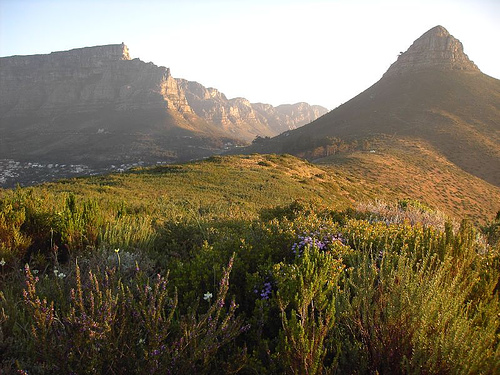
Signal Hill, South Africa
Hluhluwe Game Reserve
Hluhluwe Game Reserve
Hluhluwe Game Reserve
Simons Town- Bolders Beach Penguins
South African sunset over the ocean
Cape Point, South Africa
Airline displays the South African flag
Hermanus, South Africa
South african city
Cape Town, South Africa
Cape Town, South Africa


Travel and Tourism
Travel and Tourism
- Travel Alert Status
- Level 2: Exercise Increased Caution
- Currency
- rand (ZAR)
- Time Difference
- UTC+2 (7 hours ahead of Washington, DC, during Standard Time)
- Climate
- South Africa has a moderate climate with sunny days and cool nights. The most southerly point has a mean yearly temperature of 61.8 degrees Fahrenheit, while Johannesburg, situated at 5,700 above sea level, has an annual mean of 60.8 degrees Fahrenheit. Pretoria, at 4,452 feet above sea level, is warmer with a mean annual temperature of 63.5 degrees Fahrenheit. The temperatures can be deceiving because of the very bright and dangerous high sun during most of the year, especially in the highveld areas. Although the country lies close to the Tropic of Capricorn, the high altitude of the inland areas results in a temperate climate in most of the country. In the Southern Hemisphere, seasons are opposite those of the Northern Hemispher-summer extends from October to March; winter from June to September. The rainy season in the Pretoria-Johannesburg area is during summer, and the temperature seldom rises above 90 degrees F, with cool nights. Winter is dry and cool with daily temperatures varying from as low as 30 degrees F during the night to as high as 75 degrees F during the day. Along the coastal area where Durban and Cape Town are located, heavier rainfall occurs during winter and spring, causing high humidity. Both cities experience strong winds - Durban from August through October and Cape Town throughout the year. The seasons are not pronounced but blend almost imperceptibly. For the most part, trees and shrubs remain green, with flowers blooming throughout the year. The highveld, which includes the Pretoria-Johannesburg area, remains dry and brown throughout much of the year.
- Airports
- 728
Read the full travel guide — health, safety, vaccinations, disease risk, sanitation, and transit details.
View full travel guideRecipes
Recipes
Putu-Pap
Bread
Main Dish
South African Vegetable Curry
Main Dish
Bobotie (Beef Pie)
Main Dish
Cape Kidgeree (Fish and Rice)
Main Dish
Green Bean Bredie (Lamb and Green Bean Stew)
Main Dish
Rock Lobster Soup
Main Dish
Sosaties (Grilled Marinated Meat with Apricots)
Side Dish
PremiumBiltong (South African Dried Meat)
Side Dish
PremiumHot Turkey Curry Salad
Side Dish
PremiumGreen Bean Salad
History
History
Historical Eras
Pre-Colonial Era
500 BCE – 1652
Southern Africa was home to diverse indigenous peoples, including the San hunter-gatherers, Khoikhoi herders, and Bantu-speaking Iron Age agriculturalists who had settled south of the Limpopo River by around 300 CE. Portuguese navigators Bartholomeu Dias and Vasco da Gama made early European contact in the late 15th century, but sustained foreign settlement had not yet begun. These communities developed complex political structures, trade networks, and cattle-farming economies that would later be disrupted by European colonization.
Dutch Colonial Period
1652 – 1806
The Dutch East India Company established the first permanent European settlement at the Cape of Good Hope in 1652, initially as a refreshment station for passing ships. Settlers imported enslaved people from Angola, West Africa, and Southeast Asia, and violent frontier conflicts with the Khoikhoi erupted in the 1670s. French Huguenot refugees arrived in 1688, reinforcing a distinct Dutch-speaking settler culture that would evolve into Afrikaner identity.
British Cape Colony
1806 – 1910
Britain seized permanent control of the Cape in 1806, prompting many Boers to undertake the Great Trek northward from the 1830s to escape British authority, founding the Boer republics of Transvaal and the Orange Free State. The discovery of diamonds in 1867 and gold in 1886 transformed the region's economy, intensified British imperial ambitions, and led to the rapid military conquest of most remaining African societies. The Anglo-Boer War of 1899–1902 ended Boer independence and paved the way for political unification.
Union & Apartheid
1910 – 1994
The Union of South Africa was established in 1910 with a constitution that entrenched white political and economic supremacy. The National Party's election victory in 1948 introduced apartheid — a rigid legal system of racial segregation enforced through pass laws, forced removals, and the suppression of Black political organizations such as the African National Congress. Decades of internal resistance, international sanctions, and figures such as Nelson Mandela and Steve Biko ultimately brought the apartheid system to its negotiated end in the early 1990s.
Democratic South Africa
1994 – present
South Africa's first fully democratic elections in April 1994 brought Nelson Mandela and the ANC to power, marking the formal end of apartheid and the birth of the 'Rainbow Nation.' A new constitution adopted in 1996 enshrined extensive civil rights and created institutions designed to address the inequalities of the past, including the Truth and Reconciliation Commission. The country continues to grapple with persistent economic inequality, high unemployment, and governance challenges while remaining the continent's most industrialized economy.
Overview
Timeline of Key Events
500 BCE
Earliest archaeological evidence of sheep and cattle herding.
Earliest archaeological evidence of sheep and cattle herding.
300
Archaeological evidence of Iron-Age settlements south of the Limpopo River.
Archaeological evidence of Iron-Age settlements south of the Limpopo River.
1488
Portuguese navigator Bartholomeu Dias rounds Cape of Good Hope.
Portuguese navigator Bartholomeu Dias rounds Cape of Good Hope. Khoisan-speaking herdsmen and hunters establish trade with Europeans.
1497
Portuguese navigator Vasco da Gama arrives at Cape of Good Hope en route to India.
Portuguese navigator Vasco da Gama arrives at Cape of Good Hope en route to India.
1652
First permanent Dutch settlement at Cape of Good Hope.
First permanent Dutch settlement at Cape of Good Hope.
1658
Dutch import slaves from Angola and West Africa.
Dutch import slaves from Angola and West Africa.
1673 – 1677
Warfare between Khoikhoi and Dutch.
Warfare between Khoikhoi and Dutch.
Read the full history profile — narrative overview, defining eras, and the complete timeline in one place.
View expanded historyInteresting Facts
Interesting Facts
When a child loses a tooth they leave their tooth in a slipper in their room. That night a mouse will come, take the tooth and leave a gift.
After the Anglo-Boer War, three capitals were established: an administrative capital in Pretoria, a legislative capital at Cape Town and a judicial seat at Bloemfontein. This arrangement continues today.
Ceremonial clothing and adornment play an important role in traditional customs of the Black peoples and vary according to such things as age and marital status.
South Africa has mines deeper than any other country in the world. The Western Deep Levels Mine is almost four kilometres deep.
Dr. Christiaan Barnard performed the world's first heart transplant operation in Groot Schur Hospital in Cape Town in 1967.
A system of Adult Basic Education and Training (ABET) has been introduced recently by the government to promote literacy and numeracy among adults.
See every fact — trivia, oddities, and curious tidbits gathered from across the country.
View all interesting factsGeography and Environment
Geography and Environment
- Terrain
- vast interior plateau rimmed by rugged hills and narrow coastal plain
- Climate
- South Africa has a moderate climate with sunny days and cool nights. The most southerly point has a mean yearly temperature of 61.8 degrees Fahrenheit, while Johannesburg, situated at 5,700 above sea level, has an annual mean of 60.8 degrees Fahrenheit. Pretoria, at 4,452 feet above sea level, is warmer with a mean annual temperature of 63.5 degrees Fahrenheit. The temperatures can be deceiving because of the very bright and dangerous high sun during most of the year, especially in the highveld areas. Although the country lies close to the Tropic of Capricorn, the high altitude of the inland areas results in a temperate climate in most of the country. In the Southern Hemisphere, seasons are opposite those of the Northern Hemispher-summer extends from October to March; winter from June to September. The rainy season in the Pretoria-Johannesburg area is during summer, and the temperature seldom rises above 90 degrees F, with cool nights. Winter is dry and cool with daily temperatures varying from as low as 30 degrees F during the night to as high as 75 degrees F during the day. Along the coastal area where Durban and Cape Town are located, heavier rainfall occurs during winter and spring, causing high humidity. Both cities experience strong winds - Durban from August through October and Cape Town throughout the year. The seasons are not pronounced but blend almost imperceptibly. For the most part, trees and shrubs remain green, with flowers blooming throughout the year. The highveld, which includes the Pretoria-Johannesburg area, remains dry and brown throughout much of the year.
- Natural Hazards
- prolonged droughts
- Current Environmental Issues
- lack of important arterial rivers or lakes requires extensive water conservation and control measures; growth in water usage outpacing supply; pollution of rivers from agricultural runoff and urban discharge; air pollution resulting in acid rain; soil erosion; desertification
Read the full geography and environment profile — terrain, climate, natural resources, hazards, land use, and international agreements.
View full geographyPeople & Demographics
People & Demographics
Religion
Languages Spoken
11 official languages, including Afrikaans, English, Ndebele, Pedi, Sotho, Swazi, Tsonga, Tswana, Venda, Xhosa, Zulu
- Afrikaans
- Sotho
- Tswana
- Xhosa
- Zulu
Population
- Population
- 49,109,107
- Population: Male/Female
- male: 29,664,388 female: 30,778,259
- Population Distribution
- the population concentrated along the southern and southeastern coast, and inland around Pretoria; the eastern half of the country is more densely populated than the west
- Urban Population
- urban population: 68.8% of total population rate of urbanization: 1.72% annual rate of change
- Population in Major Urban Areas
- 10.316 million Johannesburg (includes Ekurhuleni), 4.890 million Cape Town (legislative capital), 3.228 million Durban, 2.818 million PRETORIA (administrative capital), 1.296 million Port Elizabeth, 934,000 West Rand
- Nationality Noun
- noun: South African(s) adjective: South African
- Ethnic Groups
- Black African 81.4%, Coloured 8.2%, White 7.3%, Indian/Asian 2.7%, other 0.4%
- Language Note
- isiZulu or Zulu (official) 25.3%, isiXhosa or Xhosa (official) 14.8%, Afrikaans (official) 12.2%, Sepedi or Pedi (official) 10.1%, Setswana or Tswana (official) 9.1%, English (official) 8.1%, Sesotho or Sotho (official) 7.9%, Xitsonga or Tsonga (official) 3.6%, siSwati or Swati (official) 2.8%, Tshivenda or Venda (official) 2.5%, isiNdebele or Ndebele (official) 1.6%, other (includes South African sign language (official) and Khoi or Khoisan or Khoe languages) 2%; note - data represent language spoken most often at home
Demographic Profile
South Africa’s youthful population is gradually aging, as the country’s total fertility rate (TFR) has declined dramatically from about 6 children per woman in the 1960s to roughly 2.2 in 2014, and has remained at this level as of 2022. This pattern is similar to fertility trends in South Asia, the Middle East, and North Africa, and sets South Africa apart from the rest of Sub-Saharan Africa, where the average TFR remains higher than other regions of the world. Today, South Africa’s decreasing number of reproductive age women is having fewer children, as women increase their educational attainment, workforce participation, and use of family planning methods; delay marriage; and opt for smaller families.
As the proportion of working-age South Africans has grown relative to children and the elderly, South Africa has been unable to achieve a demographic dividend because persistent high unemployment and the prevalence of HIV/AIDs have created a larger-than-normal dependent population. HIV/AIDS was also responsible for South Africa’s average life expectancy plunging to less than 43 years in 2008; it has rebounded to 65 years as of 2022. HIV/AIDS continues to be a serious public health threat, although awareness-raising campaigns and the wider availability of anti-retroviral drugs is stabilizing the number of new cases, enabling infected individuals to live longer, healthier lives, and reducing mother-child transmissions.
Migration to South Africa began in the second half of the 17th century when traders from the Dutch East India Company settled in the Cape and started using slaves from South and southeast Asia (mainly from India but also from present-day Indonesia, Bangladesh, Sri Lanka, and Malaysia) and southeast Africa (Madagascar and Mozambique) as farm laborers and, to a lesser extent, as domestic servants. The Indian subcontinent remained the Cape Colony’s main source of slaves in the early 18th century, while slaves were increasingly obtained from southeast Africa in the latter part of the 18th century and into the 19th century under British rule.
After slavery was completely abolished in the British Empire in 1838, South Africa’s colonists turned to temporary African migrants and indentured labor through agreements with India and later China, countries that were anxious to export workers to alleviate domestic poverty and overpopulation. Of the more than 150,000 indentured Indian laborers hired to work in Natal’s sugar plantations between 1860 and 1911, most exercised the right as British subjects to remain permanently (a small number of Indian immigrants came freely as merchants). Because of growing resentment toward Indian workers, the 63,000 indentured Chinese workers who mined gold in Transvaal between 1904 and 1911 were under more restrictive contracts and generally were forced to return to their homeland.
In the late 19th century and nearly the entire 20th century, South Africa’s then British colonies’ and Dutch states’ enforced selective immigration policies that welcomed "assimilable" white Europeans as permanent residents but excluded or restricted other immigrants. Following the Union of South Africa’s passage of a law in 1913 prohibiting Asian and other non-white immigrants and its elimination of the indenture system in 1917, temporary African contract laborers from neighboring countries became the dominant source of labor in the burgeoning mining industries. Others worked in agriculture and smaller numbers in manufacturing, domestic service, transportation, and construction. Throughout the 20th century, at least 40% of South Africa’s miners were foreigners; the numbers peaked at over 80% in the late 1960s. Mozambique, Lesotho, Botswana, and Eswatini were the primary sources of miners, and Malawi and Zimbabwe were periodic suppliers.
Under apartheid, a "two gates" migration policy focused on policing and deporting illegal migrants rather than on managing migration to meet South Africa’s development needs. The exclusionary 1991 Aliens Control Act limited labor recruitment to the highly skilled as defined by the ruling white minority, while bilateral labor agreements provided exemptions that enabled the influential mining industry and, to a lesser extent, commercial farms, to hire temporary, low-paid workers from neighboring states. Illegal African migrants were often tacitly allowed to work for low pay in other sectors but were always under threat of deportation.
The abolishment of apartheid in 1994 led to the development of a new inclusive national identity and the strengthening of the country’s restrictive immigration policy. Despite South Africa’s protectionist approach to immigration, the downsizing and closing of mines, and rising unemployment, migrants from across the continent believed that the country held work opportunities. Fewer African labor migrants were issued temporary work permits and, instead, increasingly entered South Africa with visitors’ permits or came illegally, which drove growth in cross-border trade and the informal job market. A new wave of Asian immigrants has also arrived over the last two decades, many operating small retail businesses.
In the post-apartheid period, increasing numbers of highly skilled white workers emigrated, citing dissatisfaction with the political situation, crime, poor services, and a reduced quality of life. The 2002 Immigration Act and later amendments were intended to facilitate the temporary migration of skilled foreign labor to fill labor shortages, but instead the legislation continues to create regulatory obstacles. Although the education system has improved and brain drain has slowed in the wake of the 2008 global financial crisis, South Africa continues to face skills shortages in several key sectors, such as health care and technology.
South Africa’s stability and economic growth has acted as a magnet for refugees and asylum seekers from nearby countries, despite the prevalence of discrimination and xenophobic violence. Refugees have included an estimated 350,000 Mozambicans during its 1980s civil war and, more recently, several thousand Somalis, Congolese, and Ethiopians. Nearly all of the tens of thousands of Zimbabweans who have applied for asylum in South Africa have been categorized as economic migrants and denied refuge.
Education
- Literacy Definition
- age 15 and over can read and write
Rural, township, and peri-urban state schools are usually provisioned to meet the bare minimum many are cash-strapped and they lack the basics of sanitation and water supply, and are most often targets of vandalism and crime. Parents contribute to the schools in the form of school fees. Private schools provide paths of excellence and offer education that is religion-based due to their originations from mission schools. There are some state-aided schools that are on par with some private institutions.
The legislative process established the “Children’s Act” in 2008. The Children’s Act provides for the protection of children and a definition of basic human rights which include:
1. Children have rights to an equal, free, non-sexist, non-racial, and compulsory education that serves as a right and not as a privilege.
2. Children have the right to an education and to develop individual talents through informal and formal education. It is also a requirement that all teachers must be qualified and treat the children with respect, patience, and dignity.
3. Parent’s duties must include involvement in children's development and education and participation in children’s education at home and at school.
4. Children have rights to play sports that are free and adequate and to recreational facilities.
5. Children have the right to participate in the upgrading and evaluating of a curriculum that respects all cultures, traditions, and values of all children in South Africa.
6. Children have rights to education regarding issues of AIDS, sexuality, history, and background of South Africa and family life.
7. Children have rights to educational facilities that are adequate and transport to facilities must be provided for children in violent or difficult situations.
Health Information
- Life Expectancy at Birth
- total population: 71.9 years male: 70.3 years female: 73.5 years
- Major Infectious Diseases — degree of risk
- degree of risk: intermediate food or waterborne diseases: bacterial diarrhea, hepatitis A, and typhoid fever vectorborne diseases: sexually transmitted diseases: HIV/AIDS, hepatitis B (2024) water contact diseases: schistosomiasis
- Alcohol consumption per capita
- total: 7.21 liters of pure alcohol beer: 3.99 liters of pure alcohol wine: 1.21 liters of pure alcohol spirits: 1.31 liters of pure alcohol other alcohols: 0.7 liters of pure alcohol
- Tobacco Use
- total: 20.3% male: 34% female: 6.5%
- Child Marriage
- women married by age 15: 0.9% women married by age 18: 3.6% men married by age 18: 0.6%
- Infant Mortality Rate
- total: 21.9 deaths/1,000 live births male: 23.9 deaths/1,000 live births female: 20 deaths/1,000 live births
Life Expectancy
- Life Expectancy at Birth
- total population: 71.9 years male: 70.3 years female: 73.5 years
- Median Age
- total: 30.4 years male: 30.1 years female: 30.6 years
- Age Structure
- 0-14 years: 27.2% (male 8,227,690/female 8,194,392) 15-64 years: 65.3% (male 19,524,873/female 19,947,839) 65 years and over: 7.5% (male 1,911,825/female 2,636,028)
- Infant Mortality Rate
- total: 21.9 deaths/1,000 live births male: 23.9 deaths/1,000 live births female: 20 deaths/1,000 live births
Read the full people and society profile — demographics, health, education, religion, languages, and notable people.
View full people and societyGovernment & Politics
Government & Politics
Country Identity
- Country Name
- SouthAfrica
- Full Country Name
- Republic of South Africa
- Former Name
- Union of South Africa
Government Structure
- Government Type
- republic
- Legal System
- based on Roman-Dutch law and English common law; accepts compulsory ICJ jurisdiction, with reservations
- Executive Branch
- chief of state: President Cyril RAMAPHOSA (since 15 February 2018); note - the president is both the chief of state and head of government head of government: President Cyril RAMAPHOSA (since 15 February 2018); note - the president is both the chief of state and head of government cabinet: Cabinet appointed by the president elections: president elected by the National Assembly for a five-year term; election last held 29 May 2024 (next to be held in 2029) election results: Cyril RAMAPHOSA reelected president by the National Assembly on 14 June 2024 following general elections in which the African National Congress (ANC) lost its parliamentary majority for the first time since the end of apartheid; RAMAPHOSA secured sufficient support through a coalition government arrangement
- Legislative Branch
- bicameral Parliament consisting of the National Assembly (400 seats; members are elected by popular vote under a system of proportional representation to serve five-year terms) and the National Council of Provinces (90 seats, 10 members elected by each of the nine provincial legislatures for five-year terms; has special powers to protect regional interests, including the safeguarding of cultural and linguistic traditions among ethnic minorities); note - following the implementation of the new constitution on 3 February 1997, the former Senate was disbanded and replaced by the National Council of Provinces with essentially no change in membership and party affiliations, although the new institution's responsibilities have been changed somewhat by the new constitution elections: National Assembly and National Council of Provinces - last held 14 April 2004 (next to be held NA 2009) election results: National Assembly - percent of vote by party - ANC 69.7%, DA 12.4%, IFP 7%, UDM 2.3%, NNP 1.7%, ACDP 1.6%, other 5.3%; seats by party - ANC 279, DA 50, IFP 28, UDM 9, NNP 7, ACDP 6, other 21; National Council of Provinces - percent of vote by party - NA%; seats by party - NA
- Judicial Branch
- Constitutional Court; Supreme Court of Appeals; High Courts; Magistrate Courts
- Suffrage
- 18 years of age; universal
- Constitution
- 10 December 1996; this new constitution was certified by the Constitutional Court on 4 December 1996, was signed by then President MANDELA on 10 December 1996, and entered into effect on 3 February 1997; it is being implemented in phases
- Independence
- 31 May 1910 (from UK); note - South Africa became a republic in 1961 following an October 1960 referendum
- National Holiday
- Freedom Day, 27 April (1994)
Capital City
- Capital Name
- Pretoria (administrative capital); Cape Town (legislative capital); Bloemfontein (judicial capital)
- Capital - geographic coordinate
- 25 42 S, 28 13 E
- Capital Time Difference
- UTC+2 (7 hours ahead of Washington, DC, during Standard Time)
Pretoria is named in honor of Andries PRETORIUS, the father of voortrekker (pioneer) leader Marthinus PRETORIUS; Cape Town reflects its location on the Cape of Good Hope; Bloemfontein is a combination of the Dutch words bloem (flower) and fontein (fountain) meaning "fountain of flowers"
Military
Branches: South African National Defense Force (SANDF): South African Army, South African Navy (SAN), South African Air Force (SAAF), South African Military Health Services
Embassy / Diplomatic Mission
U.S. Embassy Pretoria
877 Pretorius Street, Arcadia, Pretoria
Telephone: (27-12) 431-4000 (from within South Africa 012-431-4000)
Fax: (27-12) 431-5504 (from within South Africa 012-431-5504)
U.S. Consulate General Johannesburg
1 Sandton Drive (opposite Sandton City Mall just west of the intersection of Sandton Drive and Rivonia Road), Johannesburg
Telephone: (27-11) 290-3000 (from South Africa 011-290-3000)
Emergency after-hours telephone: 079-111-1684 (from outside South Africa: 27 79-111-1684)
Fax: (27-11) 884-0396 (from within South Africa 011-884-0396)
Consular jurisdiction: Pretoria area and Gauteng, Mpumalanga, Limpopo, North West, and Free State provinces.
U.S. Consulate General Cape Town
2 Reddam Avenue, West Lake 7945, Cape Town
Telephone: (27-21) 702-7300 (from South Africa 021-702-7300)
Emergency after-hours telephone: 021-702-7411(from outside of Africa 27 21-702-7411)
Fax (27-21) 702-7493 (from within South Africa 021-702-7493)
Consular jurisdiction: Western Cape, Eastern Cape, and Northern Cape provinces.
U.S. Consulate General Durban
Located at: The Old Mutual Building, 31st floor, 303 Dr. Pixley KaSeme Street, Durban 4001
Telephone: (27-31) 305-7600 (from within South Africa 031-305-7600)
Emergency after-hours telephone: 079-111-1445 (from outside South Africa: 27 79-111-1445)
Fax: (27-31) 305-7691 (from within South Africa 031-305-7691)
Consular jurisdiction: KwaZulu-Natal Province.
Read the full government profile — flag symbolism, national anthem, and other national symbols.
View full government detailsEconomy
Economy
South Africa is an upper-middle-income, emerging market economy with abundant natural resources; well-developed financial, legal, communications, energy, and transport sectors; and the Johannesburg Stock Exchange, which ranks among the 20 largest in the world by market capitalization. The country maintains a modern infrastructure that supports efficient distribution of goods to major urban centers throughout the southern African region. However, economic growth has remained sluggish for over a decade, and the unemployment rate is among the highest in the world, consistently exceeding 30 percent, with youth unemployment significantly higher. Persistent structural challenges include deep income inequality, widespread poverty, and slow progress on economic empowerment for historically disadvantaged groups. Chronic electricity shortages stemming from problems at state utility Eskom, frequent load shedding, deteriorating rail and port logistics, high crime rates, and concerns over governance and corruption continue to deter investment. South African economic policy remains broadly fiscally conservative but pragmatic, balancing inflation targeting and trade liberalization with efforts to boost employment, expand social support, and stabilize public debt, which has risen substantially in recent years.
Snapshot
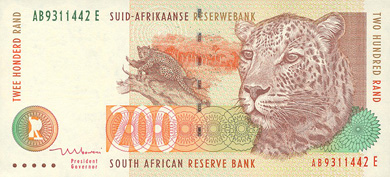
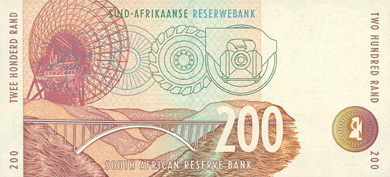
- Currency Name and Code
- Rand (ZAR)
- GDP — official exchange rate
- $187,300,000,000 (USD)
- GDP Real Growth Rate
- 4.9%
- Gini Index
- 59.3
Banknotes
Budget & Public Finance
- Fiscal Year
- 1 April - 31 March
- Annual Budget
- $70,620,000,000 (USD)
- Public Debt (% of GDP)
- 37.7%
- External Debt
- $44,330,000,000 (USD)
- Investment (% of GDP)
- 17.9%
- Economic Aid
- $487,500,000 (USD)
- Current Account Balance
- -$9,584,000,000 (USD)
- Reserves of Foreign Exchange
- $2,147,483,647 (USD)
Labor, Industry & Trade
- Labor Force by Occupation
- agriculture 30%; industry 25%; services 45%
- Household Income — highest 10%
- 45.9%
- Industries
- mining (world's largest producer of platinum, gold, chromium), automobile assembly, metalworking, machinery, textile, iron and steel, chemicals, fertilizer, foodstuffs
- Agriculture Products
- corn, wheat, sugarcane, fruits, vegetables; beef, poultry, mutton, wool, dairy products
- Export Commodities
- gold, diamonds, platinum, other metals and minerals, machinery and equipment
- Export Partners
- UK 12.8%, US 12.7%, Germany 9.3%, Japan 8.9%, Italy 5.8%
- Import Commodities
- machinery and equipment, chemicals, petroleum products, scientific instruments, foodstuffs (2000 est.)
- Import Partners
- Germany 15.5%, US 9.5%, UK 9.1%, Japan 5.8%, Saudi Arabia 5.3%, France 5%, China 4.9%
Energy
- Oil Production
- 2,167,000 bbl/day
- Oil Consumption
- 484,000 bbl/day
- Oil Reserves
- 7,840,000 bbl/day
- Natural Gas Production
- 2,350,000,000 cu m
- Natural Gas Consumption
- 2,350,000,000 cu m
- Natural Gas Imports
- 0 cu m
- Natural Gas Exports
- 0 cu m
- Natural Gas Reserves
- 28,320,000 cu m
Communications
- Telephone System
- general assessment: the system is the best developed and most modern in Africa domestic: combined fixed-line and mobile-cellular teledensity is roughly 140 telephones per 100 persons; consists of carrier-equipped open-wire lines, coaxial cables, microwave radio relay links, fiber-optic cable, radiotelephone communication stations, and wireless local loops; key centers are Bloemfontein, Cape Town, Durban, Johannesburg, Port Elizabeth, and Pretoria international: country code - 27; the SAT-3/WASC and SAFE fiber-optic submarine cable systems connect South Africa to Europe and Asia; the EASSy fiber-optic cable system connects with Europe and North America; satellite earth stations - 3 Intelsat (1 Indian Ocean and 2 Atlantic Ocean)
- Internet Country Code
- .za
News & Weather
News & Weather
Current Weather
Latest News
Fleeing Migrants Leave Hard-to-Fill Gap in South Africa’s Moribund Economy - Bloomberg.com
Bloomberg.com · 3d ago
Ski enthusiasts flock to sub-Saharan Africa and a snowy mountain resort in Lesotho - Yahoo! Finance Canada
Yahoo! Finance Canada · 3h ago
South Africa's Jayden Adams' 'big-time goal' was to play for Liverpool - Memorial video - ESPN
ESPN · 1d ago
South African rand steady as investors await central bank guidance - Reuters
Reuters · 1d ago
Chidimma Adesina deportation case update: South Africa Home Affairs court return to court wit former Miss Universe - BBC
BBC · 22h ago
Botswana Unites With Zimbabwe, Mozambique, Namibia and Other Global Destinations as South Africa Tourism Arrivals Strengthen in 2026, With Nearly Two Million Road Movements Driving Regional Travel Growth, Cross-Border Connections, Overnight Sta - Travel And Tour World
Travel And Tour World · 18h ago
Nigeria and Ghana call on AU to address 'Afrophobic protests' in South Africa - africanews.com
africanews.com · 19h ago
South Africa crowned Junior World Championship 2026 winners - World Rugby
World Rugby · 2d ago
News via Google News
Climate Overview
South Africa has a moderate climate with sunny days and cool nights. The most southerly point has a mean yearly temperature of 61.8 degrees Fahrenheit, while Johannesburg, situated at 5,700 above sea level, has an annual mean of 60.8 degrees Fahrenheit. Pretoria, at 4,452 feet above sea level, is warmer with a mean annual temperature of 63.5 degrees Fahrenheit. The temperatures can be deceiving because of the very bright and dangerous high sun during most of the year, especially in the highveld areas.
Although the country lies close to the Tropic of Capricorn, the high altitude of the inland areas results in a temperate climate in most of the country. In the Southern Hemisphere, seasons are opposite those of the Northern Hemispher-summer extends from October to March; winter from June to September. The rainy season in the Pretoria-Johannesburg area is during summer, and the temperature seldom rises above 90 degrees F, with cool nights. Winter is dry and cool with daily temperatures varying from as low as 30 degrees F during the night to as high as 75 degrees F during the day.
Along the coastal area where Durban and Cape Town are located, heavier rainfall occurs during winter and spring, causing high humidity. Both cities experience strong winds - Durban from August through October and Cape Town throughout the year. The seasons are not pronounced but blend almost imperceptibly.
For the most part, trees and shrubs remain green, with flowers blooming throughout the year. The highveld, which includes the Pretoria-Johannesburg area, remains dry and brown throughout much of the year.
Videos
Videos
2 curated YouTube videos.
Source: YouTube
Source: YouTube
Frequently Asked Questions
Frequently Asked Questions
What is the population of South Africa?
How do people greet each other in South Africa?
What are the dining customs in South Africa?
What should I know about visiting and hospitality in South Africa?
How should I dress in South Africa?
What gestures should I be aware of in South Africa?
What is family life like in South Africa?
What do people do for fun in South Africa?
What is the capital of South Africa?
Where is South Africa located?
What countries border South Africa?
What is the predominant religion in South Africa?
What is the currency of South Africa?
What languages are spoken in South Africa?
What is the geography of South Africa like?
What is South Africa known for?
Last reviewed 2026