
 English
 Español
 中文
中文 हिन्दी
 Français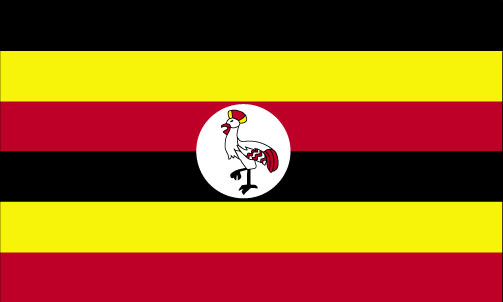
Uganda
Declare Your Relationship to Uganda
CountryReports Community
- Studying4
- From Uganda1
- Uganda heritage1
- Visited2
- Want to visit1
Customs and Culture
Customs and Culture
About the People
Ugandans are very involved in the social life of their communities. Sociability is shown through their ritualized greetings that may take up to ten minutes. To not greet someone is considered rude.
Cultural Attributes
Ugandans are very involved in the social life of their communities. Sociability is shown through their ritualized greetings that may take up to ten minutes. To not greet someone is considered rude.

The Source of the Nile
Greetings, Gestures & Visiting
Greetings are an essential part of Ugandan social norms. When meeting someone, it's customary to greet them with a handshake or hug, depending on the level of familiarity. It's also polite to ask about their health and well-being.
Western style of clothing is worn. Native clothing worn by women in the southern Uganda are called busuuti, which is a floor length cloth dress with short sleeves, a square neckline with two buttons and a sash at the waist.
Diet
Millet and sorghum are common in the northern region. Cassava, manioc, sweet potatoes and plantains are common in the southern and eastern regions. Matooke (plantains) are a staple that is served with various sauces made from peanuts, green leaves, mushrooms, tomatoes fish, white ants or grasshoppers.

Family
Marriage and family are very important. The extended family continues to be important as well. In recent years the national ideal is to only have one wife. Ugandans usually pay a marriage fee (bride price) and maintain allegiance to the extended family.
Recreation
Soccer is the most important sport. Cricket, rugby, track and field and boxing are also popular. Urban families enjoy visiting restaurants where the can watch traditional dancing. Okwesa is a game of strategy involving a wooden board and stones or beans that are placed in the pockets of the board. Verbal games such as riddles are played in the evenings.
Holidays
Independence Day
10/9Independence Day
Christmas
12/25Christmas
Christmas dinner may consist of beef or chicken with matoka (mashed or cooked banana served with groundnut sauce). Although no gifts are exchanged, men customarily purchase new dresses for their wives at this time.
Dates of Interest
- June 3rd
A food festival that celebrates the popular Ugandan street food known as "rolex." A rolex is a chapati (flatbread) filled with eggs, vegetables, and sometimes meat. The festival features competitions, food vendors, and live music.
How do people greet each other in Uganda?
Greetings are an essential social norm and may be quite lengthy, with people commonly shaking hands or hugging depending on familiarity, and asking about each other's health and well-being.
Do
- Greet everyone you meet
- Shake hands or hug based on how well you know the person
- Ask about the person's health and well-being
Don’t
- Skip greeting someone, as it is considered rude
Good to know
- Ritualized greetings can take up to ten minutes
What is the food and eating culture like in Uganda?
Staples vary by region: millet and sorghum are common in the north, while cassava, manioc, sweet potatoes, and plantains are common in the south and east.
Good to know
- Matooke (plantains) is a staple served with sauces made from peanuts, green leaves, mushrooms, tomatoes, fish, white ants, or grasshoppers
What should I wear in Uganda?
Western-style clothing is commonly worn.
Good to know
- In southern Uganda, women may wear a busuuti, a floor-length short-sleeved dress with a square neckline, two buttons, and a waist sash
How important is family in Uganda?
Marriage and family, including the extended family, are very important in Ugandan life.
Good to know
- A marriage fee (bride price) is usually paid
- The national ideal in recent years is to have only one wife
- Allegiance to the extended family is maintained
What do people do for fun in Uganda?
Soccer is the most important sport, with cricket, rugby, track and field, and boxing also popular.
Good to know
- Urban families enjoy restaurants where they can watch traditional dancing
- Okwesa is a strategy game played on a wooden board with stones or beans placed in pockets
- Verbal games such as riddles are played in the evenings
Last updated: 2026-07-12 · Sources: CountryReports
Photos of Uganda
Photos of Uganda
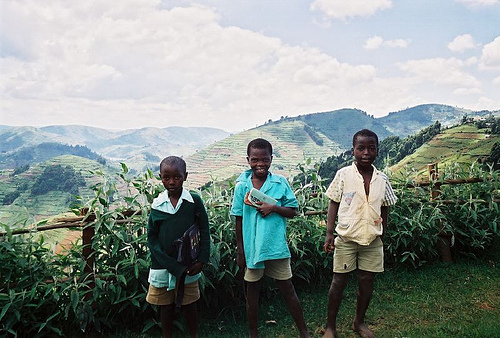
Children in Uganda
Auto mechanics in Uganda
Landscape in Uganda
Children in Uganda
Various drums in Uganda
Banana merchant in Uganda
Bulls in the road, Uganda
Two youngt boys smile for the camera in Kitgum, Uganda
Homes near Gulu, Uganda
Ugandan river on the Road to Gulu, Northern Uganda
Mountain gorilla in Uganda
Girls in Uganda


Travel and Tourism
Travel and Tourism
- Travel Alert Status
- Level 3: Reconsider Travel
- Currency
- Ugandan shilling (UGX)
- Time Difference
- UTC+3 (8 hours ahead of Washington, DC during Standard Time)
- Climate
- The average temperature in Kampala ranges from a high of 85 degrees F at noon to a low of 60 at night. The temperature changes more during the course of each day than it does from season to season. The hottest weather occurs from October through March. Kampala has an annual rainfall of about 63 inches. During the rainy seasons—March to April and September to October—the weather is cooler. Frequent, heavy thunderstorms last from 30 minutes to 1 hour. It seldom rains an entire day, even during the so-called rainy seasons. Wind gusts that accompany downpours are sometimes strong enough to knock down tree limbs and even an occasional tree. Red murram dust, which can be a particular problem during dry periods, effects Kampala dwellers when venturing beyond the main asphalt roads.
- Airports
- 27
Read the full travel guide — health, safety, vaccinations, disease risk, sanitation, and transit details.
View full travel guideRecipes
Recipes
Pasta Frola
Dessert
Main Dish
Matoke (Steamed Plantain with Chicken)
Main Dish
(Ugandan Kebabs)
Main Dish
Pascualina (Uruguayan Spinach Pie)
Main Dish
Vitel Tonne
Side Dish
(Mealie-Meal Porridge)
Side Dish
Pasta Puttanesca
Soup
PremiumBuseca
Dessert
PremiumPasta Frola
Beverage
PremiumKhchaf (Fruit Drink)
History
History
Historical Eras
Bantu & Early Kingdoms
500 BCE – 1894
Bantu-speaking peoples migrated into the Great Lakes region and gradually established sophisticated kingdoms, most notably Buganda and Bunyoro. By the 18th century Buganda had emerged as the dominant regional power, expanding at Bunyoro's expense. Arab and Swahili traders arrived by the 1840s, introducing Islam, while British explorer John Hanning Speke reached the Buganda court in 1862 and Christian missionaries followed in 1875 under King Mutesa I.
British Protectorate
1894 – 1962
Following the 1890 Anglo-German treaty, Britain formally declared Uganda a protectorate between 1894 and 1900, incorporating multiple kingdoms under colonial administration. Commercial cotton cultivation began in 1904 and became the backbone of the economy, cultivated by African smallholders rather than a settler class. Uganda was granted internal self-government in 1958, and independence arrived in October 1962 with relatively little nationalist conflict compared to neighboring territories.
Early Independence & Obote I
1962 – 1971
Uganda's first decade of independence under Prime Minister and later President Milton Obote showed early promise, with new schools, improved infrastructure, and a flourishing economy anchored by Makerere University and the Mulago teaching hospital. Political tensions between the central government and the powerful Buganda kingdom led Obote to suspend the 1962 constitution in 1966, abolish the traditional kingdoms, and rule by executive decree, laying the groundwork for the authoritarian crises to follow.
Amin's Dictatorship
1971 – 1979
General Idi Amin Dada seized power in a military coup in January 1971 and imposed a brutal regime responsible for the deaths of an estimated 300,000 opponents, including the expulsion of Uganda's Asian community in 1972 and the decimation of professional and intellectual classes. Amin's erratic foreign policy included border clashes with Tanzania in 1972–73 and the seizure of British businesses. A Tanzanian military invasion in 1979, supported by Ugandan exiles, ended his rule and forced him into permanent exile.
Civil War & Obote II
1979 – 1986
The post-Amin transitional period proved chaotic, culminating in Obote's contested return to power after disputed 1980 elections. His second government oversaw a devastating civil war against Yoweri Museveni's National Resistance Army, during which government forces conducted genocidal sweeps of the Luwero Triangle, killing at least 100,000 civilians. A military coup removed Obote in 1985, but instability continued until Museveni's NRA captured Kampala in January 1986.
Museveni & Modern Uganda
1986 – present
Yoweri Museveni's National Resistance Movement government brought relative stability and economic recovery after two decades of catastrophic misrule, introducing a no-party 'movement system' before transitioning to multiparty politics. Uganda held its first presidential election in sixteen years in 1996, and the country became a key regional actor, though it faced ongoing challenges from the Lord's Resistance Army insurgency in the north and controversy over Museveni's extended rule. Economic growth, regional influence, and contested democratic governance define the contemporary era.
Overview
Timeline of Key Events
500 BCE – 1300
Bantu-speaking people migrate to the region. They establish the state of Buganda.
Bantu-speaking people migrate to the region. They establish the state of Buganda.
1700
Buganda begins to expand at the expense of Bunyoro.
Buganda begins to expand at the expense of Bunyoro.
1840
Muslim traders from the Indian Ocean coast exchange slaves of Buganda.
Muslim traders from the Indian Ocean coast exchange firearms, cloth and beads for the ivory and slaves of Buganda.
1862
British explorer John Hanning Speke becomes the first European to visit Buganda.
British explorer John Hanning Speke becomes the first European to visit Buganda.
1875
Bugandan King Mutesa I allows Christian missionaries to enter his realm.
Bugandan King Mutesa I allows Christian missionaries to enter his realm.
1890
Britain and Germany sign treaty giving Britain rights to what was to become Uganda.
Britain and Germany sign treaty giving Britain rights to what was to become Uganda.
1894 – 1900
Britain takes control of the area, calling it Uganda.
Britain takes control of the area, calling it Uganda. Britain recognizes the kabaka, or Buganda tribal king, as ruler, but maintains its authority.
Read the full history profile — narrative overview, defining eras, and the complete timeline in one place.
View expanded historyInteresting Facts
Interesting Facts
When a child loses a tooth they leave their tooth behind a pot along the path the rats use. They next day their tooth will be gone and they will find money in that spot. Some rats are poorer than others.
John Hanning Speke visited Uganda in 1862; he discovered that Lake Victoria was the source of the Nile. On 14 August 1992, Mbale in Uganda experienced a meteorite fall when many stones fell through the roofs of buildings.
See every fact — trivia, oddities, and curious tidbits gathered from across the country.
View all interesting factsGeography and Environment
Geography and Environment
- Terrain
- mostly plateau with rim of mountains
- Climate
- The average temperature in Kampala ranges from a high of 85 degrees F at noon to a low of 60 at night. The temperature changes more during the course of each day than it does from season to season. The hottest weather occurs from October through March. Kampala has an annual rainfall of about 63 inches. During the rainy seasons—March to April and September to October—the weather is cooler. Frequent, heavy thunderstorms last from 30 minutes to 1 hour. It seldom rains an entire day, even during the so-called rainy seasons. Wind gusts that accompany downpours are sometimes strong enough to knock down tree limbs and even an occasional tree. Red murram dust, which can be a particular problem during dry periods, effects Kampala dwellers when venturing beyond the main asphalt roads.
- Natural Hazards
- NA
- Current Environmental Issues
- draining of wetlands for agricultural use; deforestation; overgrazing; soil erosion; water hyacinth infestation in Lake Victoria; poaching is widespread
Read the full geography and environment profile — terrain, climate, natural resources, hazards, land use, and international agreements.
View full geographyPeople & Demographics
People & Demographics
Religion
Languages Spoken
English (official language, Ganda or Luganda , other Niger-Congo languages, Nilo-Saharan languages, Swahili, Arabic)
- Arabic
- English
- Swahili
Population
- Population
- 33,398,682
- Population in Major Urban Areas
- KAMPALA (capital) 1.659 million
- Nationality Noun
- Ugandan(s)
- Ethnic Groups
- Baganda 17%, Ankole 8%, Basoga 8%, Iteso 8%, Bakiga 7%, Langi 6%, Rwanda 6%, Bagisu 5%, Acholi 4%, Lugbara 4%, Batoro 3%, Bunyoro 3%, Alur 2%, Bagwere 2%, Bakonjo 2%, Jopodhola 2%, Karamojong 2%, Rundi 2%, non-African (European, Asian, Arab) 1%, other 8%
Education
- Literacy Definition
- age 15 and over can read and write
Health Information
- Major Infectious Diseases — degree of risk
- very high
Read the full people and society profile — demographics, health, education, religion, languages, and notable people.
View full people and societyGovernment & Politics
Government & Politics
Country Identity
- Country Name
- Uganda
- Full Country Name
- Republic of Uganda
Government Structure
- Government Type
- republic
- Legal System
- in 1995, the government restored the legal system to one based on English common law and customary law; accepts compulsory ICJ jurisdiction, with reservations
- Executive Branch
- chief of state: President Yoweri Kaguta MUSEVENI (since seizing power on 26 January 1986); note - the president is both chief of state and head of government head of government: President Yoweri Kaguta MUSEVENI (since 26 January 1986); Prime Minister Robinah NABBANJA (since 14 June 2021); note - the president is both chief of state and head of government; the prime minister assists the president in the supervision of the cabinet cabinet: Cabinet appointed by the president from among elected legislators with approval from Parliament elections: president elected by popular vote for a five-year term; election last held on 14 January 2021 (next to be held in 2026) election results: Yoweri Kaguta MUSEVENI reelected president; percent of vote - Yoweri Kaguta MUSEVENI 58.6%, Robert Kyagulanyi SSENTAMU (also known as Bobi WINE) 34.8%, other 6.6%
- Legislative Branch
- unicameral National Assembly (303 members - 214 directly elected by popular vote, 81 nominated by legally established special interest groups [women 56, army 10, disabled 5, youth 5, labor 5], 8 ex officio members; members serve five-year terms) elections: last held 23 February 2006 (next to be held in 2011 ) election results: percent of vote by party - NA%; seats by party - NA; note - election results had not been posted as of March 2006
- Judicial Branch
- Court of Appeal (judges are appointed by the president and approved by the legislature); High Court (judges are appointed by the president)
- Suffrage
- 18 years of age; universal
- Constitution
- 8 October 1995; adopted by the interim, 284-member Constituent Assembly, charged with debating the draft constitution that had been proposed in May 1993; the Constituent Assembly was dissolved upon the promulgation of the constitution in October 1995
- Independence
- 9 October 1962 (from UK)
- National Holiday
- Independence Day, 9 October (1962)
Capital City
- Capital Name
- Kampala
- Capital - geographic coordinate
- 0 19 N, 32 33 E
- Capital Time Difference
- UTC+3 (8 hours ahead of Washington, DC during Standard Time)
the site of the original British settlement was referred to by its native name as Akasozi ke'Empala ("hill of the impala" [plural]); over time this designation was shortened to K'empala and finally Kampala
Military
Branches: Uganda People's Defense Force (UPDF): Land Forces (includes Marine Unit), Uganda Air Force
Embassy / Diplomatic Mission
U.S.Embassy Kampala
1577 Ggaba Road, Kampala
Telephone: 256-414-259-791 or 256-414-306-001
Facsimile: 256-414-258-451
Read the full government profile — flag symbolism, national anthem, and other national symbols.
View full government detailsEconomy
Economy
Uganda possesses substantial natural resources, including fertile soils, regular rainfall, and sizable mineral deposits of copper, cobalt, gold, and significant recently discovered oil reserves in the Albertine Rift Basin. Agriculture remains a cornerstone of the economy, employing roughly 70% of the workforce, with coffee continuing to be the country's leading export commodity, followed by gold, fish, and tea. Since the late 1980s, the government has pursued economic reforms supported by international partners, including currency stabilization, liberalization of trade and investment, privatization of state enterprises, and improvements in public financial management.
Over the past two decades, Uganda has achieved relatively strong and steady economic growth, averaging around 6% annually, driven by services, construction, telecommunications, and agricultural exports. However, growth has been uneven, and challenges persist, including high population growth, widespread poverty, youth unemployment, infrastructure gaps, and vulnerability to climate shocks. The COVID-19 pandemic temporarily slowed growth in 2020, but the economy rebounded, with GDP expanding by approximately 5–6% in recent years.
Corruption, governance concerns, and rising public debt remain significant constraints on long-term development. Uganda benefited from the Heavily Indebted Poor Countries (HIPC) Initiative and the Multilateral Debt Relief Initiative in the 2000s, but external debt has since climbed substantially, driven by borrowing for infrastructure projects such as roads, hydropower dams, and oil sector development.
The anticipated start of commercial crude oil production, expected later this decade through the East African Crude Oil Pipeline (EACOP) and the Tilenga and Kingfisher projects, is projected to transform the economy, though it has also drawn scrutiny over environmental and human rights concerns. Diversification, regional trade integration through the East African Community and the African Continental Free Trade Area, and continued investment in human capital are seen as critical to sustaining inclusive growth.
Snapshot
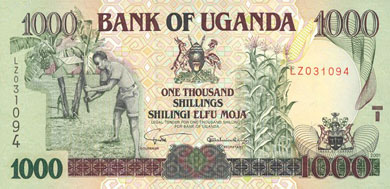
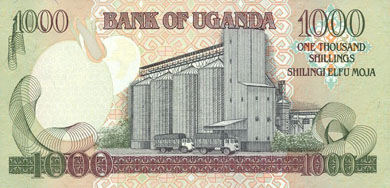
- Currency Name and Code
- Uganda Shilling (UGX)
- GDP — official exchange rate
- $7,909,000,000 (USD)
- GDP Real Growth Rate
- 4%
- Gini Index
- 43
Banknotes
Budget & Public Finance
- Fiscal Year
- 1 July - 30 June
- Annual Budget
- $1,904,000,000 (USD)
- Public Debt (% of GDP)
- 62.8%
- External Debt
- $4,949,000,000 (USD)
- Investment (% of GDP)
- 23.4%
- Economic Aid
- $1,400,000,000 (USD)
- Current Account Balance
- -$339,000,000 (USD)
- Reserves of Foreign Exchange
- $1,450,000,000 (USD)
Labor, Industry & Trade
- Labor Force by Occupation
- agriculture 82%; industry 5%; services 13%
- Household Income — highest 10%
- 21%
- Industries
- sugar, brewing, tobacco, cotton textiles, cement
- Agriculture Products
- coffee, tea, cotton, tobacco, cassava (tapioca), potatoes, corn, millet, pulses; beef, goat meat, milk, poultry, cut flowers
- Export Commodities
- coffee, fish and fish products, tea; gold, cotton, flowers, horticultural products
- Export Partners
- Belgium 16.8%, Netherlands 14.3%, Germany 7.9%, Spain 5.8%, US 4.9%, Italy 4.3%, Portugal 4.3%, UK 4.3%, Japan 4%
- Import Commodities
- capital equipment, vehicles, petroleum, medical supplies; cereals
- Import Partners
- Kenya 46.4%, South Africa 6.9%, India 5.7%, UK 5.6%
Energy
- Oil Production
- 0 bbl/day
- Oil Consumption
- 10,000 bbl/day
- Oil Reserves
- 0 bbl/day
- Natural Gas Production
- 0 cu m
- Natural Gas Consumption
- 0 cu m
- Natural Gas Imports
- 0 cu m
- Natural Gas Exports
- 0 cu m
- Natural Gas Reserves
- 0 cu m
Communications
- Telephone System
- general assessment: mobile cellular service is increasing rapidly, but the number of main lines is still deficient; work underway on a national backbone information and communications technology infrastructure; international phone networks and Internet connectivity provided through satellite and VSAT applications domestic: intercity traffic by wire, microwave radio relay, and radiotelephone communication stations, fixed and mobile-cellular systems for short-range traffic; mobile-cellular teledensity about 50 per 100 persons in 2010 international: country code - 256; satellite earth stations - 1 Intelsat (Atlantic Ocean) and 1 Inmarsat; analog links to Kenya and Tanzania
- Internet Country Code
- .ug
News & Weather
News & Weather
Current Weather
Latest News
From Uganda’s streets to the FIFA World Cup 2026 final: Ghetto Kids to share spotlight with Shakira at half-time show - olympics.com
olympics.com · 1d ago
At least 20 students killed in Uganda bus crash - CNN
CNN · 3d ago
Death toll from Uganda school bus crash rises to 24 - Al Jazeera
Al Jazeera · 2d ago
Morocco Follows Uganda, Egypt, Burkina Faso, And More African Nations Facing A Major Travel Barrier As South Africa Restricts Visa-Free Entry For 28 Countries, Shaking Cross-Border Tourism, Business Travel And Regional Connectivity - Travel And Tour World
Travel And Tour World · 1d ago
Food emergency deepens across Uganda’s Karamoja - Al Jazeera
Al Jazeera · 3d ago
Democratic Republic of Congo Overtakes Uganda, Kenya, Tanzania and Others in Africa Fueling Rwanda’s Tourism Through Record-Breaking Regional Travel Demand During the First Six Months of 2026 - Travel And Tour World
Travel And Tour World · 2d ago
Ebola disease caused by Bundibugyo virus, Democratic Republic of the Congo & Uganda - World Health Organization (WHO)
World Health Organization (WHO) · 43d ago
King David Junior School, Ndejje: Uganda suspends school trips after 20 pupils die in bus crash - BBC
BBC · 3d ago
News via Google News
Climate Overview
The average temperature in Kampala ranges from a high of 85 degrees F at noon to a low of 60 at night. The temperature changes more during the course of each day than it does from season to season. The hottest weather occurs from October through March.
Kampala has an annual rainfall of about 63 inches. During the rainy seasons—March to April and September to October—the weather is cooler. Frequent, heavy thunderstorms last from 30 minutes to 1 hour. It seldom rains an entire day, even during the so-called rainy seasons. Wind gusts that accompany downpours are sometimes strong enough to knock down tree limbs and even an occasional tree. Red murram dust, which can be a particular problem during dry periods, effects Kampala dwellers when venturing beyond the main asphalt roads.
Videos
Videos
1 curated YouTube videos.
Source: YouTube
Frequently Asked Questions
Frequently Asked Questions
What is the population of Uganda?
How do people greet each other in Uganda?
What is the food and eating culture like in Uganda?
What should I wear in Uganda?
How important is family in Uganda?
What do people do for fun in Uganda?
What is the capital of Uganda?
Where is Uganda located?
What countries border Uganda?
What religion is practiced in Uganda?
What is the currency of Uganda?
What languages are spoken in Uganda?
What is Uganda known for?
What is the history of Uganda's independence?
Last reviewed 2026