
 English
 Español
 中文
中文 हिन्दी
 Français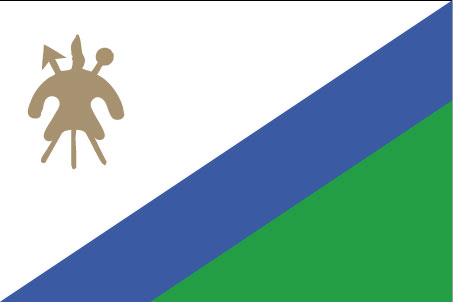
Lesotho
Declare Your Relationship to Lesotho
CountryReports Community
- Studying0
- From Lesotho0
- Lesotho heritage0
- Visited0
- Want to visit0
Customs and Culture
Customs and Culture
About the People
Politeness, good manners and willingness to server are values that are strongly encouraged in children.The general attitude of childhood is defined by the statement "Children benefit from serving their elders".
Cultural Attributes
Politeness, good manners and willingness to server are values that are strongly encouraged in children.The general attitude of childhood is defined by the statement "Children benefit from serving their elders".

Kingdom of Ancient Footprints
Greetings, Gestures & Visiting
ntate (father) and mme (mother) are commonly used to address one's elders. Abuti (brother) and ausi (sister) are used when addressing someone of the same age. A child who answers a question with a simple yes is considered impolite. To be polite a child would answer yes my father or yes my mother.
Hospitality and generosity are expected and even those with very little will share their food with visitors.
Western style clothing is the norm in Lesotho. The most acceptable form of clothing for women is a dress. Women also cover their hair with a scarf, head cloth or hat. Many wear brightly colored blankets instead of coats. The blankets are usually store bought.
Diet
Staple foods are maize (corn) eaten as a thick paste and bread. Beef, chicken and mutton (lamb) are popular meats. Milk is drunk in a soured form. Breakfast and the evening meal are the main meals of the day. Some people go without a lunch meal. Families usually share a pot of nsima, picking a ball of the porridge and making a small scoop with the thumb to put the stew in the mouth. Urban people eat using European style of eating.

Family
The man is considered the head of the household. Women are defined as farmers and bearers of children. Marriages where the man has more than one wife is common among the elite. Many marriages are still arranged by transfer of the bohadi (bride wealth) from the family of the groom to the family of the bride. Upon marriage a bride is expected to leave her family and live with the family of the husband. In Lesotho there are many clans which bear animal names. Recently family life has been disrupted as men live in all male housing and work in the gold mines.
Recreation
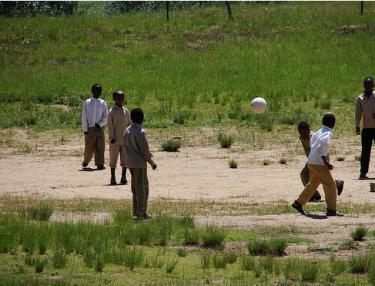
Lesotho children like to play soccer. The only sports the children compete in at school are netball and running, these sports they compete in with other schools. They are organized every year by the school bodies.
There are a few unique games children play; however, they are of African cultures, for instance, Liketo an indigenous game using stones. Children also play games that are similar to European and American games like ‘Khati’ (skipping), ‘Lebekere’ (hide and seek) and Hop Scotch.
Student Life
On a school day children will wake up, take a quick bath, have breakfast and be on the way to school. Some of the common foods for breakfast are bread and tea. A typical morning greeting for a child is LUMELA if greeting his peer; LUMELANG is greeting a number of peers or an elderly person.
On a typical day, some children walk quite a distance to and from home because there is no money for transportation, they lost it or they have spent the money on sweets and snacks. Some children get picked up by hired mini-buses or taxis. Depending on how young the child is, the parent takes them to school. Most children walk home. Transportation is provided by business people who saw the business opportunity.
On average primary school starts at 6 years to 12 years, however, because of unknown reasons, some children start at a late age. Classrooms are always crowded, now more than before because education is considered free. Desks are short, books are few, so the teachers normally read to the children and write on the board for notes, tasks, exams and/or assignments. Children provide their own writing books, exam books, writing utensils and stationery. Government schools do not offer computer lessons.
A typical day at school starts with assembly, first and second periods, break, two more periods, lunch time, then younger children go home. The older ones go back to classes till about 2 o’clock. A typical period lasts about 30 minutes, break lasts for about 15 minutes and lunch break for about an hour. Some children bring lunch to school, but the schools provides lunch. A teacher would probably have between 20 and 30 children per class. Sesotho is their primary language at home, except for a few children. Children are encouraged, or pressured to communicate in English in their classrooms. The main subjects taught at primary level are Maths, English, Sesotho, Science and Geography. About 80% go on to secondary level, for those who do not, it is mainly because they failed or due to financial reasons, as secondary education is not free. Children get a hiding when they have been naughty. Sometimes they get a hiding in front of the whole school in assembly or get expelled, but this normally happens in cases of pregnancy and alcohol. The Headmaster/Principal is the deciding body of what is to happen, what punishment is to be implemented. The teachers report to the principal. Every child must wear a uniform, socks, a dress for the females and khaki shorts or long pants for the males, a shirt, jersey, a belt and black shoes. Teachers are normally greeted in class rooms and because they are encouraged to communicate in English, students greet the teachers in English except in Sesotho classes. A typical lunch meal brought from home is a bread or sandwich and juice. Meals provided by the schools deferrer according to days. Some days the children will eat beans and papa (maize meal), papa and cabbage and porridge.
After school is playtime. Some children stay behind at school, playing. For the older children, they have afternoon classes which maybe hosted by one of the teachers at a fee every month, mainly when exams are approaching. The only sports the children partake in are netball and running, these are the only sports they compete in with other schools. They are organized every year by the school bodies. There are a few unique games children play; however, they are of African cultures, for instance, ‘Liketo’ an indigenous game using stones. Children also play games that are similar to European and American games like ‘Khati’ (skipping), ‘Lebekere’ (hide and seek) and Hop Scotch.
When children are not at school, maybe on weekends, they help around the house with light chores like washing dishes, feeding animals, sweeping and dusting and playing. For the older children, when they get home they ensure that their uniform is clean for the next day and if it is not, they wash it, polish their shoes, read and do assignments, play, have dinner and watch TV, wash dishes and maybe feeding any pets. This is assuming there is no helper around the house. There isn’t really any set time for bedtime. A typical meal nighttime meal is made of papa, moroho (cabbage/spinach) and eggs or meat.
For most families, education and communication in English are encouraged. Some families will ensure that their children are ready for the next day’s classes, encouraging the children to speak more English by conversing in English with them. Government schools don’t have Art, Drama and Music lessons; however, they have choirs and compete with other schools in singing.
Holidays
Independence Day
10/4Independence Day
Dates of Interest
- October 4th
How do people address each other in Lesotho?
Respectful terms of address are important: use ntate (father) and mme (mother) for elders, and abuti (brother) or ausi (sister) for people your own age.
Do
- Address elders as ntate (father) or mme (mother)
- Use abuti (brother) or ausi (sister) for peers
- Answer politely, e.g., 'yes my father' or 'yes my mother'
Don’t
- Don't answer a question with a simple 'yes,' which is considered impolite
What are the eating customs in Lesotho?
Staple foods include maize eaten as a thick paste and bread, with beef, chicken and mutton as popular meats and milk drunk soured. Families often share a communal pot.
Do
- Share a pot of nsima with the family
- Pick a ball of the porridge and make a small scoop with your thumb to hold the stew
- Use European-style eating in urban areas
Good to know
- Breakfast and the evening meal are the main meals
- Some people skip lunch
- Milk is drunk in a soured form
What should I know about hospitality in Lesotho?
Hospitality and generosity are expected, and even those with very little will share their food with visitors. Politeness and good manners are highly valued.
Good to know
- Expect to be offered food even from those with little
How should I dress in Lesotho?
Western-style clothing is the norm; for women, a dress is the most acceptable form of clothing.
Do
- Women may cover their hair with a scarf, head cloth or hat
- Many people wear brightly colored (store-bought) blankets instead of coats
What is family life like in Lesotho?
The man is considered the head of the household, women are seen as farmers and bearers of children, and many marriages are arranged through transfer of the bohadi (bride wealth).
Good to know
- Upon marriage, a bride is expected to leave her family and live with the husband's family
- Many clans bear animal names
- Family life has recently been disrupted as men live in all-male housing to work in the gold mines
What do people do for recreation in Lesotho?
Soccer is popular among children, while netball and running are the main competitive school sports. Both indigenous and Western-style games are played.
Good to know
- Liketo is an indigenous game using stones
- Children play Khati (skipping), Lebekere (hide and seek) and Hop Scotch
- School sports competitions are organized annually
Last updated: 2026-07-12 · Sources: CountryReports
Photos of Lesotho
Photos of Lesotho


Travel and Tourism
Travel and Tourism
- Travel Alert Status
- Level 1: Exercise Normal Precautions
- Currency
- loti (LSL); South African rand (ZAR)
- Time Difference
- UTC+2 (7 hours ahead of Washington, DC, during Standard Time)
- Climate
- The climate is temperate year round. Rainfall, occurring mostly from October to April, ranges from 24 inches a year over most of the lowlands to over 40 inches a year in the mountains. A windy season during August and September occasionally brings dust storms. Average daytime temperatures are in the high 80°F in summer and can reach 100°F in Maseru. In winter, daytime temperatures average in the mid 60°F and at night sometimes drop to the teens in Maseru. Nighttime temperatures are regularly below freezing in June, July and August. Temperatures in the mountains are even more extreme with snowfalls common in winter. The humidity year round is quite low.
- Airports
- 28
Read the full travel guide — health, safety, vaccinations, disease risk, sanitation, and transit details.
View full travel guideRecipes
Recipes
History
History
Historical Eras
Basotho Origins
1820 – 1868
King Moshoeshoe I consolidated diverse Sotho-speaking clans into a unified nation at Thaba Bosiu during the difaqane, a period of widespread displacement and warfare across southern Africa. His skilled diplomacy and military strategy allowed the Basotho to resist Zulu, Boer, and other encroachments. This era established the cultural and political foundations of the Basotho nation.
British Protectorate
1868 – 1966
Facing mounting pressure from Boer settlers, Moshoeshoe I requested British protection in 1868, and Basutoland became a Crown protectorate administered from the Cape Colony, then directly from London after 1884. The Gun War of 1880–1881 saw the Basotho resist British disarmament orders, preserving a degree of autonomy. Approximately 20,000 Sotho men served with Allied forces during World War II, accelerating nationalist consciousness and demands for self-governance.
Independence & Early Rule
1966 – 1986
Lesotho gained independence on October 4, 1966, under Prime Minister Leabua Jonathan and his Basotho National Party. Jonathan annulled the 1970 elections when his party faced defeat, imprisoning opposition leaders and ruling by decree. The kingdom remained economically dependent on South Africa while Jonathan increasingly distanced his government from the apartheid regime, drawing cross-border tensions.
Military Rule
1986 – 1993
A military coup in January 1986 ousted Jonathan, installing a Military Council that granted executive authority to King Moshoeshoe II. Internal army power struggles led to the king's forced exile in 1990 and the installation of his son, Letsie III. Major General Ramaema ultimately replaced coup leader Lekhanya and steered the country toward a democratic transition.
Democratic Transition
1993 – 2002
The Basotho Congress Party won the 1993 elections, ending over two decades of authoritarian rule, though political instability persisted through a royal coup in 1994 and Letsie III's brief deposition of the elected government. A South African and Botswana military intervention in 1998 suppressed a mutiny following disputed elections, causing widespread destruction. Electoral reforms introducing proportional representation stabilized the system, producing internationally accepted elections in 2002.
Modern Lesotho
2002 – present
The reformed mixed-member proportional electoral system allowed meaningful opposition representation for the first time, with nine parties winning seats in 2002. Lesotho celebrated its fortieth independence anniversary in 2006 with a redesigned national flag, while challenges including HIV/AIDS, chronic poverty, and regional drought required sustained international development assistance. The country continues to deepen democratic institutions while navigating economic dependence on South Africa and remittances from migrant labor.
Overview
The BNP ruled by decree until January 1986 when a military coup forced them out of office. The Military Council that came into power granted executive powers to King Moshoeshoe II, who was until then a ceremonial monarch. In 1990, however, the King was forced into exile after a falling out with the army. His son was installed as King Letsie III.
The chairman of the military junta, Major General Metsing Lekhanya, was ousted in 1991 and then replaced by Major General Phisoane Ramaema, who handed over power to a democratically elected government of the BCP in 1993. Moshoeshoe II returned from exile in 1992 as an ordinary citizen. After the return to democratic government, King Letsie III tried unsuccessfully to persuade the BCP government to reinstate his father (Moshoeshoe II) as head of state. In August 1994, Letsie III staged a coup which was backed by the military and deposed the BCP government. The new government did not receive full international recognition. Member states of the Southern African Development Community (SADC) engaged in negotiations aimed at the reinstatement of the BCP government. One of the conditions put forward by the King for the return of the BCP government was that his father should be re-installed as head of state. After protracted negotiations, the BCP government was reinstated and the King abdicated in favor of his father in 1995, but Moshoeshoe II died in a car accident in 1996 and was again succeeded by his son, Letsie III. The ruling BCP split over leadership disputes in 1997.
Prime Minister Ntsu Mokhehle formed a new party, the Lesotho Congress for Democracy (LCD), and was followed by a majority of Members of Parliament, which enabled him to form a new government. The LCD won the general elections in 1998 under the leadership of Pakalitha Mosisili, who had succeeded Mokhehle as party leader. Despite the elections being pronounced free and fair by local and international observers and a subsequent special commission appointed by SADC, the opposition political parties rejected the results.
Opposition protests in the country intensified, culminating in a violent demonstration outside the royal palace in August 1998. When junior members of the armed services mutinied in September, the government requested a SADC task force to intervene to prevent a coup and restore stability. A military group of South African and Botswana troops entered the country in September, put down the mutiny, and withdrew in May 1999. Looting, casualties, and widespread destruction of property followed.
An Interim Political Authority (IPA), charged with reviewing the electoral structure in the country, was created in December 1998. The IPA devised a proportional electoral system to ensure that there be opposition in the National Assembly. The new system retained the existing 80 elected Assembly seats, but added 40 seats to be filled on a proportional basis. Elections were held under this new system in May 2002, and the LCD won again. For the first time, however, opposition political parties won significant numbers of seats. Nine opposition parties now hold all 40 of the proportional seats, with the BNP having the largest share (21). The LCD has 79 of the 80 constituency-based seats. Although its elected members participate in the National Assembly, the BNP has launched several legal challenges to the elections, including a recount; none has been successful.
Timeline of Key Events
1860
Lesotho becomes a British protectorate.
Lesotho becomes a British protectorate.
1884
Becomes a British colony.
Becomes a British colony after revolt against Cape Colonial rule. Paramount chiefs retain large degree of autonomy.
1939 – 1945
World War II, with 20,000 Sotho serving in the British forces.
World War II, with 20,000 Sotho serving in the British forces.
1966
Lesotho gained independence from Britain.
Lesotho gained independence from Britain.
1990
King Moshoeshoe II goes into exile. His son is sworn in as Letsie III.
King Moshoeshoe II goes into exile. His son is sworn in as Letsie III.
1994
Fighting among rival army factions.
Fighting among rival army factions.
1995
Moshoeshoe II restored to throne, but dies in a car crash. Letsie III restored as king.
Moshoeshoe II restored to throne, but dies in a car crash. Letsie III restored as king.
Read the full history profile — narrative overview, defining eras, and the complete timeline in one place.
View expanded historyInteresting Facts
Interesting Facts
Dinosaur footprints can be found in many sites in Lesotho. A dinosaur is named after Lesotho. Lesothosaurus was one metre long and lived around two hundred million years ago.
See every fact — trivia, oddities, and curious tidbits gathered from across the country.
View all interesting factsGeography and Environment
Geography and Environment
- Terrain
- mostly highland with plateaus, hills, and mountains
- Climate
- The climate is temperate year round. Rainfall, occurring mostly from October to April, ranges from 24 inches a year over most of the lowlands to over 40 inches a year in the mountains. A windy season during August and September occasionally brings dust storms. Average daytime temperatures are in the high 80°F in summer and can reach 100°F in Maseru. In winter, daytime temperatures average in the mid 60°F and at night sometimes drop to the teens in Maseru. Nighttime temperatures are regularly below freezing in June, July and August. Temperatures in the mountains are even more extreme with snowfalls common in winter. The humidity year round is quite low.
- Natural Hazards
- periodic droughts
- Current Environmental Issues
- population pressure forcing settlement in marginal areas results in overgrazing, severe soil erosion, and soil exhaustion; desertification; Highlands Water Project controls, stores, and redirects water to South Africa
Read the full geography and environment profile — terrain, climate, natural resources, hazards, land use, and international agreements.
View full geographyPeople & Demographics
People & Demographics
Religion
Languages Spoken
Sesotho (southern Sotho), English (official), Zulu, Xhosa
- Sesotho
- English
- Xhosa
- Zulu
Population
- Population
- 1,919,552
- Population in Major Urban Areas
- MASERU (capital) 239,000
- Nationality Noun
- Mosotho (singular), Basotho (plural)
- Ethnic Groups
- Sotho 99.7%, Europeans, Asians, and other 0.3%,
Education
- Literacy Definition
- age 15 and over can read and write
On average primary school starts at 6 years to 12 years, however, because of unknown reasons, some children start at a late age. Classrooms are always crowded, now more than before because education is considered free. Desks are short, books are few, so the teachers normally read to the children and write on the board for notes, tasks, exams and/or assignments. Children provide their own writing books, exam books, writing utensils and stationery. Government schools do not offer computer lessons.
Read the full people and society profile — demographics, health, education, religion, languages, and notable people.
View full people and societyGovernment & Politics
Government & Politics
Country Identity
- Country Name
- Lesotho
- Full Country Name
- Kingdom of Lesotho
- Former Name
- Basutoland
Government Structure
- Government Type
- parliamentary constitutional monarchy
- Legal System
- based on English common law and Roman-Dutch law; judicial review of legislative acts in High Court and Court of Appeal; has not accepted compulsory ICJ jurisdiction
- Executive Branch
- chief of state: King LETSIE III (since 7 February 1996); note - King LETSIE III formerly occupied the throne from November 1990 to February 1995, while his father, King Moshoeshoe II, was in exile head of government: Prime Minister Samuel Matekane (since 28 October 2022) cabinet: Cabinet appointed by the prime minister and approved by the king elections: none - according to the constitution, the leader of the majority party or coalition in the National Assembly automatically becomes prime minister; the monarch is hereditary, but under the terms of the constitution, which came into effect following the March 1993 elections, the monarch serves as a "living symbol of national unity" with no executive or legislative powers; under traditional law, the college of chiefs retains the authority to depose the monarch, determine the line of succession, or appoint a regent in the event that the successor has not reached maturity
- Legislative Branch
- bicameral Parliament consists of the Senate (33 members - 22 principal chiefs and 11 other members appointed by the ruling party) and the Assembly (120 seats, 80 by direct popular vote and 40 by proportional vote; members elected by popular vote for five-year terms); note - number of seats in the Assembly rose from 80 to 120 in the May 2002 election elections: last held 25 May 2002 (next to be held by May 2007) election results: percent of vote by party - LCD 54%, BNP 21%, LPC 7%, other 18%; seats by party - LCD 76, BNP 21, LPC 5, other 18
- Judicial Branch
- High Court (chief justice appointed by the monarch acting on the advice of the Prime Minister); Court of Appeal; Magistrate's Court; customary or traditional court
- Suffrage
- 18 years of age; universal
- Constitution
- 2-Apr-93
- Independence
- 4 October 1966 (from UK)
- National Holiday
- Independence Day, 4 October (1966)
Capital City
- Capital Name
- Maseru
- Capital - geographic coordinate
- 29 19 S, 27 29 E
- Capital Time Difference
- UTC+2 (7 hours ahead of Washington, DC, during Standard Time)
in the Sesotho language the name means "[place of] red sandstones"
Military
Branches: Lesotho Defense Force (LDF): Army (includes Air Wing)
Embassy / Diplomatic Mission
U.S. Embassy Maseru
254 Kingsway Avenue
Maseru 100, Lesotho
Telephone: (266) 2231-2666
Emergency after-hours telephone: (266) 5888-4035
Facsimile: (266) 2231-0116
Email: USConsularMaseru@state.gov
Read the full government profile — flag symbolism, national anthem, and other national symbols.
View full government detailsEconomy
Economy
Small, landlocked, and mountainous, Lesotho remains one of the world's most aid-dependent and unequal economies. It relies heavily on customs duties from the Southern African Customs Union (SACU), which typically account for roughly 40–50 percent of government revenue, as well as remittances from Basotho workers employed in South Africa, primarily in mining and domestic service. The government has worked to broaden its tax base and modernize revenue administration to reduce its vulnerability to volatile SACU receipts.
The Lesotho Highlands Water Project, a multi-phase engineering scheme that began delivering water to South Africa in 1998, continues to generate royalties and hydroelectric power for the country. Phase II of the project, centered on the Polihali Dam, is under construction and expected to significantly expand water transfers and revenue once completed later this decade.
The number of Basotho working in South African mines has fallen sharply over recent decades, but a manufacturing sector has developed around textiles and apparel assembly, much of it supplying the United States market under the African Growth and Opportunity Act (AGOA). Smaller industries process farm products through milling, canning, and leather operations. The economy nonetheless remains rooted in subsistence agriculture, particularly livestock herding and the cultivation of maize, sorghum, and wheat, all of which are highly vulnerable to recurrent drought and the effects of climate change.
Extreme income inequality, high unemployment, persistent poverty, and one of the world's highest HIV/AIDS prevalence rates continue to constrain development. Lesotho has worked with the IMF under successive programs, including an Extended Credit Facility arrangement, to support fiscal reform and macroeconomic stability.
Snapshot
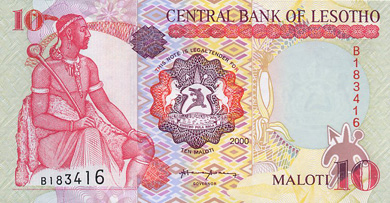
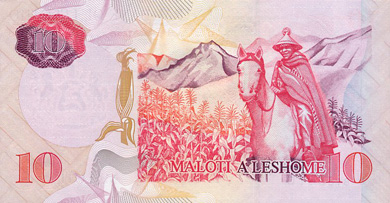
- Currency Name and Code
- Loti (LSL)
- GDP — official exchange rate
- $1,362,000,000 (USD)
- GDP Real Growth Rate
- 0.8%
- Gini Index
- 63.2
Banknotes
Budget & Public Finance
- Fiscal Year
- 1 April - 31 March
- Annual Budget
- $792,100,000 (USD)
- External Debt
- $735,000,000 (USD)
- Investment (% of GDP)
- 29.5%
- Economic Aid
- $41,500,000 (USD)
- Current Account Balance
- -$152,100,000 (USD)
- Reserves of Foreign Exchange
- $411,000,000 (USD)
Labor, Industry & Trade
- Labor Force by Occupation
- 86% of resident population engaged in subsistence agriculture; roughly 35% of the active male wage earners work in South Africa
- Household Income — highest 10%
- 43.4%
- Industries
- food, beverages, textiles, apparel assembly, handicrafts; construction; tourism
- Agriculture Products
- corn, wheat, pulses, sorghum, barley; livestock
- Export Commodities
- manufactures 75% (clothing, footwear, road vehicles), wool and mohair, food and live animals
- Export Partners
- US 97.1%, Canada 0.9%, France 0.6%
- Import Commodities
- food; building materials, vehicles, machinery, medicines, petroleum products
- Import Partners
- Hong Kong 48.3%, China 23.2%, Singapore 3.7%
Energy
- Oil Production
- 0 bbl/day
- Oil Consumption
- 1,400 bbl/day
- Oil Reserves
- 0 bbl/day
- Natural Gas Production
- 0 cu m
- Natural Gas Consumption
- 0 cu m
- Natural Gas Imports
- 0 cu m
- Natural Gas Exports
- 0 cu m
- Natural Gas Reserves
- 0 cu m
Communications
- Telephone System
- general assessment: rudimentary system consisting of a modest number of landlines, a small microwave radio relay system, and a small radiotelephone communication system; mobile-cellular telephone system is expanding domestic: privatized in 2001, Telecom Lesotho was tasked with providing an additional 50,000 fixed-line connections within five years, a target not met; mobile-cellular service dominates the market and is expanding with a subscribership roughly 65 per 100 persons in 2011; rural services are scant international: country code - 266; satellite earth station - 1 Intelsat (Atlantic Ocean)
- Internet Country Code
- .ls
News & Weather
News & Weather
Current Weather
Latest News
Ski enthusiasts flock to sub-Saharan Africa and a snowy mountain resort in Lesotho - AP News
AP News · 3h ago
Ski enthusiasts flock to sub-Saharan Africa and a snowy mountain resort in Lesotho - Oskaloosa Herald
Oskaloosa Herald · 3h ago
Lesotho Skiing - Dayton Daily News
Dayton Daily News · 3h ago
Lesotho Skiing - Idaho State Journal
Idaho State Journal · 1h ago
Lesotho Skiing - The Herald Journal
The Herald Journal · 3h ago
Lesotho Skiing - Bluefield Daily Telegraph
Bluefield Daily Telegraph · 3h ago
Ski enthusiasts flock to sub-Saharan Africa and a snowy mountain resort in Lesotho - The Joplin Globe
The Joplin Globe · 3h ago
Lesotho Skiing - The Herald Journal
The Herald Journal · 3h ago
News via Google News
Climate Overview
The climate is temperate year round. Rainfall, occurring mostly from October to April, ranges from 24 inches a year over most of the lowlands to over 40 inches a year in the mountains. A windy season during August and September occasionally brings dust storms.
Average daytime temperatures are in the high 80°F in summer and can reach 100°F in Maseru. In winter, daytime temperatures average in the mid 60°F and at night sometimes drop to the teens in Maseru. Nighttime temperatures are regularly below freezing in June, July and August. Temperatures in the mountains are even more extreme with snowfalls common in winter. The humidity year round is quite low.
Frequently Asked Questions
Frequently Asked Questions
What is the population of Lesotho?
How do people address each other in Lesotho?
What are the eating customs in Lesotho?
What should I know about hospitality in Lesotho?
How should I dress in Lesotho?
What is family life like in Lesotho?
What do people do for recreation in Lesotho?
What is the capital of Lesotho?
Where is Lesotho located?
What countries border Lesotho?
What religion is practiced in Lesotho?
What is the currency of Lesotho?
What language is spoken in Lesotho?
What is Lesotho known for?
What form of government does Lesotho have?
Last reviewed 2026