
 English
 Español
 中文
中文 हिन्दी
 Français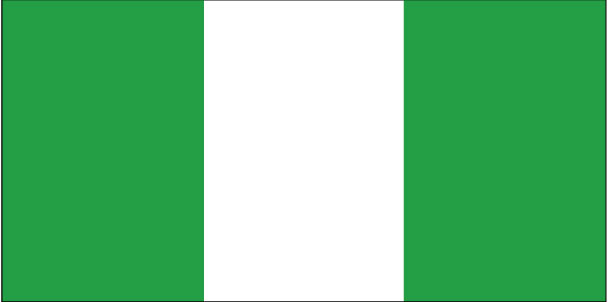
Nigeria
Declare Your Relationship to Nigeria
CountryReports Community
- Studying2
- From Nigeria0
- Nigeria heritage0
- Visited0
- Want to visit0
Customs and Culture
Customs and Culture
About the People
Individual Nigerians are proud of the unique cultural heritage of their particular ethnic group. Nigerians oppose dictatorship, regardless of the ethnicity of the leader, and this has united striking workers and other citizens of all groups. Nigerians are sensitive about their past status as a colony and have been striving to create a modern industrial society that is uniquely African and not a “carbon copy” of Western society. Life in Nigeria moves at a relaxed pace. Schedules are not as important as the needs of an individual.
Cultural Attributes
Nigerians are proud of the unique cultural heritage of their particular ethnic group. Nigerians oppose dictatorship, regardless of the ethnicity of the leader, and this has united striking workers and other citizens of all groups.
Nigerians are sensitive about their past status as a colony and have been striving to create a modern industrial society that is uniquely African and not a “carbon copy” of Western society. Life in Nigeria moves at a relaxed pace. Schedules are not as important as the needs of an individual.

Giant of Africa
Greetings, Gestures & Visiting
People are courteous and cheerful when exchanging greetings. Nigerians, who treat others with respect, expect to be treated likewise. Persons conversing with one another may stand or sit very close. Personal space between members of the some sex is much closer.
Pushing the palm of the hand forward with the fingers spread is rude and should be avoided. Pointing the sole of the foot or shoe at someone is considered rude. Objects are passed with the right hand or both hands, but usually not the left hand alone. Gestures may be different in ethnic groups.
When visiting bringing a small gift is appreciated, but not necassary. Relatives frequently visit each other. Unannounced guests are welcome.
Amongst Muslims, dress is very conservative for both men and women. Dress is more casual in the non-Muslim east and west. Nigerian women and young girls wear a traditional, long, wraparound skirt, a short-sleeved top, and a scarf.
Diet
The mainstays of the Nigerian diet are yams, cassava (a starchy root), and rice. Nigerians are fond of hot, spicy food. Their meals are normally accompanied by a pepper sauce made with fish, meat, or chicken. Climatic conditions favor a wide variety of fruits and vegetables to supplement the diet. Because of tse-tse fly, dairy cattle are scarce in coastal regions, but powdered milk, margarine and cheese are dairy substitutes.
Eating habits vary between different ethnic groups. Some eat with the hand (right hand only), while others use utensils. Hands are generally kept above the table.
The mainstays of the Nigerian diet are yams, cassava (a starchy root), and rice. Nigerians are fond of hot, spicy food. Their meals are normally accompanied by a pepper sauce made with fish, meat, or chicken. Climatic conditions favor a wide variety of fruits and vegetables to supplement the diet. Because of tse-tse fly, dairy cattle are scarce in coastal regions, but powdered milk, margarine and cheese are dairy substitutes.

Family
Although specific details of the family structure vary from one ethnic group to another, Nigerian families are generally male dominated. The practice of polygamy (having more than one wife) is not uncommon since it is allowed by Islamic law. About one-fifth of the labor force is female. Large families traditionally share the work load at home. Nigerians have deep respect for their elders. Children are trained to be quiet, respectful, and unassertive in their relations with adults.
Dating Customs
Marriage customs vary, but the payment of a bridal token or dowry is common throughout the country. The groom is expected to give money, property, or service to the family of the bride. Women usually marry by the time they are twenty. Living together without a formal marriage ceremony is common and socially accepted.
Recreation
Soccer is the most popular sport. Wrestling, archery and horse races are also popular. Basketball and polo are popular in the north. Visiting family or friends is the most popular use of leisure time.
Student Life
In Nigeria, the significant factors that determine the nature of a child’s daily activities include the financial status of the child’s parents, religion, ethnicity, and whether the child resides in a rural or urban area. To have a clear picture of what a day in the life of a Nigerian child looks like, knowledge of the two major geographical zones in Nigeria is necessary. Nigeria is divided into the North, mainly comprised of Hausa people, generally Muslims, and the South, which primarily includes the Yoruba and Igbo people, mostly Christians. As mentioned above, religion is one key factor affecting a child’s daily life, especially for Northerners. For instance, a good number of kids in the North receive informal education by attending Qur’anic schools, while informal education is almost nonexistent in the South. Greetings are an essential part of a child’s upbringing. In Nigeria, a child who fails to greet his or her elders is considered disrespectful and poorly brought up. On a school morning, once a child wakes up, regardless of whether he resides in a rural or urban area, it is expected of the child to greet his parents and older siblings as a sign of respect for them. For a family where English is the language of communication, a child greets by saying “good morning”; otherwise, the greeting will be in the native language used in the home. Although there are over 250 languages in Nigeria, the three major ones are Yoruba, Igbo, and Hausa. A Yoruba male child greets by saying “eku aro” as he prostrates on the ground while a female child kneels on both knees. An Igbo child greets by saying “otutu oma” while a Hausa child greets his parents, saying “ina quo na. “ In Nigeria, the activity of a child residing in a rural area is quite different from that of a child living in a city or town. A child residing in a rural area will probably engage in certain chores before school. Such chores include walking long distances to fetch water from a stream or well (although, these days’, bore-holes are being provided by the government in various communities to ease the stress encountered by children), fetching firewood, and other tasks. Children that reside in the North occasionally engage in farm work before heading off to school as this is the primary source of livelihood for rural Northerners in Nigeria, and parents in need of more hands on the farm often involve their kids, especially in the planting and harvesting seasons. For a child residing in an urban area, life is a little simpler depending on the child’s parents' financial status and exposure to Western education and lifestyle.
In Nigeria, the government does not handle the transportation of schoolchildren to school. Some private schools provide school buses for their pupils, but such schools usually charge high fees for such services. Parents who cannot afford such schools are left with the option of placing their children in government-run schools where the standard of education is very low. Most children who live in rural areas usually have to journey to school on foot for long distances to and fro every day, while in urban areas, getting to school and back for most of the kids is by public transport. Such means of transportation include buses, motorcycles, and tricycles or tricars. Kids whose parents own a car are taken to school by their parents but are often left to return home after school by walking or public transport.
Over the past 30 years, the government has made little or no effort to provide new buildings, maintain existing ones, or provide up-to-date teaching technology, like computers and audiovisuals. Dilapidated structures, poorly maintained buildings, and lack of proper teaching and learning materials are some of the many features of government and some privately owned primary schools in Nigeria. Out of Nigeria's three levels of education, primary education receives the least attention from the government, leaving primary education to be funded chiefly by private individuals or groups. Some of the features seen in such poorly managed schools include the inadequate supply of desks and chairs for students use, which leaves many pupils either standing or sitting on the floor during classes; lack of teaching, learning, and writing materials like chalk, pen, pencils, text and exercise books; the inadequate number of teaching staff; no or poorly stocked libraries; absence of health care facilities like sick-bay, etc. In a government-owned primary school, the average number of people in a classroom ranges from 60-100 students, and the teacher-to-student ratio is about 1-100. The situation is similar in rural and urban areas except for big cities like Lagos, Abuja, and Port Harcourt. In the case of privately run schools, the reverse is the case. Private schools in Nigeria, though not all, provide qualitative education to students but at costly rates. One significant similarity between public and private primary schools is the lack of space for adequate sporting facilities. The most common sporting facility in a typical Nigerian school is a soccer field, while very few boast an outdoor basketball court or a long tennis court. Outside these sporting facilities mentioned, most others used in developed countries, like the gymnasium, are almost unavailable.
Since the advent of Western education in Nigeria, uniforms have been worn by primary and secondary school children, forming part of the criteria for establishing a primary or secondary school. Learning in Nigerian schools encompasses not just the regular classes but also includes morals and values. Therefore, students are expected to show respect to their teachers and have high regard for them. Once a teacher arrives in class, the students are expected to stand on their feet and greet in unison. Although this does not apply to all schools, most do carry out this practice to input moral standards in their pupils. Flogging and other forms of physical punishment, like kneeling while raising the hands, are accepted modes of discipline in primary and secondary schools. The class teacher can punish any student, though with caution. Generally, regardless of whether it is public or private, classes in primary schools begin by 8 a.m. and end by 2 p.m., except on Fridays, where classes end by 1 p.m. because it is a Muslim day of worship. Break time typically starts at 11 a.m. and ends at 11:30 a.m., although some schools may have short breaks between classes. Kids are expected to use this period to eat, play games, and relax before returning to class. It is very unusual for you to find a primary school in Nigeria, whether public or private, that offers lunch or break time meals (as it is called in Nigeria) to students. Kids come to school with their food and snacks, while kids from poor homes come with nothing at all. You may also find schools with canteens where food is sold to students, usually in public primary and secondary schools. Subjects commonly taught in primary schools include English, mathematics, integrated science, social studies, verbal reasoning, quantitative aptitude (taught in private schools only), fine art, and French language (private schools only). Kids in Nigeria often communicate in their native language at home and in school and find it difficult to speak English fluently. Except for private schools, the government of Nigeria has made little or no effort to solve this problem. Primary schools lack adequate English teaching staff and materials needed for teaching English. Even teachers who are supposed to be teaching in English are forced to teach in the native language of the students to carry the kids along, especially in the rural areas of Northern and Southern Nigeria. Year after year, the number of students who fail English and are deprived of entry into the university increases.
After school each day, most school children return home, while others may engage in sporting activities like soccer or basketball. Some schools organize after-school classes for their students (known as lessons in Nigeria), especially for students in their final year in primary and secondary schools. This lets teachers cover the school syllabus and help the students prepare for their final exams. Most parents also organize private tutors to teach their kids after school to keep them busy while they are away and to make up for the poor standard of teaching and learning in school. Although extracurricular activities are unfamiliar, schools usually organize inter-house sports competitions yearly where different houses compete in various games to win trophies. Some games include sack racing, soccer, basketball, match past, track and field events, and tug of war. You rarely find public schools organizing such an event, citing a lack of funds from the government. Some schools also have societies like Jet Club, Debating Society, Press Club, Rotary Club, Girls’ Guide, Boys’ Brigade, and Red Cross Society. Most of these social groups only exist in schools for formality reasons because most of them are almost non-functional.
Weekends are a time for Nigerian kids to play. Boys play soccer on the street or the open field, while girls visit friends and use the weekend to change their hair for the next school week. Parents use this time to be with their children by taking them out to have fun or relax in the house. In rural areas, where farming is the means of livelihood, children accompany their parents to the farm.
The activities a child will engage in after school differ from home to home, but on average, they eat, do their homework, and play. Children who are housemaids in people’s homes face many chores after school. Such tasks include washing clothes by hand, ironing, scrubbing the floor, picking up the kids from school, etc. This seriously affects their output in school because they do not have time to do their homework or study. In many Nigerian cities, kids hawking is widespread. Many kids from poor homes are forced to hawk every day after school, thereby exposing them to sexual abuse, kidnapping for money rituals, and child trafficking. Parents who cannot make ends meet force their kids into harsh practices. The money made from the sales is used to pay children’s school fees, buy books and school sandals, and sew uniforms. Although hawking is now illegal in Nigeria, many kids still hawk daily because of the government’s inability to enforce the law. In most Nigerian homes, evening meals are usually eaten by 7 p.m., and bedtime for children is usually by 9 p.m.
Many parents in Nigeria view formal education as a compulsorily part of a child’s upbringing and make it their responsibility to ensure that their kids attend school regardless of their financial status. Culture also plays a vital role in a child's education level. Previously, female children were not encouraged to attend university or even secondary school. Still, these days, girls attend school to the highest possible level, although in the North, education and culture are still at loggerheads, especially where girls are concerned. Some girls are married off at 12 years of age, while boys are made to attend Qur’anic schools. Western education is not accepted in the rural north because of the belief that it only turns children away from the Islamic way of life. In the south, however, education is highly accepted, and statistics have shown that more girls are enrolled in primary and secondary schools than boys in the southeastern part of the country.
Holidays
Independence Day
10/1Independence Day
National Day
Christmas
12/25Christmas
In Nigeria you might hear “Merry Christmas” but more likely you will hear “Yesu yana Kaunacce Ni” or Jesus Loves me. Music is important to the people of Nigeria. On Christmas afternoon, children go from house to house singing carols and hoping for candies and cookies. Some children wear decorative masks. Drums are considered the most important musical instrument, and are used to accompany the singing. Gift giving is not widely practiced but on Christmas Day families often exchange food.
Dates of Interest
- May 29th
This traditional religious festival is celebrated in Osogbo, Osun State, in honor of the river goddess Osun. It involves colorful processions, rituals, sacrifices, and performances, drawing participants and spectators from various parts of Nigeria and beyond.
How do people greet each other in Nigeria?
Nigerians are courteous and cheerful when exchanging greetings, treating others with respect and expecting the same in return.
Do
- Greet others with courtesy and cheerfulness
- Treat people with respect
Good to know
- People may stand or sit very close when conversing
- Personal space between members of the same sex is much closer
What are dining customs like in Nigeria?
Eating habits vary between ethnic groups; some eat with the right hand only while others use utensils, and staples include yams, cassava, and rice with spicy pepper sauces.
Do
- If eating with your hand, use the right hand only
- Keep your hands above the table
Good to know
- Meals are often accompanied by a hot, spicy pepper sauce made with fish, meat, or chicken
- Dairy substitutes like powdered milk, margarine, and cheese are used, as dairy cattle are scarce in coastal regions
What should I know about etiquette and visiting in Nigeria?
Nigerians are hospitable; unannounced guests are welcome and a small gift is appreciated though not necessary.
Do
- Bring a small gift when visiting, though it is not required
- Pass objects with the right hand or both hands
Don’t
- Don't pass objects with the left hand alone
Good to know
- Relatives frequently visit each other and unannounced guests are welcome
- Life moves at a relaxed pace, and schedules matter less than individual needs
How should I dress in Nigeria?
Dress is very conservative among Muslims for both men and women, but more casual in the non-Muslim east and west.
Good to know
- Nigerian women and girls traditionally wear a long wraparound skirt, a short-sleeved top, and a scarf
- Dress conservatively in Muslim areas
Which gestures should I avoid in Nigeria?
Some gestures are considered rude and should be avoided, though gestures may differ between ethnic groups.
Don’t
- Don't push the palm of your hand forward with fingers spread
- Don't point the sole of your foot or shoe at someone
- Don't pass objects with the left hand alone
What are families like in Nigeria?
Nigerian families are generally male dominated, with deep respect for elders, though structures vary by ethnic group.
Good to know
- Polygamy is not uncommon, as it is allowed by Islamic law
- Children are raised to be quiet, respectful, and unassertive with adults
- Large families traditionally share the work at home
What do people do for fun in Nigeria?
Soccer is the most popular sport, and visiting family or friends is the most popular use of leisure time.
Good to know
- Wrestling, archery, and horse races are also popular
- Basketball and polo are popular in the north
Last updated: 2026-07-12 · Sources: CountryReports
Photos of Nigeria
Photos of Nigeria
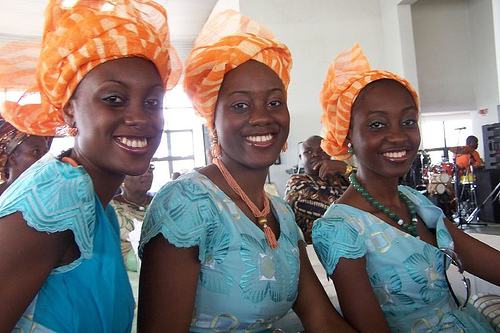
Women attend a religious celebration, Dubai, Nigeria
An old tree overlooking Dubai, Nigeria
Dubai, Nigeria
Church in Dubai, Nigeria
Roadway in Dubai, Nigeria
Marketplace in Dubai, Nigeria
Marketplace in Dubai, Nigeria
House in Dubai, Nigeria
Museum in Dubai, Nigeria
Truck transports goods to market, Dubai, Nigeria
Fabric store in Dubai, Nigeria
Fruit stand in Dubai, Nigeria


Travel and Tourism
Travel and Tourism
- Travel Alert Status
- Level 3: Reconsider Travel
- Currency
- naira (NGN)
- Time Difference
- UTC+1 (6 hours ahead of Washington, DC, during Standard Time)
- Climate
- Due to its size and diversity, Nigeria has different climate zones. In the coastal area, where Lagos is located, temperatures range from the mid-70s to the low 90s during most of the year. Rainfall is heaviest in this area, averaging 70 inches per year. The rainy season is fairly distinct throughout Nigeria. Along the coast, the heaviest rains fall during May to October. Humidity is high most of the year but declines during the winter months. In the central plateau, where Abuja is located, temperatures can climb to over 100(F) between March and June. Abuja's climate is generally hot and humid during the rainy season of June to September and rainfall in the area averages 50 inches per year. The humidity decreases considerably during the coolest months of December and January, when night temperatures are often in the 60s. The climate in northern Nigeria is drier, averaging as low as 20 inches of rain per year in the far north. A distinctive feature of Nigerian weather is the harmattan, a dry northeasterly wind that carries sand from the Sahara south as far as Nigeria's coast during the months of December through February. The effects of the harmattan are felt strongest in the northern part of the country and decrease gradually the further south one goes. Visually, the harmattan creates a haze that on certain days can almost block the views of the surrounding hills in the Abuja region. Many people experience eye, nose and throat problems during this time of year.
- Airports
- 70
Read the full travel guide — health, safety, vaccinations, disease risk, sanitation, and transit details.
View full travel guideRecipes
Recipes
History
History
Historical Eras
Ancient Peoples & Kingdoms
1000 BCE – 1500
The Nok culture, flourishing from roughly 1000 BCE to 300 CE, produced some of Africa's earliest known terra-cotta sculpture and ironworking. Subsequent centuries saw the rise of powerful states including the Kanem-Bornu Empire in the northeast, the Hausa city-states, and the Yoruba kingdom of Ife, each developing sophisticated political structures, trade networks, and artistic traditions long before European contact.
Slave Trade Era
1500 – 1800
Portuguese navigators reached the Nigerian coast in 1472, opening contact with European powers and inaugurating centuries of the transatlantic slave trade. Between the 1650s and 1860s, an estimated 3.5 million people were forcibly exported from the region, profoundly disrupting societies, reshaping ethnic boundaries, and fueling internal warfare. Simultaneously, a steady trans-Saharan slave trade reinforced the spread of Islam across northern Nigeria.
Sokoto Caliphate
1800 – 1903
The jihadist reformer Usman dan Fodio launched a holy war in 1804–08 that overthrew the Hausa kings and established the Sokoto Caliphate, uniting most of northern Nigeria under a single Islamic government. The caliphate became one of the largest states in nineteenth-century Africa and possessed more enslaved people than virtually any other polity of its time. Its administrative and religious structures deeply shaped northern Nigerian society and would directly condition the nature of British colonial rule.
British Colonial Rule
1903 – 1960
British forces completed their conquest of northern Nigeria in 1903, and in 1914 Governor Frederick Lugard amalgamated the northern and southern protectorates into the Colony and Protectorate of Nigeria. Indirect rule through existing chiefs preserved many pre-colonial hierarchies while accelerating agricultural export economies and urban migration. Nationalist movements grew steadily after World War II, led by figures such as Nnamdi Azikiwe and Obafemi Awolowo, culminating in formal independence on October 1, 1960.
Independence & Civil War
1960 – 1970
Nigeria's early independence was marred by ethnic tensions, electoral violence, and successive military coups beginning in January 1966. In 1967, the predominantly Igbo eastern region seceded as the Republic of Biafra, triggering a brutal civil war in which an estimated one to three million people perished, many from famine. Biafran leaders surrendered in January 1970, and the federal government pursued a policy of reconciliation and reintegration as oil revenues began to transform the national economy.
Oil Booms & Military Rule
1970 – 1999
The 1970s oil boom generated enormous revenues that were largely squandered through corruption, mismanagement, and grandiose infrastructure projects, leaving Nigeria deeply indebted when prices collapsed in the 1980s. Civilian government was briefly restored in 1979 under Shehu Shagari but ended in a 1983 coup, and nearly continuous military rule followed. General Sani Abacha's brutal regime (1993–98) annulled a presidential election, imprisoned opposition leaders including Chief Moshood Abiola, and drew wide international condemnation before Abacha's sudden death opened the path to democratic transition.
Democratic Nigeria
1999 – present
A new constitution in 1999 ended sixteen years of military rule, and Olusegun Obasanjo was elected president; his 2003 re-election marked Nigeria's first civilian transfer of power. The government has struggled to convert vast petroleum wealth into broad development, combat endemic corruption, and manage persistent ethnic and religious tensions, including the emergence of Boko Haram insurgency in the northeast after 2009. Nigeria has nonetheless consolidated its role as Africa's most populous nation and largest economy, exercising significant continental diplomatic and cultural influence.
Overview
Timeline of Key Events
500 BCE – 200
Nok culture flourishes.
Jos plateau settled by Nok - a neolithic and iron age civilization.
1472
Portuguese navigators reach Nigerian coast.
Portuguese settlers become the first Europeans to live in Nigeria. Other Europeans follow.
1650 – 1860
Slave trade.
Millions of Nigerians are forcibly sent to the Americas.
1800
Nigeria comes under the loose control of an Islamic empire.
Nigeria comes under the loose control of an Islamic empire.
1914
Britain unites the northern and southern regions, forming the Colony of Nigeria.
Britain unites the northern and southern regions, forming the Colony of Nigeria.
1960
Nigeria gains independence from Britain
Nigeria gains independence from Britain and joins the United Nations. A new constitution and government are adopted.
1965 – 1966
Charges of voting irregularities and riots followed elections.
Charges of voting irregularities and riots followed elections.
Read the full history profile — narrative overview, defining eras, and the complete timeline in one place.
View expanded historyInteresting Facts
Interesting Facts
When a child loses a tooth they hold their tooth in their fist with eight stones to make a total of nine (a girl will hold six stones and her tooth to make seven). Next, they close their eyes and say their name out loud, count to the number in their fist, and say “Oh, I want my tooth back!” Then they throw them and run away. It is very important to run away.
Nigeria's population is the largest in Africa.
The name Nigeria was suggested by the British journalist Flora Shaw. It refers to the Niger River.
Nigerians are very proud of traditional titles. One of the most sought-after titles in Nigeria is Chief, which is considered more important than a doctoral degree.
It is a common practice to bargain for goods in Nigerian markets. Bargaining requires great skill. The shopper must know the latest prices.
Many Nigerians have entered the world of sports in North America. Hakeem Olajuwan, who plays basketball for Houston Rockets, is Nigerian. Dave Defiagbo, who was born in Nigeria, won the silver medal in boxing for Canada in the 1996 Olympics.
See every fact — trivia, oddities, and curious tidbits gathered from across the country.
View all interesting factsGeography and Environment
Geography and Environment
- Terrain
- southern lowlands merge into central hills and plateaus; mountains in southeast, plains in north
- Climate
- Due to its size and diversity, Nigeria has different climate zones. In the coastal area, where Lagos is located, temperatures range from the mid-70s to the low 90s during most of the year. Rainfall is heaviest in this area, averaging 70 inches per year. The rainy season is fairly distinct throughout Nigeria. Along the coast, the heaviest rains fall during May to October. Humidity is high most of the year but declines during the winter months. In the central plateau, where Abuja is located, temperatures can climb to over 100(F) between March and June. Abuja's climate is generally hot and humid during the rainy season of June to September and rainfall in the area averages 50 inches per year. The humidity decreases considerably during the coolest months of December and January, when night temperatures are often in the 60s. The climate in northern Nigeria is drier, averaging as low as 20 inches of rain per year in the far north. A distinctive feature of Nigerian weather is the harmattan, a dry northeasterly wind that carries sand from the Sahara south as far as Nigeria's coast during the months of December through February. The effects of the harmattan are felt strongest in the northern part of the country and decrease gradually the further south one goes. Visually, the harmattan creates a haze that on certain days can almost block the views of the surrounding hills in the Abuja region. Many people experience eye, nose and throat problems during this time of year.
- Natural Hazards
- periodic droughts; flooding
- Current Environmental Issues
- soil degradation; rapid deforestation; urban air and water pollution; desertification; oil pollution - water, air, and soil; has suffered serious damage from oil spills; loss of arable land; rapid urbanization
Read the full geography and environment profile — terrain, climate, natural resources, hazards, land use, and international agreements.
View full geographyPeople & Demographics
People & Demographics
Religion
Languages Spoken
English (official), Hausa, Yoruba, Igbo (Ibo), Fulani
- English
- Fulani
- Hausa
- Igbo (Ibo)
- Yoruba
Population
- Population
- 152,217,341
- Population: Male/Female
- male: 119,514,449 female: 117,232,681
- Population Distribution
- largest population of any African nation; significant population clusters are scattered throughout the country, with the highest density areas being in the south and southwest
- Urban Population
- urban population: 54.3% of total population rate of urbanization: 3.92% annual rate of change
- Population in Major Urban Areas
- 15.946 million Lagos, 4.348 million Kano, 3.875 million Ibadan, 3.840 million ABUJA (capital), 3.480 million Port Harcourt, 1.905 million Benin City
- Nationality Noun
- noun: Nigerian(s) adjective: Nigerian
- Ethnic Groups
- Hausa 30%, Yoruba 15.5%, Igbo (Ibo) 15.2%, Fulani 6%, Tiv 2.4%, Kanuri/Beriberi 2.4%, Ibibio 1.8%, Ijaw/Izon 1.8%, other 24.9%
- Language Note
- English (official), Hausa, Yoruba, Igbo (Ibo), Fulani, over 500 additional indigenous languages
Demographic Profile
Nigeria’s population is projected to grow from more than 186 million people in 2016 to 392 million in 2050, becoming the world’s fourth most populous country. Nigeria’s sustained high population growth rate will continue for the foreseeable future because of population momentum and its high birth rate. Abuja has not successfully implemented family planning programs to reduce and space births because of a lack of political will, government financing, and the availability and affordability of services and products, as well as a cultural preference for large families. Increased educational attainment, especially among women, and improvements in health care are needed to encourage and to better enable parents to opt for smaller families.
Nigeria needs to harness the potential of its burgeoning youth population in order to boost economic development, reduce widespread poverty, and channel large numbers of unemployed youth into productive activities and away from ongoing religious and ethnic violence. While most movement of Nigerians is internal, significant emigration regionally and to the West provides an outlet for Nigerians looking for economic opportunities, seeking asylum, and increasingly pursuing higher education. Immigration largely of West Africans continues to be insufficient to offset emigration and the loss of highly skilled workers. Nigeria also is a major source, transit, and destination country for forced labor and sex trafficking.
Education
- Literacy Definition
- age 15 and over can read and write
Over the past 30 years, the government has made little or no effort to provide new buildings, maintain existing ones, or provide up-to-date teaching technology, like computers and audiovisuals. Dilapidated structures, poorly maintained buildings, and lack of proper teaching and learning materials are some of the many features of government and some privately owned primary schools in Nigeria. Out of Nigeria's three levels of education, primary education receives the least attention from the government, leaving primary education to be funded chiefly by private individuals or groups. Some of the features seen in such poorly managed schools include the inadequate supply of desks and chairs for students use, which leaves many pupils either standing or sitting on the floor during classes; lack of teaching, learning, and writing materials like chalk, pen, pencils, text and exercise books; the inadequate number of teaching staff; no or poorly stocked libraries; absence of health care facilities like sick-bay, etc. In a government-owned primary school, the average number of people in a classroom ranges from 60-100 students, and the teacher-to-student ratio is about 1-100. The situation is similar in rural and urban areas except for big cities like Lagos, Abuja, and Port Harcourt. In the case of privately run schools, the reverse is the case. Private schools in Nigeria, though not all, provide qualitative education to students but at costly rates. One significant similarity between public and private primary schools is the lack of space for adequate sporting facilities. The most common sporting facility in a typical Nigerian school is a soccer field, while very few boast an outdoor basketball court or a long tennis court. Outside these sporting facilities mentioned, most others used in developed countries, like the gymnasium, are almost unavailable.
Health Information
- Life Expectancy at Birth
- total population: 62.2 years male: 60.4 years female: 64.2 years
- Major Infectious Diseases — degree of risk
- degree of risk: very high food or waterborne diseases: bacterial and protozoal diarrhea, hepatitis A, and typhoid fever vectorborne diseases: malaria, dengue fever, and sexually transmitted diseases: hepatitis B water contact diseases: schistosomiasis animal contact diseases: rabies respiratory diseases: meningococcal meningitis aerosolized dust or soil contact diseases: Lassa fever note 1: on 4 May 2022, the Centers for Disease Control and Prevention issued a Travel Health Notice for a Yellow Fever outbreak in Nigeria; a large, ongoing outbreak of yellow fever in Nigeria began in September 2017; the outbreak is now spread throughout the country with the Nigerian Ministry of Health reporting cases of the disease in multiple states (Bauchi, Benue, Delta, Ebonyi, and Enugu); the CDC recommends travelers going to Nigeria should receive vaccination against yellow fever at least 10 days before travel and should take steps to prevent mosquito bites while there; those never vaccinated against yellow fever should avoid travel to Nigeria during the outbreak note 2: on 31 August 2023, the US Centers for Disease Control and Prevention (CDC) issued a Travel Alert for polio in Africa; Nigeria is currently considered a high risk to travelers for circulating vaccine-derived polioviruses (cVDPV); vaccine-derived poliovirus (VDPV) is a strain of the weakened poliovirus that was initially included in oral polio vaccine (OPV) and that has changed over time and behaves more like the wild or naturally occurring virus; this means it can be spread more easily to people who are unvaccinated against polio and who come in contact with the stool or respiratory secretions, such as from a sneeze, of an “infected” person who received oral polio vaccine; the CDC recommends that before any international travel, anyone unvaccinated, incompletely vaccinated, or with an unknown polio vaccination status should complete the routine polio vaccine series; before travel to any high-risk destination, the CDC recommends that adults who previously completed the full, routine polio vaccine series receive a single, lifetime booster dose of polio vaccine note 3: on 20 September 2023, the Centers for Disease Control and Prevention updated a Travel Health Alert for a diphtheria outbreak in several states in Nigeria; vaccination against diphtheria is essential to protect against disease; if you are traveling to an affected area, you should be up to date with your diphtheria vaccines; before travel, discuss the need for a booster dose with your healthcare professional; diphtheria is a serious infection caused by strains of Corynebacterium diphtheriae bacteria that make a toxin from which people get very sick; diphtheria bacteria spread from person to person through respiratory droplets like from coughing or sneezing; people can also get sick from touching open sores or ulcers of people sick with diphtheria note 1: The Nigeria Centre for Disease Control (NCDC) is reporting yellow fever outbreaks in multiple states (Bauchi, Benue, Delta, Ebonyi, and Enugu). Unless vaccinated, travelers should not visit these areas. Yellow fever is caused by a virus transmitted through bites of infected mosquitoes. Travelers to Nigeria should take steps to prevent yellow fever by getting vaccinated at least 10 days before travel and taking steps to prevent mosquito bites. note 3: There is an outbreak of diphtheria in several states in Nigeria. Vaccination against diphtheria is essential to protect against disease. If you are traveling to an affected area, you should be up to date with your diphtheria vaccines.
- Alcohol consumption per capita
- total: 4.49 liters of pure alcohol beer: 0.73 liters of pure alcohol wine: 0.09 liters of pure alcohol spirits: 0.4 liters of pure alcohol other alcohols: 3.27 liters of pure alcohol
- Tobacco Use
- total: 3.7% male: 6.9% female: 0.5%
- Child Marriage
- women married by age 15: 12.3% women married by age 18: 30.3% men married by age 18: 1.6% note: due to prolonged insecurity concerns, some parts of states, including Borno state, were not sampled
- Infant Mortality Rate
- total: 53.7 deaths/1,000 live births male: 58.9 deaths/1,000 live births female: 48.2 deaths/1,000 live births
Life Expectancy
- Life Expectancy at Birth
- total population: 62.2 years male: 60.4 years female: 64.2 years
- Median Age
- total: 19.3 years male: 19.1 years female: 19.6 years
- Age Structure
- 0-14 years: 40.4% (male 48,856,606/female 46,770,810) 15-64 years: 56.2% (male 66,897,900/female 66,187,584) 65 years and over: 3.4% (male 3,759,943/female 4,274,287)
- Infant Mortality Rate
- total: 53.7 deaths/1,000 live births male: 58.9 deaths/1,000 live births female: 48.2 deaths/1,000 live births
Read the full people and society profile — demographics, health, education, religion, languages, and notable people.
View full people and societyGovernment & Politics
Government & Politics
Country Identity
- Country Name
- Nigeria
- Full Country Name
- Federal Republic of Nigeria
Government Structure
- Government Type
- republic transitioning from military to civilian rule
- Legal System
- based on English common law, Islamic Shariah law (only in some northern states), and traditional law
- Executive Branch
- chief of state: President Bola Ahmed TINUBU (since 29 May 2023); note - the president is both the chief of state and head of government head of government: President Bola Ahmed TINUBU (since 29 May 2023); note - the president is both the chief of state and head of government cabinet: Federal Executive Council appointed by the president elections: president is elected by popular vote for no more than two four-year terms; election last held 25 February 2023 (next to be held in February 2027) election results: Bola Ahmed TINUBU elected president; percent of vote - Bola Ahmed TINUBU (APC) 36.6%, Atiku ABUBAKAR (PDP) 29.1%, Peter OBI (LP) 25.4%, Rabiu KWANKWASO (NNPP) 6.4%, other 2.5%
- Legislative Branch
- bicameral National Assembly consists of Senate (109 seats - 3 from each state plus 1 from Abuja, members elected by popular vote to serve four-year terms) and House of Representatives (360 seats, members elected by popular vote to serve four-year terms) elections: Senate - last held 12 April 2003 (next to be held in 2007); House of Representatives - last held 12 April 2003 (next to be held in 2007) election results: Senate - percent of vote by party - PDP 53.7%, ANPP 27.9%, AD 9.7%; seats by party - PDP 76, ANPP 27, AD 6; House of Representatives - percent of vote by party - PDP 54.5%, ANPP 27.4%, AD 8.8%, other 9.3%; seats by party - PDP 223, ANPP 96, AD 34, other 6; note - one seat is vacant
- Judicial Branch
- Supreme Court (judges appointed by the President); Federal Court of Appeal (judges are appointed by the federal government on the advice of the Advisory Judicial Committee)
- Suffrage
- 18 years of age; universal
- Constitution
- new constitution adopted May 1999
- Independence
- 1 October 1960 (from UK)
- National Holiday
- Independence Day (National Day), 1 October (1960)
Capital City
- Capital Name
- Abuja
- Capital - geographic coordinate
- 9 05 N, 7 32 E
- Capital Time Difference
- UTC+1 (6 hours ahead of Washington, DC, during Standard Time)
Abuja is a planned capital city, it replaced Lagos in 1991; situated in the center of the country, Abuja takes its name from a nearby town, now renamed Suleja
Military
Branches: Nigerian Armed Forces: Army, Navy, Air Force
Embassy / Diplomatic Mission
U.S. Embassy Abuja
1075 Diplomatic Drive, Central Area, Abuja
Telephone: 234 (9) 461-4176 during office hours (Monday through Thursday, 7:30 a.m. to 4:30 p.m.; Friday, 7:30 a.m. to 1:30 p.m.)
For after-hours emergencies, call 234 (9) 461-4000
Email: consularabuja@state.gov
U.S. Consulate General Lagos
2 Walter Carrington Crescent, Victoria Island, Lagos
Telephone: 234 (1) 460-3600 during office hours (Monday through Thursday 7:00 a.m. to 4:00 p.m.; Friday, 7:00 a.m. to 1:00 p.m.)
For after-hours emergencies, call 234 (1) 460-3400 or 0805-301-0268
Email: LagosACS@state.gov
Read the full government profile — flag symbolism, national anthem, and other national symbols.
View full government detailsEconomy
Economy
Nigeria, Africa's largest economy by GDP and its most populous country with over 220 million people, remains heavily dependent on its oil and gas sector despite ongoing efforts at diversification. While oil accounts for less than 10% of GDP, it still generates roughly 80% of export earnings and a significant portion of government revenue, leaving the economy vulnerable to global price volatility. Long-standing challenges including corruption, inadequate infrastructure, insecurity, foreign exchange shortages, and inconsistent macroeconomic management continue to weigh on growth.
The agricultural sector employs a large share of the workforce but remains largely subsistence-based and has not kept pace with rapid population growth, forcing Nigeria to import substantial quantities of food. Insecurity in key farming regions, including banditry in the northwest and conflict in the northeast, has further disrupted production.
Under President Bola Tinubu, who took office in May 2023, the government has pursued a series of bold reforms, including removing the costly fuel subsidy and unifying the multiple exchange rates that had distorted the naira. While these measures have been welcomed by international institutions such as the IMF and World Bank, they have also driven inflation to multi-decade highs, eroded household purchasing power, and sparked widespread cost-of-living protests. The Central Bank of Nigeria has responded with aggressive interest rate hikes to contain inflation and stabilize the currency.
Efforts to revive domestic refining, including the long-delayed startup of the massive Dangote Refinery, could reduce Nigeria's heavy reliance on imported refined petroleum products. However, crude oil production has frequently fallen short of OPEC quotas due to theft, pipeline vandalism, and underinvestment. Growth in the coming years is expected to be modest, supported by improving oil output, expanding services, and a growing technology and fintech sector, though sustained progress will depend on continued reform implementation, improved security, and stronger non-oil revenue mobilization.
Snapshot
- Currency Name and Code
- Nigerian Naira (NGN)
- GDP — official exchange rate
- $77,330,000,000 (USD)
- GDP Real Growth Rate
- 6.2%
- Gini Index
- 50.6
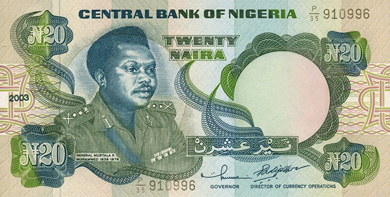
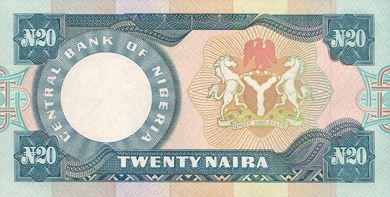
Banknotes
Budget & Public Finance
- Fiscal Year
- calendar year
- Annual Budget
- $13,540,000,000 (USD)
- Public Debt (% of GDP)
- 11.2%
- External Debt
- $37,490,000,000 (USD)
- Investment (% of GDP)
- 23.1%
- Economic Aid
- $1,000,000,000 (USD)
- Current Account Balance
- $9,622,000,000 (USD)
- Reserves of Foreign Exchange
- $2,147,483,647 (USD)
Labor, Industry & Trade
- Labor Force by Occupation
- agriculture 70%; industry 10%; services 20%
- Household Income — highest 10%
- 40.8%
- Industries
- crude oil, coal, tin, columbite, palm oil, peanuts, cotton, rubber, wood, hides and skins, textiles, cement and other construction materials, food products, footwear, chemicals, fertilizer, printing, ceramics, steel
- Agriculture Products
- cocoa, peanuts, palm oil, corn, rice, sorghum, millet, cassava (tapioca), yams, rubber; cattle, sheep, goats, pigs; timber; fish
- Export Commodities
- petroleum and petroleum products 95%, cocoa, rubber
- Export Partners
- US 33.2%, Spain 7.4%, Brazil 6.4%, Indonesia 6%, France 5.7%, India 4.8%, Japan 4%
- Import Commodities
- machinery, chemicals, transport equipment, manufactured goods, food and live animals
- Import Partners
- UK 9.5%, US 9.4%, China 9.3%, France 8.7%, Germany 6.5%, South Korea 6.1%, Netherlands 5.2%, Italy 4.7%, Brazil 4.5%
Energy
- Oil Production
- 2,451,000 bbl/day
- Oil Consumption
- 310,000 bbl/day
- Oil Reserves
- 36,000,000,000 bbl/day
- Natural Gas Production
- 19,200,000,000 cu m
- Natural Gas Consumption
- 7,410,000,000 cu m
- Natural Gas Imports
- 0 cu m
- Natural Gas Exports
- 7,830,000,000 cu m
- Natural Gas Reserves
- 4,502,000,000,000 cu m
Communications
- Telephone System
- general assessment: further expansion and modernization of the fixed-line telephone network is needed; network quality remains a problem domestic: the addition of a second fixed-line provider in 2002 resulted in faster growth but subscribership remains only about 1 per 100 persons; mobile-cellular services growing rapidly, in part responding to the shortcomings of the fixed-line network; multiple cellular providers operate nationally with subscribership base approaching 60 per 100 persons international: country code - 234; landing point for the SAT-3/WASC fiber-optic submarine cable that provides connectivity to Europe and Asia; satellite earth stations - 3 Intelsat (2 Atlantic Ocean and 1 Indian Ocean)
- Internet Country Code
- .ng
News & Weather
News & Weather
Current Weather
Latest News
Many feared dead in another Nigeria boat disaster but why do they keep happening? - BBC
BBC · 14h ago
Nigerian children pay the price for the Iran war as malnutrition and poverty surge - PBS
PBS · 1d ago
Children describe how Nigerian militants moving south are seizing more young captives - AP News
AP News · 1d ago
Octopus-Backed MOPO Partners Nigeria in $75 Million Battery Plan - Bloomberg.com
Bloomberg.com · 1d ago
West African leaders approve Nigeria-Morocco gas pipeline - africanews.com
africanews.com · 1d ago
Fever 105-57 NIGERIA (May 2, 2026) Final Score - ESPN
ESPN · 3d ago
Meet the women protecting the last remaining gorillas in Nigeria: 'Our men have failed to stop the threats' - Good Good Good News
Good Good Good News · 1d ago
Nigeria Targets Record 3 Million Bpd Oil Output by 2030 - Crude Oil Prices Today | OilPrice.com
Crude Oil Prices Today | OilPrice.com · 15h ago
News via Google News
Climate Overview
Due to its size and diversity, Nigeria has different climate zones. In the coastal area, where Lagos is located, temperatures range from the mid-70s to the low 90s during most of the year. Rainfall is heaviest in this area, averaging 70 inches per year. The rainy season is fairly distinct throughout Nigeria. Along the coast, the heaviest rains fall during May to October. Humidity is high most of the year but declines during the winter months. In the central plateau, where Abuja is located, temperatures can climb to over 100(F) between March and June. Abuja's climate is generally hot and humid during the rainy season of June to September and rainfall in the area averages 50 inches per year. The humidity decreases considerably during the coolest months of December and January, when night temperatures are often in the 60s. The climate in northern Nigeria is drier, averaging as low as 20 inches of rain per year in the far north.
A distinctive feature of Nigerian weather is the harmattan, a dry northeasterly wind that carries sand from the Sahara south as far as Nigeria's coast during the months of December through February. The effects of the harmattan are felt strongest in the northern part of the country and decrease gradually the further south one goes. Visually, the harmattan creates a haze that on certain days can almost block the views of the surrounding hills in the Abuja region. Many people experience eye, nose and throat problems during this time of year.
Videos
Videos
1 curated YouTube videos.
Source: YouTube
Frequently Asked Questions
Frequently Asked Questions
What is the population of Nigeria?
How do people greet each other in Nigeria?
What are dining customs like in Nigeria?
What should I know about etiquette and visiting in Nigeria?
How should I dress in Nigeria?
Which gestures should I avoid in Nigeria?
What are families like in Nigeria?
What do people do for fun in Nigeria?
What is the capital of Nigeria?
Where is Nigeria located?
What countries border Nigeria?
What religion is practiced in Nigeria?
What is the currency of Nigeria?
What language is spoken in Nigeria?
What is Nigeria known for?
Who are the major ethnic groups in Nigeria?
Last reviewed 2026