
 English
 Español
 中文
中文 हिन्दी
 Français
Martinique
Martinique
Declare Your Relationship to Martinique
CountryReports Community
- Studying0
- From Martinique0
- Martinique heritage0
- Visited0
- Want to visit0
Customs and Culture
Customs and Culture
About the People
Most people are descendants of African slaves with some being a mix of black and European origin. The island is an administrative district of France and has a French influence in the culture. Tourism is the major economy which also influences the culture. France has provided substantial financial aid to provide for a modest level of prosperity for the people of the island.
Cultural Attributes
Most people are descendants of African slaves with some being a mix of black and European origin. The island is an administrative district of France and has a French influence in the culture. Tourism is the major economy which also influences the culture. France has provided substantial financial aid to provide for a modest level of prosperity for the people of the island.

Island of Flowers, Rhythm of the Caribbean
Diet
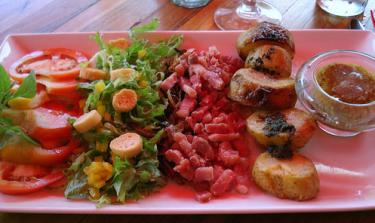
Although Martinique is a mountainous island, sugar cane is grown as the primary crop. Other crops include bananas, cotton, pineapples, and tobacco.
Holidays
Bastille Day
7/14Other
Dates of Interest
- July 14th
What foods are common in Martinique?
Martinique is a mountainous island where sugar cane is grown as the primary crop.
Good to know
- Other crops include bananas, cotton, pineapples, and tobacco
What should I know about Martinique's culture before visiting?
Martinique is an administrative district of France with a strong French influence in its culture, and most people are descendants of African slaves, some of mixed black and European origin.
Good to know
- Tourism is the major economy and also influences the culture
- France has provided substantial financial aid supporting a modest level of prosperity
Last updated: 2026-07-12 · Sources: CountryReports
Photos of Martinique
Photos of Martinique
Travel and Tourism
Travel and Tourism
- Currency
- euro (EUR)
- Climate
- tropical; moderated by trade winds; rainy season (June to October); vulnerable to devastating cyclones (hurricanes) every eight years on average; average temperature 17.3 degrees C; humid
- Airports
- 2
Read the full travel guide — health, safety, vaccinations, disease risk, sanitation, and transit details.
View full travel guideHistory
History
Historical Eras
Pre-Columbian Era
130 – 1502
Martinique was successively inhabited by Arawak (Saladoid) peoples and later by the Caribs (Kalinago), who called the island 'Madinina.' These communities sustained themselves through fishing, agriculture, and inter-island trade across the Caribbean. The Caribs were the dominant inhabitants when European contact finally occurred in the late 15th century.
European Contact
1502 – 1635
Christopher Columbus likely sighted and landed on Martinique in 1502, but Spanish colonial interest in the island remained minimal due to the absence of precious metals. The Caribs successfully resisted early European encroachments, leaving Martinique largely unsettled by Europeans for over a century following first contact.
French Colonization
1635 – 1794
French settlers under Pierre Belain d'Esnambuc established a permanent colony in 1635, displacing and ultimately decimating the Carib population despite initial promises of shared territory. Sugar cultivation transformed the island's economy, driving the mass importation of enslaved Africans. Britain made repeated attempts to seize the island during this period, occupying it briefly during the Seven Years' War and the Anglo-French conflicts of the late 18th century.
Abolition & Plantation Era
1794 – 1902
Slavery was definitively abolished in 1848 under Victor Schoelcher's landmark decree, fundamentally reshaping Martinique's labor structure. Tens of thousands of indentured workers subsequently arrived from India to fill the plantation workforce. The era closed catastrophically in 1902 when the eruption of Mount Pelée obliterated the city of Saint-Pierre, killing approximately 30,000 people.
Overseas Department
1902 – 1974
Following the devastation of the Pelée eruption, Fort-de-France rose as the island's new capital. During World War II, Martinique aligned with the Vichy regime until a U.S. naval blockade compelled its transfer to the Free French in 1943. In 1946, Martinique was formally integrated into France as an Overseas Department rather than pursuing independence, granting its inhabitants full French citizenship.
Autonomy & Modern Era
1974 – present
Martinique gained regional status in 1974 and received expanded local political and economic autonomy under President Mitterrand's decentralization reforms of 1982–1983. The island's political landscape has been shaped by parties ranging from Gaullist conservatives to nationalist movements such as the Mouvement Indépendantiste Martiniquais. Martinique continues to navigate its dual identity as an integral part of France and a distinct Caribbean society, balancing economic dependency with cultural sovereignty.
Overview
There was no real European interest in the island until French colonies were established in 1635. Though the British made brief attempts to occupy the island during the 18th and 19th centuries, it has remained under French control ever since (along with Guadeloupe). Slavery was abolished in 1848 and, in the late 19th century, tens of thousands of immigrant workers arrived from India to replace the slave workforce on the plantations. Both Martinique and Guadeloupe were administered as parts of French Antilles. Martinique supported the Vichy regime after France’s collapse in World War II, but in 1943 a U.S. naval blockade forced the island to transfer its allegiance to the Free French. In 1946, rather than following a path to independence, the two islands were incorporated into the French nation with the status of Overseas Departments. It became a department of France in 1946 and an administrative region in 1974.
There was little political evolution until 1974 when Martinique, along with Guadeloupe and French Guiana, was granted some local political and economic autonomy. This was increased in 1982 and 1983 following a package of decentralization policies introduced by French President Mitterand. Most affairs, with the major exceptions of defense and security, are now generally under local control. The thrust of French government policy in the region is now to bolster links between its remaining possessions, Martinique and Guadeloupe, and other French Caribbean nations.
Four parties dominate the political scene in Martinique: the Gaullist RPR-UDF (allied to the French party of the same name), the Parti Communiste Martiniquais and two island-based nationalist parties, the Parti Progressiste Martiniquais (PPM) and the Mouvement Indépendantiste Martiniquais (MIM, which now operates under the moniker Patriotes Martiniquais). Martinique’s political center of gravity is generally, but not always, to the left of the French mainstream.
Although the island has recovered from the extensive damage caused by a hurricane in 1980, France has continued its attempts to improve the economic life of the Martinique, which is plagued by overpopulation and a lack of development.
Timeline of Key Events
130
http://www.la-martinique.net/Communicator/anglais/history.htm
Appearance of the first inhabitants : Arawaks. They come from the tropical forest
295
http://www.la-martinique.net/Communicator/anglais/history.htm
Disappearance of the Arawak culture, following a eruption of the vulcano ”montagne Peléel“.The island is left during one century
400
http://www.la-martinique.net/Communicator/anglais/history.htm
New arawak arrival.
600
http://www.la-martinique.net/Communicator/anglais/history.htm
Appearance of a new civilization, the Caraïbes. Like the Arawak one, it is from the tropical forest. The Arawaks fear the Caraïbes, because they had strange habits (castration, ...) and confront them during years
600
http://www.la-martinique.net/Communicator/anglais/history.htm
Appearance of a new civilization, the Caraïbes. Like the Arawak one, it is from the tropical forest. The Arawaks fear the Caraïbes, because they had strange habits (castration, ...) and confront them during years. However, the Arawaks are exterminated and they disappear of the island.
1502
http://www.la-martinique.net/Communicator/anglais/history.htm
Christopher Colombus discovers Martinique. He lands where the town called Carbet is now located (in the north of the island, on the Caribbean Sea).
1635
http://www.la-martinique.net/Communicator/anglais/history.htm
Belain d'Esnambuc lands near the Roxelane river with a hundred of settlers. They build a fort to protect the area (origin of the fort of Saint Pierre).
Read the full history profile — narrative overview, defining eras, and the complete timeline in one place.
View expanded historyInteresting Facts
Interesting Facts
The world's deadliest volcanic eruption happened May 8, 1902 at Mount Pelee. There were an estimated 29,025 deaths.
The island was called "Madinina" (Island of Flowers) by the Caribs.
See every fact — trivia, oddities, and curious tidbits gathered from across the country.
View all interesting factsGeography and Environment
Geography and Environment
- Terrain
- mountainous with indented coastline; dormant volcano
- Climate
- tropical; moderated by trade winds; rainy season (June to October); vulnerable to devastating cyclones (hurricanes) every eight years on average; average temperature 17.3 degrees C; humid
- Natural Hazards
- hurricanes, flooding, and volcanic activity (an average of one major natural disaster every five years)
- Current Environmental Issues
- NA
Read the full geography and environment profile — terrain, climate, natural resources, hazards, land use, and international agreements.
View full geographyPeople & Demographics
People & Demographics
Religion
Languages Spoken
French, Creole patois
- Creole patois
- French
Population
- Population
- 3,129,486
- Nationality Noun
- Martiniquais (singular and plural)
- Ethnic Groups
- African and African-white-Indian mixture 90%, white 5%, East Indian, Chinese less than 5%
Education
- Literacy Definition
- age 15 and over can read and write
Read the full people and society profile — demographics, health, education, religion, languages, and notable people.
View full people and societyGovernment & Politics
Government & Politics
Country Identity
- Country Name
- Martinique
- Full Country Name
- Department of Martinique
- Local - Long
- Departement de la Martinique
- Local - Short
- Martinique
Government Structure
- Government Type
- NA
- Legal System
- French legal system
- Executive Branch
- chief of state: President of France Emmanuel MACRON (since 14 May 2017); Prefect Jean-Christophe BOUVIER (since 2021) head of government: President of the Territorial Collectivity Serge LETCHIMY (since December 2021); note - Martinique became a single Territorial Collectivity in December 2015, replacing the former separate General Council and Regional Council cabinet: Executive Council elected by the Territorial Council elections: French president elected by popular vote for a five-year term; prefect appointed by the French president on the advice of the French Ministry of Interior; the president of the Territorial Council is elected by the members of that council
- Legislative Branch
- unicameral General Council or Conseil General (45 seats; members are elected by popular vote to serve six-year terms) and a unicameral Regional Council or Conseil Regional (41 seats; members are elected by popular vote to serve six-year terms) elections: General Council - last held March 2000 (next to be held in 2006); Regional Council - last held on 28 March 2004 (next to be held by March 2010) election results: General Council - percent of vote by party - NA; seats by party - left-wing candidates 13, PPM 11, RPR 6, right-wing candidates 5, PCM 3, UDF 3, PMS 2, independents 2; note - the PPM won a plurality; Regional Council (second round) - percent of vote by party - MIM 53.8%, PPM 30.6%; seats by party - MIM 28, PPM 9, other 4 note: Martinique elects 2 seats to the French Senate; elections last held September 2004 (next to be held September 2008); results - percent of vote by party - NA; seats by party - PPM 1, left-wing candidate 1; Martinique also elects 4 seats to the French National Assembly; elections last held, first round - 9 June 2002, second round - 16 June 2002 (next to be held not later than June 2007); results - percent of vote by party - NA; seats by party - UMP-RPR 1, PMS 1, MIM 1, left-wing candidate 1 (candidacy of the left-wing candidate was found invalid by the Constitutional Council; new elections will be called)
- Judicial Branch
- Court of Appeal or Cour d'Appel
- Suffrage
- 18 years of age; universal
- Constitution
- 28 September 1958 (French Constitution)
- Independence
- none (overseas department of France)
- National Holiday
- Bastille Day, 14 July (1789)
Capital City
- Capital Name
- Fort-de-France
Embassy / Diplomatic Mission
U.S. Embassy in Bridgetown
Wildey Business park
Wildey
St. Michael, Barbados
Telephone: (246) 227-4399
Emergency after-hours telephone: (246) 227-4000
Facsimile: (246) 431-0179
Email: BridgetownACS@state.gov
Hours of operation are 8:30 a.m. – 4:30 p.m. Monday through Friday, except Barbadian and U.S. holidays.
Read the full government profile — flag symbolism, national anthem, and other national symbols.
View full government detailsEconomy
Economy
Martinique's economy is based on tourism, services, light industry, agriculture, and a substantial public sector supported by financial transfers from mainland France. Services dominate the economy, accounting for over 80% of GDP, while agriculture contributes roughly 2% and industry about 12%. Bananas and rum remain the principal agricultural exports, with bananas shipped mainly to France and rum increasingly recognized internationally for its quality. Sugar production has largely disappeared, with most sugarcane now diverted to rum distillation. The island must import the majority of its food, fuel, and consumer goods, resulting in a persistent trade deficit offset by significant aid and subsidies from France and the European Union. Tourism is a key source of foreign exchange, with cruise traffic and stay-over visitors providing employment for thousands of residents. Unemployment remains a chronic challenge, particularly among youth, and the economy continues to rely heavily on its status as a French overseas department for stability and investment.
Snapshot
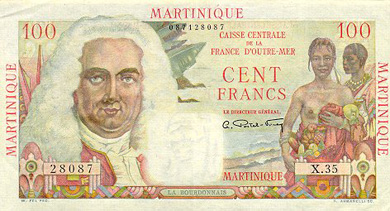
- Currency Name and Code
- Euro (EUR)
Banknotes

Budget & Public Finance
- Fiscal Year
- calendar year
- Annual Budget
- $317,500,000 (USD)
- External Debt
- $180,000,000 (USD)
Labor, Industry & Trade
- Labor Force by Occupation
- agriculture 10%; industry 17%; services 73%
- Industries
- construction, rum, cement, oil refining, sugar, tourism
- Agriculture Products
- pineapples, avocados, bananas, flowers, vegetables, sugarcane
- Export Commodities
- refined petroleum products, bananas, rum, pineapples
- Export Partners
- France 45%, Guadeloupe 28%
- Import Commodities
- petroleum products, crude oil, foodstuffs, construction materials, vehicles, clothing and other consumer goods
- Import Partners
- France 62%, Venezuela 6%, Germany 4%, Italy 4%, US 3%
Energy
- Oil Production
- 0 bbl/day
- Oil Consumption
- 13,800 bbl/day
- Oil Reserves
- 0 bbl/day
- Natural Gas Production
- 0 cu m
- Natural Gas Consumption
- 0 cu m
- Natural Gas Imports
- 0 cu m
- Natural Gas Exports
- 0 cu m
- Natural Gas Reserves
- 0 cu m
Communications
- Internet Country Code
- .mq
News & Weather
News & Weather
Current Weather
Latest News
Martinique - World Population Review
World Population Review · 4d ago
Martinique and French Guiana strengthen Caribbean ties through CARICOM - TravelMole
TravelMole · 1d ago
Martinique Air Quality Index (AQI) and France Air Pollution - IQAir
IQAir · 26d ago
Martinique, French Guiana newest members of CARICOM (Video) - Miami Herald
Miami Herald · 11d ago
27346 Martinique Ln Unit 27346, Summerland Key, FL 33042 - Realtor.com
Realtor.com · 10d ago
Principle Martinique Corona Debuts at Small Batch Cigar - halfwheel
halfwheel · 19d ago
Julian Marley And Tarrus Riley To Headline Martinique’s Reggae Therapy Festival 2026 - The Black Wall Street Times
The Black Wall Street Times · 18d ago
Julian Marley backstage in Martinique @ Reggae Therapy Festival 2026 [7/11/2026] - Reggaeville
Reggaeville · 10d ago
News via Google News
Climate Overview
tropical; moderated by trade winds; rainy season (June to October); vulnerable to devastating cyclones (hurricanes) every eight years on average; average temperature 17.3 degrees C; humid
Frequently Asked Questions
Frequently Asked Questions
What is the population of Martinique?
What foods are common in Martinique?
What should I know about Martinique's culture before visiting?
What is the capital of Martinique?
Where is Martinique located?
What religion is practiced in Martinique?
What currency is used in Martinique?
What languages are spoken in Martinique?
What is the geography of Martinique like?
What language and cultural influences shape Martinican identity?
What is Martinique's relationship with France?
Last reviewed 2026