
 English
 Español
 中文
中文 हिन्दी
 Français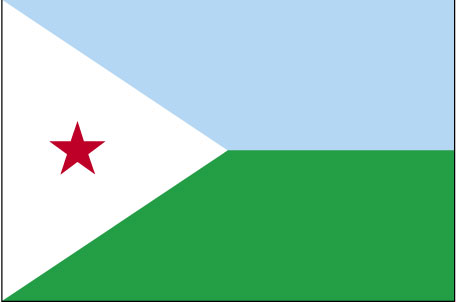
Djibouti
Declare Your Relationship to Djibouti
CountryReports Community
- Studying2
- From Djibouti0
- Djibouti heritage0
- Visited1
- Want to visit0
Customs and Culture
Customs and Culture
About the People
Djiboutians respect traditional especially oral poetry and song. The visual arts are influenced by Islam which does not allow humans or animals to be represented in artwork. Wealthy upper-class businessmen live comfortably in modern cities. In rural areas herders have few possessions.
Cultural Attributes
Djiboutians respect traditional especially oral poetry and song. The visual arts are influenced by Islam which does not allow humans or animals to be represented in artwork. Wealthy upper-class businessmen live comfortably in modern cities. In rural areas herders have few possessions.

The Horn's Crossroads of Trade and Tradition
Greetings, Gestures & Visiting
Among the nomadic Afar, accepting a drink of milk signifies the formation of a bond between two people. The left side of the body is considered unclean. The left hand is never to be used for eating, accepting a present, or shaking another person's hand.
Women in Djibouti do not wear veils although Afar women wear a black headscarf. In the cities people wear Western style clothing. In rural areas people wear the loose clothing of desert people.
Diet
Islamic dietary laws are observed by many which include not eating pork or drinking alcohol. Goats, sheep, camels and cattle are the main staples of meat and milk for the nomadic herders. Sheep and goats provide common meals while beef is reserved for special occasions. Grain or vegetables are obtained by bartering. Burri a papyrus root is combined with milk to make a porridge. A favorite delicacy is a thick flatbread made from wheat and eaten with a sauce made from ghee.

Family
Djiboutians show great respect for their elders. Family relationships are strong among the nomads because they do not have a chance to build strong relationships with their neighbors. Clan membership plays an important role social standing. Marriage is considered a union between two families. Traditionally Muslim men can marry up to four women. When a woman marries she will move into the house of her husband which often holds his entire extended family. Unmarried men and women generally do not live by themselves, but remain with their extended families.
Djiboutian population is made up of two groups, Afars and Issas. Within the Afars are two classes of people. The Asaimara or "Red Man" who constitute the tribes nobility and the Adoimara or "White Man" who make up the peasant class and do not own property.
Recreation
In rural areas women enjoy visiting and doing crafts such as weaving or needlework while talking. Men enjoy drinking coffee and socializing. In villages the market serves as an import place for people to socialize. In cities, people enjoy movies and other urban activities. City children play football (soccer).
Holidays
Independence Day
6/27Independence Day
Dates of Interest
- June 27th
What are the dining customs in Djibouti?
Many Djiboutians observe Islamic dietary laws, so pork and alcohol are avoided, and meat comes mainly from goats, sheep, camels and cattle.
Do
- Try common meals of sheep and goat meat
- Sample burri, a papyrus root porridge made with milk
- Enjoy the thick wheat flatbread eaten with a ghee-based sauce
Don’t
- Don't expect pork or alcohol to be served
- Don't assume beef is everyday fare—it's reserved for special occasions
What should I know about gestures in Djibouti?
The left side of the body is considered unclean, so the right hand is used for social and eating interactions.
Do
- Use your right hand for eating, accepting gifts, and shaking hands
- Accept a drink of milk among the Afar, as it signifies a bond between two people
Don’t
- Never use your left hand for eating, accepting a present, or shaking hands
How should I dress in Djibouti?
Dress varies by setting: Western-style clothing is worn in cities, while loose desert clothing is common in rural areas.
Good to know
- Women in Djibouti do not wear veils, though Afar women wear a black headscarf
- In rural areas, expect the loose clothing suited to desert life
What is family life like in Djibouti?
Djiboutians show great respect for elders, and family and clan ties are central to social standing.
Good to know
- Marriage is seen as a union between two families
- Traditionally Muslim men may marry up to four women
- A married woman moves into her husband's often extended-family household
- Unmarried men and women usually remain with their extended families
What do people do for recreation in Djibouti?
Socializing is central, with activities differing between rural areas and cities.
Good to know
- In rural areas women visit and do crafts like weaving or needlework while talking
- Men enjoy drinking coffee and socializing
- The village market is an important place to socialize
- In cities people enjoy movies and urban activities, and children play football (soccer)
Last updated: 2026-07-12 · Sources: CountryReports
Photos of Djibouti
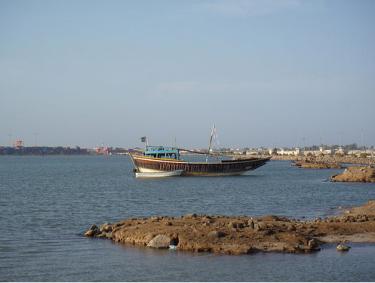
Photos of Djibouti


Travel and Tourism
Travel and Tourism
- Travel Alert Status
- Level 2: Exercise Increased Caution
- Currency
- 177.7
- Time Difference
- UTC+3 (8 hours ahead of Washington, DC, during Standard Time)
- Climate
- Djibouti has two seasons. During the May-to-September hot season, daytime temperatures average over 100°F and often exceed 120°F. The high temperatures are sometimes accompanied by hot, sandy winds called the "Kahm Sin." The beginning and ending months of the hot season are also marked by high humidity. The cooler season, from October through April, has clear skies, refreshingly cool breezes, somewhat lower humidity, and temperatures in the 80s. Because of its geographic location between the Ethiopian and Yemeni escarpments, Djibouti gets little precipitation. Occasional rains occur mostly in the hills in the interior, but the average annual rainfall is only 5 to 10 inches. Rains most often come to Djibouti City in the fall and spring; some years are rainless. Because of a high water table and lack of drainage, the rare heavy rain can cause flooding in and around the capital.
- Airports
- 13
Read the full travel guide — health, safety, vaccinations, disease risk, sanitation, and transit details.
View full travel guideRecipes
Recipes
History
History
Historical Eras
Ancient & Pre-Colonial
3000 BCE – 1862
For millennia, the nomadic Afar and Somali peoples of the region engaged in trade with ancient Egypt, India, and China, exchanging hides and skins for spices and perfumes. Through sustained contact with the Arabian Peninsula over more than a thousand years, these tribes became among the first in Africa to adopt Islam. The area's strategic position at the mouth of the Red Sea made it a valued crossroads of Indian Ocean commerce.
French Protectorate
1862 – 1896
French interest in the Horn of Africa grew following explorer Rochet d'Hericourt's journeys into Shoa in the 1840s and the opening of the Suez Canal in 1869. France purchased the anchorage of Obock from the sultans of Raheita, Tadjoura, and Gobaad in 1862, and by 1884–85 had expanded its protectorate to include the Gulf of Tadjoura coastline. The administrative capital was transferred from Obock to the town of Djibouti in 1892.
French Somaliland
1896 – 1967
Formally named French Somaliland in 1896, the colony's borders were demarcated in 1897 by agreement with Ethiopian Emperor Menelik II, and the Franco-Ethiopian railway connecting Djibouti to Addis Ababa was completed in 1917, cementing the territory's role as a vital trade corridor. During World War II the territory fell under Vichy administration and British blockade before being recaptured by Allied forces in late 1942. Postwar reforms granted increasing self-governance, culminating in a territorial assembly and executive council established under the Loi Cadre of 1956.
Territory of Afars & Issas
1967 – 1977
A 1967 referendum, shaped by an amended electoral law that favored the Afar population and European residents, produced a vote to remain within the French Community, and the territory was renamed the French Territory of the Afars and Issas. Somali nationalist sentiment and mounting pressure for self-determination intensified throughout the early 1970s, however, and a second referendum held in May 1977 returned an overwhelming majority for independence. On June 27, 1977, the Republic of Djibouti was formally proclaimed.
One-Party Republic
1977 – 1999
Founding president Hassan Gouled Aptidon established an authoritarian single-party state under the Rassemblement Populaire pour le Progrès, serving three consecutive six-year terms. An armed Afar insurgency launched in 1991 destabilized the north of the country, prompting a limited political opening: the 1992 constitution permitted four legally recognized parties for a ten-year period. A peace accord signed in 2001 formally concluded the decade-long uprising, though tensions persisted throughout the transition.
Modern Djibouti
1999 – present
Ismail Omar Guelleh assumed the presidency in May 1999 and has consolidated power through successive constitutional amendments, while steering Djibouti toward its role as a premier Horn of Africa logistics and military hub. The country hosts French, American, and Chinese military bases, reflecting its extraordinary strategic value at the mouth of the Red Sea. A brief border conflict with Eritrea erupted in 2008, underscoring the region's continued volatility even as Djibouti's port economy expanded rapidly.
Overview
It was Rochet d’Hericourt’s exploration into Shoa (1839-42) that marked the beginning of French interest in the African shores of the Red Sea. Further exploration by Henri Lambert, French Consular Agent at Aden, and Captain Fleuriot de Langle led to a treaty of friendship and assistance between France and the sultans of Raheita, Tadjoura, and Gobaad, from whom the French purchased the anchorage of Obock (1862).
Growing French interest in the area took place against a backdrop of British activity in Egypt and the opening of the Suez Canal in 1869. In 1884-85, France expanded its protectorate to include the shores of the Gulf of Tadjoura and the Somaliland. Boundaries of the protectorate, marked out in 1897 by France and Emperor Menelik II of Ethiopia, were affirmed further by agreements with Ethiopian Emperor Haile Selassie I in 1945 and 1954.
The administrative capital was moved from Obock to Djibouti in 1892. In 1896, Djibouti was named French Somaliland. Djibouti, which has a good natural harbor and ready access to the Ethiopian highlands, attracted trade caravans crossing East Africa as well as Somali settlers from the south. The Franco-Ethiopian railway, linking Djibouti to the heart of Ethiopia, was begun in 1897 and reached Addis Ababa in June 1917, further facilitating the increase of trade.
During the Italian invasion and occupation of Ethiopia in the 1930s and during World War II, constant border skirmishes occurred between French and Italian forces. The area was ruled by the Vichy (French) government from the fall of France until December 1942, and fell under British blockade during that period. Free French and the Allied forces recaptured Djibouti at the end of 1942. A local battalion from Djibouti participated in the liberation of France in 1944.
On July 22, 1957, the colony was reorganized to give the people considerable self-government. On the same day, a decree applying the Overseas Reform Act (Loi Cadre) of June 23, 1956, established a territorial assembly that elected eight of its members to an executive council. Members of the executive council were responsible for one or more of the territorial services and carried the title of minister. The council advised the French-appointed governor general.
In a September 1958 constitutional referendum, French Somaliland opted to join the French community as an overseas territory. This act entitled the region to representation by one deputy and one senator in the French Parliament, and one counselor in the French Union Assembly.
The first elections to the territorial assembly were held on November 23, 1958, under a system of proportional representation. In the next assembly elections (1963), a new electoral law was enacted. Representation was abolished in exchange for a system of straight plurality vote based on lists submitted by political parties in seven designated districts. Ali Aref Bourhan, allegedly of Turkish origin, was selected to be the president of the executive council. French President Charles de Gaulle’s August 1966 visit to Djibouti was marked by 2 days of public demonstrations by Somalis demanding independence. On September 21, 1966, Louis Saget, appointed governor general of the territory after the demonstrations, announced the French Government’s decision to hold a referendum to determine whether the people would remain within the French Republic or become independent. In March 1967, 60% chose to continue the territory’s association with France.
In July of that year, a directive from Paris formally changed the name of the region to the French Territory of Afars and Issas. The directive also reorganized the governmental structure of the territory, making the senior French representative, formerly the governor general, a high commissioner. In addition, the executive council was redesignated as the council of government, with nine members.
In 1975, the French Government began to accommodate increasingly insistent demands for independence. In June 1976, the territory’s citizenship law, which favored the Afar minority, was revised to reflect more closely the weight of the Issa Somali. The electorate voted for independence in a May 1977 referendum. The Republic of Djibouti was establish
Timeline of Key Events
1892
Djibouti becomes capital of French Somaliland.
Djibouti becomes capital of French Somaliland.
1897
Ethiopia acquires parts of Djibouti after signing a treaty with France.
Ethiopia acquires parts of Djibouti after signing a treaty with France.
1946
Djibouti made an overseas territory within the French Union.
Djibouti made an overseas territory within the French Union with its own legislature and representation in the French parliament.
1958
Djibouti votes to join the French Community.
Djibouti votes to join the French Community.
1967
Afar people and Europeans vote to remain part of the French Community.
Referendum takes place during which Afar people and Europeans vote to remain part of the French Community; French Somaliland renamed the French Territory of the Afars and the Issas.
1977
The electorate voted for independence.
The electorate voted for independence in a May 1977 referendum. The Republic of Djibouti was established on June 27, 1977, and Hassan Gouled Aptidon became the country’s first president.
1992
The constitution permitted the legalization of four political parties for a period of 10 years.
The constitution permitted the legalization of four political parties for a period of 10 years, after which a complete multiparty system would be installed.
Read the full history profile — narrative overview, defining eras, and the complete timeline in one place.
View expanded historyInteresting Facts
Interesting Facts
The nomadic way of life in Djibouti goes back thousands of years.
See every fact — trivia, oddities, and curious tidbits gathered from across the country.
View all interesting factsGeography and Environment
Geography and Environment
- Terrain
- coastal plain and plateau separated by central mountains
- Climate
- Djibouti has two seasons. During the May-to-September hot season, daytime temperatures average over 100 ºF and often exceed 120 ºF. The high temperatures are sometimes accompanied by hot, sandy winds called the "Kahm Sin." The beginning and ending months of the hot season are also marked by high humidity. The cooler season, from October through April, has clear skies, refreshingly cool breezes, somewhat lower humidity, and temperatures in the 80s. Because of its geographic location between the Ethiopian and Yemeni escarpments, Djibouti gets little precipitation. Occasional rains occur mostly in the hills in the interior, but the average annual rainfall is only 5 to 10 inches. Rains most often come to Djibouti City in the fall and spring; some years are rainless. Because of a high water table and lack of drainage, the rare heavy rain can cause flooding in and around the capital.
- Natural Hazards
- earthquakes; droughts; occasional cyclonic disturbances from the Indian Ocean bring heavy rains and flash floods
- Current Environmental Issues
- inadequate supplies of potable water; limited arable land; desertification; endangered species
Read the full geography and environment profile — terrain, climate, natural resources, hazards, land use, and international agreements.
View full geographyPeople & Demographics
People & Demographics
Religion
Languages Spoken
French (official), Arabic (official), Somali, Afar
- Arabic
- French
Population
- Population
- 740,528
- Population in Major Urban Areas
- DJIBOUTI (capital) 496,000
- Nationality Noun
- Djiboutian(s)
- Ethnic Groups
- Somali 60%, Afar 35%, French, Arab, Ethiopian, and Italian 5%
Education
- Literacy Definition
- Age 15 and over can read and write
Health Information
- Major Infectious Diseases — degree of risk
- High
Read the full people and society profile — demographics, health, education, religion, languages, and notable people.
View full people and societyGovernment & Politics
Government & Politics
Country Identity
- Country Name
- Djibouti
- Full Country Name
- Republic of Djibouti
- Former Name
- French Territory of the Afars and Issas, French Somaliland
Government Structure
- Government Type
- republic
- Legal System
- based on French civil law system, traditional practices, and Islamic law
- Executive Branch
- chief of state: President Ismail Omar GUELLEH (since 8 May 1999) head of government: Prime Minister Aden Hassan AWED (since 27 March 2023) cabinet: Council of Ministers responsible to the president elections: president elected by popular vote for a six-year term; election last held on 9 April 2021 (next to be held in 2027); prime minister appointed by the president election results: Ismail Omar GUELLEH reelected president; percent of vote - Ismail Omar GUELLEH 97.4%
- Legislative Branch
- unicameral Chamber of Deputies or Chambre des Deputes (65 seats; members elected by popular vote for five-year terms) elections: last held 10 January 2003 (next to be held January 2008) election results: percent of vote - RPP 62.2%, FRUD 36.9%; seats - RPP 65, FRUD 0; note - RPP (the ruling party) dominated the election
- Judicial Branch
- Supreme Court or Cour Supreme
- Suffrage
- 18 years of age; universal adult
- Constitution
- multiparty constitution approved by referendum 4 September 1992
- Independence
- 27 June 1977 (from France)
- National Holiday
- Independence Day, 27 June (1977)
Capital City
- Capital Name
- Djibouti
- Capital - geographic coordinate
- 11 35 N, 43 09 E
- Capital Time Difference
- UTC+3 (8 hours ahead of Washington, DC, during Standard Time)
The origin of the name is disputed; multiple descriptions, possibilities, and theories have been proposed
Military
Branches: Djibouti Armed Forces (Forces Armees Djiboutiennes, FAD): Djibouti National Army (includes Navy, Djiboutian Air Force (Force Aerienne Djiboutienne, FAD), National Gendarmerie (GN)
Embassy / Diplomatic Mission
U.S. Embassy Djibouti
Lotissement Haramous Lot # 350B
Djibouti City, Republic of Djibouti
Phone: 253-21-453-000
Email: ConsularDjibouti@State.gov
Read the full government profile — flag symbolism, national anthem, and other national symbols.
View full government detailsEconomy
Economy
Djibouti's economy is based largely on service activities tied to the country's strategic location at the entrance to the Red Sea and its status as a free trade zone in the Horn of Africa. Roughly 70% of the population lives in the capital, with the remainder consisting mostly of nomadic herders. Scanty rainfall and arid terrain limit crop production to small quantities of fruits and vegetables, so most food must be imported.
The country serves as a key transit port for the region and as an international transshipment and refueling center, handling the bulk of landlocked Ethiopia's maritime trade. Port activities, logistics, and related services dominate the economy, supported by significant Chinese investment in infrastructure including the Doraleh Multipurpose Port and the Addis Ababa–Djibouti electric railway. Djibouti also hosts foreign military bases from the United States, France, Japan, China, and Italy, which generate substantial rental income.
Despite steady GDP growth in recent years, often among the highest in Africa, Djibouti faces persistent challenges. Unemployment remains high, estimated at around 26% overall and significantly higher among youth, and roughly one in five Djiboutians lives in extreme poverty. The country has few natural resources and a limited industrial base, leaving it dependent on foreign assistance and external borrowing to finance development. Public debt has risen sharply, exceeding 70% of GDP, much of it owed to Chinese creditors, raising concerns about debt sustainability. Inflation has remained moderate, supported by the long-standing peg of the Djiboutian franc to the US dollar. The government continues to pursue its Vision 2035 strategy aimed at diversifying the economy and positioning the country as a regional logistics and commercial hub.
Snapshot
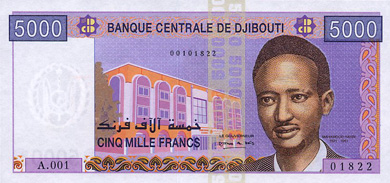
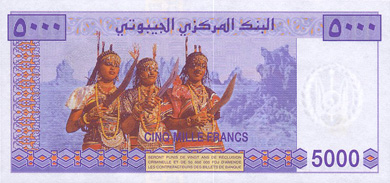
- Currency Name and Code
- Djiboutian francs (DJF)
- GDP Real Growth Rate
- 3.5%
Banknotes
Budget & Public Finance
- Fiscal Year
- calendar year
- Annual Budget
- $182,000,000 (USD)
- External Debt
- $366,000,000 (USD)
Labor, Industry & Trade
- Labor Force by Occupation
- NA%
- Industries
- construction, agricultural processing
- Agriculture Products
- fruits, vegetables; goats, sheep, camels
- Export Commodities
- reexports, hides and skins, coffee
- Export Partners
- Somalia 61.9%, Yemen 21.9%, Pakistan 5.2%, Ethiopia 4.5%
- Import Commodities
- foods, beverages, transport equipment, chemicals, petroleum products
- Import Partners
- Saudi Arabia 18.2%, Ethiopia 10.5%, US 9.3%, France 8.6%, China 8.3%, Netherlands 4.2%
Energy
- Oil Production
- 0 bbl/day
- Oil Consumption
- 12,000 bbl/day
- Oil Reserves
- 0 bbl/day
- Natural Gas Production
- 0 cu m
- Natural Gas Consumption
- 0 cu m
- Natural Gas Imports
- 0 cu m
- Natural Gas Exports
- 0 cu m
- Natural Gas Reserves
- 0 cu m
Communications
- Telephone System
- General Assessment: Telephone facilities in the city of Djibouti are adequate, as are the microwave radio relay connections to outlying areas of the country Domestic: Djibouti Telecom is the sole provider of telecommunications services and utilizes mostly a microwave radio relay network; fiber-optic cable is installed in the capital; rural areas connected via wireless local loop radio systems; mobile cellular coverage is primarily limited to the area in and around Djibouti city International: Country code - 253; landing point for the SEA-ME-WE-3 and EASSy fiber-optic submarine cable systems providing links to Asia, the Middle East, Europe and North America; satellite earth stations - 2 (1 Intelsat - Indian Ocean and 1 Arabsat); Medarabtel regional microwave radio relay telephone network
- Internet Country Code
- .dj
News & Weather
News & Weather
Current Weather
Latest News
UN report: Djibouti faces severe food insecurity - JURIST - News - Jurist.org
Jurist.org · 1d ago
Djibouti: Emergency alert spotlights sharp hunger spike - UN News
UN News · 3d ago
Djibouti Catholic Bishop Calls for Extreme Measures to Safeguard Environment - ACI Africa
ACI Africa · 12h ago
Djibouti, Rwanda celebrate national days; Mexico welcomes new envoy - Washington Diplomat
Washington Diplomat · 3d ago
Turning Flood Alerts into Community Action in Djibouti - World Meteorological Organization WMO
World Meteorological Organization WMO · 22h ago
EU reinforces Red Sea naval mission with strategic Djibouti deal - Shipping Telegraph
Shipping Telegraph · 7h ago
Far from the global headlines: Humanity on the move in Djibouti - IFRC
IFRC · 4d ago
WHO Mediterranean Office calls for $6.42 million to Sustain Health and Nutrition Services Across Somalia, Sudan and Djibouti - pan african visions
pan african visions · 5h ago
News via Google News
Climate Overview
Djibouti has two seasons. During the May-to-September hot season, daytime temperatures average over 100°F and often exceed 120°F. The high temperatures are sometimes accompanied by hot, sandy winds called the "Kahm Sin." The beginning and ending months of the hot season are also marked by high humidity. The cooler season, from October through April, has clear skies, refreshingly cool breezes, somewhat lower humidity, and temperatures in the 80s.
Because of its geographic location between the Ethiopian and Yemeni escarpments, Djibouti gets little precipitation. Occasional rains occur mostly in the hills in the interior, but the average annual rainfall is only 5 to 10 inches. Rains most often come to Djibouti City in the fall and spring; some years are rainless. Because of a high water table and lack of drainage, the rare heavy rain can cause flooding in and around the capital.
Videos
Videos
1 curated YouTube videos.
Source: YouTube
Frequently Asked Questions
Frequently Asked Questions
What is the population of Djibouti?
What are the dining customs in Djibouti?
What should I know about gestures in Djibouti?
How should I dress in Djibouti?
What is family life like in Djibouti?
What do people do for recreation in Djibouti?
What is the capital of Djibouti?
Where is Djibouti located?
What countries border Djibouti?
What is the predominant religion in Djibouti?
What currency does Djibouti use?
What languages are spoken in Djibouti?
What is the geography of Djibouti like?
What is Djibouti known for?
Last reviewed 2026