
 English
 Español
 中文
中文 हिन्दी
 Français
Central African Republic
CAR
Declare Your Relationship to Central African Republic
CountryReports Community
- Studying0
- From Central African Republic0
- Central African Republic heritage0
- Visited0
- Want to visit0
Quick Look Factsheet
A multi-page overview of Central African Republic.
Central African Republic FactsheetCustoms and Culture
Customs and Culture
Cultural Attributes
The Central African Republic is home to a rich and diverse cultural tapestry shaped by the traditions of more than 80 ethnic groups, including the Baya, Banda, Mandjia, Sara, Mboum, M'Baka, and Yakoma peoples. Despite this diversity, a shared sense of national identity has developed over generations, expressed through music, dance, storytelling, and communal ritual. Music plays a central role in everyday social life. Traditional instruments such as the balafon (a wooden xylophone), the ngombi (a harp-like instrument), and various hand drums accompany ceremonies marking births, marriages, and harvests. Polyphonic singing — particularly among the Aka forest peoples of the southwest — is considered one of the country's most distinctive cultural contributions and has been recognized internationally for its complexity and communal significance. The Aka, also known as BaAka, maintain a semi-nomadic lifestyle and a deep spiritual connection to the forest. Their vocal traditions, which include intricate interlocking vocal patterns and improvisational styles, reflect an intimate relationship with the natural world that has been preserved across centuries. Sango, one of the country's two official languages alongside French, functions as a national lingua franca that unifies speakers from different ethnic backgrounds. Originally the language of traders along the Ubangi River, Sango evolved into a creole-like tongue and is now spoken by the vast majority of the population, regardless of ethnic origin. Art and craft traditions are also prominent. Wood carving, basketry, pottery, and beadwork are practiced throughout the country, with styles and motifs varying by region and ethnic group. These crafts often carry symbolic and spiritual meaning, serving purposes beyond mere decoration. Religious life in the Central African Republic blends Christianity, Islam, and indigenous animist beliefs, sometimes simultaneously within the same household. Respect for ancestors, belief in spiritual forces within nature, and the role of traditional healers remain significant aspects of daily life across much of the country, reflecting a cultural continuity that predates colonial influence.

Land of the Ubangi's Rapids
Greetings, Gestures & Visiting
Central Africans greet other family members in the morning with a handshake and ask how they slept. When a new person enters a group they are expected to greet the most important person, usually the eldest, with a handshake and then greet the rest of the people in the group with a handshake. Close friends may follow the handshake with a snap of the fingers.
Sharing a meal is an important aspect of the culture. It is considered rude to refuse a meal, one should eat a few bites even if full so not to offend the host.
Visiting others plays an important role in society. On Sunday afternoons or holidays many will put on their finest clothes to visit friends and relatives.
Women wear a pagne (cotton cloth) tied around the waist with a matching blouse made of the same fabric. Men wear matching pants and shirts from the same cloth. The European style of clothing is worn by the wealthy for important meetings. In urban areas Western style of clothing is worn.
Diet
Cassava is the staple food. It is soaked for two-three days dried in the sun and then ground into a flour. Goza is a paste made from cassava flour and water. Most meals consist of goza served with a sauce made from meat, fish or vegetables. Ngunga is a dish made from the dark green leaves of the cassava plant. Most sauces are thickened with peanut butter for added protein. Everyone eats with their fingers from a common dish. Men and women who are not relatives do not eat together. In public men and women do not eat together. The main cooked meal is at noon. Breakfast and the evening meal are usually leftovers.

Family
For many, there are no formal wedding ceremonies but the man's family must pay a bride-price to the bride's family ranging from a few goats or chickens to large sums of money. If the wife can not have children the man's family can demand the bride-price back. Honoring the deceased is important, mourning may last from a few days to a few years. In the first few hours after death male family members are expected to display grief by shaving their heads. An all-night vigil will be held around the corpse during the first night.
Recreation
Soccer and basketball are the most popular sports. Dancing is a popular recreational pastime.
Student Life
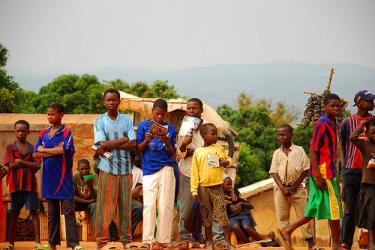
Children in most of the villages will wake up as early as 4:00 a.m. for a trip to the river or the community water pump to fetch a few cans of water for use at home before they prepare to go to school. The trip to the river may take about an hour or so and the little water they bring will be used for cooking, drinking, and a little cleaning up. The typical house is made of sun-dried bricks and the roofs are thatched with wild grass or palm fronds in areas where the proper kind of grass is not available. Other people still live in mud and wattle (animal hair) structures. House floors are made of pounded earth and people generally sleep on the floor on mats or homemade beds. The whole family occupies one single dwelling which may be divided into smaller cubicles. There is likely to be a goat pen just next to the house to keep the few family animals and in most cases, there are no latrines, especially in rural villages. The main use of the simple dwellings is to store grain and sleep during the cold months but it is not uncommon for people to sleep outside, especially in the six-month dry season. The food is prepared in a hearth that is usually found at the front of the dwelling and much of the family interaction is conducted in open spaces just outside the house. Only about 50% of children attend any form of schooling. More than half of the children do not get the opportunity of attending even the lowest level of primary school. The main cause of this is the levels of poverty, the lack of facilities, as well as materials and teachers. In places where schools exist there is one teacher for every 95 students.
When children get back home there usually will be no major activity apart from homework that must be done before darkness sets in. It will also be time to prepare dinner which is served anytime before 7:00 p.m. The evening meal is mainly made of the staple food of this region which is mainly a dough-like mixture that is prepared from cassava “gozo” or sorghum. This is usually accompanied by a sauce that is made of vegetables, poultry, meat, or fish. In other instances, they will have to wild game which is killed in dry season grass-burning hunts as a supplement to the natural diet. Those that live in forest areas usually subsist on cassava, banana, plantains, palm-nut oils, forest caterpillars, and on leaves of a wild plant known as “koko”. The rest of the people survive on sorghum, peanuts, corn, wild tubers as well as wild mushrooms. The most common meal however is boiled cassava paste that is dipped in some cassava greens with a little palm oil or none in many cases. As soon as the evening meal is done the children will wait for a semblance of darkness to come so that they can take their baths outside the house.
Holidays
Republic Day
12/1Independence
Dates of Interest
- December 1st
How do people greet each other in the Central African Republic?
Greetings are done with a handshake, and family members typically greet each other in the morning by asking how they slept.
Do
- Shake hands when greeting
- Greet the most important person, usually the eldest, first, then greet everyone else in the group
- Ask family members how they slept in the morning
Good to know
- Close friends may follow the handshake with a snap of the fingers
What are dining customs like in the Central African Republic?
The staple food is cassava, often served as goza (a cassava-flour paste) with a sauce of meat, fish, or vegetables, and everyone eats with their fingers from a common dish.
Do
- Eat with your fingers from the common dish
- Expect the main cooked meal at noon
Don’t
- Do not expect unrelated men and women to eat together, including in public
Good to know
- Ngunga is a dish made from dark green cassava leaves
- Sauces are often thickened with peanut butter for added protein
- Breakfast and the evening meal are usually leftovers
What etiquette should travelers know in the Central African Republic?
Sharing a meal is an important part of the culture, and visiting friends and relatives plays a central social role.
Do
- Eat a few bites of an offered meal even if you are full
- Dress in your finest clothes when visiting friends and relatives on Sundays or holidays
Don’t
- Do not refuse a meal, as it is considered rude and may offend the host
How should travelers dress in the Central African Republic?
Traditional dress includes a pagne (cotton cloth) for women with a matching blouse, and matching pants and shirts for men, while Western-style clothing is common in urban areas.
Good to know
- Women wear a pagne tied around the waist with a matching blouse of the same fabric
- Men wear matching pants and shirts from the same cloth
- European-style clothing is worn by the wealthy for important meetings
What are family customs like in the Central African Republic?
Many marriages have no formal ceremony but involve a bride-price paid by the man's family, and honoring the deceased through extended mourning is important.
Good to know
- Bride-price can range from a few goats or chickens to large sums of money
- If the wife cannot have children, the man's family may demand the bride-price back
- Mourning may last from a few days to a few years
- Male family members shave their heads to display grief, and an all-night vigil is held around the corpse the first night
What do people do for recreation in the Central African Republic?
Soccer and basketball are the most popular sports, and dancing is a popular recreational pastime.
Good to know
- Music is central to social life, accompanying births, marriages, and harvests
Last updated: 2026-07-12 · Sources: CountryReports
Photos of Central African Republic
Photos of Central African Republic


Travel and Tourism
Travel and Tourism
- Travel Alert Status
- Level 4: Do Not Travel
- Currency
- 605.7
- Time Difference
- UTC+1 (6 hours ahead of Washington, DC, during Standard Time)
- Climate
- Average monthly temperatures range from a low of around 66°F to a high of about 93°F. Most of the precipitation in the area of Bangui occurs between May and October, usually characterized by short, violent thunderstorms. Although it rains hard at times, the sun shines almost every day. Dust, generally sunny skies, and warm weather are the forecast for the dry season (November to April).
- Airports
- 50
- Recommended Vaccinations
- How important is it to do your research about vaccinations? It might just save your life! Make yourself aware of the different types of vaccinations and which ones you may need to travel to your destination. Schedule an appointment with your doctor at least four to six weeks before you travel to ensure you receive all important shots. Be sure that you and your family are up to date on your routine vaccinations. Which vaccinations you need will depend on a number of factors including your destination, whether you will be spending time in rural areas, the season of the year you are traveling, your age, health status, and previous immunizations.
Read the full travel guide — health, safety, vaccinations, disease risk, sanitation, and transit details.
View full travel guideRecipes
Recipes
History
History
Historical Eras
Pre-Colonial Era
700 – 1885
The region was settled from at least the 7th century and shaped by overlapping empires including Kanem-Bornou, Ouaddai, Baguirmi, and Darfur, all centered around Lake Chad and the Upper Nile. Successive sultanates exploited the Oubangui basin as a slave reservoir, trading captives northward across the Sahara and westward to European traders. Population migrations in the 18th and 19th centuries introduced the Zande, Banda, and Baya-Mandjia peoples into the territory.
French Colonial Rule
1885 – 1958
France secured the right bank of the Oubangui River by convention in 1887, established Bangui as an outpost in 1889, and formally organized Oubangui-Chari as a territory in 1894. By 1910 it was incorporated into the Federation of French Equatorial Africa alongside Chad, Congo-Brazzaville, and Gabon. The following decades were marked by indigenous resistance, plantation-economy abuses, and eventual post-war reforms granting citizenship and local assemblies to colonial subjects.
Independence & Dacko
1958 – 1966
The Central African Republic was proclaimed on December 1, 1958, under Barthélemy Boganda, the independence movement's most prominent leader, who died in a plane crash in March 1959. His cousin David Dacko succeeded him and presided over full independence on August 13, 1960. Dacko's government struggled to build stable institutions and was ultimately ousted in a swift, nearly bloodless coup on January 1, 1966.
Bokassa & Military Rule
1966 – 1993
Colonel Jean-Bédel Bokassa seized power in 1966, abolished the constitution, and in 1976 crowned himself Emperor Bokassa I, transforming the republic into a monarchy in an extravagant ceremony funded largely by France. His regime was defined by severe human rights abuses, culminating in the massacre of schoolchildren in 1979, which prompted a French-backed coup restoring David Dacko. A succession of military governments followed, including General André Kolingba's rule from 1981, before multiparty politics were gradually permitted beginning in 1991.
Civilian Rule & Instability
1993 – 2003
Democratic elections in 1993 brought Ange-Félix Patassé to the presidency, marking the country's first genuine civilian government and a decade of nominal constitutional rule. The period was nonetheless turbulent, featuring army mutinies in 1996–1997, regional peacekeeping interventions, and persistent economic decline. A military coup led by General François Bozizé in March 2003 ended Patassé's government and returned the country to authoritarian rule.
Bozizé & Modern CAR
2003 – present
General François Bozizé established a transitional government after his 2003 coup, overseeing a new constitution approved by referendum in 2004 and elections in 2005. The country remained deeply fractured, with the central government unable to control large swaths of territory, and a devastating civil conflict erupting in 2012–2013 between the Séléka rebel coalition and Anti-Balaka militias. International peacekeeping missions, including the UN's MINUSCA force deployed in 2014, have struggled to restore stability amid ongoing violence and a humanitarian crisis.
Overview
In 1875 the Egyptian sultan Rabah governed Upper-Oubangui, which included present-day C.A.R. Europeans, primarily the French, German, and Belgians, arrived in the area in 1885. The French consolidated their legal claim to the area through an 1887 convention with Congo Free State, which granted France possession of the right bank of the Oubangui River. Two years later, the French established an outpost at Bangui, and in 1894, Oubangui-Chari became a French territory. However, the French did not consolidate their control over the area until 1903 after having defeated the forces of the Egyptian sultan Rabah and established colonial administration throughout the territory. In 1906, the Oubangui-Chari territory was united with the Chad colony; in 1910, it became one of the four territories of the Federation of French Equatorial Africa (A.E.F.), along with Chad, Congo (Brazzaville), and Gabon. The next 30 years were marked by small-scale revolts against French rule and the development of a plantation-style economy.
In August 1940, the territory responded, with the rest of the A.E.F., to the call from Gen. Charles de Gaulle to fight for Free France. After World War II, the French Constitution of 1946 inaugurated the first of a series of reforms that led eventually to complete independence for all French territories in western and equatorial Africa. In 1946, all A.E.F. inhabitants were granted French citizenship and allowed to establish local assemblies. The assembly in C.A.R. was led by Barthelemy Boganda, a Catholic priest who also was known for his forthright statements in the French Assembly on the need for African emancipation. In 1956 French legislation eliminated certain voting inequalities and provided for the creation of some organs of self-government in each territory. The French constitutional referendum of September 1958 dissolved the A.E.F., and on December 1 of the same year the Assembly declared the birth of the Central African Republic with Boganda as head of government. Boganda ruled until his death in a March 1959 plane crash. His cousin, David Dacko, replaced him, governing the country until 1965 and overseeing the country’s declaration of independence on August 13, 1960.
On January 1, 1966, following a swift and almost bloodless coup, Col. Jean-Bedel Bokassa assumed power as President of the Republic. Bokassa abolished the constitution of 1959, dissolved the National Assembly, and issued a decree that placed all legislative and executive powers in the hands of the president. On December 4, 1976, the republic became a monarchy with the promulgation of the imperial constitution and the proclamation of the president as Emperor Bokassa I. His regime was characterized by numerous human rights atrocities.
Following riots in Bangui and the murder of between 50 and 200 schoolchildren, former President Dacko led a successful French-backed coup against Bokassa on September 20, 1979. Dacko’s efforts to promote economic and political reforms proved ineffectual, and on September 20, 1981, he in turn was overthrown in a bloodless coup by Gen. Andre Kolingba. For 4 years, Kolingba led the country as head of the Military Committee for National Recovery (CRMN). In 1985 the CRMN was dissolved, and Kolingba named a new cabinet with increased civilian participation, signaling the start of a return to civilian rule. The process of democratization quickened in 1986 with the creation of a new political party, the Rassemblement Democratique Centrafricain (RDC), and the drafting of a new constitution that subsequently was ratified in a national referendum. General Kolingba was sworn in as constitutional President on November 29, 1986. The constitution established a National Assembly made up of 52 elected deputies, elected in July 1987. Due to mounting political pressure, in 1991 President Kolingba announced the creation of a national commission to rewrite the constitution to provide for a multi-party system. Multi-party presidential elections were conducted in 1992 but were later cancelled due to serious logistical and other irregularities. Ange Felix Patasse won a second-round victory in rescheduled elections held in October 1993, and was re-elected for another 6-year term in September 1999.
Salary arrears, labor unrest, and unequal treatment of military officers from different ethnic groups led to three mutinies against the Patasse gover
Timeline of Key Events
1880
France annexes the area.
France annexes the area.
1894
France sets up a dependency in the area called Ubangi-Chari.
France sets up a dependency in the area called Ubangi-Chari and partitions it among commercial concessionaires.
1910
Ubangi-Chari becomes part of the Federation of French Equatorial Africa.
Ubangi-Chari becomes part of the Federation of French Equatorial Africa.
1920 – 1930
Indigenous Africans stage violent protests against abuses by concessionaires.
Indigenous Africans stage violent protests against abuses by concessionaires.
1946
The territory is given its own assembly and representation in the French parliament.
The territory is given its own assembly and representation in the French parliament; Barthelemy Boganda, founder of the pro-independence Social Evolution Movement of Black Africa (MESAN), becomes the first Central African to be elected to the French parliament.
1960
The Central African Republic becomes independent.
The Central African Republic becomes independent with David Dacko, nephew of Boganda, as president.
1991
Political parties permitted to form.
Political parties permitted to form.
Read the full history profile — narrative overview, defining eras, and the complete timeline in one place.
View expanded historyInteresting Facts
Interesting Facts
From the 16th to 19th century, the people of this region were ravaged by slave traders. The Banda, Baya, Ngbandi, and Azande make up the largest ethnic groups.
See every fact — trivia, oddities, and curious tidbits gathered from across the country.
View all interesting factsGeography and Environment
Geography and Environment
- Terrain
- vast, flat to rolling, monotonous plateau; scattered hills in northeast and southwest
- Climate
- Average monthly temperatures range from a low of around 66°F to a high of about 93°F. Most of the precipitation in the area of Bangui occurs between May and October, usually characterized by short, violent thunderstorms. Although it rains hard at times, the sun shines almost every day. Dust, generally sunny skies, and warm weather are the forecast for the dry season (November to April ).
- Natural Hazards
- hot, dry, dusty harmattan winds affect northern areas; floods are common
- Current Environmental Issues
- tap water is not potable; poaching has diminished the country's reputation as one of the last great wildlife refuges; desertification; deforestation
Read the full geography and environment profile — terrain, climate, natural resources, hazards, land use, and international agreements.
View full geographyPeople & Demographics
People & Demographics
Religion
Languages Spoken
French (official), Sangho (lingua franca and national language), tribal languages
- French
Population
- Population
- 4,844,927
- Population in Major Urban Areas
- BANGUI (capital) 740,000
- Nationality Noun
- Central African(s)
- Ethnic Groups
- Baya 33%, Banda 27%, Mandjia 13%, Sara 10%, Mboum 7%, M'Baka 4%, Yakoma 4%, other 2%
Education
- Literacy Definition
- Age 15 and over can read and write
Health Information
- Major Infectious Diseases — degree of risk
- very high
Read the full people and society profile — demographics, health, education, religion, languages, and notable people.
View full people and societyGovernment & Politics
Government & Politics
Country Identity
- Country Name
- CentralAfricanRepublic
- Full Country Name
- Central African Republic
- Local - Long
- Republique Centrafricaine
- Local - Short
- CAR
- Former Name
- Ubangi-Shari, Central African Empire
Government Structure
- Government Type
- republic
- Legal System
- based on French law
- Executive Branch
- chief of state: President Faustin-Archange TOUADERA (since 30 March 2016; reelected 27 December 2020) head of government: Prime Minister Felix MOLOUA (since 15 February 2022); note - Henri-Marie DONDRA resigned 7 February 2022 cabinet: Council of Ministers appointed by the president elections: president elected by popular vote to a five-year term, eligible for a second term; election last held on 27 December 2020 (next to be held in 2025); prime minister appointed by the president election results: Faustin-Archange TOUADERA reelected president in the first round; percent of vote - Faustin-Archange TOUADERA (MCU) 53.2%, Anicet-Georges DOLOGUELE (URCA) 21.0%, other candidates combined 25.8%
- Legislative Branch
- unicameral National Assembly or Assemblee Nationale (109 seats; members are elected by popular vote to serve five-year terms) elections: last held 13 March 2005 and 8 May 2005 (next to be held NA 2010) election results: percent of vote by party - MLPC 43%, RDC 18%, MDD 9%, FPP 6%, PSD 5%, ADP 4%, PUN 3%, FODEM 2%, PLD 2%, UPR 1%, FC 1%, independents 6%; seats by party - MLPC 47, RDC 20, MDD 8, FPP 7, PSD 6, ADP 5, PUN 3, FODEM 2, PLD 2, UPR 1, FC 1, independents 7
- Judicial Branch
- Supreme Court or Cour Supreme; Constitutional Court (3 judges appointed by the president, 3 by the president of the National Assembly, and 3 by fellow judges); Court of Appeal; Criminal Courts; Inferior Courts
- Suffrage
- 21 years of age; universal
- Constitution
- passed by referendum 29 December 1994; adopted 7 January 1995
- Independence
- 13 August 1960 (from France)
- National Holiday
- Republic Day, 1 December (1958)
Capital City
- Capital Name
- Bangui
- Capital - geographic coordinate
- 4 22 N, 18 35 E
- Capital Time Difference
- UTC+1 (6 hours ahead of Washington, DC, during Standard Time)
established as a French settlement in 1889 and named after its location on the northern bank of the Ubangi River; the Ubangi itself was named from the native word for the "rapids" located beside the outpost, which marked the end of navigable water north from Brazzaville
Military
Branches: Central African Armed Forces (Forces Armees Centrafricaines, FACA): Ground Forces (includes Military Air Service), General Directorate of Gendarmerie Inspection (DGIG), National Police
Embassy / Diplomatic Mission
The U.S. Embassy in Bangui suspended operations in December 2012, and therefore cannot provide protection or routine consular services to U.S. citizens in CAR. The Government of the Republic of France, acting through its Embassy in Bangui, serves as Protecting Power for U.S. interests in CAR. The range of consular services the French Republic provides to U.S. citizens is extremely limited, and those services may require significantly more processing time than at U.S. embassies or consulates outside of CAR. U.S. citizens in CAR who seek consular services should contact the Embassy of the Republic of France in Bangui by calling 236 21 61 30 00.
U.S. citizens in CAR who are in need of emergency assistance in CAR, and are unable to reach the Embassy of the Republic of France, or must make contact outside business hours, should contact the U.S. Embassy in Yaounde, Cameroon:
Telephone: 237 2220-1500 ext. 4341/4023 (Monday through Friday, 9:00 a.m. – 12:00 p.m. local time)
Emergencies: 237 2220-1500, ext. 4531 or 237 2222-25-89
E-mail: YaoundeACS@state.gov
If you seek information about U.S. citizens' services in CAR from the Office of Overseas Citizens Services in Washington, please e-mail: CARemergencyUSC@state.gov.
Read the full government profile — flag symbolism, national anthem, and other national symbols.
View full government detailsEconomy
Economy
Subsistence agriculture and forestry remain the backbone of the Central African Republic (CAR) economy, with more than 70% of the population living in rural areas and engaged in agricultural activities. The agricultural sector generates roughly one-third of GDP. Timber and diamonds have historically been the country's principal exports, though diamond revenues have been disrupted by conflict, international sanctions, and the suspension of CAR's certification under the Kimberley Process for much of the past decade. Gold has also emerged as a significant export commodity.
Key constraints to economic development include the CAR's landlocked position, poor transportation infrastructure, a largely unskilled workforce, weak institutions, and a legacy of political instability. Recurrent armed conflict between the government and rebel factions continues to undermine economic recovery, displace populations, and deter investment. The country remains one of the poorest and most fragile states in the world, consistently ranking near the bottom of the UN Human Development Index.
Income distribution is extraordinarily unequal, and more than two-thirds of the population lives below the poverty line. The economy is heavily dependent on foreign aid, with grants from France, the European Union, the World Bank, the IMF, and other international partners providing essential support for both humanitarian needs and basic government functions. Modest GDP growth has resumed in recent years, driven by agriculture, forestry, and a gradual recovery in mining, though security challenges and global commodity price volatility continue to weigh on the outlook.
Snapshot
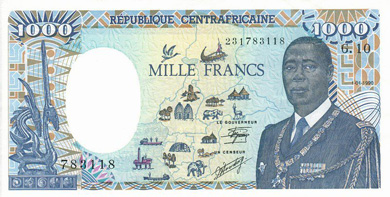
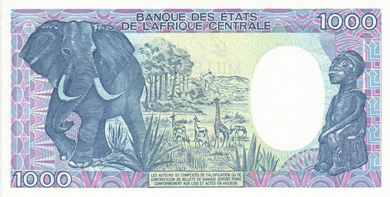
- Currency Name and Code
- Cooperation Financiere en Afrique Centrale francs (XAF)
- GDP — official exchange rate
- $1,462,000,000 (USD)
- GDP Real Growth Rate
- 2.2%
- Gini Index
- 61.3
Banknotes
Budget & Public Finance
- Fiscal Year
- calendar year
- External Debt
- $1,060,000,000 (USD)
- Economic Aid
- $73,000,000 (USD)
Labor, Industry & Trade
- Household Income — highest 10%
- 47.7%
- Industries
- diamond mining, logging, brewing, textiles, footwear, assembly of bicycles and motorcycles
- Agriculture Products
- cotton, coffee, tobacco, manioc (tapioca), yams, millet, corn, bananas; timber
- Export Commodities
- diamonds, timber, cotton, coffee, tobacco
- Export Partners
- Belgium 70.3%, Spain 7%, Italy 4.1%
- Import Commodities
- food, textiles, petroleum products, machinery, electrical equipment, motor vehicles, chemicals, pharmaceuticals
- Import Partners
- France 30.9%, US 5.1%, Cameroon 4.4%
Energy
- Oil Production
- 0 bbl/day
- Oil Consumption
- 2,400 bbl/day
- Oil Reserves
- 0 bbl/day
- Natural Gas Production
- 0 cu m
- Natural Gas Consumption
- 0 cu m
- Natural Gas Imports
- 0 cu m
- Natural Gas Exports
- 0 cu m
- Natural Gas Reserves
- 0 cu m
Communications
- Telephone System
- General Assessment: network consists principally of microwave radio relay and low-capacity, low-powered radiotelephone communication Domestic: limited telephone service with less than 1 fixed-line connection per 100 persons; spurred by the presence of multiple mobile-cellular service providers, cellular usage is increasing from a low base; most fixed-line and mobile-cellular telephone services are concentrated in Bangui International: country code - 236; satellite earth station - 1 Intelsat (Atlantic Ocean)
- Internet Country Code
- .cf
News & Weather
News & Weather
Current Weather
Latest News
Central African Republic Population 2026 - World Population Review
World Population Review · 4d ago
For Core, For Country: Arnaud Tattevin Representing Central African Republic - MLSNEXTPro.com
MLSNEXTPro.com · 3d ago
Central African Republic is stepping up efforts to reduce home births - WHO | Regional Office for Africa
WHO | Regional Office for Africa · 1d ago
Africa CDC Epidemic Intelligence Weekly Report, July 2026 - ReliefWeb
ReliefWeb · 18h ago
Today's top news: Pakistan, Venezuela, Occupied Palestinian Territory, Central African Republic, Cuba - OCHA
OCHA · 5d ago
Cholera outbreak declared in the Central African Republic, First outbreak in 10 years - Outbreak News Today
Outbreak News Today · 17d ago
Atrocity Alert No. 488: Eritrea, Central African Republic and Children and Armed Conflict - Global Centre for the Responsibility to Protect
Global Centre for the Responsibility to Protect · 27d ago
Central African Republic peace gains must be preserved: UN envoy - UN News
UN News · 28d ago
News via Google News
Climate Overview
Average monthly temperatures range from a low of around 66°F to a high of about 93°F. Most of the precipitation in the area of Bangui occurs between May and October, usually characterized by short, violent thunderstorms. Although it rains hard at times, the sun shines almost every day. Dust, generally sunny skies, and warm weather are the forecast for the dry season (November to April).
Videos
Videos
1 curated YouTube videos.
Source: YouTube
Frequently Asked Questions
Frequently Asked Questions
What is the population of Central African Republic?
How do people greet each other in the Central African Republic?
What are dining customs like in the Central African Republic?
What etiquette should travelers know in the Central African Republic?
How should travelers dress in the Central African Republic?
What are family customs like in the Central African Republic?
What do people do for recreation in the Central African Republic?
What is the capital of the Central African Republic?
Where is the Central African Republic located?
What countries border the Central African Republic?
What religion is practiced in the Central African Republic?
What is the currency of the Central African Republic?
What languages are spoken in the Central African Republic?
What is the Central African Republic known for?
Last reviewed 2026