
 English
 Español
 中文
中文 हिन्दी
 Français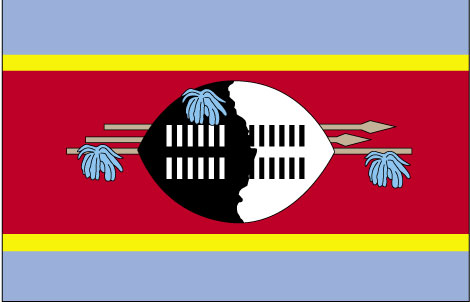
Eswatini
Declare Your Relationship to Eswatini
CountryReports Community
- Studying1
- From Eswatini1
- Eswatini heritage1
- Visited1
- Want to visit1
Customs and Culture
Customs and Culture
About the People
Swazi demand strict adherence to rules of kinship and political hierarchy. Respect must be shown by youth to their elders and by women to men. Adults wear beads to designate social and marital status. A young woman gives beadwork to her sweetheart as a token of love. Different beadwork serves as different stages of courtship.
Cultural Attributes
Swazi demand strict adherence to rules of kinship and political hierarchy. Respect must be shown by youth to their elders and by women to men. Adults wear beads to designate social and marital status. A young woman gives beadwork to her sweetheart as a token of love. Different beadwork serves as different stages of courtship.

Kingdom of Beads and Stars
Greetings, Gestures & Visiting
Respect is show to elders by lowering one's eyes, kneeling or moving quietly about them. A newborn baby is welcomed with white luck beads placed around its waist, wrists or ankles. At puberty, a boy joins his libutfo (age group) where he learns about manhood and service to the king. A girl at puberty is instructed by her mother about observances and taboos.
Western style clothing is usually worn but some people still wear the traditional costumes. For men this is a colorful cloth skirt covered by an emajobo (leather apron) with a ligcebesha (neckband) and a sagibo (walking stick). Women's traditional clothing consists of an ilihhiya (cloth) wrapped around the waist. Married women cover their upper bodies. Single women only wear beads on their upper bodies especially for ceremonial occasions.
Diet
Mealie meal (ground corn) is the primary food. It is usually eaten with chicken and vegetables. Sorghum, beans, peanuts and sweet potatoes are also popular foods. Breakfast usually consists of tea, bread and sour milk porridge. Leftovers are eaten for lunch. The evening meal or dinner is the main meal, it consists or porridge, vegetables and meat.

Family
Marriages can be arranged or western style where the boy and girl decide who they are going to marry. Most Swazi reside in a group of households called a umuti (homestead). Each indlu (household) consist of a husband, wife and their children. Sometimes the wife has a co-wife or inhlanti.
Recreation
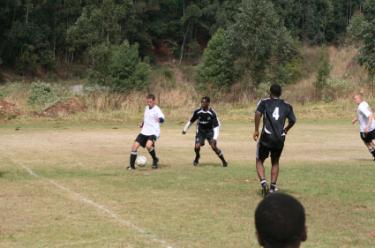
Soccer is the most popular sport but the balls are usually homemade from twine or rubber. Most rural areas do not have electricity and games and toys are created out of discarded items such as tin cans, wires or corn cobs.
Holidays
Independence Day
9/6Independence Day
Dates of Interest
- April 25th
What are meals like in Eswatini?
Mealie meal (ground corn) is the primary food, usually eaten with chicken and vegetables, with dinner as the main meal.
Good to know
- Breakfast is typically tea, bread and sour milk porridge
- Lunch is often leftovers
- Dinner (the main meal) consists of porridge, vegetables and meat
- Sorghum, beans, peanuts and sweet potatoes are also popular
What social customs should I be aware of in Eswatini?
Swazi society demands strict adherence to rules of kinship and political hierarchy, with respect shown by youth to elders and by women to men.
Good to know
- Adults wear beads to designate social and marital status
- A young woman gives beadwork to her sweetheart as a token of love, with different beadwork marking stages of courtship
What should I wear in Eswatini?
Western-style clothing is usually worn, though some people still wear traditional costumes.
Good to know
- Traditional men's dress includes a colorful cloth skirt, an emajobo (leather apron), a ligcebesha (neckband) and a sagibo (walking stick)
- Traditional women's dress is an ilihhiya (cloth) wrapped around the waist
- Married women cover their upper bodies
- Single women wear beads on their upper bodies, especially for ceremonial occasions
How is respect shown in Eswatini?
Respect is shown to elders by lowering one's eyes, kneeling, or moving quietly around them.
Good to know
- A newborn is welcomed with white luck beads placed around its waist, wrists or ankles
- At puberty a boy joins his libutfo (age group) to learn about manhood and service to the king
- A girl at puberty is instructed by her mother about observances and taboos
How is family life structured in Eswatini?
Most Swazi live in a group of households called an umuti (homestead), with each indlu (household) consisting of a husband, wife and their children.
Good to know
- Marriages can be arranged or western style, where the couple chooses each other
- A wife sometimes has a co-wife, or inhlanti
What do people do for recreation in Eswatini?
Soccer is the most popular sport, though balls are usually homemade from twine or rubber.
Good to know
- In rural areas without electricity, games and toys are made from discarded items such as tin cans, wires or corn cobs
Last updated: 2026-07-12 · Sources: CountryReports
Photos of Eswatini
Photos of Eswatini


Travel and Tourism
Travel and Tourism
- Travel Alert Status
- Level 2: Exercise Increased Caution
- Currency
- lilangeni (SZL)
- Time Difference
- UTC+2 (7 hours ahead of Washington, DC, during Standard Time)
- Climate
- Swaziland is divided into four well-defined regions running from west to east. The mountainous highveld, where Mbabane is located, has a humid, near-temperate climate with mean annual rainfall of 40-90 inches (100-230 centimeters), rarely suffering from drought. Daytime weather is more variable in the highveld than in other regions; a foggy morning may be followed by a sunny afternoon and vice versa. Temperatures in Mbabane range from an average of 51ºF to an average of 72ºF. In some parts of Mbabane, frost develops in winter and snow occasionally occurs. The middleveld and the Lubombo Plateau (the central and extreme eastern sections) are subtropical and drier, with mean annual rainfall of 25-47 inches (65-120 centimeters). Temperatures average 78ºF to an average low of 57 degrees. The middleveld is the site of the industrial center of the country, Manzini, as well as the University of Swaziland campuses and has an average elevation of 2,500 feet. The average elevation of the Lubombo Plateau is 1,800 feet. The lowveld is subtropical and drier with a mean annual rainfall of 20-30 inches (50-90 centimeters); the majority of this rainfall is from heavy storms. Temperatures in Big Bend, the largest town in the lowveld, range from an average low of 58ºF to a high of 84ºF. The altitude ranges from 500 to 1,000 feet.
- Airports
- 18
Read the full travel guide — health, safety, vaccinations, disease risk, sanitation, and transit details.
View full travel guideRecipes
Recipes
History
History
Historical Eras
Pre-Swazi Origins
1400 – 1750
The ancestors of the Swazi people migrated southward from the Great Lakes region before the 16th century, settling temporarily in what is now Mozambique. Following conflicts with local peoples near modern Maputo, they relocated to northern Zululand around 1750, laying the foundation for a distinct Swazi identity and political community.
Swazi Kingdom Formation
1750 – 1894
Pressured northward by Zulu expansion, the Swazis established themselves in the territory of present-day Eswatini and consolidated their kingdom under a series of capable rulers. Mswati II, reigning in the 1840s, gave the nation its name, expanded its territory northwest, stabilized the southern frontier with the Zulus, and invited early British contact, while the first white settlers arrived during his reign.
Colonial Rule
1894 – 1968
South Africa's Transvaal Republic administered Swazi affairs from 1894 before Britain assumed full protectorate control in 1903. Under British authority, King Sobhuza II ascended in 1921 and skillfully navigated colonial governance; after World War II, South Africa's apartheid policies prompted Britain to steer Swaziland toward independence, culminating in full sovereignty on September 6, 1968.
Independence & Royal Absolutism
1968 – 1996
Swaziland's post-independence politics were dominated by Sobhuza II's Imbokodvo National Movement, which swept legislative elections. In 1973 Sobhuza repealed the constitution, dissolved parliament, and banned political parties, consolidating absolute royal power. A new royally appointed parliament was established in 1979, entrenching a system of governance rooted in traditional Swazi institutions rather than multiparty democracy.
Reform Pressures
1996 – 2005
Student and labor unrest throughout the 1990s forced the monarchy to acknowledge demands for democratic reform. A Constitutional Review Commission was established in 1996, and after years of deliberation King Mswati III signed a new constitution in 2005. The document preserved the ban on political parties and entrenched royal authority, while Eswatini simultaneously confronted the world's highest rate of HIV/AIDS infection.
Modern Monarchy
2005 – present
Operating as one of the world's last absolute monarchies, Eswatini under King Mswati III has faced persistent criticism over political repression, inequality, and lavish royal spending amid widespread poverty. Pro-democracy protests intensified in 2021, resulting in a government crackdown, while the country continues to grapple with HIV/AIDS, economic underdevelopment, and pressure from international bodies to liberalize its political system.
Overview
They consolidated their hold under several able leaders. The most important was Mswati II, from whom the Swazis derive their name. Under his leadership in the 1840s, the Swazis expanded their territory to the northwest and stabilized the southern frontier with the Zulus.
Contact with the British came early in Mswati’s reign, when he asked British authorities in South Africa for assistance against Zulu raids into Swaziland. It also was during Mswati’s reign that the first whites settled in the country. Following Mswati’s death, the Swazis reached agreements with British and South African authorities over a range of issues, including independence, claims on resources by Europeans, administrative authority, and security. South Africans administered the Swazi interests from 1894 to 1902. In 1902 the British assumed control.
In 1921, after more than 20 years of rule by Queen Regent Lobatsibeni, Sobhuza II became Ngwenyama (lion) or head of the Swazi nation. The same year, Swaziland established its first legislative body--an advisory council of elected European representatives mandated to advise the British high commissioner on non-Swazi affairs. In 1944, the high commissioner conceded that the council had no official status and recognized the paramount chief, or king, as the native authority for the territory to issue legally enforceable orders to the Swazis.
In the early years of colonial rule, the British had expected that Swaziland would eventually be incorporated into South Africa. After World War II, however, South Africa’s intensification of racial discrimination induced the United Kingdom to prepare Swaziland for independence. Political activity intensified in the early 1960s. Several political parties were formed and jostled for independence and economic development. The largely urban parties had few ties to the rural areas, where the majority of Swazis lived. The traditional Swazi leaders, including King Sobhuza II and his Inner Council, formed the Imbokodvo National Movement (INM), a political group that capitalized on its close identification with the Swazi way of life. Responding to pressure for political change, the colonial government scheduled an election in mid-1964 for the first legislative council in which the Swazis would participate. In the election, the INM and four other parties, most having more radical platforms, competed in the election. The INM won all 24 elective seats.
Having solidified its political base, INM incorporated many demands of the more radical parties, especially that of immediate independence. In 1966, the U.K. Government agreed to discuss a new constitution. A constitutional committee agreed on a constitutional monarchy for Swaziland, with self-government to follow parliamentary elections in 1967. Swaziland became independent on September 6, 1968. Swaziland’s post-independence elections were held in May 1972. The INM received close to 75% of the vote. The Ngwane National Liberatory Congress (NNLC) received slightly more than 20% of the vote, which gained the party three seats in parliament.
In response to the NNLC’s showing, King Sobhuza repealed the 1968 constitution on April 12, 1973 and dissolved parliament. He assumed all powers of government and prohibited all political activities and trade unions from operating. He justified his actions as having removed alien and divisive political practices incompatible with the Swazi way of life. In January 1979, a new parliament was convened, chosen partly through indirect elections and partly through direct appointment by the King.
King Sobhuza II died in August 1982, and Queen Regent Dzeliwe assumed the duties of the head of state. In 1984, an internal dispute led to the replacement of the Prime Minister and eventual replacement of Dzeliwe by a new Queen Regent Ntombi. Ntombi’s only child, Prince Makhosetive, was named heir to the Swazi throne. Real power at this time was concentrated in the Liqoqo, a supreme traditional advisory body that claimed to give binding advice to the Queen Regent. In October 1985, Queen Regent Ntombi demonstrated her power by dismissing the leading figures of the Liqoqo. Prince Makhosetive returned from school in England to ascend to the throne and help end the continuing internal disputes. He was enthroned as Mswati III on April 25, 1986. Shortly afterwards he abolished the Liqoqo. In November 1987, a new parliament was elected and a new cabinet appointed.
In 1988 and 1989, an underground politica
Timeline of Key Events
1894
Britain and the Boer Republic of Transvaal jointly rule Swaziland.
Britain and the Boer Republic of Transvaal jointly rule Swaziland.
1903
Swaziland becomes a British protectorate.
Swaziland becomes a British protectorate.
1907
Swaziland becomes a British High Commission territory.
Swaziland becomes a British High Commission territory.
1968
Swaziland is granted formal independence.
Swaziland is granted formal independence, within the Commonwealth, and adopts a new constitution. Authority is vested in the new parliament, a proportion of the members are nominated by the monarch.
1977
The parliamentary system is abolished and replaced by traditional tribal communities.
The parliamentary system is abolished and replaced by traditional tribal communities.
1988
A motion calling for a review of the legislative structure is rejected by the prime minister.
A motion calling for a review of the legislative structure is rejected by the prime minister, despite majority support in the senate.
1996
Constitutional Review Commission to draft proposals for a new constitution.
King Mswati announces a Constitutional Review Commission to draft proposals for a new constitution.
Read the full history profile — narrative overview, defining eras, and the complete timeline in one place.
View expanded historyInteresting Facts
Interesting Facts
The night sky is different. Some constellations are upsidedown, some are missing, there is no big dipper.
Both girls and boys have their ears pierced and they keep bits of straw in the holes because they do not have earrings. Both have their heads shaved for the entire time they are in school.
School starts at 8am and ends at 1pm. Most schoolrooms have 1 teacher and 25-50 students. All children walk to school.
A good African hint for saving pencils: Cut your pencil in three small pieces. Take one piece of pencil and wear it on a string around your neck. That way if you lose your pencil you will be losing only 1/3 of it.
Every year the people of Swaziland celebrate Ncwala, the Festival of the First Fruits.
The Kingdom of Swaziland is one of three remaining monarchies in Africa. The other two are Lesotho and Morocco.
See every fact — trivia, oddities, and curious tidbits gathered from across the country.
View all interesting factsGeography and Environment
Geography and Environment
- Terrain
- mostly mountains and hills; some moderately sloping plains
- Climate
- Swaziland is divided into four well-defined regions running from west to east. The mountainous highveld, where Mbabane is located, has a humid, near-temperate climate with mean annual rainfall of 40-90 inches (100-230 centimeters), rarely suffering from drought. Daytime weather is more variable in the highveld than in other regions; a foggy morning may be followed by a sunny afternoon and vice versa. Temperatures in Mbabane range from an average of 51ºF to an average of 72ºF. In some parts of Mbabane, frost develops in winter and snow occasionally occurs. The middleveld and the Lubombo Plateau (the central and extreme eastern sections) are subtropical and drier, with mean annual rainfall of 25-47 inches (65-120 centimeters). Temperatures average 78ºF to an average low of 57 degrees. The middleveld is the site of the industrial center of the country, Manzini, as well as the University of Swaziland campuses and has an average elevation of 2,500 feet. The average elevation of the Lubombo Plateau is 1,800 feet. The lowveld is subtropical and drier with a mean annual rainfall of 20-30 inches (50-90 centimeters); the majority of this rainfall is from heavy storms. Temperatures in Big Bend, the largest town in the lowveld, range from an average low of 58ºF to a high of 84ºF. The altitude ranges from 500 to 1,000 feet.
- Natural Hazards
- drought
- Current Environmental Issues
- limited supplies of potable water; wildlife populations being depleted because of excessive hunting; overgrazing; soil degradation; soil erosion
Read the full geography and environment profile — terrain, climate, natural resources, hazards, land use, and international agreements.
View full geographyPeople & Demographics
People & Demographics
Religion
Languages Spoken
English (official, government business conducted in English), siSwati (official)
- SiSwati
- English
Population
- Population
- 1,354,051
- Population in Major Urban Areas
- MBABANE (capital) 66,000
- Nationality Noun
- Swazi(s)
- Ethnic Groups
- African 97%, European 3%
Education
- Literacy Definition
- Age 15 and over can read and write
Health Information
- Major Infectious Diseases — degree of risk
- Intermediate
Read the full people and society profile — demographics, health, education, religion, languages, and notable people.
View full people and societyGovernment & Politics
Government & Politics
Country Identity
- Country Name
- Eswatini
- Full Country Name
- Kingdom of Swaziland
Government Structure
- Government Type
- monarchy; independent member of Commonwealth
- Legal System
- based on South African Roman-Dutch law in statutory courts and Swazi traditional law and custom in traditional courts; has not accepted compulsory ICJ jurisdiction
- Executive Branch
- chief of state: King MSWATI III (since 25 April 1986) head of government: Prime Minister Russell Mmiso DLAMINI (since 6 November 2023) cabinet: Cabinet recommended by the prime minister and confirmed by the monarch elections: none; the monarch is hereditary; the prime minister is appointed by the monarch
- Legislative Branch
- bicameral Parliament or Libandla, an advisory body, consists of the Senate (30 seats - 10 appointed by the House of Assembly and 20 appointed by the monarch; members serve five-year terms) and the House of Assembly (65 seats - 10 appointed by the monarch and 55 elected by popular vote; members serve five-year terms) elections: House of Assembly - last held 18 October 2003 (next to be held October 2008) election results: House of Assembly - balloting is done on a nonparty basis; candidates for election are nominated by the local council of each constituency and for each constituency the three candidates with the most votes in the first round of voting are narrowed to a single winner by a second round
- Judicial Branch
- High Court; Court of Appeal; judges for both courts are appointed by the monarch
- Suffrage
- 18 years of age
- Constitution
- none; constitution of 6 September 1968 was suspended 12 April 1973; a new constitution was promulgated 13 October 1978, but was not formally presented to the people; since then a few more outlines for a constitution have been compiled under the Constitutional Review Commission (CRC), but so far none have been accepted
- Independence
- 6 September 1968 (from UK)
- National Holiday
- Independence Day, 6 September (1968)
Capital City
- Capital Name
- Mbabane (administrative capital); Lobamba (royal and legislative capital)
- Capital - geographic coordinate
- 26 19 S, 31 08 E
- Capital Time Difference
- UTC+2 (7 hours ahead of Washington, DC, during Standard Time)
Named after a Swati chief, Mbabane KUNENE, who lived in the area at the onset of British settlement
Military
Branches: Umbutfo Swaziland Defense Force (USDF): Ground Force (includes Air Wing (no operational aircraft))
Embassy / Diplomatic Mission
U.S. Embassy Mbabane
Central Bank Building
Mahlokohla Street
P.O. Box 199
Telephone: 268-2404-6441/5
Emergency after-hours telephone: 268-7602-8414
Facsimile: 268-2404-5959
Read the full government profile — flag symbolism, national anthem, and other national symbols.
View full government detailsEconomy
Economy
Eswatini is a small, landlocked economy heavily intertwined with that of South Africa, which surrounds it on three sides, with a short eastern border shared with Mozambique. Roughly 70% of the population lives in rural areas, where subsistence agriculture remains a primary livelihood, though it contributes only a small share of GDP. The economy is classified as lower-middle income, with services, manufacturing, and agriculture as its main pillars.
The manufacturing sector has diversified considerably since the mid-1980s and now includes soft drink concentrates, textiles, garments, and processed sugar. Sugar and wood pulp products historically have been leading exports, though the closure of the country's main pulp mill in 2010 reduced the role of forestry. Sugar remains a major foreign exchange earner, alongside soft drink concentrate, which is one of Eswatini's top export commodities. Mining has diminished in importance, with coal and quarried stone among the few active operations, though there has been renewed interest in iron ore and gold exploration.
Eswatini's trade is dominated by South Africa, which supplies the majority of its imports and receives a large share of its exports. The country is a member of the Southern African Customs Union (SACU), and SACU receipts account for a significant portion of government revenue, though this income stream is volatile and has contributed to fiscal pressures in recent years. The local currency, the lilangeni, is pegged at par to the South African rand.
The government continues efforts to improve the climate for foreign direct investment, promote private sector growth, and reduce reliance on SACU transfers. However, persistent challenges include high unemployment—particularly among youth—deep income inequality, slow growth, and recurring fiscal deficits. Environmental pressures such as overgrazing, soil degradation, and drought remain ongoing concerns, with climate variability affecting both agriculture and food security. Eswatini also continues to face one of the world's highest HIV/AIDS prevalence rates, with roughly a quarter of adults living with HIV, although expanded treatment programs have significantly improved life expectancy and outcomes.
Snapshot
- Currency Name and Code
- SZL
- GDP — official exchange rate
- $2,117,000,000 (USD)
- GDP Real Growth Rate
- 1.8%
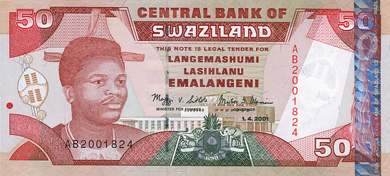
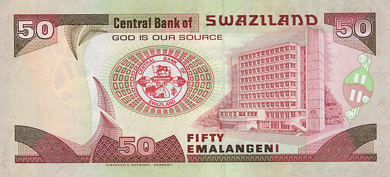
Banknotes
Budget & Public Finance
- Fiscal Year
- 1 April - 31 March
- Annual Budget
- $957,100,000 (USD)
- External Debt
- $357,000,000 (USD)
- Investment (% of GDP)
- 10.4%
- Economic Aid
- $104,000,000 (USD)
- Current Account Balance
- -$142,400,000 (USD)
- Reserves of Foreign Exchange
- $357,200,000 (USD)
Labor, Industry & Trade
- Household Income — highest 10%
- 50.2%
- Industries
- mining (coal), wood pulp, sugar, soft drink concentrates, textile and apparel
- Agriculture Products
- sugarcane, cotton, corn, tobacco, rice, citrus, pineapples, sorghum, peanuts; cattle, goats, sheep
- Export Commodities
- soft drink concentrates, sugar, wood pulp, cotton yarn, refrigerators, citrus and canned fruit
- Export Partners
- South Africa 72%, EU 14.2%, Mozambique 3.7%, US 3.5%
- Import Commodities
- motor vehicles, machinery, transport equipment, foodstuffs, petroleum products, chemicals
- Import Partners
- South Africa 88.8%, EU 5.6%, Japan 0.6%, Singapore 0.4%
Energy
- Oil Production
- 0 bbl/day
- Oil Consumption
- 3,500 bbl/day
- Oil Reserves
- 0 bbl/day
- Natural Gas Production
- 0 cu m
- Natural Gas Consumption
- 0 cu m
- Natural Gas Imports
- 0 cu m
- Natural Gas Exports
- 0 cu m
- Natural Gas Reserves
- 0 cu m
Communications
- Telephone System
- General assessment: A somewhat modern but not an advanced system Domestic: The single source for mobile-cellular service with a geographic coverage of about 90% and a rising subscribership base; combined fixed-line and mobile-cellular teledensity roughly 60 telephones per 100 persons in 2011; telephone system consists of carrier-equipped, open-wire lines and low-capacity, microwave radio relay International: Country code - 268; satellite earth station - 1 Intelsat (Atlantic Ocean)
- Internet Country Code
- .sz
News & Weather
News & Weather
Current Weather
Latest News
‘Paving The Way For Missionaries’: In Africa’s Last Absolute Monarchy, Christianity Blends With Tradition - Religion Unplugged
Religion Unplugged · 7h ago
Jamaica says 2 citizens deported by US to Eswatini rejected repatriation offers - AP News
AP News · 3d ago
Rural health monitors wield digital handheld devices to help close Eswatini’s immunisation gap - Gavi, the Vaccine Alliance
Gavi, the Vaccine Alliance · 19h ago
ESWATINI: 70-YEAR-OLD PRESSURED INTO FORCED EVICTION (59.26) - Amnesty International USA
Amnesty International USA · 2d ago
Two Jamaicans deported by US to Eswatini decline government's offer to return home - Caribbean National Weekly
Caribbean National Weekly · 3d ago
Eswatini Launches First Costed National Disability Plan to Accelerate - UNESCO
UNESCO · 4d ago
Egypt, Eswatini discuss expanding banking cooperation - Dailynewsegypt
Dailynewsegypt · 14h ago
Eswatini: Fourth US third-country removal operation raises fresh human rights concerns - Amnesty International
Amnesty International · 10d ago
News via Google News
Climate Overview
Swaziland is divided into four well-defined regions running from west to east. The mountainous highveld, where Mbabane is located, has a humid, near-temperate climate with mean annual rainfall of 40-90 inches (100-230 centimeters), rarely suffering from drought. Daytime weather is more variable in the highveld than in other regions; a foggy morning may be followed by a sunny afternoon and vice versa. Temperatures in Mbabane range from an average of 51ºF to an average of 72ºF. In some parts of Mbabane, frost develops in winter and snow occasionally occurs.
The middleveld and the Lubombo Plateau (the central and extreme eastern sections) are subtropical and drier, with mean annual rainfall of 25-47 inches (65-120 centimeters). Temperatures average 78ºF to an average low of 57 degrees. The middleveld is the site of the industrial center of the country, Manzini, as well as the University of Swaziland campuses and has an average elevation of 2,500 feet. The average elevation of the Lubombo Plateau is 1,800 feet.
The lowveld is subtropical and drier with a mean annual rainfall of 20-30 inches (50-90 centimeters); the majority of this rainfall is from heavy storms. Temperatures in Big Bend, the largest town in the lowveld, range from an average low of 58ºF to a high of 84ºF. The altitude ranges from 500 to 1,000 feet.
Videos
Videos
1 curated YouTube videos.
Source: YouTube
Frequently Asked Questions
Frequently Asked Questions
What is the population of Eswatini?
What are meals like in Eswatini?
What social customs should I be aware of in Eswatini?
What should I wear in Eswatini?
How is respect shown in Eswatini?
How is family life structured in Eswatini?
What do people do for recreation in Eswatini?
What is the capital of Eswatini?
Where is Eswatini located?
What countries border Eswatini?
What religion is practiced in Eswatini?
What currency does Eswatini use?
What languages are spoken in Eswatini?
What is Eswatini known for?
What is the geography of Eswatini like?
Last reviewed 2026