
 English
 Español
 中文
中文 हिन्दी
 Français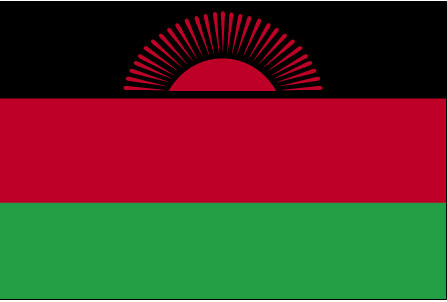
Malawi
Declare Your Relationship to Malawi
CountryReports Community
- Studying0
- From Malawi0
- Malawi heritage1
- Visited0
- Want to visit0
Customs and Culture
Customs and Culture
Cultural Attributes
Malawi is often called the "Warm Heart of Africa," a nickname that reflects the genuine hospitality and friendliness that define everyday social interactions throughout the country. This spirit of warmth is not merely a tourism slogan but an observable cultural reality rooted in the values of community, generosity, and mutual respect that permeate Malawian society. The population is ethnically diverse, with the Chewa being the largest group, alongside the Tumbuka, Lomwe, Yao, Ngoni, Sena, Tonga, and Nyanja peoples, among others. Chichewa serves as the national language and is spoken across much of the country, functioning as a cultural bridge among different ethnic communities. English is the official language used in government and education. Family and community ties are central to Malawian culture. Extended family networks play a significant role in daily life, with decisions about marriage, child-rearing, and financial matters often involving the wider family unit. Many communities in the central and southern regions follow matrilineal descent traditions, where lineage, inheritance, and land rights are traced through the mother's side of the family. Music and dance are deeply embedded in cultural expression. Traditional dances such as the Gule Wamkulu, performed by the Chewa people, have been recognized by UNESCO as an Intangible Cultural Heritage of Humanity. This masked dance tradition carries spiritual and social significance, used to mark rites of passage including initiations and funerals. The Vimbuza healing dance of the Tumbuka people is similarly inscribed on UNESCO's heritage list. Christianity is the dominant religion, practiced by approximately 77 percent of the population, while Islam is followed by around 13 percent, primarily among Yao communities in the southern and lakeshore regions. Traditional beliefs often coexist alongside formal religious practice. Food culture centers on nsima, a thick porridge made from maize flour, typically served with relishes of vegetables, fish, beans, or meat. Lake Malawi provides an important source of protein through chambo and usipa fish, which are staples in the local diet and central to both cuisine and economic life in lakeside communities.

Land of Lake Malawi and Unbounded Waters
Greetings, Gestures & Visiting
Men and women of the same age group shake hands vigorously when greeting. Hugging is not common. A young person is supposed to look to the side or bow when being addressed by an elder.
Kissing in public is frowned upon.
It is customary to prepare food when one receives a guest. It is considered rude for guests to decline food even if they have already eaten.
In urban areas, women usually wear a skirt and a blouse or a colorful modern dress. In rural areas, women wear a loin cloth tied around the waist and a blouse. Men wear pants, shirts, shorts, and occasionally a suit. Middle income business people wear Western style clothing mostly suits.
Diet
In the little country, Malawi, in Africa, most people are subsistence
farmers. They grow most of their own food in small gardens.
If a family has extra food, they take it to market to trade for other
necessities. Common crops are potatoes, cassava, beans, maize, rice, and
tea. Wild animals are always a danger to farmers.

Family
In Malawi, women have a special place as descent is determined not by the father but through the mother. Couples often establish their households near the wife's family. Most people are black Africans who belong to the Bantu groups.
Traditionally Malawi women raised the food crops and the men provided the meat and fish. Currently the roles have blurred and both men and women farm the land, the women grow the food crops while the men grow the crops that are grown for sale.
Recreation
Soccer is the main sport. Basketball is growing in popularity. Malawians engage in a variety of activities when they are not working in the fields. Women tell folktales in the evenings.
Sometimes children play games in the early part of the evening, before they go to sleep. Other times young people, boys and girls, organize traditional dances, which are usually done in circles.
On ceremonial occasions such as the graduation of initiates, funerals of important people and weddings, a variety of masked figures representing man, spirit, and animal enact moments of creation to bring harmony to the world. The dancing is intense and energetic, patterned by a variety of drums along with calls and responses between the masked figures and parts of the audiences consisting of initiated men and women.
Holidays
Independence Day
7/6Independence Day
Dates of Interest
- July 6th
How do people greet each other in Malawi?
Men and women of the same age group shake hands vigorously, while hugging is uncommon. Malawi is known as the "Warm Heart of Africa" for its genuine hospitality and friendliness.
Do
- Shake hands vigorously with people of your own age group
- As a young person, look to the side or bow when addressed by an elder
Don’t
- Don't expect hugging as a common greeting
What are the dining customs in Malawi?
Meals center on nsima, a thick maize-flour porridge served with relishes of vegetables, fish, beans, or meat, with chambo and usipa fish from Lake Malawi as key protein staples.
Do
- Accept food offered to you as a guest
Don’t
- Don't decline food as a guest, even if you have already eaten — it is considered rude
Good to know
- Hosts customarily prepare food when receiving a guest
- Common crops include potatoes, cassava, beans, maize, rice, and tea
What etiquette should I know in Malawi?
Malawian society is rooted in community, generosity, and mutual respect, with strong deference shown to elders.
Do
- Show respect to elders
- Respect the spiritual significance of traditional ceremonies and dances
What should I wear in Malawi?
In urban areas women usually wear a skirt and blouse or a colorful modern dress, while in rural areas women wear a loin cloth tied at the waist with a blouse. Men wear pants, shirts, shorts, and occasionally a suit.
Good to know
- Middle-income business people mostly wear Western-style clothing, usually suits
Are there gestures to avoid in Malawi?
Public displays of affection are not welcome.
Don’t
- Don't kiss in public, as it is frowned upon
What is family life like in Malawi?
Family and community ties are central, and many communities in the central and southern regions follow matrilineal descent, tracing lineage, inheritance, and land rights through the mother's side. Couples often establish their households near the wife's family.
Good to know
- Decisions about marriage, child-rearing, and finances often involve the wider extended family
- Both men and women farm the land, with women growing food crops and men growing crops for sale
What do people do for recreation in Malawi?
Soccer is the main sport and basketball is growing in popularity, while music and dance are deeply embedded in cultural expression.
Good to know
- Women tell folktales in the evenings and young people organize traditional circle dances
- Masked dances such as the Chewa Gule Wamkulu (a UNESCO Intangible Cultural Heritage) are performed at initiations, funerals, and weddings
- The Vimbuza healing dance of the Tumbuka people is also on UNESCO's heritage list
Last updated: 2026-07-12 · Sources: CountryReports
Photos of Malawi
Photos of Malawi

Travel and Tourism
Travel and Tourism
- Travel Alert Status
- Level 2: Exercise Increased Caution
- Currency
- Malawian kwacha (MWK)
- Time Difference
- UTC+2 (7 hours ahead of Washington, DC, during Standard Time)
- Climate
- Malawi has wet and dry seasons. The wet season is from November to April; the heaviest rainfall occurs between December and March. The dry season begins in May and lasts until November. It is hottest just before rains begin. The capital, Lilongwe (altitude 3,400 feet) is in a high, central plateau area. The average daily temperature in Lilongwe during October is 84.6°F. June, July, and August are the coolest months, and nights can be quite chilly when temperatures drop to between 41°F and 57°F. Frost occasionally occurs in Lilongwe. During the dry season, particularly September and October, high winds and some dust occur. The annual mean temperature in Lilongwe is 67.4°F, and the annual rainfall is 31.9 inches. Nights are generally cool and pleasant in Lilongwe, even during the hottest weather. Dry season days are generally sunny and warm; rains during the wet season are brief. The Blantyre area is more mountainous, and its weather more humid. The climate is also more hot and humid around Lake Malawi.
- Airports
- 42
Read the full travel guide — health, safety, vaccinations, disease risk, sanitation, and transit details.
View full travel guideRecipes
Recipes
History
History
Historical Eras
Pre-Colonial Era
1000000 BCE – 1891
Malawi's territory has been inhabited for over one million years, with Bantu-speaking peoples migrating into the region by the first millennium CE and displacing earlier Twa inhabitants. Around 1480, Bantu tribes consolidated into the Maravi Confederacy, a significant political and cultural union that gave the country its name. Portuguese contact in the 16th century and David Livingstone's arrival at Lake Malawi in 1859 preceded formal colonization, while Arab-driven slave trading intensified through the late 19th century.
Nyasaland Protectorate
1891 – 1964
Britain formally established the Nyasaland Protectorate in 1891, consolidating control over the region through administrative and economic structures favoring European settlers and planters. African resistance surfaced periodically, most notably in the 1915 armed uprising led by Reverend John Chilembwe against colonial labor conditions. Political consciousness accelerated after 1944 through the Nyasaland African Congress, and Dr. Hastings Kamuzu Banda's return in 1958 galvanized the independence movement that dismantled British rule.
Banda One-Party State
1964 – 1994
Malawi achieved full independence on July 6, 1964, with Banda becoming Prime Minister and subsequently declaring a one-party state under the Malawi Congress Party in 1966. Proclaimed President for Life in 1971, Banda exercised authoritarian control through institutions including the paramilitary Young Pioneers, suppressing political dissent and curtailing civil liberties for three decades. The capital was relocated from Zomba to Lilongwe in 1975, symbolizing Banda's ambitions for national transformation even as poverty and repression deepened.
Democratic Transition
1994 – 2000
A June 1993 referendum, driven by church pressure and international demands, saw Malawians vote overwhelmingly to end one-party rule. Free multiparty elections in May 1994 brought Bakili Muluzi and his United Democratic Front to power, inaugurating a new constitutional order that came into full effect in 1995. Muluzi was reelected in 1999, though his subsequent attempts to amend the constitution to permit a third presidential term were ultimately defeated.
Modern Malawi
2000 – present
The early 21st century confronted Malawi with converging crises including severe drought in 2002 that devastated harvests across southern Africa, a deepening HIV/AIDS epidemic, and persistent corruption within successive governments. Rapid population growth placed acute pressure on agricultural land in one of the world's most densely farmed nations, while donor-dependent economic policies yielded uneven development. Democratic consolidation continued through successive elections, though governance deficits and food insecurity remained central challenges to national stability.
Overview
Although the Portuguese reached the area in the 16th century, the first significant Western contact was the arrival of David Livingstone along the shore of Lake Malawi in 1859. Subsequently, Scottish Presbyterian churches established missions in Malawi. One of their objectives was to end the slave trade to the Persian Gulf that continued to the end of the 19th century. In 1878, a number of traders, mostly from Glasgow, formed the African Lakes Company to supply goods and services to the missionaries. Other missionaries, traders, hunters, and planters soon followed.
In 1883, a consul of the British Government was accredited to the "Kings and Chiefs of Central Africa," and in 1891, the British established the Nyasaland Protectorate (Nyasa is the Yao word for "lake"). Although the British remained in control during the first half of the 1900s, this period was marked by a number of unsuccessful Malawian attempts to obtain independence. A growing European and U.S.-educated African elite became increasingly vocal and politically active--first through associations, and after 1944, through the Nyasaland African Congress (NAC).
During the 1950s, pressure for independence increased when Nyasaland was joined with Northern and Southern Rhodesia in 1953 to form the Federation of Rhodesia and Nyasaland. In July 1958, Dr. Hastings Kamuzu Banda returned to the country after a long absence in the United States (where he had obtained his medical degree at Meharry Medical College in Nashville, Tennessee in 1937), the United Kingdom (where he practiced medicine), and Ghana. He assumed leadership of the NAC, which later became the Malawi Congress Party (MCP). In 1959, Banda was sent to Gwelo Prison for his political activities but was released in 1960 to participate in a constitutional conference in London.
On April 15, 1961, the MCP won an overwhelming victory in elections for a new Legislative Council. It also gained an important role in the new Executive Council and ruled Nyasaland in all but name a year later. In a second constitutional conference in London in November 1962, the British Government agreed to give Nyasaland self-governing status the following year.
Dr. Banda became Prime Minister on February 1, 1963, although the British still controlled Malawi’s financial, security, and judicial systems. A new constitution took effect in May 1963, providing for virtually complete internal self-government. The Federation of Rhodesia and Nyasaland was dissolved on December 31, 1963, and Malawi became a fully independent member of the Commonwealth (formerly the British Commonwealth) on July 6, 1964. Two years later, Malawi adopted a new constitution and became a one-party state with Dr. Banda as its first President.
In 1970 Dr. Banda was declared President for life of the MCP, and in 1971 Banda consolidated his power and was named President for life of Malawi itself. The paramilitary wing of the Malawi Congress Party, the Young Pioneers, helped keep Malawi under authoritarian control until the 1990s. Increasing domestic unrest and pressure from Malawian churches and from the international community led to a referendum in which the Malawian people were asked to vote for either a multi-party democracy or the continuation of a one-party state. On June 14, 1993, the people of Malawi voted overwhelmingly in favor of multi-party democracy. Free and fair national elections were held on May 17, 1994.
Bakili Muluzi, leader of the United Democratic Front (UDF), was elected President in those elections. The UDF won 82 of the 177 seats in the National Assembly and formed a coalition government with the Alliance for Democracy (AFORD). That coalition disbanded in June 1996, but some of its members remained in the government. The President was referred to as Dr. Muluzi, having received an honorary degree at Lincoln University in Missouri in 1995. Malawi’s newly written constitution (1995) eliminated special powers previously reserved for the Malawi Congress Party. Accelerated economic liberalization and structural reform accompanied the political transition.
On June 15, 1999, Malawi held its second democratic elections. Dr. Bakili Muluzi was re-elected to serve a second 5-year term as President, despite an MCP-AFORD alliance that ran a joint slate against the UDF.
Malawi saw its first transition between democratically elected presidents in May 2004, when the UDF’s presidential candidate Bingu wa Mutharika defeated MCP candidate John Tembo and Gwanda Chakuamba, who was bac
Timeline of Key Events
1 – 1499
Malawi is home to the Twa and Fulani peoples until Bantu-speaking tribes invade the region.
The region of Africa which is now known as Malawi is home to the Twa and Fulani peoples until Bantu-speaking tribes invade the region. A continuing influx of Bantu-speaking people to the area will usher in southern Africa’s Iron Age in the 13th century.
1480
Bantu tribes unite several smaller political states to form the Maravi Confederacy.
Bantu tribes unite several smaller political states to form the Maravi Confederacy which at its height includes large parts of present-day Zambia and Mozambique plus the modern state of Malawi.
1790 – 1860
Slave trade increases dramatically.
Slave trade increases dramatically.
1859
Dr. David Livingstone, Scottish missionary, arrived in Malawi.
Dr. David Livingstone, Scottish missionary, arrived in Malawi. The town of Livingstonia was later named in his honor.
1859
Maize replaced the native crops in Malawi soon after the arrival of David Livingstone.
Maize replaced the native crops in Malawi soon after the arrival of David Livingstone. It had been introduced in Africa in the 16th century by Portuguese colonizers as a reliable staple for slaving outposts.
1891 – 1893
Britain establishes the Nyasaland and District Protectorate.
Britain establishes the Nyasaland and District Protectorate, and changes its name to the British Central African Protectorate two years later. Africans are soon forced to work on White-owned coffee plantations.
1901
Britain and Germany agreed on a boundary between German East Africa and Nyasaland.
Britain and Germany agreed on a boundary between German East Africa [later Tanganyika, Rwanda and Burundi] and Nyasaland [later Malawi].
Read the full history profile — narrative overview, defining eras, and the complete timeline in one place.
View expanded historyInteresting Facts
Interesting Facts
Malawi has the world's fewest doctors with 1 per 49,118 people.
Lake Malawi is the third largest of Africa’s great lakes.
The name Malawi is derived from Marawi, the name of people who migrated to the region hundreds of years ago.
The Nyika National Park is particularly famous for its orchids.
Maize, the staple food in Malawi, is not a native plant but was introduced by the Portuguese at the end of the eighteenth century.
See every fact — trivia, oddities, and curious tidbits gathered from across the country.
View all interesting factsGeography and Environment
Geography and Environment
- Terrain
- narrow elongated plateau with rolling plains, rounded hills, some mountains
- Climate
- Malawi has wet and dry seasons. The wet season is from November to April; the heaviest rainfall occurs between December and March. The dry season begins in May and lasts until November. It is hottest just before rains begin. The capital, Lilongwe (altitude 3,400 feet) is in a high, central plateau area. The average daily temperature in Lilongwe during October is 84.6°F. June, July, and August are the coolest months, and nights can be quite chilly when temperatures drop to between 41°F and 57°F. Frost occasionally occurs in Lilongwe. During the dry season, particularly September and October, high winds and some dust occur. The annual mean temperature in Lilongwe is 67.4°F, and the annual rainfall is 31.9 inches. Nights are generally cool and pleasant in Lilongwe, even during the hottest weather. Dry season days are generally sunny and warm; rains during the wet season are brief. The Blantyre area is more mountainous, and its weather more humid. The climate is also more hot and humid around Lake Malawi.
- Natural Hazards
- NA
- Current Environmental Issues
- deforestation; land degradation; water pollution from agricultural runoff, sewage, industrial wastes; siltation of spawning grounds endangers fish populations
Read the full geography and environment profile — terrain, climate, natural resources, hazards, land use, and international agreements.
View full geographyPeople & Demographics
People & Demographics
Religion
Languages Spoken
English (official), Chichewa (official), other languages important regionally
- Chichewa
- English
Population
- Population
- 15,447,500
- Population in Major Urban Areas
- LILONGWE (capital) 772,000
- Nationality Noun
- Malawian(s)
- Ethnic Groups
- Chewa, Nyanja, Tumbuka, Yao, Lomwe, Sena, Tonga, Ngoni, Ngonde, Asian, European
Education
- Literacy Definition
- age 15 and over can read and write
Health Information
- Major Infectious Diseases — degree of risk
- very high
Read the full people and society profile — demographics, health, education, religion, languages, and notable people.
View full people and societyGovernment & Politics
Government & Politics
Country Identity
- Country Name
- Malawi
- Full Country Name
- Republic of Malawi
- Former Name
- British Central African Protectorate, Nyasaland Protectorate, Nyasaland
Government Structure
- Government Type
- multiparty democracy
- Legal System
- based on English common law and customary law; judicial review of legislative acts in the Supreme Court of Appeal; has not accepted compulsory ICJ jurisdiction
- Executive Branch
- chief of state: President Lazarus CHAKWERA (since 28 June 2020); note - the president is both the chief of state and head of government head of government: President Lazarus CHAKWERA (since 28 June 2020); note - the president is both the chief of state and head of government cabinet: Cabinet named by the president elections: president elected by popular vote for a five-year term; election last held on 23 June 2020 (next to be held in 2025) election results: Lazarus CHAKWERA elected president; percent of vote - Lazarus CHAKWERA (MCP) 59.3%, Peter MUTHARIKA (DPP) 39.9%, other 0.8%
- Legislative Branch
- unicameral National Assembly (193 seats; members elected by popular vote to serve five-year terms) elections: last held 20 May 2004 (next to be held May 2009) election results: percent of vote by party - NA%; seats by party - UDF 74, MCP 60, Independents 24, RP 16, others 18, vacancies 1
- Judicial Branch
- Supreme Court of Appeal; High Court (chief justice appointed by the president, puisne judges appointed on the advice of the Judicial Service Commission); magistrate's courts
- Suffrage
- 18 years of age; universal
- Constitution
- 18-May-94
- Independence
- 6 July 1964 (from UK)
- National Holiday
- Independence Day (Republic Day), 6 July (1964)
Capital City
- Capital Name
- Lilongwe
- Capital - geographic coordinate
- 13 58 S, 33 47 E
- Capital Time Difference
- UTC+2 (7 hours ahead of Washington, DC, during Standard Time)
named after the Lilongwe River that flows through the city
Military
Branches: Malawi Defense Forces (MDF): Army (includes Air Wing, Marine Unit)
Embassy / Diplomatic Mission
U.S. Embassy Lilongwe
Area 40, City Center
Lilongwe, Malawi
Mailing Address: PO Box 30016, Lilongwe 3, Malawi
Telephone: (265) 1-773-166, 1-773-342 and 1-773-367
(if dialing within Malawi add "0" before the "1"); fax (265) 1-774-976 (if dialing within Malawi add "0" before the "1").
In case of emergency, you may call the Embassy 24 hours a day and request extension 3443. In case the landlines are malfunctioning, you may also dial (265) (0)999-591024 or (265) (0) 888-734-826.
Read the full government profile — flag symbolism, national anthem, and other national symbols.
View full government detailsEconomy
Economy
Landlocked Malawi remains one of the world's least developed countries, with a per capita income among the lowest globally. The economy is predominantly agricultural, with roughly 80% of the population living in rural areas. Agriculture accounts for about a quarter of GDP and around 80% of export earnings, while the broader service sector contributes the largest share of economic output. The country depends heavily on inflows of economic assistance from the IMF, the World Bank, the African Development Bank, and bilateral donors. Malawi reached the completion point under the Heavily Indebted Poor Countries (HIPC) initiative in 2006, which provided significant debt relief, though external debt has since climbed back to worrying levels.
The economy continues to face severe structural challenges, including chronic foreign exchange shortages, high inflation, persistent fiscal deficits, and vulnerability to climate shocks such as droughts, cyclones, and flooding, which have repeatedly disrupted agricultural output. In 2023, the government devalued the kwacha sharply in an effort to restore macroeconomic stability and unlock a new IMF Extended Credit Facility arrangement. Key policy priorities include diversifying the economy beyond rain-fed agriculture, expanding mining and manufacturing, improving education and health systems, addressing environmental degradation and rapid population growth, and managing the long-term burden of HIV/AIDS. Tobacco remains the dominant cash crop and largest single export, though its share has declined amid global anti-smoking trends, prompting increased focus on alternative exports such as tea, sugar, soybeans, macadamia nuts, and minerals including uranium and rare earths.
Snapshot
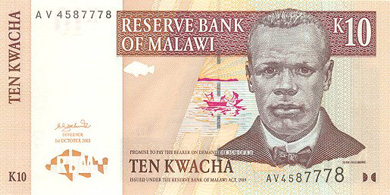
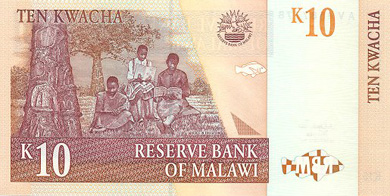
- Currency Name and Code
- Kwacha (MWK)
- GDP — official exchange rate
- $1,984,000,000 (USD)
- GDP Real Growth Rate
- -3%
- Gini Index
- 50.3
Banknotes
Budget & Public Finance
- Fiscal Year
- 1 July - 30 June
- Annual Budget
- $913,900,000 (USD)
- Public Debt (% of GDP)
- 208.6%
- External Debt
- $3,284,000,000 (USD)
- Investment (% of GDP)
- 9.5%
- Economic Aid
- $540,000,000 (USD)
- Current Account Balance
- -$217,000,000 (USD)
- Reserves of Foreign Exchange
- $146,000,000 (USD)
Labor, Industry & Trade
- Labor Force by Occupation
- agriculture 90%
- Industries
- tobacco, tea, sugar, sawmill products, cement, consumer goods
- Agriculture Products
- tobacco, sugarcane, cotton, tea, corn, potatoes, cassava (tapioca), sorghum, pulses; groundnuts, Macadamia nuts; cattle, goats
- Export Commodities
- tobacco 60%, tea, sugar, cotton, coffee, peanuts, wood products, apparel
- Export Partners
- South Africa 22%, US 14.7%, Germany 12.2%, Egypt 5.3%, Japan 5.1%, Netherlands 4.7%, Russia 4.1%
- Import Commodities
- food, petroleum products, semimanufactures, consumer goods, transportation equipment
- Import Partners
- South Africa 45.1%, Zambia 12.3%, US 5.4%, India 4.1%
Energy
- Oil Production
- 0 bbl/day
- Oil Consumption
- 5,450 bbl/day
- Oil Reserves
- 0 bbl/day
- Natural Gas Production
- 0 cu m
- Natural Gas Consumption
- 0 cu m
- Natural Gas Imports
- 0 cu m
- Natural Gas Exports
- 0 cu m
- Natural Gas Reserves
- 0 cu m
Communications
- Telephone System
- general assessment: rudimentary; privatization of Malawi Telecommunications (MTL), a necessary step in bringing improvement to telecommunications services, completed in 2006 domestic: limited fixed-line subscribership of about 1 per 100 persons; mobile-cellular services are expanding but network coverage is limited and is based around the main urban areas; mobile-cellular subscribership about 25 per 100 persons international: country code - 265; satellite earth stations - 2 Intelsat (1 Indian Ocean, 1 Atlantic Ocean)
- Internet Country Code
- .mw
News & Weather
News & Weather
Current Weather
Latest News
Ver Chitipa United vs. Ekhaya FC Online en Vivo | DAZN US - DAZN
DAZN · 1h ago
Providing space and dignity for school children in Malawi - Church News
Church News · 3d ago
The varied delights of a safari in Malawi - The Week
The Week · 2d ago
Learning what matters in Malawi - Brookings
Brookings · 21d ago
Malawi government plans to invite new telecom operators to foster competition - Telecompaper
Telecompaper · 42m ago
CODEV-PI visits Malawi - EEAS
EEAS · 17h ago
Malawi agroecologists see opportunity in Gulf fertilizer supply disruption - news - Mongabay
news - Mongabay · 18d ago
Embracing African feminism to end child marriage - KU News
KU News · 99d ago
News via Google News
Climate Overview
Malawi has wet and dry seasons. The wet season is from November to April; the heaviest rainfall occurs between December and March. The dry season begins in May and lasts until November. It is hottest just before rains begin.
The capital, Lilongwe (altitude 3,400 feet) is in a high, central plateau area. The average daily temperature in Lilongwe during October is 84.6°F. June, July, and August are the coolest months, and nights can be quite chilly when temperatures drop to between 41°F and 57°F. Frost occasionally occurs in Lilongwe. During the dry season, particularly September and October, high winds and some dust occur. The annual mean temperature in Lilongwe is 67.4°F, and the annual rainfall is 31.9 inches. Nights are generally cool and pleasant in Lilongwe, even during the hottest weather. Dry season days are generally sunny and warm; rains during the wet season are brief. The Blantyre area is more mountainous, and its weather more humid. The climate is also more hot and humid around Lake Malawi.
Frequently Asked Questions
Frequently Asked Questions
What is the population of Malawi?
How do people greet each other in Malawi?
What are the dining customs in Malawi?
What etiquette should I know in Malawi?
What should I wear in Malawi?
Are there gestures to avoid in Malawi?
What is family life like in Malawi?
What do people do for recreation in Malawi?
What is the capital of Malawi?
Where is Malawi located?
What countries border Malawi?
What religion is practiced in Malawi?
What is the currency of Malawi?
What languages are spoken in Malawi?
What is the geography of Malawi like?
What is Malawi known for?
Last reviewed 2026