
 English
 Español
 中文
中文 हिन्दी
 Français
Burkina Faso
Declare Your Relationship to Burkina Faso
CountryReports Community
- Studying0
- From Burkina Faso0
- Burkina Faso heritage0
- Visited0
- Want to visit0
Customs and Culture
Customs and Culture
About the People
Burkinabe respect the older generations. The majority of the population are farmers raising enough crops to meet their own needs.
Cultural Attributes
Burkinabe respect the older generations. The majority of the population are farmers raising enough crops to meet their own needs.

Land of the Griots and Golden Earth
Greetings, Gestures & Visiting
Rural women wear a long cotton skirt wrapped a the waist, with a top being added in recent years. Men's traditional clothing is a cotton shirt and pants. Urban people are wearing used Western style of clothing.
Diet
Millet, sorghum and grains are staples with the primary food being tô or fufu
a porridge made from millet flour. Chickens and guinea fowl are the main meats.

Family
A funeral marks the transition from a living elder to a watching ancestor. Burials occur soon after death due to the hot climate, but the funeral may be delayed for months until the family including relatives can be present.
Descent is through the father except in some places in the southwest where some ethnic groups pass goods through the female line. Families feel responsible for the well-being of those in the village who are usually relatives.
For the Mossi people, marriage is usually arranged between families and at the time of a marriage, the wife's family receives payments from her husband and his family.
Recreation
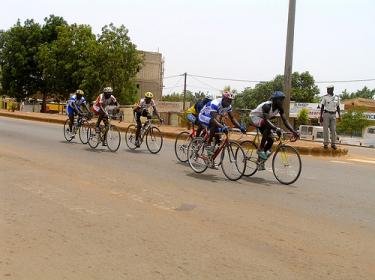
Soccer and bicycle racing are the most popular sports.
Student Life
The day for the child who goes to school begins before dawn, and in rural villages, children wake to the crowing rooster and the first signs of light - usually between 5:00 a.m. and 6:00 a.m. There are no alarm clocks in the village so the rooster comes in extremely handy. As soon as they wake up the children need to quickly sweep the courtyard and also tend to the family sheep and goats before they prepare to run to school. As there are not many schools the average child will walk about 3 to 5 kilometers to attend the nearest school. In many families, it is the boys who will go to school, while the girls will remain behind to assist in family chores. Some mothers have many children and because there are no people to assist around, the responsibility often falls to the older girls to help. In families that have many animals, the older children may also have to remain at home to take care of the animals as the younger ones go to school. For breakfast, there are a few homes where sorghum porridge will be eaten, and in other homes there are leftovers from the evening meal. The rest will consider breakfast a luxury, and will run to school after washing their faces without eating. Many will go barefooted because shoes are also a luxury of the rich who live in the cities. Some children are seconded (loaned out) to other families to help with chores and in return, the family receives some money for subsistence. These children, usually girls, are referred to as “bonne”. The reason girls are seconded is most parents consider it a loss to educate a girl since she is going to just get married and have children. In such cases, the older girl child has no choice but to work as their hosts children go to school.
School begins with a general assembly at about 7:30 a.m. and classes begin immediately thereafter. The average class has about 70 pupils. About three-quarters of the class will be boys because very few girls are allowed to attend school. The official language of the school is French and the lessons take an average of about 40 minutes each. The schools are made of bricks and the roofs are made of iron sheets which can make the class extremely hot. The only advantage may be that there are rarely any windows so the hot wind blows in the classroom bringing just a little relief. Break time is usually the time for children to catch up with one another and for boys, they will play their usual football (soccer) matches with any makeshift balls they make themselves. There usually are not many other games to play because of lack of equipment and balls are easy to get or simply make. Because the population of students per class is quite high, many teachers do not get the time to give personal attention to the students, especially those who are weak or slow. The children in schools are also taught some practical lessons such as how to tend gardens and some students learn to grow vegetables in the school gardens.
The journey home from school is usually a quick one because the children need to get home before nightfall. As they walk home, boys will more often than not have catapults (slingshots) with which they try shooting birds and geckos. The girls have to run home because they are culturally expected to assist with the chores in the home. Most of the time the children will have to get home by 6:30 p.m. Dinner is usually served before darkness falls and will most likely be a traditional meal which is the main staple known as “to” ‘in Burkinabe, a paste prepared with millet or corn flour In Bissa tô is known as wu, and in Mooré it is called sagabo. It is eaten lukewarm and accompanied by a sauce. The most popular sauces are made with baobab and/or sorrel leaves and contain condiments, which vary from region to region. This will be followed by homework which is done next to the kerosene lamp.
Homework is never supervised at home because the majority of the parents are illiterate. When children get back to school without completing their homework it is not unusual for them to receive corporal punishment. For children in other families, the few hours before nightfall are spent hawking any wares such as snacks that some of their mothers make in an effort to secure some money for the family. The sources of income are extremely limited. The girls and boys will carry the wares on small trays on their heads and walk around the village paths and a few passersby will buy them but as soon as darkness falls it is time to return back home. The family setting is usually such that there is one big family house that is shared by all. The number of children in most households could go up to 12 or even more because this is a polygamous society. Since there is a great Muslim population, men are allowed to marry up to four wives. When it comes to bedtime the boys will sleep in one corner and the girls in another corner, usually on a mat or an animal hide. Bedtime comes anytime after it is dark and homework is over in order to save the kerosene.
During the long school holiday which is usually between July and October most of the children will work on the family farm because this is mostly the rainy season. The children will join the grownups working on the farm doing such chores as planting and weeding using hoes. The girls remain to do house chores which include fetching water from a communal water pump. In some areas that are hardest hit by drought and because of hunger and malnutrition children may not go to school. In some areas, organizations run school feeding programs and kids are given two meals daily which is helping bridge the gap brought by poverty. This has helped to increase enrollment in schools in such areas. The children are given porridge (blended flour) at breakfast and lunch which improves concentration and learning capacity and help keeps children coming to school on time. School feeding is also a powerful incentive encouraging families to send children to school, rather than having them work at home or go outside to earn additional income.
Holidays
Republic Day
12/11Independence
Dates of Interest
- December 11th
What foods should I expect in BurkinaFaso?
Millet, sorghum and grains are staples, with the main dish being tô or fufu, a porridge made from millet flour. Chickens and guinea fowl are the main meats.
Good to know
- Tô or fufu, a millet-flour porridge, is the primary food
- Chicken and guinea fowl are the common meats
How do people dress in BurkinaFaso?
Rural women wear a long cotton skirt wrapped at the waist, increasingly with a top added, while rural men wear a cotton shirt and pants; urban people wear used Western-style clothing.
Good to know
- Rural men wear cotton shirts and pants
- Urban dress is Western-style
What is family life like in BurkinaFaso?
Descent generally passes through the father (though some southwestern ethnic groups pass goods through the female line), and families feel responsible for the well-being of others in the village, who are usually relatives.
Good to know
- A funeral marks an elder's transition from living to watching ancestor
- Burials happen soon after death due to the hot climate, but funerals may be delayed for months until relatives can attend
- Among the Mossi, marriage is usually arranged and the wife's family receives payments from the husband and his family
What do people do for fun in BurkinaFaso?
Soccer and bicycle racing are the most popular sports.
Good to know
- Soccer is a favorite pastime
- Bicycle racing is widely followed
What should I know before visiting BurkinaFaso?
Burkinabe respect older generations, and the majority of the population are farmers raising enough crops to meet their own needs.
Do
- Show respect toward older generations
Last updated: 2026-07-12 · Sources: CountryReports
Photos of Burkina Faso
Photos of Burkina Faso


Travel and Tourism
Travel and Tourism
- Travel Alert Status
- Level 4: Do Not Travel
- Currency
- 605.7
- Time Difference
- UTC 0 (5 hours ahead of Washington, DC, during Standard Time)
- Climate
- Burkina Faso's climate is sunny, hot, dry, and dusty. The hot season is from mid-February to June, when maximum temperatures exceed 104°F in the shade. The rainy season typically lasts from June to September. The first rains, called the mango rains, usually begin in May/June and provide some relief from the heat and dust. Annual rainfall ranges from about 10 inches in the extreme north to nearly 40 inches in the south. Temperatures begin to moderate in late September/early October as the rainy season winds down. Mid-November to mid-February is the cool season with high temperatures in the 80s and lows in the 60s. The Harmattan, a hot, dust-laden wind from the Sahara, often blows in January and February, leading to reduced visibility and temporarily unpleasant living conditions.
- Airports
- 33
- Recommended Vaccinations
- How important is it to do your research about vaccinations? It might just save your life! Make yourself aware of the different types of vaccinations and which ones you may need to travel to your destination. Schedule an appointment with your doctor at least four to six weeks before you travel to ensure you receive all important shots. Be sure that you and your family are up to date on your routine vaccinations. Which vaccinations you need will depend on a number of factors including your destination, whether you will be spending time in rural areas, the season of the year you are traveling, your age, health status, and previous immunizations.
Read the full travel guide — health, safety, vaccinations, disease risk, sanitation, and transit details.
View full travel guideRecipes
Recipes
History
History
Historical Eras
Mossi Kingdoms
1400 – 1896
The Mossi people established a series of powerful, centralized kingdoms — most notably Ouagadougou and Yatenga — that dominated the region of present-day Burkina Faso for nearly five centuries. These states were governed by sacred kings called Mogho Naabas and maintained remarkable political continuity, resisting incorporation into neighboring empires such as Mali and Songhai. Trade, cavalry warfare, and elaborate court hierarchies defined Mossi civilization throughout this era.
French Colonial Rule
1896 – 1960
French forces claimed the region in 1896, but sustained Mossi resistance ended only with the fall of Ouagadougou in 1901. The colony of Upper Volta was formally created in 1919, then dissolved and partitioned among neighboring territories in 1932 before being reconstituted within its present boundaries in 1947. France governed largely through existing Mossi authorities, and Upper Volta became a self-governing republic within the French Community in 1958.
First Republic & Early Coups
1960 – 1983
Upper Volta achieved independence on August 5, 1960, with Maurice Yaméogo as its first president, but he quickly banned opposition parties and was ousted in 1966 by Lt. Col. Sangoulé Lamizana, inaugurating an era of alternating military and civilian rule. Lamizana governed through the 1970s until Colonel Saye Zerbo toppled him in 1980, only to be overthrown himself in 1982 by Maj. Jean-Baptiste Ouédraogo. Political instability, union opposition, and factional military rivalries defined these two decades.
Sankara Revolution
1983 – 1987
Captain Thomas Sankara seized power in a coup on August 4, 1983, launching an ambitious Marxist-inspired revolutionary program aimed at economic self-sufficiency, women's emancipation, anti-corruption, and mass mobilization. In 1984 he renamed the country Burkina Faso — "land of honorable people" — and introduced a new flag and anthem as symbols of the break with the colonial past. Sankara became a celebrated pan-African figure, but his austere policies generated opposition and he was assassinated on October 15, 1987, in a coup led by his former ally Blaise Compaoré.
Compaoré Era
1987 – 2014
Blaise Compaoré came to power pledging to "rectify" the revolution but swiftly reversed most of Sankara's policies, liberalizing the economy and consolidating personal authority. Multiparty elections were introduced in the early 1990s, yet Compaoré dominated every subsequent electoral cycle and amended the constitution to extend his tenure, including a controversial third term in 2005. His 27-year rule ended abruptly in October 2014 when mass popular protests forced him into exile after he attempted to remove presidential term limits entirely.
Instability & Insurgency
2014 – present
Following Compaoré's fall, transitional governance gave way to elected president Roch Marc Christian Kaboré in 2015, but mounting jihadist insurgency linked to al-Qaeda and Islamic State affiliates destabilized large swaths of the country's north and east. Two military coups in 2022 — the first bringing Lieutenant-Colonel Paul-Henri Sandaogo Damiba to power and the second installing Captain Ibrahim Traoré — reflected the government's failure to contain the security crisis. Millions of civilians have been internally displaced, making Burkina Faso one of the world's most acute humanitarian emergencies.
Overview
The French administered the area indirectly through Mossi authorities until independence was achieved on August 5, 1960. The first President, Maurice Yameogo, amended the constitution soon after taking office to ban opposition political parties. His government lasted until 1966, when the first of several military coups placed Lt. Col. Sangoule Lamizana at the head of a government of senior army officers. Lamizana remained in power throughout the 1970s, as President of military and then elected governments.
With the support of unions and civil groups, Col. Saye Zerbo overthrew President Lamizana in 1980. Colonel Zerbo also encountered resistance from trade unions and was overthrown 2 years later by Maj. Dr. Jean-Baptiste Ouedraogo and the Council of Popular Salvation (CSP). Factional infighting developed between moderates in the CSP and radicals led by Capt. Thomas Sankara, who was appointed Prime Minister in January 1983, but was subsequently arrested. Efforts to bring about his release, directed by Capt. Blaise Compaore, resulted in yet another military coup d’etat, led by Sankara and Compaore on August 4, 1983.
Sankara established the National Revolutionary Committee with himself as President and vowed to "mobilize the masses." But the committee’s membership remained secret and was dominated by Marxist-Leninist military officers. In 1984, Upper Volta changed its name to Burkina Faso, meaning "the country of honorable people." But many of the strict security and austerity measures taken by Sankara provoked resistance. Despite his initial popularity and personal charisma, Sankara was assassinated in a coup which brought Capt. Blaise Compaore to power in October 1987.
Compaore pledged to pursue the goals of the revolution but to "rectify" Sankara’s "deviations" from the original aims. In fact, Compaore reversed most of Sankara’s policies and combined the leftist party he headed with more centrist parties after the 1989 arrest and execution of two colonels who had supported Compaore and governed with him up to that point.
Timeline of Key Events
1400
Mossi States
Mossi states were built up by peoples migrating from the north of modern Ghana
1896
kingdom of Ouagadougou
The French set up a protectorate over the kingdom of Ouagadougou
1904
kingdom of Ouagadougou
The kingdom of Ouagadougou becames part of the colony of Haut-Sénégal-Niger
1919
French West Africa
The kingdom of Ouagadougou is made into a separate constituent territory of French West Africa
1932
French Sudan
Land divided up in between the French Sudan and Côte d’ Ivoire
1947
Upper Volta
The land is reconstituted as the separate territory of Upper Volta.
1958
Upper Volta Self Governing Republic
Upper Volta becames a self-governing republic within the French community.
Read the full history profile — narrative overview, defining eras, and the complete timeline in one place.
View expanded historyInteresting Facts
Interesting Facts
Burkina Faso consistently produces silk purses from sows' ears
See every fact — trivia, oddities, and curious tidbits gathered from across the country.
View all interesting factsGeography and Environment
Geography and Environment
- Terrain
- mostly flat to dissected, undulating plains; hills in west and southeast
- Climate
- Burkina Faso’s climate is sunny, hot, dry, and dusty. The hot season is from mid-February to June, when maximum temperatures exceed 104° F in the shade. The rainy season typically lasts from June to September. The first rains, called the mango rains, usually begin in May/June and provide some relief from the heat and dust. Annual rainfall ranges from about 10 inches in the extreme north to nearly 40 inches in the south. Temperatures begin to moderate in late September/early October as the rainy season winds down. Mid-November to mid-February is the cool season — with high temperatures in the 80s and lows in the 60s. The Harmattan, a hot, dust-laden wind from the Sahara, often blows in January and February, leading to reduced visibility and temporarily unpleasant living conditions
- Natural Hazards
- recurring droughts
- Current Environmental Issues
- recent droughts and desertification severely affecting agricultural activities, population distribution, and the economy; overgrazing; soil degradation; deforestation
Read the full geography and environment profile — terrain, climate, natural resources, hazards, land use, and international agreements.
View full geographyPeople & Demographics
People & Demographics
Religion
Languages Spoken
French (official), native African languages belonging to the Sudanic family spoken by 90% of the population
- French
Population
- Population
- 16,241,811
- Population in Major Urban Areas
- OUAGADOUGOU (capital) 2.053 million
- Nationality Noun
- Burkinabe (singular and plural)
- Ethnic Groups
- Mossi over 40%, Gurunsi, Senufo, Lobi, Bobo, Mande, Fulani
Education
- Literacy Definition
- Age 15 and over can read and write
Health Information
- Major Infectious Diseases — degree of risk
- Very high
Read the full people and society profile — demographics, health, education, religion, languages, and notable people.
View full people and societyGovernment & Politics
Government & Politics
Country Identity
- Country Name
- BurkinaFaso
- Former Name
- Upper Volta, Republic of Upper Volta
Government Structure
- Government Type
- parliamentary republic
- Legal System
- based on French civil law system and customary law
- Executive Branch
- chief of state: Transitional President Captain Ibrahim TRAORE (since 2 October 2022), following a military coup; TRAORE leads the Alliance for Salvation and Restoration (MPSR2) junta that seized power from transitional leader Paul-Henri Sandaogo DAMIBA, who had himself taken power in a January 2022 coup ousting elected President Roch Marc Christian KABORE head of government: Prime Minister Jean-Baptiste OUEDRAOGO (since January 2023), appointed by Captain TRAORE to oversee civilian governance functions under the military-led transitional government cabinet: Transitional Council serves in an advisory and legislative capacity; a Council of Ministers is appointed by the transitional president elections: Prior to the military coups of 2022, the president was elected by popular vote for a five-year term; the constitution allowed for one presidential re-election; democratic elections have been suspended under the current transitional military government, with a return to civilian rule tentatively targeted for mid-2024, though the timeline has faced repeated delays election results: The last democratic presidential election was held in November 2020, in which Roch Marc Christian KABORE was reelected with approximately 57.9% of the popular vote; KABORE was subsequently deposed in a military coup in January 2022
- Legislative Branch
- unicameral National Assembly or Assemblee Nationale (111 seats; members are elected by popular vote to serve five-year terms) elections: National Assembly election last held 5 May 2002 (next to be held May 2007) election results: percent of vote by party - NA; seats by party - CDP 57, RDA-ADF 17, PDP/PS 10, CFD 5, PAI 5, other 17
- Judicial Branch
- Supreme Court; Appeals Court
- Suffrage
- universal
- Constitution
- 2 June 1991 approved by referendum; 11 June 1991 formally adopted; ammended April 2000
- Independence
- 5 August 1960 (from France)
- National Holiday
- Republic Day, 11 December (1958)
Capital City
- Capital Name
- Ouagadougou
- Capital - geographic coordinate
- 12 22 N, 1 31 W
- Capital Time Difference
- UTC 0 (5 hours ahead of Washington, DC, during Standard Time)
Ouagadougou is a Francophone spelling of the native name "Wogodogo," meaning "where people get honor and respect"
Military
Branches: Army, Air Force of Burkina Faso (Force Aerienne de Burkina Faso, FABF), National Gendarmerie
Embassy / Diplomatic Mission
U.S. Embassy Ouagadougou
Avenue Sembene Ousmane, Secteur 15, Ouaga 2000
Ouagadougou, Burkina Faso
Telephone: 226 50 49 53 00
Facsimile: 226 50 49 56 23
Read the full government profile — flag symbolism, national anthem, and other national symbols.
View full government detailsEconomy
Economy
Burkina Faso is one of the poorest countries in the world, a landlocked Sahelian nation with limited natural resources, fragile soils, and a highly unequal distribution of income. Roughly 80% of the population relies on agriculture, much of it subsistence farming that remains highly vulnerable to droughts and erratic rainfall. Cotton has historically been the country's most important cash crop, though gold has surpassed it as the leading export and now accounts for the majority of export earnings, making Burkina Faso one of Africa's top gold producers.
The economy has been buffeted by mounting security and political challenges. A worsening jihadist insurgency that began spilling over from Mali in 2015, combined with military coups in January and September 2022, has destabilized governance, displaced more than two million people, and disrupted agricultural production in large parts of the country. Despite these shocks, GDP growth has remained positive in recent years, supported by the mining sector and resilient services, though inflation spiked following global food and fuel price increases.
The ruling junta has shifted Burkina Faso's foreign policy away from traditional Western partners, suspending cooperation with France, expelling French troops, and announcing in 2024 its withdrawal from the Economic Community of West African States alongside Mali and Niger. These realignments, together with persistent insecurity, have weighed on investor confidence and complicated access to international financing.
Sustained economic progress will depend on improving security, restoring fiscal stability, broadening the export base beyond gold and cotton, and creating conditions to attract private investment. Humanitarian needs remain severe, and international assistance continues to play a critical role in supporting the population.
Snapshot
- Currency Name and Code
- Communaute Financiere Africaine francs (XOF)
- GDP — official exchange rate
- $5,405,000,000 (USD)
- GDP Real Growth Rate
- 4.5%
- Gini Index
- 48.2
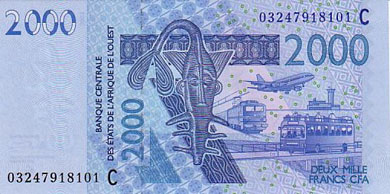
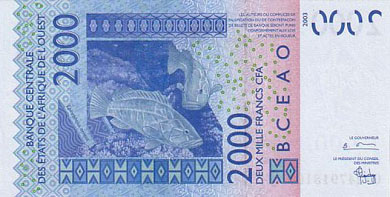
Banknotes
Budget & Public Finance
- Fiscal Year
- calendar year
- Annual Budget
- $1,382,000,000 (USD)
- External Debt
- $1,850,000 (USD)
- Investment (% of GDP)
- 20.3%
- Economic Aid
- $484,100,000 (USD)
- Current Account Balance
- -$562,000,000 (USD)
- Reserves of Foreign Exchange
- $791,000,000 (USD)
Labor, Industry & Trade
- Labor Force by Occupation
- agriculture 90%
- Household Income — highest 10%
- 46.8%
- Industries
- cotton lint, beverages, agricultural processing, soap, cigarettes, textiles, gold
- Agriculture Products
- cotton, peanuts, shea nuts, sesame, sorghum, millet, corn, rice; livestock
- Export Commodities
- cotton, livestock, gold
- Export Partners
- Singapore 15.2%, Italy 11.7%, Colombia 8.8%, France 7.6%, India 7%, Ghana 6.4%, Japan 4.7%, Thailand 4.1%
- Import Commodities
- capital goods, foodstuffs, petroleum
- Import Partners
- France 27.4%, Cote d'Ivoire 22.6%, Togo 4.2%
Energy
- Oil Production
- 0 bbl/day
- Oil Consumption
- 8,000 bbl/day
- Oil Reserves
- 0 bbl/day
- Natural Gas Production
- 0 cu m
- Natural Gas Consumption
- 0 cu m
- Natural Gas Imports
- 0 cu m
- Natural Gas Exports
- 0 cu m
- Natural Gas Reserves
- 0 cu m
Communications
- Telephone System
- General Assessment: system includes microwave radio relay, open-wire, and radiotelephone communication stations; in 2006 the government sold a 51 percent stake in the national telephone company and ultimately plans to retain only a 23 percent stake in the company Domestic: fixed-line connections stand at less than 1 per 100 persons; mobile-cellular usage, fostered by multiple providers, is increasing rapidly from a low base International: country code - 226; satellite earth station - 1 Intelsat (Atlantic Ocean)
- Internet Country Code
- .bf
News & Weather
News & Weather
Current Weather
Latest News
Unsdg | Secretary-General appoints Njoya Tikum of Cameroon as the United Nations Resident and Humanitarian Coordinator in Burkina Faso - United Nations Sustainable Development Group
United Nations Sustainable Development Group · 12h ago
Kayao Air Quality Index (AQI) and Burkina Faso Air Pollution | IQAir Mexico - IQAir
IQAir · 10h ago
Niger joins regional biometric passport initiative with Burkina Faso, Mali - Biometric Update
Biometric Update · 15h ago
Burkina Faso’s army accused of preventing civilians from leaving jihadist-besieged towns - The New Humanitarian
The New Humanitarian · 15d ago
Burkina Faso's Traore cautions against comparisons as new Thomas Sankara - TRT Afrika
TRT Afrika · 2d ago
Cameroonian Njoya Tikum Appointed UN Resident Coordinator and Humanitarian Coordinator in Burkina Faso - pan african visions
pan african visions · 5h ago
Burkina Faso Forces Closure of UN Human Rights Office - Human Rights Watch
Human Rights Watch · 19d ago
Burkina Faso/Mali/Niger: Withdrawal from the Rome Statute consecrates impunity and threatens to deny victims of war crimes justice and reparations - Amnesty International
Amnesty International · 19d ago
News via Google News
Climate Overview
Burkina Faso's climate is sunny, hot, dry, and dusty. The hot season is from mid-February to June, when maximum temperatures exceed 104°F in the shade. The rainy season typically lasts from June to September. The first rains, called the mango rains, usually begin in May/June and provide some relief from the heat and dust. Annual rainfall ranges from about 10 inches in the extreme north to nearly 40 inches in the south. Temperatures begin to moderate in late September/early October as the rainy season winds down. Mid-November to mid-February is the cool season with high temperatures in the 80s and lows in the 60s. The Harmattan, a hot, dust-laden wind from the Sahara, often blows in January and February, leading to reduced visibility and temporarily unpleasant living conditions.
Videos
Videos
1 curated YouTube videos.
Source: YouTube
Frequently Asked Questions
Frequently Asked Questions
What is the population of Burkina Faso?
What foods should I expect in BurkinaFaso?
How do people dress in BurkinaFaso?
What is family life like in BurkinaFaso?
What do people do for fun in BurkinaFaso?
What should I know before visiting BurkinaFaso?
What is the capital of Burkina Faso?
Where is Burkina Faso located?
What countries border Burkina Faso?
What is the predominant religion in Burkina Faso?
What currency does Burkina Faso use?
What languages are spoken in Burkina Faso?
What is the geography and terrain of Burkina Faso like?
What is Burkina Faso known for?
Last reviewed 2026