
 English
 Español
 中文
中文 हिन्दी
 Français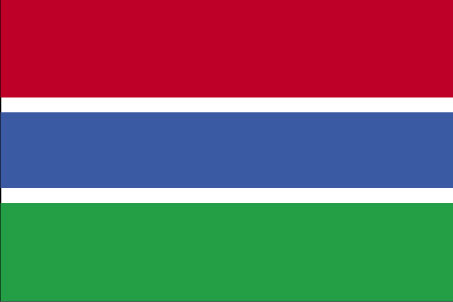
The Gambia
Declare Your Relationship to The Gambia
CountryReports Community
- Studying0
- From The Gambia0
- The Gambia heritage0
- Visited0
- Want to visit1
Customs and Culture
Customs and Culture
About the People
Gambians are usually self-confident, proud of their heritage and curious about western civilization.
Cultural Attributes
Gambians are usually self-confident, proud of their heritage and curious about western civilization.

Land of the River's Gift
Greetings, Gestures & Visiting
Greetings are important and differ according to time of day, location, with family members or not, formal or informal and social status . The initial greeting is the Arabic salaam aleekum. If one does not know the surname it is appropriate to ask. When visiting the person who arrives begins the greeting the person of higher rank first.
Women wear long skirts usually of local cloth with a loose upper cloth and a head tie. Men wear second hand western style clothes. Young people like to jeans and tee-shirts.
Diet
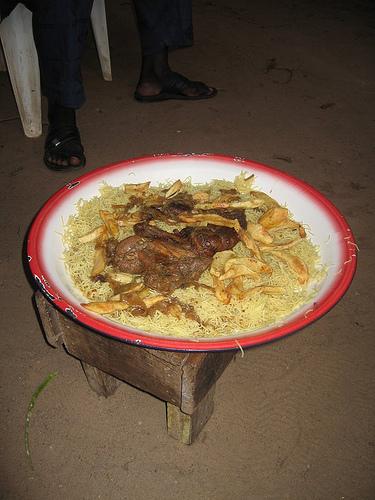
Rice and millet are the main food staples. Mango trees and papaya are abundant in most areas. In the dry season garden vegetables are grown such as tomatoes, eggplant and okra. Usually leftovers are eaten as a small snack in the morning. A light meal is eaten at lunch and the main meal is eaten in the evening. Men eat from a common bowl. Women and children eat separately. When a boy gains good manners he may eat with the men. Eating is done with the right hand. Each ethnic group has it own dishes.
Family
In rural areas people live in a series of houses around an open courtyard. The oldest man in the linage settles any disputes and land allocations. Most of the family labor is done by the women including gardening, cooking, washing, and in many areas drawing water. A man can marry to four wives. In the rural areas many marriages are arranged but in urban areas young men have greater freedom of choice. Social status is still important when it comes to marriage.
Recreation
Soccer is the main sport with basketball becoming more popular. Checkers is played by many as well as ludo a game in which markers are moved around a board with six cups on each side. The aim being to capture the opponents markers at the end of each move.
Holidays
Independence Day
2/18Independence Day
Dates of Interest
- February 18th
How do people greet each other in The Gambia?
Greetings are important and vary by time of day, location, family relationship, formality, and social status. The initial greeting is the Arabic salaam aleekum.
Do
- Begin the greeting yourself when you are the one arriving
- Greet the person of higher rank first
- Ask for the surname if you don't know it
What are the dining customs in The Gambia?
Rice and millet are the main staples, with a light lunch and the main meal in the evening; men eat from a common bowl while women and children eat separately.
Do
- Eat with the right hand
- Expect leftovers as a small morning snack
Good to know
- Each ethnic group has its own dishes
- Boys may join the men to eat once they gain good manners
- Mango, papaya, and dry-season garden vegetables like tomatoes, eggplant and okra are common
How should I dress in The Gambia?
Women typically wear long skirts of local cloth with a loose upper cloth and a head tie, while men wear second-hand western-style clothes and young people favor jeans and tee-shirts.
What is family life like in The Gambia?
In rural areas families live in houses around an open courtyard, with the oldest man in the lineage settling disputes and land allocations, and women doing most of the family labor.
Good to know
- A man may marry up to four wives
- Many rural marriages are arranged, while urban young men have greater freedom of choice
- Social status remains important in marriage
What do people do for fun in The Gambia?
Soccer is the main sport, with basketball growing in popularity, and board games like checkers and ludo are widely played.
Good to know
- Ludo is played by moving markers around a board with six cups on each side to capture the opponent's markers
Last updated: 2026-07-12 · Sources: CountryReports
Photos of The Gambia
Photos of The Gambia
Travel and Tourism
Travel and Tourism
- Currency
- Dalasi
- Time Difference
- UTC 0 (5 hours ahead of Washington, DC during Standard Time)
- Climate
- Climate is subtropical with a distinct hot and rainy season from June to October, and a cooler dry season from November to May. The beginning and end of the rains are marked by high temperatures and high humidity, whereas the dry season is noted for the dusty and dry trade winds (harmattan) blowing in from the central Sahara. Temperatures range from a low of 48°F (9°C) in January to a high of 110°F (43°C) in October. Because of the cooling effect of the ocean, temperatures are lower along the coast than in the interior. Rainfall varies widely from year to year but ranges from an annual mean of 48 inches in the west to 34 inches upriver. Because of the humid climate and the salt air along the coast, metal rusts rapidly in The Gambia, and houses near the sea may be affected by the corrosive salt air. Termites abound year round in soils and woodwork. During the dry season, the harmattan winds blow in a fine dust. However, the moderate temperatures during the dry season with mostly sunny days give The Gambia one of West Africa’s more pleasant climates.
Read the full travel guide — health, safety, vaccinations, disease risk, sanitation, and transit details.
View full travel guideRecipes
Recipes
History
History
Historical Eras
Pre-Colonial Era
900 – 1455
The Gambia River region formed part of successive West African empires, including the Ghana and Mali empires, whose trade networks stretched across the Sahara. Arab traders documented the region as early as the 9th and 10th centuries, establishing trans-Saharan routes for gold, ivory, and slaves. The Mandinka, Wolof, Fula, and other ethnic groups established the cultural foundations that persist to the present day.
European Contact & Slave Trade
1455 – 1816
Portuguese navigators established the first European trading stations along the Gambia River in 1455, and in 1588 Portugal sold exclusive trading rights to English merchants, confirmed by Queen Elizabeth I. England and France competed fiercely for commercial dominance throughout the 17th and 18th centuries, with the 1783 Treaty of Versailles ultimately securing British possession. During this period, as many as three million people were taken from the broader region in the transatlantic slave trade, one of the most devastating demographic catastrophes in West African history.
British Colonial Rule
1816 – 1965
Britain established the military post of Bathurst (now Banjul) in 1816 as a base to suppress the slave trade, and The Gambia was formally declared a Crown Colony in 1888 with boundaries agreed with France in 1889. Slavery was abolished by ordinance in 1906, and the colony gradually developed its own executive and legislative councils from 1901 onward. Gambian troops served with Allied forces in Burma during World War II, and the country steadily advanced toward self-governance through the mid-20th century.
Independence & First Republic
1965 – 1994
The Gambia achieved independence on February 18, 1965, with Dawda Jawara serving as prime minister and later president, leading the People's Progressive Party for nearly three decades. The country briefly entered the Senegambia Confederation with Senegal in 1982, a union that dissolved in 1989, followed by a bilateral friendship treaty in 1991. Despite relative political stability, the republic struggled with poverty, drought, and economic underdevelopment throughout this period.
Jammeh Military Era
1994 – 2017
Lieutenant Yahya Jammeh seized power in a bloodless coup in July 1994, dissolving the legislature and banning political activity. A new constitution in 1996 and subsequent elections nominally restored civilian rule, but Jammeh governed with increasing authoritarianism, suppressing opposition, expelling critics, and making eccentric public claims including a purported cure for HIV/AIDS. His 22-year rule ended when he lost the 2016 presidential election to Adama Barrow and was forced into exile under regional military pressure from ECOWAS.
Democratic Transition
2017 – present
Adama Barrow assumed the presidency in January 2017, inaugurating a period of democratic reform and transitional justice following Jammeh's departure. A Truth, Reconciliation and Reparations Commission was established to document human rights abuses committed under the previous regime. The Gambia rejoined the International Criminal Court and the Commonwealth, signaling a reorientation toward democratic norms and international engagement.
Overview
Muslims constitute more than 95% of the population. Christians of different denominations account for most of the remainder. Gambians officially observe the holidays of both religions and practice religious tolerance.
More than 63% of Gambians live in rural villages (1993 census), although more and more young people come to the capital in search of work and education. Provisional figures from the 2003 census show that the gap between the urban and rural populations is narrowing as more areas are declared urban. While urban migration, development projects, and modernization are bringing more Gambians into contact with Western habits and values, the traditional emphasis on the extended family, as well as indigenous forms of dress and celebration, remain integral parts of everyday life.
The Gambia was once part of the Empire of Ghana and the Kingdom of the Songhais. The first written accounts of the region come from records of Arab traders in the 9th and 10th centuries A.D. Arab traders established the trans-Saharan trade route for slaves, gold, and ivory. In the 15th century, the Portuguese took over this trade using maritime routes. At that time, The Gambia was part of the Kingdom of Mali.
In 1588, the claimant to the Portuguese throne, Antonio, Prior of Crato, sold exclusive trade rights on The Gambia River to English merchants; this grant was confirmed by letters patent from Queen Elizabeth I. In 1618, King James I granted a charter to a British company for trade with The Gambia and the Gold Coast (now Ghana).
During the late 17th century and throughout the 18th, England and France struggled continuously for political and commercial supremacy in the regions of the Senegal and Gambia Rivers. The 1783 Treaty of Versailles gave Great Britain possession of The Gambia, but the French retained a tiny enclave at Albreda on the north bank of the river, which was ceded to the United Kingdom in 1857.
As many as 3 million slaves may have been taken from the region during the three centuries that the transatlantic slave trade operated. It is not known how many slaves were taken by Arab traders prior to and simultaneous with the transatlantic slave trade. Most of those taken were sold to Europeans by other Africans; some were prisoners of intertribal wars; some were sold because of unpaid debts, while others were kidnapped. Slaves were initially sent to Europe to work as servants until the market for labor expanded in the West Indies and North America in the 18th century. In 1807, slave trading was abolished throughout the British Empire, and the British tried unsuccessfully to end the slave traffic in The Gambia. They established the military post of Bathurst (now Banjul) in 1816. In the ensuing years, Banjul was at times under the jurisdiction of the British governor general in Sierra Leone. In 1888, The Gambia became a separate colonial entity.
An 1889 agreement with France established the present boundaries, and The Gambia became a British Crown Colony, divided for administrative purposes into the colony (city of Banjul and the surrounding area) and the protectorate (remainder of the territory). The Gambia received its own executive and legislative councils in 1901 and gradually progressed toward self-government. A 1906 ordinance abolished slavery.
During World War II, Gambian troops fought with the Allies in Burma. Banjul served as an air stop for the U.S. Army Air Corps and a port of call for Allied naval convoys. U.S. President Franklin D. Roosevelt stopped overnight in Banjul en route to and from the Casablanca Conference in 1943, marking the first visit to the African Continent by an American president while in office.
After World War II, the pace of constitutional reform quickened. Following general elections in 1962, full internal self-government was granted in 1963. The Gambia achieved independence on February 18, 1965, as a constitutional monarchy within the British Commonwealth. Shortly thereafter, the government proposed conversion from a monarchy to a republic with an elected president replacing the British monarch as chief of state. The proposal failed to receive the two-thirds majority required to amend the constitution, but the results won widespread attention abroad as testimony to The Gambia’s observance of secret balloting, honest elections, and civil rights and liberties. On April 24, 1970, The Gambia became a republic following a referendum.
Until a military coup in July 1994, The Gambia was led by President Sir Dawda Kairaba Jawara, who was re-elected five times. The relativ
Timeline of Key Events
1455
Portuguese establish trading stations along Gambia river.
Portuguese establish trading stations along Gambia river.
1618
Portugal sells its rights to the coastal region to Britain.
Portugal sells its rights to the coastal region to Britain.
1642
France founds a trading post on the Gambia river.
France founds a trading post on the Gambia river.
1658
James Island given over to the Dutch.
James Island given over to the Dutch.
1665 – 1667
James Island recaptured by Britain during the Second Dutch War.
James Island recaptured by Britain during the Second Dutch War.
1866 – 1888
The Gambia is governed as part of Sierra Leone.
The Gambia is governed as part of Sierra Leone.
1888
The Gambia becomes British Crown Colony.
The Gambia becomes British Crown Colony.
Read the full history profile — narrative overview, defining eras, and the complete timeline in one place.
View expanded historyInteresting Facts
Interesting Facts
Stone circles found in parts of the country are thought to be ancient burial sites. Alex Haley's Pulitzer Prize winning book "Roots" is based upon the story of one of his ancestors, from the Gambian village of Juffure, who was forced into slavery in the eighteenth century.
See every fact — trivia, oddities, and curious tidbits gathered from across the country.
View all interesting factsGeography and Environment
Geography and Environment
- Terrain
- flood plain of the Gambia River flanked by some low hills
- Climate
- Climate is subtropical with a distinct hot and rainy season from June to October, and a cooler dry season from November to May. The beginning and end of the rains are marked by high temperatures and high humidity, whereas the dry season is noted for the dusty and dry trade winds (harmattan) blowing in from the central Sahara. Temperatures range from a low of 48°F (9°C) in January to a high of 110°F (43°C) in October. Because of the cooling effect of the ocean, temperatures are lower along the coast than in the interior. Rainfall varies widely from year to year but ranges from an annual mean of 48 inches in the west to 34 inches upriver. Because of the humid climate and the salt air along the coast, metal rusts rapidly in The Gambia, and houses near the sea may be affected by the corrosive salt air. Termites abound year round in soils and woodwork. During the dry season, the harmattan winds blow in a fine dust. However, the moderate temperatures during the dry season with mostly sunny days give The Gambia one of West Africa’s more pleasant climates.
- Natural Hazards
- drought (rainfall has dropped by 30% in the last 30 years)
- Current Environmental Issues
- deforestation; desertification; water-borne diseases prevalent
Read the full geography and environment profile — terrain, climate, natural resources, hazards, land use, and international agreements.
View full geographyPeople & Demographics
People & Demographics
Religion
Languages Spoken
English (official), Mandinka, Wolof, Fula, other indigenous vernaculars
- English
- Mandinka
- Wolof
Population
- Population
- 1,824,158
- Population in Major Urban Areas
- BANJUL (capital) 506,000
- Nationality Noun
- Gambian(s)
- Ethnic Groups
- African 99% (Mandinka 42%, Fula 18%, Wolof 16%, Jola 10%, Serahuli 9%, other 4%), non-African 1%
Education
- Literacy Definition
- Age 15 and over can read and write
Health Information
- Major Infectious Diseases — degree of risk
- Very high
Read the full people and society profile — demographics, health, education, religion, languages, and notable people.
View full people and societyGovernment & Politics
Government & Politics
Country Identity
- Country Name
- TheGambia
- Full Country Name
- Republic of The Gambia
Government Structure
- Executive Branch
- chief of state: President Adama BARROW (since 19 January 2017); note - the president is both the chief of state and head of government head of government: President Adama BARROW (since 19 January 2017); Vice President Mohammed JALLOW (since 2023); note - the president is both the chief of state and head of government cabinet: Cabinet appointed by the president elections: president elected by popular vote for a five-year term; election last held on 4 December 2021 (next to be held in December 2026) election results: Adama BARROW reelected president; percent of vote - Adama BARROW 53.2%, Ousainou DARBOE 27.7%, Mamma KANDEH 12.3%
- Legislative Branch
- unicameral National Assembly (53 seats; 48 elected by popular vote, 5 appointed by the president; members serve five-year terms) elections: last held 17 January 2002 (next to be held February 2007) election results: percent of vote by party - NA; seats by party - APRC 45, PDOIS 2, NRP 1,
- Judicial Branch
- Supreme Court
Capital City
- Capital Name
- Banjul
- Capital - geographic coordinate
- 13 27 N, 16 34 W
- Capital Time Difference
- UTC 0 (5 hours ahead of Washington, DC during Standard Time)
Banjul is located on Saint Mary's Island at the mouth of the Gambia River; the Mandinka used to gather fibrous plants on the island for the manufacture of ropes; "bang julo" is Mandinka for "rope fiber"; mispronunciation over time caused the term became the word Banjul
Military
Branches: Office of the Chief of Defense Staff: Gambian National Army (GNA), Gambian Navy (GN), Republican National Guard (RNG)
Embassy / Diplomatic Mission
U.S. Embassy Banjul
Address: The U.S. Embassy is located at 92 Kairaba Avenue in Fajara, a populated area and business center a few miles from the capital city of Banjul. The mailing address is P.M.B.19, Banjul, The Gambia.
Telephone: 220-439-2856, 220-439-2858 and 220-439-1971
(available 24 hours a day)
Facsimile: 220-439-2475
Work hours: Monday – Thursday 8:00 a.m. – 5:30 p.m.; Friday 8:00 a.m. – 12:00 p.m.
Read the full government profile — flag symbolism, national anthem, and other national symbols.
View full government detailsEconomy
Economy
The Gambia is one of the smallest and least developed countries in Africa, with limited mineral resources and a narrow agricultural base. Roughly 70% of the population depends on agriculture for their livelihood, with crops, livestock, and fishing forming the backbone of rural economic activity. Small-scale manufacturing centers on the processing of peanuts (groundnuts), fish, and hides, while groundnuts remain a key export commodity despite declining global prices and recurring production challenges.
Reexport trade to neighboring West African countries, particularly Senegal, has traditionally been a significant component of the economy, though it has been periodically disrupted by border closures, currency volatility, and regional trade policy shifts. Tourism is another vital sector, typically accounting for around 20% of GDP and providing important foreign exchange earnings, though it remains vulnerable to external shocks such as the COVID-19 pandemic, which caused a sharp contraction in 2020.
Since the political transition in 2017 following the end of Yahya Jammeh's 22-year rule, The Gambia has pursued economic reforms aimed at restoring macroeconomic stability, attracting foreign investment, and improving governance. Growth rebounded in the years following the transition, averaging around 5–6% before the pandemic, and has since gradually recovered. However, the economy continues to face significant challenges, including high public debt, persistent inflation, a weak Gambian dalasi, high youth unemployment, and vulnerability to climate change and external shocks.
Short-term economic prospects remain heavily dependent on sustained bilateral and multilateral assistance, prudent fiscal management supported by IMF programs, remittance inflows (which exceed 20% of GDP), and continued investment in infrastructure, agriculture, and tourism.
Snapshot
- Currency Name and Code
- Dalasi (GMD)
- GDP — official exchange rate
- $429,000,000 (USD)
- GDP Real Growth Rate
- 5.5%
- GDP by Sector
- agriculture: 26.8% industry: 14.5% services: 58.7%
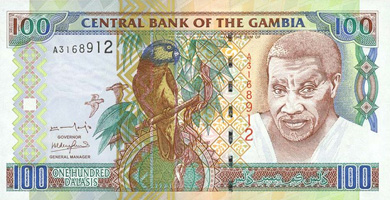
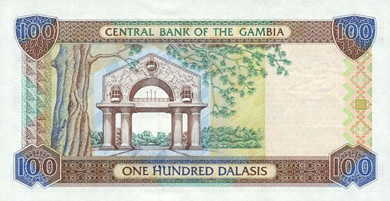
Banknotes
Budget & Public Finance
- Fiscal Year
- calendar year
- Annual Budget
- $62,660,000 (USD)
- External Debt
- $628,800,000 (USD)
- Investment (% of GDP)
- 25.8%
- Current Account Balance
- -$20,540,000 (USD)
- Reserves of Foreign Exchange
- $81,550,000 (USD)
Labor, Industry & Trade
- Labor Force by Occupation
- agriculture 75%; industry; commerce; and services 19%; government 6%
- Industries
- processing peanuts, fish, and hides; tourism; beverages; agricultural machinery assembly, woodworking, metalworking; clothing
Energy
- Oil Production
- 0 bbl/day
- Oil Consumption
- 2,000 bbl/day
- Oil Reserves
- 0 bbl/day
- Natural Gas Production
- 0 cu m
- Natural Gas Consumption
- 0 cu m
- Natural Gas Imports
- 0 cu m
- Natural Gas Exports
- 0 cu m
- Natural Gas Reserves
- 0 cu m
Communications
- Telephone System
- General assessment: Adequate microwave radio relay and open-wire network; state-owned Gambia Telecommunications partially privatized in 2007 Domestic: Combined fixed-line and mobile-cellular teledensity, aided by multiple mobile-cellular providers, is roughly 80 per 100 persons International: Country code - 220; microwave radio relay links to Senegal and Guinea-Bissau; a landing station for the Africa Coast to Europe (ACE) undersea fiber-optic cable is scheduled for completion in 2011; satellite earth station - 1 Intelsat (Atlantic Ocean)
- Internet Country Code
- .gm
News & Weather
News & Weather
Current Weather
Latest News
From The Gambia to Peterborough: Stories Behind Houston's 2026 Roster - Houston Texans
Houston Texans · 18h ago
WFP The Gambia Country Brief, July 2026 - ReliefWeb
ReliefWeb · 19h ago
Gambian mothers fear for their daughters as court weighs FGM ban - Al Jazeera
Al Jazeera · 14d ago
Environmental Security Weekly Watch July 13-17, 2026 - New Security Beat
New Security Beat · 3d ago
Ten ambulances and medical equipment strengthen emergency care in The Gambia - African Development Bank Group
African Development Bank Group · 3d ago
OIC General Secretariat Delegation Commends The Gambia’s Chairmanship of the Islamic Summit، and its International Efforts in the Rohingya Issue, during Meeting with H.E. President of the Republic of The Gambia - Organisation of Islamic Cooperation — OIC
Organisation of Islamic Cooperation — OIC · 6d ago
Redefining Possibilities for Young Farmers in The Gambia - Catholic Relief Services | CRS
Catholic Relief Services | CRS · 11d ago
Binta Barry: Development in The Gambia Is About People, Not Numbers - United Nations Development Programme
United Nations Development Programme · 3d ago
News via Google News
Climate Overview
Climate is subtropical with a distinct hot and rainy season from June to October, and a cooler dry season from November to May. The beginning and end of the rains are marked by high temperatures and high humidity, whereas the dry season is noted for the dusty and dry trade winds (harmattan) blowing in from the central Sahara. Temperatures range from a low of 48°F (9°C) in January to a high of 110°F (43°C) in October. Because of the cooling effect of the ocean, temperatures are lower along the coast than in the interior. Rainfall varies widely from year to year but ranges from an annual mean of 48 inches in the west to 34 inches upriver.
Because of the humid climate and the salt air along the coast, metal rusts rapidly in The Gambia, and houses near the sea may be affected by the corrosive salt air. Termites abound year round in soils and woodwork. During the dry season, the harmattan winds blow in a fine dust. However, the moderate temperatures during the dry season with mostly sunny days give The Gambia one of West Africa’s more pleasant climates.
Frequently Asked Questions
Frequently Asked Questions
What is the population of The Gambia?
How do people greet each other in The Gambia?
What are the dining customs in The Gambia?
How should I dress in The Gambia?
What is family life like in The Gambia?
What do people do for fun in The Gambia?
What is the capital of The Gambia?
Where is The Gambia located?
What countries border The Gambia?
What is the predominant religion in The Gambia?
What is the currency of The Gambia?
What languages are spoken in The Gambia?
What is The Gambia known for?
Last reviewed 2026