
 English
 Español
 中文
中文 हिन्दी
 Français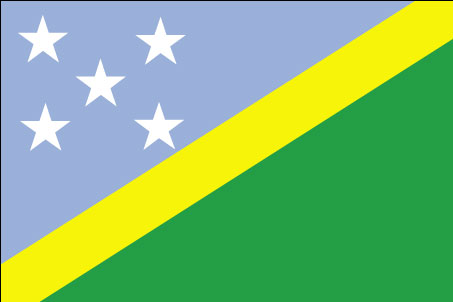
Solomon Islands
Declare Your Relationship to Solomon Islands
CountryReports Community
- Studying0
- From Solomon Islands0
- Solomon Islands heritage0
- Visited0
- Want to visit0
Customs and Culture
Customs and Culture
About the People
The essence of village life and welfare is the wantok or 'one talk' system. Wantoks, who are people of the same language, village or extended family, share their belongings and give help as needed. When a woman is sick, a wantok may do the gardening and look after the children till she is well. If the wantok runs short of supplies, he or she may request help in return. This system works well at the village level, but is more challenging in an urban setting. Solomon Islanders place a high value on family and children, their relationship with the land and do not like to be hurried. A third part, perhaps a chief, will resolve disputes.
Cultural Attributes
The essence of village life and welfare is the wantok or 'one talk' system. Wantoks, who are people of the same language, village, or extended family, share their belongings and give help as needed. When a woman is sick, a wantok may do the gardening and look after the children till she is well. If the wantok runs short of supplies, he or she may request help in return.

Archipelago of Ancient Kinship
Greetings, Gestures & Visiting
Villagers greet one another by their first names in their language or pijin if they are from different language groups. A standard greeting is: Where have you come from, or where are you going? Formal titles are used with strangers, like 'Mr' or 'Mrs.' One greets a chief according to one's familiarity with him. When arriving at a village, one is expected to inform the chief of the nature of the visit and the length of the stay.
Diet
A large proportion of the food is grown in family gardens, or wild food from the forest. Staples include cassava, sweet potato, taro, and yam. Leafy greens include pumpkin and taro leaves, watercress, ferns and slippery cabbage. Fish, pork, wild nuts and eggs provide the protein in the diet. Pigs and chickens are bred for special occasions, and wild pigs are hunted. Coconut water can be drunk before it is ripened.

Family
The family unit consists of both parents and their children. The members of the extended family keep close ties. Generally, men are responsible for earning an income, fishing, clearing gardens, and building houses. Traditional houses are made from sago leaves lashed to a bamboo frame. Modern homes are timber-framed with glass windows and steel roofs. These are more lasting but more challenging to keep cool.
Dating Customs
The wantoks arranged the traditional marriages. The groom's family customarily paid the bride's parents a bride price of shell money, pigs, or root crops.
Recreation
Recreational activities commonly found on the Solomon Islands:
Holidays
Independence Day
7/7Independence Day
Dates of Interest
- July 7th
Held in the Central Islands Province, this festival celebrates the unique culture and traditions of the Kakamora people, including traditional dances and rituals.
How do people greet each other in the Solomon Islands?
Villagers greet one another by first name in their own language, or in pijin if from different language groups; a standard greeting is 'Where have you come from?' or 'Where are you going?'
Do
- Use formal titles like 'Mr' or 'Mrs' with strangers
- Inform the chief of the nature and length of your visit when arriving at a village
- Greet a chief according to your familiarity with him
What are the dining customs in the Solomon Islands?
The main meal is usually after sunset and includes staples like cassava or sweet potato with fish, vegetables and fruit; families sit together on the floor of an open-air kitchen or veranda.
Do
- Wait for grace, which is traditionally said before eating
- Eat with your fingers or use utensils, as you prefer
- As a guest, expect to eat with the father
Good to know
- The mother and elder girls serve the meal, giving the first serve to the men
- Women and children eat elsewhere from male guests
- Speeches are made by the host and reciprocated by the visitor
- Food is covered with towels or leaves before being served
What etiquette should I know when visiting homes in the Solomon Islands?
Visiting is central to life; formal invitations are only for feasts, and visits are mostly about conversation and storytelling on the veranda.
Do
- Call out as you approach a house
- Take off your shoes at the door
- Accept tea and food if it is offered
Good to know
- Women generally visit women, and men visit men
- People gather outside on the veranda
How should I dress in the Solomon Islands?
Dress is casual: men wear shorts and T-shirts, and women wear under-the-knee skirts; men and women often wear lavalavas (large wrapped cloths).
Good to know
- Adults like to wear jewelry such as shell necklaces, armbands and hair combs
- Flowers may be tucked behind the ear or braided into the hair
What gestures are important in the Solomon Islands?
Facial expression is a vital part of conversation; quickly raised eyebrows indicate agreement, and pointing is done with pursed lips and chin rather than the hand.
Do
- Beckon by waving the fingers of one hand with the palm down
Don’t
- Do not shout, as it is impolite
- Do not step over a man
- As a man, do not walk under a woman's clothing or a clothesline
- Do not hold hands or walk arm in arm with someone of the opposite sex
Good to know
- Clicking the tongue may suggest disapproval or concern
- Same-sex friends may hold hands or walk arm in arm
- Women cross or fold their legs under them in the company of men
What role does family play in the Solomon Islands?
Family and children are highly valued, and extended families keep close ties through the wantok system, where people of the same language, village or family share belongings and help one another.
Good to know
- Men typically earn income, fish, clear gardens and build houses
- Women maintain gardens, prepare food and firewood, and care for children
- Children help out after the age of five
- Do not rush people, as Solomon Islanders do not like to be hurried
What can I do for recreation in the Solomon Islands?
The islands are known for diving and snorkeling among coral reefs and shipwrecks, plus surfing, kayaking, hiking, fishing and beach relaxation.
Good to know
- Explore coral reefs and marine life while diving or snorkeling
- Try surfing in the Western Province
- Take cultural tours to villages, dances and ceremonies
- Go whale and dolphin watching at certain times of year
Last updated: 2026-07-12 · Sources: CountryReports
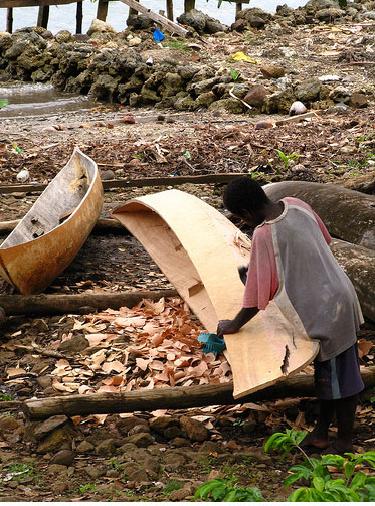
Photos of Solomon Islands
Photos of Solomon Islands


Travel and Tourism
Travel and Tourism
- Travel Alert Status
- Level 2: Exercise Increased Caution
- Currency
- Solomon Islands dollar (SBD)
- Time Difference
- UTC+11 (16 hours ahead of Washington, DC, during Standard Time)
- Climate
- tropical monsoon; few extremes of temperature and weather
- Airports
- 33
Read the full travel guide — health, safety, vaccinations, disease risk, sanitation, and transit details.
View full travel guideRecipes
Recipes
History
History
Historical Eras
Prehistoric Settlement
1000 BCE – 1568
Hunter-gatherer peoples inhabited the larger Solomon Islands as early as 1000 BCE, with material evidence recovered from sites on Santa Ana, Guadalcanal, and Gawa. Later waves of Neolithic Austronesian-speaking migrants from Southeast Asia added to the population, establishing the ancestral communities that would shape the islands' diverse cultures and languages for millennia.
European Contact
1568 – 1893
Spanish explorer Álvaro de Mendaña y Neyra first sighted the islands in 1568, seeking the legendary Isles of Solomon. European contact intensified through the 18th and 19th centuries, bringing explorers, missionaries, and the brutal practice of 'blackbirding'—the coerced recruitment of islanders as laborers for Queensland and Fiji sugar plantations—which provoked widespread violence and massacre.
British Protectorate
1893 – 1942
Britain declared a protectorate over the southern Solomons in 1893, partly to curb the abuses of the labor trade, and absorbed German-administered northern islands by 1900. Christian missionaries converted much of the population, while British and Australian firms established large-scale coconut plantations. Economic development remained slow and largely excluded the indigenous population.
World War II
1942 – 1945
Japan occupied the islands from mid-1942, triggering some of the Pacific War's most ferocious fighting. The Battle of Guadalcanal—including the struggle for Henderson Field and the naval clash off Savo Island—claimed over 7,000 American and 21,000 Japanese lives before Japanese withdrawal in February 1943. The massive Allied presence left a profound cultural and infrastructural legacy, including the relocation of the capital to Honiara.
Late Colonial Period
1945 – 1978
British administration resumed after the war, but indigenous resistance movements such as Marching Rule challenged colonial authority through the late 1940s. Progressive constitutional reforms culminated in a new parliamentary constitution in 1974, self-governance on January 2, 1976, and full independence within the Commonwealth on July 7, 1978.
Independence & Modern Era
1978 – present
Independence brought persistent challenges including ethnic conflict between Guadalcanal and Malaita militias that erupted into open violence in 1998–2000, destabilizing the government and economy. The 2001 Marau Peace Agreement and a 2003 Australian-led multinational intervention force helped restore order. The nation continues to navigate issues of governance, natural disasters, and economic development.
Overview
Although little prehistory of the Solomon Islands is known, material excavated on Santa Ana, Guadalcanal, and Gawa indicates that a hunter-gatherer people lived on the larger islands as early as 1000 B.C. Some Solomon Islanders are descendants of Neolithic Austronesian-speaking peoples who migrated from Southeast Asia.
Timeline of Key Events
1899
Germany cedes the northern Solomon islands to the United Kingdom.
Germany cedes the northern Solomon islands to the United Kingdom, which had declared a protectorate over the southern Solomon islands in 1893.
1942
During World War II the islands are occupied by Japan.
During World War II the islands are occupied by Japan. There is very heavy fighting, especially on and around Guadalcanal. The Japanese are forced from the islands by the Allies in 1945, and British rule is restored.
1976
The islands become fully self-governing.
The islands become fully self-governing.
1978
The islands achieve independence within the British Commonwealth.
The islands achieve independence within the British Commonwealth. Queen Elizabeth II remains head of state.
1998
Fighting breaks out between two rival militias.
The Isatubu Freedom Movement, which says it represents the native people of Guadalcanal, begins to forcibly evict Malaitans, whom they accuse of taking jobs and land. The Malaitan Eagle Force (MEF) is formed in response. At least 20,000 Malaitans are forced off Guadalcanal. Fighting breaks out between the two rival militias.
2001
Marau peace agreement is signed bringing together the two warring factions.
Marau peace agreement is signed bringing together the two warring factions, Marau Eagle Force and Isatabu Freedom Movement. It is aimed at ending two years of conflict.
2009
The Solomon Islands declare a national disaster after heavy rain and flooding.
The Solomon Islands declare a national disaster after heavy rain and flooding claim lives on Guadalcanal island, and people are evacuated from there and nearby Savo island.
Read the full history profile — narrative overview, defining eras, and the complete timeline in one place.
View expanded historyInteresting Facts
Interesting Facts
The Arnavon Islands provide an important nesting area for endangered hawksbill turtles.
See every fact — trivia, oddities, and curious tidbits gathered from across the country.
View all interesting factsGeography and Environment
Geography and Environment
- Terrain
- mostly rugged mountains with some low coral atolls
- Climate
- tropical monsoon; few extremes of temperature and weather
- Natural Hazards
- typhoons, but rarely destructive; geologically active region with frequent earth tremors; volcanic activity
- Current Environmental Issues
- deforestation; soil erosion; many of the surrounding coral reefs are dead or dying
Read the full geography and environment profile — terrain, climate, natural resources, hazards, land use, and international agreements.
View full geographyPeople & Demographics
People & Demographics
Religion
Languages Spoken
Melanesian pidgin in much of the country is lingua franca; English is official but spoken by only 1%-2% of the population.
- Melanesian pidgin
Population
- Population
- 609,794
- Population in Major Urban Areas
- HONIARA (capital) 68,000
- Nationality Noun
- Solomon Islander(s)
- Ethnic Groups
- Melanesian 93%, Polynesian 4%, Micronesian 1.5%, European 0.8%, Chinese 0.3%, other 0.4%
- Language Note
- While English is the official language, there are 65 indigenous languages spoken in the Solomons. Solomon Island Pijin enables islanders from differing language groups to communicate. The vocabulary is English, but the grammar is Melanesian. 93% are Melanesians, 4% are Polynesian, and some Micronesians re-settled from the Gilbert Islands.
Education
- Literacy Definition
- NA
Read the full people and society profile — demographics, health, education, religion, languages, and notable people.
View full people and societyGovernment & Politics
Government & Politics
Country Identity
- Country Name
- SolomonIslands
- Former Name
- British Solomon Islands
Government Structure
- Government Type
- parliamentary democracy tending toward anarchy
- Legal System
- English common law, which is widely disregarded
- Executive Branch
- chief of state: Queen ELIZABETH II (since 6 February 1952), represented by Governor General Nathaniel WAENA (since 7 July 2004) head of government: Prime Minister Sir Allan KEMAKEZA (since 17 December 2001); Deputy Prime Minister Snyder RINI (since 17 December 2001) cabinet: Cabinet consists of 20 members appointed by the governor general on the advice of the prime minister from among the members of Parliament elections: none; the monarch is hereditary; governor general appointed by the monarch on the advice of Parliament for up to five years; following legislative elections, the leader of the majority party or the leader of a majority coalition is usually elected prime minister by Parliament; deputy prime minister appointed by the governor general on the advice of the prime minister from among the members of Parliament
- Legislative Branch
- unicameral National Parliament (50 seats; members elected from single-member constituencies by popular vote to serve four-year terms) elections: last held 5 December 2001 (next to be held 5 April 2006) election results: percent of vote by party - PAP 40%, SIACC 40%, PPP 20%; seats by party - PAP 16, SIACC 13, PPP 2, SILP 1, independents 18
- Judicial Branch
- Court of Appeal
- Suffrage
- 21 years of age; universal
- Constitution
- 7-Jul-78
- Independence
- 7 July 1978 (from UK)
- National Holiday
- Independence Day, 7 July (1978)
Capital City
- Capital Name
- Honiara
- Capital - geographic coordinate
- 9 26 S, 159 57 E
- Capital Time Difference
- UTC+11 (16 hours ahead of Washington, DC, during Standard Time)
the name derives from "nagho ni ara," which in one of the Guadalcanal languages roughly translates as "facing the eastern wind"
Military
Branches: no regular military forces; Royal Solomon Islands Police Force
Embassy / Diplomatic Mission
The U.S. Embassy in Port Moresby, Papua New Guinea provides assistance for U.S. citizens in Solomon Islands. There is a U.S. Consular Agent in Honiara. The Consular Agent provides general information and applications and can provide limited emergency services. The United States Consular Agency in Honiara is located on Commonwealth Avenue, Point Cruz, telephone (677) 23426, (677) 98367, (677) 94731, or (677) 22539; e-mail ConsularPortMoresby@state.gov.
U.S. Embassy in Port Moresby, Papua New Guinea,
Courier Service Address: Douglas Street, adjacent to the Bank of Papua New Guinea, Port Moresby, Papua New Guinea
Mailing Address: PO Box 1492, Port Moresby, N.C.D. 121, Papua New Guinea
Telephone number: (675) 321-1455
After hours duty officer telephone number for American Citizen emergencies: (675) 7200-9439
E-mail: ConsularPortMoresby@state.gov
Read the full government profile — flag symbolism, national anthem, and other national symbols.
View full government detailsEconomy
Economy
The Solomon Islands economy remains heavily reliant on subsistence agriculture, fishing, and forestry, which together support the livelihoods of the majority of the population. Most manufactured goods and petroleum products must be imported. The islands possess significant undeveloped mineral resources, including gold, bauxite, nickel, lead, and zinc, though commercial extraction has been limited and at times contentious.
Following the ethnic tensions and breakdown of law and order in the late 1990s and early 2000s, the Regional Assistance Mission to Solomon Islands (RAMSI), an Australian-led multinational force, arrived in July 2003 to restore stability, rebuild government institutions, and revive the economy. RAMSI formally concluded its mission in 2017, leaving behind improved governance structures, though challenges persist.
Logging has long been a leading export and source of government revenue, but unsustainable harvesting rates have raised concerns about the rapid depletion of natural forests. Fisheries, particularly tuna, remain a vital sector, alongside exports of palm oil, copra, and cocoa. Tourism has grown modestly but remains constrained by limited infrastructure.
The economy has faced renewed strain in recent years, including damage from the November 2021 riots in Honiara, the impact of the COVID-19 pandemic on tourism and trade, and ongoing fiscal pressures. In 2019, the government switched diplomatic recognition from Taiwan to the People's Republic of China, and in 2022 signed a security pact with Beijing, developments that have reshaped its external economic relationships. Growth has gradually resumed, supported by infrastructure projects, donor assistance, and preparations for regional events, but the country remains one of the poorest in the Pacific, with high youth unemployment and vulnerability to climate change and natural disasters.
Snapshot
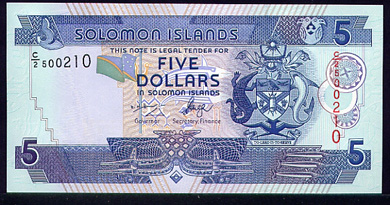
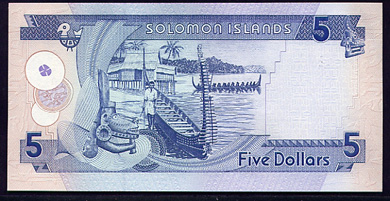
- Currency Name and Code
- Solomon Island Dollar (SBD)
- GDP Real Growth Rate
- 5.8%
Banknotes
Budget & Public Finance
- Fiscal Year
- calendar year
- Annual Budget
- $75,100,000 (USD)
- External Debt
- $180,400,000 (USD)
- Economic Aid
- $23,000,000 (USD)
Labor, Industry & Trade
- Labor Force by Occupation
- agriculture 75%; industry 5%; services 20%
- Industries
- fish (tuna), mining, timber
- Agriculture Products
- cocoa beans, coconuts, palm kernels, rice, potatoes, vegetables, fruit; cattle, pigs; timber; fish
- Export Commodities
- timber, fish, copra, palm oil, cocoa
- Export Partners
- Japan 21.1%, China 18.9%, South Korea 15.6%, Philippines 10%, Thailand 7.8%, Singapore 4.4%
- Import Commodities
- food, plant and equipment, manufactured goods, fuels, chemicals
- Import Partners
- Australia 32.3%, Singapore 20.2%, Fiji 5.1%, New Zealand 5.1%, Papua New Guinea 4%
Energy
- Oil Production
- 0 bbl/day
- Oil Consumption
- 1,270 bbl/day
- Oil Reserves
- 0 bbl/day
- Natural Gas Production
- 0 cu m
- Natural Gas Consumption
- 0 cu m
- Natural Gas Imports
- 0 cu m
- Natural Gas Exports
- 0 cu m
- Natural Gas Reserves
- 0 cu m
Communications
- Telephone System
- domestic: mobile-cellular telephone density is about 50 per 100 persons international: country code - 677; satellite earth station - 1 Intelsat (Pacific Ocean)
- Internet Country Code
- .sb
News & Weather
News & Weather
Current Weather
Latest News
SOFF in Action: What It Takes to Strengthen Global Weather Observations - World Meteorological Organization WMO
World Meteorological Organization WMO · 4h ago
Evangelistic Series in the Solomon Islands Starts Strong, Leaders Report - Adventist Review
Adventist Review · 1d ago
Reengaging the Solomon Islands: A Strategic Opportunity for the United States - CSIS | Center for Strategic and International Studies
CSIS | Center for Strategic and International Studies · 45d ago
China sends a message to Pacific islands amid unease over missile test - South China Morning Post
South China Morning Post · 6d ago
Australia, Solomon Islands vows stronger ties, criticise China's Pacific missile test - Reuters
Reuters · 14d ago
Solomon Islands pivots to niche tourism as travelers flee crowded hubs - Travel Daily Media
Travel Daily Media · 15h ago
New Solomon Islands PM breaks with China, cozies up to the West - Responsible Statecraft
Responsible Statecraft · 18d ago
New prime minister says Solomon Islands will review its secretive security treaty with China - NBC News
NBC News · 47d ago
News via Google News
Climate Overview
tropical monsoon; few extremes of temperature and weather
Videos
Videos
1 curated YouTube videos.
Source: YouTube
Frequently Asked Questions
Frequently Asked Questions
What is the population of Solomon Islands?
How do people greet each other in the Solomon Islands?
What are the dining customs in the Solomon Islands?
What etiquette should I know when visiting homes in the Solomon Islands?
How should I dress in the Solomon Islands?
What gestures are important in the Solomon Islands?
What role does family play in the Solomon Islands?
What can I do for recreation in the Solomon Islands?
What is the capital of the Solomon Islands?
Where is the Solomon Islands located?
What are the ocean and sea borders of the Solomon Islands?
What religion is practiced in the Solomon Islands?
What currency is used in the Solomon Islands?
What languages are spoken in the Solomon Islands?
What is the terrain and geography of the Solomon Islands like?
What is the Solomon Islands known for?
Last reviewed 2026