
 English
 Español
 中文
中文 हिन्दी
 Français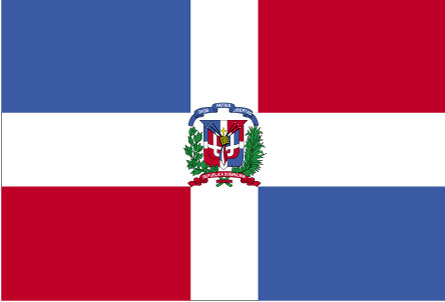
Dominican Republic
Declare Your Relationship to Dominican Republic
CountryReports Community
- Studying2
- From Dominican Republic0
- Dominican Republic heritage1
- Visited2
- Want to visit0
Customs and Culture
Customs and Culture
About the People
Dominicans adhere to very traditional gender roles. Men and boys are expected to demonstrate machismo, or maleness, and personalismo which means putting one's dignity and honor above abstract political and collective ideologies. Women are expected to be submissive and to stay at home. However, many women must work outside the home to earn money.
Cultural Attributes
Dominicans adhere to very traditional gender roles. Men and boys are expected to demonstrate "machismo", or maleness, and "personalismo" which means "putting one's dignity and honor above abstract political and collective ideologies". Women are expected to be submissive and to stay at home. However, many women must work outside the home to earn money.

Land of Quisqueya, Where Columbus First Planted the Cross
Greetings, Gestures & Visiting
Maintaining eye contact is crucial as it indicates interest. When shaking hands, use the appropriate greeting for the time of day "buenos dias", "buenas noches", or "buenas tardes". If invited to dinner at a Dominican's home bring a gift such as chocolates or pastries. Avoid gifts that are black or purple. They are considered mourning colors. Gifts are opened when received.
To hail a taxi, one wags a finger or fingers (depending on the number of passengers) in the directions one is going. At a restaurant, one will clap to request the check. A handshake, with direct eye contact and a welcoming smile is standard when meeting someone.
Hosts offer visitors something to drink and invite them to eat if mealtime is near. It is not considered impolite to refuse such an offer.
Dominicans work long hours and have little time for recreation and socializing. In small towns, the focus of social life is the central park or plaza, where people go to stroll and chat with friends. In rural areas, men get together in stores, bars or pool rooms, to talk and play pool or dominoes. Farm families go to town on Sundays to shop and attend mass. Women and children generally return home first, to prepare Sunday dinner, while the men stay to enjoy an afternoon cockfight or a game of baseball or basketball.
Dominicans pride themselves on their hospitality. When someone visits, Dominicans go out of their way to make guests feel welcome and comfortable House guests are treated royally and Dominicans attempt to cater to their every desire.
In Dominican society appearance is very important. People are extremely fashion conscious and believe that clothes indicate social standing and success. They take great pride in wearing good fabrics and clothes of the best standard they can afford. Designer labels, particularly those from the United States, are looked upon favorably.
Diet
Eating style is Continental, with the fork in the left hand and the knife in the right. Meals are generally served family style or buffet style. If there are visitors the host says “buen provecho” (“enjoy” or “have a good meal”) as an invitation to start eating. Dominicans keep there hands visible when eating, and do not rest your elbows on the table. When Dominicans have finished eating, they place their knife and fork across their plate with the prongs facing down and the handles facing to the right.
Dominican cuisine uses seafood, meat and vegetables, although poorer people in the rural areas cannot afford to eat meat regularly. The most common dish is la bandera, which consists of white rice, beans, vegetables and frito verdes (fried green plantain), served with savory chicken, beef or goat. Goat meat is particularly popular. Beef is common only in the Cibao region.
Another typical dish is sancochos, a version of the Spanish cocido (stew). Each region has its own unique way of preparing sancochos. Sancochos is a hearty mixture of seven meats, that may include goat, pork, tripe, oxtails, chicken, rabbit or pigeon. Sancochos may be served with avocado, wild rice, cassava or plantains.
El desayuno, or breakfast, is the first meal in the morning. Mangu, a puree made from cassava, is often served for breakfast, particularly in poorer areas. In cities, el desayuno may consist of bread, jam and coffee. Most people try to go home at midday for the largest and most elaborate meal of the day, el almuerzo. It usually consists of rice and beans with meat. After lunch, some Dominicans take a nap for a couple of hours before they go to work again. Supper, la cena, is served late, when all family members have returned from school and work.
Evening is the time for desserts. A favorite dessert is hibichela con dulce, a sweet porridge made with beans, coconut milk, sweet potatoes, raisins, cassava and cinnamon. Other traditional desserts include arroz con dulce, a sweet rice pudding, and majarete, a corn pudding. Flans with caramel custard are also popular, such as quesillo de leche y pina, a flan made with pineapple and milk.
Sancocho is the national dish and is served on special occasions. Tropical fruits are found in abundance. Mamgu is served for breakfast in many areas.
Eating style is Continental, a fork in the left hand and the knife in the right hand. Meals are generally served family style or buffet style. If there are visitors the host says “buen provecho” (“enjoy” or “have a good meal”) as an invitation to start eating. Dominicans keep there hands visible when eating, and do not rest your elbows on the table. When Dominicans have finished eating, they place their knife and fork across their plate with the prongs facing down and the handles facing to the right.
Dominican cuisine uses seafood, meat and vegetables, although poorer people in the rural areas cannot afford to eat meat regularly. The most common dish is la bandera, which consists of white rice, beans, vegetables and frito verdes (fried green plantain), served with savory chicken, beef or goat. Goat meat is particularly popular. Beef is common only in the Cibao region.
Another typical dish is sancochos, a version of the Spanish cocido (stew). Each region has its own unique way of preparing sancochos. Sancochos is a hearty mixture of seven meats, that may include goat, pork, tripe, oxtails, chicken, rabbit or pigeon. Sancochos may be served with avocado, wild rice, cassava or plantains.
El desayuno, or breakfast, is the first meal in the morning. Mangu, a puree made from cassava, is often served for breakfast, particularly in poorer areas. In cities, el desayuno may consist of bread, jam and coffee. Most people try to go home at midday for the largest and most elaborate meal of the day, el almuerzo. It usually consists of rice and beans with meat. After lunch, some Dominicans take a nap for a couple of hours before they go to work again. Supper, la cena, is served late, when all family members have returned from school and work.
Evening is the time for desserts. A favorite dessert is hibichela con dulce, a sweet porridge made with beans, coconut milk, sweet potatoes, raisins, cassava and cinnamon. Other traditional desserts include arroz con dulce, a sweet rice pudding, and majarete, a corn pudding. Flans with caramel custard are also popular, such as quesillo de leche y pina, a flan made with pineapple and milk.

Family
Although influenced by North American values, the Dominican Republic maintains the Spanish tradition of familial solidarity. People look to their family and relatives for support and help. In addition to blood relationships, people may have relationships of compadrazgo or "co-parentage." Com-padres are godparents who play an important role in their god children's life. Godparents are chosen before the child's birth and are expected to assist with the child's education, career and even finances.
Many poor couples do not have a religious or civil wedding ceremony because of the high cost. They live together in common-law relationships
Recreation
Dominicans are passionate fans of baseball, or pelota, as they call it. Before baseball became popular, cockfights were the national passion. These fights are legal, and are still popular among men in small towns and rural areas, although the authorities disapprove of them. Each town and village has its own "gallera", or cockfight pit.
On Saturdays and Sundays, men and boys bring their favorite roosters to compete in the "gallera". Others come to watch the match and bet on the outcome. During cockfights, music is played and rum is served, and police officers supervise. In Santo Domingo, the sport is considered an upper-class activity.
Holidays
Independence Day
2/27Independence Day
Dates of Interest
- February 27th
How do people greet each other in the Dominican Republic?
Greet with a handshake, direct eye contact and a welcoming smile, using the greeting for the time of day.
Do
- Maintain eye contact to show interest
- Say "buenos dias," "buenas tardes" or "buenas noches" for the time of day
- Shake hands when meeting someone
Don’t
- Avoid gifts that are black or purple, as these are mourning colors
Good to know
- If invited to dinner, bring a gift such as chocolates or pastries
- Gifts are opened when received
What are the dining customs in the Dominican Republic?
Eating is Continental style with the fork in the left hand and knife in the right, and meals are served family or buffet style.
Do
- Keep your hands visible while eating
- Wait for the host to say "buen provecho" before starting
- Place knife and fork across the plate with prongs down and handles to the right when finished
Don’t
- Don't rest your elbows on the table
Good to know
- La bandera (rice, beans, vegetables and fried green plantain with meat) is the most common dish
- Sancocho is the national dish, served on special occasions
- Most people go home at midday for el almuerzo, the largest meal of the day
What should I know about hospitality and social etiquette?
Dominicans pride themselves on hospitality and go out of their way to make guests feel welcome and comfortable.
Do
- Accept or decline offers of food and drink freely
- Expect house guests to be treated royally
Good to know
- Hosts offer visitors a drink and invite them to eat if mealtime is near
- It is not considered impolite to refuse such an offer
How should I dress in the Dominican Republic?
Appearance is very important; people are extremely fashion conscious and believe clothes indicate social standing and success.
Do
- Wear good fabrics and the best clothes you can afford
Good to know
- Designer labels, especially from the United States, are viewed favorably
What gestures are common in the Dominican Republic?
Simple gestures are used to hail taxis and to request service in restaurants.
Good to know
- Wag a finger or fingers (for the number of passengers) to hail a taxi
- Clap to request the check at a restaurant
What is family life like in the Dominican Republic?
Family solidarity is central, with people relying on relatives for support and help.
Good to know
- Compadres (godparents) play an important role, chosen before birth to help with education, career and finances
- Many poor couples live in common-law relationships due to the cost of weddings
What do people do for recreation in the Dominican Republic?
Dominicans are passionate baseball fans, and cockfighting remains popular among men in small towns and rural areas.
Good to know
- Baseball, or pelota, is a national passion
- Each town and village has its own gallera (cockfight pit), busiest on weekends
- In small towns social life centers on the central park or plaza
Last updated: 2026-07-12 · Sources: CountryReports
Photos of Dominican Republic
Photos of Dominican Republic


Travel and Tourism
Travel and Tourism
- Travel Alert Status
- Level 2: Exercise Increased Caution
- Currency
- 46.2
- Time Difference
- UTC-4 (1 hour ahead of Washington, DC, during Standard Time)
- Climate
- The climate varies little year round. Although the country is in the tropics, constant trade winds keep temperatures from frequently exceeding 90°F. Temperatures in its coastal cities average about 78°F, with seasonal variations of 5-8 degrees. Rainfall varies regionally with about two-thirds of the annual 57 inches in the capital falling in the rainy season from May to November. Hurricanes are a significant weather threat, particularly from June through October, and have caused serious damage in the past.
- Airports
- 31
Read the full travel guide — health, safety, vaccinations, disease risk, sanitation, and transit details.
View full travel guideRecipes
Recipes
La Bandera
Main Dish
Main Dish
Asopao de Mariscos
Side Dish
Moro de Habichuelas Rojas (Red Beans and Rice)
Side Dish
Sancocho (Rice, Vegetable and Meat Stew)
Side Dish
Mamgu (Mashed Green Plantains)
Side Dish
Flan (Custard)
Beverage
Milk and Papaya Drink
Main Dish
PremiumLa Bandera
History
History
Historical Eras
Taino & Pre-Contact
600 – 1492
The island of Hispaniola was home to the Taino people, an Arawakan-speaking civilization that developed complex chiefdoms, agricultural systems, and rich ceremonial culture. By the late 15th century, the Taino population numbered in the hundreds of thousands. Their society would be catastrophically dismantled within decades of European contact, largely through disease, forced labor, and violence.
Spanish Colonial Era
1492 – 1795
Christopher Columbus claimed Hispaniola for Spain in 1492, and his brother Bartholomew founded Santo Domingo in 1496, establishing the oldest permanent European settlement in the Americas. The colony served as the administrative and commercial hub for early Spanish expansion. The indigenous Taino were effectively annihilated by 1515, replaced by enslaved Africans as the primary labor force on sugar plantations. The 1697 Treaty of Ryswick formally divided the island, ceding its western third to France.
Haitian Domination
1795 – 1844
Spain ceded its eastern portion of Hispaniola to France in 1795, and following the Haitian Revolution, the island experienced turbulent shifts in sovereignty. A brief declaration of independence in 1821 was quickly extinguished when Haitian President Jean-Pierre Boyer unified the entire island under Haitian rule in 1822. For twenty-two years, the eastern territory endured occupation, land redistribution, and suppression of its distinct colonial Creole culture.
Early Independence
1844 – 1916
The Dominican Republic proclaimed full independence from Haiti on February 27, 1844, largely through the efforts of Juan Pablo Duarte and the secret society La Trinitaria. The republic's early decades were defined by chronic instability, caudillo rivalries, and severe financial weakness, leading to the extraordinary decision to seek reannexation by Spain from 1861 to 1865, ended only by the War of Restoration. The late 19th and early 20th centuries saw mounting foreign debt and repeated political upheaval, inviting increasing United States scrutiny over Dominican affairs.
U.S. Occupation & Trujillo Era
1916 – 1961
The United States militarily occupied the Dominican Republic from 1916 to 1924, restructuring its finances, infrastructure, and national guard — the institution that would propel Rafael Leónidas Trujillo Molina to power. Trujillo seized the presidency in 1930 and maintained near-absolute authoritarian control for thirty-one years, presiding over economic modernization alongside systematic repression, mass killings including the 1937 Parsley Massacre of Haitians, and a pervasive cult of personality. His assassination in 1961 ended one of the longest and most brutal dictatorships in Latin American history.
Democratic Transition & Modern Era
1961 – present
Trujillo's death opened a turbulent period of contested democratic experiments, a U.S.-backed military coup against elected president Juan Bosch in 1963, and a brief civil war in 1965 that prompted a second U.S. military intervention. Joaquín Balaguer dominated politics for much of the following three decades through a mix of clientelism and repression. A genuine democratic transition took hold after 1996, and the Dominican Republic has since held regular competitive elections while sustaining one of the fastest-growing economies in Latin America, anchored by tourism, remittances, and free-trade-zone manufacturing.
Overview
Timeline of Key Events
1492
Christopher Columbus visits the island
Christopher Columbus visits the island, which he names Hispaniola, or “Little Spain”.
1496
Bartholomew Columbus founds the city of Santo Domingo
Bartholomew Columbus, brother of Christopher Columbus, founds the city of Santo Domingo, now part of the Dominican Republic, making it the oldest European City and permanent settlement in the New World.
1510
First slaves brought to the New World.
The first shipment of Africans to Santo Domingo.
1515
The indigenous Taino Indians were practically annihilated
The indigenous Taino Indians were practically annihilated due to continuos clashes and rebellion against the Spanish.
1586
Francis Drake attacked the heavily fortified city of Santo Domingo
Francis Drake attacked the heavily fortified city of Santo Domingo in Hispanola and forced the governor to pay a large ransom.
1697
Treaty of Ryswick gives Haiti to France and the present Dominican Republic to Spain.
Treaty of Ryswick gives Haiti to France and the present Dominican Republic to Spain.
1793
The 1st British soldiers came ashore at St. Domingue.
The 1st British soldiers came ashore at St. Domingue.
Read the full history profile — narrative overview, defining eras, and the complete timeline in one place.
View expanded historyInteresting Facts
Interesting Facts
When a child loses a tooth they throw the tooth on the rood of thier house so a mouse can come take it away and bring a better one. Someitmes they get money.
The aboriginal name for the Dominican Republic is Quisqueya, which means in the Taino language, “Mother of all lands.”
The northern coast of the rocky shelf on which Hispaniola sits provides an excellent breeding ground for humpback whales. During the first few months of the year, humpback whales can be seen off the northern coast of the Dominican Republic near Puerto Plata.
Taino means “ good” or “noble.” It is believed that the Tainos used this name to distinguish themselves from the warlike Caribs.
Divorce laws are so lax that people come from other countries to obtain a divorce in the Dominican Republic.
The compadrazgo relationship is considered so important that Rafael Trujillo used it to his advantage. He conducted mass baptisms at which he became the godfather of thousands of peasants' children.
See every fact — trivia, oddities, and curious tidbits gathered from across the country.
View all interesting factsGeography and Environment
Geography and Environment
- Terrain
- rugged highlands and mountains with fertile valleys interspersed
- Climate
- The climate varies little year round. Although the country is in the tropics, constant trade winds keep temperatures from frequently exceeding 90ºF. Temperatures in its coastal cities average about 78ºF, with seasonal variations of 5–8 degrees. Rainfall varies regionally with about two-thirds of the annual 57 inches in the capital falling in the rainy season from May to November. Hurricanes are a significant weather threat, particularly from June through October, and have caused serious damage in the past.
- Natural Hazards
- lies in the middle of the hurricane belt and subject to severe storms from June to October; occasional flooding; periodic droughts
- Current Environmental Issues
- water shortages; soil eroding into the sea damages coral reefs; deforestation
Read the full geography and environment profile — terrain, climate, natural resources, hazards, land use, and international agreements.
View full geographyPeople & Demographics
People & Demographics
Religion
Languages Spoken
Spanish
- Spanish
Population
- Population
- 9,794,487
- Population: Male/Female
- Male: 5,465,776 Female: 5,350,081
- Population Distribution
- Coastal development is significant, especially in the southern coastal plains and the Cibao Valley, where population density is highest; smaller population clusters exist in the interior mountains (Cordillera Central)
- Urban Population
- Urban population: 84.4% of total population Rate of urbanization: 1.64% annual rate of change
- Population in Major Urban Areas
- 3.524 million SANTO DOMINGO
- Nationality Noun
- Noun: Dominican(s) Adjective: Dominican
- Ethnic Groups
- Mixed 70.4% (Mestizo/Indio 58%, Mulatto 12.4%), Black 15.8%, White 13.5%, other 0.3%
- Language Note
- Spanish (official)
Education
- Literacy Definition
- Age 15 and over can read and write
Health Information
- Life Expectancy at Birth
- Total population: 72.6 years Male: 71 years Female: 74.3 years
- Major Infectious Diseases — degree of risk
- Degree of risk: High Food or waterborne diseases: Bacterial diarrhea, hepatitis A, and typhoid fever Vectorborne diseases: Dengue fever
- Alcohol consumption per capita
- Total: 5.56 liters of pure alcohol Beer: 3.15 liters of pure alcohol Wine: 0.17 liters of pure alcohol Spirits: 2.18 liters of pure alcohol Other alcohols: 0.06 liters of pure alcohol
- Tobacco Use
- Total: 10.6% Male: 14.6% Female: 6.5%
- Child Marriage
- Women married by age 15: 9.4% Women married by age 18: 31.5%
- Infant Mortality Rate
- Total: 21.7 deaths/1,000 live births Male: 24.3 deaths/1,000 live births Female: 19 deaths/1,000 live births
Life Expectancy
- Life Expectancy at Birth
- Total population: 72.6 years Male: 71 years Female: 74.3 years
- Median Age
- Total: 29.2 years Male: 29.1 years Female: 29.4 years
- Age Structure
- 0-14 years: 25.5% (male 1,402,847/female 1,358,833) 15-64 years: 66.9% (male 3,667,584/female 3,563,848) 65 years and over: 7.6% (male 395,345/female 427,400)
- Infant Mortality Rate
- Total: 21.7 deaths/1,000 live births Male: 24.3 deaths/1,000 live births Female: 19 deaths/1,000 live births
Read the full people and society profile — demographics, health, education, religion, languages, and notable people.
View full people and societyGovernment & Politics
Government & Politics
Country Identity
- Country Name
- DominicanRepublic
- Full Country Name
- Dominican Republic
- Local - Long
- Republica Dominicana
Government Structure
- Government Type
- representative democracy
- Legal System
- based on French civil codes; undergoing modification in 2004 towards an accusatory system
- Executive Branch
- chief of state: President Luis ABINADER Corona (since 16 August 2020); Vice President Raquel PEÑA de Antinori (since 16 August 2020); note - the president is both the chief of state and head of government head of government: President Luis ABINADER Corona (since 16 August 2020); Vice President Raquel PEÑA de Antinori (since 16 August 2020); note - the president is both the chief of state and head of government cabinet: Cabinet nominated by the president elections: president and vice president elected on the same ticket by popular vote for four-year terms; election last held 5 July 2020 (next to be held in May 2024) election results: Luis ABINADER Corona elected president; percent of vote - Luis ABINADER Corona (PRM) 52.5%, Gonzalo CASTILLO Terrero (PLD) 37.5%, Leonel FERNANDEZ Reyna (FP) 8.9%
- Legislative Branch
- bicameral National Congress or Congreso Nacional consists of the Senate or Senado (32 seats; members are elected by popular vote to serve four-year terms) and the Chamber of Deputies or Camara de Diputados (150 seats; members are elected by popular vote to serve four-year terms) elections: Senate - last held 16 May 2002 (next to be held in May 2006); Chamber of Deputies - last held 16 May 2002 (next to be held in May 2006) election results: Senate - percent of vote by party - NA; seats by party - PRD 29, PLD 2, PRSC 1; Chamber of Deputies - percent of vote by party - NA; seats by party - PRD 73, PLD 41, PRSC 36
- Judicial Branch
- Supreme Court or Corte Suprema (judges are appointed by a the National Judicial Council comprised of the president, the leaders of both chambers of congress, the president of the Supreme Court, and an opposition or non-governing party member)
- Suffrage
- 18 years of age, universal and compulsory; married persons regardless of age
- Constitution
- 28-Nov-66
- Independence
- 27 February 1844 (from Haiti)
- National Holiday
- Independence Day, 27 February (1844)
Capital City
- Capital Name
- Santo Domingo
- Capital - geographic coordinate
- 18 28 N, 69 54 W
- Capital Time Difference
- UTC-4 (1 hour ahead of Washington, DC, during Standard Time)
Named after Saint Dominic de GUZMAN (1170-1221), founder of the Dominican Order
Military
Branches: Army (Ejercito Nacional, EN), Navy (Marina de Guerra, MdG; includes naval infantry), Dominican Air Force (Fuerza Aerea Dominicana, FAD)
Embassy / Diplomatic Mission
The Consular Section of the U.S. Embassy is located at the corner of Calle César Nicolás Penson and Avenida Máximo Gómez. The American Citizens Services (ACS) Unit can be reached by telephone at 809-221-2171, or via email at sdoamericans@state.gov. ACS Unit office hours are 7:30 a.m. to 4:30 p.m., Monday through Thursday, Friday 7:30 a.m. to 11am, except on U.S. and Dominican holidays. The Chancery of the U.S. Embassy is located a quater-mile away from the Consular Section, at the corner of Calle César Nicolás Penson and Calle Leopoldo Navarro. The telephone number is 809-221-2171.
There is a consular agency in Bavaro/Punta Cana, located in the Palma Real Shopping Center, 2nd floor. Office hours are 8:30 a.m. to 12:30 p.m., and 2p.m. to 5p.m., Monday through Friday, except holidays. The email is puntacanaconsularagency@state.gov.
There is a consular agency in the north coast city of Puerto Plata, at Calle Villanueva esq. Avenida John F. Kennedy, Edificio Abraxa Libraria, 2nd floor, telephone 809-586-4204, 809-586-8017, 809-586-8023; office hours are 8:30 a.m. to 12:30 p.m., and 2p.m. to 5p.m., Monday through Friday, except holidays. The email is PuertoPlataConsularAgency@state.gov.
Read the full government profile — flag symbolism, national anthem, and other national symbols.
View full government detailsEconomy
Economy
The Dominican Republic, a representative democracy in the Caribbean, has the largest economy in Central America and the Caribbean region. Once known primarily as an exporter of sugar, coffee, and tobacco, the country has transformed into a service-based economy, with tourism, free trade zones, telecommunications, finance, and remittances now serving as the principal drivers of growth. The service sector accounts for the majority of GDP and employs the largest share of the workforce, while agriculture has diminished in relative importance.
The Dominican Republic has consistently ranked among the fastest-growing economies in Latin America over the past two decades, with annual GDP growth averaging around 5% prior to the COVID-19 pandemic. After contracting sharply in 2020 due to the collapse of global tourism, the economy rebounded strongly, posting growth above 12% in 2021 and continuing to expand at a healthy pace in subsequent years. Tourism has returned to record levels, with the country welcoming more than 10 million visitors annually, and foreign direct investment has remained robust, particularly in mining, real estate, and renewable energy.
Despite these gains, significant challenges remain. Income inequality is still pronounced, with substantial disparities between urban and rural areas and limited access to quality education, healthcare, and formal employment for much of the population. Poverty has declined notably from earlier decades but continues to affect a meaningful share of households. The country also remains vulnerable to external shocks, including fluctuations in the U.S. economy, its largest trading partner and the primary source of remittances and tourism, as well as exposure to hurricanes and rising energy import costs.
The DR-CAFTA free trade agreement, in force since 2007, has deepened economic integration with the United States and Central America, supporting manufacturing exports in textiles, medical devices, and electrical equipment. Mining, particularly gold production at the Pueblo Viejo mine, has become an increasingly important source of export earnings alongside traditional agricultural products.
Snapshot
- Currency Name and Code
- Dominican pesos (DOP)
- GDP — official exchange rate
- $18,150,000,000 (USD)
- GDP Real Growth Rate
- 9.3%
- Gini Index
- 47.4
Banknotes
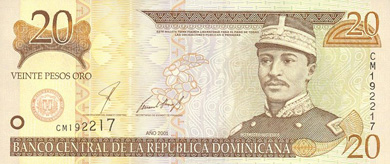
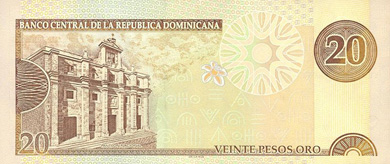
Budget & Public Finance
- Fiscal Year
- calendar year
- Annual Budget
- $5,485,000,000 (USD)
- Public Debt (% of GDP)
- 51.4%
- External Debt
- $7,907,000,000 (USD)
- Investment (% of GDP)
- 25.4%
- Economic Aid
- $239,600,000 (USD)
- Current Account Balance
- -$383,000,000 (USD)
- Reserves of Foreign Exchange
- $850,000,000 (USD)
Labor, Industry & Trade
- Labor Force by Occupation
- services and government 58.7%; industry 24.3%; agriculture 17%
- Household Income — highest 10%
- 37.9%
- Industries
- tourism, sugar processing, ferronickel and gold mining, textiles, cement, tobacco
- Agriculture Products
- sugarcane, coffee, cotton, cocoa, tobacco, rice, beans, potatoes, corn, bananas; cattle, pigs, dairy products, beef, eggs
- Export Commodities
- ferronickel, sugar, gold, silver, coffee, cocoa, tobacco, meats, consumer goods
- Export Partners
- US 85.3%, Canada 1.6%, UK 1.6%
- Import Commodities
- foodstuffs, petroleum, cotton and fabrics, chemicals and pharmaceuticals
- Import Partners
- US 51.1%, Venezuela 9.1%, Mexico 4.8%
Energy
- Oil Production
- 0 bbl/day
- Oil Consumption
- 128,000 bbl/day
- Oil Reserves
- 0 bbl/day
- Natural Gas Production
- 0 cu m
- Natural Gas Consumption
- 300,000,000 cu m
- Natural Gas Imports
- 0 cu m
- Natural Gas Exports
- 0 cu m
- Natural Gas Reserves
- 0 cu m
Communications
- Telephone System
- General assessment: Relatively efficient system based on island-wide microwave radio relay network Domestic: Fixed-line teledensity is about 10 per 100 persons; multiple providers of mobile-cellular service with a subscribership of nearly 90 per 100 persons International: Country code - 1-809; landing point for the Americas Region Caribbean Ring System (ARCOS-1), Antillas 1, and the Fibralink submarine cables that provide links to South and Central America, parts of the Caribbean, and US; satellite earth station - 1 Intelsat (Atlantic Ocean)
- Internet Country Code
- .do
News & Weather
News & Weather
Current Weather
Latest News
Almón, Dominican Republic qualify for the 2027 AmeriCup - Florida Gators
Florida Gators · 19h ago
Stefano Mazzoli birdies 18th hole in Dominican Republic, completes comeback for first PGA Tour win - Golf Channel
Golf Channel · 1d ago
CDPI expands digital public infrastructure bootcamp to Dominican Republic - Biometric Update
Biometric Update · 14h ago
Boxing News: Results From Dominican Republic » July 21, 2026 - FightNews
FightNews · 6h ago
Dominican Republic's Panorama Jets phases out Mustang - ch-aviation
ch-aviation · 13h ago
Avoid packing pork products when traveling to the United States - U.S. Embassy in the Dominican Republic (.gov)
U.S. Embassy in the Dominican Republic (.gov) · 12h ago
Dominican Republic rules out troop deployment to Haiti’s anti-gang force - The Haitian Times
The Haitian Times · 5d ago
Italy's Mazzoli wins US PGA Dominican Republic title - RFI
RFI · 1d ago
News via Google News
Climate Overview
The climate varies little year round. Although the country is in the tropics, constant trade winds keep temperatures from frequently exceeding 90°F. Temperatures in its coastal cities average about 78°F, with seasonal variations of 5-8 degrees.
Rainfall varies regionally with about two-thirds of the annual 57 inches in the capital falling in the rainy season from May to November. Hurricanes are a significant weather threat, particularly from June through October, and have caused serious damage in the past.
Frequently Asked Questions
Frequently Asked Questions
What is the population of Dominican Republic?
How do people greet each other in the Dominican Republic?
What are the dining customs in the Dominican Republic?
What should I know about hospitality and social etiquette?
How should I dress in the Dominican Republic?
What gestures are common in the Dominican Republic?
What is family life like in the Dominican Republic?
What do people do for recreation in the Dominican Republic?
What is the capital of the Dominican Republic?
Where is the Dominican Republic located?
What countries border the Dominican Republic?
What is the predominant religion in the Dominican Republic?
What currency is used in the Dominican Republic?
What language is spoken in the Dominican Republic?
What is the Dominican Republic known for?
Last reviewed 2026