
 English
 Español
 中文
中文 हिन्दी
 Français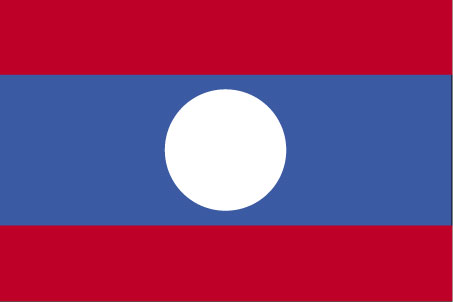
Laos
Declare Your Relationship to Laos
CountryReports Community
- Studying0
- From Laos1
- Laos heritage1
- Visited0
- Want to visit0
Customs and Culture
Customs and Culture
About the People
The Lao are a frank, open and friendly people. They also have a strongly developed sense of courtesy and respect. It is considered very bad taste to publicly criticize a person since it results in a loss of face within the community. Necessary criticisms and suggestions should be made within a general context to avoid placing blame or shame upon any individual. Bo pen nyang (Never mind) is a common expression that characterizes Laotians’ feelings toward life. Life should be enjoyed at the moment; problems are not taken so seriously as to disrupt this enjoyment. Given the hardships people face in the country, with more than half living in poverty, this is an invaluable attitude. Loyalty to family and friends is important. Showing anger or disappointment in public is inappropriate.
Cultural Attributes
Showing anger in public is inappropriate. The Lao are generally a courteous people. It is considered rude criticize a person in public as it results in a loss of face. Loyalty amongst friends and family is important.

Kingdom of a Million Elephants
Greetings, Gestures & Visiting
The generally accepted form of greeting among Lao people is the "Nop", which involves placing one's hands together in a prayer position, chest high and not touching the body.
The "Nop" is not only an expression of greeting but also of thanks or regard. It is appropriate to shake hands with Westerners. The Lao address each other by the first name. Children address adults by the first name, prefaced by the equivalent of Mr or Mrs or if well acquainted, Mr Uncle or Mrs Aunt, a courtesy title.
Women are not permitted to touch a Buddhist monk. The head is considered the most sacred part of the body. One should not touch a person's head, nor should one use the foot to point at a person or a sacred object. Men and women rarely show affection in public.
Bringing a gift when visiting is not necessary. Women frequently sit with legs off to one's side. It is customary to remove shoes when entering a house or Buddhist temple. Shoes are left near the doorway of the home. When food or drink is offered refusing to taste the them is considered rude.
Lao women wear western- style blouses with colorful calf-length, sarong-style skirts made of locally hand-woven materials in multicolor designs and fastened with a silver link belt. Men wear pants with casual, open-neck, short-sleeve shirts. Both men and women usually wear sandals. Some ethnic groups also wear distinct headdresses.
Diet
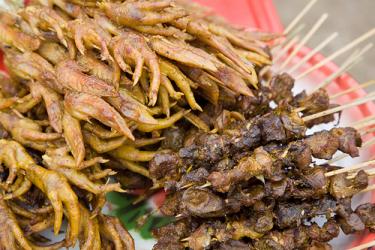
Sticky or glutinous rice is the staple of the Lao diet. Other foods include fish, eggs, chicken, pork, owl, and (rarely) beef. Rice is served with chili sauce or a spicy sauce make with fermented fish. Beverages include coffee and tea. The traditions of royal Thai cuisine combine the best features of Indian, Chinese and Thai elements.
The Lao eat with a fork in the left hand and a spoon in the right. However, glutinous rice is eaten with the fingers, which are cleaned with a napkin. Lao food, which is very spicy, is served in communal dishes with meat and vegetables cut into bite-size pieces. In a traditional home, the meal is served while diners sit on a mat on the floor. As a sign of respect to a guest, the host and his family will not raise their heads above the level of that of the guest’s. Therefore, they may bring the food in a squat position so as not to offend guests.
Sticky or glutinous rice is the staple of the Lao diet. Other foods include fish, eggs, chicken, pork, owl, and (rarely) beef. Rice is served with chili sauce or a spicy sauce make with fermented fish. Beverages include coffee and tea. The traditions of royal Thai cuisine combine the best features of Indian, Chinese and Thai elements.

Family
The eldest man is the patriarch of the family. The Lao have great respect for their parents and elders. Among the Hmong, the household is composed of the extended family: parents, unmarried children, and married sons with their families.
Dating Customs
Young people can meet eligible partners at dances held during festivals, where they are free to sit and talk privately. Wealthier families may conduct a marriage ceremony. Marriage is traditionally done by living together or eloping. New couples frequently live with the wife's family, until her first child is born.
Recreation
One popular traditional game is called "kataw". It is played with a small ball woven out of rattan (modern balls may be made of plastic). The players stand in a circle and try to keep the ball in the air without using their hands, by kicking it or hitting it with their knees and elbows. A more competitive version is called "sepak takraw". Two teams of three players toss the ball back and forth over a volleyball net, using their legs, arms, shoulders and head. Laotian "sepak takraw" teams participate in the King's Cup international competition, which attracts competitors from throughout southeast Asia.
Another traditional game is top spinning, using large wooden tops. People compete to see how long they can keep the top in motion. Sometimes people play against each other, using their tops to knock out their opponents' tops.
A courtship ball game is popular among the hill tribes. Girls and boys line up facing each other. The two groups throw a ball back and forth. When someone drops it, he or she must sing a song. This is a way for boys and girls to get acquainted. Men from the Hmong tribe in the mountain areas of Laos enjoy cock fighting and even fish fighting. They place bets on the outcome of the fights and gather around to watch.
Children and young people often take part in track and field sports at school. Girls actively participate in a number of sports such as volleyball, badminton and basketball at city schools.
Holidays
Republic Day
12/2Independence
Dates of Interest
- December 2nd
How do people greet each other in Laos?
The traditional greeting is the "Nop," made by placing your hands together in a prayer position at chest height without touching the body; it also expresses thanks and regard. It's fine to shake hands with Westerners.
Do
- Return the "Nop" with hands together at chest height
- Shake hands when greeting Westerners
- Address people by their first name
- Use a courtesy title (like Mr/Mrs, or Mr Uncle/Mrs Aunt) when a child addresses an adult
What are the dining customs in Laos?
Sticky (glutinous) rice is the staple, served with chili or spicy fermented-fish sauce alongside communal dishes of bite-size meat and vegetables; food is very spicy. In a traditional home, diners sit on a mat on the floor.
Do
- Eat with a fork in the left hand and a spoon in the right
- Eat glutinous rice with your fingers and clean them with a napkin
- Taste food or drink when it is offered to you
Don’t
- Don't refuse to taste offered food or drink, as this is considered rude
Good to know
- Beverages include coffee and tea
- As a sign of respect, hosts may serve food from a squat position to avoid raising their heads above a guest's
What etiquette should I know when visiting Laos?
The Lao are courteous and value not causing loss of face, so public criticism and displays of anger are inappropriate. Bringing a gift when visiting is not necessary.
Do
- Remove your shoes when entering a home or Buddhist temple, leaving them near the doorway
- Make any criticism in a general way to avoid blaming an individual
- Show loyalty to family and friends
Don’t
- Don't criticize someone publicly, as it causes loss of face
- Don't show anger or disappointment in public
Good to know
- "Bo pen nyang" (Never mind) reflects the relaxed Lao attitude toward problems
- Women frequently sit with their legs off to one side
How should I dress in Laos?
Women wear western-style blouses with colorful calf-length sarong-style skirts of hand-woven material fastened with a silver link belt, while men wear pants with casual open-neck, short-sleeve shirts. Both usually wear sandals.
Good to know
- Some ethnic groups wear distinct headdresses
Are there gestures or physical customs to be careful about in Laos?
The head is considered the most sacred part of the body, and public displays of affection are rare.
Don’t
- Don't touch a person's head
- Don't use your foot to point at a person or a sacred object
- Women should not touch a Buddhist monk
- Avoid showing affection in public
What is family life like in Laos?
The eldest man is the patriarch of the family, and the Lao have great respect for their parents and elders.
Good to know
- Among the Hmong, the household includes the extended family: parents, unmarried children, and married sons with their families
What do people do for recreation in Laos?
Popular traditional games include "kataw" (keeping a rattan ball in the air without hands) and its competitive version "sepak takraw" played over a net, as well as top spinning with large wooden tops.
Good to know
- Laotian sepak takraw teams compete in the King's Cup international competition
- A courtship ball game is popular among hill tribes, where dropping the ball means you must sing a song
- Hmong men in mountain areas enjoy cock fighting and fish fighting
- Students take part in track and field, and girls play volleyball, badminton and basketball at city schools
Last updated: 2026-07-12 · Sources: CountryReports
Photos of Laos
Photos of Laos


Travel and Tourism
Travel and Tourism
- Travel Alert Status
- Level 2: Exercise Increased Caution
- Currency
- kip (LAK)
- Time Difference
- UTC+7 (12 hours ahead of Washington, DC, during Standard Time)
- Climate
- Laos has a monsoon climate with three overlapping seasons. The rainy season is about 5 months, June-September. In October, rains start to taper off, and the cool season begins in November, lasting through February. In March "mango rains" occur. March, April, and May are hot and humid. In April, the hottest month, temperatures in Vientiane range from 72°F to 93°F, and in January, the coolest month, 52°F to 83°F. Temperature extremes of 103°F (April) and 39°F (January) have been recorded.
- Airports
- 46
Read the full travel guide — health, safety, vaccinations, disease risk, sanitation, and transit details.
View full travel guideRecipes
Recipes
History
History
Historical Eras
Early Kingdoms
500 – 1353
Before the emergence of a unified Lao state, the middle Mekong Valley was shaped by a succession of overlapping polities including Zhenla, Khmer-dominated mandalas, and small confederative communities of valley and highland peoples. Cultural identity was forged through migrations, religious syncretism between Hinduism and Theravada Buddhism, and shifting vassalage to powers such as the Cham, Khmer, and Sukhothai. These centuries laid the ethnic and institutional foundations upon which Lan Xang would be built.
Lan Xang Kingdom
1353 – 1778
Founded in 1353 by Fa Ngum, the Kingdom of Lan Xang — 'Land of a Million Elephants' — became one of the largest kingdoms in Southeast Asia and established Theravada Buddhism as the state religion. Under King Souligna Vongsa in the seventeenth century the kingdom reached its cultural and political zenith, but succession disputes after his death in 1694 fractured Lan Xang into the rival kingdoms of Louangphrabang, Vientiane, and Champasak. This fragmentation left the Lao states vulnerable to encroachment by Burma and Siam.
Siamese Dominance
1778 – 1893
From 1778, Siam extended its suzerainty over Champasak, Vientiane, and eventually Louangphrabang, reducing the Lao kingdoms to tributary states. A major Lao revolt led by Chao Anouvong of Vientiane was crushed by Siamese forces in 1828, after which Vientiane was razed and much of its population deported. The Lao principalities survived only as diminished vassals until French imperial expansion into the region fundamentally altered the political order.
French Protectorate
1893 – 1953
Following Auguste Pavie's diplomatic campaign, France established a protectorate over Laos in 1893, incorporating it into French Indochina and defining its modern borders via the Anglo-French Convention of 1896. French administration was light, preserving the royal house of Louangphrabang and relying on Vietnamese immigration to staff civil services, which sowed long-lasting ethnic tensions. Japanese occupation during World War II briefly eclipsed French power and galvanized the nascent Lao Issara independence movement, setting the stage for decolonization.
Independence & Civil War
1953 – 1975
Laos gained full independence from France in 1953, but the Royal Lao Government immediately faced an armed insurgency by the communist Pathet Lao, backed by North Vietnam and the Soviet Union. The country became a Cold War battleground; the United States conducted a covert 'secret war' including massive aerial bombardment of the Ho Chi Minh Trail and support for Hmong guerrillas. Coalition governments repeatedly failed to integrate the Pathet Lao, and the collapse of South Vietnam in 1975 sealed the Royal Government's fate.
Lao PDR
1975 – present
In December 1975 the Pathet Lao abolished the six-century-old monarchy and proclaimed the Lao People's Democratic Republic under single-party rule of the Lao People's Revolutionary Party. Early years brought collectivization, mass re-education camps, and close alignment with Vietnam, driving hundreds of thousands of Lao into exile. From the late 1980s the government gradually liberalized the economy through the New Economic Mechanism, opened to foreign investment, and joined ASEAN in 1997, transforming Laos into one of Southeast Asia's fastest-growing economies.
Overview
Timeline of Key Events
500
Mid-sixth century Zhenla established, centered on Champasak.
Mid-sixth century Zhenla established, centered on Champasak.
700
Eighth-twelfth centuries Mon mandala of central Mekong region fall under Khmer domination.
Eighth-twelfth centuries Mon mandala of central Mekong region fall under Khmer domination; Theravada Buddhism spread by Mon monks.
1100
Twelfth century Candapuri mandala in Vientiane region absorbed within Khmer Empire.
Twelfth century Candapuri mandala in Vientiane region absorbed within Khmer Empire.
1271 – 1272
Panya Lang rules Xieng Dong Xieng Thong.
Panya Lang rules Xieng Dong Xieng Thong.
1279
Tai mandala of Sukhotai founded by King Ramkhamhaeng.
Tai mandala of Sukhotai founded by King Ramkhamhaeng; Xieng Dong Xieng Thong and Muang Vieng Chan Vieng Kham (Vientiane) briefly incorporated into Sukhotai mandala.
1353 – 1373
Reign of Fa Ngum, king of Lan Xang; beginning of recorded Laotian history.
Reign of Fa Ngum, king of Lan Xang; beginning of recorded Laotian history.
1373 – 1547
Successors of Fa Ngum continue to organize Lan Xang
Successors of Fa Ngum continue to organize Lan Xang; Phetsarath (r. 1520-47) involves Lan Xang in battles against Burma and Siam lasting two centuries.
Read the full history profile — narrative overview, defining eras, and the complete timeline in one place.
View expanded historyInteresting Facts
Interesting Facts
Laos was once known as Lan Xang, meaning “the Kingdom of a Million Elephants.” It was given the name by King Fa Ngum in 1353. The country was renamed Laos during the French colonial period, because the dominant ethnic group is called Lao.
The Mekong River is known as “the Sea of Laos.” More than 1,000 indigenous species of fish live in the Mekong and its tributaries.
The Plain of Jars is a remarkable historic site in central Laos. It is a large plateau dotted with hundreds of ancient stone jars. Some are as high as three metres and weigh as much as one tonne. No one knows who made the jars or why.
In the past, Laotians used only their first names. They started using family names in 1943, when a law was passed making the use of surnames mandatory. However, Laotians may change their names to signify a new occupation or the move to a new place, to mark a stage in growing up, or to ward off evil spirits.
There are about 40 ethnic groups in Laos. The Lao include three main cultural groups: the Lao Sung (Lao of the mountains), the Lao Theung (Lao of the lower mountain areas), and the Lao Loum (Lao of the lowlands). Within these large groups are various ethnic cultures, such as the Hmong and the Mien (both part of the Lao Sung).
Laos is a member of the Association of South-East Asian Nations (ASEAN), an economic organization that includes Thailand, Vietnam, Singapore, Indonesia, Malaysia, the Philippines and Brunei.
See every fact — trivia, oddities, and curious tidbits gathered from across the country.
View all interesting factsGeography and Environment
Geography and Environment
- Terrain
- mostly rugged mountains; some plains and plateaus
- Climate
- Laos has a monsoon climate with three overlapping seasons. The rainy season is about 5 months, June-September. In October, rains start to taper off, and the cool season begins in November, lasting through February. In March "mango rains" occur. March, April, and May are hot and humid. In April, the hottest month, temperatures in Vientiane range from 72°F to 93°F, and in January, the coolest month, 52°F to 83°F. Temperature extremes of 103°F (April) and 39°F (January) have been recorded.
- Natural Hazards
- floods, droughts
- Current Environmental Issues
- unexploded ordnance; deforestation; soil erosion; most of the population does not have access to potable water
Read the full geography and environment profile — terrain, climate, natural resources, hazards, land use, and international agreements.
View full geographyPeople & Demographics
People & Demographics
Religion
Languages Spoken
Lao (official), French, English, and various ethnic languages
- French
- Lao
Population
- Population
- 6,993,767
- Population in Major Urban Areas
- VIENTIANE (capital) 810,000
- Nationality Noun
- Lao(s) or Laotian(s)
- Ethnic Groups
- Lao Loum (lowland) 68%, Lao Theung (upland) 22%, Lao Soung (highland) including the Hmong and the Yao 9%, ethnic Vietnamese/Chinese 1%
- Language Note
- <p>Some ethnic minority languages have never been codified in written form. A small percentage of older people and those who attended high school prior to 1975 speak French, which has been the language of international commerce in the past. Some English is spoken.</p><p> The official language is Lao, the native language of the lowland Lao which is used in all official communications and taught in schools. Other main languages include Thai, Hmong, and midland Lao.</P
Education
- Literacy Definition
- age 15 and over can read and write
Health Information
- Major Infectious Diseases — degree of risk
- very high
Read the full people and society profile — demographics, health, education, religion, languages, and notable people.
View full people and societyGovernment & Politics
Government & Politics
Country Identity
- Country Name
- Laos
- Full Country Name
- Lao People's Democratic Republic
- Local - Long
- Sathalanalat Paxathipatai Paxaxon Lao
Government Structure
- Government Type
- Communist state
- Legal System
- based on traditional customs, French legal norms and procedures, and socialist practice
- Executive Branch
- chief of state: President THONGLOUN Sisoulith (since 22 March 2021); Vice President PANY Yathotou (since 22 March 2021); Vice President BOUNTHONG Chitmany (since 22 March 2021) head of government: Prime Minister PHANKHAM Viphavanh (since 22 March 2021); Deputy Prime Ministers SONEXAY Siphandon, KIKEO Khaykhamphithoune, SALEUMXAY Kommasith, and VILAYVONG Bouddakham (all since 22 March 2021) cabinet: Council of Ministers appointed by the president, approved by the National Assembly elections: president elected by the National Assembly for a five-year term; election last held on 22 March 2021 (next to be held in 2026); prime minister appointed by the president with the approval of the National Assembly for a five-year term election results: THONGLOUN Sisoulith elected president; percent of National Assembly vote — NA
- Legislative Branch
- unicameral National Assembly (109 seats; members elected by popular vote to serve five-year terms); note - total number of seats increased from 99 to 109 for the 2002 election elections: last held 24 February 2002 (next to be held in 2007) election results: percent of vote by party - NA; seats by party - LPRP or LPRP-approved (independent, non-party members) 109
- Judicial Branch
- People's Supreme Court (the president of the People's Supreme Court is elected by the National Assembly on the recommendation of the National Assembly Standing Committee; the vice president of the People's Supreme Court and the judges are appointed by the National Assembly Standing Committee)
- Suffrage
- 18 years of age; universal
- Constitution
- promulgated 14 August 1991
- Independence
- 19 July 1949 (from France)
- National Holiday
- Republic Day, 2 December (1975)
Capital City
- Capital Name
- Vientiane (Viangchan)
- Capital - geographic coordinate
- 17 58 N, 102 36 E
- Capital Time Difference
- UTC+7 (12 hours ahead of Washington, DC, during Standard Time)
the meaning in Pali, a Buddhist liturgical language, is "city of sandalwood"
Military
Branches: Lao People's Armed Forces (LPAF): Lao People's Army (LPA; includes Riverine Force), Air Force
Embassy / Diplomatic Mission
U.S. Embassy Vientiane
Rue Bartholonie (near That Dam), Vientiane – for local mail
Unit 8165, Box V, APO AP 96546 – for mail from the United States
Telephone: (856-21) 267-000
Recorded emergency information for U.S. citizens: (856-21) 267-111
Duty officer emergency cellular telephone: (856-20) 5550-2016
Embassy-wide fax number: (856-21) 267-190.
E-mail the Embassy’s Consular Section.
Read the full government profile — flag symbolism, national anthem, and other national symbols.
View full government detailsEconomy
Economy
Laos, one of the few remaining single-party Communist states, began decentralizing economic control and encouraging private enterprise in 1986 through its New Economic Mechanism reforms. The results have been substantial: from a very low base, the economy grew at an average annual rate of roughly 7% from the early 1990s through the 2010s, briefly interrupted by the 1997 Asian financial crisis and again by the COVID-19 pandemic in 2020. Growth has since slowed, averaging closer to 3–4% in recent years, weighed down by high public debt, persistent inflation, and a sharp depreciation of the kip.
Despite decades of expansion, Laos remains one of the poorest countries in Southeast Asia, though its infrastructure has improved markedly. The 2021 opening of the China–Laos Railway between Vientiane and the Chinese border transformed the country's long-standing status as a landlocked nation without rail service, and road networks, electrification, and telecommunications have expanded significantly. Electricity now reaches the large majority of the population, and the country has become a major regional power exporter through its extensive hydropower sector, earning it the informal label "the battery of Southeast Asia."
Agriculture, much of it still subsistence-based, employs a large share of the workforce but accounts for a declining share of GDP, as services and industry — particularly mining, hydropower, construction, and tourism — have grown in importance. The economy continues to depend heavily on foreign investment, with China as the dominant partner, as well as on support from the IMF, World Bank, and Asian Development Bank. Key challenges include managing external debt, stabilizing the currency, curbing inflation, and diversifying beyond resource-based growth.
Snapshot
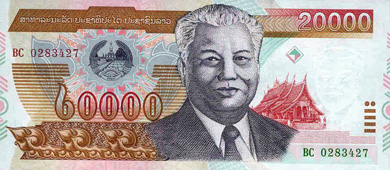
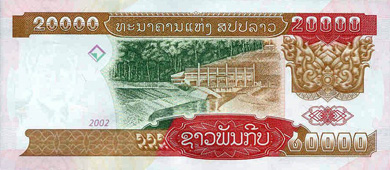
- Currency Name and Code
- Kip (LAK)
- GDP — official exchange rate
- $2,523,000,000 (USD)
- GDP Real Growth Rate
- 7.2%
- Gini Index
- 37
Banknotes
Budget & Public Finance
- Fiscal Year
- 1 October - 30 September
- Annual Budget
- $434,600,000 (USD)
- External Debt
- $2,490,000,000 (USD)
- Economic Aid
- $243,000,000 (USD)
- Current Account Balance
- -$58,350,000 (USD)
- Reserves of Foreign Exchange
- $217,000,000 (USD)
Labor, Industry & Trade
- Labor Force by Occupation
- agriculture 80%
- Household Income — highest 10%
- 30.6%
- Industries
- tin and gypsum mining, timber, electric power, agricultural processing, construction, garments, tourism
- Agriculture Products
- sweet potatoes, vegetables, corn, coffee, sugarcane, tobacco, cotton, tea, peanuts, rice, water buffalo, pigs, cattle, poultry
- Export Commodities
- garments, wood products, coffee, electricity, tin
- Export Partners
- Thailand 21.5%, Vietnam 16.9%, France 8.6%, Germany 5.6%
- Import Commodities
- machinery and equipment, vehicles, fuel, consumer goods
- Import Partners
- Thailand 60.7%, Vietnam 10.5%, China 8.2%, Singapore 4%
Energy
- Oil Production
- 0 bbl/day
- Oil Consumption
- 2,950 bbl/day
- Oil Reserves
- 0 bbl/day
- Natural Gas Production
- 0 cu m
- Natural Gas Consumption
- 0 cu m
- Natural Gas Imports
- 0 cu m
- Natural Gas Exports
- 0 cu m
- Natural Gas Reserves
- 0 cu m
Communications
- Telephone System
- general assessment: service to general public is improving; the government relies on a radiotelephone network to communicate with remote areas domestic: 4 service providers with mobile cellular usage growing very rapidly international: country code - 856; satellite earth station - 1 Intersputnik (Indian Ocean region) and a second to be developed by China
- Internet Country Code
- .la
News & Weather
News & Weather
Current Weather
Latest News
Laos methanol developments - Australian Minister for Foreign Affairs
Australian Minister for Foreign Affairs · 4d ago
2 Teen Backpackers Were Among Those Killed After Poisoning at Hostel. Now There Are Charges — But Parents Are Outraged - People.com
People.com · 3d ago
Bears freed from Laos farm step outdoors for the first time, after Singaporean helped lead rescue - Asia News Network
Asia News Network · 1d ago
Authorities make determination in tourists’ death in Laos - NewsNation
NewsNation · 6h ago
Rescuers stop search for last two men lost in Laos cave - Al Jazeera
Al Jazeera · 45d ago
‘The best outcome’: Laos cave survivors surprise rescuers by freeing themselves - CNN
CNN · 52d ago
Two men believed trapped in cave for nearly two weeks as rescue mission turns to vertical tunnels - ABC News & Headlines – Australian Broadcasting Corporation
ABC News & Headlines – Australian Broadcasting Corporation · 49d ago
Giant Stone Urns Hint at the Death Rites of a Lost People in Laos - The New York Times
The New York Times · 50d ago
News via Google News
Climate Overview
Laos has a monsoon climate with three overlapping seasons. The rainy season is about 5 months, June-September. In October, rains start to taper off, and the cool season begins in November, lasting through February. In March "mango rains" occur. March, April, and May are hot and humid. In April, the hottest month, temperatures in Vientiane range from 72°F to 93°F, and in January, the coolest month, 52°F to 83°F. Temperature extremes of 103°F (April) and 39°F (January) have been recorded.
Videos
Videos
1 curated YouTube videos.
Source: YouTube
Frequently Asked Questions
Frequently Asked Questions
What is the population of Laos?
How do people greet each other in Laos?
What are the dining customs in Laos?
What etiquette should I know when visiting Laos?
How should I dress in Laos?
Are there gestures or physical customs to be careful about in Laos?
What is family life like in Laos?
What do people do for recreation in Laos?
What is the capital of Laos?
Where is Laos located?
What countries border Laos?
What is the main religion in Laos?
What currency is used in Laos?
What language is spoken in Laos?
What is Laos known for?
What is the terrain of Laos like?
Last reviewed 2026