
 English
 Español
 中文
中文 हिन्दी
 Français
Suriname
Suriname
Declare Your Relationship to Suriname
CountryReports Community
- Studying1
- From Suriname1
- Suriname heritage0
- Visited0
- Want to visit0
Customs and Culture
Customs and Culture
Cultural Attributes
Suriname is a culturally diverse country located on the northeastern coast of South America. Its population is composed of various ethnic groups, resulting in a rich and unique cultural tapestry.
Ethnic Diversity: Suriname's population is a blend of different ethnicities, including Creoles, Hindustanis, Javanese, Maroons, Chinese, and Indigenous peoples, among others. Each group brings its own traditions, languages, and customs, creating a vibrant multicultural society.
Languages: Suriname is known for its linguistic diversity. Dutch is the official language, inherited from its colonial past. However, Sranan Tongo, a Creole language derived from English and various African languages, is widely spoken and serves as a symbol of Surinamese identity. Other languages spoken include Hindi, Javanese, Chinese, and Indigenous languages.
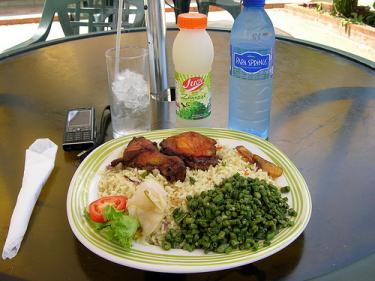
Cuisine: Surinamese cuisine is a fusion of flavors and culinary traditions from various cultures. Dishes such as roti (a flatbread with curried fillings), pom (a baked dish with chicken or fish), and saoto soup (a Javanese chicken soup) reflect diverse cultural influences. Rice, cassava, plantains, and spices like masala and tamarind are common ingredients in Surinamese dishes.
Festivals and Celebrations: Suriname celebrates a multitude of cultural festivals and religious holidays throughout the year. These include Holi Phagwa (Hindu festival of colors), Eid al-Fitr (Islamic festival marking the end of Ramadan), Pagara Estafette (Chinese New Year celebration), and Keti Koti (Emancipation Day commemorating the end of slavery). These events showcase the traditions, music, dance, and food of each community.
Music and Dance: Suriname is known for its vibrant music scene, with diverse genres such as kaseko, kawina, baithak gana, and Indian classical music. Traditional dances like the kawina and the awasa reflect African and Indigenous influences. The Tambú, a drum-based dance of Afro-Surinamese origin, is also popular and often performed during special occasions.
Maroon Culture: The Maroons, descendants of African slaves who escaped from plantations and formed independent communities in the interior rainforests, have a unique cultural heritage. They maintain traditional practices, including the use of medicinal plants, storytelling, and the vibrant rituals of the Winti religion. Maroon villages like Brownsweg and Pikin Slee offer opportunities to experience their distinctive culture.
Nature and Indigenous Heritage: Suriname is blessed with pristine rainforests, rivers, and diverse wildlife. Indigenous communities, such as the Trio, Wayana, and Lokono, have a deep connection to the land and maintain their ancestral traditions. Visitors can learn about their sustainable practices, traditional crafts, and spiritual beliefs, contributing to the preservation of Suriname's natural and cultural heritage.

Land of Rainforest and Wooden Dreams
Greetings, Gestures & Visiting
In Suriname, greetings vary depending on the cultural background of the individuals involved. The country is known for its diverse population, consisting of various ethnic groups, including Creole, Hindustani, Javanese, Maroons, Chinese, and Indigenous peoples. As a result, different greetings and customs are practiced among these communities.
Handshake: A handshake is a common and widely accepted form of greeting in Suriname, especially in formal or business settings. A firm handshake with direct eye contact is considered polite and respectful.
Cheek-to-Cheek Kiss: Among close friends and family members, a cheek-to-cheek kiss might be used as a greeting. The number of kisses may vary based on personal familiarity, ranging from one to three on alternating cheeks.
Namaste: In Hindustani culture, particularly influenced by Indian customs, people may greet each other with the "Namaste" gesture. This involves placing both palms together in a prayer-like position in front of the chest and slightly bowing the head as a sign of respect.
Bowing: Some individuals from Asian communities, such as Chinese or Javanese, may greet each other with a slight bow or nod of the head as a sign of acknowledgment and respect.
Verbal Greetings: Verbal greetings are common across Suriname, and they may include phrases such as "hello," "good morning," "good afternoon," or "good evening." These greetings can be accompanied by a smile and are often followed by asking about one's well-being or exchanging pleasantries.
In Suriname, as in any cultural context, it's important to be mindful of gestures that may be considered inappropriate or offensive. While cultural norms can vary, here are a few gestures that are generally advised to avoid or use with caution in Suriname:
Pointing with the index finger: Pointing directly at someone with your index finger can be perceived as rude or aggressive in Surinamese culture. It's better to use an open hand or gesture with your whole hand to indicate a person or direction.
Showing the sole of your foot: In Surinamese culture, as in many other cultures, showing the sole of your foot, especially towards someone, is considered disrespectful. Crossing your legs with the sole of your foot pointing towards someone or propping up your feet on furniture should be avoided.
Touching someone's head: Touching someone's head, particularly without permission, is considered impolite in Suriname. It's best to refrain from touching people's heads, even in a friendly manner.
Making an "OK" sign with the thumb and index finger: While the "OK" sign (forming a circle with the thumb and index finger) may be innocuous in many cultures, in some parts of the world, including Suriname, it can be interpreted as offensive or vulgar. It's safer to avoid using this gesture to prevent any misinterpretation.
Offensive hand gestures: Suriname, like many countries, has specific hand gestures that are considered offensive or vulgar. It's important to refrain from using any offensive hand gestures, even unintentionally, as they can cause offense or confusion.
Remember that cultural norms can vary, and it's always best to be respectful and observe the behavior of the locals. If you're uncertain about a particular gesture or custom, it's acceptable to politely ask or observe how others behave in similar situations. Demonstrating cultural sensitivity and adapting to local customs will help ensure positive interactions and avoid misunderstandings while in Suriname.
To not be considered rude, anyone visiting a friend is expected to visit everyone they know in the same neighborhood.
In Suriname, the traditional attire varies among the different ethnic groups and is often worn during special occasions and cultural festivals.
Creole Attire: Creole women in Suriname often wear colorful and elaborate dresses called "koto." The koto consists of a long, flowing skirt with a matching blouse. The skirt is typically made of bright, patterned fabric and is worn with a wraparound cloth tied around the waist. The blouse is often made of lace or embroidered fabric and has puffed sleeves.
Hindustani Attire: Hindustani women may wear traditional Indian garments, such as a saree or a salwar kameez. A saree is a long piece of fabric wrapped around the body, while a salwar kameez consists of loose-fitting pants (salwar), a tunic-like top (kameez), and a dupatta (scarf). These outfits come in a variety of colors, fabrics, and patterns, reflecting the rich diversity of Indian culture.
Javanese Attire: Javanese women in Suriname often wear traditional Javanese kebaya, which is a fitted blouse with intricate embroidery and a batik sarong (a wrapped skirt). The kebaya is usually made of delicate lace or silk and is paired with a batik sarong that features traditional Javanese patterns.
Maroon Attire: The Maroon communities in Suriname have their distinct clothing styles. Women may wear colorful headscarves, brightly patterned dresses, and wraparound skirts made of hand-woven cloth. Beaded jewelry, such as necklaces and bracelets, is also commonly worn.
Western-style Clothing: In urban areas and everyday life, Surinamese people commonly wear modern Western-style clothing, similar to what you would see in many other countries. T-shirts, jeans, dresses, and suits are common attire for both men and women. Due to the warm climate, lightweight and breathable fabrics are preferred.
The Javanese women wear sarongs as they would in Indonesia. The Creole women wear the traditional kotomisse, with an angisa or handkerchief.
Diet
Rice is a staple food along with cassava, sweet potatoes, plantains, chicken and seafood. Favorite meals include Moksie alesie (a creole rice dish with chicken, white beans, tomatoes, peppers and spices), bami (a noodle dish mixed with a dark sauce, fried chicken and a hot pepper mixture), saoto ( chicken soup) and poffertjes (tiny dutch pancakes) Pom or Pomtajer is a root of the cassava family. It is ground into a mush and mixed into a casserole with fried chicken and baked in the oven. It is usually eaten with rice and is very popular during special occasions
Rice is a staple food along with cassava, sweet potatoes, plantains, chicken and seafood. Favorite meals include Moksie alesie (a creole rice dish with chicken, white beans, tomatoes, peppers and spices), bami (a noodle dish mixed with a dark sauce, fried chicken and a hot pepper mixture), saoto ( chicken soup) and poffertjes (tiny dutch pancakes) Pom or Pomtajer is a root of the cassava family. It is ground into a mush and mixed into a casserole with fried chicken and baked in the oven. It is usually eaten with rice and is very popular during special occasions

Family
For some groups, child care is handled by one parent at a time. Children spend the first five to six years with their mother and then they can be given to their father or another relative for child-rearing.
Dating Customs
In Suriname, dating rituals can vary depending on cultural backgrounds, personal preferences, and individual circumstances.
Courtship: Traditional courtship practices, such as getting to know each other's families, still hold significance in Suriname. In some communities, it is customary for a man to formally approach the woman's family to express his interest and seek their approval before pursuing a relationship.
Social Gatherings: Dating often involves socializing in group settings. Couples may go out with friends or attend community events together. These occasions provide an opportunity for individuals to get to know each other in a more relaxed and casual environment.
Cultural Influences: Surinamese dating rituals can be influenced by the cultural backgrounds of the individuals involved. For example, individuals from Hindustani or Javanese communities may adhere to specific customs and traditions when it comes to dating, which may involve the involvement of family members and adherence to religious guidelines.
Modern Approaches: With globalization and modernization, dating practices in Suriname have also been influenced by Western norms. Individuals may meet through mutual friends, online dating platforms, or social media. Casual dating, where individuals spend time together without a serious commitment, is becoming more common among younger generations.
Respect and Politeness: Politeness and respect are important aspects of dating in Surinamese culture. It is expected that individuals treat each other with courtesy, show genuine interest, and engage in open communication. Being considerate of cultural and personal boundaries is essential in building a successful relationship.
Traditional Gender Roles: Traditional gender roles can influence dating dynamics in Suriname, although they are evolving over time. It is not uncommon for men to take the lead in initiating dates and planning activities, while women may be expected to demonstrate modesty and traditional feminine qualities.
Recreation
In Suriname, there are various recreational activities enjoyed by its residents.
Outdoor Exploration: Suriname's abundant natural beauty provides opportunities for outdoor activities and exploration. Many people enjoy hiking through rainforests, visiting nature reserves, and exploring the country's diverse ecosystems. Popular destinations for outdoor enthusiasts include the Central Suriname Nature Reserve, Brownsberg Nature Park, and the Galibi Nature Reserve.
Water Activities: With its vast rivers and coastal areas, water activities are popular in Suriname. People engage in fishing, boating, kayaking, and canoeing in rivers like the Suriname River and Marowijne River. Suriname's Atlantic coastline offers opportunities for swimming, sunbathing, and beach picnics.
Sports: Football (soccer) is widely popular in Suriname, and many people actively participate in or watch matches. Basketball, volleyball, cricket, and athletics are also enjoyed by both young and old. Suriname has produced talented athletes who have excelled in international competitions.
Cultural Events and Festivals: Suriname's rich multicultural heritage is celebrated through various cultural events and festivals. These vibrant gatherings provide opportunities for recreational enjoyment and cultural immersion. Festivals such as Holi Phagwa, Keti Koti (Emancipation Day), and the Suriname Jazz Festival attract locals and tourists alike with music, dance, food, and traditional performances.
Cuisine and Socializing: Surinamese cuisine is diverse and delicious, and dining out with friends and family is a popular recreational activity. People often gather at restaurants or food stalls to enjoy local dishes like roti, bami, and pom. Sharing a meal, conversing, and socializing are integral parts of Surinamese culture.
Music, Dance, and Art: Suriname has a vibrant arts and cultural scene. Music and dance play significant roles in recreational activities, with genres such as kaseko, kawina, and baithak gana being popular. Local artists and musicians regularly perform at concerts, clubs, and cultural events, providing entertainment and opportunities for leisure.
Community Events and Gatherings: Surinamese communities often organize social events, such as fairs, religious celebrations, and neighborhood gatherings. These events bring people together and provide opportunities for socializing, connecting with others, and enjoying local traditions and customs.
Shopping and Entertainment: Shopping malls, markets, and entertainment centers offer recreational opportunities for Surinamese residents. People enjoy shopping for clothes, electronics, and local crafts, as well as watching movies at cinemas or attending live performances and shows.
Holidays
Independence Day
11/25Independence Day
Dates of Interest
- October/November
Suriname's Javanese community celebrates various cultural events, including Javanese New Year (Suro) and Javanese Independence Day (Hari Kemerdekaan). These celebrations often involve traditional music, dance, and rituals.
How do people greet each other in Suriname?
Greetings vary by ethnic background, but a firm handshake with direct eye contact is common and widely accepted, especially in formal or business settings. Verbal greetings like 'hello' or 'good morning' with a smile are used across all communities.
Do
- Offer a firm handshake with direct eye contact in formal settings
- Use 'Namaste' (palms together, slight bow) with people of Hindustani culture
- Offer a slight bow or nod when greeting people from Chinese or Javanese communities
- Reserve cheek-to-cheek kisses for close friends and family
Good to know
- Cheek kisses among close friends may range from one to three on alternating cheeks
- Follow greetings by asking about someone's well-being
What is the food like and how do people eat in Suriname?
Surinamese cuisine is a fusion of many cultures, built around staples like rice, cassava, sweet potatoes, plantains, chicken and seafood. Popular dishes include roti, bami, saoto soup, moksie alesie, and pom.
Good to know
- Pom (or pomtajer) is a baked cassava-family casserole with chicken, popular at special occasions
- Dining out and sharing meals with friends and family is an integral social activity
- Try local favorites like roti, bami, saoto, and poffertjes (tiny Dutch pancakes)
What social etiquette should I know for visiting people in Suriname?
Hospitality carries strong social obligations, and politeness and respect are central to interactions.
Do
- When visiting a friend, also visit everyone you know in the same neighborhood to avoid seeming rude
- Treat others with courtesy and observe local behavior when unsure
What should I wear in Suriname?
In urban areas and everyday life, people wear modern Western-style clothing such as t-shirts, jeans, dresses, and suits. Traditional ethnic attire like the Creole koto, Hindustani saree, and Javanese kebaya is worn on special occasions and cultural festivals.
Good to know
- Choose lightweight, breathable fabrics due to the warm climate
Which gestures should I avoid in Suriname?
Several gestures are considered rude or offensive, so use hand gestures with care and observe how locals behave.
Do
- Use an open hand or your whole hand to indicate a person or direction
Don’t
- Don't point directly at someone with your index finger
- Don't show the sole of your foot toward someone or prop feet on furniture
- Don't touch someone's head, even in a friendly way
- Don't make the 'OK' sign, as it can be seen as offensive or vulgar
Good to know
- If unsure about a gesture, politely ask or observe others
What are family and child-rearing customs like in Suriname?
For some groups, childcare is handled by one parent at a time: children spend their first five to six years with their mother, then may be given to their father or another relative for further child-rearing.
What do people do for fun in Suriname?
Residents enjoy the country's natural beauty through hiking, boating, and beach activities, while football is the most popular sport. Cultural festivals, music, dining out, and community gatherings are central to leisure.
Good to know
- Explore nature at the Central Suriname Nature Reserve, Brownsberg Nature Park, or Galibi Nature Reserve
- Try water activities like fishing, kayaking, and canoeing on the Suriname and Marowijne Rivers
- Enjoy festivals such as Holi Phagwa, Keti Koti, and the Suriname Jazz Festival
- Watch or join football, basketball, volleyball, or cricket
Last updated: 2026-07-12 · Sources: CountryReports
Photos of Suriname
Photos of Suriname

Travel and Tourism
Travel and Tourism
- Travel Alert Status
- Level 1: Exercise Normal Precautions
- Currency
- Surinamese Dollar (SRD)
- Time Difference
- UTC-3 (2 hours ahead of Washington, DC, during Standard Time)
- Climate
- Suriname's climate is tropical, hot and humid year-round. Daytime temperatures in Paramaribo average 75°F to 90°F. Temperatures in the interior, not moderated by the steady coastal breezes, are generally higher. Seasons are distinguished mainly by more or less rain, with annual rainfall averaging 87 inches. Indeed, locals will tell you that the four seasons of Suriname are: 1) Little Rainy Season (December to February); 2) Little Dry Season (March to April); 3) Big Rainy Season (May to August); and Big Dry Season (September to November). The hottest months of the year are September and October when temperatures average 90 �F (32 �C). Suriname lies outside hurricane and earthquake zones. Parts of Paramaribo experience heavy flooding. Isolated flooding occurs on some city streets and in low-lying areas of Paramaribo for up to 24 hours at a time.
- Airports
- 46
Read the full travel guide — health, safety, vaccinations, disease risk, sanitation, and transit details.
View full travel guideRecipes
Recipes
History
History
Historical Eras
Indigenous & Early Contact
3000 BCE – 1651
Arawak and Carib peoples inhabited the Suriname region for millennia before European contact. Christopher Columbus sighted the coast in 1498, and Spain formally claimed the territory in 1593, but neither power invested significantly in colonization. The region remained primarily under indigenous control until sustained European settlement began in the early seventeenth century.
Colonial Plantation Era
1651 – 1863
The first permanent European settlement was established in 1651, and the colony passed definitively to the Dutch in 1667 following the Treaty of Breda. Sugar, coffee, and cocoa plantations were built on the labor of enslaved Africans, who endured extreme brutality; many escaped into the interior, founding the Bush Negro (Maroon) communities that persist today. Britain briefly administered the colony twice (1799–1802 and 1804–1816) before the Dutch resumed control, and slavery was finally abolished in 1863.
Late Colonial & Bauxite Age
1863 – 1954
Following emancipation, plantation agriculture declined as labor costs rose, and rice, bananas, and citrus gradually replaced traditional export crops. The economy was fundamentally transformed after World War I when the American firm ALCOA began exploiting vast bauxite deposits, with Suriname supplying over 75% of U.S. bauxite imports during World War II. The colony gained increasing administrative autonomy through the mid-twentieth century.
Autonomy & Independence
1954 – 1980
Suriname became an autonomous constituent country of the Kingdom of the Netherlands on December 15, 1954, and achieved full independence on November 25, 1975, with Henk Arron serving as the country's first Prime Minister. Political parties formed largely along ethnic lines, representing Creole, Hindustani, and Javanese constituencies, while leftist factions pressed for deeper structural reform. The new parliamentary democracy functioned for only five years before its institutions were dismantled.
Military Rule
1980 – 1991
On February 25, 1980, sixteen noncommissioned officers led by Desi Bouterse overthrew the elected government, suspended the constitution, and dissolved the legislature. In December 1982, fifteen prominent opposition figures — including journalists, lawyers, and union leaders — were arrested and executed, prompting the Netherlands and the United States to suspend aid and triggering severe economic contraction. After years of nominally civilian cabinets and mounting internal and international pressure, a democratic election was held in 1987, though the military briefly seized power again in 1989.
Democratic Modern Era
1991 – present
A democratically elected government was restored in 1991, inaugurating a period of gradual political stabilization despite recurring economic challenges and the lingering influence of Bouterse, who was later convicted of drug trafficking by a Dutch court yet returned to the presidency in 2010. The Surinamese dollar replaced the guilder in 2004, reflecting ongoing efforts to modernize the economy, which remains anchored by bauxite, gold, and oil revenues. Suriname continues to navigate ethnic pluralism, environmental pressures, and questions of accountability for the abuses of the military era.
Overview
Suriname became a Dutch colony in 1667. The new colony, Dutch Guiana, did not thrive. Historians cite several reasons for this, including Holland’s preoccupation with its more extensive (and profitable) East Indian territories, violent conflict between whites and native tribes, and frequent uprisings by the imported slave population, which was often treated with extraordinary cruelty. Barely, if at all, assimilated into European society, many of the slaves fled to the interior, where they maintained a West African culture and established the five major Bush Negro tribes in existence today--the Djuka, Saramaccaner, Matuwari, Paramaccaner, and Quinti.
Plantations steadily declined in importance as labor costs rose. Rice, bananas, and citrus fruits replaced the traditional crops of sugar, coffee, and cocoa. Exports of gold rose beginning in 1900. The Dutch Government gave little financial support to the colony. Suriname’s economy was transformed in the years following World War I, when an American firm (ALCOA) began exploiting bauxite deposits in East Suriname. Bauxite processing and then alumina production began in 1916. During World War II, more than 75% of U.S. bauxite imports came from Suriname.
In 1951, Suriname began to acquire a growing measure of autonomy from the Netherlands. Suriname became an autonomous part of the Kingdom of the Netherlands on December 15, 1954, and gained independence on November 25, 1975.
Most of Suriname’s political parties took shape during the autonomy period and were overwhelmingly based on ethnicity. For example, the National Party of Suriname found its support among the Creoles, the Progressive Reform Party members came from the Hindustani population, and the Indonesian Peasant’s Party was Javanese. Other smaller parties found support by appealing to voters on an ideological or pro-independence platform; the Partij Nationalistische Republiek (PNR) was among the most important. Its members pressed most strongly for independence and for the introduction of leftist political and economic measures. Many former PNR members would go on to play a key role following the coup of February 1980.
Suriname was a working parliamentary democracy in the years immediately following independence. Henk Arron became the first Prime Minister and was re-elected in 1977. On February 25, 1980, 16 noncommissioned officers overthrew the elected government. The military-dominated government then suspended the constitution, dissolved the legislature, and formed a regime that ruled by decree. Although a civilian filled the post of president, a military man, Desi Bouterse, actually ruled the country.
Throughout 1982, pressure grew for a return to civilian rule. In response, the military ordered drastic action. Early in December 1982, military authorities arrested and killed 15 prominent opposition leaders, including journalists, lawyers, and trade union leaders.
Following the murders, the United States and the Netherlands suspended economic and military cooperation with the Bouterse regime, which increasingly began to follow an erratic but generally leftist-oriented political course. Economic decline rapidly set in after the suspension of economic aid from the Netherlands. The regime restricted the press and limited the rights of its citizens.
Continuing economic decline brought pressure for change. During the 1984-87 period, the Bouterse regime tried to end the crisis by appointing a succession of nominally civilian-led cabinets. Many figures in the government came from the traditional political parties that had been shoved aside during the coup. The military eventually agreed to free elections in 1987, a new constitution, and a civilian government.
Another pressure for change had erupted in July 1986, when a Bush Negro (aka Maroon) insurgency, led by former soldier Ronnie Brunswijk, began attacking economic targets in the country’s interior. In response, the army ravaged villages and killed suspected Brunswijk supporters. Thousands of Bush Negroes fled to nearby French Guiana. In an effort to end the bloodshed, the Surinamese Government negotiated a peace treaty, called the Kourou Accord, with Brunswijk in 1989. However, Bouterse and other military leaders blocked the accord’s implementation.
On December 24, 1990, military officers forced the resignations of the civilian President and Vice President elected in 1987. Military-selected replacements were hastily approved by the National Assembly on December 29. Faced with mounting pressure from the U.S., other nations, the Organizatio
Timeline of Key Events
1498
Christopher Columbus sights the coast of Suriname.
Christopher Columbus sights the coast of Suriname.
1593
Spanish explorers visit the area and name it Suriname.
Spanish explorers visit the area and name it Suriname, after the country’s earliest inhabitants, the Surinen.
1651
First permanent European settlement in Suriname.
First permanent European settlement in Suriname, established by the British at Paramaribo by Lord Francis Willoughby.
1667
British cede their part of Suriname to the Netherlands .
British cede their part of Suriname to the Netherlands in exchange for New Amsterdam (later called New York City).
1682
Coffee and sugar cane plantations established and worked by African slaves.
Coffee and sugar cane plantations established and worked by African slaves.
1799 – 1802
British rule reimposed.
British rule reimposed.
1804 – 1816
British rule reimposed.
British rule reimposed.
Read the full history profile — narrative overview, defining eras, and the complete timeline in one place.
View expanded historyInteresting Facts
Interesting Facts
Eighty percent of Suriname is covered with tropical rainforest.
African slaves were brought to Suriname to work on the coffee and sugar plantations
See every fact — trivia, oddities, and curious tidbits gathered from across the country.
View all interesting factsGeography and Environment
Geography and Environment
- Terrain
- mostly rolling hills; narrow coastal plain with swamps
- Climate
- Suriname's climate is tropical, hot and humid year-round. Daytime temperatures in Paramaribo average 75°F to 90°F. Temperatures in the interior, not moderated by the steady coastal breezes, are generally higher. Seasons are distinguished mainly by more or less rain, with annual rainfall averaging 87 inches. Indeed, locals will tell you that the four seasons of Suriname are: 1) Little Rainy Season (December to February); 2) Little Dry Season (March to April); 3) Big Rainy Season (May to August); and Big Dry Season (September to November). The hottest months of the year are September and October when temperatures average 90 °F (32 °C). Suriname lies outside hurricane and earthquake zones. Parts of Paramaribo experience heavy flooding. Isolated flooding occurs on some city streets and in low-lying areas of Paramaribo for up to 24 hours at a time.
- Natural Hazards
- NA
- Current Environmental Issues
- deforestation as timber is cut for export; pollution of inland waterways by small-scale mining activities
Read the full geography and environment profile — terrain, climate, natural resources, hazards, land use, and international agreements.
View full geographyPeople & Demographics
People & Demographics
Religion
Languages Spoken
Dutch (official), English (widely spoken), Sranang Tongo (Surinamese, sometimes called Taki-Taki, is native language of Creoles and much of the younger population and is lingua franca among others), Hindustani (a dialect of Hindi), Javanese
- Dutch
Population
- Population
- 486,618
- Population in Major Urban Areas
- PARAMARIBO (capital) 278,000
- Nationality Noun
- Surinamer(s)
- Ethnic Groups
- Hindustani (also known locally as ""East Indians""; their ancestors emigrated from northern India in the latter part of the 19th century) 37%, Creole (mixed white and black) 31%, Javanese 15%, ""Maroons"" (their African ancestors were brought to the count
Education
- Literacy Definition
- age 15 and over can read and write
Health Information
- Major Infectious Diseases — degree of risk
- very high
Read the full people and society profile — demographics, health, education, religion, languages, and notable people.
View full people and societyGovernment & Politics
Government & Politics
Country Identity
- Country Name
- Suriname
- Full Country Name
- Republic of Suriname
- Local - Long
- Republiek Suriname
- Local - Short
- Suriname
- Former Name
- Netherlands Guiana, Dutch Guiana
Government Structure
- Government Type
- constitutional democracy
- Legal System
- based on Dutch legal system incorporating French penal theory
- Executive Branch
- chief of state: President Chan Santokhi (since 16 July 2020); Vice President Ronnie Brunswijk (since 16 July 2020); note - the president is both the chief of state and head of government head of government: President Chan Santokhi (since 16 July 2020); Vice President Ronnie Brunswijk (since 16 July 2020); note - the president is both the chief of state and head of government cabinet: Cabinet of Ministers appointed by the president elections: president and vice president elected by the National Assembly or, if no presidential or vice presidential candidate receives a two-thirds constitutional majority in the National Assembly after two votes, by a simple majority in the larger United People's Assembly (893 representatives from the national, local, and regional councils), for five-year terms; election last held on 25 May 2020 (next to be held in 2025) election results: Chan Santokhi elected president unopposed by the National Assembly on 13 July 2020; Santokhi's Progressive Reform Party had won a majority in the May 2020 parliamentary elections, allowing the National Assembly to elect him directly without requiring a vote in the United People's Assembly
- Legislative Branch
- unicameral National Assembly or Nationale Assemblee (51 seats; members are elected by popular vote to serve five-year terms) elections: last held 25 May 2005 (next to be held in 2010) election results: percent of vote by party - NF 39.73%, NDP 22.2%, VVV 13.79%, A-Com 7.21%, A-1 5.86%, other 7.42%; seats by party - NF 23, NDP 15, VVV 5, A-Com 5, A-1 3
- Judicial Branch
- Cantonal Courts and a Court of Justice as an appellate court (justices are nominated for life)
- Suffrage
- 18 years of age; universal
- Constitution
- ratified 30 September 1987
- Independence
- 25 November 1975 (from Netherlands)
- National Holiday
- Independence Day, 25 November (1975)
Capital City
- Capital Name
- Paramaribo
- Capital - geographic coordinate
- 5 50 N, 55 10 W
- Capital Time Difference
- UTC-3 (2 hours ahead of Washington, DC, during Standard Time)
the name may be the corruption of a Carib (Kalina) village or tribe named Parmirbo
Military
Branches: Suriname Armed Forces: Ground Forces, Naval Forces, Air Forces
Embassy / Diplomatic Mission
U.S. Embassy Paramaribo
Drs. Sophie Redmondstraat 129, Paramaribo, Suriname
Telephone: (597)-472900
Emergency after-hours telephone: (597)-0710-1112
Facsimile: (597)-425788
Read the full government profile — flag symbolism, national anthem, and other national symbols.
View full government detailsEconomy
Economy
Suriname's economy has historically been dominated by the mining sector, with bauxite, gold, and oil traditionally accounting for the bulk of export earnings and a significant share of GDP. However, the closure of the Suralco alumina refinery in 2017 ended nearly a century of bauxite production in the country, and gold and crude oil now serve as the main export commodities. Gold mining, led by operations from Newmont and Zijin Mining (formerly IAMGOLD's Rosebel), contributes the largest share of foreign exchange earnings, while state oil company Staatsolie continues to play a central role in the economy.
The country has faced severe macroeconomic challenges in recent years, including high public debt, currency depreciation, and double-digit inflation. In 2021, Suriname defaulted on its sovereign debt and entered into a debt restructuring process, securing an Extended Fund Facility arrangement with the International Monetary Fund to support fiscal consolidation, monetary tightening, and structural reforms. The government of President Chan Santokhi has implemented austerity measures, reduced fuel and electricity subsidies, and moved toward a market-determined exchange rate.
Medium-term prospects have been transformed by major offshore oil discoveries in Block 58, where TotalEnergies and APA Corporation reached a final investment decision in 2024 on the GranMorgu project, with first oil expected around 2028. These developments are projected to deliver substantial revenues and reshape the economy, though success will depend on prudent fiscal management, transparent governance of resource wealth, and continued progress on reducing inflation and stabilizing the Surinamese dollar.
Snapshot
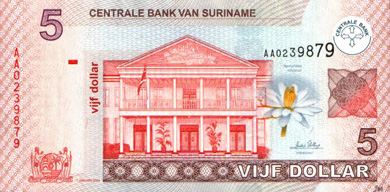
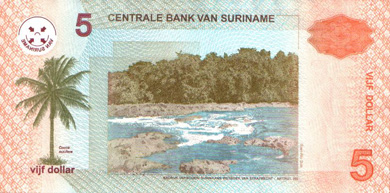
- Currency Name and Code
- Suriname Guilder (SRG)
- GDP — official exchange rate
- $1,130,000,000 (USD)
- GDP Real Growth Rate
- 2%
Banknotes
Budget & Public Finance
- Fiscal Year
- calendar year
- Annual Budget
- $425,900,000 (USD)
- External Debt
- $504,300,000 (USD)
- Economic Aid
- $37,000,000 (USD)
Labor, Industry & Trade
- Industries
- bauxite and gold mining, alumina production, oil, lumbering, food processing, fishing
- Agriculture Products
- paddy rice, bananas, palm kernels, coconuts, plantains, peanuts; beef, chickens; forest products; shrimp
- Export Commodities
- alumina, crude oil, lumber, shrimp and fish, rice, bananas
- Export Partners
- US 25.7%, Norway 20.4%, France 8.3%, Trinidad and Tobago 6.5%, Canada 6.1%, Iceland 6.1%, Netherlands 5.7%
- Import Commodities
- capital equipment, petroleum, foodstuffs, cotton, consumer goods
- Import Partners
- US 22.7%, Netherlands 16.1%, China 12.3%, Trinidad and Tobago 11.4%, France 7.6%, Japan 6%, Netherlands Antilles 4.5%
Energy
- Oil Production
- 12,000 bbl/day
- Oil Consumption
- 14,000 bbl/day
- Oil Reserves
- 150,000,000 bbl/day
- Natural Gas Production
- 0 cu m
- Natural Gas Consumption
- 0 cu m
- Natural Gas Imports
- 0 cu m
- Natural Gas Exports
- 0 cu m
- Natural Gas Reserves
- 0 cu m
Communications
- Telephone System
- general assessment: international facilities are good domestic: combined fixed-line and mobile-cellular teledensity 185 telephones per 100 persons; microwave radio relay network international: country code - 597; satellite earth stations - 2 Intelsat (Atlantic Ocean)
- Internet Country Code
- .sr
News & Weather
News & Weather
Current Weather
Latest News
Centurion Commences Field Work at Limestone Gold Project, Suriname - Investing News Network
Investing News Network · 20h ago
STS Joint Venture and TotalEnergies partner with Beyond the Sea to Evaluate Wind-Assisted Towing for Suriname’s GranMorgu FPSO - SBM Offshore
SBM Offshore · 5d ago
Find a slice of Suriname’s diversity at Grand Roopram Roti | Review - Orlando Sentinel
Orlando Sentinel · 4d ago
Wind-assisted towing on the cards for SBM Offshore’s Suriname-bound FPSO - Offshore-Energy.biz
Offshore-Energy.biz · 5d ago
News - South Dakota National Guard concludes historic “Operation Rumble in the Jungle” in Suriname - DVIDS
DVIDS · 15d ago
FPSO Will Validate Wind-Assisted Kite Traction Towing on Trip to Suriname - The Maritime Executive
The Maritime Executive · 4d ago
Centurion Commences Field Work at Limestone Gold Project, Suriname - TradingView
TradingView · 21h ago
Halliburton Wins Contract for TotalEnergies' Offshore Suriname Project - Yahoo Finance
Yahoo Finance · 6d ago
News via Google News
Climate Overview
Suriname's climate is tropical, hot and humid year-round. Daytime temperatures in Paramaribo average 75°F to 90°F. Temperatures in the interior, not moderated by the steady coastal breezes, are generally higher.
Seasons are distinguished mainly by more or less rain, with annual rainfall averaging 87 inches. Indeed, locals will tell you that the four seasons of Suriname are: 1) Little Rainy Season (December to February); 2) Little Dry Season (March to April); 3) Big Rainy Season (May to August); and Big Dry Season (September to November). The hottest months of the year are September and October when temperatures average 90 �F (32 �C). Suriname lies outside hurricane and earthquake zones. Parts of Paramaribo experience heavy flooding. Isolated flooding occurs on some city streets and in low-lying areas of Paramaribo for up to 24 hours at a time.
Videos
Videos
2 curated YouTube videos.
Source: YouTube
Source: YouTube
Frequently Asked Questions
Frequently Asked Questions
What is the population of Suriname?
How do people greet each other in Suriname?
What is the food like and how do people eat in Suriname?
What social etiquette should I know for visiting people in Suriname?
What should I wear in Suriname?
Which gestures should I avoid in Suriname?
What are family and child-rearing customs like in Suriname?
What do people do for fun in Suriname?
What is the capital of Suriname?
Where is Suriname located?
What countries border Suriname?
What are the major religions practiced in Suriname?
What is the currency of Suriname?
What languages are spoken in Suriname?
What is the geography of Suriname like?
What is Suriname known for?
Last reviewed 2026