
 English
 Español
 中文
中文 हिन्दी
 Français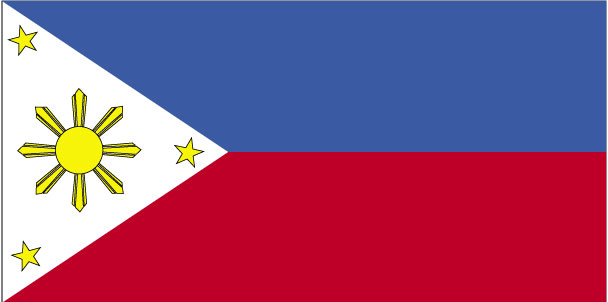
Philippines
Pilipinas
Declare Your Relationship to Philippines
CountryReports Community
- Studying2
- From Philippines1
- Philippines heritage0
- Visited0
- Want to visit0
Customs and Culture
Customs and Culture
About the People
Filipinos are sensitive people. Insincerity is easily detected and can ruin a relationship. Individualism is less important than the family. A family member will often sacrifice personal goals or desires to help the family or another family member. In general, Filipinos have a more relaxed view of time and may not always begin meetings or appointments promptly. Gratitude and saving face, is paramount to Filipinos. Fatalism is a common attitude. Success may also be attributed to fate rather than ability or effort.
Unlike other Asian countries where women tend to be in more subservient positions, women in the Philippines have had high societal positions since precolonial times. Since there is sexual equality, businesses are more accepting of women performing business. This attitude is apparent with the current Philippine preside. President Gloria Macapagal-Arroyo is the second woman to hold this esteemed position. Corazon Aquino was the first female president and held the position from 1986-1992).
Filipinos are simple people and are content with having enough money to put food on the table. Or that they strive to earn only as much as they need. This is called “isang kahig, isang tuka”, which is basically working & spending all of the amount of money that you earned, and not being able to save some for an emergency or the future.
Cultural Attributes
Filipinos are sensitive people. Insincerity is easily detected and can ruin a relationship. Individualism is less important than the family. A family member often sacrifices personal goals or desires to help the family or another family member. Filipinos generally have a more relaxed view of time and may not always begin meetings or appointments promptly. Gratitude and saving face are paramount to Filipinos. Fatalism is a common attitude. Success may also be attributed to fate rather than ability or effort.
Unlike other Asian countries where women tend to be more subservient, women in the Philippines have had high societal positions since pre-colonial times. Since sexual equality exists, businesses are more accepting of women performing business. This attitude is apparent with the current Philippine president. President Gloria Macapagal-Arroyo is the second woman to hold this esteemed position. Corazon Aquino was the first female president and held the position from 1986-1992).
Filipinos are simple people who are content with having enough money to put food on the table. They strive to earn only as much as they need. This is called “isang kahig, isang tuka,” which means working and spending all of the money that you earn and not being able to save some for an emergency or the future.

Island of a Thousand Smiles
Greetings, Gestures & Visiting
English is commonly used in urban areas, and normal English greetings are acceptable. The common greeting for acquaintances and friends is Komusta, which loosely translates in English as “where are you going/what are you doing.” People are taught to show respect to each other.
People greet each other in English or Tagalog, since Filipinos are bilingual (many speak Filipino--which is the relatively new “breed” of Tagalog--it is a mixture of old “Tagalog” words, plus some Filipinized Spanish/English words, or Visayan, & English). During the day, people greet each other Good Morning/Magandang Umaga (which translates to beautiful morning/day). Using the term “po” when speaking to someone older is considered courteous so that Magandang Umaga would be Magandang Umaga Po. Good morning / Magandang umaga (with or without “po”), Good afternoon / Magandang tanghali (with or without “po”), Good evening / Magandang gabi (with or without “po”).
It is “warmer” to greet someone in Tagalog or whatever dialect they speak. It is like greeting a family member.
To call someone over one would call the person by their first name, some (which is considered rude) say “psst” or "hoy”, which is like “hey”. When referring to older people, one uses the term lola (grandma), lolo (grandpa) or when referring to strangers, one uses the term "manang" (for an older woman) and manong (for an older man).
Beckoning is done by waving all fingers with the palm facing down. It is also customary for Filipinos to use a lot of hand and facial gestures to communicate. Filipinos will point to an object by shifting their eyes toward it or pursing their lips and pointing with their mouth, not their hands. Filipinos often greet each other with an "eyebrow" flash, quickly lifting the eyebrows. In their communication, speaking politely is as essential as talking with a gentle tone. Arguing is not acceptable, along with public criticism. To recognize an elder's presence (usually someone at least 15 years older), there is this gesture called "mano"; like "kissing the hand"; in English, it is to momentarily place one's forehead (by bowing) on the back of an older person's hand. One usually says “mano po” when doing this. This is done when greeting older people: grandparents, godparents, uncles & aunts. When dining, leaving some food on your plate indicates that your host has provided you with enough food. You may be asked to participate in group singing sessions when you are being entertained during business times.
Hospitality is important to Filipinos. Guests are made to feel at ease and should, in turn, be tactful and sincere. The word “hostess” should not be used when referring to the woman of the house. Filipinos attach great importance to personal and family honor. If possible, criticism should be avoided. As with many Asian countries, removal of shoes is customary when entering someone's home. By doing this, the visitors show their respect for the family and their home, as well as show basic courtesy.
When guests leave, it is ethical for them to say “thank you.” Women hug and/or kiss each other on the cheek when greeting each other hello or saying goodbye; this is referred to as a “beso.”
People in the Philippines love to socialize. A colloquial term for going out is “gimik”. This is when people go out at night on weekends to meet up with peers, in which case they wear their “Gimik outfits” (whatever is “in”).
As elsewhere in the world, clothing trends in the Philippines have somewhat conformed to Western standards, with a few exceptions. Women generally wear Western-style dresses or wraparound skirts with blouses. Traditional clothing is generally worn on special occasions and by very few ethnic minorities. This would include the Barong Tagalog, which is worn with a shirt inside for men. Then for women, there is the “baro at saya”or “baro't saya”
Other clothes include “pambahay” or “pang-bahay” wear (bahay means house), or clothes that one wears at home. A typical pambahay would be a loose-fitting garment for women that some refer to as “bestida” This would be a one-piece clothing that is either sleeveless/sleeved, & extends down to the knee area, sometimes longer (kind of like this dress but 2-3 sizes bigger and is worn with rubber 'slippers' or flip flops, which are un or de-glamorized Havaianas. They are called tsinelas. Men usually wear a pair of shorts & a shirt or shorts & sando at home & “tsinelas” too. Some women prefer to wear sleeveless cotton tops and shorts when staying in.
Diet
Rice is the staple food in the Filipino diet. It is prepared in a variety of tasty ways and is often included in desserts as well as main meals. The primary source of protein is fish, which is accompanied by a variety of vegetables and tropical fruits.
A typical family eats 3-4 times a day. Breakfast, lunch, (some have “merienda”, which usually consists of desserts called “kakanin” which are made of sticky rice, sugar, coconut milk, etc., or some light snacks such as rice porridge or pansit--noodles) & dinner. Some eat twice a day (brunch, dinner). The “traditional” eat rice with every meal. A typical Filipino meal consists of rice and a “viand” which usually has some type of meat like
beef/chicken/pork or fish in some soup mixed with veggies. Filipinos love sauces, too. Usually there's fish sauce (“patis”), soy sauce (“toyo”), vinegar (”suka“)
Standard mealtimes would be around 8-10 for breakfast, 12-2 for lunch, 3-4 for merienda, and 6-9 pm for dinner.
Conversation is casual during meals. The best way for a guest to compliment a meal is to eat heartily. A small portion is left on the plate to indicate the person has had enough to eat.
Rice is the staple food in the Filipino diet. The primary source of protein is fish, which is accompanied by a variety of vegetables and tropical fruits.
A typical family eats three to four times a day. Breakfast, lunch, (some have “merienda”, which usually consists of desserts called “kakanin” which are made of sticky rice, sugar, coconut milk, etc., or some light snacks such as rice porridge or pansit--noodles) & dinner. Some eat twice a day (brunch, dinner). A "traditional" person eats rice at every meal. A typical Filipino meal consists of rice and a “viand” which usually has some type of meat like
beef/chicken/pork or fish in some soup mixed with veggies. Filipinos love sauces, too. Usually there's fish sauce (“patis”), soy sauce (“toyo”), vinegar (”suka“).
Standard mealtimes is around 8-10 AM for breakfast, 12-2 PM for lunch, for merienda, and 6-9 PM for dinner.

Family
The average Filipino family is large, often with four or more children. Professionally and otherwise, Filipino women generally enjoy equality with men. Family ties are significant to Filipinos and usually influence many aspects of their lives. Filipino family members tend to feel free to call on one another for financial assistance. The borrower is then expected to help other family members when in a position to do so.
Dating Customs
In urban areas, dating habits are similar to Western styles. Group dating begins in the early teens. The groom and his family are obligated to pay for the wedding ceremony and feast.
Recreation
Teenagers form peer groups called barkadas, a kind of friendship club that is essential to their lives. Each barkada is either all male or all female. Members develop their slang and go almost everywhere together.
Filipinos enthusiastic about games such mahjongg, a Chinese game played with 144 tiles. Chess, checkers, dama (a type of darts), and dominos are also very popular and often played on street corners. Kali, a martial art indigenous to the Philippines, was originally developed for defense and partly based on skill with a wavy-edged sword. According to legend, when Ferdinand Magellan, the first Spanish visitor, arrived in 1524, islanders opposed him using kali swords and were killed by their leader, Lapu Lapu-now, considered a folk hero. Modern kali practitioners use weapons such as sticks and knives.
Children play sipa, patintero, luksong tinik, piko, “jack stone”, rock paper scissors, bahay-bahayan, lutu-lutuan which is played at home/in the streets/in their communities. The wealthier children have electronic toys that they play with on televisions and also play chess, badminton, tennis, and swimming.
Student Life
Children do different things before school, depending on their family status and location. For example, children in rural areas get up and care for their animals before school. In the lower-middle class and upper classes, children must take a bath and have breakfast before going to school. Sometimes, lower-income families send their children to school without eating breakfast. Other lower-income families have rice with canned sardines, dried fish, or noodles. Families with a higher income tend to have meat, fish, or fried eggs for breakfast.
Most children in the rural area walk to school. Some take the jeepney (a Philippines bus seating about a dozen passengers) or the tricycle (motorcycles with a sidecar). Only a few families have their transportation. Families are responsible for ensuring their children attend school, but the school does not provide this service.
Except for schools in remote, mountainous areas, the Philippines has essential resources such as books, paper, and desks. Some of the modern equipment is either donated by the government or by foreign-assisted programs. Private schools have much better facilities than public schools. Problems in the schools include a lack of updated technology and a lack of teacher training. Some teachers are not motivated because their salaries are at the poverty level. The most severe problem is the lack of classrooms. Some classes are held under the trees, or the classes are so full that children are sitting on floors.
School usually starts at 7:30 A.M., with the first recess around 9:30. Lunch is generally at 11:30. The children typically go home to eat lunch. Those children whose homes are far from school bring a packed lunch of rice and a viand. Classes resume again around 1:00 P.M. and end around 4:00 P.M. In a public school ratio, the student-teacher would be 45:1. For private schools, it is less. After school, some children play around the school grounds or in the plaza. Additionally, going to computer stations and playing computer games is becoming a trend. Most children go directly home and watch TV. Somebody at home, like a mom or a relative, always stays with the family to watch the children. Very few attend private lessons such as piano, ballet, or taekwondo because of the cost of such classes. A child starts grade one at 6-7 years old and then finishes grade 6 at around 12. The main subjects taught at the primary level include English (grammar and literature), Filipino (grammar and literature), science, math, values, social studies (History, etc), P.E., and home economics. Private schools also have computer classes. English subjects are taught from pre-school to college. In addition, exposure to media provides children with enough English to be familiar with the language but not to master it.
Holidays
Independence Day
6/12Independence Day
note: 12 June 1898 was the date of independence from Spain; 4 July 1946 was the date of independence from the US
Christmas
12/25Christmas
The Philippines have celebrated Christmas since the sixteenth century when the Philippines were a Spanish Colony. The holiday begins with the Feast of the Immaculate Conception on December 8th followed by the nine-day Novena of Misas del Gallo (Masses of the Rooster), a series of pre-dawn masses beginning on December 16th. In Tagalog the masses are knows as Simbang Gabi (Night Mass).
Christmas decorations include Santa Claus, Christmas Trees, wreaths, candles, colored lights, Christmas cards and the Parol (a symbolic five pointed star of Bethlehem, with tassels at each point and affixed to bamboo poles covered with colored rice paper.).
During the days before Christmas, villages sponsor lantern festivals. These festivals originated from the parol parades of the nineteenth century.
Midnight Mass is celebrated on Christmas Eve after which families return home for a meal of stuffed chicken or fish, stuffed rolls, noodles, rice pudding with ground coconut, ginger tea, rice cakes and fruit.
Although children hang up stockings for Santa Claus the principal gift giver is lola (grandmother) who distributes presents either on Christmas Eve or Christmas Day.
Dates of Interest
- December 30th
Observed on November 1st and 2nd respectively, these days are dedicated to honoring deceased loved ones with visits to cemeteries and the offering of prayers and flowers.
How do people greet each other in the Philippines?
Normal English greetings are acceptable in urban areas, but it is warmer to greet in Tagalog or the local dialect, as most Filipinos are bilingual.
Do
- Use time-based greetings like Magandang umaga (good morning), Magandang tanghali (good afternoon), or Magandang gabi (good evening)
- Add "po" when speaking to someone older, e.g., Magandang Umaga Po
- Women may hug or kiss on the cheek ("beso") when greeting hello or goodbye
- Use "mano" to recognize an elder: momentarily place your forehead on the back of an older person's hand, saying "mano po"
Don’t
- Don't call someone over by saying "psst" or "hoy" — it's considered rude
Good to know
- Address older people as lola (grandma) or lolo (grandpa), and strangers as manang (older woman) or manong (older man)
- Komusta is a common greeting for acquaintances and friends
What are the dining customs in the Philippines?
Meals are casual and conversation is relaxed; rice is the staple, usually served with a "viand" of meat or fish, vegetables, and sauces.
Do
- Eat heartily to compliment the meal
- Leave a small portion on your plate to show you've had enough
Good to know
- Common sauces include fish sauce (patis), soy sauce (toyo), and vinegar (suka)
- Meals are 3-4 times a day: breakfast (8-10 AM), lunch (12-2 PM), merienda (3-4 PM), and dinner (6-9 PM)
- Merienda often includes kakanin (sticky-rice desserts) or light snacks like rice porridge or pansit
What etiquette should I know when visiting a Filipino home?
Hospitality is important; guests are made to feel at ease and should be tactful, sincere, and respectful of family honor.
Do
- Remove your shoes when entering someone's home
- Say "thank you" when leaving
- Be sincere — insincerity is easily detected
Don’t
- Don't use the word "hostess" when referring to the woman of the house
- Avoid criticism, arguing, and public criticism
- Don't be insincere, as it can ruin a relationship
Good to know
- Saving face and personal and family honor are very important
- Filipinos have a relaxed view of time and may not start meetings promptly
What should I wear in the Philippines?
Clothing largely follows Western standards, with traditional dress reserved for special occasions.
Do
- Women commonly wear Western-style dresses or wraparound skirts with blouses
Good to know
- Traditional clothing includes the Barong Tagalog for men and the baro't saya for women, worn on special occasions
- At home, people wear "pambahay" clothes, such as a loose bestida for women or shorts and a shirt/sando for men, with tsinelas (flip flops)
- For a night out ("gimik"), people wear whatever is currently in style
What gestures are important in the Philippines?
Filipinos use many hand and facial gestures and value speaking politely with a gentle tone.
Do
- Beckon by waving all fingers with the palm facing down
- Point to objects by shifting your eyes or pursing your lips, not with your hands
- Recognize an elder's presence with the "mano" gesture ("mano po")
Don’t
- Don't argue or criticize in public
Good to know
- Filipinos often greet with an "eyebrow" flash — quickly lifting the eyebrows
What is family life like in the Philippines?
Family ties are central and often influence many aspects of life; families are typically large with four or more children.
Good to know
- Family members feel free to call on one another for financial assistance, with borrowers expected to help others later
- Individualism is less important than the family, and members may sacrifice personal goals to help relatives
- Women generally enjoy equality with men, professionally and otherwise
What do people do for recreation in the Philippines?
Filipinos enjoy games and social peer groups; teenagers form close friendship clubs called barkadas.
Good to know
- Popular games include mahjongg, chess, checkers, dama, and dominos, often played on street corners
- Kali is a martial art indigenous to the Philippines, using weapons like sticks and knives
- Children play traditional games such as sipa, patintero, luksong tinik, piko, and bahay-bahayan
- You may be asked to join group singing sessions when entertained during business times
Last updated: 2026-07-12 · Sources: CountryReports
Photos of Philippines
Photos of Philippines
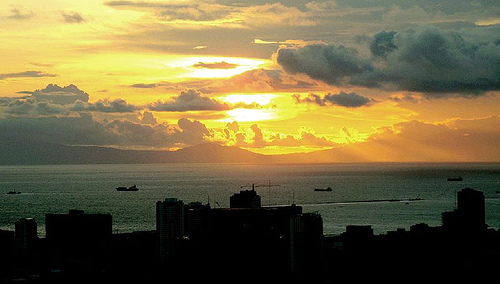
Sunset over Manila Bay, Philippines
Young kids stop to pose for the camera, Makati, Philippines
A young boy prepares to cook a fish dinner, Anawangin, Philippines
A young girl at Anawangin, Philippines
Beach at Anawangin, Philippines
Beach at Anawangin, Philippines
Buhi Lake
Bus stops in Makati, Philippines
Cemetary near Manila
Coastal area at Anawangin, Philippines
Coastal beach at Anawangin, Philippines
Coconut tree near San Jose


Travel and Tourism
Travel and Tourism
- Travel Alert Status
- Level 2: Exercise Increased Caution
- Currency
- Philippine peso (PHP)
- Time Difference
- UTC+8 (13 hours ahead of Washington, DC, during Standard Time)
- Climate
- The Philippines has a tropical climate, but it is marginally less hot and humid than many tropical countries for most of the year. Although the sun shines almost year round, there are slight seasonal variations in the weather. The dry summer season, which runs from about late April to early June is hot and humid and with little rainfall. The typhoon season runs from June to September, with frequent drenching rains that can temper the heat somewhat but also preclude any outdoor activities. The downpours are often limited in duration, but the resulting flash floods can create chaos by blocking streets, stranding motorists, and bringing the already congested traffic of Manila to a virtual standstill. The most pleasant season follows the rainy season, from November until March. During this time of year, mornings can be fresh, and even the midday temperatures remain bearable, with frequent breezes that temper the heat. The temperature range in Manila is relatively narrow, with minimum temperatures in the mid-70s and highs in the mid-90s, and an annual mean of about 80°F. Average relative humidity ranges from 69% in April to 84% in August or September. Baguio, the original summer capital of the Philippines, is located 155 miles north of Manila at an altitude of about 5,000 feet. The climate varies between the dry and the very wet season, each lasting about six months. The dry season runs from December to May, with temperatures ranging from the 50s and 60s at night to highs in the mid-80s during the day. Baguio averages 176 inches of rainfall a year, about half of which falls in July and August alone. The rains begin tapering off in September and are light in October and November.
- Airports
- 253
Read the full travel guide — health, safety, vaccinations, disease risk, sanitation, and transit details.
View full travel guideRecipes
Recipes
Spicy Rice
Side Dish
Main Dish
SINIGANG NA MANOK (Chicken in Sour Broth)
Main Dish
Shrimp & Shiitake Mushroom Lumpia with Orange Chili Mint
Main Dish
Arroz a la Cubana (Rice with Meat and Vegetables)
Main Dish
Morisqueta Tostada (Rice with Sausage and Ham)
Main Dish
Pancit Guisado
Main Dish
Fish Tinola
Main Dish
PremiumChicken with Sotanghon
Main Dish
PremiumChicken Adobo
Main Dish
PremiumPork Adobo
History
History
Historical Eras
Pre-Colonial Era
5000 BCE – 1565
Successive waves of Austronesian and Malay migrants settled the archipelago from around 5000 BCE, displacing earlier Negrito inhabitants. By the first millennium CE, thriving barangay communities engaged in trade with China, India, and the Malay world. The arrival of Islam in the south by the 14th century established the Sultanates of Sulu and Maguindanao before any European contact.
Spanish Colonial Period
1565 – 1898
Ferdinand Magellan's 1521 landing preceded formal colonization, which began when Miguel López de Legazpi established the first permanent Spanish settlement in 1565, naming the islands for King Philip II. Spain imposed Catholicism, the encomienda system, and centralized rule from Manila, profoundly reshaping culture, religion, and land tenure. Growing nationalism culminated in the 1896 revolution led by Andrés Bonifacio and José Rizal's reformist writings.
American Colonial Period
1898 – 1946
Spain ceded the Philippines to the United States following the Spanish-American War, crushing Emilio Aguinaldo's independence movement in a brutal Philippine-American War that ended in 1902. The U.S. introduced public education, representative institutions, and a path toward self-rule, culminating in the Commonwealth of the Philippines in 1935 under President Manuel Quezon. Japanese occupation from 1941 to 1945 inflicted enormous civilian suffering before U.S. forces liberated the islands.
Early Independence
1946 – 1965
Full independence was granted on July 4, 1946, establishing a republic with democratic institutions modeled on American governance, including a two-party system, independent judiciary, and free press. The Huk Rebellion, a communist-led agrarian uprising, was suppressed under President Ramon Magsaysay in the early 1950s. Despite political stability, power remained concentrated among a landed elite, and meaningful land reform was largely blocked.
Marcos Era
1965 – 1986
Ferdinand Marcos was elected president in 1965 and, seeking to extend his rule, declared martial law in September 1972, dismantling democratic institutions and ruling by decree. Corruption, economic stagnation, and military brutality fueled communist and Muslim insurgencies across the archipelago. The 1983 assassination of opposition leader Benigno Aquino galvanized mass opposition, and a popular uprising in February 1986 forced Marcos into exile, bringing Corazon Aquino to power.
Democratic Restoration
1986 – present
Corazon Aquino's presidency restored constitutional democracy and dismantled the structures of martial law, though coup attempts and persistent insurgencies tested the fragile state. Subsequent presidents including Fidel Ramos, Joseph Estrada—removed by the Supreme Court in 2001—and Gloria Macapagal-Arroyo navigated economic reform, regional Muslim separatism in Mindanao, and recurring political turbulence. The era has been defined by ongoing efforts to strengthen democratic institutions against entrenched elite power and corruption.
Overview
Timeline of Key Events
5000 BCE – 3000 BCE
The "New Stone Age"
Sea faring Malays from what is today Indonesia come to the archipelago. These new settlers bring with them polished stone tools, boat building, bark and animal skin cloth making, pottery, rice planting, the process of cooking food in bamboo tubes, the techniques of making fire by rubbing two sticks together. The Negritos begin to move out of caves and settle in a scattered manner along the coasts and rivers.
5000 BCE
Second wave of Malay immigrants
Second wave of Malay immigrants arrives in the Philippines by sea.
2500 BCE
Ancient Negroid people immigrate to the Philippines
Ancient Negroid people immigrate to the Philippines over a land bridge then still connecting the archipelago with the Asian mainland.
200 BCE
Malays in large numbers migrate to the Philippines
Malays in large numbers migrate to the Philippines. They are the racial stock of the majority of today’s Philippine populace.
1521
Ferdinand Magellan discovered the Philippine Islands
Ferdinand Magellan discovered the Philippine Islands and names them: Archipelago of San Lazaro, where he was killed by natives the following month.
1542
Spanish expedition
Commandeered by Ruy Lopez de Villalobos claims the islands for Spain and names them “Philippines” after Prince Philip; later King Philip II of Spain. The Philippines becomes part of Spanish Empire.
1898
Emilio Aguinaldo declares the Philippines independent
The US navy destroys the Spanish fleet in Manila Bay. Spain cedes the Philippines to the US under the Treaty of Paris in December, Philippines rebel leader Emilio Aguinaldo declares the Philippines independent on June 12, which will be recognized in the future as the Philippines’ Independence Day.
Read the full history profile — narrative overview, defining eras, and the complete timeline in one place.
View expanded historyInteresting Facts
Interesting Facts
When a child loses a tooth they hide their tooth in a special place and make a wish. A year later, if they can still find the tooth, they can make another wish.
The deepest spot in the ocean is the Mariana Trench. It is 36,202 feet deep.
The Philippines was named after the Spanish crown prince Philip, later Philip II.
The white, star-shaped sampaguita flower, often sold by street vendors or wound into necklaces given to visitors, is the Philippines' national flower.
With a wing span of two metres, the country's national bird is the haribon eagle-popularly known as the monkey-eating eagle, though the name literally means &@8220;king of birds.&@8221; Indigenous to Mindanao Island, the eagle is the world's second-largest in its species and is capable of catching a monkey for its prey.
Corazon Aquino was the first woman president of the Philippines
See every fact — trivia, oddities, and curious tidbits gathered from across the country.
View all interesting factsGeography and Environment
Geography and Environment
- Terrain
- mostly mountains with narrow to extensive coastal lowlands
- Climate
- The Philippines has a tropical climate, but it is marginally less hot and humid than many tropical countries for most of the year. Although the sun shines almost year round, there are slight seasonal variations in the weather. The dry summer season, which runs from about late April to early June is hot and humid and with little rainfall. The typhoon season runs from June to September, with frequent drenching rains that can temper the heat somewhat but also preclude any outdoor activities. The downpours are often limited in duration, but the resulting flash floods can create chaos by blocking streets, stranding motorists, and bringing the already congested traffic of Manila to a virtual standstill. The most pleasant season follows the rainy season, from November until March. During this time of year, mornings can be fresh, and even the midday temperatures remain bearable, with frequent breezes that temper the heat. The temperature range in Manila is relatively narrow, with minimum temperatures in the mid-70s and highs in the mid-90s, and an annual mean of about 80°F. Average relative humidity ranges from 69% in April to 84% in August or September. Baguio, the original summer capital of the Philippines, is located 155 miles north of Manila at an altitude of about 5,000 feet. The climate varies between the dry and the very wet season, each lasting about six months. The dry season runs from December to May, with temperatures ranging from the 50s and 60s at night to highs in the mid-80s during the day. Baguio averages 176 inches of rainfall a year, about half of which falls in July and August alone. The rains begin tapering off in September and are light in October and November.
- Natural Hazards
- astride typhoon belt, usually affected by 15 and struck by five to six cyclonic storms per year; landslides; active volcanoes; destructive earthquakes; tsunamis
- Current Environmental Issues
- uncontrolled deforestation especially in watershed areas; soil erosion; air and water pollution in major urban centers; coral reef degradation; increasing pollution of coastal mangrove swamps that are important fish breeding grounds
Read the full geography and environment profile — terrain, climate, natural resources, hazards, land use, and international agreements.
View full geographyPeople & Demographics
People & Demographics
Religion
Languages Spoken
two official languages - Filipino (based on Tagalog) and English; eight major dialects - Tagalog, Cebuano, Ilocano, Hiligaynon or Ilonggo, Bicol, Waray, Pampango, and Pangasinense
- Filipino
- Tagalog
Population
- Population
- 99,900,177
- Population in Major Urban Areas
- MANILA (capital) 11.862 million; Davao 1.565 million; Cebu City 855,000; Zamboanga 884,000
- Nationality Noun
- Filipino(s)
- Ethnic Groups
- Christian Malay 91.5%, Muslim Malay 4%, Chinese 1.5%, other 3%
- Language Note
- There are two official languages in the Philippines, Pilipino and English. English is used for business, government, and education from the fourth grade through college. Pilipino, which is based mostly on Tagalog, which is the language spoken in central Luzon. Pilipino is referred to as Tagalog by most people.
Education
- Literacy Definition
- age 15 and over can read and write
Except for schools in remote, mountainous areas, the Philippines has essential resources such as books, paper, and desks. Some of the modern equipment is either donated by the government or by foreign-assisted programs. Private schools have much better facilities than public schools. Problems in the schools include a lack of updated technology and a lack of teacher training. Some teachers are not motivated because their salaries are at the poverty level. The most severe problem is the lack of classrooms. Some classes are held under the trees, or the classes are so full that children are sitting on floors.
Health Information
- Major Infectious Diseases — degree of risk
- high
Read the full people and society profile — demographics, health, education, religion, languages, and notable people.
View full people and societyGovernment & Politics
Government & Politics
Country Identity
- Country Name
- Philippines
- Full Country Name
- Republic of the Philippines
- Local - Long
- Republika ng Pilipinas
- Local - Short
- Pilipinas
Government Structure
- Government Type
- republic
- Legal System
- based on Spanish and Anglo-American law; accepts compulsory ICJ jurisdiction, with reservations
- Executive Branch
- chief of state: President Ferdinand MARCOS Jr. (since 30 June 2022); note - president is both chief of state and head of government head of government: President Ferdinand MARCOS Jr. (since 30 June 2022); note - president is both chief of state and head of government cabinet: Cabinet appointed by the president with the consent of the Commission of Appointments elections: president and vice president elected on separate tickets by popular vote for six-year terms; election last held 9 May 2022 (next to be held in May 2028) election results: results of the election - Ferdinand MARCOS Jr. elected president; percent of vote - Ferdinand MARCOS Jr. 58.7%, Leni ROBREDO 27.9%, Manny PACQUIAO 6.8%, others 6.6%; Sara DUTERTE-Carpio elected vice president with approximately 61.5% of the vote
- Legislative Branch
- bicameral Congress or Kongreso consists of the Senate or Senado (24 seats - one-half elected every three years; members elected at large by popular vote to serve six-year terms) and the House of Representatives or Kapulungan Ng Mga Kinatawan (212 members representing districts plus 24 sectoral party-list members; members elected by popular vote to serve three-year terms; note - the Constitution prohibits the House of Representatives from having more than 250 members) elections: Senate - last held 10 May 2004 (next to be held in May 2007); House of Representatives - elections last held 10 May 2004 (next to be held in May 2007) election results: Senate - percent of vote by party - Lakas 30%, LP 13%, KNP 13%, independents 17%, others 27%; seats by party - Lakas 7, LP 3, KNP (coalition) 3, independents 4, others 6; note - there are 23 rather than 24 sitting senators because one senator was elected Vice President; House of Representatives - percent of vote by party - NA%; seats by party - Lakas 93, NPC 53, LP 34, LDP 11, others 20; party-listers 24 (2004)
- Judicial Branch
- Supreme Court (15 justices are appointed by the president on the recommendation of the Judicial and Bar Council and serve until 70 years of age); Court of Appeals; Sandigan-bayan (special court for hearing corruption cases of government officials)
- Suffrage
- 18 years of age; universal
- Constitution
- 2 February 1987, effective 11 February 1987
- Independence
- 12 June 1898 (from Spain)
- National Holiday
- Independence Day, 12 June (1898)
Capital City
- Capital Name
- Manila
- Capital - geographic coordinate
- 14 36 N, 120 58 E
- Capital Time Difference
- UTC+8 (13 hours ahead of Washington, DC, during Standard Time)
derives from the Tagalog "may-nila" meaning "where there is indigo" and refers to the presence of indigo-yielding plants growing in the area surrounding the original settlement
Military
Branches: Armed Forces of the Philippines (AFP): Army, Navy (includes Marine Corps), Air Force
Embassy / Diplomatic Mission
The U.S. EmbassyManila
1201 Roxas Boulevard
Manila, Philippines
Email:acsinfomanila@state.gov
Telephone (63) (2) 301-2000
Facsimile: (63) (2) 301-2017
There is a Consular Agency in Cebu City, which provides limited services to U.S. citizens, but it is not authorized to issue passports or visas. If you are requesting service at the Consular Agency, you should call ahead to verify that the service requested will be available on the day you expect to visit the Agency.
U.S. Consular Agency
Ground Level, Waterfront Hotel
Salinas Drive
Lahug, Cebu City
Philippines 6000
Email: amconsularcebu@ bayandsl.com
Telephone: (63)(32) 231-1261
Facsimile: (63)(32) 231-0174
Read the full government profile — flag symbolism, national anthem, and other national symbols.
View full government detailsEconomy
Economy
The Philippines has one of the most dynamic economies in the Asia-Pacific region, supported by strong domestic consumption, a large and growing services sector, and substantial remittances from overseas Filipino workers, which exceeded $38 billion in 2024 and remain a cornerstone of household spending and foreign exchange reserves. After contracting by 9.5% in 2020 during the COVID-19 pandemic—its worst recession on record—the economy rebounded strongly, posting GDP growth of 5.7% in 2021, 7.6% in 2022, 5.5% in 2023, and an estimated 5.6% in 2024, making it one of the fastest-growing economies in Southeast Asia.
The services sector, particularly business process outsourcing (BPO), retail, tourism, and finance, accounts for more than 60% of GDP and remains the principal driver of growth. The BPO industry generates over $35 billion in annual revenues and employs more than 1.7 million Filipinos. Industry, including electronics manufacturing, construction, and food processing, contributes roughly a quarter of GDP, while agriculture has declined in relative importance and continues to face challenges from typhoons, aging infrastructure, and low productivity.
Despite sustained growth, structural challenges remain. Poverty incidence stood at around 15.5% in 2023, and income inequality, underemployment, and regional disparities continue to limit inclusive development. Inflation, which surged to a 14-year high of 6.0% in 2023 due to food and energy price pressures, eased to roughly 3.2% in 2024 as the Bangko Sentral ng Pilipinas tightened monetary policy.
The Marcos Jr. administration has prioritized infrastructure development through the "Build Better More" program, digital transformation, tax reform, and expanded foreign investment access following amendments to the Public Service Act, Foreign Investments Act, and Retail Trade Liberalization Act. Major trading partners include China, the United States, Japan, and other ASEAN economies. Medium-term prospects depend on sustaining fiscal consolidation, addressing infrastructure gaps, managing external risks from global trade conditions, and translating macroeconomic growth into broader poverty reduction.
Snapshot
- Currency Name and Code
- Philippines Peso (PHP)
- GDP — official exchange rate
- $91,360,000,000 (USD)
- GDP Real Growth Rate
- 5.1%
- Gini Index
- 46.6
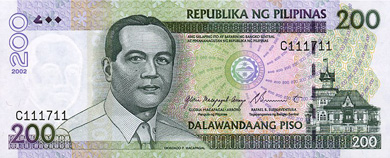
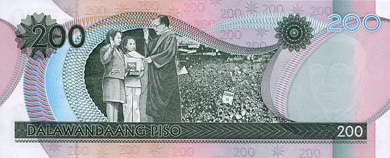
Banknotes
Budget & Public Finance
- Fiscal Year
- calendar year
- Annual Budget
- $15,770,000,000 (USD)
- Public Debt (% of GDP)
- 77.4%
- External Debt
- $67,620,000,000 (USD)
- Investment (% of GDP)
- 16.3%
- Economic Aid
- $1,200,000,000 (USD)
- Current Account Balance
- $3,872,000,000 (USD)
- Reserves of Foreign Exchange
- $2,147,483,647 (USD)
Labor, Industry & Trade
- Labor Force by Occupation
- agriculture 45%; industry 15%; services 40%
- Household Income — highest 10%
- 31.9%
- Industries
- electronics assembly, textiles, pharmaceuticals, chemicals, wood products, food processing, petroleum refining, fishing
- Agriculture Products
- rice, coconuts, corn, sugarcane, bananas, pineapples, mangoes, pork, eggs, beef, fish
- Export Commodities
- electronic equipment, machinery and transport equipment, garments, coconut products, chemicals
- Export Partners
- US 24.7%, Japan 15%, Netherlands 8.7%, Taiwan 7.1%, Singapore 7%, Hong Kong 6.7%, Malaysia 4.7%
- Import Commodities
- raw materials, machinery and equipment, fuels, chemicals
- Import Partners
- US 20.6%, Japan 20.4%, South Korea 7.8%, Singapore 6.5%, Taiwan 5%, Hong Kong 4.5%
Energy
- Oil Production
- 14,360 bbl/day
- Oil Consumption
- 335,000 bbl/day
- Oil Reserves
- 152,000,000 bbl/day
- Natural Gas Production
- 2,300,000,000 cu m
- Natural Gas Consumption
- 2,300,000,000 cu m
- Natural Gas Imports
- 0 cu m
- Natural Gas Exports
- 0 cu m
- Natural Gas Reserves
- 106,800,000,000 cu m
Communications
- Telephone System
- general assessment: good international radiotelephone and submarine cable services; domestic and interisland service adequate domestic: telecommunications infrastructure includes the following platforms: fixed-line, mobile cellular, cable TV, over-the-air TV, radio and Very Small Aperture Terminal (VSAT), fiber-optic cable, and satellite; mobile-cellular communications now dominate the industry international: country code - 63; a series of submarine cables together provide connectivity to Asia, US, the Middle East, and Europe; multiple international gateways
- Internet Country Code
- .ph
News & Weather
News & Weather
Current Weather
Latest News
U.S. condemns China's 'dangerous and aggressive' acts after Philippine sailor injured at disputed shoal - CNBC
CNBC · 5h ago
Boeing and Philippine Airlines Announce Commitment for up to 20 787 Dreamliner Jets - Boeing Newsroom
Boeing Newsroom · 21h ago
New Zealand and Philippines form comprehensive partnership - Reuters
Reuters · 4h ago
Rubio in Philippines as US condemns 'dangerous' China actions - France 24
France 24 · 6h ago
Watch China, Philippines Clash Again in South China Sea - Bloomberg.com
Bloomberg.com · 4h ago
US Slams "Dangerous" China Action In Sea Clash With Philippines Navy - NDTV
NDTV · 7h ago
Philippines says China Coast Guard injured sailor with baton - The Japan Times
The Japan Times · 3h ago
Philippines ASEAN - Dayton Daily News
Dayton Daily News · 4h ago
News via Google News
Climate Overview
The Philippines has a tropical climate, but it is marginally less hot and humid than many tropical countries for most of the year. Although the sun shines almost year round, there are slight seasonal variations in the weather. The dry summer season, which runs from about late April to early June is hot and humid and with little rainfall. The typhoon season runs from June to September, with frequent drenching rains that can temper the heat somewhat but also preclude any outdoor activities. The downpours are often limited in duration, but the resulting flash floods can create chaos by blocking streets, stranding motorists, and bringing the already congested traffic of Manila to a virtual standstill. The most pleasant season follows the rainy season, from November until March. During this time of year, mornings can be fresh, and even the midday temperatures remain bearable, with frequent breezes that temper the heat.
The temperature range in Manila is relatively narrow, with minimum temperatures in the mid-70s and highs in the mid-90s, and an annual mean of about 80°F. Average relative humidity ranges from 69% in April to 84% in August or September.
Baguio, the original summer capital of the Philippines, is located 155 miles north of Manila at an altitude of about 5,000 feet. The climate varies between the dry and the very wet season, each lasting about six months. The dry season runs from December to May, with temperatures ranging from the 50s and 60s at night to highs in the mid-80s during the day. Baguio averages 176 inches of rainfall a year, about half of which falls in July and August alone. The rains begin tapering off in September and are light in October and November.
Videos
Videos
2 curated YouTube videos.
Source: YouTube
Source: YouTube
Frequently Asked Questions
Frequently Asked Questions
What is the population of Philippines?
How do people greet each other in the Philippines?
What are the dining customs in the Philippines?
What etiquette should I know when visiting a Filipino home?
What should I wear in the Philippines?
What gestures are important in the Philippines?
What is family life like in the Philippines?
What do people do for recreation in the Philippines?
What is the capital of the Philippines?
Where is the Philippines located?
What are the sea and ocean borders of the Philippines?
What is the predominant religion in the Philippines?
What is the currency of the Philippines?
What languages are spoken in the Philippines?
What is the geography of the Philippines like?
What is the Philippines known for?
Last reviewed 2026