
 English
 Español
 中文
中文 हिन्दी
 Français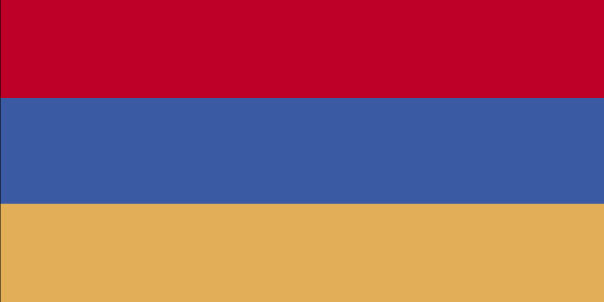
Armenia
Hayastan
Declare Your Relationship to Armenia
CountryReports Community
- Studying0
- From Armenia1
- Armenia heritage1
- Visited1
- Want to visit0
Customs and Culture
Customs and Culture
Cultural Attributes
Armenia possesses one of the world's oldest and most distinctive cultural identities, shaped by millennia of history, a unique alphabet, and the enduring influence of the Armenian Apostolic Church. Armenians take tremendous pride in their cultural continuity, maintaining traditions that predate many modern civilizations. The Armenian alphabet, created by the monk Mesrop Mashtots in 405 AD, is considered a cornerstone of national identity. With 38 letters specifically designed to represent the sounds of the Armenian language, it enabled the translation of religious texts and helped preserve Armenian culture through centuries of foreign rule and occupation.
Christianity is central to Armenian cultural life. Armenia adopted Christianity as its state religion in 301 AD, making it the first nation in the world to do so officially. The Armenian Apostolic Church remains deeply woven into daily life, celebrations, and national consciousness. Monasteries such as Geghard and Khor Virap are not only religious sites but powerful cultural symbols visited by Armenians and tourists alike. The monastic ensembles of Haghpat and Sanahin, both designated UNESCO World Heritage Sites, further reflect the country's extraordinary legacy of religious architecture and craftsmanship.
Armenian cuisine reflects both the country's geography and its cultural exchanges over centuries. Staple dishes include khorovats (barbecue), dolma (grape leaves or vegetables stuffed with spiced meat and rice), lavash (a thin flatbread recognized by UNESCO as an Intangible Cultural Heritage), and manti (small baked dumplings typically served with yogurt and garlic). Lavash in particular holds ceremonial importance at weddings and holidays, where it is draped over the shoulders of newlyweds as a symbol of prosperity and good fortune. Music and dance are vital expressions of Armenian culture. The duduk, an ancient double-reed woodwind instrument carved from apricot wood, produces a haunting, soulful sound that UNESCO has recognized as an Intangible Cultural Heritage of Humanity. Traditional folk dances, often performed at community gatherings and celebrations, vary by region but share expressive, rhythmic movements rooted in ancient customs. Armenia also has a rich classical music tradition, with composers such as Aram Khachaturian — best known internationally for his Sabre Dance — having achieved global recognition in the twentieth century. Hospitality is a deeply ingrained cultural value.
Guests are typically welcomed with generosity, and sharing a meal is considered an important social ritual. The apricot holds special symbolic meaning in Armenian culture — the country is widely regarded as one of the fruit's earliest cultivated homelands, and the species name Prunus armeniaca reflects this association — and it appears frequently in cuisine, art, and cultural references. Literature and oral storytelling also occupy an honored place in Armenian tradition, with the medieval epic poem the Daredevils of Sassoun celebrated as a defining work of national identity and recognized on UNESCO's list of Intangible Cultural Heritage.

Land of Ararat's Faith
Greetings, Gestures & Visiting
The Armenian greeting in the morning is bari aravot (good morning), in the afternoon barev (hello), while in the evening it is bari yereko (good evening) and bari gisher(good night) when going to sleep. At school when the kid meets one of his/her teachers he/she usually adds comrade and the teacher’s surname after the greeting expression of good morning, For example, if the teacher’s surname is Hambardzumyan the kid would great him with “good morning, Comrade Hambardzumyan!”
Armenians greet each other with a handshake, and close friends greet with kisses on the cheek. Men and women show affection for friends of the same sex. It is as common to see two men walking down the street arm in arm as it is two women.
It is considered polite to visit without an invitation. As a sign of love and respect, most social gatherings include toasting each family's good health and good luck.
Urban Armenians wear the styles of Europe. Jeans are popular among the youth. Traditional costumes include baggy pants worn under long overcoats. Regional accessories include sheepskin hats, engraved metal belts, and jewelry. Women traditionally wear their hair in two long braids.
Diet
Armenians like borscht (beet soup); khorovadz (roasted meat), potatoes and stews. Some delicacies are fresh trout from Lake Sevan. grapevine leaves stuffed with rice, dolma (herbs), lavash (flat bread) harissa (chicken porridge) and madzun (yogurt)

Family
In villages Armenians have private houses, many having small farming plots and small barns. Adults when first married usually live with their parents with the new bride moving into her husband's parent's home. Children usually care for their parents in old age. Grandparents play a large role in raising their grandchildren.
When the bride and groom enter their home for the first time as a married couple lavash (flat bread) is placed over their shoulders for good luck. On the fortieth day the bride's parents visit her in her new home and give her a ozhit (the personal possessions of a bride usually including clothes, accessories, and household linens and wares)
In urban Armenia, most families live in apartment buildings ranging from four(4) to fifteen(15) stories high.
Recreation
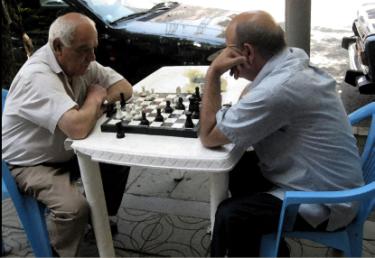
Armenian men like to play backgammon and chess in city parks when the weather is nice. In the summer trips to the beach at Lake Sevan and picnics in the countryside are common. Soccer is the most popular sport. Skiing and Tennis are also popular.
Student Life
The usual day of the child going to school starts with the alarm clock or with one of the parents’ voices aimed at waking up the child. After getting out of bed the child usually gets busy with his personal hygiene and when he/she is clean, clothed and hair combed it is time to have breakfast. For breakfast children usually eat boiled or half-boiled eggs or an omelet and drink a cup of sweet tea with cheese, butter, jam, or honey spread on bread.
Children usually go to school near their house. Depending on the distance some go there on foot others by public minibusses since there is no transportation provided by the school system or state. If the child is in elementary school i.e. too little to go to school alone, usually one of his parents, or relatives takes him to school and then meets him to take him back home when the classes are over. In villages, children don’t take transportation to school as there are no public or state transportations inside any village in Armenia. So for village children, the only choice to get to school is on foot.
There are many schools near each other and the ages of those schools are different. There are old buildings and also very new ones built in the post-war period and the number of children studying there also differs. There are about 160 – 300 children at a school. A typical Armenian school classroom usually has desks for children, a desk for the teacher, a blackboard, domestic flowers on the windowsills, and wallpapers concerning the subjects taught in the classroom. Some classrooms also have bookshelves for different books. Many schools have different classrooms for different subjects and those classrooms are equipped with corresponding equipment. But this does not apply to every school. Many schools do not have audiovisual equipment. There is a computer room nearly in every school and, perhaps, this is the best and the most interesting classroom for the children.
A typical day at school starts with the bell ringing. Then the teacher enters the class and all the children greet him/her with bari aravot (good morning). Children who study in the primary grades usually have four lessons. Every lesson is 45 minutes long, and between each lesson there is 5 minutes break. After the second lesson, the break is a bit longer - 10 minutes long. Usually, pupils bring something to eat during the breaks. This can be apples, biscuits or sweets. There is also a buffet in every school where the pupils and teachers can buy sandwiches, patty, doughnuts, khachapuri (Georgian cuisine dish made from cheese and pastry in layers), zhengyalov hats (Armenian cuisine dish made from pastry and herbs (literal translation is bread with greens)), drink tea or coffee. Secondary education in Armenia is compulsory. The duration of secondary school in Armenia is 11 years (two years ago it was 10 years) and it has three levels. The first level is the primary school ( 1-4 grades) where children study from the age of 6 till 9. The second level is the Intermediate School (5-9 grades) where pupils study from the age of 10 till 15. Here children get general education. It is also called incomplete secondary education and after finishing it pupils obtain a Certificate of Basic Education. Having graduated from the intermediate school they can go either to High School to continue their education or to specialized secondary and technical secondary educational institutions. The third level is high or senior school (10-11 grades) and pupils study there from the age of 16 to 17. After graduating from high school pupils obtain a Certificate of Full Secondary Education. More than 75 percent of pupils move to high schools. Only pupils who have unsatisfactory grades or satisfactory grades and who are going to become musicians move to specialized secondary or technical secondary educational institutions. The grading system at schools has changed recently in Armenia. Before it had 5 grades like all the former Soviet countries. The mark “2” was equal to “unsatisfactory”, “3” was “satisfactory”, “4” -“good” and “5” was equal to “excellent”. Now there are 10 grades, from which 1,2, 3 are considered to be “unsatisfactory” marks; 4,5,6 are “satisfactory”; 7,8 are good; 9,10 are “excellent” marks. In Armenia, primary and intermediate schools are usually in the same building. High school can also be in the same building but this is not the case in all school buildings. The subjects taught in primary schools are mother language, fine arts, technology, mathematics, music, and physical culture, which children study from the first grade and the Russian and English languages from the second grade. In some schools in Armenia, the French or German language is taught instead of English. The primary language for the children who attend school is Armenian. They can speak Russian with their family members sometimes but they don’t speak English at home. Maybe this is because Armenia is a former Soviet country and also because children watch a lot of films and animated cartoons in Russian on TV. The number of students per teacher differs as it depends on the number of children in the grade. It can vary from 15 to 30. The headmaster of the school has all the authority of the school, all the teachers and children are under his/her supervision while the teachers are responsible for their classes only. Children don’t wear uniforms at school, everybody is free to wear whatever he/she wants. Children usually don’t have their lunch at school if they don’t have extracurricular activities. They just come home after school and have their lunch at home. In case they have extracurricular activities they buy whatever there is in the buffet and have their lunch there after school.
Some schools have a few extracurricular activities, for example, chorus, circles of Armenian language and literature, physics, chemistry, volleyball, and basketball. It depends on the school. On holidays kids at the primary level usually have shows or dramas dedicated to the holiday. There are also other extracurricular activities in the public system and private entities for the children. Girls usually go to music or chorographical schools, painting circles, circles for singing, knitting, while boys start training Karate and playing football from an early age. Playing chess and tennis is also popular among kids. There are not as many extracurricular activities for the kids in villages and they usually get involved in the activities that are offered by their school. Pupils go to school from Monday till Saturday in Armenia. This means that they have only Sunday as a weekend. At weekends kids usually get ready for their Monday lessons, play in the yard with their neighbors, watch animated cartoons and play computer games which is the most popular activity among kids.
In the evening when the child returns home he/she usually has dinner and learns his/her lessons. After all the lessons are done children either play computer games, watch cartoons or go to sleep. Village children usually help their parents to look after domestic animals after school.
Education plays a central role in the lives of most children and their families. Since the school program has become difficult to study during these last years parents spend a lot of time with their children to make them learn their lessons. The school program is so complicated that parents hire individual tutors for their children for each subject. The average child’s day is overloaded as he/she comes home from school and after having his/her lunch many go to a tutor.
Holidays
Independence Day
9/21Independence Day
Christmas
1/19Christmas
To understand what day Armenians celebrate Christmas, you must first understand two important points. First, some cultures celebrate the Nativity (Birth of Jesus) and the Epiphany (Baptism of Jesus) at the same time. Armenia is one such country and they celebrate these two events on January 6th. The second important point to understand is that not everyone in the world uses the same calendar. Armenians use the Julian calendar while many countries including the United States and Canada use the Gregorian calendar. Currently the Julian calendar is 13 days behind the Gregorian calendar, therefore if you are looking at a Gregorian calendar the Armenian celebration of Christmas would be on January 19th. Whether it is January 6th on the Julian calendar or January 19th on the Gregorian calendar.
In the Armenian tradition, preparations for Christmas begin weeks in advance. Families start by cleaning their houses from top to bottom in anticipation of the local priest who visits each home to bless it with salt and water. Seeds of lentils, chickpeas, or wheat are placed on cotton balls and allowed to sprout so that families are reminded of the rebirth of life that comes in the spring.
Armenians usually fast in the week proceeding Christmas avoiding all meat, eggs and dairy products, and break their fast on Christmas Eve, after attending special church services. Foods like braided bread, rice pilaf, fresh vegetables, rice pudding, figs, baklava, and anoushabour (a pudding made from wheat, berries and apricots) have become traditional for the holiday season.
Food plays a large role in Armenian Christmas trees and ornamentation. Fruits are often hung on trees along with the white doves that symbolize peace and golden bows for decoration. Ribbons in the three colors of the Armenian flag also garland the Christmas tree.
During the holiday season, most homes feature a nativity scene or crèche. Children hang handkerchiefs from their roofs in the hopes that they will be filled with fried wheat, raisins, and coins. Children sing carols to passersby from the rooftops, chanting, “Rejoice and be glad! Open your bag and fill our handkerchiefs. Hallelujah, Hallelujah!” On New Years Eve their wishes are fulfilled when Gah-ghant Baba, the Old Father, visits them to distribute gifts.
Dates of Interest
- February 13th
A traditional Armenian holiday celebrating the end of winter and the arrival of spring. Bonfires are lit, and people gather around to jump over the flames for good luck and purification.
How do people greet each other in Armenia?
Greetings vary by time of day: bari aravot (good morning), barev (hello) in the afternoon, bari yereko (good evening), and bari gisher (good night) before sleep.
Good to know
- At school, children add 'Comrade' plus the teacher's surname, e.g., 'Good morning, Comrade Hambardzumyan!'
What should I know about eating in Armenia?
Armenian cuisine features dishes like khorovats (roasted meat), dolma (stuffed grape leaves), lavash (flatbread), harissa (chicken porridge), borscht, and fresh trout from Lake Sevan.
Good to know
- Sharing a meal is an important social ritual
- Social gatherings often include toasts to each family's good health and good luck
- Lavash holds ceremonial importance at weddings and holidays
What are the etiquette and hospitality customs in Armenia?
Hospitality is deeply valued, and guests are welcomed with generosity. It is considered polite to visit without an invitation.
Do
- Feel free to visit without a prior invitation
- Take part in toasts to good health and good luck
How should I dress in Armenia?
Urban Armenians dress in European styles, and jeans are popular among youth. Traditional costumes include baggy pants under long overcoats.
Good to know
- Regional accessories include sheepskin hats, engraved metal belts, and jewelry
- Women traditionally wear their hair in two long braids
What gestures and physical greetings are common in Armenia?
Armenians greet with a handshake, while close friends greet with kisses on the cheek.
Good to know
- Same-sex friends openly show affection; it's common to see two men or two women walking arm in arm
What is family life like in Armenia?
Newly married couples often live with the husband's parents, and children typically care for their parents in old age. Grandparents play a large role in raising grandchildren.
Good to know
- When newlyweds first enter their home, lavash is placed over their shoulders for good luck
- On the fortieth day, the bride's parents visit and give her an ozhit (personal possessions)
- Village families often have private houses with small farming plots; urban families usually live in apartment buildings of 4 to 15 stories
What do people do for recreation in Armenia?
Men enjoy playing backgammon and chess in city parks, and summer brings trips to Lake Sevan and countryside picnics. Soccer is the most popular sport.
Good to know
- Skiing and tennis are also popular
Last updated: 2026-07-12 · Sources: CountryReports
Photos of Armenia
Photos of Armenia
2 men playing chess
Armenia Creche -- Cave of Carved Figures
Matenadaran -- Museum of Ancient Manuscripts in Yerevan
Sardarapat in Yerevan
Echmiadzin Church Center of the Armenian Apostolic Church.
Yerevan city with Mount Ararat in the Background
Eggplant rolls
Train
Airport
Bubbler - water fountain
Cars on the street
Kapan School #2


Travel and Tourism
Travel and Tourism
- Travel Alert Status
- Level 2: Exercise Increased Caution
- Currency
- 492.7
- Time Difference
- UTC+4 (9 hours ahead of Washington, DC during Standard Time)
- Climate
- The climate is highland continental. It is dry, with an average of 550mm (21.6 inches) in annual rainfall. In the Ararat Valley, where Yerevan is located, there is far less rain; with an average range of from 200mm to 250mm (7.9 to 10 inches). Seasonal extremes are pronounced in the Ararat Valley. Temperatures can approach the record summer high of 42°C (107.6°F) or plunge towards the record winter low of -30°C (-22°F). Mean temperatures are more temperate, however. July readings give an average high range of from 25°C (77°F) to 30°C (86°F). The January low range averages from -5°C (23°F) to -7°C (19°F). Autumns are long and golden; Armenia enjoys around 2700 hours of sunshine each year. Drought is a perennial problem.
- Airports
- 17
- Recommended Vaccinations
- How important is it to do your research about vaccinations? It might just save your life! Make yourself aware of the different types of vaccinations and which ones you may need to travel to your destination. Schedule an appointment with your doctor at least four to six weeks before you travel to ensure you receive all important shots. Be sure that you and your family are up to date on your routine vaccinations. Which vaccinations you need will depend on a number of factors including your destination, whether you will be spending time in rural areas, the season of the year you are traveling, your age, health status, and previous immunizations.
Read the full travel guide — health, safety, vaccinations, disease risk, sanitation, and transit details.
View full travel guideRecipes
Recipes
Sajoostoo (Flat Thin-Layered Bread)
Bread
Main Dish
Khabourga (Stuffed Lamb Flank)
Side Dish
Tahnabour (Hot Yogurt Soup)
Side Dish
Yalanchy Sarma (Stuffed Grape Leaves)
Bread
Sajoostoo (Flat Thin Layered Bread)
Dessert
Madzoon Gargantag (Yogurt Cake)
Bread
Sajoostoo (Flat Thin-Layered Bread)
History
History
Historical Eras
Ancient & Classical Armenia
600 BCE – 301
Armenian tribes settled the highland plateau between the Black Sea and the Caspian, forming a distinct civilization under successive kingdoms. The Armenian Empire reached its zenith under Tigranes the Great (95–55 BCE), stretching from the Caspian to the Mediterranean, before Roman conquest reduced it to a client state. This era established a durable Armenian national identity and set the stage for the country's pivotal religious transformation.
Christian Kingdom & Arab Rule
301 – 885
King Tiridates III adopted Christianity in 301 CE, making Armenia the first nation to declare it a state religion — a defining moment that shaped Armenian culture, art, and alphabet development under Saint Mesrop Mashtots. The Byzantine Empire and Sassanid Persia competed for control until Arab conquests absorbed Armenia in 653, installing the Bagratid family as governors by 806. Armenian ecclesiastical and literary traditions flourished even under foreign suzerainty.
Bagratid Golden Age
885 – 1064
The Bagratid dynasty established an independent Armenian kingdom in 885, with Ashot I and later Ashot III presiding over a celebrated cultural renaissance — an era of monastic architecture, manuscript illumination, and poetry. The capital Ani became a prosperous metropolis rivaling Constantinople. Seljuk Turkish invasions culminating in the fall of Ani in 1064 shattered this golden age and triggered large-scale Armenian displacement.
Foreign Empires & Genocide
1064 – 1918
For nearly nine centuries Armenians lived under successive Seljuk, Mongol, Ottoman, and Persian dominions, with a notable interlude of autonomy in Cilician Armenia (1080–1375) whose forces participated in the Crusades. Russia incorporated eastern Armenia in 1828, while western Armenians remained under Ottoman rule and endured massacres of approximately 300,000 in 1895 and the systematic genocide of 1915–1916, killing an estimated 1–1.5 million people. The collapse of the Ottoman Empire in World War I briefly opened the door to independence.
Soviet Armenia
1918 – 1991
A short-lived independent republic (1918–1920) was absorbed into the Soviet Union in 1920, and Armenia became a constituent republic of the USSR. Soviet rule brought rapid industrialization, urbanization, and literacy alongside political repression and the forced collectivization of agriculture. Moscow's 1921 decision to assign the predominantly Armenian enclave of Nagorno-Karabakh to Soviet Azerbaijan planted the seeds of a conflict that would erupt violently in 1988.
Independent Republic
1991 – present
Armenia declared independence in September 1991 as the Soviet Union dissolved, but immediately confronted war with Azerbaijan over Nagorno-Karabakh; a 1994 ceasefire left Armenian forces in control of the enclave and surrounding territories. Turkey's economic blockade and the unresolved conflict severely hampered development, though Armenia pursued democratic reforms and closer ties with both Russia and Western institutions. A renewed Azerbaijani offensive in 2020 and 2023 resulted in the fall of Nagorno-Karabakh, driving its Armenian population into Armenia and redefining the republic's geopolitical position.
Overview
Timeline of Key Events
95 BCE – 55 BCE
Armenian Empire reaches greatest size and influence under Tigran the Great.
Armenian Empire reaches greatest size and influence under Tigran the Great.
30 BCE
Romans conquer Armenian Empire.
Romans conquer Armenian Empire.
310
Tiridates III accepts Christianity for the Armenian people.
Tiridates III accepts Christianity for the Armenian people.
653
Byzantine Empire cedes Armenia to Arabs.
Byzantine Empire cedes Armenia to Arabs.
806
Arabs install Bagratid family to govern Armenia.
Arabs install Bagratid family to govern Armenia.
862
Second golden age of Armenian culture, under Ashot I and Ashot III.
Second golden age of Armenian culture, under Ashot I and Ashot III.
1100 – 1300
Cilician Armenian and Georgian armies aid European armies in Crusades.
Cilician Armenian and Georgian armies aid European armies in Crusades to limit Muslim control of Holy Land.
Read the full history profile — narrative overview, defining eras, and the complete timeline in one place.
View expanded historyInteresting Facts
Interesting Facts
A common pastime among Armenians is a slow, lazy game of backgammon. Backgammon is probably the oldest game in recorded history. It is believed to have originated in Mesopotamia.
Chess is practically the national sport. Chess as a form of education is highly encouraged, children are taught to play at a young age.
Shamiram, or the Armenian Women’s Union, was founded in April 1995 to champion and safeguard women’s rights and increase the involvement of women in the field of police, decisionmaking and democratic and market reforms.
In Armenia it was a custom that on New Year's Eve, children gathered in-groups and went around their village, singing songs and greeting the New Year by singing to their neighbors. They usually received lots of fruit as present. Decorating a New Year's tree was not one of the customs in the past. Within the family, it was a custom for the family members to exchange presents, but, a wife never received a present from her husband, as this was considered a disgrace. Children in the family, the youngest ones following the elderly, would go to their father, who had the presents hidden in his coat, and after kissing their father's hand everyone would receive their present.
See every fact — trivia, oddities, and curious tidbits gathered from across the country.
View all interesting factsGeography and Environment
Geography and Environment
- Terrain
- Armenian Highland with mountains; little forest land; fast flowing rivers; good soil in Aras River valley
- Climate
- The climate is highland continental. It is dry, with an average of 550mm (21.6 inches) in annual rainfall. In the Ararat Valley, where Yerevan is located, there is far less rain; with an average range of from 200mm to 250mm (7.9 to 10 inches). Seasonal extremes are pronounced in the Ararat Valley. Temperatures can approach the record summer high of 42°C (107.6°F) or plunge towards the record winter low of -30°C (-22°F). Mean temperatures are more temperate, however. July readings give an average high range of from 25°C (77°F) to 30°C (86°F). The January low range averages from -5°C (23°F) to -7°C (19°F). Autumns are long and golden; Armenia enjoys around 2700 hours of sunshine each year. Drought is a perennial problem.
- Natural Hazards
- occasionally severe earthquakes; droughts
- Current Environmental Issues
- soil pollution from toxic chemicals such as DDT; the energy crisis of the 1990s led to deforestation when citizens scavenged for firewood; pollution of Hrazdan (Razdan) and Aras Rivers; the draining of Sevana Lich (Lake Sevan), a result of its use as a source for hydropower, threatens drinking water supplies; restart of Metsamor nuclear power plant in spite of its location in a seismically active zone
Read the full geography and environment profile — terrain, climate, natural resources, hazards, land use, and international agreements.
View full geographyPeople & Demographics
People & Demographics
Religion
Languages Spoken
Armenian 96%, Russian 2%, other 2%
- Armenian
- Russian
Population
- Population
- 2,966,802
- Population: Male/Female
- male: 1,456,415 female: 1,520,350
- Population Distribution
- most of the population is located in the northern half of the country; the capital of Yerevan is home to more than five times as many people as Gyumri, the second largest city in the country
- Urban Population
- urban population: 63.7% of total population rate of urbanization: 0.23% annual rate of change
- Population in Major Urban Areas
- 1.095 million YEREVAN (capital)
- Nationality Noun
- noun: Armenian(s) adjective: Armenian
- Ethnic Groups
- Armenian 98.1%, Yezidi 1.1%, other 0.8%
- Language Note
- Armenian (official) 97.9%, Kurmanji (spoken by Yezidi minority) 1%, other 1.1%; note - Russian is widely spoken
Demographic Profile
Armenia’s population peaked at nearly 3.7 million in the late 1980s but has declined sharply since independence in 1991, to just over 3 million in 2021, largely as a result of its decreasing fertility rate, increasing death rate, and negative net emigration rate. The total fertility rate (the average number of children born per woman) first fell below the 2.1 replacement level in the late 1990s and has hovered around 1.6-1.65 for over 15 years. In an effort to increase the country’s birth rate, the government has expanded its child benefits, including a substantial increase in the lump sum payment for having a first and second child and a boost in the monthly payment to mothers of children under two. Reversing net negative migration, however, remains the biggest obstacle to stabilizing or increasing population growth. Emigration causes Armenia not only lose individuals but also the children they might have.
The emigration of a significant number of working-age people combined with decreased fertility and increased life expectancy is causing the elderly share of Armenia’s population to grow. The growing elderly population will put increasing pressure on the government’s ability to fund the pension system, health care, and other services for seniors. Improving education, creating more jobs (particularly in the formal sector), promoting labor market participation, and increasing productivity would mitigate the financial impact of supporting a growing elderly population.
Armenia has a long history of migration, some forced and some voluntary. Its large diaspora is diverse and dispersed around the world. Widely varying estimates suggest the Armenian diaspora may number anywhere from 5-9 million, easily outnumbering the number of Armenians living in Armenia. Armenians forged communities abroad from ancient Egypt, Greece and Rome to Russia and to the Americas, where they excelled as craftsmen, merchants, and in other occupations.
Several waves of Armenian migration occurred in the 20th century. In the aftermath of the 1915 Armenian genocide, hundreds of thousands of survivors fled to communities in the Caucasus (including present day Armenia), Lebanon, Syria, Iran, Europe, and Russia and established new communities in Africa and the Americas. In the 1930s, the Soviets deported thousands of Armenians to Siberia and Central Asia. After World War II, the Soviets encouraged the Armenian diaspora in France, the Middle East, and Iran to return the Armenian homeland in order to encourage population growth after significant losses in the male workforce during the war.
Following Armenian independence in 1991, the economic downturn and high unemployment prompted hundreds of thousands of Armenians to seek better economic opportunities primarily in Russia but also in the US, former Soviet states, and Europe. In the early 1990s, hundreds of thousands of Armenians fled from Azerbaijan to Armenia because of the ongoing Nagorno-Karbakh conflict, but many of them then emigrated again, mainly to Russia and the US. When the economy became more stable in the late 1990s, permanent emigration slowed, but Armenians continued to seek temporary seasonal work in Russia. The remittances families receive from relatives working abroad is vital to Armenian households and the country’s economy.
Education
- Literacy Definition
- age 15 and over can read and write
There are many schools near each other and the ages of those schools are different. There are old buildings and also very new ones built in the post-war period and the number of children studying there also differs. There are about 160 – 300 children at a school.
A typical Armenian school classroom usually has desks for children, a desk for the teacher, a blackboard, domestic flowers on the windowsills, and wallpapers concerning the subjects taught in the classroom. Some classrooms also have bookshelves for different books. Many schools have different classrooms for different subjects and those classrooms are equipped with corresponding equipment. But this does not apply to every school. Many schools do not have audiovisual equipment.
There is a computer room nearly in every school and, perhaps, this is the best and the most interesting classroom for the children.
Health Information
- Life Expectancy at Birth
- total population: 76.7 years male: 73.4 years female: 80.1 years
- Alcohol consumption per capita
- total: 3.77 liters of pure alcohol beer: 0.52 liters of pure alcohol wine: 0.46 liters of pure alcohol spirits: 2.78 liters of pure alcohol other alcohols: 0.01 liters of pure alcohol
- Tobacco Use
- total: 25.5% male: 49.4% female: 1.5%
- Child Marriage
- women married by age 15: 0% women married by age 18: 5.3% men married by age 18: 0.4%
- Infant Mortality Rate
- total: 11.6 deaths/1,000 live births male: 13.1 deaths/1,000 live births female: 10 deaths/1,000 live births
Life Expectancy
- Life Expectancy at Birth
- total population: 76.7 years male: 73.4 years female: 80.1 years
- Median Age
- total: 38.9 years male: 37.6 years female: 40.3 years
- Age Structure
- 0-14 years: 17.7% (male 275,589/female 250,630) 15-64 years: 67% (male 991,490/female 1,004,101) 65 years and over: 15.3% (male 189,336/female 265,619)
- Infant Mortality Rate
- total: 11.6 deaths/1,000 live births male: 13.1 deaths/1,000 live births female: 10 deaths/1,000 live births
Read the full people and society profile — demographics, health, education, religion, languages, and notable people.
View full people and societyGovernment & Politics
Government & Politics
Country Identity
- Country Name
- Armenia
- Full Country Name
- Republic of Armenia
- Local - Long
- Hayastani Hanrapetut'yun
- Local - Short
- Hayastan
- Former Name
- Armenian Soviet Socialist Republic; Armenian Republic
Government Structure
- Government Type
- republic
- Legal System
- based on civil law system
- Executive Branch
- chief of state: President Vahagn KHACHATURYAN (since 13 March 2022) head of government: Prime Minister Nikol PASHINYAN (since 8 May 2018, reconfirmed following subsequent elections) cabinet: Council of Ministers appointed by the prime minister elections: president elected by the National Assembly for a seven-year term (eligible for a single term); election last held on 2 March 2022 (next to be held in 2029); prime minister nominated by the parliamentary majority and appointed by the president following National Assembly elections election results: Vahagn KHACHATURYAN elected president by the National Assembly; Nikol PASHINYAN's Civil Contract party won a majority in the June 2021 parliamentary elections, securing his continued tenure as prime minister
- Legislative Branch
- unicameral National Assembly (Parliament) or Azgayin Zhoghov (131 seats; members elected by popular vote to serve four-year terms; 90 members elected by party list, 41 by direct vote) elections: last held 25 May 2003 (next to be held in the spring of 2007) election results: percent of vote by party - Republican Party 23.5%, Justice Bloc 13.6%, Rule of Law 12.3%, ARF (Dashnak) 11.4%, National Unity Party 8.8%, United Labor Party 5.7%; seats by faction - Republican Party 39, Rule of Law 20, Justice Bloc 14, ARF (Dashnak) 11, National Unity 7, United Labor 6, People's Deputy Group 16, independent (not in faction or group) 18; note - as of 10 March 2006; voting blocs in the legislature are more properly termed factions and can be composed of members of several parties; seats by faction change frequently as deputies switch parties or announce themselves independent
- Judicial Branch
- Constitutional Court; Court of Cassation (Appeals Court)
- Suffrage
- 18 years of age; universal
- Constitution
- adopted by nationwide referendum 5 July 1995
- Independence
- 21 September 1991 (from Soviet Union)
- National Holiday
- Independence Day, 21 September (1991)
Capital City
- Capital Name
- Yerevan
- Capital - geographic coordinate
- 40 10 N, 44 30 E
- Capital Time Difference
- UTC+4 (9 hours ahead of Washington, DC during Standard Time)
name likely derives from the ancient Urartian fortress of Erebuni established on the current site of Yerevan in 782 B.C. and whose impressive ruins still survive
Military
Branches: Armenian Armed Forces: Ground Forces, Air Force, and Air Defense; "Nagorno-Karabakh Republic": Nagorno-Karabakh Self-Defense Force (NKSDF)
Embassy / Diplomatic Mission
U.S. Embassy Yerevan
1 American Avenue
Embassy switchboard: 374 10 46 47 00
Emergency after-hours telephone: 374 10 49 44 44
Facsimile: 374 46 47 37
Read the full government profile — flag symbolism, national anthem, and other national symbols.
View full government detailsEconomy
Economy
Under the Soviet central planning system, Armenia developed a modern industrial sector that supplied machine tools, textiles, and other manufactured goods to sister republics in exchange for raw materials and energy. Since the dissolution of the USSR in December 1991, Armenia has shifted toward small-scale agriculture, moving away from the large agro-industrial complexes of the Soviet era. The agricultural sector continues to need significant investment and modernized technology. The privatization of industry has proceeded more slowly but remains a government priority. Armenia is a net food importer, and while it has notable deposits of copper, molybdenum, and gold, its mineral resource base is relatively limited.
The ongoing conflict with Azerbaijan over Nagorno-Karabakh, combined with the collapse of the Soviet economic system, contributed to a severe economic decline in the early 1990s. Beginning in 1994, the Armenian government launched an IMF-sponsored economic liberalization program that produced sustained positive growth rates through the 2000s. Armenia joined the WTO in February 2003 and became a member of the Russian-led Eurasian Economic Union (EAEU) in January 2015, deepening its economic integration with Russia and other post-Soviet states.
Armenia has brought inflation under control, stabilized the dram, and privatized most small- and medium-sized enterprises. The chronic energy shortages of the early and mid-1990s have been largely overcome through output from the Metsamor nuclear power plant, hydroelectric generation, and imported natural gas. Metsamor remains under international pressure to close due to safety concerns, though the government has extended its operational life while exploring replacement options. The electricity distribution system was privatized in 2002 and is now controlled by Russian-linked interests.
The economy has shown notable resilience in recent years, with strong GDP growth driven in part by an influx of Russian citizens, businesses, and capital following Russia's 2022 invasion of Ukraine, which boosted services, IT, construction, and remittance inflows. The information technology sector has emerged as one of the fastest-growing parts of the economy. Nonetheless, Armenia continues to face a persistent trade deficit, high dependence on remittances, and significant exposure to economic conditions in Russia. The 2020 Nagorno-Karabakh war and Azerbaijan's 2023 military operation, which led to the dissolution of the breakaway region and the displacement of its ethnic Armenian population, have added new fiscal and humanitarian pressures, while also prompting Armenia to seek closer economic and security ties with the European Union, the United States, and other Western partners.
Snapshot
- Currency Name and Code
- Armenian Dram (AMD)
- GDP — official exchange rate
- $4,868,000,000 (USD)
- GDP Real Growth Rate
- 13.9%
- GDP by Sector
- agriculture: 23.1% industry: 35.4% services: 41.5%
- Gini Index
- 41.3
Banknotes
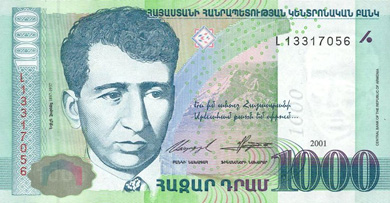
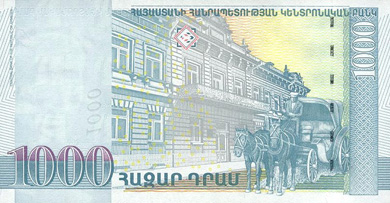
Budget & Public Finance
- Fiscal Year
- calendar year
- Annual Budget
- $930,700,000 (USD)
- External Debt
- $1,819,000,000 (USD)
- Investment (% of GDP)
- 25%
- Economic Aid
- $170,000,000 (USD)
- Current Account Balance
- -$237,000,000 (USD)
- Reserves of Foreign Exchange
- $625,600,000 (USD)
Labor, Industry & Trade
- Labor Force by Occupation
- agriculture 45%; services 30%; industry 25%
- Household Income — highest 10%
- 41.3%
- Industries
- diamond-processing, metal-cutting machine tools, forging-pressing machines, electric motors, tires, knitted wear, hosiery, shoes, silk fabric, chemicals, trucks, instruments, microelectronics, jewelry manufacturing, software development, food processing, brandy
- Agriculture Products
- fruit (especially grapes), vegetables; livestock
- Export Commodities
- diamonds, mineral products, foodstuffs, energy
- Export Partners
- Belgium 21.9%, Israel 16.4%, Russia 14.7%, Iran 11.2%, US 8.4%, Germany 6.6%
- Import Commodities
- natural gas, petroleum, tobacco products, foodstuffs, diamonds
- Import Partners
- US 14.1%, Russia 11.9%, Belgium 11.3%, Israel 10%, Iran 9.5%, UAE 5.7%, Germany 5.1%, Italy 4.5%, Ukraine 4.2%
Energy
- Oil Production
- 0 bbl/day
- Oil Consumption
- 40,000 bbl/day
- Oil Reserves
- 0 bbl/day
- Natural Gas Production
- 0 cu m
- Natural Gas Consumption
- 1,685,000,000 cu m
- Natural Gas Imports
- 1,685,000,000 cu m
- Natural Gas Exports
- 0 cu m
- Natural Gas Reserves
- 0 cu m
Communications
- Telephone System
- General Assessment: telecommunications investments have made major inroads in modernizing and upgrading the outdated telecommunications network inherited from the Soviet era; now 100% privately owned and undergoing modernization and expansion; mobile-cellular services monopoly terminated in late 2004 and a second provider began operations in mid-2005 Domestic: reliable modern fixed-line and mobile-cellular services are available across Yerevan in major cities and towns; significant but ever-shrinking gaps remain in mobile-cellular coverage in rural areas International: country code - 374; Yerevan is connected to the Trans-Asia-Europe fiber-optic cable through Iran; additional international service is available by microwave radio relay and landline connections to the other countries of the Commonwealth of Independent States, through the Moscow international switch, and by satellite to the rest of the world; satellite earth stations - 3
- Internet Country Code
- .am
News & Weather
News & Weather
Current Weather
Latest News
News - 2,700-Year-Old Irrigation System Studied in Armenia - Archaeology Magazine
Archaeology Magazine · 12h ago
Putin’s war is going badly — and China, Kazakhstan, Azerbaijan, Armenia and Turkey are quietly walking away - EUobserver
EUobserver · 20h ago
Armenian Democracy Faces a Threat From Within - Foreign Policy
Foreign Policy · 3h ago
Pressured by Azerbaijan, Israel drops Knesset Armenian genocide recognition vote - Haaretz
Haaretz · 1d ago
European Commission President Visits Armenia - The Jamestown Foundation
The Jamestown Foundation · 11h ago
Slovakia vs Armenia - Class. Game 19-20 - FIBA U20 EuroBasket 2026, Division B - FIBA Basketball
FIBA Basketball · 2d ago
Armenia: 40 Singers Competed in the Second Round of Auditions for Junior Eurovision 2026 - Eurovoix
Eurovoix · 1d ago
Preview: Ararat-Armenia vs Shamrock Rovers - prediction, team news, lineups - Sports Mole
Sports Mole · 1d ago
News via Google News
Climate Overview
The climate is highland continental. It is dry, with an average of 550mm (21.6 inches) in annual rainfall. In the Ararat Valley, where Yerevan is located, there is far less rain; with an average range of from 200mm to 250mm (7.9 to 10 inches).
Seasonal extremes are pronounced in the Ararat Valley. Temperatures can approach the record summer high of 42°C (107.6°F) or plunge towards the record winter low of -30°C (-22°F). Mean temperatures are more temperate, however. July readings give an average high range of from 25°C (77°F) to 30°C (86°F). The January low range averages from -5°C (23°F) to -7°C (19°F). Autumns are long and golden; Armenia enjoys around 2700 hours of sunshine each year. Drought is a perennial problem.
Videos
Videos
1 curated YouTube videos.
Source: YouTube
Frequently Asked Questions
Frequently Asked Questions
What is the population of Armenia?
How do people greet each other in Armenia?
What should I know about eating in Armenia?
What are the etiquette and hospitality customs in Armenia?
How should I dress in Armenia?
What gestures and physical greetings are common in Armenia?
What is family life like in Armenia?
What do people do for recreation in Armenia?
What is the capital of Armenia?
Where is Armenia located?
What countries border Armenia?
What is the predominant religion in Armenia?
What currency is used in Armenia?
What language is spoken in Armenia?
What is the geography of Armenia like?
What is Armenia known for?
Last reviewed 2026