
 English
 Español
 中文
中文 हिन्दी
 Français
Kuwait
Al Kuwayt
Declare Your Relationship to Kuwait
CountryReports Community
- Studying0
- From Kuwait0
- Kuwait heritage1
- Visited1
- Want to visit1
Customs and Culture
Customs and Culture
About the People
Kuwaitis use food to convey the spirit of hospitality and generosity. Food is presented in abundance and variety. No single food expresses this spirit more than Arabic coffee. The ornate coffeepot is ever present. Coffee is offered in the Diwaniya, served in small, delicate cups. To show proper appreciation of a meal, one must eat mightily.
Cultural Attributes
Women play a greater role in Kuwaiti society then women do in many other Gulf countries, although they seldom socialize together in public.
Kuwaitis use food to convey the spirit of hospitality and generosity. Food is presented in abundance and variety. No single food expresses this spirit more than Arabic coffee. The ornate coffeepot is ever present. Coffee is offered in the Diwaniya, served in small, delicate cups. To show proper appreciation of a meal, one must eat mightily.

The Fort of Abundance
Greetings, Gestures & Visiting
Kuwaitis often sprinkle their language with references to Allah. Common terms used include: Al-hamdu-lilah, All Praise is due to Allah, In Sha-Allah, Allah Willing and Subhan-Allah, Glory be to Allah. Although women play a greater role in Kuwaiti society then women do in many other Gulf countries, they seldom socialize together in public. Greetings are therefore between members of the same sex. In all cases they are given with a sense of enthusiasm and general pleasure at meeting or seeing the person again.
Kuwaitis take time during the greeting process to converse about their health, family, mutual friends and acquaintances, and other general matters of interest.
Titles are important. Use the honorific "Mister" and any academic or political title and the first name when addressing people. The title "Sheikh" denotes that someone is a member of the royal family. It is also used for old men.
Touching noses together three times is an old Bedouin greeting. Placing the palm of the right hand on the chest after shaking hands with another man can mean "no thank you" and shows respect. It is often used in refusing food, in which case the heart is patted several times. A slight bow of the head may be added.
Touching the fingertips of your right hand to your forehead while bowing the head slightly show deep respect. Placing the right hand or forefinger on the tip of the nose, right lower eyelid, top of the head, mustache or beard means "it's my responsibility", or "I'll do it for you".
Putting a right hand out, palm down, with fingers brought toward oneself repeatedly is the sign for "come here". Hitting the right fist into the open palm of the left hand indicates obscenity or contempt.
A quick snap of the head upwards, with an accompanying click of the tongue, is an expression of doubting the accuracy of what another has said or is a general sign of disapproval.
Stroking the mustache in connection with an oath or promise indicates sincerity. Making the "A-OK" sign as in the western culture means the “evil eye” and is used with curses. Pointing the index finger at someone, or beckoning with it shows contempt for the person being pointed at, as if they were an animal.
Kuwaitis spend much of their free time socializing with family members and friends. Diwaniya is a place separate from the main house that is usually used by men for socializing. Diwaniya is known throughout the Arabian Peninsula. It continues to be significant in the lives of most Kuwaitis. Diwaniya sessions occur regularly, usually weekly. The atmosphere in the Diwaniya is reminiscent of late night relaxing in a desert tent, and resembles a social club.
Visitors are offered refreshments. They engage in discussions of politics and life, or enjoy various forms of entertainment, such as watching television and videos, playing cards, discussing family and neighborhood affairs, or simply sitting in friendly silence.
Meals are generally served family-style. Guests are served first. Then the oldest, continuing in some rough approximation of age order until the youngest is served. Honored guests are often offered the most prized pieces or delicacies such as the sheep's head.
In urban areas Western style clothing is becoming popular with the young people. However many Kuwaitis still wear traditional Arab clothing. This includes the "dishdasha" (ankle length robe) and ghutra (head scarf). Women are veiled according to Islamic law.
Diet
In Kuwaiti homes, foods from other Arab countries are commonly prepared. Favorites are dolma, rolled vine leaves stuffed with flavored rice and meat, hummus, a ground chickpea mix, and tabbouleh, chopped parsley, tomato, onion and bulgur wheat. In addition, western style fast food is now easily available. It is especially popular among young Kuwaitis.
Kuwaitis usually eat a light breakfast. Their main meal of the day, lunch, consists of many different dishes presented at once to allow individual choice. Dessert is usually a variety of fruits or prepared sweets. Common drinks consumed with the meal are water, soft drinks and leban or diluted yogurt. Tea or coffee are served in a sitting room after the meal. Dinner is a small meal.
Traditionally, Bedouin Arabs sat on the floor, eating from a communal platter using the fingers of the right hand. Most Kuwaiti homes have both western-style dining tables as well as traditional dining facilities. Many Kuwaitis still prefer to eat sitting at a low table, but are more likely to use individual plates, cutlery and napkins.
Kuwaitis abstain from pork or alcohol as Muslims are forbidden to consume such foods. Religious Kuwaitis are particularly attentive to these prohibitions and will not consume any prepared foods that contain pork by-products such as lard or pepsin. In addition, some of the more religious Kuwaitis will only eat meat and chicken that is slaughtered according to Islamic ritual practices. Meat of this type is called Halal.
In Kuwaiti homes, foods from other Arab countries are commonly prepared. Favorites are dolma, rolled vine leaves stuffed with flavored rice and meat, hummus, a ground chickpea mix, and tabbouleh, chopped parsley, tomato, onion and bulgur wheat. In addition, western style fast food is now easily available. It is especially popular among young Kuwaitis.
Kuwaitis usually eat a light breakfast. Their main meal of the day, lunch, consists of many different dishes presented at once to allow individual choice. Dessert is usually a variety of fruits or prepared sweets. Common drinks consumed with the meal are water, soft drinks and leban or diluted yogurt. Tea or coffee are served in a sitting room after the meal. Dinner is a small meal.
Traditionally, Bedouin Arabs sat on the floor, eating from a communal platter using the fingers of the right hand. Most Kuwaiti homes have both western-style dining tables as well as traditional dining facilities. Many Kuwaitis still prefer to eat sitting at a low table, but are more likely to use individual plates, cutlery and napkins.
Kuwaitis abstain from pork or alcohol as Muslims are forbidden to consume such foods. Religious Kuwaitis are particularly attentive to these prohibitions and will not consume any prepared foods that contain pork by-products such as lard or pepsin. In addition, some of the more religious Kuwaitis will only eat meat and chicken that is slaughtered according to Islamic ritual practices. Meat of this type is called Halal.

Family
Family Names: The first name is the personal name The second name is the father’s personal name. It is used with the connector “al- ”. The third and fourth names are the grandfather’s personal name and a name that denotes the family lineage. Both names generally start with the prefix “al-”.
Kuwaiti families average three to five children. The care of children is the primary responsibility of mothers supported by other women from the extended family. Many wealthy families also use nannies and other servants.
Families are broken into small family units, who live in separate homes. Related families tend to cluster near each other. Social relations and family obligations are conducted and expressed through the extended family. Parents usually reside with one or more of their children.
Modernization has led to greater flexibility in gender roles and family relations. Marriage outside the extended family is more common now, although parental consent remains vital. Women have the opportunity to work outside the home and segregation within the home and extended family is diminishing.
Recreation
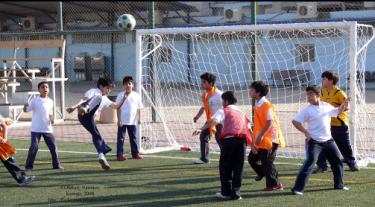
Football (soccer) is the most popular sport. People on the coast enjoy swimming in pools (jellyfish are a concern in the Persian Gulf) , wind surfing, water skiing, scuba diving and yachting. In addition they enjoy horse racing and falconry.
Holidays
National Day
2/25Independence
Dates of Interest
- July - August
Ramadan, the greatest religious observance in Islam, is an annual month of fasting. The exact dates of Islamic holidays cannot be determined in advance, due to the nature of the Islamic lunar calender. Estimates are based on expected visibility of the hilal (waxing crescent moon following a new moon) and may vary according to location.
How do people greet each other in Kuwait?
Greetings are warm and enthusiastic, given between members of the same sex, since men and women seldom socialize together in public. Kuwaitis take time to ask about health, family, and mutual friends.
Do
- Greet people of your own sex
- Take time to ask about health, family, and mutual acquaintances
- Use the honorific "Mister" plus any academic or political title and the first name
Good to know
- "Sheikh" denotes a member of the royal family and is also used for old men
- Language is often sprinkled with references to Allah, such as Al-hamdu-lilah, In Sha-Allah, and Subhan-Allah
What are dining customs like in Kuwait?
Food expresses hospitality and generosity, served in abundance and variety; lunch is the main meal, with many dishes presented at once. Meals are served family-style with guests first, then oldest to youngest.
Do
- Eat mightily to show proper appreciation of a meal
- Accept Arabic coffee served in small, delicate cups
- Try favorites like dolma, hummus, and tabbouleh
Don’t
- Don't expect pork or alcohol, which Muslims are forbidden to consume
Good to know
- Traditionally people ate from a communal platter with the right hand, sitting at a low table
- Honored guests may be offered prized pieces such as the sheep's head
- Tea or coffee are served in a sitting room after the meal
- Some religious Kuwaitis eat only Halal meat and avoid pork by-products like lard or pepsin
What should I wear in Kuwait?
Western-style clothing is popular among young people in urban areas, but many Kuwaitis still wear traditional Arab dress.
Good to know
- Traditional dress includes the ankle-length "dishdasha" robe and "ghutra" head scarf
- Women are veiled according to Islamic law
Which gestures should I know in Kuwait?
Gestures carry strong meaning in Kuwait, from signs of respect to signs of contempt and obscenity.
Do
- Place the right palm on your chest after a handshake to show respect or politely decline food
- Touch fingertips of the right hand to the forehead with a slight bow to show deep respect
- Stroke the mustache with an oath to indicate sincerity
Don’t
- Don't make the "A-OK" sign, which means the "evil eye" and is used with curses
- Don't point or beckon with the index finger, which shows contempt
- Don't hit your right fist into your left palm, which indicates obscenity or contempt
Good to know
- Touching noses together three times is an old Bedouin greeting
- Palm-down hand with fingers pulled toward oneself means "come here"
- Right hand or finger on the nose, eyelid, head, mustache, or beard means "I'll do it for you"
How is family life structured in Kuwait?
Families average three to five children and live in small family units in separate but clustered homes, with social relations expressed through the extended family.
Good to know
- Names run as personal name, father's name, grandfather's name, and family lineage, often linked with "al-"
- Mothers, supported by extended-family women (and sometimes nannies), have primary care of children
- Parents usually reside with one or more of their children
- Marriage outside the extended family is increasingly common, but parental consent remains vital
What do people do for recreation in Kuwait?
Football (soccer) is the most popular sport, and coastal residents enjoy a range of water activities.
Good to know
- Popular activities include swimming, windsurfing, water skiing, scuba diving, and yachting
- Horse racing and falconry are also enjoyed
- Beware of jellyfish when swimming in the Persian Gulf
Last updated: 2026-07-12 · Sources: CountryReports
Photos of Kuwait
Photos of Kuwait


Travel and Tourism
Travel and Tourism
- Travel Alert Status
- Level 1: Exercise Normal Precautions
- Currency
- Kuwaiti dinar (KD)
- Time Difference
- UTC+3 (8 hours ahead of Washington, DC,during Standard Time)
- Climate
- The country is a sandy, riverless desert interspersed with small hills. Vegetation is sparse. Kuwait's climate is typical of the region. Summer (April-October) temperatures often exceed 120°F, although daytime temperatures of 110-115°F are more common. Mean annual rainfall is 45 inches and occurs mostly during December and January. Short autumn and spring seasons (November, February, and March) are delightful. During winter (December and January), clear, sunny days are common, but it is often cold enough to require a light winter coat in the mornings and evenings. In the early morning the frost point is occasionally reached. Sand and dust storms occur throughout the year, especially between March and August. Periods of high humidity occur, but during the hottest months (June, July, and August), humidity levels usually remain very low.
- Airports
- 7
Read the full travel guide — health, safety, vaccinations, disease risk, sanitation, and transit details.
View full travel guideRecipes
Recipes
History
History
Historical Eras
Early Settlement
1700 – 1899
Settlers arrived at the site of present-day Kuwait City around 1700, establishing a small fishing and pearling community on the northwestern shore of the Persian Gulf. By 1756, the Al-Sabah family consolidated political authority over the settlement, founding the dynasty that continues to rule Kuwait today. The town gradually developed as a regional trading and maritime center linking Arabia, India, and the broader Gulf world.
British Protectorate
1899 – 1961
In 1899, Sheikh Mubarak Al-Sabah signed an agreement placing Kuwait's foreign relations and defense under British oversight, shielding the emirate from Ottoman and later Iraqi territorial ambitions. The discovery of oil in 1937 transformed Kuwait's economic trajectory entirely, and the subsequent decades saw rapid development of petroleum infrastructure. British-defined boundaries with Iraq, established in 1913 and refined thereafter, would remain a source of regional tension for generations.
Independence & Nation-Building
1961 – 1990
Kuwait gained full independence from Britain on June 19, 1961, and quickly moved to institutionalize governance with a new constitution and an elected National Assembly in 1963. Vast oil revenues funded one of the most comprehensive welfare states in the world, providing citizens with free healthcare, education, and subsidized utilities. Kuwait emerged as a significant regional financial power, though it faced persistent border disputes with Iraq and supported Baghdad financially during the Iran-Iraq War of 1980–1988.
Iraqi Invasion & Liberation
1990 – 1991
On August 2, 1990, Iraqi forces under Saddam Hussein invaded and occupied Kuwait, triggering an international crisis and the imposition of sweeping UN sanctions against Iraq. A US-led coalition launched an air campaign in January 1991, followed by a ground offensive beginning February 23 that liberated Kuwait in just four days. The occupation left catastrophic damage to Kuwait's oil infrastructure, requiring more than $5 billion in repairs and hundreds of burning oil wells that took months to extinguish.
Reconstruction & Reform
1991 – present
In the post-liberation decade, Kuwait rebuilt its oil industry and secured international recognition of its borders, with Iraq formally acknowledging Kuwaiti sovereignty in 1994 and the UN demarcating a new boundary in 1993. Gradual political reforms expanded democratic participation, most notably in 2005 when parliament granted women the right to vote and stand for election — a right first exercised in 2006 municipal by-elections. Kuwait has continued to navigate tensions between parliamentary politics, the authority of the Al-Sabah ruling family, and the pressures of economic diversification beyond hydrocarbons.
Overview
Timeline of Key Events
700
Kuwait became a part of the Abbasid empire.
Kuwait became a part of the Abbasid empire.
1600
North-east portion of Arabian peninsula becomes part of the Turkish Ottoman empire.
North-east portion of Arabian peninsula becomes part of the Turkish Ottoman empire.
1700
Settlers arrive at the site of present-day Kuwait City
Settlers arrive at the site of present-day Kuwait City from the interior of the Arabian peninsula. The settlement grows into a bustling trading hub by the early 1800s.
1756
Kuwait comes under the control of the Al-Sabah family, predecessors of Kuwait’s present rulers.
Kuwait comes under the control of the Al-Sabah family, predecessors of Kuwait’s present rulers. A degree of semi-autonomy from Ottoman Turkey prevails.
1899
Kuwait became a British protectorate.
Kuwait became a British protectorate.
1913
The boundary between Iraq and Kuwait was defined.
The boundary between Iraq and Kuwait was defined.
1937
Oil was found in Kuwait.
Large oil reserves discovered by the US-British Kuwait Oil Company. Exploitation is delayed by World War II, but thereafter fuels the country’s development into a modern commercial center.
Read the full history profile — narrative overview, defining eras, and the complete timeline in one place.
View expanded historyInteresting Facts
Interesting Facts
Kuwait has the world's lowest death rate with 2.2 per 1,000 people.
The name Kuwait is derived from the word Kut, an Arabic word meaning fort.
During the aftermath of the Gulf War virtually all of Kuwait's 732 oil wells were set ablaze by the fleeing Iraqi army. It took seven months to douse the oil blazes.
Traditionally, the Bedouins depended on camels, sheep and goats for their survival.
Historically the vote in Kuwait’s electoral process was provided only to men, However in May 2005 parliament voted to give women full political rights. The vote passed by a margin of 35 votes for giving women rights, and 23 against giving women full political rights.
Though geographically small, Kuwait has one of the highest per capita incomes in the world.
See every fact — trivia, oddities, and curious tidbits gathered from across the country.
View all interesting factsGeography and Environment
Geography and Environment
- Terrain
- flat to slightly undulating desert plain
- Climate
- The country is a sandy, riverless desert interspersed with small hills. Vegetation is sparse. Kuwait's climate is typical of the region. Summer (April-October) temperatures often exceed 120 °F, although daytime temperatures of 110-115 °F are more common. Mean annual rainfall is 45 inches and occurs mostly during December and January. Short autumn and spring seasons (November, February, and March) are delightful. During winter (December and January), clear, sunny days are common, but it is often cold enough to require a light winter coat in the mornings and evenings. In the early morning the frost point is occasionally reached. Sand and dust storms occur throughout the year, especially between March and August. Periods of high humidity occur, but during the hottest months (June, July, and August), humidity levels usually remain very low.
- Natural Hazards
- sudden cloudbursts are common from October to April and bring heavy rain, which can damage roads and houses; sandstorms and dust storms occur throughout the year, but are most common between March and August
- Current Environmental Issues
- limited natural fresh water resources; some of world's largest and most sophisticated desalination facilities provide much of the water; air and water pollution; desertification
Read the full geography and environment profile — terrain, climate, natural resources, hazards, land use, and international agreements.
View full geographyPeople & Demographics
People & Demographics
Religion
Languages Spoken
Arabic (official), English widely spoken
- Arabic
Population
- Population
- 2,789,132
- Population in Major Urban Areas
- KUWAIT (capital) 2.406 million
- Nationality Noun
- Kuwaiti(s)
- Ethnic Groups
- Kuwaiti 45%, other Arab 35%, South Asian 9%, Iranian 4%, other 7%
Education
- Literacy Definition
- age 15 and over can read and write
Read the full people and society profile — demographics, health, education, religion, languages, and notable people.
View full people and societyGovernment & Politics
Government & Politics
Country Identity
- Country Name
- Kuwait
- Full Country Name
- State of Kuwait
- Local - Long
- Dawlat al Kuwayt
- Local - Short
- Al Kuwayt
Government Structure
- Government Type
- nominal constitutional monarchy
- Legal System
- civil law system with Islamic law significant in personal matters; has not accepted compulsory ICJ jurisdiction
- Executive Branch
- chief of state: Amir MISHAL al-Ahmad al-Jabir al-Sabah (since 16 December 2023); Crown Prince SABAH al-Khalid al-Hamad al-Sabah (since 16 December 2023) head of government: Prime Minister AHMAD al-Abdullah al-Ahmad al-Sabah (since 15 May 2024); Deputy Prime Ministers and cabinet members appointed in accordance with the prime minister's recommendations cabinet: Council of Ministers appointed by the prime minister and approved by the amir elections: none; the amir is hereditary; prime minister and deputy prime ministers are appointed by the amir
- Legislative Branch
- unicameral National Assembly or Majlis al-Umma (50 seats; members elected by popular vote to serve four-year terms) elections: last held 6 July 2003 (next to be held in 2007) election results: percent of vote - NA; seats - Islamists 21, government supporters 14, liberals 3, independents 12; note - all cabinet ministers are also ex officio members of the National Assembly
- Judicial Branch
- High Court of Appeal
- Suffrage
- adult males who have been naturalized for 30 years or more or have resided in Kuwait since before 1920 and their male descendants at age 21
- Constitution
- approved and promulgated 11 November 1962
- Independence
- 19 June 1961 (from UK)
- National Holiday
- National Day, 25 February (1950)
Capital City
- Capital Name
- Kuwait City
- Capital - geographic coordinate
- 29 22 N, 47 58 E
- Capital Time Difference
- UTC+3 (8 hours ahead of Washington, DC,during Standard Time)
the name derives from Arabic "al-Kuwayt" a diminutive of "kut" meaning "fortress," possibly a reference to a small castle built on the current location of Kuwait City by the Beni Khaled tribe in the 17th century
Military
Branches: Kuwaiti Land Forces (KLF), Kuwaiti Navy, Kuwaiti Air Force (Al-Quwwat al-Jawwiya al-Kuwaitiya; includes Kuwaiti Air Defense Force, KADF), Kuwaiti National Guard (KNG)
Embassy / Diplomatic Mission
U.S. Embassy Kuwait
Al-Masjid Al-Aqsa Street, Block 6, Plot 14,
Bayan, Kuwait
Telephone: [965] 2259-1001 or 2259-1002
Emergency after-hours telephone: [965] 2259-1001
Facsimile: [965] 2259-1438
Email: KuwaitACS@state.gov
The U.S. Embassy is open Sunday through Thursday, except on U.S. or local holidays.
Read the full government profile — flag symbolism, national anthem, and other national symbols.
View full government detailsEconomy
Economy
Kuwait is a small, wealthy, and relatively open economy with proved crude oil reserves of about 101.5 billion barrels, representing roughly 6% of global reserves. Petroleum accounts for around 40% of GDP, more than 90% of export revenues, and approximately 90% of government income, making the country highly dependent on hydrocarbons. Kuwait's harsh climate and limited arable land severely restrict agricultural development, and with the exception of fish, it relies almost entirely on food imports. The majority of potable water must be produced through desalination or imported. In recent years, the government has pursued its Kuwait Vision 2035 development plan, which aims to diversify the economy, attract foreign investment, and reduce reliance on oil revenues. Kuwait also continues to engage foreign oil companies in efforts to expand production capacity and develop fields in the northern part of the country.
Snapshot
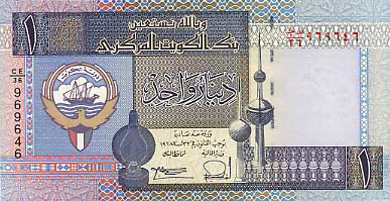
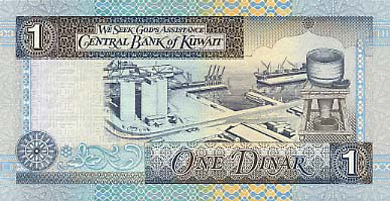
- Currency Name and Code
- Kuwaiti Dinar (KWD)
- GDP — official exchange rate
- $52,760,000,000 (USD)
- GDP Real Growth Rate
- 4.8%
Banknotes
Budget & Public Finance
- Fiscal Year
- 1 April - 31 March
- Annual Budget
- $20,770,000,000 (USD)
- Public Debt (% of GDP)
- 17.6%
- External Debt
- $14,930,000,000 (USD)
- Investment (% of GDP)
- 6.6%
- Current Account Balance
- $31,510,000,000 (USD)
- Reserves of Foreign Exchange
- $2,147,483,647 (USD)
Labor, Industry & Trade
- Labor Force by Occupation
- agriculture NA%; industries NA%; services NA%
- Industries
- petroleum, petrochemicals, desalination, food processing, construction materials
- Agriculture Products
- practically no crops; fish
- Export Commodities
- oil and refined products, fertilizers
- Export Partners
- Japan 24.1%, South Korea 12.8%, US 11.8%, Singapore 10%, Taiwan 7.4%, Netherlands 4.4%, Pakistan 4.3%
- Import Commodities
- food, construction materials, vehicles and parts, clothing
- Import Partners
- US 12.8%, Japan 10.9%, Germany 9.7%, Saudi Arabia 6.4%, UK 5.9%, Italy 5.3%, France 5.1%
Energy
- Oil Production
- 2,418,000 bbl/day
- Oil Consumption
- 305,000 bbl/day
- Oil Reserves
- 96,500,000,000 bbl/day
- Natural Gas Production
- 8,300,000,000 cu m
- Natural Gas Consumption
- 8,300,000,000 cu m
- Natural Gas Imports
- 0 cu m
- Natural Gas Exports
- 0 cu m
- Natural Gas Reserves
- 1,572,000,000,000 cu m
Communications
- Telephone System
- general assessment: the quality of service is excellent domestic: new telephone exchanges provide a large capacity for new subscribers; trunk traffic is carried by microwave radio relay, coaxial cable, and open-wire and fiber-optic cable; a mobile-cellular telephone system operates throughout Kuwait, and the country is well supplied with pay telephones international: country code - 965; linked to international submarine cable Fiber-Optic Link Around the Globe (FLAG); linked to Bahrain, Qatar, UAE via the Fiber-Optic Gulf (FOG) cable; coaxial cable and microwave radio relay to Saudi Arabia; satellite earth stations - 6 (3 Intelsat - 1 Atlantic Ocean and 2 Indian Ocean, 1 Inmarsat - Atlantic Ocean, and 2 Arabsat)
- Internet Country Code
- .kw
News & Weather
News & Weather
Current Weather
Latest News
Iran attacks Bahrain, Kuwait and Jordan after US hits Iranian nuclear site - Al Jazeera
Al Jazeera · 1d ago
Iran and Kuwait report attacks on water and power infrastructure as strikes escalate - NBC News
NBC News · 2d ago
Iran live updates: Trump says Iran 'will pay' for killing US troops - ABC News - Breaking News, Latest News and Videos
ABC News - Breaking News, Latest News and Videos · 11h ago
The Gulf nation that became Iran’s softest target - Financial Times
Financial Times · 3h ago
Live: Iran Revolutionary Guards say they hit US radar and air defence systems in Bahrain and Kuwait - France 24
France 24 · 5h ago
Iranian army says it targeted US HIMARS systems in Kuwait - Anadolu Ajansı
Anadolu Ajansı · 4h ago
Iran says it targeted a US base in Kuwait with missiles - The Times of Israel
The Times of Israel · 8h ago
Iran launched drones, missiles, towards US bases in Kuwait, IRGC claims - The Jerusalem Post
The Jerusalem Post · 9h ago
News via Google News
Climate Overview
The country is a sandy, riverless desert interspersed with small hills. Vegetation is sparse. Kuwait's climate is typical of the region. Summer (April-October) temperatures often exceed 120°F, although daytime temperatures of 110-115°F are more common. Mean annual rainfall is 45 inches and occurs mostly during December and January. Short autumn and spring seasons (November, February, and March) are delightful. During winter (December and January), clear, sunny days are common, but it is often cold enough to require a light winter coat in the mornings and evenings. In the early morning the frost point is occasionally reached. Sand and dust storms occur throughout the year, especially between March and August. Periods of high humidity occur, but during the hottest months (June, July, and August), humidity levels usually remain very low.
Videos
Videos
1 curated YouTube videos.
Source: YouTube
Frequently Asked Questions
Frequently Asked Questions
What is the population of Kuwait?
How do people greet each other in Kuwait?
What are dining customs like in Kuwait?
What should I wear in Kuwait?
Which gestures should I know in Kuwait?
How is family life structured in Kuwait?
What do people do for recreation in Kuwait?
What is the capital of Kuwait?
Where is Kuwait located?
What countries border Kuwait?
What is the religion of Kuwait?
What is the currency of Kuwait?
What language is spoken in Kuwait?
What is Kuwait known for?
Last reviewed 2026