
 English
 Español
 中文
中文 हिन्दी
 Français
Reunion
Ile de la Reunion
Declare Your Relationship to Reunion
CountryReports Community
- Studying0
- From Reunion0
- Reunion heritage0
- Visited0
- Want to visit0
Customs and Culture
Customs and Culture
Cultural Attributes
Réunion's culture is a vibrant tapestry woven from African, European, South Asian, East Asian, and Malagasy influences, reflecting the island's complex history of colonization and immigration. This multicultural heritage has produced a society that locals describe as "Créole," a term that encompasses not just a language but an entire way of life rooted in blending and coexistence. The Créole language, known locally as Réunionnais Créole or Kréol, is spoken by the vast majority of the population alongside French, which remains the official language used in government, education, and formal settings. Créole serves as the everyday vernacular and is a powerful marker of shared island identity that cuts across ethnic and religious lines. Religion plays a significant role in cultural life, and the island's diversity is especially visible in its places of worship. Roman Catholicism is the dominant faith, practiced by roughly 85 percent of the population, but Tamil Hindu temples, mosques, and Chinese shrines are found throughout the island, and multi-faith festivals are woven into the annual calendar. The Tamil fire-walking ceremony, known as Cavadee, draws large crowds and reflects the deep roots of the South Indian community descended from indentured laborers brought to the island in the 19th century. Réunionese cuisine is another powerful expression of cultural fusion. The staple dish, cari, is a fragrant stew typically made with chicken, seafood, or pork and served with rice, lentils, and rougail, a spiced tomato condiment. Each ethnic community has contributed flavors and techniques, making the local table one of the richest in the Indian Ocean region. Music and dance are central to social life. Séga, a rhythmic style rooted in the traditions of enslaved Africans and Malagasy people, and maloya, its deeper, more ceremonial counterpart, are beloved forms of cultural expression. Maloya was recognized by UNESCO as an Intangible Cultural Heritage of Humanity in 2009, underscoring its significance not just locally but globally. Together, these art forms serve as living connections to the island's layered and often painful history.
Island of a Thousand Fires
Diet
Reunion's cuisine combine some Creole, French as well as Indian and Chinese foods.
The famous and ubiquitous local dish called “cari” is unique in the Indian Ocean. It is prepared with meat, poultry, fish or seafood and contains garlic, onion, plenty of tomatoes, turmeric, clove and ginger : those are reminder of the good old days when Bourbon (Reunion's former name) was an island of spices.
Traditional Indian cuisine includes “massalés”. The right way to eat a genuine Indian curry dish is directly from banana leaves
The Chinese from the Canton region, arrived in the island towards the end of the 19th century and brought their cooking influence.
Reunion's cuisine combine some Creole, French as well as Indian and Chinese foods.
The famous and ubiquitous local dish called “cari” is unique in the Indian Ocean. It is prepared with meat, poultry, fish or seafood and contains garlic, onion, plenty of tomatoes, turmeric, clove and ginger : those are reminder of the good old days when Bourbon (Reunion's former name) was an island of spices.
Traditional Indian cuisine includes “massalés”. The right way to eat a genuine Indian curry dish is directly from banana leaves
The Chinese from the Canton region, arrived in the island towards the end of the 19th century and brought their cooking influence.
Holidays
Bastille Day
7/14Other
Dates of Interest
- July 14th
What should I know about food and eating customs in Reunion?
Réunion's cuisine is a fusion of Creole, French, Indian, and Chinese influences, with the staple dish being cari, a fragrant stew of meat, poultry, fish, or seafood served with rice, lentils, and rougail (a spiced tomato condiment).
Do
- Try cari, the ubiquitous local stew made with garlic, onion, tomatoes, turmeric, clove, and ginger
- Eat a genuine Indian curry dish directly from banana leaves, as is traditional
- Sample massalés, part of the island's traditional Indian cuisine
Good to know
- Chinese immigrants from the Canton region arrived in the late 19th century and shaped local cooking
- The island was formerly known as Bourbon and was historically an island of spices
- Réunionese cuisine is considered one of the richest in the Indian Ocean region
What cultural background should I know before visiting Reunion?
Réunion has a multicultural 'Créole' culture blending African, European, South Asian, East Asian, and Malagasy influences, with French as the official language and Créole (Kréol) as the everyday vernacular.
Do
- Expect French in government, education, and formal settings, and Créole in daily life
- Explore the island's diverse places of worship, including Catholic churches, Tamil Hindu temples, mosques, and Chinese shrines
- Experience local music and dance forms like séga and maloya
Good to know
- Roman Catholicism is practiced by roughly 85 percent of the population
- The Tamil fire-walking ceremony, Cavadee, draws large crowds and reflects the South Indian community's heritage
- Maloya was recognized by UNESCO as Intangible Cultural Heritage of Humanity in 2009
Last updated: 2026-07-12 · Sources: CountryReports
Travel and Tourism
Travel and Tourism
- Currency
- euro (EUR)
- Climate
- tropical, but temperature moderates with elevation; cool and dry from May to November, hot and rainy from November to April
- Airports
- 2
Read the full travel guide — health, safety, vaccinations, disease risk, sanitation, and transit details.
View full travel guideHistory
History
Historical Eras
Uninhabited Island
Réunion was uninhabited when Portuguese navigator Pedro de Mascarenhas first documented it around 1513, naming the Mascarene archipelago. The island lay untouched for over a century, visited occasionally by passing European mariners as a waypoint on Indian Ocean trade routes but never permanently settled.
Early French Colony
1642 – 1715
French colonists established a permanent presence on the island, then named Bourbon, in the 1640s under the direction of the French East India Company. Enslaved Malagasy and mainland Africans were brought to cultivate coffee plantations, laying the foundation for the island's hierarchical colonial society and its multiethnic demographic character.
Plantation Era
1715 – 1815
Bourbon became a prosperous node on the East Indies trade route, its economy driven by coffee and later other plantation crops worked by an expanding enslaved population. A brief British occupation during the Napoleonic Wars (1810–1815) introduced sugar cane cultivation, which would reshape the island's economy for generations. The island was returned to France by the Treaty of Paris in 1815.
Colonial Maturity
1815 – 1946
Renamed Réunion after the Revolution and then Bourbon again under the Restoration, the island settled into its identity as a French colonial sugar economy. The abolition of slavery in 1848 prompted the importation of indentured laborers from India, China, and Southeast Asia, deepening the island's ethnic diversity. The opening of the Suez Canal in 1869 diminished Réunion's strategic value as a trade-route stopover, causing prolonged economic decline.
French Département
1946 – 2000
In 1946 Réunion was transformed from a colony into a full overseas département of France, granting its inhabitants French citizenship and access to metropolitan social programs. Significant investment modernized infrastructure, but structural unemployment and a stark wealth gap fueled persistent social tensions, culminating in violent anti-government riots in 1991 that left ten people dead. Independence movements remained marginal, with most Réunionnais preferring continued integration with France.
Modern Overseas Region
2000 – present
Réunion holds the status of both a French overseas département and an outermost region of the European Union, anchoring it firmly within European governance and economic frameworks. Tourism centered on the island's volcanic landscapes, cirques, and biodiversity supplements an economy still reliant on sugar exports and substantial transfers from metropolitan France. High youth unemployment and cyclical tropical storms remain central challenges, while the hyperactive Piton de la Fournaise volcano continues to shape daily life and global scientific interest.
Overview
The opening of the Suez Canal in 1869 cost the island its importance as a stopover on the East Indies trade route.
The island was ruled as a colony until 1946, when it was made a "departement", or administrative unit, of France. The Reunionese are French citizens and many of them wish to remain so; independence movements have been sporadic and there is little will to sever ties with Paris.
Reunion is a volcanic hotspot; lava sometimes reaches the sea. Reunion is home to one of the world’s most active volcanos, the Piton de la Fournaise, which has erupted more than 170 times since the mid-17th century. Lava flows have closed roads and damaged buildings.
Sugar cane was introduced during a brief period of British rule in the early 19th century. It provides the raw material for Reunion’s main exports. Tourism is also important; attractions include spectacular gorges and "cirques" - natural amphitheatres surrounded by mountains.
A large wealth gap has fuelled social tensions. These spilled over into violence in 1991 when 10 people were killed in anti-government riots. Unemployment is high, particularly among the young, and migration is commonplace.
The territory is prone to tropical storms; a cyclone monitoring station in the capital serves the Indian Ocean region.
Timeline of Key Events
1640
French colonists arrived on the island, then known as Bourbon.
French colonists arrived on the island, then known as Bourbon.
1801 – 1900
Sugar cane was introduced during a brief period of British rule in the early 19th century.
Sugar cane was introduced during a brief period of British rule in the early 19th century.
1946
The island was ruled as a colony until 1946.
The island was ruled as a colony until 1946, when it was made a "departement", or administrative unit, of France.
Read the full history profile — narrative overview, defining eras, and the complete timeline in one place.
View expanded historyInteresting Facts
Interesting Facts
Slaves from Madagascar and mainland Africa were brought in to work the island's coffee plantations.
Reunion is home to one of the world’s most active volcanos, the Piton de la Fournaise, which has erupted more than 170 times since the mid-17th century. Lava flows have closed roads and damaged buildings.
See every fact — trivia, oddities, and curious tidbits gathered from across the country.
View all interesting factsGeography and Environment
Geography and Environment
- Terrain
- mostly rugged and mountainous; fertile lowlands along coast
- Climate
- tropical, but temperature moderates with elevation; cool and dry from May to November, hot and rainy from November to April
- Natural Hazards
- periodic, devastating cyclones (December to April); Piton de la Fournaise on the southeastern coast is an active volcano
- Current Environmental Issues
- NA
Read the full geography and environment profile — terrain, climate, natural resources, hazards, land use, and international agreements.
View full geographyPeople & Demographics
People & Demographics
Religion
Languages Spoken
French (official), Creole widely used
- Creole
- French
Population
- Population
- 0
- Nationality Noun
- Reunionese (singular and plural)
- Ethnic Groups
- French, African, Malagasy, Chinese, Pakistani, Indian
Education
- Literacy Definition
- age 15 and over can read and write
Read the full people and society profile — demographics, health, education, religion, languages, and notable people.
View full people and societyGovernment & Politics
Government & Politics
Country Identity
- Country Name
- Reunion
- Full Country Name
- Department of Reunion
- Local - Short
- Ile de la Reunion
- Former Name
- Bourbon Island
Government Structure
- Government Type
- NA
- Legal System
- French law
- Executive Branch
- chief of state: President Emmanuel MACRON of France (since 14 May 2017), represented by Prefect Jeannie DOUVRY (since 2023) head of government: President of the Departmental Council Cyrille MELCHIOR (since December 2020) and President of the Regional Council Huguette BELLO (since April 2021) cabinet: NA elections: French president elected by popular vote for a five-year term; prefect appointed by the French president on the advice of the French Ministry of the Interior; the presidents of the Departmental and Regional Councils are elected by the members of those councils
- Legislative Branch
- unicameral General Council (49 seats; members are elected by direct, popular vote to serve six-year terms) and a unicameral Regional Council (45 seats; members are elected by direct, popular vote to serve six-year terms) elections: General Council - last held 15 and 22 March 1998 (next to be held NA); Regional Council - last held 28 March 2004 (next to be held in 2010) election results: General Council - percent of vote by party - NA; seats by party - various right-wing candidates 13, PCR 10, PS 10, UDF 8, RPR 6, other left-wing candidates 2; Regional Council (second round) - percent of vote by party - PCR 44.9%, UMP 32.8%, PS-Greens 22.3%; seats by party - PCR 27, UMP 11, PS-Greens 7 note: Reunion elects three representatives to the French Senate; elections last held in 2001 (next to be held in 2006); results - percent of vote by party - NA; seats by party - PRC 1, UDF 1, UMP 1; Reunion also elects five deputies to the French National Assembly; elections last held 9 June-16 June 2002 (next to be held in 2007); results - percent of vote by party - NA; seats by party - UMP 3, PS 1, independent 1
- Judicial Branch
- Court of Appeals or Cour d'Appel
- Suffrage
- 18 years of age; universal
- Constitution
- 28 September 1958 (French Constitution)
- Independence
- none (overseas department of France)
- National Holiday
- Bastille Day, 14 July (1789)
Capital City
- Capital Name
- Saint-Denis
Read the full government profile — flag symbolism, national anthem, and other national symbols.
View full government detailsEconomy
Economy
Reunion's economy has evolved significantly from its agricultural roots, with the services sector now accounting for the vast majority of GDP and employment. Sugarcane remains the dominant agricultural crop and the island's principal export commodity, supporting a sugar and rum industry that continues to play a cultural and economic role, though agriculture overall represents only a small share of total economic output. Tourism has expanded as a key development priority, drawing visitors to the island's volcanic landscapes, beaches, and UNESCO-listed national park, though the sector remains vulnerable to external shocks, as demonstrated during the COVID-19 pandemic.
Unemployment, while no longer at the extreme levels of past decades, remains stubbornly high at around 17–19%, well above the French national average, and youth unemployment is particularly severe. Income inequality continues to be a defining feature of Reunionese society, with roughly a third of the population living below the poverty line. These disparities have periodically fueled social unrest, most notably during the widespread "gilets jaunes" protests in late 2018, which began over fuel taxes but quickly evolved into broader demonstrations against the high cost of living and economic marginalization.
As an overseas department and region of France, Reunion benefits from substantial transfers from the French state and the European Union, which underpin public services, infrastructure, and social welfare programs. This financial support remains essential to the island's economic stability, and Reunion's standard of living, while uneven, is considerably higher than that of neighboring countries in the southwestern Indian Ocean.
Snapshot
- Currency Name and Code
- Euro (EUR)
- GDP Real Growth Rate
- 2.5%
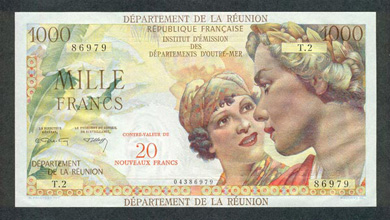
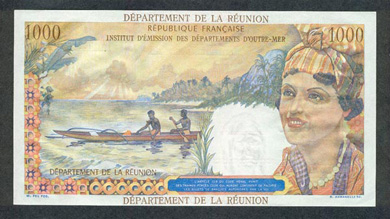
Banknotes
Budget & Public Finance
- Fiscal Year
- calendar year
- Annual Budget
- $554,700,000 (USD)
Labor, Industry & Trade
- Labor Force by Occupation
- agriculture 13%; industry 12%; services 75%
- Industries
- sugar, rum, cigarettes, handicraft items, flower oil extraction
- Agriculture Products
- sugarcane, vanilla, tobacco, tropical fruits, vegetables, corn
- Export Commodities
- sugar 63%, rum and molasses 4%, perfume essences 2%, lobster 3%
- Export Partners
- France 74%, Japan 6%, Comoros 4%
- Import Commodities
- manufactured goods, food, beverages, tobacco, machinery and transportation equipment, raw materials, and petroleum products
- Import Partners
- France 64%, Bahrain 3%, Germany 3%, Italy 3%
Energy
- Oil Production
- 0 bbl/day
- Oil Consumption
- 18,500 bbl/day
- Oil Reserves
- 0 bbl/day
- Natural Gas Production
- 0 cu m
- Natural Gas Consumption
- 0 cu m
- Natural Gas Imports
- 0 cu m
- Natural Gas Exports
- 0 cu m
- Natural Gas Reserves
- 0 cu m
Communications
- Internet Country Code
- .re
News & Weather
News & Weather
Current Weather
Latest News
Connor Bedard hoping for Patrick Kane, Blackhawks reunion: ‘Would make us a way better team’ - The New York Times
The New York Times · 12h ago
Exclusive | Prince Harry, Meghan Markle’s reunion with King Charles ‘wasn’t entirely warm and fuzzy’: royal expert - Page Six
Page Six · 2d ago
Meghan Markle’s Reunion With King Charles Wasn’t What She Expected — Source - Yahoo
Yahoo · 20h ago
Queen Camilla “Dropped Everything” to Be Part of King Charles and Prince Harry’s Reunion - Vanity Fair
Vanity Fair · 6d ago
Kyle Juszczyk, George Kittle replies to Deebo Samuel spark reunion talks - USA Today
USA Today · 2d ago
Column: A sweet hangover from the 2016 Chicago Cubs reunion - Chicago Tribune
Chicago Tribune · 19h ago
Exclusive | Prince Harry gives update on King Charles’ health, Meghan Markle and kids after private UK reunion - Page Six
Page Six · 3d ago
Klay Thompson hints at potential Warriors reunion with three-word statement - NBC Sports Bay Area & California
NBC Sports Bay Area & California · 1d ago
News via Google News
Climate Overview
tropical, but temperature moderates with elevation; cool and dry from May to November, hot and rainy from November to April
Frequently Asked Questions
Frequently Asked Questions
What should I know about food and eating customs in Reunion?
What cultural background should I know before visiting Reunion?
What is the capital of Reunion?
Where is Reunion located?
What ocean and sea borders surround Reunion?
What is the main religion practiced in Reunion?
What currency is used in Reunion?
What languages are spoken in Reunion?
What is Reunion known for?
Last reviewed 2026