
 English
 Español
 中文
中文 हिन्दी
 Français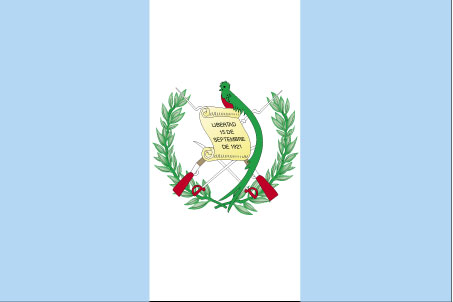
Guatemala
Guatemala
Declare Your Relationship to Guatemala
CountryReports Community
- Studying2
- From Guatemala3
- Guatemala heritage4
- Visited2
- Want to visit1
Customs and Culture
Customs and Culture
About the People
Guatemalans are friendly and humble. Personal criticism is taken seriously and should be avoided. Punctuality is admired but people are considered more important than a regimented schedule.
Cultural Attributes
Guatemalans are friendly and humble. Personal criticism is taken seriously and should be avoided. Punctuality is admired but people are considered more important than a regimented schedule.

Home of the Sacred Quetzal
Greetings, Gestures & Visiting
A younger woman may kiss a male friend, but older women will only kiss close relatives. In smaller group settings, it is important to greet each individual one by one. Guests greet hosts individually, regardless of the size of the group. Titles are used when speaking to others to show respect.
Guatemalans may summon someone by waving their hand downward and than in. A method of pointing is when person purses their lips towards the direction of what they are indicating.
Visiting is important to building strong relationships with relatives and friends. Not visiting frequently can be an insult, as it reflects the relationship's value. Regular visitors do not usually bring gifts, but if staying more than a day it is courteous to something for the home such as chocolateas or flowers.
In cities, people generally wear clothing fashion's from the West. However, the rural Maya have retained traditional dress. Clothing may be unique from group to group, but typically the things in common are a faja (a woven belt), knee high pants for men and wrap around skirts for women.
Diet
Corn tortillas are eaten with every meal. Other foods include black beans, rice, tamales (cornmeal or rice dough stuffed with meat and tomato sauce), and fried platanos (bananas) with honey, cream, or black beans. Meats are often stewed, and sauces are important. Papaya and breadfruit are among the many fruits eaten in Guatemala.
Tortillas are often used as a scoop for some foods. Other foods are eaten with the hands, but utensils are otherwise used at most meals. Hands are kept above the table, not placed in the lap. When a meal is finished, each person often thanks all others at the table.
Corn tortillas are often eaten with every meal. Other foods include black beans, rice, tamales (cornmeal or rice dough stuffed with meat and tomato sauce), and fried platanos (bananas) with honey, cream, or black beans. Meats are often stewed, and sauces are frequently used. Papaya and breadfruit are among the many fruits eaten in Guatemala.

Family
The father is the head of the family, but the wife yields great influence over the household. Unmarried adults live with their parents unless they must go elsewhere for work. Adult children in Guatemala are responsible for the care of their elderly parents. One-fourth of the labor force is female. Although apartment living is often necessary, people prefer the privacy of homes.
Dating Customs
Girls are chaperoned by family members or close relatives. Young men and women living within larger cities typically begin interacting in small groups around the age of fifteen. Women often marry by the age of twenty or earlier in rural communities. Men typically marry by the age of twenty-four. Common-law marriages are acceptable.
Recreation
Football (soccer) is the national pastime. Fiestas are a popular form of entertainment. Almost every town has a marimba orchestra and most weddings have marimba music.
Student Life
Guatemalans in general eat three meals a day, breakfast being the lightest of the three. Breakfast may consist of fruit and a drink, such as bananas and milk, or perhaps a traditional bread and fruit juice.
School generally begins at 7:30 in the morning and is done at around 1:30 in the afternoon. Kids will usually walk or ride a public transportation bus to school, depending on how far from the school they live. Children are home for lunch, which may consist of a traditional Guatemalan stew made of chicken, potatoes, and local vegetables and seasonings. It might also include rice and tortillas. Lunch is the biggest meal of the day for most areas, especially in the country and mountainous regions. In some schools, mothers will take turns preparing lunch for the children, but the government provides the money to buy the food.
Because there are few schools in rural areas, many private schools have been opened, usually run by the Roman Catholic Church. In rural areas, some grade schools with between 100 and 200 students have only one teacher for the entire school. Even when schools have sufficient desks and teachers, which is too often not the case, they usually lack books. Very often, as much as 80% of the class time is taken up in copying material from the blackboard at the front of the classroom because students don’t have books. This lack of books also prevents teachers from requiring homework, which means that students do not practice their study skills at home either. Teachers also are not well trained, especially in rural schools. Currently it is possible to become a teacher right after passing the exam at the conclusion of secondary school. Guatemalan schools are not well equipped with computers or other electronic technology. Although some universities are making good progress in this area, schools for the younger children lack even the basics, especially in the mountainous, rural areas. Students who are able to afford such technology often take courses offered outside the country via the Internet. Most schools require a uniform, which families must pay for in addition to the school enrollment fee and monthly tuition.
Children attend up to four years of preschool, six years of elementary or primary school, three years of secondary school, and two or three years of high school, depending on the technical training they are receiving. School is required from ages 7 to 14. Spanish is the official language of Guatemala, but approximately 40% of the country’s population speaks one of the local Indian languages instead. For this reason, many of the rural schools are taught in the local language rather than in Spanish. Better equipped schools, such as one might find in the larger cities, will teach students not only Spanish but also emphasize English-language learning or perhaps French, German, or Italian. Other standard courses include science, mathematics, and history. At the end of each school year, students are given a test. If a student fails any part of that test, he or she must repeat that entire school year. Compulsory education ends at the end of elementary school. Like many Latin American countries, the quality of education can vary widely throughout the country, with money being the most important influence. In communities with more money, the schools have better resources; in poor villages, the local school can struggle to even provide the most basic education. A higher quality of education is available from private schools, but only the upper-middle and upper-class families can afford to send their children there. The biggest problem throughout the country and in all levels of schools is the lack of money.
Schools in Guatemala as a general practice offer no extracurricular activities.
Regardless of where they gather, young Guatemalans are friendly and outgoing. They enjoy social experiences. Soccer is the most popular sport in Guatemala. However, without painting too bleak a picture, the country does not offer too much free time to the children. On average, one-third do not go to school, which translates into about 70% in rural areas. Thus, as soon as a child can work in some way, whether it be raiding the local dump for food or saleable trinkets, making some craft, or working in the fields, he is often pressed into labor very young. If a family has 5 children, the parents will usually only send the boys and will keep the girls home to teach them domestic skills to prepare for an early marriage. Children who are fortunate enough to attend school must often work in the evenings after school hours, which does not allow for developing good study habits or achieving a quality education.
Families are very important to the social and economic lifestyle of Guatemala. There is a saying in the country that parents are mirrors for their children: “Through them, you learn who you are and what you can become.” Children are respectful of the older members of their family, and the elderly are included in all parts of the family’s activities. Evenings at home then are most often spent with the extended family members who live in the home. Children, including teens, do not have much discretionary income for attending movies or other commercial entertainment. And the older the children get, the more likely it is that they will work rather attend school. It is also common for children to work in the afternoons and evenings after they get out of school. This does not leave much free time for leisure and socializing, particularly in rural and lower-income areas. Women marry fairly young and have lots of children. They are responsible in the home for food, cleaning the house, clothing, religious duties, and the children, including their education. Men work in the fields and handle other physical labor. Women also work, but are more likely to do handicraft work rather than serve in professional positions. These gender traits also help drive evening routines more along the lines of household chores, dinner, and resting for the next day’s work. Family conversations are typical. Households that can afford a television will gather around it for evening entertainment, as is the case around the world. But poverty and economic challenge do not mean that people cannot have fun. Holidays and occasions for festivals bring creativity and great celebrations. For example, for All Saints Day (similar to Halloween in the United States), children make “skulls” from grapefruit and place candles inside them, as other cultures do with pumpkins. Local fruits and homemade treats replace packaged candies. Deeply held traditions and close family ties bring smiles and good times even in difficult circumstances.
The literacy rate in Guatemala is one of the lowest in Central America. Education is valued among the wealthier families, but even they find the costs difficult to manage. For the poor, many find it simply impossible, especially for girls. More boys than girls in Guatemala can read, and girls are sometimes encouraged to stay home from school and prepare for marriage. Many children in Guatemala do not attend school. Rather, they begin working at a fairly young age to support the family, and often do not understand the value of an education. Two-thirds of all students do not attend school after elementary school. Approximately only 2% will ever attend a university, and only half of those will graduate. Perhaps more significant, however, are the numbers who end up marrying young or joining gangs instead of pursuing secondary and high school. Because of the rather significant adult reading problem in the country (the country produces one million illiterate citizens every nine years), Guatemala began a rather interesting program for their high school students. In order to graduate and obtain an official certificate from high school, each student wishing to graduate must teach five people to read. Although schools initially were concerned about this program, it has turned out to be quite successful. Another challenge in some parts of the country is that the Indian populations often feel discriminated against and will not send their children to school. The lessons are in Spanish, and they include nothing of the local customs or culture. School in Guatemala runs from January through October.
Holidays
Christmas
12/25Christmas
Dates of Interest
- December 12th
Celebrated throughout the country, especially in Antigua and Guatemala City, with processions, traditional dances, and the portrayal of indigenous children dressed as Juan Diego, who is said to have seen the Virgin Mary.
How do people greet each other in Guatemala?
Greetings are personal and individual—greet each person one by one, even in groups, and use titles to show respect.
Do
- Greet each individual one by one in smaller groups
- Greet hosts individually regardless of group size
- Use titles when speaking to others
Good to know
- A younger woman may kiss a male friend, but older women only kiss close relatives
What are the dining customs in Guatemala?
Corn tortillas accompany every meal and are often used as a scoop; most other foods are eaten with utensils, though some are eaten with the hands.
Do
- Keep your hands above the table
- Use tortillas to scoop some foods
- Thank everyone at the table when the meal is finished
Don’t
- Don't place your hands in your lap
Good to know
- Common dishes include black beans, rice, tamales, and fried platanos
- Meats are often stewed and sauces are important
- Fruits like papaya and breadfruit are widely eaten
What etiquette should I know when visiting Guatemala?
Guatemalans are friendly and humble, and visiting is central to maintaining relationships. Avoid personal criticism, which is taken seriously.
Do
- Visit relatives and friends regularly
- Bring something for the home, such as chocolates or flowers, if staying more than a day
Don’t
- Don't visit infrequently—it can be seen as an insult
- Avoid personal criticism
Good to know
- Punctuality is admired, but people matter more than a strict schedule
- Regular visitors do not usually bring gifts
How should I dress in Guatemala?
In cities people wear Western fashions, while the rural Maya retain traditional dress.
Good to know
- Traditional dress often includes a faja (woven belt)
- Men may wear knee-high pants and women wrap-around skirts
- Clothing styles can vary from group to group
What gestures are used in Guatemala?
Guatemalans have distinctive gestures for summoning and pointing.
Good to know
- To summon someone, wave the hand downward and then in
- Point by pursing the lips toward the direction indicated
What is family life like in Guatemala?
The father heads the family while the wife holds great household influence, and family ties are close.
Good to know
- Unmarried adults live with their parents unless work requires otherwise
- Adult children care for their elderly parents
- Girls are chaperoned by family or close relatives
- People prefer the privacy of homes over apartment living
What do people do for fun in Guatemala?
Football (soccer) is the national pastime, and fiestas are a popular form of entertainment.
Good to know
- Almost every town has a marimba orchestra
- Most weddings feature marimba music
Last updated: 2026-07-12 · Sources: CountryReports
Photos of Guatemala
Photos of Guatemala
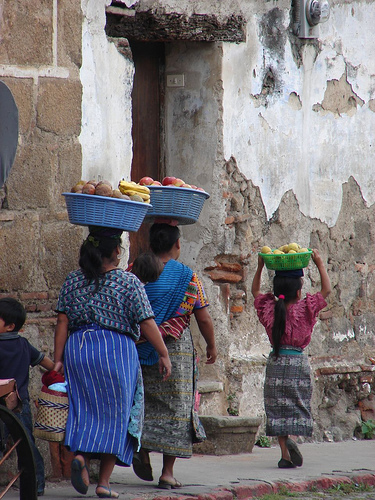
Carrying groceries home from the market.
San Pedro Volcano
Jaguar Temple at Tikal
Mayan Jaguar Temple at Tikal
Two religious people at the Jaguar Temple
Ladies at the market
Tourist hut in Lanquin
Calm pools of Semuc Champey
Lava spews from Pacaya near Antigua
Lake Atitlan with volcano in background
Laundry day at Lake Atitlan
Early morning on Lake Atitlan


Travel and Tourism
Travel and Tourism
- Travel Alert Status
- Level 3: Reconsider Travel
- Currency
- quetzal (GTQ), US dollar (USD), others allowed
- Time Difference
- UTC-6 (1 hour behind Washington, DC, during Standard Time)
- Climate
- Guatemala City's rainy season is May through October, and its dry season November through April. Temperatures are generally moderate during both seasons, ranging from an average low of 53°F in January to 60°-85°F in April. Frost and snow are unknown, and flowers bloom year round. Rainfall is heaviest from June through October, and the annual average is about 52 inches. Wet months can cause mildew damage to clothing, shoes, luggage, and upholstered furniture. During the dry season, days are clear and the sun is hot at midday with chilly to cold mornings and evenings. During these months it is dusty, foliage turns brown, grass and shrubs wither, and gardens must be watered.
- Airports
- 452
Read the full travel guide — health, safety, vaccinations, disease risk, sanitation, and transit details.
View full travel guideRecipes
Recipes
Chirmol
Dessert
Main Dish
Tamales Negros (Black Tamales)
Main Dish
Pollo en Pina (Chicken in Pineapple)
Main Dish
Carne en Jocon (Beef in Tomato and Pepper Sauce)
Main Dish
Jocon (Chicken in Green Sauce)
Main Dish
Chuchitos (Cornmeal Dumplings Stuffed with Meat)
Main Dish
Verdura con Mayonesa y Pollo (Vegetables with Mayonnaise and Chicken)
Main Dish
PremiumVerdura con Mayonesa y Pollo (Vegetables with Mayonnaise and Chicken)
Side Dish
PremiumArroz Guatemalteco (Guatemalan Rice)
Side Dish
PremiumChojin (Radish and Pork Rind Salad)
History
History
Historical Eras
Maya Civilization
2000 BCE – 1524
Maya city-states such as Tikal, Quiriguá, and Kaminaljuyú flourished across the Guatemalan highlands and lowlands, producing sophisticated architecture, astronomy, writing, and calendar systems. Civilization peaked during the Classic Period (250–900 CE) before a prolonged decline marked by warfare, drought, and political fragmentation. By the time Spanish forces arrived, many great centers had been long abandoned, though Maya populations remained numerous.
Spanish Colonial Era
1524 – 1821
Pedro de Alvarado's conquest beginning in 1523–24 brought Guatemala under Spanish dominion, and the Captaincy General of Guatemala became the administrative hub for much of Central America. Successive capitals at Ciudad Vieja, Antigua, and finally Guatemala City (founded 1776) reflected the region's vulnerability to earthquakes and volcanic eruptions. The colonial economy rested on forced indigenous labor, cacao, and indigo exports, while the Catholic Church played a dominant role in cultural and civic life.
Independence & Federation
1821 – 1839
Guatemala declared independence from Spain on September 15, 1821, briefly joined the Mexican Empire under Agustín de Iturbide, then became a founding member of the United Provinces of Central America in 1823. The federation was plagued by ideological conflict between Liberal and Conservative factions and by regional separatism. Guatemala withdrew from the union in 1839 as the federation dissolved, emerging as a fully independent republic.
Liberal Dictatorships
1839 – 1944
A succession of strongmen dominated Guatemalan politics, most notably Liberal reformer Justo Rufino Barrios (1873–1885), who secularized the state, expanded coffee exports, and modernized infrastructure. The early 20th century saw the United Fruit Company establish powerful banana plantations after 1906, entrenching foreign economic influence. Jorge Ubico's harsh authoritarian rule (1931–1944) ended when a coalition of military officers, students, and professionals forced his resignation in July 1944.
Revolution & Civil War
1944 – 1996
The 'October Revolution' of 1944 ushered in democratic reformers Juan José Arévalo and Jacobo Árbenz, whose land reform program prompted a U.S.-backed coup in 1954 that installed Colonel Carlos Castillo Armas. The coup reignited deep political polarization, and by the 1960s four left-wing guerrilla organizations were conducting armed insurgency against successive military governments. The resulting 36-year civil war killed more than 100,000 people, displaced roughly one million, and was formally ended by the UN-brokered peace accords signed in December 1996.
Post-Peace Modern Era
1996 – present
The 1996 peace accords opened a new chapter of civilian democratic governance, though Guatemala continued to face severe challenges including gang violence, pervasive corruption, indigenous inequality, and narco-trafficking. High-profile anti-corruption efforts, including the UN-backed CICIG commission (2007–2019), led to the prosecution of senior officials but also generated intense political resistance. Guatemala remains one of the hemisphere's most unequal societies, while recurring migration crises and democratic backsliding define its ongoing political landscape.
Overview
The first colonial capital, Ciudad Vieja, was ruined by floods and an earthquake in 1542. Survivors founded Antigua, the second capital, in 1543. In the 17th century, Antigua became one of the richest capitals in the New World. Always vulnerable to volcanic eruptions, floods, and earthquakes, Antigua was destroyed by two earthquakes in 1773. The remnants of its Spanish colonial architecture have been preserved as a national monument. The third capital, Guatemala City, was founded in 1776, after Antigua was abandoned.
Guatemala gained independence from Spain on September 15, 1821; it briefly became part of the Mexican Empire, and then for a period belonged to a federation called the United Provinces of Central America. From the mid-19th century until the mid-1980s, the country passed through a series of dictatorships, insurgencies (particularly beginning in the 1960s), coups, and stretches of military rule with only occasional periods of representative government.
1944 to 1986
In 1944, Gen. Jorge Ubico’s dictatorship was overthrown by the "October Revolutionaries," a group of dissident military officers, students, and liberal professionals. A civilian President, Juan Jose Arevalo, was elected in 1945 and held the presidency until 1951. Social reforms initiated by Arevalo were continued by his successor, Col. Jacobo Arbenz. Arbenz permitted the communist Guatemalan Labor Party to gain legal status in 1952. By the mid-point of Arbenz’s term, communists controlled key peasant organizations, labor unions, and the governing political party, holding some key government positions. Despite most Guatemalans’ attachment to the original ideals of the 1944 uprising, some private sector leaders and the military viewed Arbenz’s policies as a menace. The army refused to defend the Arbenz government when a U.S.-backed group led by Col. Carlos Castillo Armas invaded the country from Honduras in 1954 and quickly took over the government. Gen. Miguel Ydigoras Fuentes took power in 1958 following the murder of Colonel Castillo Armas.
In response to the increasingly autocratic rule of Ydigoras Fuentes, a group of junior military officers revolted in 1960. When they failed, several went into hiding and established close ties with Cuba. This group became the nucleus of the forces that were in armed insurrection against the government for the next 36 years. Four principal left-wing guerrilla groups--the Guerrilla Army of the Poor (EGP), the Revolutionary Organization of Armed People (ORPA), the Rebel Armed Forces (FAR), and the Guatemalan Labor Party (PGT)--conducted economic sabotage and targeted government installations and members of government security forces in armed attacks. These organizations combined to form the Guatemalan National Revolutionary Unity (URNG) in1982. At the same time, extreme right-wing groups of self-appointed vigilantes, including the Secret Anti-Communist Army (ESA) and the White Hand, tortured and murdered students, professionals, and peasants suspected of involvement in leftist activities.
Shortly after President Julio Cesar Mendez Montenegro took office in 1966, the army launched a major counterinsurgency campaign that largely broke up the guerrilla movement in the countryside. The guerrillas then concentrated their attacks in Guatemala City, where they assassinated many leading figures, including U.S. Ambassador John Gordon Mein in 1968. Between 1966 and 1982, there was a series of military or military-dominated governments.
On March 23, 1982, army troops commanded by junior officers staged a coup to prevent the assumption of power by Gen. Angel Anibal Guevara, the hand-picked candidate of outgoing President and Gen. Romeo Lucas Garcia. They denounced Guevara’s electoral victory as fraudulent. The coup leaders asked retired Gen. Efrain Rios Montt to negotiate the departure of Lucas and Guevara. Rios Montt had been the candidate of the Christian Democracy Party in the 1974 presidential elections and was widely regarded as having been denied his own victory through fraud.
Rios Montt was at this time a lay pastor in the evangelical protestant "Church of the Word." In his 1982 inaugural address, he stated that his presidency resulted from the will of God. He formed a three-member military junta that annulled the 1965 constitution, dissolved Congress, suspended political parties, and canceled the electoral law. After a few months, Rios Montt dismissed his junta colleagues and assumed the de facto title of "President of the Republic."
Guerrilla forces and their leftist allies denounced Rio
Timeline of Key Events
1523
Pedro de Alvarado led a Spanish expedition from Mexico and invaded Guatemala.
Pedro de Alvarado led a Spanish expedition from Mexico and invaded Guatemala. Alvarado established Spanish rule.
1570
Spain established the Audiencia in Guatemala.
Spain established the Audiencia in Guatemala. It was a high court of judges and administrators. It was headquartered in Antigua.
1776
The Audencia was moved to Guatemala City.
The Audencia was moved to Guatemala City. An earthquake had destroyed Antigua.
1821
Guatemala becomes independent and joins the Mexican empire the following year.
Guatemala becomes independent and joins the Mexican empire the following year.
1823
Guatemala broke away from Mexico and formed the United Provinces of Central America.
Guatemala broke away from Mexico and formed the United Provinces of Central America which also include Costa Rica, El Salvador, Honduras and Nicaragua.
1839
Guatemala left the United Provinces of Central America.
Guatemala left the United Provinces of Central America. Rafael Carrerea became the dictator.
1871 – 1944
A number of liberal dictators ruled Guatemala.
A number of liberal dictators ruled Guatemala. They promoted economic growth. They also encouraged foreigners to immigrate to the country.
Read the full history profile — narrative overview, defining eras, and the complete timeline in one place.
View expanded historyInteresting Facts
Interesting Facts
When a child loses a tooth they put the tooth under their pillow and wait for El Raton to leave some money.
The national symbol of Guatemala is the quetzal - a bird that signifies freedom because it dies in captivity.
Guatemala’s name is a Spanish corruption of the Nahoa (Mexican) word coactlmoctl-lan, meaning “land of the snake-eating bird,” a phrase that refers to the country’s eagle.
In Guatemala, lemons are green and limes are yellow.
Lying northwest of Guatemala City, Lake Atitlán is famous for its beauty.
Cocoa beans were used as money in ancient Guatemala. Counterfeiters were at work even in those days: some people removed the insides of the beans and filled the beanskins with clay.
See every fact — trivia, oddities, and curious tidbits gathered from across the country.
View all interesting factsGeography and Environment
Geography and Environment
- Terrain
- mostly mountains with narrow coastal plains and rolling limestone plateau (Peten)
- Climate
- Guatemala City’s rainy season is May through October, and its dry season November through April. Temperatures are generally moderate during both seasons, ranging from an average low of 53°F in January to 60°F–85°F in April. Frost and snow are unknown, and flowers bloom year round. Rainfall is heaviest from June through October, and the annual average is about 52 inches. Wet months can cause mildew damage to clothing, shoes, luggage, and upholstered furniture. During the dry season, days are clear and the sun is hot at midday with chilly to cold mornings and evenings. During these months it is dusty, foliage turns brown, grass and shrubs wither, and gardens must be watered.
- Natural Hazards
- numerous volcanoes in mountains, with occasional violent earthquakes; Caribbean coast extremely susceptible to hurricanes and other tropical storms
- Current Environmental Issues
- deforestation in the Peten rainforest; soil erosion; water pollution
Read the full geography and environment profile — terrain, climate, natural resources, hazards, land use, and international agreements.
View full geographyPeople & Demographics
People & Demographics
Religion
Languages Spoken
Spanish 60%, Amerindian languages 40% (23 officially recognized Amerindian languages, including Quiche, Cakchiquel, Kekchi, Mam, Garifuna, and Xinca)
- Spanish
Population
- Population
- 13,550,440
- Population: Male/Female
- male: 9,050,684 female: 9,204,532
- Population Distribution
- the vast majority of the populace resides in the southern half of the country, particularly in the mountainous regions; more than half of the population lives in rural areas
- Urban Population
- urban population: 53.1% of total population rate of urbanization: 2.59% annual rate of change
- Population in Major Urban Areas
- 3.095 million GUATEMALA CITY (capital)
- Nationality Noun
- noun: Guatemalan(s) adjective: Guatemalan
- Ethnic Groups
- Mestizo (mixed Indigenous-Spanish - in local Spanish called Ladino) 56%, Maya 41.7%, Xinca (Indigenous, non-Maya) 1.8%, African descent 0.2%, Garifuna (mixed West and Central African, Island Carib, and Arawak) 0.1%, foreign 0.2%
- Language Note
- Spanish (official) 69.9%, Maya languages 29.7% (Q'eqchi' 8.3%, K'iche 7.8%, Mam 4.4%, Kaqchikel 3%, Q'anjob'al 1.2%, Poqomchi' 1%, other 4%), other 0.4% (includes Xinca and Garifuna); note - the 2003 Law of National Languages officially recognized 23 indigenous languages, including 21 Maya languages, Xinca, and Garifuna
Demographic Profile
Guatemala is a predominantly poor country that struggles in several areas of health and development, including infant, child, and maternal mortality, malnutrition, literacy, and contraceptive awareness and use. The country's large indigenous population is disproportionately affected. Guatemala is the most populous country in Central America and has the highest fertility rate in Latin America. It also has the highest population growth rate in Latin America, which is likely to continue because of its large reproductive-age population and high birth rate. Almost half of Guatemala's population is under age 19, making it the youngest population in Latin America. Guatemala's total fertility rate has slowly declined during the last few decades due in part to limited government-funded health programs. However, the birth rate is still more close to three children per woman and is markedly higher among its rural and indigenous populations.
Guatemalans have a history of emigrating legally and illegally to Mexico, the United States, and Canada because of a lack of economic opportunity, political instability, and natural disasters. Emigration, primarily to the United States, escalated during the 1960 to 1996 civil war and accelerated after a peace agreement was signed. Thousands of Guatemalans who fled to Mexico returned after the war, but labor migration to southern Mexico continues.
Education
- Literacy Definition
- age 15 and over can read and write
Because there are few schools in rural areas, many private schools have been opened, usually run by the Roman Catholic Church. In rural areas, some grade schools with between 100 and 200 students have only one teacher for the entire school.
Even when schools have sufficient desks and teachers, which is too often not the case, they usually lack books. Very often, as much as 80% of the class time is taken up in copying material from the blackboard at the front of the classroom because students don’t have books. This lack of books also prevents teachers from requiring homework, which means that students do not practice their study skills at home either. Teachers also are not well trained, especially in rural schools. Currently it is possible to become a teacher right after passing the exam at the conclusion of secondary school.
Guatemalan schools are not well equipped with computers or other electronic technology. Although some universities are making good progress in this area, schools for the younger children lack even the basics, especially in the mountainous, rural areas. Students who are able to afford such technology often take courses offered outside the country via the Internet.
Most schools require a uniform, which families must pay for in addition to the school enrollment fee and monthly tuition.
Health Information
- Life Expectancy at Birth
- total population: 73.5 years male: 71.5 years female: 75.6 years
- Major Infectious Diseases — degree of risk
- degree of risk: high food or waterborne diseases: bacterial diarrhea, hepatitis A, and typhoid fever vectorborne diseases: dengue fever and malaria
- Alcohol consumption per capita
- total: 1.63 liters of pure alcohol beer: 0.9 liters of pure alcohol wine: 0.05 liters of pure alcohol spirits: 0.68 liters of pure alcohol other alcohols: 0.01 liters of pure alcohol
- Tobacco Use
- total: 10.9% male: 20.1% female: 1.6%
- Infant Mortality Rate
- total: 25 deaths/1,000 live births male: 28.1 deaths/1,000 live births female: 21.7 deaths/1,000 live births
Life Expectancy
- Life Expectancy at Birth
- total population: 73.5 years male: 71.5 years female: 75.6 years
- Median Age
- total: 24.8 years male: 24.2 years female: 25.4 years
- Age Structure
- 0-14 years: 31.5% (male 2,925,079/female 2,819,927) 15-64 years: 63.2% (male 5,688,500/female 5,839,958) 65 years and over: 5.4% (male 437,105/female 544,647)
- Infant Mortality Rate
- total: 25 deaths/1,000 live births male: 28.1 deaths/1,000 live births female: 21.7 deaths/1,000 live births
Read the full people and society profile — demographics, health, education, religion, languages, and notable people.
View full people and societyGovernment & Politics
Government & Politics
Country Identity
- Country Name
- Guatemala
- Full Country Name
- Republic of Guatemala
- Local - Long
- Republica de Guatemala
- Local - Short
- Guatemala
Government Structure
- Government Type
- constitutional democratic republic
- Legal System
- civil law system; judicial review of legislative acts; has not accepted compulsory ICJ jurisdiction
- Executive Branch
- chief of state: President Bernardo ARÉVALO de León (since 15 January 2024); Vice President Karin HERRERA Aguilar (since 15 January 2024); note - the president is both the chief of state and head of government head of government: President Bernardo ARÉVALO de León (since 15 January 2024); Vice President Karin HERRERA Aguilar (since 15 January 2024); note - the president is both the chief of state and head of government cabinet: Council of Ministers appointed by the president elections: president elected by popular vote for a four-year term; election last held 25 June 2023, with a runoff held 20 August 2023 (next to be held in 2027) election results: Bernardo ARÉVALO de León elected president in second round; percent of vote in runoff - Bernardo ARÉVALO de León (Semilla Movement) 60.9%, Sandra TORRES (UNE) 39.1%
- Legislative Branch
- unicameral Congress of the Republic or Congreso de la Republica (158 seats; members are elected by popular vote to serve four-year terms) elections: last held 9 November 2003 (next to be held September 2007) election results: percent of vote by party - NA; seats by party - GANA 49, FRG 41, UNE 33, PAN 17, other 18 note: for the 9 November 2003 election, the number of congressional seats increased from 113 to 158
- Judicial Branch
- Constitutional Court or Corte de Constitutcionalidad is Guatemala's highest court (five judges are elected for concurrent five-year terms by Congress, each serving one year as president of the Constitutional Court; one is elected by Congress, one elected by the Supreme Court of Justice, one appointed by the president, one elected by Superior Counsel of Universidad San Carlos de Guatemala, and one by Colegio de Abogados); Supreme Court of Justice or Corte Suprema de Justicia (13 members serve concurrent five-year terms and elect a president of the Court each year from among their number; the president of the Supreme Court of Justice also supervises trial judges around the country, who are named to five-year terms)
- Suffrage
- 18 years of age; universal (active duty members of the armed forces may not vote and are restricted to their barracks on election day)
- Constitution
- 31 May 1985, effective 14 January 1986; note - suspended 25 May 1993 by former President SERRANO; reinstated 5 June 1993 following ouster of president; amended November 1993
- Independence
- 15 September 1821 (from Spain)
- National Holiday
- Independence Day, 15 September (1821)
Capital City
- Capital Name
- Guatemala City
- Capital - geographic coordinate
- 14 37 N, 90 31 W
- Capital Time Difference
- UTC-6 (1 hour behind Washington, DC, during Standard Time)
the Spanish conquistadors used many native Americans as allies in their conquest of Guatemala; the site of their first capital (established in 1524), a former Maya settlement, was called "Quauhtemallan" by their Nahuatl-speaking Mexican allies, a name that means "land of trees" or "forested land", but which the Spanish pronounced "Guatemala"; the Spanish applied that name to a re-founded capital city three years later and eventually it became the name of the country
Military
Branches: National Army of Guatemala (Ejercito Nacional de Guatemala, ENG; includes Guatemalan Navy (Fuerza de Mar, including Marines), Guatemalan Air Force (Fuerza Aerea Guatemalteca, FAG))
Embassy / Diplomatic Mission
Embassy of the United States in Guatemala
Avenida Reforma 7-01, Zona 10, Guatemala Ciudad, Guatemala
Telephone: (502) 2326-4000 during embassy business hours (8:00 a.m. to 5:00 p.m. Monday – Thursday and 8:00 a.m. to 12:00 pm. Friday).
Emergency after-hours telephone: (502) 2331-2354
Facsimile: (502) 2331-3804
Internet website: http://guatelama.usembassy.gov
Read the full government profile — flag symbolism, national anthem, and other national symbols.
View full government detailsEconomy
Economy
Guatemala is the largest and most populous country in Central America, with a population of roughly 18 million and the biggest economy in the region. However, its GDP per capita remains less than half that of major South American economies such as Brazil, Argentina, and Chile. The agricultural sector accounts for about 10% of GDP, around one-third of exports, and roughly 30% of the labor force, with coffee, sugar, bananas, cardamom, and palm oil among the main products. Remittances, primarily from Guatemalans living in the United States, are a critical pillar of the economy, equivalent to nearly 20% of GDP and significantly supporting household consumption.
The 1996 peace accords, which ended 36 years of civil war, removed a major obstacle to foreign investment, and the country has since maintained relative macroeconomic stability, low inflation by regional standards, and steady growth. Still, persistent corruption, weak institutions, insecurity, and limited tax revenue continue to dampen investor confidence and constrain public services. Income distribution remains highly unequal, with roughly half the population living in poverty and chronic malnutrition rates among the highest in the world, particularly affecting Indigenous and rural communities.
Ongoing challenges include increasing government revenues from one of the lowest tax-to-GDP ratios in Latin America, strengthening the rule of law, combating drug trafficking and organized crime, addressing the root causes of migration to the United States, improving infrastructure, and diversifying exports beyond traditional agricultural commodities and apparel manufacturing.
Snapshot
- Currency Name and Code
- Quetzal (GTQ)
- GDP — official exchange rate
- $26,980,000,000 (USD)
- GDP Real Growth Rate
- 3.2%
- Gini Index
- 48.3
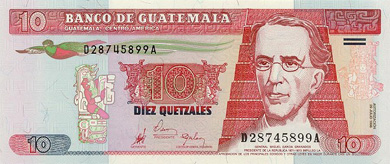
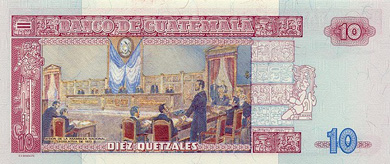
Banknotes
Budget & Public Finance
- Fiscal Year
- calendar year
- Annual Budget
- $4,041,000,000 (USD)
- Public Debt (% of GDP)
- 26.9%
- External Debt
- $5,503,000,000 (USD)
- Investment (% of GDP)
- 15.5%
- Economic Aid
- $250,000,000 (USD)
- Current Account Balance
- -$1,236,000,000 (USD)
- Reserves of Foreign Exchange
- $2,147,483,647 (USD)
Labor, Industry & Trade
- Labor Force by Occupation
- agriculture 50%; industry 15%; services 35%
- Household Income — highest 10%
- 46%
- Industries
- sugar, textiles and clothing, furniture, chemicals, petroleum, metals, rubber, tourism
- Agriculture Products
- sugarcane, corn, bananas, coffee, beans, cardamom; cattle, sheep, pigs, chickens
- Export Commodities
- coffee, sugar, bananas, fruits and vegetables, cardamom, meat, apparel, petroleum, electricity
- Export Partners
- US 59%, El Salvador 9.4%, Nicaragua 3.2%
- Import Commodities
- fuels, machinery and transport equipment, construction materials, grain, fertilizers, electricity
- Import Partners
- US 34.3%, Mexico 8.6%, South Korea 8.4%, El Salvador 5.9%, China 4.1%
Energy
- Oil Production
- 22,300 bbl/day
- Oil Consumption
- 66,000 bbl/day
- Oil Reserves
- 263,000,000 bbl/day
- Natural Gas Production
- 0 cu m
- Natural Gas Consumption
- 0 cu m
- Natural Gas Imports
- 0 cu m
- Natural Gas Exports
- 0 cu m
- Natural Gas Reserves
- 3,087,000,000 cu m
Communications
- Telephone System
- general assessment: fairly modern network centered in the city of Guatemala domestic: state-owned telecommunications company privatized in the late 1990s opening the way for competition; fixed-line teledensity roughly 10 per 100 persons; fixed-line investments are being concentrated on improving rural connectivity; mobile-cellular teledensity approaching 140 per 100 persons international: country code - 502; landing point for both the Americas Region Caribbean Ring System (ARCOS-1) and the SAM-1 fiber optic submarine cable system that, together, provide connectivity to South and Central America, parts of the Caribbean, and the US; connected to Central American Microwave System; satellite earth station - 1 Intelsat (Atlantic Ocean)
- Internet Country Code
- .gt
News & Weather
News & Weather
Current Weather
Latest News
Digital scans crack Guatemala wall writings, revealing a Maya astronomer's name - Yahoo
Yahoo · 2d ago
Mexico take down malbs-less Guatemala squad to secure final ENC NA spot - Dust2.us
Dust2.us · 1d ago
Strong quake off Mexican coast rattles Guatemala and El Salvador, but leaves no damage - The Detroit News
The Detroit News · 3d ago
Day Around the Bay: 7.3M Earthquake Strikes Mexico-Guatemala Border - SFist
SFist · 3d ago
Powerful 7.3 earthquake shakes southern Mexico, Guatemala - News On 6
News On 6 · 3d ago
7.3 quake strikes near Mexico-Guatemala border, prompting tsunami precautions - KOMO
KOMO · 3d ago
No tsunami expected for California after 7.3 magnitude quake rocks Mexico and Guatemala - Yahoo
Yahoo · 3d ago
Strong earthquake hits Mexico-Guatemala border, tsunami alert lifted - Yahoo
Yahoo · 3d ago
News via Google News
Climate Overview
Guatemala City's rainy season is May through October, and its dry season November through April. Temperatures are generally moderate during both seasons, ranging from an average low of 53°F in January to 60°-85°F in April. Frost and snow are unknown, and flowers bloom year round.
Rainfall is heaviest from June through October, and the annual average is about 52 inches. Wet months can cause mildew damage to clothing, shoes, luggage, and upholstered furniture. During the dry season, days are clear and the sun is hot at midday with chilly to cold mornings and evenings. During these months it is dusty, foliage turns brown, grass and shrubs wither, and gardens must be watered.
Videos
Videos
1 curated YouTube videos.
Source: YouTube
Frequently Asked Questions
Frequently Asked Questions
What is the population of Guatemala?
How do people greet each other in Guatemala?
What are the dining customs in Guatemala?
What etiquette should I know when visiting Guatemala?
How should I dress in Guatemala?
What gestures are used in Guatemala?
What is family life like in Guatemala?
What do people do for fun in Guatemala?
What is the capital of Guatemala?
Where is Guatemala located?
What countries border Guatemala?
What is the predominant religion in Guatemala?
What is the currency of Guatemala?
What languages are spoken in Guatemala?
What is Guatemala known for?
What are some distinctive cultural traditions of Guatemala?
Last reviewed 2026