
 English
 Español
 中文
中文 हिन्दी
 Français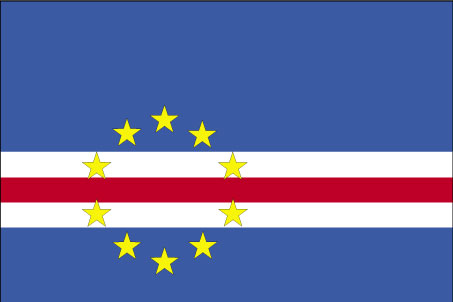
Cape Verde
Cabo Verde
Declare Your Relationship to Cape Verde
CountryReports Community
- Studying6
- From Cape Verde0
- Cape Verde heritage0
- Visited1
- Want to visit1
Customs and Culture
Customs and Culture
About the People
Farewell and returning back to the island parties are important almost like rites of passages. Social networks are important for finding jobs, and seeking marriage partners. Cape Verdeans are warm and generous.
Cultural Attributes
Farewell and returning back to the island parties are important, almost like rites of passage. Social networks are important for finding jobs and seeking marriage partners. Cape Verdeans are warm and generous.

Islands of Warmth and Connection
Greetings, Gestures & Visiting
Crioulo (creole) is widely spoken even though Portuguese is the official language. Women play an important role in passing the language from one generation to the next.
Western-style clothing is standard, many times it is second-hand clothing. Women sometimes wear their panos (cloth strips) as sashes.
Diet
Cape Verdean foods include cachupa (stew), conj (soup) djagacida (chicken with rice) and gufong (cornbread). The most common meats are pork, chicken and fish. Tropical fruits are also readily available.

Family
Family life is rooted in the culture and history of the Islands. Parents make great sacrifices to educate their children and families take pride in their children's achievements.
Recreation
Soccer is the most popular sport. Swimming and surfboarding are also popular. A favorite game is ouri, a pit and pebble game common in many African countries.
Student Life
The schools infrastructure exists in most parts of the Cape Verde islands and the major issue is to get parents to take their children to school. Parents who have known poverty, malnutrition, and sickness from which they seem to see no escape are hard-pressed to see the reason for taking their kids to school. There are many things that are done to make going to school worth the effort. For most poor parents, the payoff of education is difficult to appreciate. They would rather have their children help farm or handle household chores – especially the girls. But school feeding programs provide a nutritious school meal every day to children. For many of them, this is the only food they get and the only reason why their families send them to school.
School at the elementary level is free and basically for the first six years or until a child reaches the age of 16. There is apparently a very high enrollment level in the elementary school and boys and girls attend school in almost equal numbers. However, it is after the primary school level that enrollment goes down. About 50% of those who clear primary school get to continue to secondary school. One major challenge that is faced at the schools is a perennial shortage of teaching materials such as textbooks and in some areas, children are forced to repeat classes. School normally begins at 7:30 a.m. The schools do not have staff that cleans the compound and so it is the responsibility of the children to clean the compound. They will ensure that not only the compound is clean but their individual classrooms as well. There is a challenge with the number of teachers, and classes will be crowded. For the lower classes, the major incentive for coming to school will be the meals that are offered free which may be missing back at home. The regular lessons are 35 minutes long and subjects are taught either in French or a mother tongue in the elementary classes. There is usually a short break at 10:00 or 10:30 a.m. which may be anything between 10 and 30 minutes. Of course, there are likely to be no balls so boys will fashion their own soccer balls using plastic bags which they bundle together by using a twine. After the second session of classes children will break for lunch which takes about one hour. Where lunch is not provided by the school those who did not carry their own meals to school will have to stay hungry before they get back home for the evening meal. Teachers usually have to do with the few supplies that are available and most of the time they may have to improvise what they can come up with in order to have teaching aids. The basic teaching materials the teacher will get are a few textbooks and they have to improvise ways in which they will be shared among the students. The afternoon session begins at 2:00 p.m. and will end at about 3:30 p.m. For the children in the upper classes, there will be one more period for some extracurricular activities, but this is more often than not done once or twice a week. Extra curricular activities usually include dance, music, drama, debating, or anything that the environment may allow.
The poverty level is a little high and therefore most children will almost always do some little income-generating activities in the evenings after they leave school. This earns them their own pocket money or at times they will be supplementing the family income.
Holidays
Independence Day
7/5Independence Day
Dates of Interest
- July 5th
What language do people speak and use to communicate in CapeVerde?
Crioulo (creole) is widely spoken even though Portuguese is the official language.
Good to know
- Women play an important role in passing the language from one generation to the next.
What foods can I expect to eat in CapeVerde?
Cape Verdean cuisine features hearty dishes like cachupa (stew), conj (soup), djagacida (chicken with rice) and gufong (cornbread).
Good to know
- The most common meats are pork, chicken and fish.
- Tropical fruits are readily available.
How should I dress in CapeVerde?
Western-style clothing is standard, often second-hand.
Good to know
- Women sometimes wear their panos (cloth strips) as sashes.
What is family life like in CapeVerde?
Family life is deeply rooted in the culture and history of the Islands, and families take great pride in their children's achievements.
Good to know
- Parents make great sacrifices to educate their children.
What do people do for fun in CapeVerde?
Soccer is the most popular sport, with swimming and surfboarding also popular.
Good to know
- A favorite game is ouri, a pit and pebble game common in many African countries.
What should I know about social life before visiting CapeVerde?
Cape Verdeans are warm and generous, and social connections are highly valued.
Good to know
- Farewell and returning-to-the-island parties are important, almost like rites of passage.
- Social networks are important for finding jobs and seeking marriage partners.
Last updated: 2026-07-12 · Sources: CountryReports
Photos of Cape Verde
Photos of Cape Verde


Travel and Tourism
Travel and Tourism
- Travel Alert Status
- Level 1: Exercise Normal Precautions
- Currency
- 101.8
- Time Difference
- UTC-1 (4 hours ahead of Washington, DC, during Standard Time)
- Climate
- In terms of climate, Cape Verde is part of the Sahel region. Annual dust storms, originating in the Sahara, tend to erode the windward side of the islands and bring seasonal harmattan or smog-like dust. The climate otherwise is superb, with sub-tropical temperatures mediated by the surrounding water and the prevailing north-westerly winds. The average temperature in Praia is 75 degrees F (24.4°C), but summers are hot and humid. The range of monthly averages is from 72°F to 79°F. Rainfall is almost absent even in normal year-average precipitation is less than 10 inches. In addition, Cape Verde suffers periodically from drought. For 10 years, from 1989 until 1999, Cape Verde suffered severe drought, receiving less than half the average amount. In 1999 and 2000, the drought was relieved by a normal wet season (August to October.)
- Airports
- 7
- Recommended Vaccinations
- How important is it to do your research about vaccinations? It might just save your life! Make yourself aware of the different types of vaccinations and which ones you may need to travel to your destination. Schedule an appointment with your doctor at least four to six weeks before you travel to ensure you receive all important shots. Be sure that you and your family are up to date on your routine vaccinations. Which vaccinations you need will depend on a number of factors including your destination, whether you will be spending time in rural areas, the season of the year you are traveling, your age, health status, and previous immunizations.
Read the full travel guide — health, safety, vaccinations, disease risk, sanitation, and transit details.
View full travel guideRecipes
Recipes
History
History
Historical Eras
Pre-Settlement
The Cape Verde archipelago was uninhabited prior to European contact, with no indigenous population. Genoese and Portuguese navigators first sighted the islands around 1456, finding a volcanic, arid landscape that nonetheless held strategic promise as a mid-Atlantic waypoint for expanding Portuguese maritime exploration along the African coast.
Portuguese Colonization
1456 – 1600
Portuguese settlers founded Ribeira Grande on Santiago in 1462, establishing the first permanent European tropical settlement. The archipelago rapidly became a critical hub in the transatlantic slave trade, with merchants funneling enslaved Africans through the islands to the Americas. This commerce brought considerable prosperity, though settlements also suffered repeated pirate raids and attacks by rivals such as Sir Francis Drake in 1585.
Colonial Decline & Resupply Era
1600 – 1956
As the slave trade waned, Cape Verde's early wealth eroded, and repeated droughts compounded economic hardship. However, the islands' position astride mid-Atlantic shipping lanes sustained relevance; Mindelo on São Vicente became a thriving 19th-century coaling and resupply port. Portugal reclassified Cape Verde from a colony to an overseas province in 1951, an ineffective gesture aimed at suppressing rising nationalist sentiment.
Independence Struggle
1956 – 1975
Amílcar Cabral co-founded the PAIGC in 1956, uniting Cape Verdean and Guinea-Bissauan nationalists in a movement demanding self-determination. Armed insurgency against Portuguese rule escalated through the 1960s, primarily fought in Guinea-Bissau, and Portugal's 1974 Carnation Revolution opened the path to negotiated independence. Cape Verde formally received independence on July 5, 1975, following elections for a National Assembly on June 30.
One-Party State
1975 – 1991
The PAIGC, reconstituted as the PAICV after Guinea-Bissau's 1980 coup ended unification hopes, governed Cape Verde as a single-party state. The government pursued socialist-oriented development policies while managing persistent drought crises that drove substantial emigration, creating a diaspora that today exceeds the resident population. By the late 1980s, internal and international pressure forced the PAICV to begin dismantling one-party structures.
Democratic Era
1991 – present
The first multi-party elections in January 1991 brought the Movement for Democracy to power, and a new constitution was adopted in 1992 cementing pluralist governance. Power has since alternated peacefully between the MpD and PAICV, earning Cape Verde recognition as one of Africa's most stable democracies. The country has pursued economic development through tourism, remittances, and international partnerships, graduating from least-developed-country status in 2007.
Overview
With the decline in the slave trade, Cape Verde’s early prosperity slowly vanished. However, the islands’ position astride mid-Atlantic shipping lanes made Cape Verde an ideal location for resupplying ships. Because of its excellent harbor, Mindelo (on the island of São Vicente) became an important commercial center during the 19th century.
Portugal changed Cape Verde’s status from a colony to an overseas province in 1951 in an attempt to blunt growing nationalism. Nevertheless, in 1956, Amilcar Cabral, a Cape Verdean, and a group of Cape Verdeans and Guinea-Bissauans organized (in Guinea-Bissau) the clandestine African Party for the Independence of Guinea-Bissau and Cape Verde (PAIGC), which demanded improvement in economic, social, and political conditions in Cape Verde and Portuguese Guinea and formed the basis of the two nations’ independence movement. Moving its headquarters to Conakry, Guinea in 1960, the PAIGC began an armed rebellion against Portugal in 1961. Acts of sabotage eventually grew into a war in Portuguese Guinea that pitted 10,000 Soviet bloc-supported PAIGC soldiers against 35,000 Portuguese and African troops.
By 1972, the PAIGC controlled much of Portuguese Guinea despite the presence of the Portuguese troops, but the organization did not attempt to disrupt Portuguese control in Cape Verde. Portuguese Guinea declared independence in 1973 and was granted de jure independence in 1974. Following the April 1974 revolution in Portugal, the PAIGC became an active political movement in Cape Verde. In December 1974, the PAIGC and Portugal signed an agreement providing for a transitional government composed of Portuguese and Cape Verdeans. On June 30, 1975, Cape Verdeans elected a National Assembly, which received the instruments of independence from Portugal on July 5, 1975.
Immediately following the November 1980 coup in Guinea-Bissau, relations between Cape Verde and Guinea-Bissau became strained. Cape Verde abandoned its hope for unity with Guinea-Bissau and formed the African Party for the Independence of Cape Verde (PAICV). Problems have since been resolved, and relations between the countries are good. The PAICV and its predecessor established a one-party system and ruled Cape Verde from independence until 1990.
Responding to growing pressure for pluralistic democracy, the PAICV called an emergency congress in February 1990 to discuss proposed constitutional changes to end one-party rule. Opposition groups came together to form the Movement for Democracy (MpD) in Praia in April 1990. Together, they campaigned for the right to contest the presidential election scheduled for December 1990. The one-party state was abolished September 28, 1990, and the first multi-party elections were held in January 1991. The MpD won a majority of the seats in the National Assembly, and the MpD presidential candidate Mascarenhas Monteiro defeated the PAICV’s candidate with 73.5% of the votes. Legislative elections in December 1995 increased the MpD majority in the National Assembly. The party won 50 of the National Assembly’s 72 seats. A February 1996 presidential election returned President Mascarenhas Monteiro to office. Legislative elections in January 2001 returned power to the PAICV. The PAICV now holds 40 of the National Assembly seats, MpD 30, and PCD and PTS 1 each. In February 2001, the PAICV-supported presidential candidate Pedro Pires defeated former MpD leader Carlos Veiga by only 13 votes.
Timeline of Key Events
1456
First Europeans arrive in Cape Verde.
First Europeans arrive in Cape Verde.
1495
Cape Verde becomes a Portuguese crown colony.
Cape Verde becomes a Portuguese crown colony.
1975
Cape Verde becomes independent.
Cape Verde becomes independent and adopts constitution envisaging unity with Guinea-Bissau.
1980
Cape Verde ditches plans for unity with Guinea-Bissau following coup in latter.
Cape Verde ditches plans for unity with Guinea-Bissau following coup in latter.
1992
A new constitution brings in a multi-party system.
A new constitution brings in a multi-party system.
Read the full history profile — narrative overview, defining eras, and the complete timeline in one place.
View expanded historyInteresting Facts
Interesting Facts
The ten stars of the Cape Verde flag represent the ten main islands of the archipelago.
See every fact — trivia, oddities, and curious tidbits gathered from across the country.
View all interesting factsGeography and Environment
Geography and Environment
- Terrain
- steep, rugged, rocky, volcanic
- Climate
- In terms of climate, Cape Verde is part of the Sahel region. Annual dust storms, originating in the Sahara, tend to erode the windward side of the islands, and bring a seasonal harmattan or smog-like dust. The climate otherwise is superb, with sub-tropical temperatures mediated by the surrounding water and the prevailing north-westerly winds. The average temperature in Praia is 75 degrees F (24.4 degrees C), but summers are hot and humid. The range of monthly averages is from 72° F to 79 degrees F. Rainfall is almost absent even in a normal year-average precipitation is less than 10 inches. In addition, Cape Verde suffers periodically from drought. For 10 years, 1989 until 1999, Cape Verde suffered severe drought, receiving less than half the average amount. In 1999 and 2000, the drought was relieved by a normal wet season (August to October.)
- Natural Hazards
- prolonged droughts; seasonal harmattan wind produces obscuring dust; volcanically and seismically active
- Current Environmental Issues
- soil erosion; demand for wood used as fuel has resulted in deforestation; desertification; environmental damage has threatened several species of birds and reptiles; illegal beach sand extraction; overfishing
Read the full geography and environment profile — terrain, climate, natural resources, hazards, land use, and international agreements.
View full geographyPeople & Demographics
People & Demographics
Religion
Languages Spoken
Portuguese, Crioulo (a blend of Portuguese and West African words)
- Portuguese
Population
- Population
- 508,659
- Population in Major Urban Areas
- PRAIA (capital) 132,000
- Nationality Noun
- Cape Verdean(s)
- Ethnic Groups
- Creole (mulatto) 71%, African 28%, European 1%
Education
- Literacy Definition
- Age 15 and over can read and write
The schools infrastructure exists in most parts of the Cape Verde islands and the major issue is to get parents to take their children to school. Parents who have known poverty, malnutrition, and sickness from which they seem to see no escape are hard-pressed to see the reason for taking their kids to school. There are many things that are done to make going to school worth the effort. For most poor parents, the payoff of education is difficult to appreciate. They would rather have their children help farm or handle household chores – especially the girls. But school feeding programs provide a nutritious school meal every day to children. For many of them, this is the only food they get and the only reason why their families send them to school.
Read the full people and society profile — demographics, health, education, religion, languages, and notable people.
View full people and societyGovernment & Politics
Government & Politics
Country Identity
- Country Name
- CapeVerde
- Full Country Name
- Republic of Cape Verde
- Local - Long
- Republica de Cabo Verde
- Local - Short
- Cabo Verde
Government Structure
- Government Type
- republic
- Legal System
- derived from the legal system of Portugal
- Executive Branch
- chief of state: President Jose Maria NEVES (since 9 November 2021) head of government: Prime Minister Ulisses CORREIA SILVA (since 22 April 2016) cabinet: Council of Ministers appointed by the president on the recommendation of the prime minister elections: president elected by popular vote for a five-year term; election last held on 17 October 2021 (next to be held in 2026); prime minister nominated by the National Assembly and appointed by the president election results: Jose Maria NEVES elected president; percent of vote - Jose Maria NEVES (PAICV) 51.7%, Casimiro DE PINA (independent) 11.6%, Gilson ALVES (independent) 11.2%, other 25.5%
- Legislative Branch
- unicameral National Assembly or Assembleia Nacional (72 seats; members are elected by popular vote to serve five-year terms) elections: last held 22 January 2006 (next to be held in January 2011) election results: percent of vote by party - PAICV 52.3%, MPD 44%, UCID 2.7%; seats by party - PAICV 41, MPD 29, ADM 2
- Judicial Branch
- Supreme Tribunal of Justice or Supremo Tribunal de Justia
- Suffrage
- 18 years of age; universal
- Constitution
- new constitution came into force 25 September 1992; underwent a major revision on 23 November 1995, substantially increasing the powers of the president, and a further revision in 1999, to create the position of national ombudsman (Provedor de Justica)
- Independence
- 5 July 1975 (from Portugal)
- National Holiday
- Independence Day, 5 July (1975)
Capital City
- Capital Name
- Praia
- Capital - geographic coordinate
- 14 55 N, 23 31 W
- Capital Time Difference
- UTC-1 (4 hours ahead of Washington, DC, during Standard Time)
the earlier Portuguese name was Villa de Praia ("Village of the Beach"); it became just Praia in 1974 (prior to full independence in 1975)
Military
Branches: Armed Forces: Army (also called the National Guard, GN), Cabo Verde Coast Guard (Guardia Costeira de Cabo Verde, GCCV; includes naval infantry)
Embassy / Diplomatic Mission
Embassy Praia
Address: Rua Abilio Macedo 6, Praia, Santiago, Cabo Verde
Telephone: 238-260-8900 (general switchboard), 238-260-8948 (American Citizen Services)
Emergency after-hours telephone: 238-991-3325
Facsimile: 238-261-1355
Read the full government profile — flag symbolism, national anthem, and other national symbols.
View full government detailsEconomy
Economy
Cape Verde's island economy contends with a limited natural resource base, including chronic water shortages worsened by recurring droughts. The economy is heavily service-oriented, with commerce, tourism, transport, and public services accounting for roughly 75% of GDP. Tourism alone has become the dominant driver of growth, contributing around 25% of GDP directly and indirectly before the pandemic, and it has rebounded strongly in recent years. Agriculture and fishing together represent less than 5% of GDP, despite employing a significant share of the rural population, and the country must import the vast majority of its food. The fisheries sector, particularly tuna and lobster, remains underexploited relative to its potential.
Cape Verde consistently runs a large trade deficit, financed in part by tourism receipts, foreign aid, foreign direct investment, and remittances from its sizeable diaspora, which typically equal 12–15% of GDP. Having graduated from least developed country status in 2007 and signed a special partnership with the European Union, the government has pursued reforms focused on private sector development, fiscal consolidation, and diversification into areas such as renewable energy, the blue economy, and digital services. Economic prospects depend heavily on continued tourism growth, external financing, remittance flows, and progress in reducing high public debt, which surged following COVID-19-related shocks. Real GDP growth has recovered to above 5% in recent years as tourism arrivals reached record levels.
Snapshot
- Currency Name and Code
- Cabo Verdean escudos (CVE)
- GDP — official exchange rate
- $1,128,000,000 (USD)
- GDP Real Growth Rate
- 5.5%
Banknotes
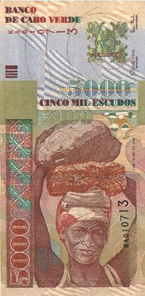
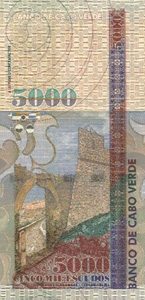
Budget & Public Finance
- Fiscal Year
- calendar year
- Annual Budget
- $393,100,000 (USD)
- External Debt
- $325,000,000 (USD)
- Investment (% of GDP)
- 26.4%
- Economic Aid
- $136,000,000 (USD)
- Current Account Balance
- -$147,700,000 (USD)
- Reserves of Foreign Exchange
- $152,200,000 (USD)
Labor, Industry & Trade
- Industries
- food and beverages, fish processing, shoes and garments, salt mining, ship repair
- Agriculture Products
- bananas, corn, beans, sweet potatoes, sugarcane, coffee, peanuts; fish
- Export Commodities
- fuel, shoes, garments, fish, hides
- Export Partners
- Portugal 38.1%, France 23.8%, UK 23.8%, US 9.5%
- Import Commodities
- foodstuffs, industrial products, transport equipment, fuels
- Import Partners
- Portugal 47.7%, Netherlands 7.1%, Germany 5.6%
Energy
- Oil Production
- 0 bbl/day
- Oil Consumption
- 1,200 bbl/day
- Oil Reserves
- 0 bbl/day
- Natural Gas Production
- 0 cu m
- Natural Gas Consumption
- 0 cu m
- Natural Gas Imports
- 0 cu m
- Natural Gas Exports
- 0 cu m
- Natural Gas Reserves
- 0 cu m
Communications
- Telephone System
- General Assessment: effective system, extensive modernization from 1996-2000 following partial privatization in 1995 Domestic: major service provider is Cabo Verde Telecom (CVT); fiber-optic ring, completed in 2001, links all islands providing Internet access and ISDN services; cellular service was introduced in 1998; broadband services were launched in 2004 International: country code - 238; landing point for the Atlantis-2 fiber-optic transatlantic telephone cable that provides links to South America, Senegal, and Europe; HF radiotelephone to Senegal and Guinea-Bissau; satellite earth station - 1 Intelsat (Atlantic Ocean)
- Internet Country Code
- .cv
News & Weather
News & Weather
Current Weather
Latest News
Cape Verde World Cup hero Vozinha gets South America contract offer - talkSPORT
talkSPORT · 2d ago
Always will remember the Cape Verde run at the 2026 FIFA World Cup (via TT/jggc2113) - FOX Sports
FOX Sports · 11h ago
All of the Records Broken at the 2026 World Cup, From Lionel Messi’s Hat Trick to Cape Verde’s Historic Run - People.com
People.com · 18h ago
Spain Won The Trophy. Cabo Verde Won The World Cup. - essence.com
essence.com · 18h ago
Spain vs Cape Verde LIVE: FIFA World Cup Group H score, commentary, updates & stats - BBC
BBC · 36d ago
Argentina 3 - 2 Cape Verde: Final score, results, recap, box score, stats - Yahoo Sports
Yahoo Sports · 24d ago
Will Cape Verde see a post-World Cup tourism boost? - NBC News
NBC News · 3d ago
World Cup 2026 best and worst: Lionel Messi and Cape Verde shine, Portugal and Cristiano Ronaldo flop - thenationalnews.com
thenationalnews.com · 14h ago
News via Google News
Climate Overview
In terms of climate, Cape Verde is part of the Sahel region. Annual dust storms, originating in the Sahara, tend to erode the windward side of the islands and bring seasonal harmattan or smog-like dust. The climate otherwise is superb, with sub-tropical temperatures mediated by the surrounding water and the prevailing north-westerly winds. The average temperature in Praia is 75 degrees F (24.4°C), but summers are hot and humid. The range of monthly averages is from 72°F to 79°F. Rainfall is almost absent even in normal year-average precipitation is less than 10 inches. In addition, Cape Verde suffers periodically from drought. For 10 years, from 1989 until 1999, Cape Verde suffered severe drought, receiving less than half the average amount. In 1999 and 2000, the drought was relieved by a normal wet season (August to October.)
Frequently Asked Questions
Frequently Asked Questions
What is the population of Cape Verde?
What language do people speak and use to communicate in CapeVerde?
What foods can I expect to eat in CapeVerde?
How should I dress in CapeVerde?
What is family life like in CapeVerde?
What do people do for fun in CapeVerde?
What should I know about social life before visiting CapeVerde?
What is the capital of Cape Verde?
Where is Cape Verde located?
What are the ocean borders of Cape Verde?
What religion is practiced in Cape Verde?
What is the currency of Cape Verde?
What languages are spoken in Cape Verde?
What is the geography of Cape Verde like?
What is Cape Verde known for?
Last reviewed 2026