
 English
 Español
 中文
中文 हिन्दी
 Français
Macedonia
Makedonija
Declare Your Relationship to Macedonia
CountryReports Community
- Studying1
- From Macedonia1
- Macedonia heritage0
- Visited0
- Want to visit0
Customs and Culture
Customs and Culture
About the People
Macedonian culture stresses the importance of the family. Parents sacrifice a great deal to support their children into adulthood, and assist them financially. This is particularly important for the poorer Macedonians who came to Australia wanting a better life for their children. The care of grand-parents is in the hands of the son, but in reality daughters do most of the caring of sick and elderly. Herbal remedies are used by many of the older generation. Women are seen as the primary carers. However, in Australia, some families use residential care for their elderly due to work and professional commitments. In Macedonia, the unemployment rate is between 25-30%. As yet, there is no Republic of Macedonia. However, the drive for autonomy is very strong.
Cultural Attributes
Macedonian culture stresses the importance of the family. Parents sacrifice a great deal to support their children into adulthood, and assist them financially. This is particularly important for the poorer Macedonians who came to Australia wanting a better life for their children. The care of grand-parents is in the hands of the son, but in reality daughters do most of the caring of sick and elderly. Herbal remedies are used by many of the older generation. Women are seen as the primary carers. However, in Australia, some families use residential care for their elderly due to work and professional commitments.
In Macedonia, the unemployment rate is between 25-30%. As yet, there is no Republic of Macedonia. However, the drive for autonomy is very strong.

Land of the Vardar, Legacy of Empires
Greetings, Gestures & Visiting
Macedonians greet friends and family warmly, with members of the same gender embracing or kissing on the cheeks. Muslim men and women do not shake hands, but use verbal greetings only. When people are introduced, the more formal title is used, whereas for friends, people are on first name terms. Good morning is dobro utro, and good evening is dobro vecher. Hallo is alo, and good-bye is prijatno.
Relatives, friends and neighbors visit regularly and informally. However, it is important to give advance notice of a visit if you are a stranger, in order for the host to receive you in the desired manner. Hospitality is a hallmark of the culture, and shoes are traditionally taken off at the door as a show of respect, although this practice is diminishing among urban Christians. A person entering the room where others are seated shakes hands with each person. Staring at strangers has been considered impolite.
Western European styles are followed by the majority of urban Macedonians, within the limits of the budget. A clean, tidy appearance is important. Albanian Muslims wear the loose pants and long tunic used by Muslim men in many areas, and a turban. Women wear head scarves and long dresses.
Diet
Breakfast consists of bread, cheese and sometimes eggs. Root vegetables, grains and fruit, wine and meats are staples. Bean casserole (tavche-gravche), is a basic food. Pizza is very popular. There are no taboos in food other than the normal ones associated with religion, but folk beliefs about food are common. Among Christians, a bird is eaten at Christmas, and lamb for Easter. Among Muslims, a lamb is slaughtered for Kurban Bayram. Sweet desserts are associated with religious holidays, New Year's Day, births, weddings and funerals.
Breakfast is eaten about 9 AM by office workers, but earlier by factory laborers and rural residents. Dinner is the main meal, taken about 2 PM. Supper is usually eaten later after an afternoon siesta. Meals are always prepared just before consumption, although they may include leftovers. Hot food is often left to cool to room temperature. Other meals begin with appetizers (meze), served with fruit brandy (rakia).
Breakfast consists of bread, cheese and sometimes eggs. Root vegetables, grains and fruit, wine and meats are staples. Bean casserole (tavche-gravche), is a basic food. Pizza is very popular. There are no taboos in food other than the normal ones associated with religion, but folk beliefs about food are common. Among Christians, a bird is eaten at Christmas, and lamb for Easter. Among Muslims, a lamb is slaughtered for Kurban Bayram. Sweet desserts are associated with religious holidays, New Year's Day, births, weddings and funerals.

Family
The traditional family unit is an extended family consisting of a married couple, their unmarried daughters and their sons with spouses and children. This unit is becoming less common in urban areas with the changes to workforce participation.
Dating Customs
Children often live with their parents till they are married. Young people are permitted to go out to movies, parks, sporting events and dances, but often chaperoned by an older sibling. Traditionally, all marriages were arranged, but nowadays most young people select their partners. Pregnancy would lead to marriage among young people, though in the past the bride was expected to be a virgin. Traditional marriages rarely cross religious lines. Marriage is the norm. Divorce and remarriage are now regulated by civil law. Women now work outside the home, but still retain the major responsibility for the household chores and child-care. Grand-mothers also often care for children wherever possible.
Recreation
Soccer and basketball are the two most popular sports. Table tennis and chess are also popular. In the cities a popular leisure activity is the korzo. One of the city's main streets is closed to traffic and turned into a promenade for a few hours each evening.
Holidays
Uprising Day
8/2Independence
also known as Saint Elijah's Day and Ilinden
Dates of Interest
- August 2nd
Also known as Saint Elijah's Day and Ilinden.
How do people greet each other in Macedonia?
Macedonians greet friends and family warmly, with people of the same gender embracing or kissing on the cheeks. Formal titles are used for introductions, while friends use first names.
Do
- Use a person's formal title when first introduced
- Shake hands with each person when entering a room where others are seated
- Use first names with friends
Don’t
- Do not expect Muslim men and women to shake hands, as they use verbal greetings only
- Do not stare at strangers, which is considered impolite
Good to know
- Useful phrases: dobro utro (good morning), dobro vecher (good evening), alo (hello), prijatno (goodbye)
What are dining customs like in Macedonia?
Dinner is the main meal, taken around 2 PM, and meals are always prepared just before eating. Staples include root vegetables, grains, fruit, wine, meats, and the basic bean casserole tavche-gravche.
Do
- Try appetizers (meze) served with fruit brandy (rakia)
- Expect breakfast of bread, cheese and sometimes eggs, around 9 AM for office workers
Good to know
- Hot food is often left to cool to room temperature
- Pizza is very popular
- Sweet desserts mark religious holidays, New Year's Day, births, weddings and funerals
- A bird is eaten at Christmas and lamb at Easter among Christians; lamb is slaughtered for Kurban Bayram among Muslims
What should I know about visiting and hospitality in Macedonia?
Hospitality is a hallmark of the culture, and relatives, friends and neighbors visit regularly and informally.
Do
- Give advance notice of a visit if you are a stranger, so the host can receive you properly
- Shake hands with each person when entering a room
- Traditionally remove your shoes at the door as a show of respect
Good to know
- The shoe-removal practice is diminishing among urban Christians
How should I dress in Macedonia?
Most urban Macedonians follow Western European styles within their budget, and a clean, tidy appearance is important.
Do
- Keep a clean, tidy appearance
Good to know
- Albanian Muslim men wear loose pants, a long tunic and a turban
- Muslim women wear head scarves and long dresses
What is family life like in Macedonia?
Macedonian culture stresses the importance of family, traditionally an extended household of a couple, their unmarried daughters, and their sons with spouses and children. Parents sacrifice greatly to support their children into adulthood.
Good to know
- The extended family unit is becoming less common in urban areas due to changes in workforce participation
- Children often live with their parents until married
- Women are seen as the primary carers and retain major responsibility for household chores and childcare
- Grandmothers often help care for children
What do people do for recreation in Macedonia?
Soccer and basketball are the two most popular sports, with table tennis and chess also popular.
Good to know
- In cities, the korzo is popular: a main street is closed to traffic and turned into an evening promenade
Last updated: 2026-07-12 · Sources: CountryReports
Photos of Macedonia
Photos of Macedonia


Travel and Tourism
Travel and Tourism
- Travel Alert Status
- Level 1: Exercise Normal Precautions
- Time Difference
- UTC+1 (6 hours ahead of Washington, DC, during Standard Time)
- Climate
- Mostly a country of hills and mountains, Macedonia has a continental Mediterranean climate characterized by long, dry, rather hot summers and short, cold winters. The average air temperature in the summer is 25°C (77°F) and 0.5°C (33°F) in winter. However, short periods of extreme temperatures of 110-115°F in summer and low 20s in the winter are common. The average annual precipitation is 445.5 mm. The humidity in Macedonia averages 66%. Occasionally, there are dust storms in the Vardar River valley. Macedonia is on a fault line and the country averages four earthquakes a year (most go unnoticed) with a median reading of 6 on the Medvedev-Sponheuer-Karnik International Seismological Scale.
Read the full travel guide — health, safety, vaccinations, disease risk, sanitation, and transit details.
View full travel guideRecipes
Recipes
History
History
Historical Eras
Ancient Macedon
800 BCE – 148 BCE
The Kingdom of Macedon rose to dominance under Philip II (359–336 BCE) and reached its zenith under Alexander the Great, whose campaigns extended Macedonian influence from Egypt to the borders of India. After Alexander's death in 323 BCE, his empire fragmented among rival successors. Rome steadily encroached on the weakened kingdom, finally conquering it at the Battle of Pydna in 168 BCE and formally annexing it as a Roman province in 148 BCE.
Roman & Byzantine Rule
148 BCE – 1371
As a Roman province, Macedonia served as a vital corridor along the Via Egnatia linking Rome to the eastern empire, and witnessed pivotal events such as the Battle of Philippi in 42 BCE. After the fall of the Western Roman Empire, the territory passed to Byzantine control, during which Slavic peoples migrated into the Balkans in the 6th and 7th centuries. Serbs, Bulgarians, and Byzantines then contested the region for centuries, leaving a complex ethnic and cultural legacy.
Ottoman Macedonia
1371 – 1912
Ottoman forces conquered Macedonia in the late 14th century, incorporating it into an empire that would hold the territory for over five hundred years. The period saw significant demographic and religious transformation, alongside the gradual emergence of Macedonian nationalist sentiment in the 19th century. This culminated in the Ilinden Uprising of August 2, 1903, when Macedonian revolutionaries briefly established the Republic of Krushevo before Ottoman forces suppressed the revolt after ten days.
Balkan Wars & World Wars
1912 – 1944
The First Balkan War of 1912 ended Ottoman rule in Macedonia, but the Second Balkan War immediately followed as Bulgaria, Serbia, and Greece fought over the territory's division, settled by the 1913 Treaty of Bucharest. After World War I, Vardar Macedonia was absorbed into the Kingdom of Serbs, Croats, and Slovenes under the 1919 Treaty of Versailles. During World War II, Bulgaria and Italy occupied the region, prompting widespread partisan resistance that eventually liberated Macedonia in late 1944.
Yugoslav Republic
1944 – 1991
Following liberation, Macedonia became a constituent republic of Marshal Tito's Socialist Federal Republic of Yugoslavia, gaining formal recognition of a distinct Macedonian national identity, language, and culture for the first time. The republic experienced relative stability and cultural flourishing within the Yugoslav federation throughout the Cold War era. As communism collapsed across Eastern Europe, Macedonia declared independence from Yugoslavia in late 1991, adopting a new constitution on November 20, 1991.
Independent Macedonia
1991 – present
Independent Macedonia faced immediate challenges, including a Greek trade blockade over the use of the name 'Macedonia' and symbols, delaying international recognition until the country joined the UN in 1993 as the Former Yugoslav Republic of Macedonia. An ethnic Albanian armed insurgency in 2001 threatened the country's stability, resolved through the internationally brokered Ohrid Framework Agreement. In 2019, a landmark agreement with Greece — the Prespa Agreement — saw the country officially renamed North Macedonia, clearing the path for NATO and EU accession processes.
Overview
The ancient territory of Macedon included, in addition to the areas of the present-day Macedonia, large parts of present-day northern Greece and southwestern Bulgaria. This ancient kingdom reached its height during the reign of Alexander III ("the Great"), who extended Macedon’s influence over most of Asia Minor, the Levant, Egypt, Mesopotamia, Persia, and even parts of India. After Alexander’s death in 323 BC, the Macedon Empire gradually declined, until Rome conquered it in 168 BC and made it a province in 148 BC.
After the fall of the Western Roman Empire, the territory of Macedonia fell under the control of the Byzantine Empire in the 6th and 7th centuries. It was during this period that large groups of Slavic people migrated to the Balkan region. The Serbs, Bulgarians, and Byzantines fought for control of Macedonia until the late 14th century, when the Ottoman Turks conquered the territory; it remained under Turkish rule until 1912.
After more than four centuries of rule, Ottoman power in the region began to wane, and by the middle of the 19th century, Greece, Bulgaria, and Serbia were competing for influence in the territory. During this time, a nationalist movement emerged and grew in Macedonia. The latter half of the 19th century was marked by sporadic nationalist uprisings, culminating in the Ilinden Uprising of August 2, 1903. Macedonian revolutionaries liberated the town of Krushevo and established the short-lived Republic of Krushevo, which was put down by Ottoman forces after 10 days. Following Ottoman Turkey’s defeat by the allied Balkan countries--Bulgaria, Serbia, Montenegro, and Greece--during the First Balkan War in autumn 1912, the same allies fought the Second Balkan War over the division of Macedonia. The August 1913 Treaty of Bucharest ended this conflict by dividing the territory between Bulgaria, Greece, and Serbia. The 1919 Treaty of Versailles sanctioned partitioning Macedonia between The Kingdom of Serbs, Croats and Slovenes, Bulgaria, and Greece. In the wake of the First World War, Vardarian Macedonia (the present day area of Macedonia) was incorporated into the newly formed Kingdom of Serbs, Croats, and Slovenes.
Throughout much of the Second World War, Bulgaria and Italy occupied Macedonia. Many people joined partisan movements during this time and succeeded in liberating the region in late 1944. Following the war, Macedonia became one of the constituent republics of the new Socialist Federal Republic of Yugoslavia under Marshall Tito. During this period, Macedonian culture and language flourished.
As communism fell throughout Eastern Europe in the late 20th century, Macedonia followed its other federation partners and declared its independence from Yugoslavia in late 1991. The new Macedonian constitution took effect November 20, 1991 and called for a system of government based on a parliamentary democracy. The first democratically elected coalition government was led by Prime Minister Branko Crvenkovski of the Social Democratic Union of Macedonia (SDSM) and included the ethnic Albanian Party for Democratic Prosperity (PDP). Kiro Gligorov became the first President of an independent Macedonia.
President Gligorov was the first president of a former Yugoslav republic to relinquish office. In accordance with the terms of the Macedonian constitution, his presidency ended in November 1999 after 8 years in office, which included surviving a car bombing assassination attempt in 1995. He was succeeded by former Deputy Foreign Minister Boris Trajkovski (VMRO), who defeated Tito Petkovski (SDSM) in a second-round run-off election for the presidency November 14, 1999. Trajkovski’s election was confirmed by a December 5, 1999 partial re-vote in 230 polling stations, which the Macedonian Supreme Court mandated due to election irregularities.
Macedonia was the only republic of the former Yugoslavia whose secession in 1991 was not clouded by ethnic or other armed conflict, although the ethnic Albanian population declined to participate in the referendum on independence. During the Yugoslav period, Macedonian ethnic identity exhibited itself, in that most of Macedonia’s Slavic population identified themselves as Macedonians, while several minority groups, in particular ethnic Albanians, sought to retain their own distinct political culture and language. Although interethnic tensions simmered under Yugoslav authority and during the first decade of its independence, the country avoided ethnically motivated conflict until several years after independence.
In November 1998 parliamentary elections, the SDSM lost its majority. A new c
Timeline of Key Events
359 BCE – 336 BCE
Philip II ruled the Kingdom of Macedonia.
Philip II ruled the Kingdom of Macedonia.
336 BCE
Alexander inherited the throne of Macedonia and all of Greece.
Alexander inherited the throne of Macedonia and all of Greece.
199 BCE – 150 BCE
The Romans made Macedonia into a province and obliterated the city of Corinth.
The Romans made Macedonia into a province and obliterated the city of Corinth.
42 BCE
Octavian and Mark Antony defeated Brutus and Cassius at Philippi in Macedonia.
Octavian and Mark Antony defeated Brutus and Cassius at Philippi in Macedonia.
1908
Russia and Britain threatened action in Macedonia if peace was not reached soon.
Russia and Britain threatened action in Macedonia if peace was not reached soon.
1912 – 1913
Balkan Wars
During the Balkan Wars the Kingdom of Greece acquired Macedonia from the Turkish Ottoman Empire.
1913
Ottoman rule in Europe ends after five centuries.
Ottoman rule in Europe ends after five centuries. Macedonia is partitioned between Serbia, Bulgaria and Greece. What is now FYROM is incorporated into Serbia.
Read the full history profile — narrative overview, defining eras, and the complete timeline in one place.
View expanded historyInteresting Facts
Interesting Facts
The youngest Prime Minister is Ljupco Georgievski. He was 32 when he became Prime Minister of the Former Yogoslav Republic of Macedonia on Nov. 30, 1998.
Macedonia had the world's oldest President, Kiro Gligorov President of the Former Yugoslav Republic of Macedonia who was 83 years old.
See every fact — trivia, oddities, and curious tidbits gathered from across the country.
View all interesting factsGeography and Environment
Geography and Environment
- Climate
- Mostly a country of hills and mountains, Macedonia has a continental Mediterranean climate characterized by long, dry, rather hot summers and short, cold winters. The average air temperature in the summer is 25°C (77°F) and 0.5°C (33°F) in winter. However, short periods of extreme temperatures of 110–115°F in summer and low 20s in the winter are common. The average annual precipitation is 445.5 mm. The humidity in Macedonia averages 66%. Occasionally, there are dust storms in the Vardar River valley. Macedonia is on a fault line and the country averages four earthquakes a year (most go unnoticed) with a median reading of 6 on the Medvedev-Sponheuer-Karnik International Seismological Scale.
Read the full geography and environment profile — terrain, climate, natural resources, hazards, land use, and international agreements.
View full geographyPeople & Demographics
People & Demographics
Religion
Languages Spoken
Macedonian 68%, Albanian 25%, Turkish 3%, Serbo-Croatian 2%, other 2%
- Albanian
- Macedonian
- Serbo-Croatian
- Turkish
Population
- Population
- 2,072,086
- Population in Major Urban Areas
- SKOPJE (capital) 499,000
- Nationality Noun
- Macedonian(s)
- Ethnic Groups
- Macedonian 58.4%, Albanian 24.3%, Turkish 3.9%, Romani 2.5%, Serb 1.3%, other 2.3%, persons for whom data were taken from administrative sources and no ethnic affiliation data was available 7.2%
- Language Note
- The official language is Macedonian, which is written in a Cyrillic script. Albanian, Turkish, and Serbian are spoken widely. Sixty-seven per cent of the population in Macedonia are Macedonian, 22.9% are Albanian and there are between 2-3% Gypsy and Serb minorities.
Education
- Literacy Definition
- NA
Read the full people and society profile — demographics, health, education, religion, languages, and notable people.
View full people and societyGovernment & Politics
Government & Politics
Country Identity
- Country Name
- Macedonia
- Full Country Name
- The Former Yugoslav Republic of Macedonia
- Local - Long
- Republika Makedonija
- Local - Short
- Makedonija
Government Structure
- Legal System
- based on civil law system; judicial review of legislative acts
- Executive Branch
- chief of state: President Gordana SILJANOVSKA-DAVKOVA (since 12 May 2024) head of government: Prime Minister Hristijan MICKOSKI (since 23 June 2024) cabinet: Council of Ministers elected by majority vote of all deputies in the Assembly; the current cabinet was formed by the governing coalition led by VMRO-DPMNE along with DUI and several smaller coalition partners elections: president elected by popular vote for a five-year term; election last held on 24 April and 8 May 2024 (next to be held in 2029); prime minister elected by the Assembly following legislative elections election results: Gordana SILJANOVSKA-DAVKOVA elected president in the second round; percent of vote - Gordana SILJANOVSKA-DAVKOVA 65.2%, Stevo PENDAROVSKI 32.0%; she is the first woman to hold the office of president in the country's history
- Legislative Branch
- unicameral Assembly or Sobranie (120 seats - members elected by popular vote from party lists based on the percentage of the overall vote the parties gain in each of six electoral districts; all serve four-year terms) elections: last held 15 September 2002 (next to be held by fall 2006) election results: percent of vote by party - NA; seats by party - Together for Macedonia coalition 60 (SDSM 43, LDP 12, others 5), VMRO-DPMNE 33 (VMRO 28 and Liberal Party 5), DUI 16, PDSH/DPA 7, PPD/PDP 2, PDK 1, SP 1
- Judicial Branch
- Supreme Court - the Assembly appoints the judges; Constitutional Court - the Assembly appoints the judges; Republican Judicial Council - the Assembly appoints the judges
- Suffrage
- 18 years of age; universal
- Constitution
- adopted 17 November 1991, effective 20 November 1991; amended November 2001 by a series of new constitutional amendments strengthening minority rights
- Independence
- 8 September 1991
- National Holiday
- Uprising Day, 2 August (1903); note - also known as Saint Elijah's Day and Ilinden
Capital City
- Capital Name
- Skopje
- Capital - geographic coordinate
- 42 00 N, 21 26 E
- Capital Time Difference
- UTC+1 (6 hours ahead of Washington, DC, during Standard Time)
Skopje derives from its ancient name Scupi, the Latin designation of a classical era Greco-Roman frontier fortress town; the name may go back even further to a pre-Greek, Illyrian name
Military
Branches: Army of the Republic of Macedonia (ARM; includes General Staff and subordinate Joint Operational Command, Training and Doctrine Command, Special Operations Regiment)
Embassy / Diplomatic Mission
U.S. Embassy Skopje
Samoilova 21, 1000 Skopje, Macedonia
Telephone: (389) (2) 310-2000
Emergency after-hours telephone: (389) (2) 310-2000
Facsimile: (389) (2) 310-2299
Email: consularskopje@state.govconsularskopje@state.gov
The Consular Section is open for American Citizen Services Monday through Friday from 2:00 p.m. to 4:00 p.m., except on U.S. and Macedonian holidays. All non-emergency services are by appointment only.
Read the full government profile — flag symbolism, national anthem, and other national symbols.
View full government detailsEconomy
Economy
Since gaining independence in September 1991, North Macedonia has transformed from the least developed of the former Yugoslav republics—producing just 5% of federal output—into a small, open, upper-middle-income economy. Early progress was hampered by the collapse of Yugoslav transfer payments, the loss of a de facto free trade area, UN sanctions on Yugoslavia, and a Greek economic embargo tied to disputes over the country's name and flag. Economic reforms gained momentum after 1996, though growth was set back by the 2001 ethnic Albanian insurgency, which caused GDP to contract by about 4.5%.
Since the mid-2000s, the country has pursued macroeconomic stability, trade liberalization, and integration with European markets. The 2018 Prespa Agreement, which renamed the country North Macedonia, resolved the longstanding dispute with Greece and opened the path to NATO membership, which was achieved in March 2020, as well as accelerated EU accession negotiations that formally began in 2022.
The economy is driven by services, manufacturing—particularly automotive components, machinery, and textiles—and agriculture. Germany is the country's largest trading partner, and free economic zones have attracted foreign direct investment from European manufacturers. GDP growth has generally averaged 2–3% in recent years, though the economy was disrupted by the COVID-19 pandemic in 2020 and by energy price shocks following Russia's invasion of Ukraine. Inflation surged to double digits in 2022 before easing in 2023 and 2024.
Unemployment, historically the country's most pressing economic challenge, has fallen significantly from its early 2000s peak of roughly one-third of the labor force to around 13% in 2024, though youth unemployment and labor force emigration remain serious concerns. The informal or "gray" economy is still estimated to account for a substantial share of GDP. Persistent challenges include weak rule of law, corruption, low productivity, and an aging, shrinking population, but political stability and EU-oriented reforms continue to underpin long-term growth prospects.
Snapshot
- Currency Name and Code
- Macedonian Denar (MKD)
- GDP — official exchange rate
- $5,304,000,000 (USD)
- GDP Real Growth Rate
- 3.7%
- GDP by Sector
- agriculture: 11.7% industry: 32.1% services: 56.2%
- Gini Index
- 28.2
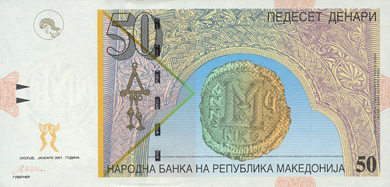
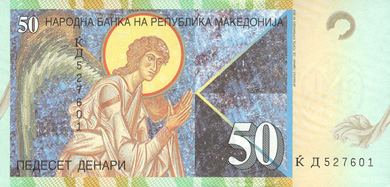
Banknotes
Budget & Public Finance
- Fiscal Year
- Calendar Year
- Annual Budget
- $2,150,000,000 (USD)
- Public Debt (% of GDP)
- 37.4%
- External Debt
- $1,939,000,000 (USD)
- Investment (% of GDP)
- 18%
- Current Account Balance
- -$303,000,000 (USD)
- Reserves of Foreign Exchange
- $1,076,000,000 (USD)
Labor, Industry & Trade
- Labor Force by Occupation
- agriculture NA%; industry NA%; services NA%
- Industries
- coal, metallic chromium, lead, zinc, ferronickel, textiles, wood products, tobacco, food processing, buses, steel
- Agriculture Products
- wheat, grapes, rice, tobacco, corn, millet, cotton, sesame, mulberry leaves, citrus, vegetables; beef, pork, poultry, mutton
- Export Partners
- Greece 15.5%, Germany 13.1%, Serbia and Montenegro 10.4%, Slovenia 8.6%, Bulgaria 8.1%, Turkey 6%, Romania 4.7%
- Import Partners
- Greece 15.5%, Germany 13.1%, Serbia and Montenegro 10.4%, Slovenia 8.6%, Bulgaria 8.1%, Turkey 6%, Romania 4.7%
Energy
- Oil Production
- 0 bbl/day
- Oil Consumption
- 23,000 bbl/day
- Oil Reserves
- 0 bbl/day
- Natural Gas Production
- 0 cu m
- Natural Gas Consumption
- 0 cu m
- Natural Gas Imports
- 0 cu m
- Natural Gas Exports
- 0 cu m
- Natural Gas Reserves
- 0 cu m
Communications
- Telephone System
- general assessment: competition from the mobile-cellular segment of the telecommunications market has led to a drop in fixed-line telephone subscriptions domestic: combined fixed-line and mobile-cellular telephone subscribership about 130 per 100 persons international: country code - 389
- Internet Country Code
- N/A
News & Weather
News & Weather
Current Weather
Latest News
4th-century BCE ritual complex in North Macedonia reveals elite feasts and Macedonian kingdom connections - Archaeology News Online Magazine
Archaeology News Online Magazine · 11h ago
Rare Hellenistic Ritual Complex Revealed at Gradište in North Macedonia - Arkeonews
Arkeonews · 8h ago
President Murmu arrives in North Macedonia; first visit by any Indian head of state - The Hindu
The Hindu · 5h ago
Driver hits, kills black bear on I-480 - FOX 8 News
FOX 8 News · 5d ago
Three arrested over N.Macedonia water supply-linked mass poisoning - Macau Business
Macau Business · 10h ago
North Macedonia Probes Water Supply After Mass Poisoning Incident - NDTV
NDTV · 1d ago
North Macedonia vs Netherlands - Class. Games 9-12 - FIBA U20 EuroBasket 2026, Division B - FIBA Basketball
FIBA Basketball · 3d ago
Annual St. Dimitria Macedonian Festival returns to Henrietta July 17-19 - 13wham.com
13wham.com · 4d ago
News via Google News
Climate Overview
Mostly a country of hills and mountains, Macedonia has a continental Mediterranean climate characterized by long, dry, rather hot summers and short, cold winters. The average air temperature in the summer is 25°C (77°F) and 0.5°C (33°F) in winter. However, short periods of extreme temperatures of 110-115°F in summer and low 20s in the winter are common. The average annual precipitation is 445.5 mm. The humidity in Macedonia averages 66%. Occasionally, there are dust storms in the Vardar River valley. Macedonia is on a fault line and the country averages four earthquakes a year (most go unnoticed) with a median reading of 6 on the Medvedev-Sponheuer-Karnik International Seismological Scale.
Videos
Videos
1 curated YouTube videos.
Source: YouTube
Frequently Asked Questions
Frequently Asked Questions
What is the population of Macedonia?
How do people greet each other in Macedonia?
What are dining customs like in Macedonia?
What should I know about visiting and hospitality in Macedonia?
How should I dress in Macedonia?
What is family life like in Macedonia?
What do people do for recreation in Macedonia?
What is the capital of Macedonia?
Where is Macedonia located?
What countries border Macedonia?
What religion is practiced in Macedonia?
What is the currency of Macedonia?
What languages are spoken in Macedonia?
What is Macedonia known for?
Who are some notable political figures in Macedonia's modern history?
Last reviewed 2026