
 English
 Español
 中文
中文 हिन्दी
 Français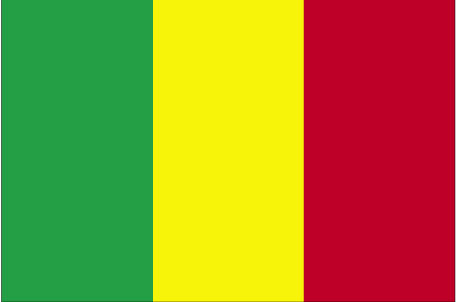
Mali
Mali
Declare Your Relationship to Mali
CountryReports Community
- Studying1
- From Mali0
- Mali heritage0
- Visited0
- Want to visit0
Customs and Culture
Customs and Culture
About the People
Mali is a developing nation and faces the problems of developing nations. Droughts have destroyed much of the regions plant and animal life. Many people are uneducated and can not read or wirte. Their are poor health conditions with only a few hundred doctors living there. Malaria is a major cause of death among Mali's children.
The majority of the people are black Africians belonging to different ethnic groups. Most live in small rural villages in southern Mali and farm for a living. They can only raise enough food for their own survival. The typical farm tool is an old fashion hand tool. Many women use gourds to water the crops as their ancestors did. They grow cassava, corn, millet, rice, sorghum and yams. Some of the people herd cattle as well.
Cultural Attributes
Mali is a developing nation and faces the problems of developing nations. Droughts have destroyed much of the regions plant and animal life. Many people are uneducated and can not read or write. There are poor health conditions with only a few hundred doctors living in Mali. Malaria is a major cause of death among Mali's children.
The majority of the people are black Africans belonging to different ethnic groups. Most live in small rural villages in southern Mali and farm for a living. They can only raise enough food for their own survival. The typical farm tool is an old fashion hand tool. Many women use gourds to water the crops as their ancestors did. They grow cassava, corn, millet, rice, sorghum and yams. Some of the people herd cattle as well.

Land of Gold and Salt, Keeper of Timbuktu's Secrets
Greetings, Gestures & Visiting
When entering a visitor gives a short greeting. If the visitor is a stranger a longer greeting is given. While the greetings are given the host and guest may hold right hands.
When greeting someone in the Bambara language a man will give a different response than a woman. For all greetings men say "nba" and women say "nse".
For example if the greeting is "I ni sogoma"(Good morning) men would respond with "nba"(like thank you). Women would respond with "nse". To greet someone around noon you would say "I ni tilé". Men would reply with "nba and women would reply with "nse". "I ni wula" (Good afternoon -- used in afternoon until dusk) men reply with "nba" and women reply with "nse".
Clothing among Malians is predominantly African in style, although young men often wear Western styles for everyday. Styles for men include the zerebou, a long tunic over pants, or for dressier wear, a grand boubou, a long, large embroidered robe worn over a short tunic and pants. Only a small number of women wear Western clothing. For everyday, women wear a blouse and a pagne, a length of cloth wrapped around the waist to make a long skirt. On formal occasions, women wear a boubou, a long flowing robe, over a pagne. Many women have elaborately braided hairstyles and often wear a scarf wound around their heads. Among the expatriate community, Western-style clothing is worn: slacks, shirts, skirts, dresses, blouses, etc. Casual, lightweight, loose, summery styles are worn most of the time.
Cotton and cotton-blend fabrics are preferable because of the heat. Clothing should be durable and washable; it is very dusty during the dry season and muddy during the rainy season. Clothing wears out quickly because it must be washed frequently due to the climate. Fairly reliable dry-cleaning is available. Western-style clothing is available in some boutiques but prices are generally high and quality is not good. Once at post, many people order clothing and shoes from U.S. mail order companies.
The Community Liaison Office maintains a collection of catalogs for this purpose. Also, many local tailors can copy a garment from a picture or sample, although the quality varies depending on cost. Ask colleagues or the CLO to recommend a tailor in your area. Available fabrics are largely the European white damask cotton, locally known as bazin, and locally woven heavy cottons; these are dyed (using the tie-dye or batik techniques for which Mali is renowned) and sometimes embroidered to produce beautiful and serviceable (mainly casual) clothes. A limited supply and variety of imported fabrics is available, and one store sells a selection of European furnishing fabrics. Patterns are not available and the supply of sewing notions (thread, buttons, zippers and trims) is good, but not of the same quality as in the US. Shoes and sandals should be low-heeled, sturdy, and comfortable. There are very few sidewalks, and those that exist are very uneven, so shoes wear out quickly from the dirt and rubble. For this reason, as well as the pollution, the heat, and traffic risks to pedestrians, few expatriates walk very far in Bamako.
Sandals can be worn most of the year and are practical because of the heat. Suede will be soon damaged because of the prevalence of heavy dust followed by rains and mud. Shoes and sandals, mostly of synthetic materials, can be found at the market, but the selection of styles and sizes is small and the quality varies from fair to poor. Handcrafted leather purses and flat or low-heeled sandals can be made to order or purchased off the rack at the Artisanat. Plastic sandals and flip-flops for adults and children are sold in the market. Be sure to bring shoe polishes and extra shoelaces. Bring sports attire, such as tennis wear, exercise leotards, and good sports shoes, etc. Also, bring several bathing suits, as chlorinated water tends to wear them out quickly. Lightweight jackets or sweaters are needed occasionally during the cool season and an umbrella is useful during the rainy season. Nylon stockings are uncomfortable because of the heat and are rarely worn. Bring lightweight hats for protection against the sun. Some warm, winter-type clothing for all family members is necessary in case of travel (vacations, trainings, TDYs or evacuation) to cooler climates. Children For children, be sure to bring a generous supply of summer clothing.
Heat and dust often necessitate several changes a day. Playwear should include shorts, pants, jeans, sundresses, tee shirts, swimsuits, sandals, sneakers, and sun hats. Dress for school is informal. Local tailors make charming children's clothes in colored cotton. Other items to bring for children are cotton underwear, socks, pajamas, a light-weight jacket, several sweaters, some winter wear and a coat for travel to cooler climates. For infants, bring a large supply of cloth and disposable diapers, diaper pins, and rubber pants. Disposable diapers are sometimes available on the local economy but are very expensive. American-style rubber pants are not available. Some baby clothes are available but the variety is small and the quality is poor. Cotton undershirts, cotton pajamas, and summer-weight infant wear should be brought to post. Don't forget extra shoes in several sizes for rapidly growing toddlers. Flip-flops and plastic sandals for children are available in the market. Bring baby towels, washcloths, crib sheets, and cotton baby blankets.
Diet
Food shopping for food in Bamako usually requires going to several locations for the items on a list. There are open-air markets, several small grocery stores, tiny neighborhood boutiques, bakeries, and butchers. Door-to-door vendors sell fish, pork, and vegetables. A good variety of food can be found in Bamako. Stores and boutiques generally have fixed prices and are open between 9 a.m. and 1 p.m., and again between 3:30 and 8 p.m., except on Sundays, when most places are either closed or only open until 1 p.m. The market is bustling at almost any time of the day although some vendors close for a long lunch break. There are no fixed prices, so bargaining is in order. Fresh fruits and vegetables are sold in outdoor markets or by vendors who come to the door. A variety of fruits and vegetables are grown, although availability, quality, and price depend upon the season.
Vegetables are generally available year round, including potatoes, onions, leeks, garlic, parsley, celery (very small stalks, mostly leaves, but adequate for cooking), lettuce, cucumbers, tomatoes, carrots, radishes, green bell peppers, hot peppers, eggplant, and okra. Available for short periods in season are beets, green beans, broccoli, cauliflower, squash, spinach, corn (field corn), turnips, green cabbage, peas, green onions, and sweet potatoes. Fruits available in season are mangoes, papayas, bananas, guavas, coconut, pineapples, oranges, lemons, limes, grapefruit, tangerines, strawberries, watermelon, melon, and avocados. Local fresh fruits and vegetables are generally less expensive than in the U.S. Imported apples are available most of the year and on occasion, other fruits and vegetables such as artichokes, asparagus, endives, mushrooms, Pascal celery, peaches, cherries, pears, grapes, nectarines and apricots can be found in the grocery stores. Imported fruits and vegetables are imported from France and Lebanon and are extremely expensive. Peanuts are available year round in the market; almonds, hazelnuts, and pistachio nuts are available in the stores at high prices. Herbs and spices are also found in the market: mint, fresh ginger, basil, hot pepper, caraway seeds, cilantro (Chinese parsley), bay leaves, nutmeg, lemon grass (citronella), peppercorns, salt, curry, bouillon cubes, and many local spices, such as ground baobab leaves. Imported spices are available at very high prices in the grocery stores.
Mali also raises good beef, pork, and mutton, which are sold in the market and in several small butcher shops. Beef and mutton purchased in the open market are freshly butchered and should be frozen before use. Beef is quite flavorful, but very lean and often tough so it is useful to bring meat tenderizers and marinades to post. The French style of cut is available, though some butchers can do U.S. cuts. Fresh meat is not expensive by U.S. standards; fillet sells for about $2.50 a pound. Chickens are frequently skinny and tough. Imported bacon, ham, sausages, and pâtés are available in the grocery stores and butcher shops, but are relatively expensive. Chicken, turkey, pigeon, guinea hen, and rabbit are also sold in the market, as are river fish (Nile Perch or capitaine) and carp. Both poultry and fresh fish are expensive by U.S. standards. Frozen shrimp is sold in grocery stores at very high prices. Canned seafood and fish (tuna, salmon, etc.) are also available. Eggs are available in the market and stores. Fresh milk can be found but must be boiled before use. UHT (ultra-high temperature) long-life milk is sold both in whole, 2%, and skimmed forms; it does not need refrigeration until opened. Powdered whole milk (full cream), butter (salted and unsalted), and margarine are available, as is long-life cream.
There is a good selection of European cheeses (Gouda, Edam, Cheddar, Roquefort, Camembert, Brie, Gruyere, several other French and Lebanese cheeses, and goat's milk cheese), but these are over $10 per pound. Cottage cheese, mozzarella, and cream cheese are usually available. Imported crème fraîche (cultured cream), whipping cream, yogurt, and ice cream are available, but very expensive. Mali Lait, the local milk producer, has passed Embassy Health Unit tests on its milk, yogurt, and ice cream but their products have a short shelf life. Yogurt makers and ice cream freezers are useful items to ship to post but it is also possible to make (or teach your cook to make) these items at home without special equipment. Infrequent shortages of staples such as butter, eggs, milk, and sugar do occur. Several grocery stores and neighborhood shops offer a variety of packaged goods and canned items such as fruits, juices, vegetables, soups, fish, and meat. The quality of some of the canned goods available is not as high as equivalent American items. Paper products, dairy products, sausages, ham, and cold cuts are available. Also found are liquors, a wide selection of wines (mostly French but some Spanish, Australian, and a few Californian), local and European beer, soft drinks, and fruit juices; cookies and crackers; jams and honey; soaps, detergents, and cleaning products; coffee and tea; spaghetti, macaroni and couscous; oils, vinegar, sauces and condiments; cocoa and spices. There are even some specialty items for Chinese and Vietnamese cooking such as soy sauce and rice wrappers for spring rolls. Most of the items stocked in the stores are imported from Europe but some U.S. products introduced to Europe end up on local shelves. Imported items are expensive. For example, five kilograms (11 pounds) of laundry detergent costs about $32.00, a liter of cream can be $16.00, a kilogram of cheese costs around $22.75. Jars of baby food and baby cereal are sold in the stores; however, there is not much variety; they are expensive and items are often out of stock. High quality European baby formulas are usually available in the pharmacies and are less expensive than American brands. Local bakeries carry French-style bread (baguettes), pastries, and pain de mie, loaf-style breads similar to, but heavier than, American bread. Whole wheat and white flour is available, though most people either bring their own or buy from the Commissary.
Cake and cookie decorating items and food colorings are available in limited variety at some of the shops. Canned pet food is sold in the grocery stores. Most pet owners prefer to have pet food prepared at home, using rice, meat, and vegetable scraps. Pet products such as flea collars, worm medicines, medication, and shampoos, rawhide chew bones and toys are not available and should be brought to post. Malian, French, and some American brands of cigarettes can be found. Pipe tobaccos are not available but Middle Eastern apple tobacco often is. The American Community Services Association of Mali (ACSAM) operates a small commissary for U.S. Government employees and contractors who have duty-free privileges. The commissary carries American foodstuffs such as cereal, baking goods, frosting, brown and confectioners sugar, vanilla and other extracts, unsweetened chocolate, chocolate chips, cake and pancake mixes and shortening. Also, sauces, condiments, pickles, jams, syrups, peanut butter, canned soups (mushroom, tomato, etc.), cereals, gelatins, puddings, candy, nuts, cookies, crackers, juices, liquors and wines, Chinese and Mexican food products, personal products, cleaning products and paper goods are all available but in limited quantity and variety. Commissary deposits are currently $250 for single and $500 for family memberships and may be paid in installments; the deposit is refunded in full on departure from post. However, this is likely to change to a non-refundable fee system (around $50 per member) in the future. Transportation expenses make many commissary items more expensive than their U.S. counterparts; shipments are sometimes irregular and supplies are limited. Employees posted to Mali are currently granted a consumables allowance of 2,500 pounds, intended to offset difficulties caused by shortage, expense, or unavailability of items at post. Some employees ship none or only part of the allowance before arrival and the remainder later when they know the availability and prices of items locally. Check favorite recipes for special ingredient needs and request catalogs from mail-order grocery outlets for ideas for consumable shipments. You might want to include laundry soap, your favorite cleaning supplies, paper items (such as baby diapers, toilet paper, paper towels, facial tissue, sanitary products), ethnic foods, beauty supplies and cosmetics or anything you do not wish to live without. You can check beforehand with your sponsor or contact in Mali whether particular items are available at post.
In rural Mali normally the food is served in a large bowl (sauce over millet), and people sit around the bowl and eat out of the same bowl with their right hands.
Typically Mali's can only raise enough food for their own survival. The typical farm tool is an old fashion hand tool. Many women use gourds to water the crops as their ancestors did. They grow cassava, corn, millet, rice, sorghum and yams for food. Some of the people herd cattle as well.
Food shopping in Bamako usually requires going to several locations for the items on a list. There are open-air markets, several small grocery stores, tiny neighborhood boutiques, bakeries, and butchers. Door-to-door vendors sell fish, pork, and vegetables. A good variety of food can be found in Bamako. Stores and boutiques generally have fixed prices and are open between 9 a.m. and 1 p.m., and again between 3:30 and 8 p.m., except on Sundays, when most places are either closed or only open until 1 p.m. The market is bustling at almost any time of the day although some vendors close for a long lunch break. There are no fixed prices, so bargaining is in order. Fresh fruits and vegetables are sold in outdoor markets or by vendors who come to the door. A variety of fruits and vegetables are grown, although availability, quality, and price depend upon the season.
Vegetables are generally available year round, including potatoes, onions, leeks, garlic, parsley, celery (very small stalks, mostly leaves, but adequate for cooking), lettuce, cucumbers, tomatoes, carrots, radishes, green bell peppers, hot peppers, eggplant, and okra. Available for short periods in season are beets, green beans, broccoli, cauliflower, squash, spinach, corn (field corn), turnips, green cabbage, peas, green onions, and sweet potatoes. Fruits available in season are mangoes, papayas, bananas, guavas, coconut, pineapples, oranges, lemons, limes, grapefruit, tangerines, strawberries, watermelon, melon, and avocados. Imported apples are available most of the year and on occasion, other fruits and vegetables such as artichokes, asparagus, endives, mushrooms, Pascal celery, peaches, cherries, pears, grapes, nectarines and apricots can be found in the grocery stores. Imported fruits and vegetables are imported from France and Lebanon and are extremely expensive. Peanuts are available year round in the market; almonds, hazelnuts, and pistachio nuts are available in the stores at high prices. Herbs and spices are also found in the market: mint, fresh ginger, basil, hot pepper, caraway seeds, cilantro (Chinese parsley), bay leaves, nutmeg, lemon grass (citronella), peppercorns, salt, curry, bouillon cubes, and many local spices, such as ground baobab leaves.
Mali also raises good beef, pork, and mutton, which are sold in the market and in several small butcher shops. Beef and mutton purchased in the open market are freshly butchered and should be frozen before use. Beef is quite flavorful, but very lean and often tough. Chickens are frequently skinny and tough. Imported bacon, ham, sausages, and pâtés are available in the grocery stores and butcher shops. Chicken, turkey, pigeon, guinea hen, and rabbit are also sold in the market, as are river fish (Nile Perch or capitaine) and carp. Frozen shrimp is sold in grocery stores. Canned seafood and fish (tuna, salmon, etc.) are also available. Eggs are available in the market and stores. Fresh milk can be found but must be boiled before use.
There is a good selection of European cheeses (Gouda, Edam, Cheddar, Roquefort, Camembert, Brie, Gruyere, several other French and Lebanese cheeses, and goat's milk cheese). Cottage cheese, mozzarella, and cream cheese are usually available. Imported crème fraîche (cultured cream), whipping cream, yogurt, and ice cream are available, but very expensive. Mali Lait, the local milk producer, has passed Embassy Health Unit tests on its milk, yogurt, and ice cream but their products have a short shelf life. Local bakeries carry French-style bread (baguettes), pastries, and pain de mie, loaf-style breads similar to, but heavier than, American bread.
Canned pet food is sold in the grocery stores. Most pet owners prefer to have pet food prepared at home, using rice, meat, and vegetable scraps. Malian, French, and some American brands of cigarettes can be found. Pipe tobaccos are not available but Middle Eastern apple tobacco often is.

Family
Malian law allows for men to have more than one wife and many have two wives. A small percentage of men have four wives which is the maximum allowable by law. When a man has more than one wife each wife is entitled to her own house or apartment and the man must provide for each wife equally. When a man has more than one wife many times the wives will share in the food preparation responsibilities.
Recreation
Soccer is the most important sport. Most young people enjoy listening to music both international and African.
Holidays
Independence Day
9/22Independence Day
Dates of Interest
- September 22nd
How do people greet each other in Mali?
When entering, a visitor gives a short greeting, while a stranger gives a longer one; the host and guest may hold right hands during the greeting. In Bambara, men and women give different set responses.
Do
- Give a short greeting on entering; a longer one if you're a stranger
- Hold right hands with the host during the greeting when appropriate
Good to know
- If you are a man, respond to greetings with "nba"; if a woman, respond with "nse"
- "I ni sogoma" means good morning; "I ni tilé" is used around noon; "I ni wula" is good afternoon until dusk
What are dining customs like in Mali?
In rural Mali, food (often sauce over millet) is served in a large shared bowl, and people sit around it and eat with their right hands. Common staples include cassava, corn, millet, rice, sorghum, and yams.
Do
- Eat from the shared bowl using your right hand
- Boil fresh milk before use
- Freeze freshly butchered beef and mutton from the open market before use
Good to know
- Bargaining is expected at the open-air market, where there are no fixed prices
- Bring meat tenderizers and marinades, as local beef is lean and often tough
What everyday etiquette should I know in Mali?
Right-hand use matters in social settings, such as during greetings and when eating from a shared bowl.
Do
- Use your right hand for greetings and eating
How should I dress in Mali?
Clothing is predominantly African in style; men may wear a zerebou (long tunic over pants) or a grand boubou for dressier occasions, and women wear a blouse and pagne, or a boubou over a pagne for formal occasions. Expatriates wear casual, lightweight, loose, summery Western clothing suited to the heat.
Do
- Choose cotton and cotton-blend fabrics for the heat
- Wear low-heeled, sturdy, comfortable shoes and sandals
- Bring lightweight hats for sun protection and an umbrella for the rainy season
Don’t
- Don't rely on suede, which is quickly damaged by dust, rain, and mud
- Avoid nylon stockings, which are uncomfortable in the heat
Good to know
- Clothing should be durable and washable, as it gets dusty in the dry season and muddy in the rains
- Pack some warm clothing in case of travel to cooler climates
What is family life like in Mali?
Malian law allows men to have more than one wife, and many have two, with a maximum of four. Each wife is entitled to her own house or apartment, and the man must provide for each equally.
Good to know
- When a man has more than one wife, the wives often share food preparation responsibilities
What do people do for recreation in Mali?
Soccer is the most important sport, and most young people enjoy listening to both international and African music.
Last updated: 2026-07-12 · Sources: CountryReports
Photos of Mali
Photos of Mali
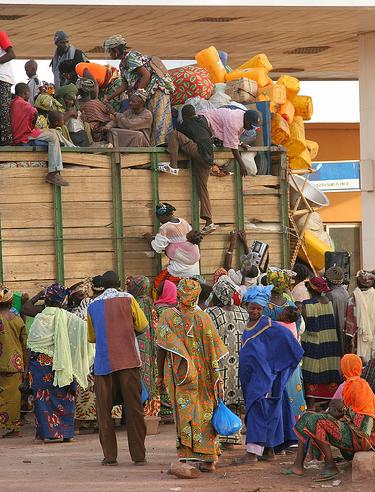
People getting a lift back home from the market in Mopti
Ist von meinem Kollegen, Mali
Mali -- Simple Figures in Wood Creche
Mali Creche -- Made from Recycled Cans
Young peul girl in Mali tattooing her mouth with needles and henna.
Riding on truck
Young Dogon men carrying straw which is used as animal feed.
Young girl at a water pump.
Group of children
Piroque on the Niger in Mali
Fulani settlemen in Mali
Monday market in Djenne, Mali


Travel and Tourism
Travel and Tourism
- Travel Alert Status
- Level 4: Do Not Travel
- Time Difference
- UTC 0 (5 hours ahead of Washington, DC, during Standard Time)
- Climate
- There are two primary seasons in West Africa. The dry period can be further divided into two distinct seasons, mild and hot, particularly in the savanna and Sahelian regions of Mali. The rainy season usually begins in June and continues into October. Almost all of the annual rainfall occurs during this time. As much as 60-80 inches of rain may fall in the southern savanna but rainfall is lower further north. Temperatures range from 70 to 100 degrees Fahrenheit (21-40°C). The cool season lasts from December to mid-February, when temperatures range from 60 degrees Fahrenheit at night to the mid-80s (about 28-34°C) during the day. The hot season starts in mid-February and goes into June. The air is dry, dusty, and very hot; temperatures often reach over 100 degrees (40°C) and clouds of dust hang in the air. This is the season of the harmattan, the dry, sandy wind that brings dust clouds southwards from the Sahara.
- Airports
- 27
Read the full travel guide — health, safety, vaccinations, disease risk, sanitation, and transit details.
View full travel guideRecipes
Recipes
History
History
Historical Eras
Ancient Empires
700 – 1591
West Africa's great Sahelian empires rose and fell across this long period. The Ghana Empire dominated trans-Saharan trade until 1075, succeeded by the Mali Empire under Sundiata Keita from 1230, which reached its zenith around 1325 with control of Timbuktu and Gao. The Songhai Empire then surpassed all predecessors under Askia Mohammad I before a Moroccan invasion destroyed it in 1591, leaving Timbuktu's renowned Islamic scholarship as the era's enduring legacy.
Pre-Colonial Period
1591 – 1880
Following Songhai's collapse, the western Sudan fragmented into smaller competing states and fell under the influence of Moroccan-backed pashas centered in Timbuktu. Tuareg and Fulani powers asserted themselves across the region during the 18th and 19th centuries, while Islamic reform movements, notably the Fulani jihads, reshaped political and religious authority. Long-distance trade along Niger River routes continued, though no single empire achieved the dominance of earlier centuries.
French Colonial Era
1880 – 1960
French military forces began penetrating the Soudan around 1880, meeting sustained resistance, most notably from the Malinke warrior Samory Touré, who was not defeated until 1898 after seven years of war. Administered as French Soudan within the Federation of French West Africa, the territory saw imposed indirect rule and appointed chiefs supplant traditional authorities. The 1956 Loi Cadre granted significant internal autonomy, and in January 1959 Soudan joined Senegal to form the Mali Federation, which achieved full independence on June 20, 1960.
Single-Party & Military Rule
1960 – 1991
After Senegal's secession dissolved the Mali Federation in August 1960, Modibo Keita proclaimed the Republic of Mali and quickly established a single-party socialist state, pursuing extensive nationalization before a deteriorating economy forced a course correction. A bloodless military coup on November 19, 1968 brought Lt. Moussa Traoré and the 14-member Military Committee for National Liberation to power. Traoré formalized one-party rule under the UDPM in 1976 and held power for over two decades, facing the Sahelian drought, a brief border war with Burkina Faso in 1985, and growing pro-democracy protests.
Democratic Transition
1991 – 2012
Mass protests and a military uprising ended Traoré's regime in March 1991, leading to a transitional government and Mali's first multiparty presidential election in 1992, which brought Alpha Konaré to power. Konaré pursued political and economic reform through two terms before stepping down constitutionally in 2002, succeeded by Amadou Toumani Touré — a model of democratic consolidation rare in the region. The period was nonetheless marked by recurring Tuareg rebellions in the north and persistent poverty, food insecurity, and locust crises.
Crisis & Instability
2012 – present
A Tuareg-led rebellion and jihadist insurgency in 2012 prompted a military coup that toppled Touré and allowed Islamist groups briefly to seize northern cities including Timbuktu and Gao. A French-led military intervention (Opération Serval) in 2013 drove back the insurgents, and elections partially restored civilian rule. Successive coups in 2020 and 2021 again interrupted democratic governance, and the country continues to grapple with jihadist violence, humanitarian displacement, and contested transitional authority.
Overview
Timeline of Key Events
146 BCE – 31 BCE
Roman conquest of North Africa; Berbers’ southern migration begins.
Roman conquest of North Africa; Berbers’ southern migration begins.
1100
City of Tombouctou founded as a small trading center along the Niger River.
City of Tombouctou founded as a small trading center along the Niger River.
1230
Sundiata, a Mandinka prince, defeats the Susu and founds the kingdom of Mali.
Sundiata, a Mandinka prince, defeats the Susu and founds the kingdom of Mali.
1325
Mali captures Gao.
Mali captures Gao.
1336
Timbuktu becomes part of the Mali Empire.
Timbuktu becomes part of the Mali Empire, now at the height of its power, and starts its own era of prosperity.
1359
Mali divided by civil war.
Mali divided by civil war.
1433
Timbuktu captured and controlled by Berbers.
Timbuktu captured and controlled by Berbers.
Read the full history profile — narrative overview, defining eras, and the complete timeline in one place.
View expanded historyInteresting Facts
Interesting Facts
When a child loses a tooth they throw their tooth in the chicken coop. The next day they might find a big fat hen in the coop and their mother will make chicken soup.
Salt was such a valuable commodity that people would trade a pound of gold for a pound of salt. Mali is famous for its salt mines.
The ancient mosque in Timbuktu has a door which has never been opened. It is said that opening the door will signal the end of world.
See every fact — trivia, oddities, and curious tidbits gathered from across the country.
View all interesting factsGeography and Environment
Geography and Environment
- Terrain
- mostly flat to rolling northern plains covered by sand; savanna in south, rugged hills in northeast
- Climate
- There are two primary seasons in West Africa. The dry period can be further divided into two distinct seasons, mild and hot, particularly in the savanna and Sahelian regions of Mali. The rainy season usually begins in June and continues into October. Almost all of the annual rainfall occurs during this time. As much as 60-80 inches of rain may fall in the southern savanna but rainfall is lower further north. Temperatures range from 70 to 100 degrees Fahrenheit (21-40°C). The cool season lasts from December to mid-February, when temperatures range from 60 degrees Fahrenheit at night to the mid-80s (about 28-34°C) during the day. The hot season starts in mid-February and goes into June. The air is dry, dusty, and very hot; temperatures often reach over 100 degrees (40°C) and clouds of dust hang in the air. This is the season of the harmattan, the dry, sandy wind that brings dust clouds southwards from the Sahara.
- Natural Hazards
- hot, dust-laden harmattan haze common during dry seasons; recurring droughts; occasional Niger River flooding
- Current Environmental Issues
- deforestation; soil erosion; desertification; inadequate supplies of potable water; poaching
Read the full geography and environment profile — terrain, climate, natural resources, hazards, land use, and international agreements.
View full geographyPeople & Demographics
People & Demographics
Religion
Languages Spoken
French (official), Bambara 80%, numerous African languages
- French
Population
- Population
- 13,796,354
- Population in Major Urban Areas
- BAMAKO (capital) 2.037 million
- Nationality Noun
- Malian(s)
- Ethnic Groups
- Mande 50% (Bambara, Malinke, Soninke), Peul 17%, Voltaic 12%, Songhai 6%, Tuareg and Moor 10%, other 5%
Education
- Literacy Definition
- age 15 and over can read and write
Health Information
- Major Infectious Diseases — degree of risk
- very high
Read the full people and society profile — demographics, health, education, religion, languages, and notable people.
View full people and societyGovernment & Politics
Government & Politics
Country Identity
- Country Name
- Mali
- Full Country Name
- Republic of Mali
- Local - Long
- Republique de Mali
- Local - Short
- Mali
- Former Name
- French Sudan and Sudanese Republic
Government Structure
- Government Type
- republic
- Legal System
- based on French civil law system and customary law; judicial review of legislative acts in Constitutional Court (which was formally established on 9 March 1994); has not accepted compulsory ICJ jurisdiction
- Executive Branch
- chief of state: Transition President General Assimi GOITA (since 7 June 2021), following a military coup in May 2021 that ousted transitional President Bah N'DAW head of government: Prime Minister General Abdoulaye MAIGA (since 21 November 2022), appointed following the dismissal of Choguel Kokalla MAIGA cabinet: Council of Ministers appointed by the prime minister and approved by the transition president elections: Under the previous constitutional order, the president was elected by popular vote for a five-year term with a two-term limit, and the prime minister was appointed by the president. Mali has been under military-led transitional governance since the August 2020 coup. A new constitution was approved by referendum in June 2023, and a return to civilian rule has been repeatedly delayed; transitional authorities have indicated elections could be held in 2024 or later. election results: The most recent competitive presidential election was held in 2013, in which Ibrahim Boubacar KEITA won with approximately 77.6% of the vote in a runoff against Soumaila CISSE. KEITA was reelected in 2018 but was overthrown in a military coup in August 2020.
- Legislative Branch
- unicameral National Assembly or Assemblee Nationale (147 seats; members are elected by popular vote to serve five-year terms) elections: last held 14 and 28 July 2002 (next to be held July 2007) election results: percent of vote by party - NA%; seats by party - Hope 2002 coalition 66, ADEMA 51, other 30
- Judicial Branch
- Supreme Court or Cour Supreme
- Suffrage
- 18 years of age; universal
- Constitution
- adopted 12 January 1992
- Independence
- 22 September 1960 (from France)
- National Holiday
- Independence Day, 22 September (1960)
Capital City
- Capital Name
- Bamako
- Capital - geographic coordinate
- 12 39 N, 8 00 W
- Capital Time Difference
- UTC 0 (5 hours ahead of Washington, DC, during Standard Time)
the name in the Bambara language can mean either "crocodile tail" or "crocodile river" and three crocodiles appear on the city seal
Military
Branches: Malian Armed Forces: Army (Armee de Terre), Republic of Mali Air Force (Force Aerienne de la Republique du Mali, FARM), National Guard (Garde National du Mali)
Embassy / Diplomatic Mission
U.S. Embassy Bamako
ACI 2000, Rue 243 Porte 297, Bamako, Mali
Telephone: (223) 20 70 23 00
Consular Section: (223) 20 70 25 05
Emergency after-hours telephone: (223) 20 70 23 01 or 20 70 23 02
Facsimile: (223) 20 70 23 40.
Email address: consularbamako@state.gov
Read the full government profile — flag symbolism, national anthem, and other national symbols.
View full government detailsEconomy
Economy
Mali is among the poorest countries in the world, with roughly 65% of its land area desert or semi-desert and a highly unequal distribution of income. Economic activity is largely concentrated in the riverine area irrigated by the Niger River. About 5-10% of the population remains nomadic, and approximately 70-80% of the labor force is engaged in agriculture, livestock, and fishing. Industrial activity is centered on processing agricultural commodities, while the broader economy is dominated by gold mining and cotton production.
Mali is the third-largest gold producer in Africa, and gold now accounts for the majority of its export earnings, followed by cotton and livestock. The country remains heavily dependent on foreign aid and is highly vulnerable to fluctuations in world commodity prices, regional security conditions, and climate-related shocks affecting agriculture.
Since the 2012 Tuareg rebellion and subsequent jihadist insurgency in the north, ongoing conflict and political instability—including military coups in 2020 and 2021—have severely disrupted economic development. International sanctions imposed by ECOWAS in early 2022, though later lifted, contracted growth, and Mali's withdrawal from ECOWAS in 2024 alongside Burkina Faso and Niger to form the Alliance of Sahel States has further reshaped its trade and diplomatic landscape. The suspension of aid from key partners such as France and the European Union has compounded fiscal pressures.
Despite these challenges, the economy has shown modest resilience, with GDP growth recovering to an estimated 3-4% in recent years, supported by strong gold prices and agricultural output. However, persistent insecurity, inflation, energy shortages, and limited access to financing continue to constrain long-term development prospects.
Snapshot
- Currency Name and Code
- CFA Franc BCEAO (XOF)
- GDP — official exchange rate
- $5,434,000,000 (USD)
- GDP Real Growth Rate
- 6%
- Gini Index
- 50.5
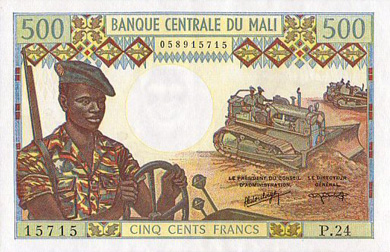
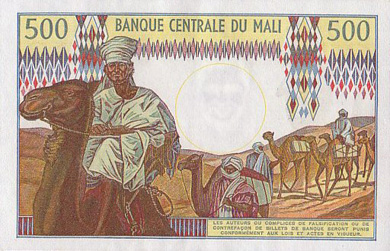
Banknotes
Budget & Public Finance
- Fiscal Year
- calendar year
- Annual Budget
- $828,000,000 (USD)
- External Debt
- $2,800,000,000 (USD)
- Economic Aid
- $596,400,000 (USD)
Labor, Industry & Trade
- Labor Force by Occupation
- agriculture and fishing 80%
- Household Income — highest 10%
- 40.4%
- Industries
- food processing; construction; phosphate and gold mining
- Agriculture Products
- cotton, millet, rice, corn, vegetables, peanuts; cattle, sheep, goats
- Export Commodities
- cotton, gold, livestock
- Export Partners
- Thailand 14.4%, Italy 10.2%, India 7.8%, Germany 4.8%, Spain 4.8%, Mauritius 4.2%, Portugal 4.2%
- Import Commodities
- petroleum, machinery and equipment, construction materials, foodstuffs, textiles
- Import Partners
- Cote d'Ivoire 16.9%, France 13.4%, Senegal 6.4%
Energy
- Oil Production
- 0 bbl/day
- Oil Consumption
- 4,250 bbl/day
- Oil Reserves
- 0 bbl/day
- Natural Gas Production
- 0 cu m
- Natural Gas Consumption
- 0 cu m
- Natural Gas Imports
- 0 cu m
- Natural Gas Exports
- 0 cu m
- Natural Gas Reserves
- 0 cu m
Communications
- Telephone System
- general assessment: domestic system unreliable but improving; increasing use of local radio loops to extend network coverage to remote areas domestic: fixed-line subscribership remains less than 1 per 100 persons; mobile-cellular subscribership has increased sharply to about 70 per 100 persons international: country code - 223; satellite communications center and fiber-optic links to neighboring countries; satellite earth stations - 2 Intelsat (1 Atlantic Ocean, 1 Indian Ocean)
- Internet Country Code
- .ml
News & Weather
News & Weather
Current Weather
Latest News
Armed groups attack Malian military convoy in Gao region - Al Jazeera
Al Jazeera · 2d ago
Mali rebels ambush an army convoy, killing or capturing scores of soldiers - AP News
AP News · 2d ago
At least 50 Malian soldiers killed in rebel-jihadist attack - France 24
France 24 · 1d ago
Casualties after rebels attack Malian army convoy in north - africanews.com
africanews.com · 2d ago
At least 50 Malian soldiers killed in attack on military convoy - Al Jazeera
Al Jazeera · 1d ago
Azawad Liberation Front claims heavy losses inflicted on Malian army and Russian forces in northern Mali - Modern Ghana
Modern Ghana · 1d ago
Malian army convoy ambushed by rebels north of Gao - France 24
France 24 · 2d ago
Mali’s Generals Promised to Bring Peace. Things Are Now Much Worse. - The New York Times
The New York Times · 42d ago
News via Google News
Climate Overview
There are two primary seasons in West Africa. The dry period can be further divided into two distinct seasons, mild and hot, particularly in the savanna and Sahelian regions of Mali. The rainy season usually begins in June and continues into October. Almost all of the annual rainfall occurs during this time. As much as 60-80 inches of rain may fall in the southern savanna but rainfall is lower further north. Temperatures range from 70 to 100 degrees Fahrenheit (21-40°C). The cool season lasts from December to mid-February, when temperatures range from 60 degrees Fahrenheit at night to the mid-80s (about 28-34°C) during the day. The hot season starts in mid-February and goes into June. The air is dry, dusty, and very hot; temperatures often reach over 100 degrees (40°C) and clouds of dust hang in the air. This is the season of the harmattan, the dry, sandy wind that brings dust clouds southwards from the Sahara.
Frequently Asked Questions
Frequently Asked Questions
What is the population of Mali?
How do people greet each other in Mali?
What are dining customs like in Mali?
What everyday etiquette should I know in Mali?
How should I dress in Mali?
What is family life like in Mali?
What do people do for recreation in Mali?
What is the capital of Mali?
Where is Mali located?
What countries border Mali?
What is the predominant religion in Mali?
What currency does Mali use?
What language is spoken in Mali?
What is Mali's geography and terrain like?
What is Mali known for?
Last reviewed 2026