
 English
 Español
 中文
中文 हिन्दी
 Français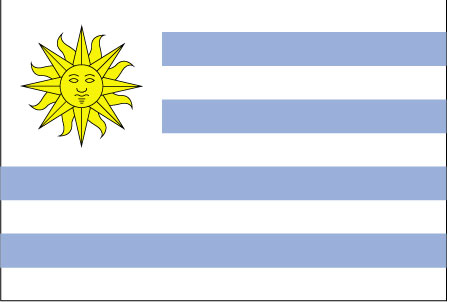
Uruguay
Uruguay
Declare Your Relationship to Uruguay
CountryReports Community
- Studying2
- From Uruguay1
- Uruguay heritage2
- Visited2
- Want to visit1
Customs and Culture
Customs and Culture
Cultural Attributes
Uruguay has several unique cultural attributes that distinguish it from other countries in the region. Here are some examples:
Mate: Mate is a traditional drink made from the dried leaves of the yerba mate plant. It is a cultural symbol of Uruguay, and is often consumed with friends and family as a social ritual.
Tango: While tango originated in Argentina, it is also a popular dance in Uruguay, and there are many tango clubs and festivals throughout the country.
Carnival: Uruguay's Carnival is one of the longest and most elaborate in the world, with celebrations lasting for several weeks. It is known for its colorful parades, street parties, and murgas (carnival groups that sing and dance satirical songs).
Gauchos: Gauchos are the traditional cowboys of the Uruguayan countryside, and are an important cultural symbol of the country's rural heritage.
Soccer: Soccer is a hugely popular sport in Uruguay, and the national team has a long and storied history, having won two World Cup championships and several Copa America titles.
Beef and barbecue: Uruguay is known for its high-quality beef, and barbecue (asado) is a popular way to cook and enjoy it. The country also has a strong wine culture, with several wine regions producing a variety of red and white wines.

Land of the Gauchos and Endless Pampas
Greetings, Gestures & Visiting
Uruguayans address people who are not close friends or family very formally. Señor, Señora or Señorita, that is Mr., Mrs. or Miss, are the usual forms of address. People may also be addressed according to their professions: lawyers may be addressed as Doctor, accountants as Contador, and engineers as Ingeniero.
It is traditional to shake hands with visitors when they arrive and when they depart. When men greet each other, they may hug each other, or pat each other on the back. Women usually kiss each others' cheeks. In conversation, Uruguayans stand close together when they talk.
Uruguayans frequently drop in on their friends. Telephoning first is not necessary. Hospitality is always extended to visitors. A gourd of yerba mate is often the first thing offered. In Uruguay, it is customary to greet strangers when passing on city streets. However, rural residents tend to be quite friendly to strangers.
Western style of clothing is worn. Uruguay's gauchos (cowboys) wear baggy pants called "bombachos", wide brimmed black hats that offer protection from the sun.
Diet
Uruguayans eat meat at most meals. Beef and lamb are relatively cheap and Uruguayans prepare them in many ways. The traditional asado is a barbecue where the meat is cooked slowly over coals. Other ways to prepare meats include sausages (salchichas) or soups (pucheros) prepared with meat and vegetables. The parrillada is a typical Uruguayan dish of roasted meats prepared in various ways. Chivito is a steak sandwich and húngaras are spicy sausages served in a roll. Milanesa Uruguaya is a breaded, deep-fried steak.
Breakfast is usually a light meal, with bread and jam and a cup of coffee or mate. Lunch may be a large meal at home, but in factories and schools most people just have a sandwich. The most substantial meal of the day is dinner, which Uruguayans eat late in the evening. Soup, salad, steak, bread, wine, cheese and fruit, followed by coffee or tea, make up a typical Uruguayan meal.
In the countryside, the gauchos often camp under the branches of the ombú tree, and light a fire for a barbecue. They boil water to make yerba mate, a bitter tea, which they drink from a hollowed gourd through a silver tube tipped with a strainer. This silver tube is called a bombilla and is often finely engraved. The gourd of yerba mate is passed from person to person. Gauchos play their guitars and vie with each other in improvising songs called payadas de contrapunto.
Uruguayans eat meat at most meals. Beef and lamb are relatively cheap and Uruguayans prepare them in many ways. The traditional asado is a barbecue where the meat is cooked slowly over coals. Other ways to prepare meats include sausages (salchichas) or soups (pucheros) prepared with meat and vegetables. The parrillada is a typical Uruguayan dish of roasted meats prepared in various ways. Chivito is a steak sandwich and húngaras are spicy sausages served in a roll. Milanesa Uruguaya is a breaded, deep-fried steak.
Breakfast is usually a light meal, with bread and jam and a cup of coffee or mate. Lunch may be a large meal at home, but in factories and schools most people just have a sandwich. The most substantial meal of the day is dinner, which Uruguayans eat late in the evening. Soup, salad, steak, bread, wine, cheese and fruit, followed by coffee or tea, make up a typical Uruguayan meal.
In the countryside, the gauchos often camp under the branches of the ombú tree, and light a fire for a barbecue. They boil water to make yerba mate, a bitter tea, which they drink from a hollowed gourd through a silver tube tipped with a strainer. This silver tube is called a bombilla and is often finely engraved. The gourd of yerba mate is passed from person to person. Gauchos play their guitars and vie with each other in improvising songs called payadas de contrapunto.

Family
In the cities, most people live in modern apartment buildings or small houses. The very poor live in shantytowns called cantegriles on the outskirts of the cities. In the countryside, houses are usually only one story and made of red brick, often with red tile roofs and open verandas.
Most families are small, with only one or two children. Sometimes a grandparent or other elderly relative shares the house with a couple and their children.
Cattle ranches on the plains are still staffed by gauchos, the cowboys of South America. Most wear the traditional clothing of baggy pants, black boots, long-sleeved cotton shirts,s, and wide-brimmed black hats. In bad weather, they wear a poncho. Gauchos spend most of their time on horseback, rounding up herds of cattle or sheep, branding them, and mending fences. They live on an estancia in a building like a dormitory, which they share with other gauchos.
Dating Customs
The age at which people in Uruguay start dating varies, but generally it is similar to other countries in the Western world, with many young people starting to date in their early to mid-teens. However, some cultural factors may influence dating practices in Uruguay. For example, family values are highly regarded in Uruguayan culture, and young people may be expected to seek the approval of their parents or guardians before starting a relationship. Additionally, some young people may choose to wait until they finish their studies or establish a career before actively seeking a romantic relationship.
Recreation
Young boys spend hours playing soccer on the street or in parks. Young women may join a volleyball or basketball team or take dance classes. Children often play games with colored marbles. Small boys like to make slingshots which they use to hunt small birds and to crack the insulating porcelain around electrical high wires.
Polo is also a popular sport among the well-to-do. Gauchos play a traditional game called pato in which two teams of horsemen compete for possession of a ball with handles. Gauchos can also demonstrate their skills in a criolla (rodeo). They try to stay on wild horses that fight to throw off their riders.
Student Life
Mornings at home in Uruguay may differ from home to home, depending on which European community the family’s ancestry comes from. In any case, children arise early and have a light breakfast of local bread and a tea-like drink called yerba maté (the national drink) or fruit juice before heading off to attend school.
Kids will either walk or ride public transportation buses to school, and then return home the same way. Uruguay has a very well-developed public transportation sytem. In some areas, bicycles may be the best way to get around, but walking remains most common. Children typically stay at school for lunch.
School uniforms are required only in private schools. Schools are beginning to deal with an unusual problem for Latin America—overcrowding. Schools in both rural and urban settings have insufficient supplies and teachers. Children from higher income families are more likely to get past these challenges and graduate to university studies. School lunch in Uruguay is usually a very well-balanced, nutritional meal, often consisting of some sort of vegetable soup, fish or chicken with rice or potatoes, a salad, cooked vegetables, and dessert (such as ice cream or fruit). The typical school day used to be in four-hour shifts to accommodate the number of students in limited schooling facilities. But a few years ago, especially in the lower-income areas, schools have begun switching from four hours per day to eight hours per day in an attempt to raise test scores, especially in language and literacy. It also helps to keep at-risk kids off the streets longer each day. Because Uruguay is the most technologically savvy country in Latin America, a small number of elementary schools in the country have been chosen to begin piloting the ambitious “One Laptop per Child” project begun by Nicholas Negroponte, former director of the media lab at the Massachesetts Institute of Technology. The goal is to create and distribute highly functional yet inexpensive ($100 each) laptops for students throughout the world. Needless to say, the children in the schools testing the new computers are very excited.
The school system is broken into two six-year periods, the first six years are primary school, followed by six years in secondary school. The last two years of secondary school are designed especially for students preparing for university studies. During those final two years, students must choose between three different focuses: biology, science, or humanities. The courses of study are established by a national organization, which means for students that they cannot choose any elective courses but can study only the subjects outlined for each school year by that organization. The average student to teacher ratio is 21 to 1. Some of the poorer schools approach ratios of 40 to 1.
Extracurricular activities in Uruguay are largely nonexistent. If children want to participate in sports or other interests, they must join a community club. This is consistent not only with the Latin American school experience in general but also with their European heritage, where sports are dominated by private clubs. Some private schools—especially for Americans living in the country—tend to offer more after-school activities than public schools so that the children will more readily fit into American schools when their families move back to the United States.
The most popular sport in Uruguay is soccer, as is the case in most Latin American countries. Also popular, however, are basketball and rugby. Because most people in the country live along the coast, all Uruguayans, including children of all ages, spend a lot of time at the beaches. Swimming is therefore a natural pastime as well. For teens, dating is usually a group activity. They enjoy going to movies, dancing, live theater, and concerts. They also enjoy going to a café for a drink or snack and just hang out.
The traditional family structure that is so very important to most of Latin America is beginning to break up in Uruguay, especially in lower income families. In many such families, the average age for grandparents is 30-32. The mothers are 14-16, and many have no steady partner. In 2004, there were more divorces than marriages in Uruguay. Nonetheless, families are still the most important social structure in the country, and evenings are usually spent with family. (Summer vacations are usually spent at the beach with the family.) So evenings usually bring family dinner, chatting together around the dinner table, and perhaps entertaining another family of friends in your home for some simple conversation and light refreshments. As in many countries, television has reduced socializing at movies and has moved such gatherings to the homes. When kids don’t get together with friends, they tend to watch television with their families at home in the evenings. The people of Uruguay eat a lot of meat, especially beef. So meals tend to revolve around beef dishes but also include plenty of vegetables and fruit. The evening meal is often eaten from nine to ten at night.
The majority of Uruguayans are descendants of European immigrants with a long tradition of educational priorities. Thus, 92% of all children in the country attend kindergarten, and many attend preschool beginning at age 4. Public schooling is free and required for children from ages 6 to 14 years old. Almost all children are able to complete this requirement. Most rural areas, however, only have elementary schools, so children must go to nearby cities if they are to attend high school. Despite this challenge, Uruguay has the highest secondary school attendance in Latin America at 85%, double the average for the southern hemisphere! The school year begins in the first or second week of March and goes until mid-December. There are often three holiday vacations also: a week before Easter, a midwinter holiday of two weeks in the middle of July, and another spring break for a week in September. The university in Monevideo was for many years the only university in Uruguay. In recent years, a number of private universities and institutions have been founded to supplement this traditional university, founded almost 200 years ago. Furthermore, there is a nationwide system of vocational schools. Other institutes of higher learning include facilities for training teachers. Currently, one out of every three workers in Uruguay has completed vocational or university studies. Because of this, Uruguay is known for its technological advances in Latin America, and for the way it easily adapts to the changing technologies of the world. It is worth noting that before World War II, Uruguay had perhaps the strongest economy in all of Latin America. However, since that time, and especially during the past 20 years, the economy has been declining, which means that social programs that depend on tax dollars, such as education, has also been declining. So while the tradition and basic infrastructure is solid, the educational system is gradually becoming more brittle, especially for lower income families whose children must hit the streets to market some small trinkets or food in an effort to not only improve their situation but more often just to eat.
Holidays
Independence Day
8/25Independence Day
Christmas
12/25xmas
Santa Claus is known as Papa Noel (Father Christmas)
Dates of Interest
- March
Fiesta de la Vendimia, or Grape Harvest Festival, is a celebration of Uruguay's wine-making traditions, held in the town of Carmelo in March, featuring wine tastings, music, and food.
How do people greet each other in Uruguay?
Uruguayans address those who aren't close friends or family formally, using Señor, Señora or Señorita, or sometimes professional titles.
Do
- Use Señor, Señora or Señorita for people you don't know well
- Address professionals by their title, e.g. Doctor for lawyers, Contador for accountants, Ingeniero for engineers
What are meals and eating customs like in Uruguay?
Meat features at most meals, with beef and lamb prepared in many ways; dinner, eaten late in the evening, is the most substantial meal.
Do
- Try the traditional asado (barbecue cooked slowly over coals)
- Sample typical dishes like parrillada, chivito (steak sandwich), húngaras (spicy sausages) and Milanesa Uruguaya
- Expect a light breakfast of bread, jam and coffee or mate
Good to know
- A typical meal is soup, salad, steak, bread, wine, cheese and fruit, followed by coffee or tea
- Yerba mate is drunk from a hollowed gourd through a silver tube called a bombilla, and the gourd is passed from person to person
What should I know about visiting and hospitality in Uruguay?
Uruguayans often drop in on friends without calling first, and hospitality is always extended to visitors, often starting with a gourd of yerba mate.
Do
- Accept a gourd of yerba mate, which is often the first thing offered
- Greet strangers when passing on city streets
Good to know
- Telephoning before dropping in on friends is not necessary
- Rural residents tend to be very friendly to strangers
How should I dress in Uruguay?
Western-style clothing is worn throughout the country.
Good to know
- Gauchos wear baggy pants called bombachos and wide-brimmed black hats for sun protection
What gestures and physical greetings are common in Uruguay?
Handshakes are traditional on arrival and departure, while men may hug or pat each other's backs and women kiss cheeks.
Do
- Shake hands with visitors when they arrive and depart
Good to know
- Uruguayans stand close together when talking
What is family life like in Uruguay?
Most families are small, with one or two children, and sometimes an elderly relative shares the home with a couple and their children.
Good to know
- City dwellers usually live in modern apartments or small houses; countryside homes are often one-story red brick with tile roofs
- On ranches, gauchos live in dormitory-like buildings shared with other gauchos
What do people do for recreation and sport in Uruguay?
Soccer is hugely popular, played by boys in streets and parks, while other activities include volleyball, basketball, dance and marbles.
Good to know
- Polo is popular among the well-to-do
- Gauchos play a traditional horseback game called pato and demonstrate skills at a criolla (rodeo)
Last updated: 2026-07-12 · Sources: CountryReports
Photos of Uruguay
Photos of Uruguay


Travel and Tourism
Travel and Tourism
- Travel Alert Status
- Level 2: Exercise Increased Caution
- Currency
- Uruguayan peso (UYU)
- Time Difference
- UTC-3 (2 hours ahead of Washington, DC, during Standard Time)
- Climate
- Except for a small subtropical area in the northwest, the climate is even throughout Uruguay. Temperatures are generally mild, but seasons are distinct: summer daytime temperatures average 70 degrees Fahrenheit and rarely exceed the mid-90s; autumn (March-May) is mild; and spring (September-November) is often damp, cool and windy. In winter, monthly temperatures range from 44� 60 degrees Fahrenheit with rare frost. However, humidity, averaging 75% year round, intensifies the cold. Average annual rainfall is 39.5 inches.
- Airports
- 64
Read the full travel guide — health, safety, vaccinations, disease risk, sanitation, and transit details.
View full travel guideHistory
History
Historical Eras
Pre-Colonial Period
8000 BCE – 1516
The territory of present-day Uruguay was inhabited by indigenous peoples, predominantly the Charrúa, Chaná, and Guaraní groups, who sustained themselves through hunting, fishing, and gathering across the rolling prairies. The Charrúa in particular developed a fierce warrior culture that would mount sustained resistance to European encroachment for generations. The region contained no precious metals, limiting its early appeal to outsiders.
Colonial Era
1516 – 1828
Juan Díaz de Solís landed on Uruguayan shores in 1516, initiating a prolonged contest between Spain and Portugal for control of the Banda Oriental. Spain founded Montevideo in 1726 as a military stronghold, and the introduction of cattle transformed the economy and shaped the gaucho culture that would define the region's identity. José Gervasio Artigas launched the independence struggle in 1811, though full sovereignty required decades of warfare against Spanish, Portuguese, and Brazilian forces.
Early Independence
1828 – 1876
British diplomatic mediation ended the Brazilian-Argentine conflict and secured Uruguay's recognition as an independent republic in 1828, with its first constitution adopted in 1830. The period was dominated by violent rivalry between the Colorado and Blanco parties, whose origins lay in the competing factions of Generals Rivera and Oribe, culminating in the devastating Guerra Grande (1839–1851). Foreign intervention by Argentina and Brazil repeatedly destabilized the young state, retarding institutional development.
Reform & Modernization
1876 – 1930
President José Batlle y Ordóñez, serving two terms (1903–1907, 1911–1915), transformed Uruguay into one of the most progressive nations in the Western Hemisphere, instituting an eight-hour workday, public education, separation of church and state, and early welfare provisions. Mass immigration from Italy and Spain swelled the population and diversified the economy beyond cattle ranching. Uruguay earned international recognition as a model democracy and was nicknamed the 'Switzerland of South America.'
Crisis & Authoritarianism
1930 – 1985
The global depression of the 1930s eroded Uruguay's prosperity and fueled political instability, culminating in a brief dictatorship under Gabriel Terra (1933–1938). Economic stagnation in the 1950s and 1960s gave rise to the Tupamaros, a Marxist urban guerrilla movement that destabilized civilian governance; President Juan María Bordaberry dissolved parliament in 1973 and ceded effective power to the military. The resulting civic-military dictatorship suppressed political activity and civil liberties until a negotiated democratic transition restored civilian rule in 1985.
Democratic Modern Era
1985 – present
The restoration of democracy under President Julio María Sanguinetti in 1985 inaugurated a sustained period of political stability and gradual reform. Uruguay became a regional pioneer in progressive legislation, legalizing same-sex marriage, cannabis, and abortion in the early twenty-first century under President José Mujica (2010–2015). Strong institutions, low corruption, and broad social freedoms have consistently ranked Uruguay among Latin America's most stable and equitable societies.
Overview
Timeline of Key Events
1500
Spanish colonists began to arrive in Uruguay.
Spanish colonists began to arrive in Uruguay.
1516
Juan Diaz de Solis became the first European to land in Uruguay.
Juan Diaz de Solis became the first European to land in Uruguay.
1600 – 1700
Spanish and Portuguese settlers colonized Uruguay.
Spanish and Portuguese settlers colonized Uruguay.
1726
Spanish found Montevideo and take over Uruguay from the Portuguese.
Spanish found Montevideo and take over Uruguay from the Portuguese; many of the indigenous people are killed.
1776
Spain encompassed all of its territories in south-east South America to create one large colony.
Spain encompassed all of its territories in south-east South America to create one large colony called the Viceroyalty of the Rio de la Plata.
1777
Spanish colonists attacked Colonia to drive out the Portuguese.
Spanish colonists attacked Colonia to drive out the Portuguese.
1800
Jose Gervasio Artigas organized an army to fight for independence from Spain.
Jose Gervasio Artigas organized an army to fight for independence from Spain.
Read the full history profile — narrative overview, defining eras, and the complete timeline in one place.
View expanded historyInteresting Facts
Interesting Facts
The official name of Uruguay is La República Oriental del Uruguay, which means “the Eastern Republic of Uruguay.” This name refers to the country's location on the east bank of the Río de la Plata. The word “Uruguay” is thought to have come from an indigenous word meaning “the river of shellfish.”
The ombú is a huge evergreen tree that grows in the prairies of Uruguay. It can reach great heights and provides a point of reference as well as shelter for travellers.
The gauchos, or Uruguayan cowboys, chase rheas on horseback and throw boleadoras at them to tangle their feet. Boleadoras are leather thongs tipped with leather-covered stones. Inuit hunters in Canada use a similar weapon to snare small birds.
In 1939, the Graf Spee, a small German battleship, after sinking several British ships in the Battle of the Atlantic, was cornered near Montevideo harbour by the British navy. The Uruguayans were not sympathetic to the Germans and insisted that the battleship leave the harbour. Rather than surrender to the British, Captain Hans Langsdorf sent his crew ashore and scuttled his ship in the Río de la Plata. This event is remembered as an important confrontation early in the Second World War.
Uruguayan women obtained the right to open separate bank accounts in 1918.
Uruguay is a member of MERCOSUR, an economic alliance uniting Argentina, Brazil, Paraguay and Uruguay.
See every fact — trivia, oddities, and curious tidbits gathered from across the country.
View all interesting factsGeography and Environment
Geography and Environment
- Terrain
- mostly rolling plains and low hills; fertile coastal lowland
- Climate
- Except for a small subtropical area in the northwest, the climate is even throughout Uruguay. Temperatures are generally mild, but seasons are distinct: summer daytime temperatures average 70 degrees Fahrenheit and rarely exceed the mid-90s; autumn (March–May) is mild; and spring (September–November) is often damp, cool and windy. In winter, monthly temperatures range from 44– 60 degrees Fahrenheit with rare frost. However, humidity, averaging 75% year round, intensifies the cold. Average annual rainfall is 39.5 inches.
- Natural Hazards
- seasonally high winds (the pampero is a chilly and occasional violent wind which blows north from the Argentine pampas), droughts, floods; because of the absence of mountains, which act as weather barriers, all locations are particularly vulnerable to rapid changes from weather fronts
- Current Environmental Issues
- water pollution from meat packing/tannery industry; inadequate solid/hazardous waste disposal
Read the full geography and environment profile — terrain, climate, natural resources, hazards, land use, and international agreements.
View full geographyPeople & Demographics
People & Demographics
Religion
Languages Spoken
Spanish, Portunol, or Brazilero (Portuguese-Spanish mix on the Brazilian frontier)
- Spanish
Population
- Population
- 3,510,386
- Population in Major Urban Areas
- MONTEVIDEO (capital) 1.672 million
- Nationality Noun
- Uruguayan(s)
- Ethnic Groups
- white 88%, mestizo 8%, black 4%, Amerindian, practically nonexistent
Education
- Literacy Definition
- age 15 and over can read and write
School uniforms are required only in private schools.
Schools are beginning to deal with an unusual problem for Latin America—overcrowding. Schools in both rural and urban settings have insufficient supplies and teachers. Children from higher income families are more likely to get past these challenges and graduate to university studies.
School lunch in Uruguay is usually a very well-balanced, nutritional meal, often consisting of some sort of vegetable soup, fish or chicken with rice or potatoes, a salad, cooked vegetables, and dessert (such as ice cream or fruit).
The typical school day used to be in four-hour shifts to accommodate the number of students in limited schooling facilities. But a few years ago, especially in the lower-income areas, schools have begun switching from four hours per day to eight hours per day in an attempt to raise test scores, especially in language and literacy. It also helps to keep at-risk kids off the streets longer each day.
Because Uruguay is the most technologically savvy country in Latin America, a small number of elementary schools in the country have been chosen to begin piloting the ambitious “One Laptop per Child” project begun by Nicholas Negroponte, former director of the media lab at the Massachesetts Institute of Technology. The goal is to create and distribute highly functional yet inexpensive ($100 each) laptops for students throughout the world. Needless to say, the children in the schools testing the new computers are very excited.
Read the full people and society profile — demographics, health, education, religion, languages, and notable people.
View full people and societyGovernment & Politics
Government & Politics
Country Identity
- Country Name
- Uruguay
- Full Country Name
- Oriental Republic of Uruguay
- Local - Long
- Republica Oriental del Uruguay
- Local - Short
- Uruguay
- Former Name
- Banda Oriental, Cisplatine Province
Government Structure
- Government Type
- constitutional republic
- Legal System
- based on Spanish civil law system; accepts compulsory ICJ jurisdiction
- Executive Branch
- chief of state: President Yamandú ORSI (since 1 March 2025) and Vice President Carolina COSSE (since 1 March 2025); note - the president is both the chief of state and head of government head of government: President Yamandú ORSI (since 1 March 2025) and Vice President Carolina COSSE (since 1 March 2025); note - the president is both the chief of state and head of government cabinet: Council of Ministers appointed by the president with parliamentary approval elections: president and vice president elected on the same ticket by popular vote for five-year terms; election last held 27 October 2024, with a runoff on 24 November 2024 (next to be held in October 2029) election results: Yamandú ORSI elected president in runoff; percent of vote in runoff - Yamandú ORSI (Frente Amplio) 49.8%, Álvaro DELGADO (Partido Nacional) 45.9%; other 4.3%
- Legislative Branch
- bicameral General Assembly or Asamblea General consists of Chamber of Senators or Camara de Senadores (30 seats; members are elected by popular vote to serve five-year terms; vice president has one vote in the Senate) and Chamber of Representatives or Camara de Representantes (99 seats; members are elected by popular vote to serve five-year terms) elections: Chamber of Senators - last held 31 October 2004 (next to be held October 2009); Chamber of Representatives - last held 31 October 2004 (next to be held October 2009) election results: Chamber of Senators - percent of vote by party - NA%; seats by party - EP-FA 16, Blanco 11, Colorado Party 3; Chamber of Representatives - percent of vote by party - NA%; seats by party - EP-FA 52, Blanco 36, Colorado Party 10, Independent Party 1
- Judicial Branch
- Supreme Court (judges are nominated by the president and elected for 10-year terms by the General Assembly)
- Suffrage
- 18 years of age; universal and compulsory
- Constitution
- 27 November 1966, effective February 1967, suspended 27 June 1973, new constitution rejected by referendum 30 November 1980; two constitutional reforms approved by plebiscite 26 November 1989 and 7 January 1997
- Independence
- 25 August 1825 (from Brazil)
- National Holiday
- Independence Day, 25 August (1825)
Capital City
- Capital Name
- Montevideo
- Capital - geographic coordinate
- 34 51 S, 56 10 W
- Capital Time Difference
- UTC-3 (2 hours ahead of Washington, DC, during Standard Time)
the name "Montevidi" was originally applied to the hill that overlooked the bay upon which the city of Montevideo was founded; the earliest meaning may have been "[the place where we] saw the hill"
Military
Branches: Uruguayan Armed Forces: Uruguayan National Army (Ejercito Nacional Uruguaya, ENU), Uruguayan National Navy (Armada Nacional del Uruguay; includes naval air arm, Naval Rifle Corps (Cuerpo de Fusileros Navales, Fusna), Maritime Prefecture in wartime), Uruguayan Air Force (Fuerza Aerea Uruguaya, FAU)
Embassy / Diplomatic Mission
U.S. Embassy Montevideo
Lauro Muller 1776, Montevideo 11200 - Uruguay
Telephone: (598) (2) 1770-2222
Emergency after-hours telephone: (598) (2) 094-870-666
Read the full government profile — flag symbolism, national anthem, and other national symbols.
View full government detailsEconomy
Economy
Uruguay has one of South America's most stable and prosperous economies, characterized by an export-oriented agricultural sector, a well-educated workforce, high levels of social spending, and strong democratic institutions. The country consistently ranks among the highest in Latin America for measures of human development, income per capita, and low levels of inequality and corruption.
After suffering a severe financial crisis in 2002 — triggered largely by spillover effects from Argentina's collapse, which caused massive bank withdrawals, a plunge in the peso, surging unemployment near 20%, and a doubling of external debt — Uruguay rebounded strongly. A 2003 debt restructuring with private creditors restored confidence, and the economy expanded steadily for more than a decade, averaging around 4–5% annual growth between 2004 and 2014.
Growth slowed in the second half of the 2010s amid weaker regional demand, and the economy contracted sharply in 2020 due to the COVID-19 pandemic. It recovered in 2021 and 2022, posting growth of roughly 4–5%, before slowing to near stagnation in 2023, when a historic drought severely impacted agricultural output. Growth resumed in 2024 at an estimated 3–3.5%, supported by recovering exports, the start-up of a third major pulp mill (UPM 2), and easing inflation.
Key exports include beef, soybeans, cellulose pulp, dairy products, rice, and wood. China, Brazil, the European Union, the United States, and Argentina are leading trading partners. The services sector — particularly tourism, logistics, and financial services — also plays a significant role, and Uruguay has emerged as a regional hub for software development and technology exports.
Persistent challenges include high public debt, a relatively large fiscal deficit, vulnerability to commodity price swings and weather shocks, and an aging population that places pressure on the pension system. A pension reform approved in 2023 gradually raised the retirement age to address long-term sustainability. Inflation, long a concern, has moved within the central bank's target range in recent years, and Uruguay retains an investment-grade sovereign credit rating — a distinction shared by few countries in the region.
Snapshot
- Currency Name and Code
- Uruguayan Peso (UYU)
- GDP — official exchange rate
- $13,240,000,000 (USD)
- GDP Real Growth Rate
- 6.5%
- Gini Index
- 44.6
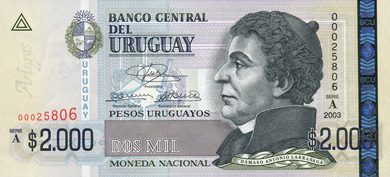
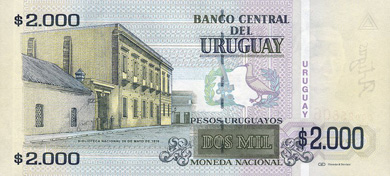
Banknotes
Budget & Public Finance
- Fiscal Year
- calendar year
- Annual Budget
- $4,845,000,000 (USD)
- Public Debt (% of GDP)
- 81.9%
- External Debt
- $11,220,000,000 (USD)
- Investment (% of GDP)
- 12.2%
- Current Account Balance
- -$19,000,000 (USD)
- Reserves of Foreign Exchange
- $2,147,483,647 (USD)
Labor, Industry & Trade
- Labor Force by Occupation
- agriculture 14%; industry 16%; services 70%
- Household Income — highest 10%
- 25.8%
- Industries
- food processing, electrical machinery, transportation equipment, petroleum products, textiles, chemicals, beverages
- Agriculture Products
- rice, wheat, corn, barley; livestock; fish
- Export Commodities
- meat, rice, leather products, wool, fish, dairy products
- Export Partners
- Brazil 22.1%, US 8.4%, Germany 5.4%, Argentina 5.1%, Mexico 4.2%, Italy 4.1%, Paraguay 4.1%, Spain 4%
- Import Commodities
- machinery, chemicals, road vehicles, crude petroleum
- Import Partners
- Argentina 23.1%, Brazil 17.5%, US 8.9%, Mexico 4.7%, China 4%
Energy
- Oil Production
- 435 bbl/day
- Oil Consumption
- 38,000 bbl/day
- Oil Reserves
- 0 bbl/day
- Natural Gas Production
- 0 cu m
- Natural Gas Consumption
- 60,000,000 cu m
- Natural Gas Imports
- 65,000,000 cu m
- Natural Gas Exports
- 0 cu m
- Natural Gas Reserves
- 0 cu m
Communications
- Telephone System
- general assessment: fully digitalized domestic: most modern facilities concentrated in Montevideo; nationwide microwave radio relay network; overall fixed-line and mobile-cellular teledensity has reached 170 telephones per 100 persons international: country code - 598; the UNISOR submarine cable system provides direct connectivity to Brazil and Argentina; satellite earth stations - 2 Intelsat (Atlantic Ocean)
- Internet Country Code
- .uy
News & Weather
News & Weather
Current Weather
Latest News
When is the next FIFA World Cup? 2030 hosts, dates and format - Al Jazeera
Al Jazeera · 1d ago
Uruguay Is Secretly Changing How The World Thinks About Travel And You Need To See The Incredible Adventure Tourism Revolution Sweeping South America - Travel And Tour World
Travel And Tour World · 20h ago
Tesla launches in Latvia and Uruguay, expanding on two continents - Electrek
Electrek · 3d ago
Uruguay World Cup 2026 team guide - The Guardian
The Guardian · 44d ago
Paleontologists Discover New Species of Titanosaur in Uruguay - Sci.News
Sci.News · 7d ago
World Cup 2026: Uruguay squad incluces Man Utd midfielder Manuel Ugarte but no Luis Suarez - BBC
BBC · 51d ago
Marcelo Bielsa omits Luis Suárez from Uruguay World Cup squad - ESPN
ESPN · 51d ago
Uruguay's Offshore Oil Province Could Be Bigger Than Vaca Muerta - Crude Oil Prices Today | OilPrice.com
Crude Oil Prices Today | OilPrice.com · 9d ago
News via Google News
Climate Overview
Except for a small subtropical area in the northwest, the climate is even throughout Uruguay. Temperatures are generally mild, but seasons are distinct: summer daytime temperatures average 70 degrees Fahrenheit and rarely exceed the mid-90s; autumn (March-May) is mild; and spring (September-November) is often damp, cool and windy. In winter, monthly temperatures range from 44� 60 degrees Fahrenheit with rare frost. However, humidity, averaging 75% year round, intensifies the cold. Average annual rainfall is 39.5 inches.
Videos
Videos
1 curated YouTube videos.
Source: YouTube
Frequently Asked Questions
Frequently Asked Questions
What is the population of Uruguay?
How do people greet each other in Uruguay?
What are meals and eating customs like in Uruguay?
What should I know about visiting and hospitality in Uruguay?
How should I dress in Uruguay?
What gestures and physical greetings are common in Uruguay?
What is family life like in Uruguay?
What do people do for recreation and sport in Uruguay?
What is the capital of Uruguay?
Where is Uruguay located?
What countries border Uruguay?
What religion is practiced in Uruguay?
What is the currency of Uruguay?
What language is spoken in Uruguay?
What is the geography of Uruguay like?
What is Uruguay known for?
Last reviewed 2026