English
 Español
 中文
中文 हिन्दी
 Français
Government and Politics
Government and Politics of Uruguay
Government structure, leadership, capital, military, and national symbols of Uruguay.
Government Structure
Constitutional foundations, branches, parties, and leadership.
- Government Type
- constitutional republic
- Administrative Divisions
- 19 departments (departamentos, singular - departamento); Artigas, Canelones, Cerro Largo, Colonia, Durazno, Flores, Florida, Lavalleja, Maldonado, Montevideo, Paysandu, Rio Negro, Rivera, Rocha, Salto, San Jose, Soriano, Tacuarembo, Treinta y Tres
- Legal System
- based on Spanish civil law system; accepts compulsory ICJ jurisdiction
- Suffrage
- 18 years of age; universal and compulsory
- Citizenship
- citizenship by birth: yes citizenship by descent: yes dual citizenship recognized: yes residency requirement for naturalization: 3-5 years
- Executive Branch
- chief of state: President Yamandú ORSI (since 1 March 2025) and Vice President Carolina COSSE (since 1 March 2025); note - the president is both the chief of state and head of government head of government: President Yamandú ORSI (since 1 March 2025) and Vice President Carolina COSSE (since 1 March 2025); note - the president is both the chief of state and head of government cabinet: Council of Ministers appointed by the president with parliamentary approval elections: president and vice president elected on the same ticket by popular vote for five-year terms; election last held 27 October 2024, with a runoff on 24 November 2024 (next to be held in October 2029) election results: Yamandú ORSI elected president in runoff; percent of vote in runoff - Yamandú ORSI (Frente Amplio) 49.8%, Álvaro DELGADO (Partido Nacional) 45.9%; other 4.3%
- Legislative Branch
- bicameral General Assembly or Asamblea General consists of Chamber of Senators or Camara de Senadores (30 seats; members are elected by popular vote to serve five-year terms; vice president has one vote in the Senate) and Chamber of Representatives or Camara de Representantes (99 seats; members are elected by popular vote to serve five-year terms) elections: Chamber of Senators - last held 31 October 2004 (next to be held October 2009); Chamber of Representatives - last held 31 October 2004 (next to be held October 2009) election results: Chamber of Senators - percent of vote by party - NA%; seats by party - EP-FA 16, Blanco 11, Colorado Party 3; Chamber of Representatives - percent of vote by party - NA%; seats by party - EP-FA 52, Blanco 36, Colorado Party 10, Independent Party 1
- Judicial Branch
- Supreme Court (judges are nominated by the president and elected for 10-year terms by the General Assembly)
- Political Parties
- Colorado Party [Julio Maria SANGUINETTI]; Independent Party (Partido Independiente) [Pablo MIERES]; Movement of Popular Participation or MPP [Jose MUJICA]; National Party or Blanco [Jorge LARRANAGA]; New Sector/Space Coalition (Nuevo Espacio) [Rafael MICHELINI]; Progressive Encounter/Broad Front Coalition (Encuentro Progresista/Frente Amplio) or EP-FA [Tabare VAZQUEZ]; Socialist Party of Uruguay or Socialists [Reinaldo GARGANO]; Uruguayan Assembly or Asamblea Uruguay [Danilo ASTORI]
- Head of State
- President Jose "Pepe" Mujica Cordano
- Head of Government
- President Jose "Pepe" Mujica Cordano
- Cabinet
- Council of Ministers appointed by the president with parliamentary approval
- Elections
- president and vice president elected on the same ticket by popular vote for five-year terms (may not serve consecutive terms); election last held on 29 November 2009 (next to be held in October 2014)
- Election Results
- Jose "Pepe" MUJICA elected president; percent of vote - Jose "Pepe" MUJICA 54.8%, Luis Alberto LACALLE 45.2%
- Constitution
- 27 November 1966, effective February 1967, suspended 27 June 1973, new constitution rejected by referendum 30 November 1980; two constitutional reforms approved by plebiscite 26 November 1989 and 7 January 1997
- Independence
- 25 August 1825 (from Brazil)
- National Holiday
- Independence Day, 25 August (1825)
- International Organization Participation
- FAO, G-77, IADB, IAEA, IBRD, ICAO, ICC, ICCt, ICRM, IFAD, IFC, IFRCS, IHO, ILO, IMF, IMO, Interpol, IOC, IOM, ISO, ITU, LAES, LAIA, Mercosur, MINURSO, MONUC, NAM (observer), OAS, OPANAL, OPCW, PCA, RG, UN, UNAMSIL, UNCTAD, UNESCO, UNIDO, UNMEE, UNMISET, UNMOGIP, UNMOT, UNOMIG, UPU, WCL, WCO, WFTU, WHO, WIPO, WMO, WToO, WTrO
- Diplomatic Representation in the U.S.
- chief of mission: Ambassador Carlos Alberto GIANELLI Derois chancery: 1913 I Street NW, Washington, DC 20006 telephone: [1] (202) 331-1313 through 1316 FAX: [1] (202) 331-8142 consulate(s) general: Chicago, Los Angeles, Miami, New York consulate(s): San Juan (Puerto Rico)
- U.S. Diplomatic Representation
- chief of mission: Charge d'Affaires James D. NEALON embassy: Lauro Muller 1776, Montevideo 11200 mailing address: APO AA 34035 telephone: [598] (2) 418-7777 FAX: [598] (2) 418-8611
Capital City
Seat of government and political history.
- Capital City
- Montevideo
- Location
- 34 51 S, 56 10 W
- Time Difference
- UTC-3 (2 hours ahead of Washington, DC, during Standard Time)
- History
- the name "Montevidi" was originally applied to the hill that overlooked the bay upon which the city of Montevideo was founded; the earliest meaning may have been "[the place where we] saw the hill"
Embassy and Diplomatic Representation
Embassy location and contact details.
U.S. Embassy Montevideo Lauro Muller 1776, Montevideo 11200 - Uruguay Telephone: (598) (2) 1770-2222 Emergency after-hours telephone: (598) (2) 094-870-666
Military
Branches, service obligations, expenditures, and manpower.
- Military Branches
- Uruguayan Armed Forces: Uruguayan National Army (Ejercito Nacional Uruguaya, ENU), Uruguayan National Navy (Armada Nacional del Uruguay; includes naval air arm, Naval Rifle Corps (Cuerpo de Fusileros Navales, Fusna), Maritime Prefecture in wartime), Uruguayan Air Force (Fuerza Aerea Uruguaya, FAU)
- Service Age and Obligation
- 18-30 years of age (18-22 years of age for navy) for male or female voluntary military service; up to 40 years of age for specialists; enlistment is voluntary in peacetime, but the government has the authority to conscript in emergencies; minimum 6-year education
National Symbols
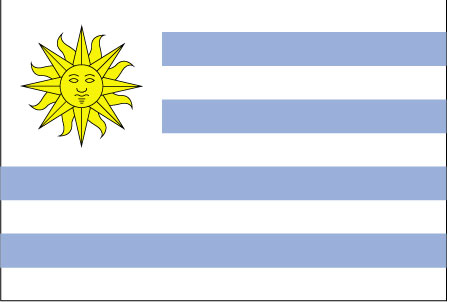
Flag, anthem, and other symbols of national identity.