
 English
 Español
 中文
中文 हिन्दी
 Français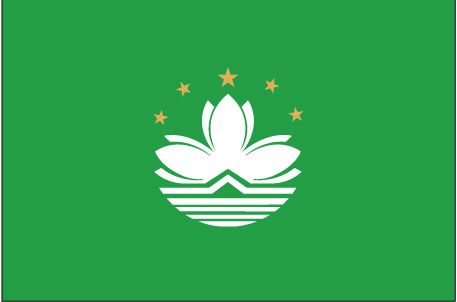
Macau
Aomen (Chinese); Macau (Portuguese)
Declare Your Relationship to Macau
CountryReports Community
- Studying0
- From Macau0
- Macau heritage0
- Visited0
- Want to visit0
Customs and Culture
Customs and Culture
Cultural Attributes
Macau's culture is one of the most distinctive in Asia, shaped by over 400 years of Portuguese colonial presence layered atop a deeply rooted Chinese identity. This blend has produced a society that is simultaneously Chinese and Lusophone, reflected in its architecture, cuisine, religion, language, and everyday customs. The official languages are Cantonese and Portuguese, though in practice the vast majority of residents speak Cantonese as their primary tongue. Mandarin has grown in everyday use due to close ties with mainland China, while English is commonly spoken in business and tourism. The co-existence of these languages is visible throughout the city on bilingual street signs and government documents. Religion in Macau is pluralistic. Buddhism and Taoism are practiced by the majority of the Chinese population, while Roman Catholicism carries a significant historical presence owing to Portuguese missionary activity. Temples and churches often stand within short walking distances of each other, and festivals from both traditions are publicly celebrated. The Feast of the Drunken Dragon, the Feast of Nezha, and the Procession of Our Lady of Fátima are among the notable annual events that illustrate this cultural coexistence. Macanese cuisine — known locally as Macanese food — is itself a cultural artifact, blending Portuguese, African, Indian, Malay, and Cantonese culinary influences. Dishes such as African chicken, minchi, and Portuguese egg tarts have evolved into defining elements of local identity. The historic centre of Macau was inscribed as a UNESCO World Heritage Site in 2005, recognizing 30 monuments and public spaces that demonstrate the convergence of Eastern and Western cultures. Structures such as the Ruins of St. Paul's, the A-Ma Temple, and Senado Square reflect this architectural hybridity. Family values rooted in Confucian tradition remain strong, emphasizing respect for elders and communal ties. At the same time, Macau's status as a major gaming and entertainment hub has introduced a cosmopolitan dimension that coexists alongside these traditional values, making its cultural identity both ancient and strikingly modern.

Gateway Between East and West

Holidays
National Day
10/1Independence
Anniversary of the Founding of the People's Republic of China), 1 October (1949); 20 December 1999 is celebrated as Macau Special Administrative Region Establishment Day
Dates of Interest
- October 1st
Anniversary of the Founding of the People's Republic of China), 1 October (1949); 20 December 1999 is celebrated as Macau Special Administrative Region Establishment Day
What should I know about food in Macau?
Macanese cuisine is a cultural blend of Portuguese, African, Indian, Malay, and Cantonese influences, and eating local dishes is a great way to experience the culture.
Good to know
- Try African chicken, minchi, and Portuguese egg tarts, which are defining local dishes
- Macanese food reflects the city's mixed Portuguese and Chinese heritage
What are family values like in Macau?
Family values rooted in Confucian tradition remain strong, emphasizing respect for elders and communal ties.
Do
- Show respect for elders
What should I know before visiting Macau?
Macau blends over 400 years of Portuguese colonial presence with a deeply rooted Chinese identity, creating a culture that is both ancient and strikingly modern.
Good to know
- Cantonese is the primary language, but Portuguese is also official, Mandarin is growing, and English is common in business and tourism
- Bilingual street signs and government documents are found throughout the city
- Buddhism, Taoism, and Roman Catholicism all have a presence, with temples and churches often near each other
- Notable annual events include the Feast of the Drunken Dragon, the Feast of Nezha, and the Procession of Our Lady of Fátima
- Visit the UNESCO-listed historic centre, including the Ruins of St. Paul's, the A-Ma Temple, and Senado Square
Last updated: 2026-07-12 · Sources: CountryReports
Photos of Macau
Photos of Macau


Travel and Tourism
Travel and Tourism
- Travel Alert Status
- Level 3: Reconsider Travel
- Currency
- pataca (MOP)
- Climate
- subtropical; marine with cool winters, warm summers
- Airports
- 1
Read the full travel guide — health, safety, vaccinations, disease risk, sanitation, and transit details.
View full travel guideHistory
History
Historical Eras
Early Chinese Settlement
1152 – 1557
Macau was administered under Xiangshan County from 1152, though sparsely inhabited for generations. Refugees of the Southern Song Dynasty arrived in 1277, fleeing Mongol conquest, becoming the first recorded permanent inhabitants. Hoklo Boat people later recognized the area's commercial potential as a trading hub for China's southern provinces, laying the groundwork for Macau's future as a mercantile center.
Portuguese Settlement
1557 – 1849
Chinese authorities consented to a permanent Portuguese presence in 1557, though sovereignty remained contested. Portuguese merchants leveraged Macau as the primary entrepôt for China-Japan trade and as a vital waypoint on the Lisbon-to-Nagasaki route. A Portuguese municipal government functioned alongside continued Chinese tax collection, reflecting the territory's ambiguous dual-authority character throughout this period.
Colonial Assertion
1849 – 1887
Governor Ferreira do Amaral abolished Chinese customs collection in 1849, unilaterally declaring Macau's independence, provoking Chinese retaliation and his own assassination. Tensions culminated in the Protocol of Lisbon in 1887, by which the Manchu government formally recognized Portuguese perpetual occupation in exchange for a guarantee that Macau would never be ceded to a third party without China's consent.
Late Colonial Period
1887 – 1966
Under entrenched Portuguese colonial rule, Macau developed a distinct Luso-Chinese culture while remaining economically overshadowed by Hong Kong. The territory enjoyed an anomalous wartime prosperity during World War II as the sole neutral port in South China, though Japan established a virtual protectorate in 1943. The Communist victory in China in 1949 introduced new ideological pressures, with Beijing branding the 1887 Protocol an invalid unequal treaty.
Decolonization & Transition
1966 – 1999
Pro-communist riots in 1966 forced Lisbon into concessions and twice prompted Portugal to offer Macau's return to China, both times rebuffed by Beijing. Following Portugal's 1974 revolution and normalization of Sino-Portuguese relations in 1979, substantive handover negotiations began in 1985, yielding the 1987 Joint Declaration. Macau was formally transferred to the People's Republic as a Special Administrative Region on 20 December 1999.
SAR & Modern Macau
1999 – present
Operating under the "one country, two systems" framework guaranteed until 2049, Macau retains its own legal system, currency, and extensive autonomy in all matters except foreign affairs and defense. The liberalization of the gaming industry in the early 2000s, ending Stanley Ho's long-held monopoly, transformed Macau into the world's highest-grossing gambling hub and one of the wealthiest territories per capita globally.
Overview
The Hoklo Boat people were the first to show commercial interest in Macau as a trading center for the southern provinces. Macau did not develop as a major settlement until the Portuguese arrived in the 16th century. Portuguese traders used Macau as a staging port as early as 1516, making it the oldest European settlement in the Far East. In 1557, the Chinese agreed to a Portuguese settlement in Macau but did not recognize Portuguese sovereignty. Although a Portuguese municipal government was established, the sovereignty question remained unresolved.
Initially, the Portuguese developed Macau’s port as a trading post for China-Japan trade and as a staging port on the long voyage from Lisbon to Nagasaki. When Chinese officials banned direct trade with Japan in 1547, Macau’s Portuguese traders carried goods between the two countries. The first Portuguese governor was appointed to Macau in 1680, but the Chinese continued to assert their authority, collecting land and customs taxes. Portugal continued to pay rent to China until 1849, when the Portuguese abolished the Chinese customs house and declared Macau’s "independence," a year which also saw Chinese retaliation and finally the assassination of Gov. Ferreira do Amaral.
On March 26, 1887, the Manchu government acknowledged the Portuguese right of "perpetual occupation." The Manchu-Portuguese agreement, known as the Protocol of Lisbon, was signed with the condition that Portugal would never surrender Macau to a third party without China’s permission.
Macau enjoyed a brief period of economic prosperity during World War II as the only neutral port in South China, after the Japanese occupied Guangzhou (Canton) and Hong Kong. In 1943, Japan created a virtual protectorate over Macau. Japanese domination ended in August 1945.
When the Chinese communists came to power in 1949, they declared the Protocol of Lisbon to be invalid as an "unequal treaty" imposed by foreigners on China. However, Beijing was not ready to settle the treaty question, requesting maintenance of "the status quo" until a more appropriate time. Beijing took a similar position on treaties relating to the Hong Kong territories.
Riots broke out in 1966 when pro-communist Chinese elements and the Macau police clashed. The Portuguese Government reached an agreement with China to end the flow of refugees from China and to prohibit all communist demonstrations. This move ended the conflict, and relations between the government and the leftist organizations have remained peaceful.
The Portuguese tried once in 1966 after the riots in Macau, and again in 1974, the year of a military revolution in Portugal, to return Macau to Chinese sovereignty. China refused to reclaim Macau however, hoping to settle the question of Hong Kong first.
Portugal and China established diplomatic relations in 1979. A year later, Gen. Melo Egidio became the first Governor of Macau to visit China. The visit underscored both parties’ interest in finding a mutually agreeable solution to Macau’s status. In 1979, Portugal and China agreed to regard Macau as "a Chinese territory under temporary Portuguese administration." Handover negotiations began in 1985, a year after the signing of the Sino-U.K. agreement returning Hong Kong to China in 1997. The result was a 1987 agreement returning Macau to Chinese sovereignty as a Special Administrative Region (SAR) of China on December 20, 1999.
Timeline of Key Events
1557
The Portuguese settled in Macao.
The Portuguese settled in Macao, on the coast of southern China, and established trading factories.
1966
Lisbon offered to give the Macao colony back to China.
Lisbon offered to give the Macao colony back to China.
1974
Lisbon removed its troops and again offered to give the colony back to China.
Lisbon removed its troops and again offered to give the colony back to China.
1987
Portugal signed an agreement to return Macau to China in 1999.
Portugal signed an agreement to return Macau to China in 1999.
2001
In Macao the gambling franchise of tycoon Stanley Ho was scheduled to expire.
In Macao the gambling franchise of tycoon Stanley Ho was scheduled to expire. Half of the government revenue was derived from gambling. American firms soon stepped in to build new facilities.
Read the full history profile — narrative overview, defining eras, and the complete timeline in one place.
View expanded historyInteresting Facts
Interesting Facts
The most famous sight in Macau is probably the ruins of the Church of St Paul's, originally built in 1602 and rebuilt in 1835 after a disastrous typhoon.
It is believed that the name ‘Macau’ was derived from the A-Ma Temple, a place of worship that was build in 1448, with Matsu (the goddess of seafarers and fishermen) as its deity.
Macau is a highly humid region, with the humidity ranging anywhere between 75% and 90%.
The economy of Macau largely depends upon the revenue generated by tourism. Gambling is also a money-generating affair in the region.
See every fact — trivia, oddities, and curious tidbits gathered from across the country.
View all interesting factsGeography and Environment
Geography and Environment
- Terrain
- generally flat
- Climate
- subtropical; marine with cool winters, warm summers
- Natural Hazards
- typhoons
- Current Environmental Issues
- NA
Read the full geography and environment profile — terrain, climate, natural resources, hazards, land use, and international agreements.
View full geographyPeople & Demographics
People & Demographics
Religion
Languages Spoken
Portuguese, Chinese (Cantonese)
- Cantonese
- Portuguese
Population
- Population
- 567,957
- Nationality Noun
- Chinese
- Ethnic Groups
- Chinese 95%, Macanese (mixed Portuguese and Asian ancestry), Portuguese, other
Education
- Literacy Definition
- age 15 and over can read and write
Read the full people and society profile — demographics, health, education, religion, languages, and notable people.
View full people and societyGovernment & Politics
Government & Politics
Country Identity
- Country Name
- Macau
- Full Country Name
- Macau Special Administrative Region
- Local - Long
- Aomen Tebie Xingzhengqu (Chinese); Regiao Administrativa Especial de Macau (Portuguese)
- Local - Short
- Aomen (Chinese); Macau (Portuguese)
Government Structure
- Government Type
- limited democracy
- Legal System
- based on Portuguese civil law system
- Executive Branch
- chief of state: President of China XI Jinping (since 14 March 2013) head of government: Chief Executive HO Iat-seng (since 20 December 2019) cabinet: Executive Council consists of government secretaries, legislators, and representatives from business, labor, and community sectors appointed by the Chief Executive elections: chief executive chosen by a 400-member Election Committee for up to two five-year terms; election last held 24 October 2019 (next to be held in 2024) election results: HO Iat-seng elected; received 392 votes out of 400 committee members, running unopposed
- Legislative Branch
- unicameral Legislative Assembly (29 seats; 12 elected by popular vote, 10 by indirect vote, and 7 appointed by the chief executive; members serve four-year terms) elections: last held 25 September 2005 (next in September 2009) election results: percent of vote - Development Union 12.8%, Macau Development Alliance 9%, Macau United Citizens' Association 16%, New Democratic Macau Association 18.2%, others NA; seats by political group - Development Union 2, Macau Development Alliance 1, Macau United Citizens' Association 2, New Democratic Macau Association 2, New Hope 1, United Forces 2, others 2; 10 seats filled by professional and business groups; seven members appointed by chief executive
- Judicial Branch
- Court of Final Appeal in Macau Special Administrative Region
- Suffrage
- direct election 18 years of age, universal for permanent residents living in Macau for the past seven years; indirect election limited to organizations registered as ""corporate voters"" (257 are currently registered) and a 300-member Election Committee d
- Constitution
- Basic Law, approved in March 1993 by China's National People's Congress, is Macau's ""mini-constitution""
- Independence
- none (special administrative region of China)
- National Holiday
- National Day (Anniversary of the Founding of the People's Republic of China), 1 October (1949); note - 20 December 1999 is celebrated as Macau Special Administrative Region Establishment Day
Capital City
- Capital Name
- Macau
Military
Branches: no regular indigenous military forces
Embassy / Diplomatic Mission
U.S. Consulate General Hong Kong & Macau
26 Garden Road, Central, Hong Kong
Telephone: 852-2841-2211, 852-2841-2225, 852-2841-2323 (Direct lines to American Citizen Services during regular business hours)
Emergency after-hours telephone: 852-2841-9011
Facsimile: 852-2845-4845
Read the full government profile — flag symbolism, national anthem, and other national symbols.
View full government detailsEconomy
Economy
Macau boasts one of the wealthiest and most open economies in the world, with one of the highest GDP per capita figures globally. Since its reversion to China in 1999, the territory has transformed into a service-based economy dominated overwhelmingly by gaming and tourism, which together account for the majority of government revenue and economic output. The liberalization of the gaming industry in 2002 ended a decades-long monopoly and attracted major foreign operators, propelling Macau past Las Vegas to become the world's largest gambling hub by revenue.
The economy is highly dependent on visitors from mainland China and Hong Kong, who make up the vast majority of arrivals. This concentration leaves Macau vulnerable to shifts in Chinese travel policy, anti-corruption campaigns, and broader economic conditions on the mainland. A crackdown on illicit capital flows beginning in 2014 caused a sharp contraction in gaming revenues, and the COVID-19 pandemic delivered an even more severe blow, with GDP plunging by more than 50% in 2020 as border closures crippled tourism.
Following the lifting of pandemic-era travel restrictions in early 2023, Macau's economy rebounded strongly, with GDP growing by roughly 80% that year, though output remains below pre-pandemic peaks. The government has continued to pursue economic diversification under its long-term development plans, promoting sectors such as financial services, traditional Chinese medicine, conventions and exhibitions, and cultural tourism. The Guangdong-Macao Intensive Cooperation Zone in Hengqin, launched in 2021, is central to this diversification strategy, offering Macau businesses expanded space and incentives to develop non-gaming industries. Despite these efforts, gaming continues to dominate, and reducing structural dependence on the casino sector remains the territory's principal long-term economic challenge.
Snapshot
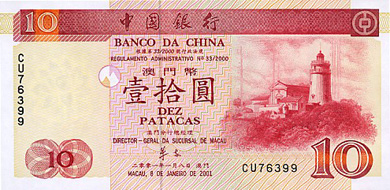
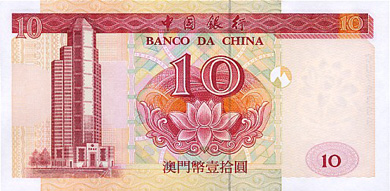
- Currency Name and Code
- Macanese Pataca (MOP)
- GDP — official exchange rate
- $10,050,000,000 (USD)
- GDP Real Growth Rate
- 2.8%
Banknotes
Budget & Public Finance
- Fiscal Year
- calendar year
- Annual Budget
- $3,160,000,000 (USD)
- External Debt
- $3,100,000,000 (USD)
Labor, Industry & Trade
- Labor Force by Occupation
- restaurants and hotels 12%; manufacturing 20%; wholesale and retail trade 15%; public sector 8%; construction 7%; transport and communications 6%; gambling 7%; other services and agriculture 25%
- Industries
- tourism, gambling, clothing, textiles, electronics, footwear, toys
- Agriculture Products
- vegetables, livestock
- Export Commodities
- clothing, textiles, footwear, cement, machines, and parts
- Export Partners
- US 48.5%, China 15.5%, Germany 7.4%, Hong Kong 5.8%, UK 5.4%
- Import Commodities
- clothing, textiles, yarn, foodstuffs, fuel, automobiles, capital goods
- Import Partners
- China 41.7%, Hong Kong 14.5%, Japan 6.8%, Taiwan 6.6%, South Korea 5%, France 4.3%, US 4.2%
Energy
- Oil Production
- 0 bbl/day
- Oil Consumption
- 12,000 bbl/day
- Oil Reserves
- 0 bbl/day
- Natural Gas Production
- 0 cu m
- Natural Gas Consumption
- 0 cu m
- Natural Gas Imports
- 0 cu m
- Natural Gas Exports
- 0 cu m
- Natural Gas Reserves
- 0 cu m
Communications
- Telephone System
- general assessment: fairly modern communication facilities maintained for domestic and international services domestic: termination of monopoly over mobile-cellular telephone services in 2001 spurred sharp increase in subscriptions with mobile-cellular teledensity exceeding 200 per 100 persons; fixed-line subscribership appears to have peaked and is now in decline international: country code - 853; landing point for the SEA-ME-WE-3 submarine cable network that provides links to Asia, the Middle East, and Europe; HF radiotelephone communication facility; satellite earth station - 1 Intelsat (Indian Ocean)
- Internet Country Code
- .mo
News & Weather
News & Weather
Current Weather
Latest News
Volleyball: Women's Volleyball Nations League (VNL) Finals 2026 in Macau: Teams in action, full schedule and how to watch live - olympics.com
olympics.com · 19h ago
Blue and White Porcelain — Macao 2026 Specialized World Stamp Exhibition - Welcome to the United Nations
Welcome to the United Nations · 3d ago
Citi: Macau’s daily GGR up 9% week-on-week as World Cup distractions fade - CDC Gaming
CDC Gaming · 18h ago
New Macau–Cheongju flight route to launch in December - Macau Business
Macau Business · 2h ago
Destination Macau: FIA FR World Cup and FIA F4 World Cup teams confirmed - Federation Internationale de l'Automobile
Federation Internationale de l'Automobile · 6d ago
UNU Macau, China Agricultural University and Tencent SSV Announce UNU RISE-hub at HLPF 2026 Side Event - UNU | United Nations University
UNU | United Nations University · 5d ago
Wynn Macau Takes Measures to Protect Guests From Dengue Fever-Carrying Mosquitoes - Casino.org
Casino.org · 14h ago
Watch Benfica de Macau vs. Hang Sai Live Stream Online | DAZN US - DAZN
DAZN · 19h ago
News via Google News
Climate Overview
subtropical; marine with cool winters, warm summers
Videos
Videos
1 curated YouTube videos.
Source: YouTube
Frequently Asked Questions
Frequently Asked Questions
What is the population of Macau?
What should I know about food in Macau?
What are family values like in Macau?
What should I know before visiting Macau?
What is the capital of Macau?
Where is Macau located?
What countries border Macau?
What religion is practiced in Macau?
What currency is used in Macau?
What languages are spoken in Macau?
What is Macau known for?
Last reviewed 2026