English
 Español
 中文
中文 हिन्दी
 Français
Government and Politics
Government and Politics of Macau
Government structure, leadership, capital, military, and national symbols of Macau.
Government Structure
Constitutional foundations, branches, parties, and leadership.
- Government Type
- limited democracy
- Administrative Divisions
- none (special administrative region of China)
- Legal System
- based on Portuguese civil law system
- Suffrage
- direct election 18 years of age, universal for permanent residents living in Macau for the past seven years; indirect election limited to organizations registered as ""corporate voters"" (257 are currently registered) and a 300-member Election Committee d
- Citizenship
- see China
- Executive Branch
- chief of state: President of China XI Jinping (since 14 March 2013) head of government: Chief Executive HO Iat-seng (since 20 December 2019) cabinet: Executive Council consists of government secretaries, legislators, and representatives from business, labor, and community sectors appointed by the Chief Executive elections: chief executive chosen by a 400-member Election Committee for up to two five-year terms; election last held 24 October 2019 (next to be held in 2024) election results: HO Iat-seng elected; received 392 votes out of 400 committee members, running unopposed
- Legislative Branch
- unicameral Legislative Assembly (29 seats; 12 elected by popular vote, 10 by indirect vote, and 7 appointed by the chief executive; members serve four-year terms) elections: last held 25 September 2005 (next in September 2009) election results: percent of vote - Development Union 12.8%, Macau Development Alliance 9%, Macau United Citizens' Association 16%, New Democratic Macau Association 18.2%, others NA; seats by political group - Development Union 2, Macau Development Alliance 1, Macau United Citizens' Association 2, New Democratic Macau Association 2, New Hope 1, United Forces 2, others 2; 10 seats filled by professional and business groups; seven members appointed by chief executive
- Judicial Branch
- Court of Final Appeal in Macau Special Administrative Region
- Political Parties
- Civil Service Union [Jose Maria Pereira COUTINHO]; Development Union [KWAN Tsui-hang]; Macau Development Alliance [Angela LEONG On-kei]; Macau United Citizens' Association [CHAN Meng-kam]; New Democratic Macau Association [Antonio NG Kuok-cheong]; United Forces [leader NA]
- Head of State
- President of China HU Jintao
- Head of Government
- Chief Executive Fernando Chui Sai-on
- Cabinet
- Executive Council consists of one government secretary, three legislators, four businessmen, one pro-Beijing unionist, and one pro-Beijing educator
- Elections
- chief executive chosen by a 300-member Election Committee for a five-year term (eligible for a second term); election last held on 26 July 2009 (next to be held in July 2014)
- Election Results
- Fernando CHUI Sai-on elected in 2009 with 282 votes, took office on 20 December 2009
- Constitution
- Basic Law, approved in March 1993 by China's National People's Congress, is Macau's ""mini-constitution""
- Independence
- none (special administrative region of China)
- National Holiday
- National Day (Anniversary of the Founding of the People's Republic of China), 1 October (1949); note - 20 December 1999 is celebrated as Macau Special Administrative Region Establishment Day
- International Organization Participation
- IMO (associate), Interpol (sub-bureau), ISO (correspondent), UNESCO (associate), WCO, WMO, WToO (associate), WTrO
- Diplomatic Representation in the U.S.
- none (special administrative region of China)
- U.S. Diplomatic Representation
- the US has no offices in Macau; US interests are monitored by the US Consulate General in Hong Kong
Capital City
Seat of government and political history.
- Capital City
- Macau
Embassy and Diplomatic Representation
Embassy location and contact details.
U.S. Consulate General Hong Kong & Macau 26 Garden Road, Central, Hong Kong Telephone: 852-2841-2211, 852-2841-2225, 852-2841-2323 (Direct lines to American Citizen Services during regular business hours) Emergency after-hours telephone: 852-2841-9011 Facsimile: 852-2845-4845
Military
Branches, service obligations, expenditures, and manpower.
- Military Branches
- no regular indigenous military forces
National Symbols
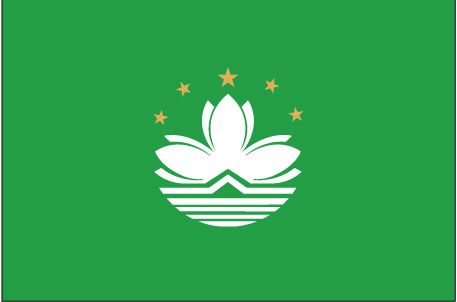
Flag, anthem, and other symbols of national identity.