
 English
 Español
 中文
中文 हिन्दी
 Français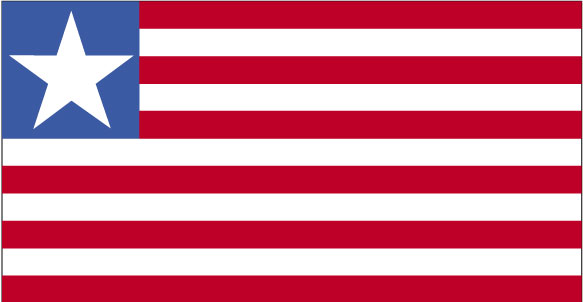
Liberia
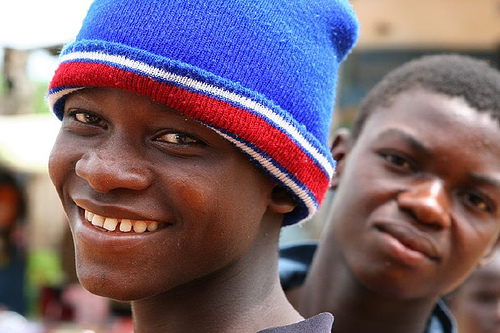
Declare Your Relationship to Liberia
CountryReports Community
- Studying1
- From Liberia0
- Liberia heritage0
- Visited1
- Want to visit0
Customs and Culture
Customs and Culture
Cultural Attributes
Liberia's cultural identity is deeply shaped by the interplay between its indigenous African heritage and the legacy of freed American and Caribbean slaves who founded the modern nation in the early 19th century. This dual heritage creates a society that is at once distinctly West African and marked by historical ties to the American South, visible in everything from architecture to social customs. The country is home to more than 16 recognized ethnic groups, including the Kpelle, Bassa, Grebo, Gio, Mano, and Lorma peoples. Each group maintains its own distinct traditions, languages, and social structures. Indigenous Liberian culture places strong emphasis on community life, oral history, and the role of secret societies. Among the most prominent are the Poro society for men and the Sande society for women, which serve as institutions of education, cultural transmission, and governance in many rural communities. Music and dance are central expressions of Liberian identity. Traditional performances often accompany ceremonies marking births, deaths, harvests, and initiations. Contemporary Liberian music blends these indigenous roots with influences from reggae, hip-hop, and highlife, and the country has produced a number of musicians with regional recognition. The cuisine reflects both indigenous and external influences. Staple foods include rice, cassava, plantains, and a variety of leafy greens. Dishes such as palava sauce, made with meat and bitter leaves, and pepper soup are widely consumed throughout the country. Rice is considered the cultural cornerstone of most meals. Christianity is the predominant religion, practiced by roughly 85 percent of the population, while Islam accounts for around 12 percent. Traditional indigenous spiritual beliefs also persist and are often practiced alongside or in combination with these major faiths. Despite the profound social disruption caused by the civil wars of 1989–2003, Liberian communities have demonstrated resilience in preserving and revitalizing cultural practices. Storytelling, craftsmanship including wood carving and weaving, and communal celebrations continue to anchor cultural life across both urban centers like Monrovia and rural communities throughout the country's interior.

Freedom's First Home in Africa
Greetings, Gestures & Visiting
A greeting between friends can take a few minutes as formal greeting questions go back and forth until they usually end with "Thanks be to Allah" It is considered bad manners not to engage in a lengthy greeting.
If a guest drops by at mealtime they will be invited to eat. Those who have been blessed with wealth are expected to share with others.
Those who live in the city have adopted to Western style clothing however villagers continue in the traditions of their fathers. One of the obligations of a husband is to give each wife the cloth for at least two new outfits every year. Women wear loose scoop-neck smock over a long skirt. They often wear matching pieces of cloth on their heads as an informal turban. Most cloth has bright colored prints.
For formal occasions they may wear a boubou. For women this is a loose dress that extends to the ground and is trimmed in lace or embroidery. For men it is a long robe-like garment covering long pants and a shirt.
Diet
Rice is a staple eaten almost every day. Cassava leaves are boiled and eaten. Sometimes with Sugar Cane you cut the bark and suck the sweet juice as a treat. Fufu a pasty starch can be made from rice, plantain, cassava, corn or yams. Cassava is usually preferred. The plant is dried, pounded until ground, boiled and rolled into balls. A variation of fufu is called dumboy where it is boiled before mashing. Fufu is swallowed instead of chewed and is usually eaten with spicy soup. Hot peppers are added to many dishes. Favorite dishes include palava sauce made from okra leaves, dried fish or meat and palm oil. Another favorite is jollof rice (made with chicken or beef), with vegetables.
At mealtime the table is set with plates and glasses turned over and the napkin on top so that guests may turn over the clean dishes. Those at the meal greet each other by shaking hands. While shaking they take the middle finger of the person's right hand and snap it down. This handshake celebrates freedom from slavery.

Family
Large families are important. Because the Islam religion allows up to four wives, wealthy men usually have more than one wife. The expensive bride price and the requirement that all wives are provided for equally keeps the poor from having more than one wife. Women are always busy but it is common to see men sitting around talking with other men and having tea.
Recreation
Soccer is played many times with a homemade ball. Other pastimes include storytelling and music provided by the griots. Woaley is a board game that is similar to backgammon and is a major pastime.
Holidays
Independence Day
7/26Independence Day
Dates of Interest
- July 26th
How do people greet each other in Liberia?
Greetings are lengthy and important; friends may exchange formal greeting questions back and forth for several minutes, often ending with "Thanks be to Allah."
Do
- Take time for a proper, extended greeting
- Engage fully in the back-and-forth of greeting questions
Don’t
- Don't skip or rush a greeting, as it is considered bad manners
Good to know
- A special handshake at meals involves shaking hands and snapping down the middle finger of the person's right hand, celebrating freedom from slavery
What are the dining customs in Liberia?
Rice is the cultural cornerstone eaten almost daily, often served with spicy soups and dishes like palava sauce, fufu, and jollof rice. Guests who arrive at mealtime are invited to eat.
Do
- Expect to eat with your hands with dishes like fufu, which is swallowed rather than chewed
- Turn over the clean plates, glasses, and napkin that are set out for you
- Shake hands with others at the meal
Good to know
- Common dishes include palava sauce (okra leaves, dried fish or meat, palm oil), pepper soup, and jollof rice with chicken or beef
- Hot peppers are added to many dishes
- Fufu can be made from rice, plantain, cassava, corn, or yams; a boiled variation is called dumboy
What should I know about hospitality and social etiquette?
Liberian culture emphasizes community and sharing; those who are wealthy are expected to share with others, and guests arriving at mealtime will be invited to eat.
Do
- Accept invitations to share a meal graciously
How should I dress in Liberia?
City dwellers have largely adopted Western-style clothing, while villagers maintain traditional dress in bright-colored prints.
Good to know
- Women often wear a loose scoop-neck smock over a long skirt, with matching cloth as an informal turban
- For formal occasions, women may wear a boubou (a long lace- or embroidery-trimmed dress) and men a long robe-like garment over pants and a shirt
What is family life like in Liberia?
Large families are highly valued, and wealthy men may have more than one wife, as Islam permits up to four, though the bride price and the requirement to provide equally for all wives limits this among the poor.
Good to know
- Women are typically very busy, while men are often seen sitting, talking, and having tea together
What do people do for fun in Liberia?
Soccer is popular, often played with a homemade ball, alongside storytelling, music by griots, and the board game Woaley.
Good to know
- Woaley is a board game similar to backgammon and a major pastime
- Music and dance are central to ceremonies and cultural life
Last updated: 2026-07-12 · Sources: CountryReports
Photos of Liberia
Photos of Liberia


Travel and Tourism
Travel and Tourism
- Travel Alert Status
- Level 2: Exercise Increased Caution
- Currency
- Liberian dollar (LRD)
- Time Difference
- UTC 0 (5 hours ahead of Washington, DC, during Standard Time)
- Climate
- Liberia is so situated in the Tropics as to be directly in the path of the seasonal winds. From May through November, the prevailing monsoon winds drop most of the nearly 200 inches of rain received annually in the capital city of Monrovia. From December through April, the red, dust-laden harmattan winds originating over the Sahara Desert prevail. The transition periods between the seasons are punctuated by violent thunderstorms and sudden torrential downpours. Temperatures average 81°F; humidity averages 82%. There is little variation over the course of the year. Precautions must be taken against mildew and rust caused by the heat, constant humidity, and the corrosive salt air of the coast.
- Airports
- 53
Read the full travel guide — health, safety, vaccinations, disease risk, sanitation, and transit details.
View full travel guideRecipes
Recipes
History
History
Historical Eras
Grain Coast
1461 – 1820
Portuguese explorers made first contact with the region in 1461, naming it the Grain Coast for its abundance of Malagueta pepper. British, Dutch, French, and Swedish traders subsequently established intermittent contact, and the coast became entangled in the transatlantic slave trade from the 1500s onward. No permanent European colonial settlement took root, leaving the region governed by indigenous peoples including the Kpelle, Bassa, Grebo, and Kru.
ACS Colony
1820 – 1847
The American Colonization Society, founded in 1816 by a coalition of Quakers and slaveholders, began resettling freed African Americans on the West African coast in 1820, establishing the settlement of Christopolis—later renamed Monrovia in honor of President James Monroe. The colonists, known as Americo-Liberians, faced violent resistance from indigenous groups, most notably at the Battle of Crown Hill in 1822. The ACS governed the growing Commonwealth of Liberia until mounting pressure for self-rule led to a declaration of independence.
Americo-Liberian Republic
1847 – 1980
On July 26, 1847, Liberia declared independence as Africa's first republic, with Joseph Jenkins Roberts as its first president and a constitution modeled closely on that of the United States. For 133 years the Americo-Liberian elite, operating through the True Whig Party, maintained a near-total monopoly on political and economic power, marginalizing the indigenous majority. The era included Liberia's declaration of war on Germany in 1917, the 1926 Firestone rubber concession that deeply tied the economy to foreign capital, and the abolition of forced-labor practices in 1936.
Doe Military Era
1980 – 1989
On April 12, 1980, Master Sergeant Samuel K. Doe of the Krahn ethnic group seized power in a bloody coup, executing President William R. Tolbert and ending 133 years of Americo-Liberian dominance. Doe's People's Redemption Council banned political parties until 1984 and won deeply fraudulent elections in 1985, while his government grew increasingly authoritarian and ethnically exclusionary. A failed invasion by former general Thomas Quiwonkpa in November 1985 was brutally suppressed, deepening ethnic tensions that would soon ignite full-scale civil war.
Civil War Period
1989 – 2003
On December 24, 1989, Charles Taylor's National Patriotic Front of Liberia launched an insurgency from Côte d'Ivoire that quickly fractured into multiple warring factions; Doe was captured and killed in 1990. A brief interlude of relative stability followed Taylor's election victory in 1997, but rebel movements seeking his ouster reignited conflict, and UN sanctions imposed for his role in Sierra Leone's civil war compelled his resignation and exile in August 2003. The successive wars killed an estimated 250,000 people and displaced hundreds of thousands more, devastating Liberia's infrastructure and economy.
Reconstruction & Modern Liberia
2003 – present
A transitional government under Chairman Gyude Bryant assumed authority in October 2003, overseeing disarmament and preparing the country for democratic elections. Ellen Johnson Sirleaf, elected president in 2005, became Africa's first elected female head of state and guided Liberia through postwar recovery and debt relief, earning the Nobel Peace Prize in 2011. The country has faced continued challenges including the devastating 2014–2016 Ebola epidemic, but democratic transfers of power have marked a significant departure from Liberia's turbulent twentieth-century history.
Overview
Liberia, which means "land of the free," was founded by freed slaves from the United States in 1820. These freed slaves, called Americo-Liberians, first arrived in Liberia and established a settlement in Christopolis now Monrovia (named after U.S. President James Monroe) on February 6, 1820. This group of 86 immigrants formed the nucleus of the settler population of what became known as the Republic of Liberia.
Thousands of freed slaves from America soon arrived during the following years, leading to the formation of more settlements and culminating in a declaration of independence on July 26, 1847 of the Republic of Liberia. The idea of resettling free slaves in Africa was nurtured by the American Colonization Society (ACS), an organization that governed the Commonwealth of Liberia until independence in 1847. The new Republic of Liberia adopted American styles of life and established thriving trade links with other West Africans.
The formation of the Republic of Liberia was not an altogether easy task. The settlers periodically encountered stiff opposition from African tribes whom they met upon arrival, usually resulting in bloody battles. On the other hand, the newly independent Liberia was encroached upon by colonial expansionists who forcibly took over much of the original territory of independent Liberia.
Liberia’s history until 1980 was largely peaceful. For 133 years after independence, the Republic of Liberia was a one-party state ruled by the Americo-Liberian-dominated True Whig Party (TWP). Joseph Jenkins Roberts, who was born and raised in America, became Liberia’s first President. The style of government and constitution was fashioned on that of the United States. The True Whig Party dominated all sectors of Liberia from independence until April 12, 1980, when indigenous Liberian Master Sergeant Samuel K. Doe--from the Krahn ethnic group--seized power in a coup d’etat. Doe’s forces executed President William R. Tolbert and several officials of his government, mostly of Americo-Liberian descent. As a result, 133 years of Americo-Liberian political domination ended with the formation of the People’s Redemption Council (PRC).
Doe’s government increasingly adopted an ethnic outlook as members of his Krahn ethnic group soon dominated political and military life in Liberia. This caused a heightened level of ethnic tension, leading to frequent hostilities between the politically and militarily dominant Krahns and other ethnic groups in the country.
Political parties remained banned until 1984. Elections were held on October 15, 1985, in which Doe’s National Democratic Party of Liberia (NDPL) was declared winner. The elections were characterized by widespread fraud and rigging. The period after the elections saw increased human rights abuses, corruption, and ethnic tensions. The standard of living, which had been rising in the 1970s, declined drastically. On November 12, 1985, former Army Commanding Gen. Thomas Quiwonkpa invaded Liberia by way of neighboring Sierra Leone and almost succeeded in toppling the government of Samuel Doe. Members of the Krahn-dominated Armed Forces of Liberia repelled Quiwonkpa’s attack and executed him in Monrovia.
On December 24, 1989, a small band of rebels led by Doe’s former procurement chief, Charles Taylor, invaded Liberia from the Ivory Coast. Taylor and his National Patriotic Front rebels rapidly gained the support of Liberians because of the repressive nature of Samuel Doe and his government. Barely 6 months after the rebels first attacked, they had reached the outskirts of Monrovia.
The 1989-1996 Liberian civil war, which was one of Africa’s bloodiest, claimed the lives of more than 200,000 Liberians and further displaced a million others into refugee camps in neighboring countries. The Economic Community of West African States (ECOWAS) intervened and succeeded in preventing Charles Taylor from capturing Monrovia. Prince Johnson--who had been a member of Taylor’s National Patriotic Front of Liberia (NPFL) but broke away because of policy differences--formed the Independent National Patriotic Front of Liberia (INPFL). Johnson’s forces captured and killed Doe on September 9, 1990.
An Interim Government of National Unity (IGNU) was formed in Gambia under the auspices of ECOWAS in October 1990, and Dr. Amos C. Sawyer became President. Taylor refused to work with the interim government and continued fighting. By 1992, several warring factions had emerged in th
Timeline of Key Events
1200
Arrival of Spanish explorers.
Arrival of Spanish explorers.
1364
Arrival of the Normans from France.
Arrival of the Normans from France.
1461
Arrival of Portuguese explorers, who name the country the Grain Coast.
Arrival of Portuguese explorers, who name the country the Grain Coast.
1500
Portuguese and British traders participate in the Transatlantic Slave Trade.
Portuguese and British traders participate in the Transatlantic Slave Trade.
1611
Arrival of Dutch traders.
Arrival of Dutch traders.
1700
Arrival of first French, then Swedish traders.
Arrival of first French, then Swedish traders. Arrival of Dutch traders.
1816
A group of Quakers and slaveholders form the American Colonization Society (ACS).
A group of Quakers and slaveholders in Washington, D.C., form the American Colonization Society (ACS) for the purpose of sending free Blacks to Africa.
Read the full history profile — narrative overview, defining eras, and the complete timeline in one place.
View expanded historyInteresting Facts
Interesting Facts
Africa's first republic, Liberia was founded in 1822 as a result of the efforts of the American Colonization Society to settle freed American slaves in West Africa.
See every fact — trivia, oddities, and curious tidbits gathered from across the country.
View all interesting factsGeography and Environment
Geography and Environment
- Terrain
- mostly flat to rolling coastal plains rising to rolling plateau and low mountains in northeast
- Climate
- Liberia is so situated in the Tropics as to be directly in the path of the seasonal winds. From May through November, the prevailing monsoon winds drop most of the nearly 200 inches of rain received annually in the capital city of Monrovia. From December through April, the red, dust-laden harmattan winds originating over the Sahara Desert prevail. The transition periods between the seasons are punctuated by violent thunderstorms and sudden torrential downpours. Temperatures average 81°F; humidity averages 82%. There is little variation over the course of the year. Precautions must be taken against mildew and rust caused by the heat, constant humidity, and the corrosive salt air of the coast.
- Natural Hazards
- dust-laden harmattan winds blow from the Sahara (December to March)
- Current Environmental Issues
- tropical rain forest deforestation; soil erosion; loss of biodiversity; pollution of coastal waters from oil residue and raw sewage
Read the full geography and environment profile — terrain, climate, natural resources, hazards, land use, and international agreements.
View full geographyPeople & Demographics
People & Demographics
Religion
Languages Spoken
English 20% (official), some 20 ethnic group languages, of which a few can be written and are used in correspondence
- English
Population
- Population
- 3,685,076
- Population in Major Urban Areas
- MONROVIA (capital) 750,000
- Nationality Noun
- Liberian(s)
- Ethnic Groups
- indigenous African tribes 95% (including Kpelle, Bassa, Gio, Kru, Grebo, Mano, Krahn, Gola, Gbandi, Loma, Kissi, Vai, Dei, Bella, Mandingo, and Mende), Americo-Liberians 2.5% (descendants of immigrants from the US who had been slaves), Congo People 2.5% (
Education
- Literacy Definition
- age 15 and over can read and write
Health Information
- Major Infectious Diseases — degree of risk
- very high
Read the full people and society profile — demographics, health, education, religion, languages, and notable people.
View full people and societyGovernment & Politics
Government & Politics
Country Identity
- Country Name
- Liberia
- Full Country Name
- Republic of Liberia
Government Structure
- Government Type
- republic
- Legal System
- dual system of statutory law based on Anglo-American common law for the modern sector and customary law based on unwritten tribal practices for indigenous sector
- Executive Branch
- chief of state: President Joseph BOAKAI (since 22 January 2024); note - the President is both the chief of state and head of government head of government: President Joseph BOAKAI (since 22 January 2024); note - the President is both the chief of state and head of government cabinet: Cabinet appointed by the president and confirmed by the Senate elections: president elected by popular vote for a six-year term (eligible for a second term); election last held on 10 October 2023, with a runoff on 14 November 2023 (next to be held in 2029) election results: Joseph BOAKAI elected president in the second round; percent of vote, second round - Joseph BOAKAI (UP) 50.6%, George WEAH (CDC) 49.4% note: Liberia held a historic and closely contested presidential election in 2023, resulting in the defeat of incumbent President George WEAH by former Vice President Joseph BOAKAI of the Unity Party. BOAKAI, who had previously served as Vice President under Ellen JOHNSON-SIRLEAF from 2006 to 2018, was inaugurated on 22 January 2024. JOHNSON-SIRLEAF, Africa's first elected female head of state, had served two six-year terms from 2006 to 2018 before being succeeded by WEAH following the 2017 election.
- Legislative Branch
- bicameral National Assembly consists of the Senate (30 seats - number of seats changed in 11 October 2005 elections; members elected by popular vote to serve nine-year terms) and the House of Representatives (64 seats; members elected by popular vote to serve six-year terms) elections: Senate - last held 11 October 2005 (next to be held in 2014); House of Representatives - last held 11 October 2005 (next to be held NA 2011) election results: Senate - percent of vote by party - NA%; seats by party - COTOL 7, NPP 4, CDC 3, LP 3, UP 3, APD 3, other 7; House of Representatives - percent of vote by party - NA%; seats by party - CDC 15, LP 9, UP 8, COTOL 8, APD 5, NPP 4, other 15 note: the current six-year term for junior senators - those who received the second most votes in the election - is mandated by the Liberian constitution to stagger Senate elections and ensure continuity of government
- Judicial Branch
- Supreme Court
- Suffrage
- 18 years of age; universal
- Constitution
- 6-Jan-86
- Independence
- 26 July 1847
- National Holiday
- Independence Day, 26 July (1847)
Capital City
- Capital Name
- Monrovia
- Capital - geographic coordinate
- 6 18 N, 10 48 W
- Capital Time Difference
- UTC 0 (5 hours ahead of Washington, DC, during Standard Time)
named after James MONROE (1758-1831), the fifth president of the United States and supporter of the colonization of Liberia by freed slaves; one of two national capitals named for a US president, the other is Washington, D.C.
Military
Branches: Armed Forces of Liberia (AFL): Army, Navy, Air Force
Embassy / Diplomatic Mission
U.S. Embassy Monrovia
The U.S. Embassy is located at 502 Benson Street, Mamba Point, Monrovia.
Telephone: 231-77-677-7111
Emergency after-hours telephone: 231-77-677-7000
Facsimile: 231-77-677-7370
U.S. citizens who wish to write to the U.S. Embassy in Monrovia may address letters to:
Consular Section
8800 Monrovia Place
U.S. Department of State, Washington, D.C. 20521-8800.
or (add Monrovia ACS email collective)
Read the full government profile — flag symbolism, national anthem, and other national symbols.
View full government detailsEconomy
Economy
Liberia's economy has been shaped by decades of civil conflict, mismanagement, and external shocks, which devastated much of its infrastructure, particularly in and around Monrovia. While the end of the second civil war in 2003 and the subsequent transition to democratic governance brought renewed hope, the country continues to face significant economic challenges. Many businesspeople who fled during the conflict took capital and expertise with them, and rebuilding the private sector remains a slow process.
Richly endowed with water, mineral resources, forests, and a climate favorable to agriculture, Liberia remains heavily dependent on the export of primary commodities — chiefly iron ore, rubber, gold, and timber. The economy is highly vulnerable to fluctuations in global commodity prices, and the country was further set back by the 2014–2016 Ebola outbreak and the COVID-19 pandemic, both of which disrupted trade, investment, and growth.
Liberia is one of the world's poorest countries, with GDP per capita among the lowest globally and a large share of the population living below the poverty line. The economy is dollarized in part, with both the U.S. dollar and the Liberian dollar in circulation, and inflation has periodically been a serious concern. Agriculture employs the majority of the workforce, though productivity remains low, and the informal sector dominates economic activity.
Under President Joseph Boakai, who took office in January 2024 following the departure of George Weah, the government has prioritized fighting corruption, improving infrastructure, attracting foreign direct investment, and strengthening public financial management. Continued recovery and long-term development depend on sound macroeconomic policy, diversification beyond extractive industries, investment in human capital, and sustained support from international donors and partners such as the IMF, World Bank, and the African Development Bank.
Snapshot
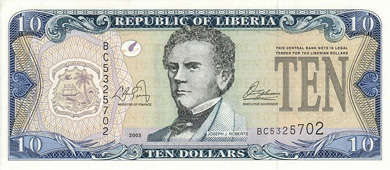
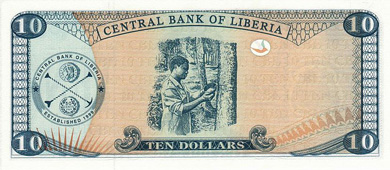
- Currency Name and Code
- Liberian Dollar (LRD)
- GDP Real Growth Rate
- 8%
Banknotes
Budget & Public Finance
- Fiscal Year
- calendar year
- Annual Budget
- $90,500,000 (USD)
- External Debt
- $3,200,000,000 (USD)
Labor, Industry & Trade
- Labor Force by Occupation
- agriculture 70%; industry 8%; services 22% (2000 est.)
- Industries
- rubber processing, palm oil processing, timber, diamonds
- Agriculture Products
- rubber, coffee, cocoa, rice, cassava (tapioca), palm oil, sugarcane, bananas; sheep, goats; timber
- Export Commodities
- rubber, timber, iron, diamonds, cocoa, coffee
- Export Partners
- Germany 52.7%, France 8.2%, Poland 6.8%, Denmark 5.3%, China 4.7%, Italy 4.4%, US 4% (2002)
- Import Commodities
- fuels, chemicals, machinery, transportation equipment, manufactured goods; foodstuffs
- Import Partners
- South Korea 31.1%, Japan 19.5%, Germany 16%, France 9.3%, Singapore 8.1% (2002)
Energy
- Oil Production
- 0 bbl/day
- Oil Consumption
- 3,400 bbl/day
- Oil Reserves
- 0 bbl/day
- Natural Gas Production
- 0 cu m
- Natural Gas Consumption
- 0 cu m
- Natural Gas Imports
- 0 cu m
- Natural Gas Exports
- 0 cu m
- Natural Gas Reserves
- 0 cu m
Communications
- Telephone System
- general assessment: the limited services available are found almost exclusively in the capital Monrovia; fixed-line service stagnant and extremely limited; telephone coverage extended to a number of other towns and rural areas by four mobile-cellular network operators domestic: mobile-cellular subscription base growing and teledensity reached 50 per 100 persons in 2011 international: country code - 231; satellite earth station - 1 Intelsat (Atlantic Ocean)
- Internet Country Code
- .lr
News & Weather
News & Weather
Current Weather
Latest News
Minnesota United Statement on International Friendly - Minnesota United FC
Minnesota United FC · 5d ago
Why are forests vanishing in southeastern Liberia? - news - Mongabay
news - Mongabay · 2d ago
Minnesota United friendly match with Liberia canceled after some players' visas were denied - 5 EYEWITNESS NEWS
5 EYEWITNESS NEWS · 5d ago
Liberia denied entry: Visa trouble still lingering in US - Inside The Games
Inside The Games · 18h ago
Liberia’s abortion law reform: A new front in the global culture wars - The New Humanitarian
The New Humanitarian · 19d ago
Mon Rovîa traces his path from Liberia to the U.S. on 'Bloodline' - NCPR: North Country Public Radio
NCPR: North Country Public Radio · 4d ago
Five charged in Liberia after more than 200kg of cocaine seized in drug bust - The Guardian
The Guardian · 14d ago
Liberia: A Catholic sister’s mission in the community - Vatican News
Vatican News · 22d ago
News via Google News
Climate Overview
Liberia is so situated in the Tropics as to be directly in the path of the seasonal winds. From May through November, the prevailing monsoon winds drop most of the nearly 200 inches of rain received annually in the capital city of Monrovia. From December through April, the red, dust-laden harmattan winds originating over the Sahara Desert prevail. The transition periods between the seasons are punctuated by violent thunderstorms and sudden torrential downpours.
Temperatures average 81°F; humidity averages 82%. There is little variation over the course of the year. Precautions must be taken against mildew and rust caused by the heat, constant humidity, and the corrosive salt air of the coast.
Frequently Asked Questions
Frequently Asked Questions
What is the population of Liberia?
How do people greet each other in Liberia?
What are the dining customs in Liberia?
What should I know about hospitality and social etiquette?
How should I dress in Liberia?
What is family life like in Liberia?
What do people do for fun in Liberia?
What is the capital of Liberia?
Where is Liberia located?
What countries border Liberia?
What are the main religions practiced in Liberia?
What is the currency of Liberia?
What language is spoken in Liberia?
What is Liberia's geography and terrain like?
What is Liberia known for?
Last reviewed 2026