
 English
 Español
 中文
中文 हिन्दी
 Français
Peru
Peru
Declare Your Relationship to Peru
CountryReports Community
- Studying0
- From Peru1
- Peru heritage1
- Visited1
- Want to visit1
Customs and Culture
Customs and Culture
About the People
Appointments and other meetings may not begin on time and Peruvians generally consider people to be more important than schedules.
Wealth is defined by having a house and car. Good food and clothing are things that many people would like to enjoy. Middle class people enjoy an education in addition to the basic necessities.
Basic services are not available in many areas of the country, especially in the cities borders and in the countryside. In rural areas, wealth is defined by extensive land holdings, a big house, a big and healthy family and lots of livestock.
The higher social classes consider expensive properties and expensive education to be important.
Cultural Attributes
Peruvians tend to be very tenacious and nationalistic people, they have a good sense of humor, they are very hospitable and they strive to please others. Jokes about their lifestyle, especially from a foreigner, are offensive to them. Personal criticism, if necessary, is expected to be expressed in a positive manner.
Appointments and other meetings may not begin on time and Peruvians generally consider people to be more important than schedules.
Wealth is defined by having a house and car. Good food and clothing are things that many people would like to enjoy. Middle-class people enjoy an education in addition to the basic necessities.
Basic services are not available in many areas of the country, especially in the cities' borders and in the countryside. In rural areas, wealth is defined by extensive land holdings, a big house, a big and healthy family, and lots of livestock.
The higher social classes consider expensive properties and expensive education to be important.
Languages: Spanish (official language), Quechua (official language), Aymara, and a large number of less-used Amazonian dialects.

Birthplace of the Incas, Home of the Andes
Greetings, Gestures & Visiting
Both men and women shake hands when meeting and parting. Close friends often greet each other with a kiss on one cheek. First names are used among friends, but elderly people and officials are referred to by their title and last name.
Between teenagers a kiss on the cheek between girls and boys is common. Never a kiss between boys. Boys usually do a slap with the hands or a hand touch on the shoulder followed by a nickname said in a loud and friendly way. There are many gestures accompanying the typical greetings. The more confidence or younger the age, the more gestures(and it is even more in low-economical classes). For example, among male teenagers, hand-slaps or hugs are common when greeting someone. If you need to get someone's attention to call them over to you, It is typical to just try to talk to the person or just stare them in the eyes which is very common. With teenagers, it is common to try to talk out loud and about funny things or smile at the person. Nice clothing is always the trend and a happy attitude to try to call someone's attention to yourself.
People stand close to each other during conversation and constant eye contact is important. When seated, placing the ankle of one leg on the knee of the other is inappropriate for women, but is okay for men. Hand gestures are used a great deal during conversation.
The most common ways to socialize with people doesn't necessarily involve food and drinks. Any person can socialize by talking. If closer socialization is wished, then the interested person may invite someone over for something to eat or invite them to go out. Peruvians enjoy visiting one another.
Between friends and relatives, most visits are unannounced. In other cases, it is polite to make advance arrangements. Special acknowledgment of children in the home is appreciated by the hosts.
Gifts are not expected when one visits the home, but small gifts such as fruit or wine are welcome on any occasion. If someone visits impromptu, the host may politely decline the visit. It would depend on the host's attitude.
Instead of meeting indoors, most people meet outdoors like at campuses, on the way home, in other public places (restaurants, pubs, shops, etc), or while using public transportation like public buses as cars are not owned by everybody.
Although Western-style clothing is worn regularly in Lima, the capital, and other urban areas, rural campesinos (farmers) often wear traditional clothing related to their ethnic background. Hand-woven fabrics are commonly used to make their clothes.
Diet
The main staples in the diet include rice, beans, fish, and a variety of tropical fruits. Soups are common. Corn, native to Peru, is the main staple among the Indians. Cebiche (raw fish seasoned with lemon and vinegar) is popular on the coast.
A polite guest eats all the food that is offered. Table manners are important in Peru. The continental style of eating is followed with both hands being kept above the table. A typical family will have three meals: breakfast, lunch and dinner. Some have a kind of pre-dinner at about 6:00 PM with dinner served at about 8 PM .The average family eats at home. Manners are practiced but not strictly. The arms can go on the table but not the elbows. The whole family is supposed to eat at the table, but if someone of the members can't stay it is not compulsory.
The main staples in the diet include rice, beans, fish, and a variety of tropical fruits. Soups are common. Corn, native to Peru, is the main staple among the Indians. Cebiche (raw fish seasoned with lemon and vinegar) is popular on the coast.

Family
The family is important in Peru. The father is the undisputed head of the family, while the mother spends most of her time directing and performing household duties. Families on average have three children.
Dating Customs
Some group dating occurs in the late teen years, but dating in couples is almost strictly reserved for courtship. Common-law marriage is not uncommon and is widely accepted, except in the upper class.
Recreation
Soccer is the most popular sport. In the evening young people go to peñas where traditional Peruvian folk music is played.
Student Life
In urban areas, children eat a light breakfast of bread and jam before going to school. In poor rural areas, children are more likely to have nothing for breakfast before leaving early to walk to school. (Many families live on the equivalent of US $1.00 a day, so food is scarce for them.)
School generally begins at 8:00 in the morning and is done at around 2:00 in the afternoon. Kids will usually walk or ride a public transportation bus to school, depending on how far from the school they live. Parents who can afford to do so might either drive their children to school, organize carpools, or participate with others in the community in hiring a private transportation company to take their children to and from school for a monthly fee. In most rural areas, native Indian children may walk as far as two or three hours in mountainous areas in order to get to school, which means they must leave home before 6:00 a.m. In these cases, where possible the children will stay with a family who lives closer to the school during the week, and return home on the weekends. However, school is important to improving living circumstances, so parents try to do whatever they can to ensure that their children get to school somehow.
Peruvian schools are very careful to teach the importance of knowing the national identity as a Peruvian. In connection with that strong feeling of nationalism, the school uniform is a sort of military cadet-looking uniform. Elementary schools are found throughout the country. Peruvians feel very strongly that younger children must get an education in order to improve their life situation. However, secondary schools are much less available. The educational ministry simply does not have enough resources to build all the secondary schools that are needed, and many children drop out of school after elementary in order to work. Most schools will have a plaza or courtyard where the students gather at the beginning of the day. On the positive side, the government has done a very good job of building schools; however, they have not done well at maintaining them. Therefore, many schools and the teaching resources in them are in poor condition. In rural areas, school buildings are often simple and poorly equipped. Students might sit around sawed-off tree stumps instead of at desks, and often only the teacher will have a book—no students. The poorest families cannot afford to give their children notebooks and pencils, and computers cannot even be thought of. Fortunately, for these children, the school tries to often provide a simple breakfast, which they would otherwise not have. Interestingly, sometimes when temperatures in parts of Peru become unseasonably cold, school schedules will move to later in the day in order to avoid early morning cold hours.
Children are required to attend elementary school for six years (ages 6-11), followed by five years of attendance in secondary school (ages 12-16). Classes are usually taught in Spanish, although that depends to some extent on where the school is. In some areas with high populations of native peoples, their local language is also taught in school. These tend to be in rural areas removed from cities and larger towns. There are five major subjects taught in Peruvian schools: communication (writing, speaking, etc.), math, social studies, science, and religion. Until recently, the Roman Catholic church was the official religion of Peru; it no longer has that status, but it is viewed as being very influential nevertheless. If non-Catholics want their children to be taught in their own religion, they must provide their own teachers for doing so. There are three national languages in Peru—Spanish (spoken by 70 percent of the people), Quecha (one of the main languages of Native Americans in the country), and Aymara (another Native American language). English is also learned and spoken in much of Peru. The biggest source of revenue in Peru is tourism, so being able to speak English is valued as a way to make money. Because of poorly trained teachers, large class sizes, and inadequate teaching resources, the quality of education in Peru tends to be lower than what is available in most other Latin American countries.
Most schools do not have the resources to offer extracurricular activities. Sports are organized by clubs rather than by schools, and even academic clubs are rare in Peru’s public school system.
What children do in the evening at home will depend on their family's economic situation, for the most part. Children in upper-income families spend time with friends playing sports or, as they get older, hanging out in local social centers (cafés, movies, etc.). However, for many of Peru’s families, the children will have jobs of various kinds as soon as they get out of school. Much of their energy will be spent on supporting the family in any way they can just so they can get food to eat and maintain a place to live. Families are therefore important social and economic units throughout Peru at all levels.
Like much of Latin America, education has been on the rise for several decades. The adult literacy rate has risen from approximately 40 percent in 1940 to over 90 percent in 2005. Public education is free and required for children between the ages of 6 and 16. However, many rural children stop attending after elementary school because of too few schools and too great a need to work to support their families. The dropout rate nationally after elementary school is nearly 50 percent. Also, although Peru does a fairly good job of getting their children into the schools, the teachers there are not as successful at teaching the children. In 2000, Peru entered a 43-country education test—and came out at the bottom, lower than any other Latin American country by a significant amount. Since then, the educational leaders of the country are slowly trying to improve the quality of schooling in Peru. They still have a long way to go, however, to catch up to the rest of Latin America. Besides the public school system, there are a number of private schools, primarily in the larger cities. However, these are often too expensive for most families. Several decades ago, nearly 40% of all Peruvians spoke only a Native American language. Frequently, Spanish speakers were better educated and received better-paying jobs. Others were looked down on. As a result, people in rural and largely native areas looked to schools as a way of learning Spanish and avoiding prejudice. Perhaps because of this, an important part of each school’s mission is to teach nationalism and a common national identity, in addition to standard subjects taught throughout the world. Well-educated people are viewed highly in today’s society, and people are often addressed by their advanced degrees (Doctor So-and-So, Engineer So-and-So, Profesora So-and-So). The school year in Peru, as in many Latin American countries, runs from April through December, with no school being held during the hotter summer months.
Holidays
Independence Day
7/28Independence Day
Christmas
12/25Christmas
Retablo (a personal portable nativity scene) are a three-dimensional box with a triangular top and one or two doors that open. Retablos range from 1 to 2 inches to several feet. They are usually divided in half with the top symbolizing heaven and the bottom symbolizing earth. Many of the figures are molded from a potato paste and varnished. The triangle and the doors often have floral patterns.
Children open gifts on Christmas eve and afterwords the family has Christmas dinner consisting of turkey and stuffing, panetón (bread with raisins and glazed fruit), biblia con pisco (eggnog made with pomace brandy) hot chocolate, and champagne.
On Christmas day many people attend a grand bullfight.
Dates of Interest
- June 24th
Held in August, Pachamama Raymi is an Andean festival dedicated to Pachamama, the Earth Mother. It involves rituals to honor and give thanks to the earth for its fertility and abundance.
How do people greet each other in Peru?
Both men and women shake hands when meeting and parting, while close friends greet with a kiss on one cheek. First names are for friends, but elderly people and officials are addressed by title and last name.
Do
- Shake hands when meeting and parting
- Use titles and last names for elderly people and officials
- Greet close friends with a kiss on one cheek
Don’t
- Never give a kiss between boys
Good to know
- Teenage boys often greet with hand-slaps, hugs, or a friendly nickname said out loud
- To get someone's attention, it's common to just talk to them or make eye contact
What are the dining customs in Peru?
Table manners matter and the continental style is followed, keeping both hands above the table. A polite guest eats all the food offered.
Do
- Eat all the food that is offered
- Keep both hands above the table (continental style)
- Rest your arms on the table if needed
Don’t
- Don't put your elbows on the table
Good to know
- A typical family eats breakfast, lunch and dinner
- Some have a pre-dinner around 6:00 PM with dinner around 8:00 PM
- Try cebiche (raw fish seasoned with lemon and vinegar), popular on the coast
- Staples include rice, beans, fish, tropical fruits, soups and corn
What should I know about social etiquette and visiting in Peru?
Peruvians are hospitable and enjoy visiting one another, and they consider people more important than schedules, so meetings may not start on time.
Do
- Make advance arrangements for visits outside close friends and family
- Acknowledge children in the home, which hosts appreciate
- Express any personal criticism in a positive manner
Don’t
- Don't joke about their lifestyle, especially as a foreigner
- Don't expect meetings to always start on time
Good to know
- Gifts aren't expected, but small gifts like fruit or wine are welcome
- Between friends and relatives, most visits are unannounced
- People often meet outdoors, in public places, or on public transportation
What should I wear in Peru?
Western-style clothing is worn regularly in Lima and other urban areas, while rural campesinos often wear traditional clothing tied to their ethnic background.
Good to know
- Nice clothing is always in trend
- Rural traditional clothes are often made from hand-woven fabrics
What gestures and body language should I be aware of in Peru?
People stand close during conversation and maintain constant eye contact, and hand gestures are used a great deal.
Do
- Maintain constant eye contact during conversation
- Expect people to stand close when talking
Don’t
- Women should not place the ankle of one leg on the knee of the other (okay for men)
What is family life like in Peru?
The family is important in Peru, with the father as the undisputed head and the mother directing household duties. Families average three children.
Good to know
- The whole family is supposed to eat together, though it isn't compulsory
- Common-law marriage is widely accepted, except in the upper class
What do people do for recreation in Peru?
Soccer is the most popular sport, and in the evenings young people go to peñas to hear traditional Peruvian folk music.
Good to know
- Visit a peña in the evening for traditional Peruvian folk music
Last updated: 2026-07-12 · Sources: CountryReports
Photos of Peru
Photos of Peru


Travel and Tourism
Travel and Tourism
- Travel Alert Status
- Peru - Level 2: Exercise Increased Caution
- Currency
- nuevo sol (PEN)
- Time Difference
- UTC-5 (same time as Washington, DC, during Standard Time)
- Climate
- Peru lies below the Equator, therefore, its seasons along the Pacific Coast, which includes Lima, are the reverse of those in the Northern Hemisphere. Summer lasts from about mid-December through April in that region and is generally pleasant, with warm, sunny days and cool, comfortable nights. February is usually the warmest month, with an average temperature of 79 (F) and humidity of 83%. Temperatures rarely range above the mid-80s. Only two distinct seasons occur in the highlands/sierra: the rainy season from December to April and a dry period the rest of the year. Temperatures fluctuate considerably depending on the weather and altitude. Winter along the coast lasts from May or June to November and the weather is chilly and damp. Sunny days in Lima's winter are rare, particularly in July, August, and September. Rain is virtually unknown; however, a fine mist often falls and fog is common. The coolest, dampest months are July and August, with average temperatures about 60(F), rarely falling below the low 50s.
- Airports
- 191
- Recommended Vaccinations
- How important is it to do your research about vaccinations? It might just save your life! Make yourself aware of the different types of vaccinations and which ones you may need to travel to your destination. Schedule an appointment with your doctor at least four to six weeks before you travel to ensure you receive all important shots. Be sure that you and your family are up to date on your routine vaccinations. Which vaccinations you need will depend on a number of factors including your destination, whether you will be spending time in rural areas, the season of the year you are traveling, your age, health status, and previous immunizations.
Read the full travel guide — health, safety, vaccinations, disease risk, sanitation, and transit details.
View full travel guideRecipes
Recipes
Cebiche de Pescado
Main Dish
Main Dish
Cupos (Ground Beef Peruvian Dish)
Main Dish
Arroz Chaufa (Chaufa Rice)
Main Dish
Ceviche Peruano (Fish Marinated in Lime and Lemon Juice)
Main Dish
Papa a la Huancaina (Huancaina Potatoes)
Main Dish
Ocopa Arequipeña (Potatoes with Peanut, Chili and Cheese Sauce)
Main Dish
Cebiche de Pescado
Dessert
PremiumArroz con Leche (Rice and Milk)
Dessert
PremiumPaneton
History
History
Historical Eras
Pre-Columbian Era
10000 BCE – 1532
Over millennia, a succession of sophisticated civilizations flourished in the Andes, including the Chavín, Tiwanaku, and Wari cultures. The Inca Empire, emerging around 1200 CE, became the culmination of this tradition — the largest empire in pre-Columbian America, stretching across a third of South America and achieving remarkable feats in agriculture, engineering, and statecraft under rulers such as Pachacuti.
Spanish Conquest
1532 – 1542
Francisco Pizarro and a small force of conquistadors captured the Inca emperor Atahualpa at Cajamarca in 1532, exploiting a devastating civil war within the empire. Despite a massive ransom paid in gold and silver, Atahualpa was executed in 1533, and Spanish forces systematically dismantled Inca political and religious institutions. Pizarro founded Lima in 1535 as the administrative capital of the emerging colonial order.
Colonial Period
1542 – 1821
The Viceroyalty of Peru, established in 1542, became Spain's most prized possession in South America, its silver mines at Potosí generating enormous imperial wealth. Indigenous populations suffered catastrophic demographic collapse through disease, forced labor, and dispossession, creating the deep social dualism between a small creole elite and an impoverished Andean majority. The mestizo leader Túpac Amaru II led a major uprising against Spanish rule in 1780–81, foreshadowing the independence movement to come.
Independence & Early Republic
1821 – 1879
Argentine general José de San Martín proclaimed Peruvian independence on July 28, 1821, and Simón Bolívar's forces secured it militarily with the decisive Battle of Ayacucho in 1824. The early republic was marked by chronic political instability, caudillo rule, and a revolving door of military governments. A mid-century guano boom brought transient prosperity but deepened dependence on foreign capital and export monocultures, leaving structural vulnerabilities unresolved.
War, Crisis & Oligarchy
1879 – 1968
Chile's invasion precipitated the War of the Pacific (1879–83), in which Peru suffered a devastating defeat — losing the nitrate-rich Tarapacá region and enduring the occupation of Lima. Reconstruction under the Civilista oligarchy relied heavily on foreign investment and export extraction, perpetuating social inequality. The rise of the APRA movement under Víctor Raúl Haya de la Torre and repeated military interventions defined the turbulent politics of the early-to-mid twentieth century.
Military Rule & Democracy
1968 – 1990
General Juan Velasco Alvarado's 1968 coup initiated a reformist military government that nationalized industries and enacted sweeping land reform, dramatically reshaping Peru's social landscape. Civilian democracy was restored in 1980, but the newly elected government simultaneously confronted hyperinflation and the emergence of the Maoist Shining Path insurgency, which unleashed two decades of brutal violence across the highlands.
Contemporary Peru
1990 – present
Alberto Fujimori's presidency (1990–2000) brought economic stabilization and the capture of Shining Path leader Abimael Guzmán in 1992, but his autogolpe and authoritarian methods ultimately led to his ouster amid corruption scandals. Subsequent democratic governments navigated a commodity-driven economic boom alongside persistent inequality, regional political fragmentation, and recurring institutional crises. Peru today remains marked by the enduring social and economic dualism that has defined its history since the colonial era.
Overview
Timeline of Key Events
1200 – 1500
The Incan Indians built a great empire in Peru.
The Incan Indians built a great empire in Peru.
1520
The Spanish conquistador Francisco Pizarro led an expedition into Peru.
The Spanish conquistador Francisco Pizarro led an expedition into Peru.
1530
Pizarro conquered the Inca and made Peru a Spanish colony.
Pizarro conquered the Inca and made Peru a Spanish colony.
1535
Pizarro founded Lima.
Pizarro founded Lima.
1780
The Mestizos, led by Tupac Amaru, revolted against the rule of Spain.
The Mestizos, led by Tupac Amaru, revolted against the rule of Spain.
1781
The Spanish captured and executed Tupac Amaru and crushed the uprising.
The Spanish captured and executed Tupac Amaru and crushed the uprising.
1810
Overthrow of the king of Spain by Napoleon.
Overthrow of the king of Spain by Napoleon.
Read the full history profile — narrative overview, defining eras, and the complete timeline in one place.
View expanded historyInteresting Facts
Interesting Facts
The world's largest canyon is in Colca Canyon. The depth is 11,00 feet and it is 37.3 miles long.
The biggest Papal crowd was on Jan 15, 1995 when Pope John Paul II offered Mass to an estimated 4-5 million people at Luneta Park, Manilla, Phillippines.
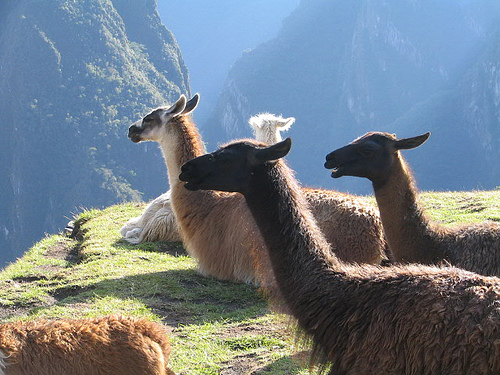
Peru has the world's highest navigable body of water. Lake Titicaca is 3800 metres above sea level.
Peru is considered to be the archeological capital of South America. The Lost City of the Incas, called Machu Picchu, is located in the Andes Mountains. It is called lost because the Incas abandoned it and the city remained unknown to explorers for several centuries.
Peruvians will offer you an item enthusiastically if you admire it and might be offended if you don't accept it.
For Peruvians an evening of socializing almost always includes lively music and salsa dancing.
See every fact — trivia, oddities, and curious tidbits gathered from across the country.
View all interesting factsGeography and Environment
Geography and Environment
- Terrain
- western coastal plain (costa), high and rugged Andes in center (sierra), eastern lowland jungle of Amazon Basin (selva)
- Climate
- Peru lies below the Equator, therefore, its seasons along the Pacific Coast, which includes Lima, are the reverse of those in the Northern Hemisphere. Summer lasts from about mid-December through April in that region and is generally pleasant, with warm, sunny days and cool, comfortable nights. February is usually the warmest month, with an average temperature of 79 (F) and humidity of 83%. Temperatures rarely range above the mid-80s. Only two distinct seasons occur in the highlands/sierra: the rainy season from December to April and a dry period the rest of the year. Temperatures fluctuate considerably depending on the weather and altitude. Winter along the coast lasts from May or June to November and the weather is chilly and damp. Sunny days in Lima's winter are rare, particularly in July, August and September. Rain is virtually unknown; however, a fine mist often falls and fog is common. The coolest, dampest months are July and August, with average temperatures about 60(F), rarely falling below the low 50s.
- Natural Hazards
- earthquakes, tsunamis, flooding, landslides, mild volcanic activity
- Current Environmental Issues
- deforestation (some the result of illegal logging); overgrazing of the slopes of the costa and sierra leading to soil erosion; desertification; air pollution in Lima; pollution of rivers and coastal waters from municipal and mining wastes
Read the full geography and environment profile — terrain, climate, natural resources, hazards, land use, and international agreements.
View full geographyPeople & Demographics
People & Demographics
Religion
Languages Spoken
Spanish (official) 84.1%, Quechua (official) 13%, Aymara (official) 1.7%, Ashaninka 0.3%, other native languages (includes a large number of minor Amazonian languages) 0.7%, other 0.2%
- Spanish
Population
- Population
- 29,907,003
- Population: Male/Female
- male: 15,952,556 female: 16,647,693
- Population Distribution
- approximately one-third of the population resides along the desert coastal belt in the west, with a strong focus on the capital city of Lima; the Andean highlands, or sierra, which is strongly identified with the country's Amerindian population, contains roughly half of the overall population; the eastern slopes of the Andes, and adjoining rainforest, are sparsely populated
- Urban Population
- urban population: 78.9% of total population rate of urbanization: 1.33% annual rate of change
- Population in Major Urban Areas
- 11.204 million LIMA (capital), 959,000 Arequipa, 904,000 Trujillo
- Nationality Noun
- noun: Peruvian(s) adjective: Peruvian
- Ethnic Groups
- Mestizo (mixed Indigenous and White) 60.2%, Indigenous 25.8%, White 5.9%, African descent 3.6%, other (includes Chinese and Japanese descent) 1.2%, unspecified 3.3%
- Language Note
- Spanish (official) 82.9%, Quechua (official) 13.6%, Aymara (official) 1.6%, Ashaninka 0.3%, other native languages (includes a large number of minor Amazonian languages) 0.8%, other (includes foreign languages and sign language) 0.2%, none 0.1%, unspecified 0.7%
Demographic Profile
Peru's urban and coastal communities have benefited much more from recent economic growth than rural, Afro-Peruvian, indigenous, and poor populations of the Amazon and mountain regions. The poverty rate has dropped substantially during the last decade but remains stubbornly high at about 30% (more than 55% in rural areas). After remaining almost static for about a decade, Peru's malnutrition rate began falling in 2005, when the government introduced a coordinated strategy focusing on hygiene, sanitation, and clean water. School enrollment has improved, but achievement scores reflect ongoing problems with educational quality. Many poor children temporarily or permanently drop out of school to help support their families. About a quarter to a third of Peruvian children aged 6 to 14 work, often putting in long hours at hazardous mining or construction sites.
Peru was a country of immigration in the 19th and early 20th centuries, but has become a country of emigration in the last few decades. Beginning in the 19th century, Peru brought in Asian contract laborers mainly to work on coastal plantations. Populations of Chinese and Japanese descent - among the largest in Latin America - are economically and culturally influential in Peru today. Peruvian emigration began rising in the 1980s due to an economic crisis and a violent internal conflict, but outflows have stabilized in the last few years as economic conditions have improved. Nonetheless, more than 2 million Peruvians have emigrated in the last decade, principally to the US, Spain, and Argentina.
Education
- Literacy Definition
- age 15 and over can read and write
Peruvian schools are very careful to teach the importance of knowing the national identity as a Peruvian. In connection with that strong feeling of nationalism, the school uniform is a sort of military cadet-looking uniform.
Elementary schools are found throughout the country. Peruvians feel very strongly that younger children must get an education in order to improve their life situation. However, secondary schools are much less available. The educational ministry simply does not have enough resources to build all the secondary schools that are needed, and many children drop out of school after elementary in order to work.
Most schools will have a plaza or courtyard where the students gather at the beginning of the day. On the positive side, the government has done a very good job of building schools; however, they have not done well at maintaining them. Therefore, many schools and the teaching resources in them are in poor condition.
In rural areas, school buildings are often simple and poorly equipped. Students might sit around sawed-off tree stumps instead of at desks, and often only the teacher will have a book—no students. The poorest families cannot afford to give their children notebooks and pencils, and computers cannot even be thought of. Fortunately, for these children, the school tries to often provide a simple breakfast, which they would otherwise not have.
Interestingly, sometimes when temperatures in parts of Peru become unseasonably cold, school schedules will move to later in the day in order to avoid early morning cold hours.
Health Information
- Life Expectancy at Birth
- total population: 68.9 years male: 65.4 years female: 72.7 years
- Major Infectious Diseases — degree of risk
- degree of risk: very high food or waterborne diseases: bacterial diarrhea, hepatitis A, and typhoid fever vectorborne diseases: dengue fever, malaria, Bartonellosis (Oroya fever), and sexually transmitted diseases: hepatitis B
- Alcohol consumption per capita
- total: 5.74 liters of pure alcohol beer: 3.01 liters of pure alcohol wine: 0.46 liters of pure alcohol spirits: 2.26 liters of pure alcohol other alcohols: 0.01 liters of pure alcohol
- Tobacco Use
- total: 8.1% male: 13.2% female: 3%
- Child Marriage
- women married by age 15: 2% women married by age 18: 14.1%
- Infant Mortality Rate
- total: 10.8 deaths/1,000 live births male: 11.9 deaths/1,000 live births female: 9.7 deaths/1,000 live births
Life Expectancy
- Life Expectancy at Birth
- total population: 68.9 years male: 65.4 years female: 72.7 years
- Median Age
- total: 30.2 years male: 29.1 years female: 31.3 years
- Age Structure
- 0-14 years: 25.8% (male 4,293,229/female 4,119,269) 15-64 years: 66.2% (male 10,546,502/female 11,041,106) 65 years and over: 8% (male 1,112,825/female 1,487,318)
- Infant Mortality Rate
- total: 10.8 deaths/1,000 live births male: 11.9 deaths/1,000 live births female: 9.7 deaths/1,000 live births
Read the full people and society profile — demographics, health, education, religion, languages, and notable people.
View full people and societyGovernment & Politics
Government & Politics
Country Identity
- Country Name
- Peru
- Full Country Name
- Republic of Peru
- Local - Long
- Republica del Peru
- Local - Short
- Peru
Government Structure
- Government Type
- constitutional republic
- Legal System
- based on civil law system; has not accepted compulsory ICJ jurisdiction
- Executive Branch
- chief of state: President Dina BOLUARTE Zegarra (since 7 December 2022); First Vice President (vacant); Second Vice President (vacant); note - the president is both the chief of state and head of government head of government: President Dina BOLUARTE Zegarra (since 7 December 2022); note - BOLUARTE assumed the presidency following the impeachment and removal of President Pedro CASTILLO Barrios on 7 December 2022 note: Prime Minister Gustavo ADRIANZÉN Olaya (since 6 March 2024) does not exercise executive power; this power is in the hands of the president cabinet: Council of Ministers appointed by the president elections: president elected by popular vote for a five-year term (eligible for a non-consecutive second term); presidential and congressional elections last held on 11 April 2021, with runoff election held 6 June 2021; next elections to be held in April 2026 election results: Pedro CASTILLO Barrios elected president in runoff election; percent of vote - Pedro CASTILLO Barrios 50.1%, Keiko FUJIMORI Higuchi 49.9%; CASTILLO was subsequently removed from office and succeeded by Vice President Dina BOLUARTE Zegarra in December 2022
- Legislative Branch
- unicameral Congress of the Republic of Peru or Congreso de la Republica del Peru (120 seats; members are elected by popular vote to serve five-year terms) elections: last held 9 April 2006 (next to be held April 2011) election results: percent of vote by party - UPP 21.2%, PAP 20.6%, UN 15.3%, AF 13.1%, FC 7.1%, PP 4.1%, RN 4.0%; seats by party - UPP 45, PAP 36, UN 17, AF 13, FC 5, PP 2, RN 2
- Judicial Branch
- Supreme Court of Justice or Corte Suprema de Justicia (judges are appointed by the National Council of the Judiciary)
- Suffrage
- 18 years of age; universal and compulsory until the age of 70; note - members of the military may not vote
- Constitution
- 31-Dec-93
- Independence
- 28 July 1821 (from Spain)
- National Holiday
- Independence Day, 28 July (1821)
Capital City
- Capital Name
- Lima
- Capital - geographic coordinate
- 12 03 S, 77 03 W
- Capital Time Difference
- UTC-5 (same time as Washington, DC, during Standard Time)
the word "Lima" derives from the Spanish pronunciation of "Limaq," the native name for the valley in which the city was founded in 1535; "limaq" means "talker" in coastal Quechua and referred to an oracle that was situated in the valley but which was eventually destroyed by the Spanish and replaced with a church
Military
Branches: Peruvian Army (Ejercito Peruano), Peruvian Navy (Marina de Guerra del Peru, MGP; includes naval air, naval infantry, and Coast Guard), Air Force of Peru (Fuerza Aerea del Peru, FAP)
Embassy / Diplomatic Mission
U.S. Embassy Lima, Peru
Avenida Encalada, Block Seventeen
Surco, Monterrico, Lima
Telephone: 51-1-618-2000
Emergency after-hours telephone: 51-1-618-2000
Facsilime: 51-1-618-2722
Email: LimaACS@state.gov
Appointments must be made through the online appointment system for most non-emergency passport and citizenship services. An individual appointment should be made for each family member seeking a service related to passports. To request emergency services from the Embassy, please call (51-1) 618-2000.
Note: The local equivalent to the “911” emergency line in Peru is 105. For life-threatening emergencies, citizens should contact the national emergency number.
The U.S. Consular Agency in Cusco may be reached at (51) 84-231-474 or in an emergency at (51) 984-621-369. The Consular Agency can provide information and assistance to U.S. citizen travelers who are victims of crime or need other assistance in Cusco, located at Av. Pardo 845.
Read the full government profile — flag symbolism, national anthem, and other national symbols.
View full government detailsEconomy
Economy
Peru's economy reflects its varied geography—an arid coastal region, the Andes further inland, and tropical lands bordering Colombia and Brazil. Abundant mineral resources are found in the mountainous areas, and Peru's coastal waters provide some of the world's richest fishing grounds. Peru is among the world's top producers of copper, silver, zinc, and gold, and mining remains the cornerstone of its export economy. However, overdependence on minerals and metals subjects the economy to fluctuations in world commodity prices, while persistent gaps in infrastructure, informality, and regional inequality continue to deter broader trade and investment.
After two decades of strong macroeconomic management that made Peru one of Latin America's fastest-growing economies, growth has moderated considerably. The economy contracted sharply in 2020 due to the COVID-19 pandemic—one of the steepest declines in the region—before rebounding in 2021. Growth has since been uneven, with the economy slipping into recession in 2023 amid social unrest, climate shocks tied to El Niño, and weaker mining output. A modest recovery took hold in 2024, with GDP expanding by roughly 3%, supported by rebounding copper production, stronger fishing yields, and easing inflation, which returned to within the central bank's target range of 1–3% after peaking above 8% in 2022.
Foreign direct investment remains concentrated in mining, hydrocarbons, and infrastructure, with the long-running Camisea natural gas project continuing to anchor the energy sector alongside major copper operations such as Quellaveco, Las Bambas, and Cerro Verde. Peru retains an investment-grade sovereign credit rating, though agencies have downgraded the outlook in recent years amid chronic political instability—Peru has cycled through six presidents since 2018—and concerns over governance, corruption investigations, and weakening institutions.
Despite the country's hard-won fiscal and financial stability, structural challenges persist. Roughly 70% of workers remain in the informal economy, poverty rates have risen above pre-pandemic levels, and rigid labor regulations continue to constrain formal hiring. Sustaining growth will depend on restoring political stability, diversifying exports beyond raw commodities, and closing long-standing gaps in infrastructure, education, and public services.
Snapshot
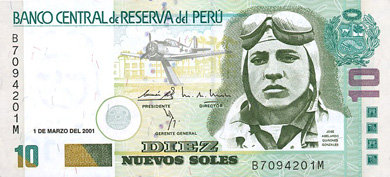
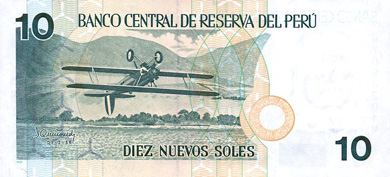
- Currency Name and Code
- Peruvian (Nuevo) Sol (PEN)
- GDP — official exchange rate
- $69,810,000,000 (USD)
- GDP Real Growth Rate
- 6.7%
- Gini Index
- 49.8
Banknotes
Budget & Public Finance
- Fiscal Year
- calendar year
- Annual Budget
- $22,470,000,000 (USD)
- Public Debt (% of GDP)
- 41.8%
- External Debt
- $30,180,000,000 (USD)
- Investment (% of GDP)
- 18.6%
- Economic Aid
- $895,100,000 (USD)
- Current Account Balance
- $241,000,000 (USD)
- Reserves of Foreign Exchange
- $2,147,483,647 (USD)
Labor, Industry & Trade
- Labor Force by Occupation
- agriculture; mining and quarrying; manufacturing; construction; transport; services
- Household Income — highest 10%
- 37.2%
- Industries
- mining of metals, petroleum, fishing, textiles, clothing, food processing, cement, auto assembly, steel, shipbuilding, metal fabrication
- Agriculture Products
- coffee, cotton, sugarcane, rice, wheat, potatoes, corn, plantains, coca; poultry, beef, dairy products, wool; fish
- Export Commodities
- fish and fish products, gold, copper, zinc, crude petroleum and byproducts, lead, coffee, sugar, cotton
- Export Partners
- US 26.1%, UK 11.6%, China 7.9%, Switzerland 7.5%, Japan 4.9%
- Import Commodities
- machinery, transport equipment, foodstuffs, petroleum, iron and steel, chemicals, pharmaceuticals
- Import Partners
- US 27.5%, Spain 8.3%, Chile 7.9%, Brazil 4.7%, Colombia 4.6%
Energy
- Oil Production
- 120,000 bbl/day
- Oil Consumption
- 157,000 bbl/day
- Oil Reserves
- 370,000,000 bbl/day
- Natural Gas Production
- 560,000,000 cu m
- Natural Gas Consumption
- 910,000,000 cu m
- Natural Gas Imports
- 0 cu m
- Natural Gas Exports
- 0 cu m
- Natural Gas Reserves
- 247,100,000,000 cu m
Communications
- Telephone System
- General Assessment: adequate for most requirements; nationwide microwave radio relay system and a domestic satellite system with 12 earth stations Domestic: fixed-line teledensity is only about 12 per 100 persons; mobile-cellular teledensity, spurred by competition among multiple providers, exceeds 100 telephones per 100 persons International: country code - 51; the South America-1 (SAM-1) and Pan American (PAN-AM) submarine cable systems provide links to parts of Central and South America, the Caribbean, and the United States; satellite earth stations - 2 Intelsat (Atlantic Ocean)
- Internet Country Code
- .pe
News & Weather
News & Weather
Current Weather
Latest News
5.5 magnitude earthquake hits Peru’s Andes region and kills at least 6 people - AP News
AP News · 1d ago
5.5-magnitude earthquake hits Peru’s Andes region, killing at least 5 people - NBC News
NBC News · 1d ago
Baby Haaland in Peru: newborns take names of World Cup stars - CNN
CNN · 2d ago
What Happened When I Underestimated One of the World’s Highest Cities - Fodors Travel Guide
Fodors Travel Guide · 20h ago
Two Hurt In Route 251 Crash In Peru - starvedrock.media
starvedrock.media · 9h ago
United States Overtakes Peru, Brazil, Jamaica and More Countries in Securing Second Spot in the Ranking as the Best Food Destination in the Americas and Caribbean Region Through Authentic Culinary Tourism Experiences: New Update You Need to Kno - Travel And Tour World
Travel And Tour World · 1d ago
Earthquake Kills 5 in Peru, Damages Historic Sites - Newser
Newser · 1d ago
Peru Man Confronts Deputies with an Axe and Machete Before Damaging a Cruiser After His Arrest - The Maine Wire
The Maine Wire · 16h ago
News via Google News
Climate Overview
Peru lies below the Equator, therefore, its seasons along the Pacific Coast, which includes Lima, are the reverse of those in the Northern Hemisphere. Summer lasts from about mid-December through April in that region and is generally pleasant, with warm, sunny days and cool, comfortable nights. February is usually the warmest month, with an average temperature of 79 (F) and humidity of 83%. Temperatures rarely range above the mid-80s. Only two distinct seasons occur in the highlands/sierra: the rainy season from December to April and a dry period the rest of the year. Temperatures fluctuate considerably depending on the weather and altitude.
Winter along the coast lasts from May or June to November and the weather is chilly and damp. Sunny days in Lima's winter are rare, particularly in July, August, and September. Rain is virtually unknown; however, a fine mist often falls and fog is common. The coolest, dampest months are July and August, with average temperatures about 60(F), rarely falling below the low 50s.
Videos
Videos
2 curated YouTube videos.
Source: YouTube
Source: YouTube
Frequently Asked Questions
Frequently Asked Questions
What is the population of Peru?
How do people greet each other in Peru?
What are the dining customs in Peru?
What should I know about social etiquette and visiting in Peru?
What should I wear in Peru?
What gestures and body language should I be aware of in Peru?
What is family life like in Peru?
What do people do for recreation in Peru?
What is the capital of Peru?
Where is Peru located?
What countries border Peru?
What religion is practiced in Peru?
What is the currency of Peru?
What languages are spoken in Peru?
What is Peru known for?
Last reviewed 2026