
 English
 Español
 中文
中文 हिन्दी
 Français
Government and Politics
Government and Politics of Peru
Government structure, leadership, capital, military, and national symbols of Peru.
Government Structure
Constitutional foundations, branches, parties, and leadership.
- Government Type
- constitutional republic
- Administrative Divisions
- 24 departments (departamentos, singular - departamento) and 1 constitutional province* (provincia constitucional); Amazonas, Ancash, Apurimac, Arequipa, Ayacucho, Cajamarca, Callao*, Cusco, Huancavelica, Huanuco, Ica, Junin, La Libertad, Lambayeque, Lima, Loreto, Madre de Dios, Moquegua, Pasco, Piura, Puno, San Martin, Tacna, Tumbes, Ucayali
- Legal System
- based on civil law system; has not accepted compulsory ICJ jurisdiction
- Suffrage
- 18 years of age; universal and compulsory until the age of 70; note - members of the military may not vote
- Citizenship
- Citizenship by birth: yes Citizenship by descent: yes Dual citizenship recognized: yes Residency requirement for naturalization: 2 years
- Executive Branch
- chief of state: President Alan GARCIA Perez (since 28 July 2006); First Vice President Luis GIAMPIETRI Rojas; Second Vice President Lourdes MENDOZA del Solar (since 28 July 2006); note - the president is both the chief of state and head of government head of government: President Alan GARCIA Perez (since 28 July 2006); First Vice President Luis GIAMPIETRI Rojas; Second Vice President Lourdes MENDOZA del Solar (since 28 July 2006) note: Prime Minister Jorge DEL CASTILLO Galvez (since 28 August 2006) does not exercise executive power; this power is in the hands of the president cabinet: Council of Ministers appointed by the president elections: president elected by popular vote for a five-year term (eligible for a second term); presidential and congressional elections held 9 April 2006, with runoff election held 4 June 2006; next to be held April 2011 election results: Alan GARCIA elected president in runoff election; percent of vote - Alan GARCIA 52.5%, Ollanta HUMALA Tasso 47.5%
- Legislative Branch
- unicameral Congress of the Republic of Peru or Congreso de la Republica del Peru (120 seats; members are elected by popular vote to serve five-year terms) elections: last held 9 April 2006 (next to be held April 2011) election results: percent of vote by party - UPP 21.2%, PAP 20.6%, UN 15.3%, AF 13.1%, FC 7.1%, PP 4.1%, RN 4.0%; seats by party - UPP 45, PAP 36, UN 17, AF 13, FC 5, PP 2, RN 2
- Judicial Branch
- Supreme Court of Justice or Corte Suprema de Justicia (judges are appointed by the National Council of the Judiciary)
- Political Parties
- Alliance For Progress (Alianza Para El Progreso) [Cesar ACUNA Peralta]; Alliance For The Future (Alianza Por El Futuro) or AF - a coalition of pro-FUJIMORI parties including Cambio 90, Nueva Mayoria, and Si Cumple [Martha CHAVEZ Cossio]; Centrist Front (Frente Del Centro) or FC - a coalition of Accion Popular, Somos Peru, and Coordinadora Nacional de Independientes [Valentin PANIAGUA Corazoa]; Independent Moralizing Front (Frente Independiente Moralizador) or FIM [Fernando OLIVERA Vega]; Nationalist Party Uniting Peru (Partido Nacionalista Uniendo al Peru) or UPP - a coalition of Union for Peru (UPP) and Peruvian Nationalist Party (PNP) [Ollanta HUMALA Tasso]; National Restoration (Restauracion Nacional) or RN [Humberto LAY Sun]; National Unity (Unidad Nacional) or UN [Lourdes FLORES Nano]; Peru Possible (Peru Posible) or PP [David WAISMAN]; Peruvian Aprista Party (Partido Aprista Peruano) or PAP - also referred to by its original name Alianza Popular Revolucionaria Americana or APRA [Alan GARCIA]
- Head of State
- Alan GARCIA Perez
- Head of Government
- Alan GARCIA Perez
- Cabinet
- Council of Ministers appointed by the president
- Elections
- president elected by popular vote for a five-year term (eligible for a nonconsecutive reelection); presidential and congressional elections held 9 April 2006 with runoff election held 4 June 2006; next to be held in April 2011
- Election Results
- Alan GARCIA Perez elected president in runoff election; percent of vote - Alan GARCIA Perez 52.5%, Ollanta HUMALA Tasso 47.5%
- Constitution
- 31-Dec-93
- Independence
- 28 July 1821 (from Spain)
- National Holiday
- Independence Day, 28 July (1821)
- International Organization Participation
- APEC, CAN, FAO, G-15, G-24, G-77, IADB, IAEA, IBRD, ICAO, ICC, ICCt, ICFTU, ICRM, IDA, IFAD, IFC, IFRCS, IHO, ILO, IMF, IMO, Interpol, IOC, IOM, ISO (correspondent), ITU, LAES, LAIA, MONUC, NAM, OAS, OPANAL, OPCW, PCA, RG, UN, UNCTAD, UNESCO, UNIDO, UNMEE, UNMIL, UPU, WCL, WCO, WFTU, WHO, WIPO, WMO, WToO, WTrO
- Diplomatic Representation in the U.S.
- chief of mission: Ambassador Felipe ORTIZ de Zevallos chancery: 1700 Massachusetts Avenue NW, Washington, DC 20036 telephone: [1] (202) 833-9860 through 9869 FAX: [1] (202) 659-8124 consulate(s) general: Boston, Chicago, Denver, Hartford, Houston, Los Angeles, Miami, New York, Paterson (New Jersey), San Francisco, Washington, DC
- U.S. Diplomatic Representation
- chief of mission: Ambassador J. Curtis STRUBLE embassy: Avenida La Encalada, Cuadra 17s/n, Surco, Lima 33 mailing address: P. O. Box 1995, Lima 1; American Embassy (Lima), APO AA 34031-5000 telephone: [51] (1) 434-3000 FAX: [51] (1) 618-2397
Capital City
Seat of government and political history.
- Capital City
- Lima
- Location
- 12 03 S, 77 03 W
- Time Difference
- UTC-5 (same time as Washington, DC, during Standard Time)
- History
- the word "Lima" derives from the Spanish pronunciation of "Limaq," the native name for the valley in which the city was founded in 1535; "limaq" means "talker" in coastal Quechua and referred to an oracle that was situated in the valley but which was eventually destroyed by the Spanish and replaced with a church
Embassy and Diplomatic Representation
Embassy location and contact details.
U.S. Embassy Lima, Peru Avenida Encalada, Block Seventeen Surco, Monterrico, Lima Telephone: 51-1-618-2000 Emergency after-hours telephone: 51-1-618-2000 Facsilime: 51-1-618-2722 Email: LimaACS@state.gov Appointments must be made through the online appointment system for most non-emergency passport and citizenship services. An individual appointment should be made for each family member seeking a service related to passports. To request emergency services from the Embassy, please call (51-1) 618-2000. Note: The local equivalent to the “911” emergency line in Peru is 105. For life-threatening emergencies, citizens should contact the national emergency number. The U.S. Consular Agency in Cusco may be reached at (51) 84-231-474 or in an emergency at (51) 984-621-369. The Consular Agency can provide information and assistance to U.S. citizen travelers who are victims of crime or need other assistance in Cusco, located at Av. Pardo 845.
Military
Branches, service obligations, expenditures, and manpower.
- Military Branches
- Peruvian Army (Ejercito Peruano), Peruvian Navy (Marina de Guerra del Peru, MGP; includes naval air, naval infantry, and Coast Guard), Air Force of Peru (Fuerza Aerea del Peru, FAP)
- Service Age and Obligation
- 18-50 years of age for males and 18-45 years of age for females voluntary military service; no conscription
National Symbols
Flag, anthem, and other symbols of national identity.
National Flag
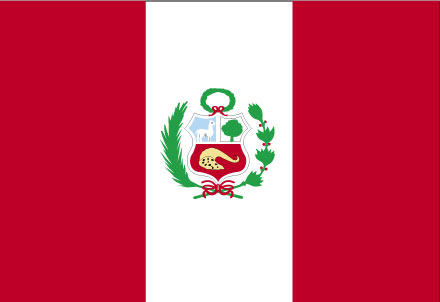
- Flag Symbolism
- three equal, vertical bands of red (hoist side), white, and red. The state flag also has a coat of arms centered in the white band; the coat of arms features a shield bearing a vicuna, cinchona tree (the source of quinine), and a yellow cornucopia spilling out gold coins, all framed by a green wreath
- Flag History
- According to legend, General Jose de San Martin saw a great number of flamingos when he arrived in Peru in 1820. Taking this as a good omen, he decided that white and red should be the colors of the Peruvian Legion that he founded to liberate Peru. The white represents peace, dignity, and progress. The red symbolizes war and courage. In the state flag the arms show symbols of the animal kingdom, vegetable kingdom, and mineral kingdom. The laurel wreath above the shield is a symbol of the republic. The palm and laurel wreath around the shield is a symbol of peace and the will to defend the country.
- Date of Adoption
- 25 February 1825
National Anthem
- Anthem Lyrics
- Somos libres, seámoslo siempre Coro Somos libres, seámoslo siempre y antes niegue sus luces el sol, que faltemos al voto solemne que la patria al Eterno elevó. Largo tiempo el peruano oprimido la ominosa cadena arrastró; condenado a cruel servidumbre largo tiempo en silencio gimió. Mas apenas el grito sagrado ¡Libertad! En sus costas se oyó, la indolencia de esclavo sacude, la humillada cerviz levantó. Ya el estruendo de broncas cadenas que escuchamos tres siglos de horror, de los libres al grito sagrado que oyó atónito el mundo, cesó. Por doquier San Martín inflamado, Libertad, libertad, pronunció, y meciendo su base los Andes la anunciaron, también a una voz. Con su influjo los pueblos despiertan y cual rayo corrió la opinión; desde el itsmo a las tierras del fuego desde el fuego a la helada región. Todos juran romper el enlace que natura a ambos mundos negó, y quebrar ese cetro que España, reclinaba orgullosa en los dos. Lima, cumple ese voto solemne, y, severa, su enojo mostró, al tirano impotente lanzando, que intentaba alargar su opresión. A su esfuerzo sellaron los grillos y los surcos que en sí reparó, le atizaron el odio y venganza que heredara de su Inca y Señor. Compatriotas, no más verla esclava si humillada tres siglos gimió, para siempre jurémosla libre manteniendo su propio esplendor. Nuestros brazos, hasta hoy desarmados estén siempre cebando el cañón, que algún día las playas de Iberia sentirán de su estruendo el terror. En su cima los Andes sostengan la bandera o pendón bicolor, que a los siglos anuncie el esfuerzo que ser libres, por siempre nos dió. A su sombra vivamos tranquilos, y al nacer por sus cumbres el sol, renovemos el gran juramento que rendimos al Dios de Jacob.
- Anthem Lyrics (English)
- CHORUS We are free, let's always be so and may the sun deny its light if we fail the solemn vow that the motherland swore to the Eternal One. For a long time the oppresed Peruvian dragged the ominous chain; condemned to a cruel servitude for a long time he cried in silence. But once the sacred cry Freedom! in its coasts it was heard the slave's indolence shakes, the humilliated neck he raised.
- Anthem History
- "Somos libres, seámoslo siempre" is the national anthem of Perú and was written by José de La Torre Ugarte and composed by José Bernardo Alcedo, who won a contest run by Don José de San Martín, known for being the liberator of Perú, in 1821. It was performed for the first time by Rosa Merino in the Municipal Theater of Lima