
 English
 Español
 中文
中文 हिन्दी
 Français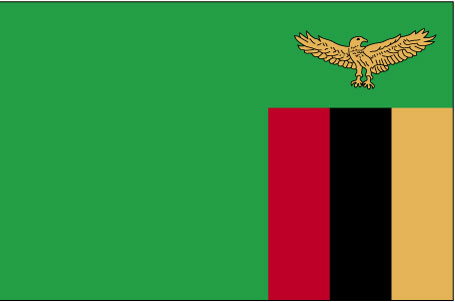
Zambia
Declare Your Relationship to Zambia
CountryReports Community
- Studying0
- From Zambia0
- Zambia heritage0
- Visited0
- Want to visit0
Customs and Culture
Customs and Culture
About the People
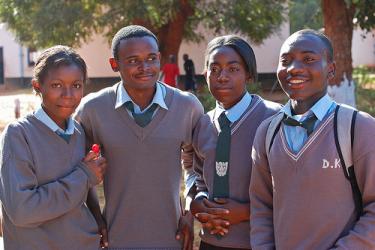
Zambians are known for their friendliness and courtesy.
Cultural Attributes
Zambians are known for their friendliness and courtesy.

The Smoke That Thunders
Greetings, Gestures & Visiting
Traditional greetings and handshakes vary across the country. In western regions, people will greet each other by alternately clasping and clapping hands three times. In the northern region, people commonly bend one knee while shaking hands. To show respect during a greeting or introduction, Zambians will sometimes support their right hand with their left.
Gift giving is an important ritual. Because gifts represent a sign of honor, friendship or gratitude, people always accept them. The refusal of a gift may surprise and offend the giver. When a gift is presented, both giver and receiver use two hands. The use of only one hand, especially the left, may be considered rude
In Zambia, handshaking is common practice, and you should always use a person's professional name if known. Be sure to make prior appointments, but don't be surprised if the engagement is broken without advance notice. You should avoid discussing such sensitive topics as local politics or economics, but most Zambians do like to discuss international politics.
Second hand Western style clothing is popular. The term salaula means to rummage through a pile referring to the second hand clothing that arrives from other nations.
Diet
The staple food in Zambia is a thick cornmeal mash called nshima. Some Zambians feel that a meal is not complete without it. Other basics such as rice, potatoes or pasta are merely substitutes for this popular dish. To prepare nshima, women in rural areas pound dried white maize kernels into a fine meal using a large mortar and pestle. In the city, people buy ground cornmeal in stores. For breakfast, Zambians may serve nshima thinned with water or milk and sweetened slightly with sugar. For lunch or supper, people usually eat nshima with fish, meat, peanuts or beans. Nshima na nkuku is a popular chicken dish.
Other common foods are sorghum and millet (cereal grains), cassava (a starchy rootstock), sweet potatoes and groundnuts (peanuts). Zambians use onions and tomatoes in soups and relishes, and the leaves of beans, okra, cow peas, pumpkins and cassava for greens. Bananas and mangoes grow well in many parts of the country.
The staple food in Zambia is a thick cornmeal mash called nshima. Some Zambians feel that a meal is not complete without it. Other basics such as rice, potatoes or pasta are merely substitutes for this popular dish. To prepare nshima, women in rural areas pound dried white maize kernels into a fine meal using a large mortar and pestle. In the city, people buy ground cornmeal in stores. For breakfast, Zambians may serve nshima thinned with water or milk and sweetened slightly with sugar. For lunch or supper, people usually eat nshima with fish, meat, peanuts or beans. Nshima na nkuku is a popular chicken dish.
Other common foods are sorghum and millet (cereal grains), cassava (a starchy rootstock), sweet potatoes and groundnuts (peanuts). Zambians use onions and tomatoes in soups and relishes, and the leaves of beans, okra, cow peas, pumpkins and cassava for greens. Bananas and mangoes grow well in many parts of the country.

Family
Zambians consider their children an investment in the future. Because the number of infant deaths is still high, most parents fear they will lose a child and tend to have large families.
Before a couple can marry, the man must pay the bride's parents a lobola (bride price). The amount is usually paid in cattle, cash or a combination of the two. Men and women can choose their own partners, but both sets of parents must usually approve the match. Wedding celebrations can last several days. Guests bring gifts, and relatives help out. A feast is prepared, and everyone enjoys singing and dancing.
In some villages, Zambians live in traditional circular homes built from a strong framework of sticks covered in dried mud. The pointed roofs are thatched with bundles of grass, carefully overlapped to keep the rain out. In other communities, people build square houses from handmade bricks and decorate their homes with wall paintings. In the cities, families may live in apartment buildings or cement block houses with tin roofs.
Recreation
Soccer is the most popular sport. Both children and adults in Zambia enjoy playing a traditional African board game called isolo. Using a wooden board shaped like an egg carton and a few stones or dried seeds, players try to capture all their opponents' pieces.
Children often make their own toys. A bundle of rags tied tightly together (ichimpombwa) can be used as a soccer ball. Pieces of discarded wire, carefully bent, can be shaped into elaborate toy cars.
Girls in eastern Zambia play a game called nchuba. They dig a shallow hole about 25 cm wide and place 10 small round stones all around the hole, about 10 cm from the rim. Sitting in a circle around the hole, the girls take turns using their right hand to toss a larger stone in the air. Before catching it, they use the same hand to move one of the smaller stones into the hole. The winner is the girl who finishes the game without making a mistake.
Holidays
Independence Day
10/24Independence Day
Dates of Interest
- October 24th
How do people greet each other in Zambia?
Handshaking is common, and traditional greetings vary by region. To show respect, Zambians sometimes support their right hand with their left.
Do
- Use a person's professional name if you know it
- Support your right hand with your left to show respect
Good to know
- In western regions, people clasp and clap hands three times
- In the northern region, people bend one knee while shaking hands
What should I know about food and eating in Zambia?
The staple food is nshima, a thick cornmeal mash that many Zambians feel is essential to a complete meal; rice, potatoes or pasta are seen as substitutes.
Good to know
- Nshima is eaten thinned with water or milk and lightly sweetened for breakfast
- For lunch or supper, nshima is served with fish, meat, peanuts or beans
- Try nshima na nkuku, a popular chicken dish
- Common foods include sorghum, millet, cassava, sweet potatoes, groundnuts, bananas and mangoes
What are the etiquette rules for visiting in Zambia?
Zambians are known for friendliness and courtesy, and gift giving is an important ritual signaling honor, friendship or gratitude.
Do
- Make prior appointments
- Present and receive gifts using both hands
- Always accept a gift that is offered
Don’t
- Don't refuse a gift, as it may offend the giver
- Don't discuss sensitive topics like local politics or economics
Good to know
- Don't be surprised if an engagement is broken without advance notice
- Most Zambians enjoy discussing international politics
How should I dress in Zambia?
Second-hand Western-style clothing is popular in Zambia.
Good to know
- The term salaula (to rummage through a pile) refers to second-hand clothing arriving from other nations
What gestures should I be aware of in Zambia?
When giving or receiving something, use both hands; using only one hand, especially the left, may be considered rude.
Don’t
- Don't hand over or accept gifts with one hand, especially the left
What is family life like in Zambia?
Zambians view children as an investment in the future and tend to have large families. Marriage involves the man paying a lobola (bride price) to the bride's parents.
Good to know
- Lobola is usually paid in cattle, cash or a combination
- Both sets of parents must usually approve a match
- Wedding celebrations can last several days with feasting, singing and dancing
- Homes range from traditional thatched circular houses to brick and cement block houses
What do people do for fun in Zambia?
Soccer is the most popular sport, and both children and adults enjoy the traditional board game isolo.
Good to know
- Isolo is played on an egg-carton-shaped board using stones or dried seeds
- Children make toys like a rag soccer ball (ichimpombwa) or bent-wire cars
- Girls in eastern Zambia play a stone-tossing game called nchuba
Last updated: 2026-07-12 · Sources: CountryReports
Photos of Zambia
Photos of Zambia


Travel and Tourism
Travel and Tourism
- Travel Alert Status
- Level 1: Exercise Normal Precautions
- Currency
- Zambian kwacha (ZMK)
- Time Difference
- UTC+2 (7 hours ahead of Washington, DC, during Standard Time)
- Climate
- Zambia lies between 8 and 18 degrees south of the Equator. The pleasant climate rivals that of Southern California, having three seasons: the warm-wet season (December to April), the cool-dry season (May to August) and the hot-dry season (September to November). Humidity is quite low except during the rainy season, and the temperature rarely exceeds 95°F; it can get into the 40s during the winter months (June and July). Summer clothing is worn from mid-August to mid-May. Light woolens are useful in winter (mid-May to mid-August). Generally, summer evenings are cool, and winter days are sunny and warm. Annual rainfall during the rainy season averages 34 inches. At the season’s beginning and end, showers are brief. During January, however, heavier rains punctuated by thunderstorms often occur. Zambia’s vegetation is mostly savannah, with areas of tropical grassland and woodland. There are 19 national parks and 32 game management areas. The native fauna is classic big game found in Southern Africa (e.g., leopards and lions). Zambia has a great variety of birds, both resident and migrant, totaling more than 700 species.
- Airports
- 109
Read the full travel guide — health, safety, vaccinations, disease risk, sanitation, and transit details.
View full travel guideRecipes
Recipes
History
History
Historical Eras
Pre-Colonial Era
10000 BCE – 1888
Zambia's earliest inhabitants were hunter-gatherers who were gradually displaced by Bantu-speaking migrants arriving from the 15th century onward, with the largest influx from the Luba and Lunda empires of the Congo basin between the late 17th and early 19th centuries. By the 19th century, distinct peoples including the Bemba, Tonga, and Lozi had established kingdoms across the territory. European penetration began in earnest after 1855, when David Livingstone became the first European to see Victoria Falls on the Zambezi River.
Colonial Rule
1888 – 1953
Cecil Rhodes obtained mineral rights concessions from local chiefs in 1888, bringing Northern Rhodesia under British South Africa Company administration by 1891. The territory was transferred to the British Colonial Office as a formal protectorate in 1924. The discovery and exploitation of vast copper deposits in the 1920s transformed the economy, spurring European immigration and large-scale mining operations while leaving Africans largely excluded from political and economic power.
Federation Period
1953 – 1964
In 1953, Northern Rhodesia was joined with Southern Rhodesia and Nyasaland to form the Federation of Rhodesia and Nyasaland, a politically contentious arrangement dominated by white settler interests. African nationalist movements, most notably Kenneth Kaunda's United National Independence Party founded in 1960, mounted sustained pressure for majority rule and secession. The federation collapsed on December 31, 1963, paving the way for Northern Rhodesia to become the independent Republic of Zambia on October 24, 1964.
First Republic
1964 – 1991
Under President Kenneth Kaunda, Zambia navigated independence with a copper-dependent economy while actively supporting liberation movements in Rhodesia, Angola, and South Africa. In 1972, Kaunda declared Zambia a one-party state under UNIP, consolidating authoritarian rule. The sharp global decline in copper prices beginning in the mid-1970s devastated the economy, producing widespread poverty, debt, and austerity that eroded the government's legitimacy throughout the 1980s.
Multiparty Democracy
1991 – 2001
Popular pressure and economic crisis forced the adoption of a multiparty constitution in 1991, ending nearly two decades of one-party rule. Frederick Chiluba of the Movement for Multi-party Democracy defeated Kaunda in elections that year, marking Zambia's first peaceful transfer of power. Subsequent elections in 1996 were marred by opposition harassment, and the 2001 vote faced legal challenges over irregularities surrounding the election of Levy Mwanawasa.
Modern Zambia
2001 – present
President Levy Mwanawasa launched an aggressive anti-corruption campaign beginning in 2002, resulting in the prosecution of his predecessor Frederick Chiluba and numerous associates. Zambia pursued economic diversification beyond copper, attracted foreign investment, and graduated to lower-middle-income status by 2011. Political competition intensified through the 2010s and 2020s, with successive transfers of power between parties reflecting the consolidation, if still imperfect, of democratic norms.
Overview
Except for an occasional Portuguese explorer, the area lay untouched by Europeans for centuries. After the mid-19th century, it was penetrated by Western explorers, missionaries, and traders. David Livingstone, in 1855, was the first European to see the magnificent waterfalls on the Zambezi River. He named the falls after Queen Victoria, and the Zambian town near the falls is named after him.
In 1888, Cecil Rhodes, spearheading British commercial and political interests in Central Africa, obtained a mineral rights concession from local chiefs. In the same year, Northern and Southern Rhodesia (now Zambia and Zimbabwe, respectively) were proclaimed a British sphere of influence. Southern Rhodesia was annexed formally and granted self-government in 1923, and the administration of Northern Rhodesia was transferred to the British colonial office in 1924 as a protectorate.
In 1953, both Rhodesias were joined with Nyasaland (now Malawi) to form the Federation of Rhodesia and Nyasaland. Northern Rhodesia was the center of much of the turmoil and crisis that characterized the federation in its last years. At the core of the controversy were insistent African demands for greater participation in government and European fears of losing political control.
A two-stage election held in October and December 1962 resulted in an African majority in the legislative council and an uneasy coalition between the two African nationalist parties. The council passed resolutions calling for Northern Rhodesia’s secession from the federation and demanding full internal self-government under a new constitution and a new national assembly based on a broader, more democratic franchise. On December 31, 1963, the federation was dissolved, and Northern Rhodesia became the Republic of Zambia on October 24, 1964.
At independence, despite its considerable mineral wealth, Zambia faced major challenges. Domestically, there were few trained and educated Zambians capable of running the government, and the economy was largely dependent on foreign expertise. Abroad, three of its neighbors--Southern Rhodesia and the Portuguese colonies of Mozambique and Angola--remained under white-dominated rule. Rhodesia’s white-ruled government unilaterally declared independence in 1965. In addition, Zambia shared a border with South African-controlled South-West Africa (now Namibia). Zambia’s sympathies lay with forces opposing colonial or white-dominated rule, particularly in Southern Rhodesia. During the next decade, it actively supported movements such as the Union for the Total Liberation of Angola (UNITA), the Zimbabwe African People’s Union (ZAPU), the African National Congress of South Africa (ANC), and the South-West Africa People’s Organization (SWAPO).
Conflicts with Rhodesia resulted in the closing of Zambia’s borders with that country and severe problems with international transport and power supply. However, the Kariba hydroelectric station on the Zambezi River provided sufficient capacity to satisfy the country’s requirements for electricity. A railroad to the Tanzanian port of Dar es Salaam, built with Chinese assistance, reduced Zambian dependence on railroad lines south to South Africa and west through an increasingly troubled Angola.
By the late 1970s, Mozambique and Angola had attained independence from Portugal. Zimbabwe achieved independence in accordance with the 1979 Lancaster House agreement, but Zambia’s problems were not solved. Civil war in the former Portuguese colonies generated refugees and caused continuing transportation problems. The Benguela Railroad, which extended west through Angola, was essentially closed to traffic from Zambia by the late 1970s. Zambia’s strong support for the ANC, which had its external headquarters in Lusaka, created security problems as South Africa raided ANC targets in Zambia.
In the mid-1970s, the price of copper, Zambia’s principal export, suffered a severe decline worldwide. Zambia turned to foreign and international lenders for relief, but as copper prices remained depressed, it became increasingly difficult to service its growing debt. By the mid-1990s, despite limited debt relief, Zambia’s per capita foreign debt remained among the highest in the world.
Timeline of Key Events
1501 – 1600
Arrival of peoples from Luba and Lunda empires of Zaire to set up small kingdoms.
Arrival of peoples from Luba and Lunda empires of Zaire to set up small kingdoms.
1701
Portuguese explorers visit in the late 18th century.
Portuguese explorers visit in the late 18th century.
1851
British missionary David Livingstone visits.
British missionary David Livingstone visits.
1889
Britain establishes control over Northern Rhodesia.
Britain establishes control over Northern Rhodesia, administering the area using a system of indirect rule which leaves power in the hands of local rulers.
1891
Portugal assigned Barotseland to Britain.
Portugal assigned Barotseland, now in Zambia, to Britain and Nyasaland becomes a British protectorate.
1907
Capital of NW Rhodesia moved from Kalolo to Livingstone.
Capital of NW Rhodesia moved from Kalolo to Livingstone.
1920
Discovery of copper.
Discovery of copper, which later encourages an influx of European technicians and administrators.
Read the full history profile — narrative overview, defining eras, and the complete timeline in one place.
View expanded historyInteresting Facts
Interesting Facts
Zambia is named after the Zambezi River, which flows through the country. Before 1964, the country was called Northern Rhodesia, after Cecil Rhodes.
Zambia has one of the lowest population densities in the world. It also has one of the highest urban populations in sub-Saharan Africa. Half of Zambia's people live in its cities. Close to 2 million people live in Lusaka, the capital.
The African name for Victoria Falls is Mosi-oa-Tunya, “the smoke that thunders.” This World Heritage Site is twice as high as Niagara Falls and one-and-a-half times as wide. It is said to be the longest curtain of water on earth.
Although most of Zambia's rulers and chiefs have been men, at least two women have ruled the Luvale people, who live near the border with Angola. The Luvale's first chief was a woman named Kenga Naweji.
Zambia is one of the world's largest exporters of roses. It can grow them throughout the year and sell them for a low price. The demand for roses within Zambia is low, as it is not customary for Zambians to give each other flowers.
One of Zambia's newest heroes is a young chess player named Amon Simutowe. At 16, he won first prize at the South African Open Chess Championships.
See every fact — trivia, oddities, and curious tidbits gathered from across the country.
View all interesting factsGeography and Environment
Geography and Environment
- Terrain
- mostly high plateau with some hills and mountains
- Climate
- Zambia lies between 8 and 18 degrees south of the Equator. The pleasant climate rivals that of Southern California, having three seasons: the warm-wet season (December to April), the cool-dry season (May to August) and the hot-dry season (September to November). Humidity is quite low except during the rainy season, and the temperature rarely exceeds 95°F; it can get into the 40s during the winter months (June and July). Summer clothing is worn from mid-August to mid-May. Light woolens are useful in winter (mid-May to mid-August). Generally, summer evenings are cool, and winter days are sunny and warm. Annual rainfall during the rainy season averages 34 inches. At the season’s beginning and end, showers are brief. During January, however, heavier rains punctuated by thunderstorms often occur. Zambia’s vegetation is mostly savannah, with areas of tropical grassland and woodland. There are 19 national parks and 32 game management areas. The native fauna is classic big game found in Southern Africa (e.g., leopards and lions). Zambia has a great variety of birds, both resident and migrant, totaling more than 700 species.
- Natural Hazards
- periodic drought, tropical storms (November to April)
- Current Environmental Issues
- air pollution and resulting acid rain in the mineral extraction and refining region; chemical runoff into watersheds; poaching seriously threatens rhinoceros, elephant, antelope, and large cat populations; deforestation; soil erosion; desertification; lack of adequate water treatment presents human health risks
Read the full geography and environment profile — terrain, climate, natural resources, hazards, land use, and international agreements.
View full geographyPeople & Demographics
People & Demographics
Religion
Languages Spoken
English (official), - Bemba, Kaonda, Lozi, Lunda, Luvale, Nyanja, Tonga, and about 70 other indigenous languages.
- English
Population
- Population
- 12,056,923
- Population in Major Urban Areas
- LUSAKA (capital) 1.802 million
- Nationality Noun
- Zambian(s)
- Ethnic Groups
- African 98.7%, European 1.1%, other 0.2%
Education
- Literacy Definition
- age 15 and over can read and write English
Health Information
- Major Infectious Diseases — degree of risk
- very high
Read the full people and society profile — demographics, health, education, religion, languages, and notable people.
View full people and societyGovernment & Politics
Government & Politics
Country Identity
- Country Name
- Zambia
- Full Country Name
- Republic of Zambia
- Former Name
- Northern Rhodesia
Government Structure
- Government Type
- republic
- Legal System
- based on English common law and customary law; judicial review of legislative acts in an ad hoc constitutional council; has not accepted compulsory ICJ jurisdiction
- Executive Branch
- chief of state: President Hakainde HICHILEMA (since 24 August 2021); Vice President Mutale NALUMANGO (since 24 August 2021); note - the president is both the chief of state and head of government head of government: President Hakainde HICHILEMA (since 24 August 2021); Vice President Mutale NALUMANGO (since 24 August 2021); note - the president is both the chief of state and head of government cabinet: Cabinet appointed by the president from among the members of the National Assembly elections: president elected by popular vote for a five-year term; election last held 12 August 2021 (next to be held in 2026); vice president appointed by the president election results: Hakainde HICHILEMA elected president; percent of vote - Hakainde HICHILEMA (UPND) 57.9%, Edgar LUNGU (PF) 37.3%, other 4.8%
- Legislative Branch
- unicameral National Assembly (150 seats; members are elected by popular vote to serve five-year terms) elections: last held 27 December 2001 (next to be held December 2006) election results: percent of vote by party - MMD 45.9%, UPND 32.4%, UNIP 8.8%, FDD 8.1%, HP 2.7%, PF 0.7%, ZRP 0.7%, independents 0.7%; seats by party - MMD 68, UPND 48, UNIP 13, FDD 12, HP 4, PF 1, ZRP 1, independents 1; seats not determined 2
- Judicial Branch
- Supreme Court (the final court of appeal; justices are appointed by the president); High Court (has unlimited jurisdiction to hear civil and criminal cases)
- Suffrage
- 18 years of age; universal
- Constitution
- 2-Aug-91
- Independence
- 24 October 1964 (from UK)
- National Holiday
- Independence Day, 24 October (1964)
Capital City
- Capital Name
- Lusaka
- Capital - geographic coordinate
- 15 25 S, 28 17 E
- Capital Time Difference
- UTC+2 (7 hours ahead of Washington, DC, during Standard Time)
named after a village called Lusaka, located at Manda Hill, near where Zambia's National Assembly building currently stands; the village was named after a headman (chief) LUSAKASA
Military
Branches: Zambian National Defense Force (ZNDF): Zambia Army, Zambia Air Force, National Service (paramilitary youth organization)
Embassy / Diplomatic Mission
The Embassy’s main telephone number for calls, including emergency calls after business hours, is 0211-357-000, or, from the United States, 011-260-211-357-000. If you are unable to get through at the above number and you have an after-hours emergency, please call 0966-877-805 or, from the United States, 011-260-966-877-805.
Email: ACSLusaka@state.gov
Mailing address: Embassy of the United States of America, P.O. Box 31617, Lusaka, Zambia.
Read the full government profile — flag symbolism, national anthem, and other national symbols.
View full government detailsEconomy
Economy
Zambia's economy, heavily dependent on copper mining, has experienced volatile growth over the past two decades. Copper accounts for roughly 70% of export earnings, leaving the country vulnerable to global price fluctuations. After averaging strong growth in the 2000s and early 2010s, the economy slowed significantly amid falling commodity prices, drought, and mounting debt.
In November 2020, Zambia became the first African country to default on its sovereign debt during the COVID-19 pandemic. Following protracted negotiations, the government reached a restructuring agreement with official creditors under the G20 Common Framework in 2023 and secured a $1.3 billion Extended Credit Facility from the IMF in 2022 to support recovery and reform efforts.
GDP growth has remained modest, with the economy expanding by an estimated 5.8% in 2023 before slowing in 2024 due to a severe drought that devastated agricultural output and crippled hydroelectric power generation, leading to widespread electricity rationing. Inflation has remained persistently in double digits, pressured by a weakening kwacha and rising food and energy costs.
Despite these challenges, Zambia continues to attract investment in its mining sector, particularly as global demand for copper grows alongside the energy transition. The government has prioritized increasing copper production to three million tonnes annually by 2031, diversifying the economy into agriculture and tourism, and strengthening fiscal discipline. However, poverty remains widespread, with more than half the population living below the poverty line, and structural reforms are still needed to deliver broad-based growth.
Snapshot
- Currency Name and Code
- Zambian Kwacha (ZMW)
- GDP — official exchange rate
- $5,351,000,000 (USD)
- GDP Real Growth Rate
- 5.1%
- Gini Index
- 52.6
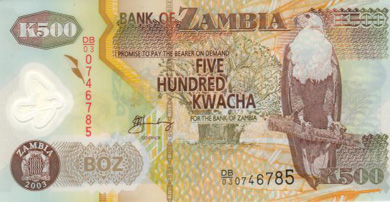
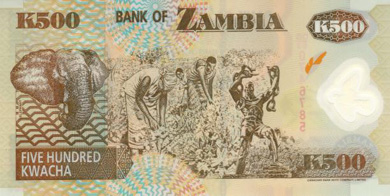
Banknotes
Budget & Public Finance
- Fiscal Year
- calendar year
- Annual Budget
- $1,866,000,000 (USD)
- Public Debt (% of GDP)
- 104.2%
- External Debt
- $5,866,000,000 (USD)
- Investment (% of GDP)
- 25.9%
- Economic Aid
- $651,000,000 (USD)
- Current Account Balance
- -$327,000,000 (USD)
- Reserves of Foreign Exchange
- $500,000,000 (USD)
Labor, Industry & Trade
- Labor Force by Occupation
- agriculture 85%; industry 6%; services 9%
- Household Income — highest 10%
- 41%
- Industries
- copper mining and processing, construction, foodstuffs, beverages, chemicals, textiles, fertilizer, horticulture
- Agriculture Products
- corn, sorghum, rice, peanuts, sunflower seed, vegetables, flowers, tobacco, cotton, sugarcane, cassava (tapioca); cattle, goats, pigs, poultry, milk, eggs, hides; coffee
- Export Commodities
- copper 55%, cobalt, electricity, tobacco, flowers, cotton
- Export Partners
- South Africa 27.8%, Malawi 8.5%, Thailand 7.6%, Japan 7.5%, Saint Pierre and Miquelon 7.5%, China 5.2%, Egypt 5.2%, Netherlands 4.6%
- Import Commodities
- machinery, transportation equipment, petroleum products, electricity, fertilizer; foodstuffs, clothing
- Import Partners
- South Africa 69.4%, US 3.3%, China 3.2%
Energy
- Oil Production
- 130 bbl/day
- Oil Consumption
- 12,250 bbl/day
- Oil Reserves
- 0 bbl/day
- Natural Gas Production
- 0 cu m
- Natural Gas Consumption
- 0 cu m
- Natural Gas Imports
- 0 cu m
- Natural Gas Exports
- 0 cu m
- Natural Gas Reserves
- 0 cu m
Communications
- Telephone System
- general assessment: among the best in sub-Saharan Africa domestic: high-capacity microwave radio relay connects most larger towns and cities; several cellular telephone services in operation and network coverage is improving; domestic satellite system being installed to improve telephone service in rural areas; Internet service is widely available; very small aperture terminal (VSAT) networks are operated by private firms international: country code - 260; satellite earth stations - 2 Intelsat (1 Indian Ocean and 1 Atlantic Ocean), 3 owned by Zamtel
- Internet Country Code
- .zm
News & Weather
News & Weather
Current Weather
Latest News
Zambian journalist detained for audio leak under cyber laws weeks before elections - Committee to Protect Journalists
Committee to Protect Journalists · 15h ago
How a Canadian mining giant infiltrated Zambia’s democracy - Global Witness
Global Witness · 3h ago
Chief Observer Michael McNamara launches the EU Election Observation Mission to Zambia’s 13 August General elections - EEAS
EEAS · 4d ago
Guy Scott, Who Caused a Stir as White Leader of Zambia, Dies at 82 - The New York Times
The New York Times · 5d ago
Zambia’s bumper harvest masks likely food insecurity amid geopolitics and climate threats - news - Mongabay
news - Mongabay · 18d ago
Bay FC Forward Racheal Kundananji Named to Zambia Women’s National Team Provisional Roster for 2026 Women’s Africa Cup of Nations - Bay FC
Bay FC · 3d ago
Zambia's former Vice President Guy Scott dies at 82 - Reuters
Reuters · 5d ago
Zambia’s Bishops appeal to country’s history of peace ahead of elections - Vatican News
Vatican News · 1d ago
News via Google News
Climate Overview
Zambia lies between 8 and 18 degrees south of the Equator. The pleasant climate rivals that of Southern California, having three seasons: the warm-wet season (December to April), the cool-dry season (May to August) and the hot-dry season (September to November). Humidity is quite low except during the rainy season, and the temperature rarely exceeds 95°F; it can get into the 40s during the winter months (June and July). Summer clothing is worn from mid-August to mid-May. Light woolens are useful in winter (mid-May to mid-August). Generally, summer evenings are cool, and winter days are sunny and warm.
Annual rainfall during the rainy season averages 34 inches. At the season’s beginning and end, showers are brief. During January, however, heavier rains punctuated by thunderstorms often occur.
Zambia’s vegetation is mostly savannah, with areas of tropical grassland and woodland. There are 19 national parks and 32 game management areas. The native fauna is classic big game found in Southern Africa (e.g., leopards and lions). Zambia has a great variety of birds, both resident and migrant, totaling more than 700 species.
Videos
Videos
1 curated YouTube videos.
Source: YouTube
Frequently Asked Questions
Frequently Asked Questions
What is the population of Zambia?
How do people greet each other in Zambia?
What should I know about food and eating in Zambia?
What are the etiquette rules for visiting in Zambia?
How should I dress in Zambia?
What gestures should I be aware of in Zambia?
What is family life like in Zambia?
What do people do for fun in Zambia?
What is the capital of Zambia?
Where is Zambia located?
What countries border Zambia?
What religion is practiced in Zambia?
What is the currency of Zambia?
What language is spoken in Zambia?
What is Zambia known for?
Last reviewed 2026