English
 Español
 中文
中文 हिन्दी
 Français
Government and Politics
Government and Politics of Zambia
Government structure, leadership, capital, military, and national symbols of Zambia.
Government Structure
Constitutional foundations, branches, parties, and leadership.
- Government Type
- republic
- Administrative Divisions
- 9 provinces; Central, Copperbelt, Eastern, Luapula, Lusaka, Northern, North-Western, Southern, Western
- Legal System
- based on English common law and customary law; judicial review of legislative acts in an ad hoc constitutional council; has not accepted compulsory ICJ jurisdiction
- Suffrage
- 18 years of age; universal
- Citizenship
- citizenship by birth: only if at least one parent is a citizen of Zambia citizenship by descent only: yes, if at least one parent was a citizen of Zambia dual citizenship recognized: yes residency requirement for naturalization: 5 years for those with an ancestor who was a citizen of Zambia, otherwise 10 years residency is required
- Executive Branch
- chief of state: President Hakainde HICHILEMA (since 24 August 2021); Vice President Mutale NALUMANGO (since 24 August 2021); note - the president is both the chief of state and head of government head of government: President Hakainde HICHILEMA (since 24 August 2021); Vice President Mutale NALUMANGO (since 24 August 2021); note - the president is both the chief of state and head of government cabinet: Cabinet appointed by the president from among the members of the National Assembly elections: president elected by popular vote for a five-year term; election last held 12 August 2021 (next to be held in 2026); vice president appointed by the president election results: Hakainde HICHILEMA elected president; percent of vote - Hakainde HICHILEMA (UPND) 57.9%, Edgar LUNGU (PF) 37.3%, other 4.8%
- Legislative Branch
- unicameral National Assembly (150 seats; members are elected by popular vote to serve five-year terms) elections: last held 27 December 2001 (next to be held December 2006) election results: percent of vote by party - MMD 45.9%, UPND 32.4%, UNIP 8.8%, FDD 8.1%, HP 2.7%, PF 0.7%, ZRP 0.7%, independents 0.7%; seats by party - MMD 68, UPND 48, UNIP 13, FDD 12, HP 4, PF 1, ZRP 1, independents 1; seats not determined 2
- Judicial Branch
- Supreme Court (the final court of appeal; justices are appointed by the president); High Court (has unlimited jurisdiction to hear civil and criminal cases)
- Political Parties
- Agenda for Zambia or AZ [Inonge MBIKUSITA-LEWANIKA]; Forum for Democracy and Development or FDD [Christon TEMBO]; Heritage Party or HP [Godfrey MIYANDA]; Liberal Progressive Front or LPF [Roger CHONGWE, president]; Movement for Multiparty Democracy or MMD [Levy MWANAWASA, acting president]; National Leadership for Development or NLD [Yobert SHAMAPANDE]; National Party or NP [Dr. Sam CHIPUNGU]; Patriotic Front or PF [Michael SATA]; Social Democratic Party or SDP [Gwendoline KONIE]; United National Independence Party or UNIP [Francis NKHOMA, president]; United Party for National Development or UPND [Anderson MAZOKA]; Zambian Republican Party or ZRP [Benjamin MWILA]
- Head of State
- Rupiah BANDA
- Head of Government
- Rupiah BANDA
- Cabinet
- Cabinet appointed by the president from among the members of the National Assembly
- Elections
- president elected by popular vote for a five-year term (eligible for a second term); election last held 30 October 2008 (next to be held in 2011); vice president appointed by the president; note - due to the untimely death of former President Levy MWANAWASA, early elections were held to identify a replacement to serve out the remainder of his term
- Election Results
- Rupiah BANDA elected president; percent of vote - Rupiah BANDA 40.1%, Michael SATA 38.1%, Hakainde HICHILEMA 19.7%, Godfrey MIYANDA 0.8%, other 1.3%
- Constitution
- 2-Aug-91
- Independence
- 24 October 1964 (from UK)
- National Holiday
- Independence Day, 24 October (1964)
- International Organization Participation
- ACP, AfDB, AU, C, FAO, G-77, IAEA, IBRD, ICAO, ICCt, ICFTU, ICRM, IDA, IFAD, IFC, IFRCS, ILO, IMF, Interpol, IOC, IOM, ISO (correspondent), ITU, MONUC, NAM, OPCW, PCA, SADC, UN, UNAMSIL, UNCTAD, UNESCO, UNIDO, UNMEE, UNMIK, UNMIL, UPU, WCL, WCO, WHO, WIPO, WMO, WToO, WTrO
- Diplomatic Representation in the U.S.
- chief of mission: Ambassador Inonge MBIKUSITA-LEWANIKA chancery: 2419 Massachusetts Avenue NW, Washington, DC 20008 telephone: [1] (202) 265-9717 through 9719 FAX: [1] (202) 332-0826
- U.S. Diplomatic Representation
- chief of mission: Ambassador Martin George BRENNAN embassy: corner of Independence and United Nations Avenues mailing address: P. O. Box 31617, Lusaka telephone: [260] (1) 250-955 FAX: [260] (1) 252-225
Capital City
Seat of government and political history.
- Capital City
- Lusaka
- Location
- 15 25 S, 28 17 E
- Time Difference
- UTC+2 (7 hours ahead of Washington, DC, during Standard Time)
- History
- named after a village called Lusaka, located at Manda Hill, near where Zambia's National Assembly building currently stands; the village was named after a headman (chief) LUSAKASA
Embassy and Diplomatic Representation
Embassy location and contact details.
The Embassy’s main telephone number for calls, including emergency calls after business hours, is 0211-357-000, or, from the United States, 011-260-211-357-000. If you are unable to get through at the above number and you have an after-hours emergency, please call 0966-877-805 or, from the United States, 011-260-966-877-805. Email: ACSLusaka@state.gov Mailing address: Embassy of the United States of America, P.O. Box 31617, Lusaka, Zambia.
Military
Branches, service obligations, expenditures, and manpower.
- Military Branches
- Zambian National Defense Force (ZNDF): Zambia Army, Zambia Air Force, National Service (paramilitary youth organization)
- Service Age and Obligation
- national registration required at age 16; 18-25 years of age for male and female voluntary military service (16 years of age with parental consent); no conscription; Zambian citizenship required; grade 12 certification required; mandatory HIV testing on enlistment; mandatory retirement for officers at age 65 (Army, Air Force)
National Symbols
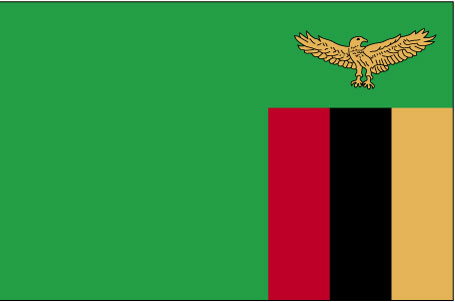
Flag, anthem, and other symbols of national identity.