
 English
 Español
 中文
中文 हिन्दी
 Français
Lithuania
Lietuva
Declare Your Relationship to Lithuania
CountryReports Community
- Studying1
- From Lithuania1
- Lithuania heritage2
- Visited3
- Want to visit2
Customs and Culture
Customs and Culture
About the People
Lithuanians are often reserved and sincere. Lithuanians are proud of their heritage but not of the Soviet period.
Cultural Attributes
Lithuanians are often reserved and sincere. Lithuanians are proud of their heritage but not of the Soviet period.

Amber's Cradle, Freedom's Spirit
Greetings, Gestures & Visiting
Lithuania belongs to the Baltic group of languages and uses the Latin alphabet. Several letters have special marks above or below them to indicate how they should be pronounced. For example, ?; is pronounced “sh” as in ship; è is pronounced “ch” as in check; é is pronounced “ai” as in pair; and i is pronounced “ee” as in feet.
The most common greeting is the handshake, with direct eye contact, and a smile.
It is impolite to talk with hands in the pockets. Lithuanians do not touch each other while speaking. Avoid pointing with your index finger; use your whole hand or resort to explaining rather than pointing.
Drinking vodka (for men only) is common during most social visits. Guests are expected to be punctual. Table manners are Continental style- with in holding a fork in the left hand and the knife in the right while eating. Napkins are kept on the table, not on the lap. To indicate you have not finished eating, cross your knife and fork on your plate. When you have finished eating, place your knife and fork across your plate with the prongs facing down and the handles facing to the right.
Western style clothing is worn. Traditional clothing is worn for festivals. The traditional costume for women is a colorful woven skirt, embroidered blouse, vest and a headpiece with ribbons.
Diet
Traditional specialties include skilandis (smoked meat), ðaltibarðèai (cold beet soup), cepelinai (potato dumplings with minced meat filling), védarai (potato sausages) and bulviniai blynai (potato pancakes). Smoked eel is a famous Baltic delicacy.
There are many regional specialties. The Highlanders, or Aukðtaièiai, who live in the northeast region, are known for their pancakes and cottage cheese dishes. The þemaièiai, who inhabit the lowlands, are known for herbed dips, porridges and gruels. In the southeast region, buckwheat, mushrooms and potatoes are important staples, and in the southwest, smoked meats, sausages and cepelinai (dumplings) are part of many dishes.
A traditional breakfast may be bread and cheese with cold cuts, or pancakes filled with cheese. At lunch, many Lithuanians enjoy a hearty soup or stew. Cold beetroot soup is refreshing in summer and hot beetroot soup (barsciai borscht) is warming in winter. For dinner, Lithuanians usually have a meat dish with potatoes and vegetables; pork is the most popular meat.
Popular Lithuanian desserts include honey cake, pastries and ice cream. At Christmas, people enjoy a special fruitcake called kisielius.
Traditional specialties include skilandis (smoked meat), ðaltibarðèai (cold beet soup), cepelinai (potato dumplings with minced meat filling), védarai (potato sausages) and bulviniai blynai (potato pancakes). Smoked eel is a famous Baltic delicacy.
There are many regional specialties. The Highlanders, or Aukðtaièiai, who live in the northeast region, are known for their pancakes and cottage cheese dishes. The þemaièiai, who inhabit the lowlands, are known for herbed dips, porridges and gruels. In the southeast region, buckwheat, mushrooms and potatoes are important staples, and in the southwest, smoked meats, sausages and cepelinai (dumplings) are part of many dishes.
A traditional breakfast may be bread and cheese with cold cuts, or pancakes filled with cheese. At lunch, many Lithuanians enjoy a hearty soup or stew. Cold beetroot soup is refreshing in summer and hot beetroot soup (barsciai borscht) is warming in winter. For dinner, Lithuanians usually have a meat dish with potatoes and vegetables; pork is the most popular meat.
Popular Lithuanian desserts include honey cake, pastries and ice cream. At Christmas, people enjoy a special fruitcake called kisielius.

Family
Many Lithuanians live in apartments and maintain a small cottage in the country, where they can grow fruits and vegetables and relax outdoors. Lithuanians tend to marry in their early twenties. Common-law marriages, although generally accepted by society, are not regarded as a legal form of marriage. The divorce rate is high and single mothers head many households. Elders are treated with respect and it is not unusual for parents to live with their adult children and help raise their grandchildren. Young children are expected to obey their parents and may be disciplined if they do not.
Recreation
Basketball is the country's most popular sport. On weekends and during vacations, many families spend time at cottages that they build themselves, known as “sodyba”. The cottages are made of brick and wood. Families grow flowers and vegetables and spend time relaxing, collecting berries and picking mushrooms. Nearly every cottage has an indoor or outdoor sauna.
Many Lithuanians visit national parks and beach resorts on their holidays. Aukstaitija National Park, in eastern Lithuania, attracts cross-country skiers in the winter and canoeists in summer. Bird-watchers frequent the west coast, especially the town of Vente, on the eastern side of the Curonian Lagoon. In the depths of winter, ice fishing is popular on the frozen Curonian Lagoon.
Holidays
Independence Day
2/16Independence Day
16 February 1918 is the date Lithuania declared its independence from Soviet Russia and established its statehood; 11 March 1990 is the date it declared its independence from the Soviet Union
Christmas
12/25Christmas
Dates of Interest
- December 25th
February 16, 1918 is the date Lithuania declared its independence from Soviet Russia and established its statehood; 11 March 1990 is the date it declared its independence from the Soviet Union
How do people greet each other in Lithuania?
The most common greeting is a handshake with direct eye contact and a smile. Lithuanian belongs to the Baltic group of languages and uses the Latin alphabet, with special marks above or below some letters to indicate pronunciation.
Do
- Shake hands with direct eye contact and a smile
What are dining and eating customs like in Lithuania?
Table manners are Continental style, and guests are expected to be punctual. Meals feature hearty dishes such as soups, stews, and pork with potatoes and vegetables.
Do
- Be punctual as a guest
- Hold your fork in the left hand and knife in the right
- Keep your napkin on the table
- Cross your knife and fork on your plate to show you are still eating
Don’t
- Don't place your napkin on your lap
Good to know
- When finished, place your knife and fork across your plate with prongs facing down and handles to the right
- Try traditional specialties like cepelinai (potato dumplings), saltibarsciai (cold beet soup), and smoked eel
- Cold beetroot soup is served in summer and hot beetroot soup in winter
What social etiquette should I know in Lithuania?
Lithuanians tend to be reserved and sincere, proud of their heritage but not of the Soviet period. Drinking vodka (for men only) is common during most social visits.
Good to know
- Be aware that Lithuanians are not proud of the Soviet period
How should I dress in Lithuania?
Western-style clothing is worn day to day, while traditional costume is reserved for festivals.
Good to know
- The traditional women's costume is a colorful woven skirt, embroidered blouse, vest, and a headpiece with ribbons
Are there gestures I should avoid in Lithuania?
Lithuanians generally do not touch each other while speaking, and certain gestures are considered impolite.
Don’t
- Don't talk with your hands in your pockets
- Don't touch others while speaking
- Don't point with your index finger
Good to know
- Use your whole hand, or explain rather than point
What is family life like in Lithuania?
Elders are treated with respect, and parents often live with their adult children to help raise grandchildren. Many Lithuanians live in apartments and keep a small country cottage.
Good to know
- Lithuanians tend to marry in their early twenties
- Young children are expected to obey their parents
What do Lithuanians do for recreation?
Basketball is the most popular sport, and families spend weekends and vacations at self-built cottages known as "sodyba" where they garden, collect berries, and pick mushrooms.
Good to know
- Nearly every cottage has an indoor or outdoor sauna
- Aukstaitija National Park attracts cross-country skiers in winter and canoeists in summer
- Bird-watchers frequent the west coast, especially the town of Vente on the Curonian Lagoon
- Ice fishing is popular on the frozen Curonian Lagoon in winter
Last updated: 2026-07-12 · Sources: CountryReports
Photos of Lithuania
Photos of Lithuania
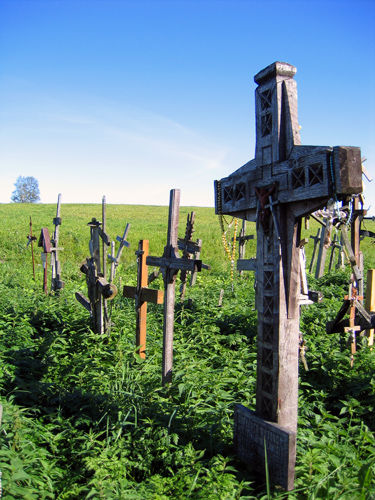
Hills of Crosses, Lithuania. September 2004
Hills of Crosses, Lithuania. September 2004
Hills of Crosses, Lithuania. September 2004
Women at country bus stop.
Woman at a country bus stop.
Trees grows on a rooftop in Vilnius, Lithuania
Curonian Spit, Lithuania
Christmas tree in Kaunas city hall
Vilnius at Christmas
Zepeliny - This is National food of Lithuania


Travel and Tourism
Travel and Tourism
- Travel Alert Status
- Level 1: Exercise Normal Precautions
- Currency
- litas (LTL)
- Time Difference
- UTC+2 (7 hours ahead of Washington, DC, during Standard Time)
- Climate
- Lithuania's climate is moderate. Summer brings average temperatures of 65°F (afternoon highs in the 70s and 80s) and plentiful rain. July is the warmest month. Summer days are long, with only a few hours of darkness. Winters tend to be cold, damp, and overcast. Temperatures average about 30°F, and days are very short. Average annual precipitation amounts to about 26 inches.
- Airports
- 102
Read the full travel guide — health, safety, vaccinations, disease risk, sanitation, and transit details.
View full travel guideRecipes
Recipes
Cottage Cheese Potato Pancakes
Main Dish
Main Dish
Saltibarsciai (Cold Beet Soup)
Main Dish
Cepelinai (Meat Cooked Inside a Ball of Potato Dough, Served With a Special Sauce)
Main Dish
Cottage Cheese Potato Pancakes
Side Dish
Kugelis (Baked Potato Pudding)
Dessert
Spanguoliu Kisielius (Cranberry pudding)
Dessert
Saltanosiai (Cold noses--Blueberry Dumplings)
Main Dish
PremiumCottage Cheese Potato Pancakes
History
History
Historical Eras
Baltic Origins
3000 BCE – 1230
Proto-Baltic peoples migrated to the eastern Baltic region around 3000 BCE, establishing amber-trading cultures known to the Romans. Over millennia, distinct ethnic groups emerged, including Lithuanians, Latvians, and Old Prussians. By the early medieval period, Lithuanian tribes were under increasing pressure from Slavic neighbors to the east and the crusading Teutonic Knights to the west.
Grand Duchy of Lithuania
1230 – 1569
Duke Mindaugas united the Lithuanian tribes around 1230 and was crowned king in 1253, founding the Lithuanian state. Under the Gediminas dynasty, the Grand Duchy expanded dramatically, stretching from the Baltic to the Black Sea. Grand Duke Jogaila's 1386 union with Poland and the decisive defeat of the Teutonic Knights at Tannenberg in 1410 marked the height of Lithuanian power and its full integration into Latin Christendom.
Polish-Lithuanian Commonwealth
1569 – 1795
The Union of Lublin in 1569 merged Lithuania and Poland into a single federated state, with its capital at Kraków. Polish nobility and the Catholic Church came to dominate Lithuanian political and cultural life, gradually marginalizing the Lithuanian language and native institutions. The Commonwealth weakened over the eighteenth century under external pressure, ending with the final partition of 1795 when Russia, Prussia, and Austria divided its territories.
Russian Imperial Rule
1795 – 1918
Following annexation by the Russian Empire, Lithuania was administered as a tsarist province and subjected to intense Russification, including bans on Lithuanian-language publications in Latin script and suppression of the Roman Catholic Church. Polish-led insurrections in 1831 and 1863 failed to restore independence. A Lithuanian national awakening in the 1880s revived cultural consciousness and laid the groundwork for independence movements that would bear fruit after World War I.
First Independence
1918 – 1940
Lithuania declared independence on February 16, 1918, and successfully defended it in wars against Soviet Russia, Germany, and Poland between 1918 and 1920. The interwar republic undertook significant land reform and recovered the Klaipėda (Memel) region in 1923, though Vilnius remained under Polish control until 1939. A military coup in 1926 installed an authoritarian government under Antanas Smetona, which governed until the Soviet occupation in June 1940.
Soviet Era & Independence
1940 – present
Soviet annexation in 1940, Nazi occupation from 1941 to 1944, and renewed Soviet rule devastated Lithuania, including the near-total destruction of its Jewish community during the Holocaust. On March 11, 1990, Lithuania became the first Soviet republic to declare restored independence, recognized internationally in September 1991. The country subsequently transitioned to a market economy and democratic governance, joining both NATO and the European Union in 2004.
Overview
Early History
Lithuanians belong to the Baltic group of nations. Their ancestors moved to the Baltic region about 3000 B.C. from beyond the Volga region of central Russia. In Roman times, they traded amber with Rome and around A.D. 900-1000 split into different language groups, namely, Lithuanians, Prussians, Latvians, Semigallians, and others. The Prussians were conquered by the Teutonic Knights, and, ironically, the name "Prussia" was taken over by the conquerors, who destroyed or assimilated Prussia’s original inhabitants. Other groups also died out or were assimilated by their neighbors. Only the Lithuanians and the Latvians survived the ravages of history. Traditions of Lithuanian statehood date from the early Middle Ages. As a nation, Lithuania emerged about 1230 under the leadership of Duke Mindaugas. He united Lithuanian tribes to defend themselves against attacks by the Teutonic Knights, who had conquered the kindred tribes of Prussia and also parts of present-day Latvia. In 1251 Mindaugas accepted Latin Christianity, and in 1253 he became king. But his nobles disagreed with his policy of coexistence with the Teutonic Knights and with his search for access to western Europe. Mindaugas was killed, the monarchy was discontinued, and the country reverted to paganism. His successors looked for expansion toward the Slavic East. At that early stage of development, Lithuania had to face the historically recurring question dictated by its geopolitical position--whether to join western or eastern Europe. At the end of the fourteenth century, Lithuania was already a large empire extending from the Baltic Sea to the shores of the Black Sea. Grand Duke Jogaila (r. 1377-81 and 1382-92) of the Gediminas Dynasty faced a problem similar to that faced by Mindaugas 150 years earlier: whether to look to the East or the West for political and cultural influences. Under pressure from the Teutonic Knights, Lithuania, a kingdom of Lithuanians and Slavs, pagans and Orthodox Christians, could no longer stand alone. Jogaila chose to open links to western Europe and to defeat the Teutonic Knights, who claimed that their mission was not to conquer the Lithuanians but to Christianize them. He was offered the crown of Poland, which he accepted in 1386. In return for the crown, Jogaila promised to Christianize Lithuania. He and his cousin Vytautas, who became Lithuania’s grand duke, converted Lithuania to Christianity beginning in 1387. Lithuania was the last pagan country in Europe to become Christian. The cousins then defeated the Teutonic Knights in the Battle of Tannenberg in 1410, stopping Germanic expansion to the east. Attempts by Vytautas to separate Lithuania from Poland (and to secure his own crown) failed because of the strength of the Polish nobility. Lithuania continued in a political union with Poland. In 1569 Lithuania and Poland united into a single state, the Polish-Lithuanian Commonwealth, whose capital was Kraków, and for the next 226 years Lithuania shared the fate of Poland. During this period, Lithuania’s political elite was dominated by the Polish nobility and church, resulting in neglect of the Lithuanian language and introduction of Polish social and political institutions. It also opened the doors to Western models in education and culture. In 1795 an alliance between the Germanic states--Prussia and Austria--and the Russian Empire ended Poland’s independent existence. Lithuania became a Russian province. Two insurrections, initiated by the Poles in 1831 and again in 1863, failed to liberate the country. The Russian Empire eliminated Polish influence on Lithuanians and introduced Russian social and political institutions. Under tsarist rule, Lithuanian schools were forbidden, Lithuanian publications in the Latin script were outlawed, and the Roman Catholic Church was severely suppressed. However, the restrictive policies failed to extinguish indigenous cultural institutions and language. A national awakening in the 1880s, led by the secular and clerical intelligentsia, produced demands for self-government. In 1905 Lithuania was the first of the Russian provinces to demand autonomy. Independence was not granted because the tsar firmly reestablished his rule after the Revolution of 1905. But the demand, articulated by the elected Grand Diet of Vilnius, was not abandoned. World War I led to the collapse of the two empires--the Russian and the German--making it possible for Lithuania to assert its statehood. Germany’s attempt to persuade Lithuania to become a German protectorate was unsuccessful. On February 16, 1918, Lithuania declared its full independence, and the country still celebrates that day as its Independence Day.Timeline of Key Events
2500 BCE – 1500 BCE
Finno-Ugric and proto-Baltic tribes settle on Baltic shores.
Finno-Ugric and proto-Baltic tribes settle on Baltic shores.
1 – 100
Early Baltic peoples experience rapid cultural progress.
Early Baltic peoples experience rapid cultural progress and expansion of trade with Roman Empire and Germanic tribes.
701 – 1200
Scandinavian Vikings and Slavic tribes engage in trade and war with Baltic peoples.
Scandinavian Vikings and, subsequently, Slavic tribes engage in trade and war with Baltic peoples.
1253
Mindaugas crowned king of Lithuania.
Mindaugas crowned king of Lithuania.
1300
Grand Duke Gediminas expand Lithuania’s territories southward to Black Sea.
Grand Duke Gediminas and his descendants expand Lithuania’s territories southward to Black Sea.
1569
Lithuania unites with Poland, forming Polish-Lithuanian Commonwealth.
Lithuania unites with Poland, forming Polish-Lithuanian Commonwealth.
1710
Russian tsar Peter I (the Great) succeeds in wresting control of Estland and Livland.
Russian tsar Peter I (the Great) succeeds in wresting control of Estland and Livland (southern Estonia and northern Latvia) from Sweden.
Read the full history profile — narrative overview, defining eras, and the complete timeline in one place.
View expanded historyInteresting Facts
Interesting Facts
When a child loses a tooth they keep their tooth as a keepsake.
There are more than one million Lithuanians living in the United States, Canada, South America, the United Kingdom, Poland, Germany and Australia. More than 150,000 Lithuanians live in Russia and other Eastern European countries.
Amber, Lithuania's gold,” washes up on the Curonian Spit. Amber is formed from the resin of ancient trees that lived 40 to 55 million years ago. Over time, the resin hardens into golden or red translucent deposits, some of which contain insects that were trapped in the resin when it hardened. Amber is used to make jewellery.
Lithuanian forests play an important part in regional folk tales. During times of war, the forests were a safe haven for those in danger. The oak tree was worshipped during pre-Christian times and today represents longevity and strength. Lithuanians often plant oak trees to mark important occasions.
The current Lithuanian president, Valdas Adamkus, elected in 1998, emigrated from Lithuania to the United States in 1944. He spent most of his adult life working in Chicago for the Environmental Protection Agency of the United States before returning to Lithuania.
In the past, Lithuanians held a wake when someone died. For the entire night before the burial of the body, hymns and laments were sung for the soul of the deceased.
See every fact — trivia, oddities, and curious tidbits gathered from across the country.
View all interesting factsGeography and Environment
Geography and Environment
- Terrain
- lowland, many scattered small lakes, fertile soil
- Climate
- Lithuania's climate is moderate. Summer brings average temperatures of 65°F (afternoon highs in the 70s and 80s) and plentiful rain. July is the warmest month. Summer days are long, with only a few hours of darkness. Winters tend to be cold, damp, and overcast. Temperatures average about 30°F, and days are very short. Average annual precipitation amounts to about 26 inches.
- Natural Hazards
- NA
- Current Environmental Issues
- contamination of soil and groundwater with petroleum products and chemicals at military bases
Read the full geography and environment profile — terrain, climate, natural resources, hazards, land use, and international agreements.
View full geographyPeople & Demographics
People & Demographics
Religion
Languages Spoken
Lithuanian (official), Polish, Russian
- Lithuanian
- Polish
- Russian
Population
- Population
- 3,545,319
- Population in Major Urban Areas
- VILNIUS (capital) 546,000
- Nationality Noun
- Lithuanian(s)
- Ethnic Groups
- Lithuanian 80.6%, Russian 8.7%, Polish 7%, Belarusian 1.6%, other 2.1%
Education
- Literacy Definition
- age 15 and over can read and write
Health Information
- Major Infectious Diseases — degree of risk
- intermediate
Read the full people and society profile — demographics, health, education, religion, languages, and notable people.
View full people and societyGovernment & Politics
Government & Politics
Country Identity
- Country Name
- Lithuania
- Full Country Name
- Republic of Lithuania
- Local - Long
- Lietuvos Respublika
- Local - Short
- Lietuva
- Former Name
- Lithuanian Soviet Socialist Republic
Government Structure
- Government Type
- parliamentary democracy
- Legal System
- based on civil law system; legislative acts can be appealed to the constitutional court
- Executive Branch
- chief of state: President Gitanas NAUSĖDA (since 12 July 2019; reelected 26 May 2024) head of government: Prime Minister Gintautas PALUCKAS (since December 2024) cabinet: Council of Ministers appointed by the president on the nomination of the prime minister elections: president elected by popular vote for a five-year term; election last held 12 and 26 May 2024 (next to be held in 2029); prime minister appointed by the president on the approval of the Parliament (Seimas) election results: Gitanas NAUSĖDA reelected president; percent of vote in second round - Gitanas NAUSĖDA 74.6%, Ingrida ŠIMONYTĖ 24.0%
- Legislative Branch
- unicameral Parliament or Seimas (141 seats, 71 members are directly elected by popular vote, 70 are elected by proportional representation; members serve four-year terms) elections: last held 10 and 24 October 2004 (next to be held October 2008) election results: percent of vote by party - Labor 28.6%, Working for Lithuania (Social Democrats and Social Liberals) 20.7%, TS 14.6%, For Order and Justice (Liberal Democrats and Lithuanian People's Union) 11.4%, Liberal and Center Union 9.1%, Union of Farmers and New Democracy 6.6%, other 9%; seats by faction - Labor 39, Homeland Union 26, Social Democrats 22, Social Liberals 10, Liberal Political group 10, Union of Farmers and New Democracy Parties 11, Liberal Democrats 9, Liberal Center Political group 8, independents 6
- Judicial Branch
- Constitutional Court; Supreme Court; Court of Appeal; judges for all courts appointed by the President
- Suffrage
- 18 years of age; universal
- Constitution
- adopted 25 October 1992
- Independence
- 11 March 1990 (independence declared from Soviet Union); 6 September 1991 (Soviet Union recognizes Lithuania's independence)
- National Holiday
- Independence Day, 16 February (1918); note - 16 February 1918 is the date Lithuania declared its independence from Soviet Russia and established its statehood; 11 March 1990 is the date it declared its independence from the Soviet Union
Capital City
- Capital Name
- Vilnius
- Capital - geographic coordinate
- 54 41 N, 25 19 E
- Capital Time Difference
- UTC+2 (7 hours ahead of Washington, DC, during Standard Time)
named after the Vilnia River, which flows into the Neris River at Vilnius; the river name derives from the Lithuanian word "vilnis" meaning "a surge"
Military
Branches: Lithuanian Armed Forces (Lietuvos Ginkluotosios Pajegos): Land Forces (Sausumos Pajegos), Naval Forces (Karines Juru Pajegos), Air Forces (Karines Oro Pajegos)
Embassy / Diplomatic Mission
U.S. Embassy Vilnius
Akmenu Gatve 6
Vilnius, Lithuania LT-03106.
Telephone: (370) (5) 266-5500
Facsimile (370) (5) 266-5590
Email: ConSec@state.gov
Read the full government profile — flag symbolism, national anthem, and other national symbols.
View full government detailsEconomy
Economy
Lithuania, once heavily dependent on trade with Russia, has transformed into one of the fastest-growing economies in the European Union. Since joining the EU in 2004, NATO in 2004, and adopting the euro in 2015, Lithuania has firmly oriented its economy toward Western markets. The country became a member of the OECD in 2018, further cementing its integration into the global economy.
Unemployment has fallen significantly from its early-2000s highs, hovering around 6–7% in recent years, though pockets of regional and structural unemployment persist. Economic growth has been supported by strong domestic consumption, a competitive export sector, robust foreign direct investment, and a rapidly expanding fintech and information technology industry, with Vilnius emerging as a major fintech hub in the EU.
Following Russia's invasion of Ukraine in 2022, Lithuania accelerated efforts to eliminate its remaining energy dependence on Russia, becoming the first EU country to halt Russian gas, oil, and electricity imports. Investments in the Klaip?da LNG terminal, renewable energy, and grid synchronization with continental Europe have strengthened energy security.
Privatization of state-owned enterprises is largely complete, and the private sector now drives the bulk of economic activity. Key exports include refined petroleum, furniture, machinery, food products, and chemicals, with Germany, Poland, Latvia, and other EU partners serving as primary trading partners. While inflation surged in 2022 amid the energy crisis, it has since moderated, and Lithuania continues to demonstrate resilience and steady convergence with Western European living standards.
Snapshot
- Currency Name and Code
- Euro (EUR)
- GDP — official exchange rate
- $23,500,000,000 (USD)
- GDP Real Growth Rate
- 7.5%
- Gini Index
- 31.9
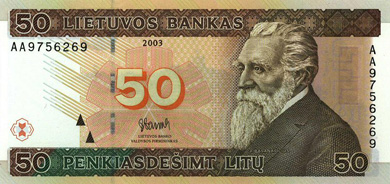
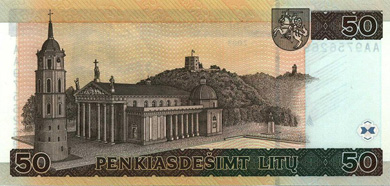
Banknotes
Budget & Public Finance
- Fiscal Year
- calendar year
- Annual Budget
- $9,103,000,000 (USD)
- Public Debt (% of GDP)
- 21.4%
- External Debt
- $10,470,000,000 (USD)
- Investment (% of GDP)
- 22.1%
- Economic Aid
- $228,500,000 (USD)
- Reserves of Foreign Exchange
- $2,147,483,647 (USD)
Labor, Industry & Trade
- Labor Force by Occupation
- industry 30%; agriculture 20%; services 50%
- Household Income — highest 10%
- 25.6%
- Industries
- metal-cutting machine tools, electric motors, television sets, refrigerators and freezers, petroleum refining, shipbuilding (small ships), furniture making, textiles, food processing, fertilizers, agricultural machinery, optical equipment, electronic components, computers, amber
- Agriculture Products
- grain, potatoes, sugar beets, flax, vegetables; beef, milk, eggs; fish
- Export Commodities
- mineral products 23%, textiles and clothing 16%, machinery and equipment 11%, chemicals 6%, wood and wood products 5%, foodstuffs 5%
- Export Partners
- UK 13.4%, Russia 12.1%, Germany 10.4%, Latvia 9.7%, Denmark 5.1%, Sweden 4.2%, France 4.1%
- Import Commodities
- mineral products 21%, machinery and equipment 17%, transport equipment 11%, chemicals 9%, textiles and clothing 9%, metals 5%
- Import Partners
- Russia 22.2%, Germany 17.8%, Italy 5.1%, Poland 5%
Energy
- Oil Production
- 12,360 bbl/day
- Oil Consumption
- 89,000 bbl/day
- Oil Reserves
- 0 bbl/day
- Natural Gas Production
- 0 cu m
- Natural Gas Consumption
- 3,030,000,000 cu m
- Natural Gas Imports
- 2,760,000,000 cu m
- Natural Gas Exports
- 0 cu m
- Natural Gas Reserves
- 0 cu m
Communications
- Telephone System
- general assessment: adequate; being modernized to provide improved international capability and better residential access domestic: rapid expansion of mobile-cellular services has resulted in a steady decline in the number of fixed-line connections; mobile-cellular teledensity stands at about 140 per 100 persons international: country code - 370; major international connections to Denmark, Sweden, and Norway by submarine cable for further transmission by satellite; landline connections to Latvia and Poland
- Internet Country Code
- .lt
News & Weather
News & Weather
Current Weather
Latest News
Lithuanian defence minister: Putin needs new victory and is eyeing Baltics and Poland - Українська правда
Українська правда · 22h ago
Lithuania vs Israel - Class. Game 9-10 - FIBA U20 EuroBasket 2026 - FIBA Basketball
FIBA Basketball · 2d ago
Lithuania‘s National Alliance eyes 2028 breakthrough as support holds at 4–5 percent - The Baltic Times
The Baltic Times · 19h ago
Putin looks for new targets in Baltics as Ukraine invasion stalls, Lithuania's defense minister warns - The Kyiv Independent
The Kyiv Independent · 19h ago
From e-waste to early warning: Lithuanian start-up turns old phones into drone detectors - TVP World
TVP World · 1d ago
Baltics and Poland warn Russia could launch limited military or hybrid provocation against NATO - AP News
AP News · 5d ago
A drone alert blasted on my phone – we had to take shelter. This is the new reality on Nato’s eastern flank | Linas Kojala - The Guardian
The Guardian · 41d ago
36 Hours in Vilnius, Lithuania: Things to Do and See - The New York Times
The New York Times · 26d ago
News via Google News
Climate Overview
Lithuania's climate is moderate. Summer brings average temperatures of 65°F (afternoon highs in the 70s and 80s) and plentiful rain. July is the warmest month. Summer days are long, with only a few hours of darkness. Winters tend to be cold, damp, and overcast. Temperatures average about 30°F, and days are very short. Average annual precipitation amounts to about 26 inches.
Frequently Asked Questions
Frequently Asked Questions
What is the population of Lithuania?
How do people greet each other in Lithuania?
What are dining and eating customs like in Lithuania?
What social etiquette should I know in Lithuania?
How should I dress in Lithuania?
Are there gestures I should avoid in Lithuania?
What is family life like in Lithuania?
What do Lithuanians do for recreation?
What is the capital of Lithuania?
Where is Lithuania located?
What countries border Lithuania?
What is the predominant religion in Lithuania?
What currency is used in Lithuania?
What language is spoken in Lithuania?
What is the geography of Lithuania like?
What is Lithuania known for?
Last reviewed 2026