
 English
 Español
 中文
中文 हिन्दी
 Français
Ireland
Declare Your Relationship to Ireland
CountryReports Community
- Studying0
- From Ireland0
- Ireland heritage2
- Visited0
- Want to visit0
Customs and Culture
Customs and Culture
About the People
Friendship is an important part of Irish culture. Loyalty to family and friends is highly valued and many Irish legends and songs describe the lengths to which people will go to help friends or family members. The Irish are courteous, quick-witted and will go out of their way to welcome visitors to their country.
Although they work very hard, the Irish are dedicated to a less stressful lifestyle that allows time for friends and family, a visit to the pub, a cup of tea, or just a bit of a chat on the corner. In the past decade, Ireland has undergone a social revolution. Practices once forbidden by the Catholic church are now permitted.
The Irish love to meet their friends in pubs, where they chat, sing songs and tell stories. There are more than 11,000 pubs in Ireland. Although the legal drinking age is 18, anyone over the age of 14 may enter a pub.
The Irish are not very physically demonstrative and are not comfortable with public displays of affection. They are uncomfortable with loud, aggressive, and arrogant behavior. A “Reverse V for victory” gesture is considered obscene.
The Irish are not very time conscious and may not be punctual for business and social meetings. They have a relaxed sense of time and may be a little late for meetings. Irish people tend to be creative and calm in a crisis. They prefer to improvise rather than follow a rigid plan.
Cultural Attributes
Friendship is an important part of Irish culture. Loyalty to family and friends is highly valued and many Irish legends and songs describe the lengths to which people will go to help friends or family members. The Irish are courteous, quick-witted, and will go out of their way to welcome visitors to their country.
Although they work very hard, the Irish are dedicated to a less stressful lifestyle that allows time for friends and family, a visit to the pub, a cup of tea, or just a bit of a chat on the corner. In the past decade, Ireland has undergone a social revolution. Practices once forbidden by the Catholic church are now permitted.
The Irish love to meet their friends in pubs, where they chat, sing songs, and tell stories. There are more than 11,000 pubs in Ireland. Although the legal drinking age is 18, anyone over the age of 14 may enter a pub.
The Irish are not very physically demonstrative and are not comfortable with public displays of affection. They are uncomfortable with loud, aggressive, and arrogant behavior. A “Reverse V for victory” gesture is considered obscene.
The Irish are not very time-conscious and may not be punctual for business and social meetings. They have a relaxed sense of time and may be a little late for meetings. Irish people tend to be creative and calm in a crisis. They prefer to improvise rather than follow a rigid plan.

Land of Rebellion and Resilient Song
Greetings, Gestures & Visiting
Ireland has two official languages: English and Gaelige (Irish Gaelic), commonly referred to simply as Irish. The Constitution recognizes Irish as the national language and English as the second official language.
In the 19th century, the Irish language became a symbol of Irish independence. In 1893 Douglas Hyde and Eoin McNeill founded the Gaelic League to promote the use of Irish Gaelic. By the early 20th century, poets were writing in Irish and children were studying Irish in schools.
When you meet people shake hands with everyone present - men, women, and children - at a business or social gathering. Shake hands again when leaving.
When visiting one may be within a traditional cottage in the countryside which is built of stone and has thatched roofs. Newer farmhouses and buildings have replaced many cottages.
European fashions with an Irish influence is common. Clothes worn in public are conservative. Shorts, flashy colors, and styles are uncommon in Irish style. A raincoat is needed year-round.
Diet
Irish cooking is based on meat, potatoes and vegetables, such as onions and cabbage. Potatoes are particularly important in the Irish diet. They are used to make chips, potato bread, boxty (a type of potato pancake), colcannon (mash potatoes with kale or scallions), and poitín (an alcoholic drink made from distilled potatoes).
The Irish enjoy pork, ham and bacon dishes, including black pudding and white pudding. Black pudding is made with pork, pork blood, cereals and seasoning; white pudding is similar, but without the blood. Mutton and lamb are also popular and are cooked with potatoes, onions and other vegetables to make struisín gaelach (Irish stew). Fish and seafood are abundant, including a miniature lobster known as a Dublin Bay prawn. The Irish produce excellent dairy products, including butter, buttermilk, cottage cheese, Irish cheddar and ring cheese.
The Irish drink tea at any time of day. They also enjoy stout, a strongly flavored beer made from malt barley, yeast, water and hops. Guinness is one of the best-known beers of this type. Cider is made with apples, fermented in oak vats, and is served cold. Irish whiskeys and Irish liquors are highly regarded throughout the world. Uisce beatha is the Irish term for whiskey. It means “water of life.”
The Irish day traditionally begins with a filling breakfast, such as eggs and bacon. The main meal of the day is served at noon and may feature a hearty soup or stew. Supper is served early in the evening and is generally lighter than the midday meal. The Irish traditionally end their day with a light snack and a cup of tea before bedtime.
Irish cooking is based on meat, potatoes and vegetables, such as onions and cabbage. Potatoes are particularly important in the Irish diet. They are used to make chips, potato bread, boxty (a type of potato pancake), colcannon (mash potatoes with kale or scallions), and poitín (an alcoholic drink made from distilled potatoes).
The Irish enjoy pork, ham and bacon dishes, including black pudding and white pudding. Black pudding is made with pork, pork blood, cereals and seasoning; white pudding is similar, but without the blood. Mutton and lamb are also popular and are cooked with potatoes, onions and other vegetables to make struisín gaelach (Irish stew). Fish and seafood are abundant, including a miniature lobster known as a Dublin Bay prawn. The Irish produce excellent dairy products, including butter, buttermilk, cottage cheese, Irish cheddar and ring cheese.
The Irish drink tea at any time of day. They also enjoy stout, a strongly flavored beer made from malt barley, yeast, water and hops. Guinness is one of the best-known beers of this type. Cider is made with apples, fermented in oak vats, and is served cold. Irish whiskeys and Irish liquors are highly regarded throughout the world. Uisce beatha is the Irish term for whiskey. It means “water of life.”
The Irish day traditionally begins with a filling breakfast, such as eggs and bacon. The main meal of the day is served at noon and may feature a hearty soup or stew. Supper is served early in the evening and is generally lighter than the midday meal. The Irish traditionally end their day with a light snack and a cup of tea before bedtime.

Family
Families are close-knit. The Constitution of the Irish State guarantees the preservation of the family and the institution of marriage. Children usually live with their parents until they marry and it is common for Irish families to take care of elderly relatives, rather than sending them to retirement homes.
Friendship is an important part of Irish culture. Loyalty to family and friends is highly valued and many Irish legends and songs describe the lengths to which people will go to help friends or family members. The Irish are also famous for their hospitality and there is a tradition of kindness to strangers and those in need. In the past, Irish women stayed at home to raise the children and were responsible for most of the housework. Women in lower-income families also help on the farm or hold jobs to supplement the household income. In recent years, more women from the middle classes have entered the workforce and many Irish men share responsibility for raising the children and taking care of the home.
More than half of the population lives in or around cities. In rural areas, living conditions are often simpler than those in cities. Traditional cottages in the countryside are built of stone and have thatched roofs. Newer farmhouses and buildings have replaced many of these cottages.
In the past decade, Ireland has undergone a social revolution. Practices once forbidden by the Catholic church are now permitted. Although Irish society has challenged the dominance of the Catholic Church, Catholicism remains an important part of Irish customs and culture. Many people belong to church organizations and participate in social events organized by their local parish.
Recreation
TRADITIONAL SPORTS
A distinctive Irish sport is hurling or camogie (the female version). The sport, which was invented about 4,000 years ago, has similarities to hockey and lacrosse. A leather ball, about the size of a tennis ball, is kicked or hit with a curved stick called a hurley. Another traditional sport is Gaelic football. The rules are almost the same as those of hurling, but no stick is used. A round ball is kicked, punched, or carried across the field.
Road bowling is another traditional Irish game. The object of the game is to bowl a ball along a two- or three-mile-long course. The winner is the one who completes the course in the fewest number of throws. Bowlers use metal balls called “bullets”.
POPULAR SPORTS
1. Swimming
2. Golf
3. Soccer
4. Aerobics/Keep Fit
5. Cycling
6. Gaelic Football
7. Billiards/Snooker
8. Hurling/Camogie
9. Tennis
10. Jogging
Holidays
Saint Patrick's Day
3/17Other
Birth date - Clive Staples (C.S.)Lewis
11/29Birthday
Birth date - Clive Staples (C.S.) Lewis, British author, was born on Nov. 29, 1898 in Belfast, Northern Ireland.
Dates of Interest
- August
Founded in the 17th century. Fruits and flowers are offered as gifts to God. Old-style country fair.
How do people greet each other in Ireland?
Shake hands with everyone present—men, women, and children—when arriving, and shake hands again when leaving. The Irish are courteous and welcoming to visitors.
Do
- Shake hands with everyone present at business or social gatherings
- Shake hands again when you leave
Don’t
- Don't engage in public displays of affection—the Irish are not very physically demonstrative
- Don't be loud, aggressive, or arrogant
What are meals and food like in Ireland?
Irish cooking centers on meat, potatoes, and vegetables like onions and cabbage, with the main meal traditionally served at noon.
Do
- Try potato dishes like boxty, colcannon, and potato bread
- Sample Irish stew (struisín gaelach), black and white pudding, and Dublin Bay prawns
- Enjoy tea at any time of day, plus stout, cider, or Irish whiskey
Good to know
- The day starts with a filling breakfast such as eggs and bacon
- The main meal is at noon; supper in the early evening is lighter
- Many finish the day with a light snack and a cup of tea before bed
What should I know about Irish etiquette and social attitudes?
The Irish value friendship, loyalty, and a relaxed, less stressful lifestyle, often meeting friends in pubs to chat, sing, and tell stories.
Do
- Relax—the Irish prefer a less stressful pace with time for chat
- Expect people to improvise rather than follow rigid plans
Don’t
- Don't expect strict punctuality—people may be a little late for meetings
- Don't behave loudly, aggressively, or arrogantly
Good to know
- Pubs are central to social life; anyone over 14 may enter, though the legal drinking age is 18
- The Irish tend to stay creative and calm in a crisis
How should I dress in Ireland?
Clothing worn in public is conservative, following European fashions with an Irish influence.
Do
- Dress conservatively
- Carry a raincoat year-round
Don’t
- Avoid shorts, flashy colors, and flashy styles, which are uncommon
Are there gestures to avoid in Ireland?
Be mindful of hand gestures—one common gesture is considered obscene.
Don’t
- Don't make the 'Reverse V for victory' gesture—it is obscene
What is family life like in Ireland?
Families are close-knit, with loyalty to family highly valued and a strong tradition of hospitality and kindness to strangers.
Good to know
- Children usually live with their parents until they marry
- Families commonly care for elderly relatives at home rather than in retirement homes
- Catholicism remains an important part of customs and culture, though society has changed
What sports and recreation are popular in Ireland?
Traditional Irish sports include hurling (and camogie), Gaelic football, and road bowling, while popular activities range from swimming and golf to soccer and cycling.
Good to know
- Hurling/camogie uses a curved stick called a hurley to hit a leather ball
- Gaelic football is similar to hurling but uses no stick
- Road bowling involves bowling a metal 'bullet' along a two- or three-mile course
- Popular sports include swimming, golf, soccer, cycling, and tennis
Last updated: 2026-07-12 · Sources: CountryReports
Photos of Ireland
Photos of Ireland
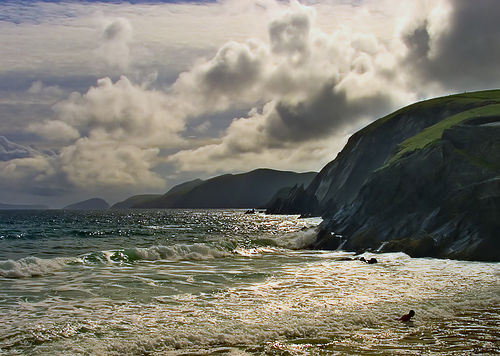
The ocean at Coumeenole, Ireland
Cliffs of Moher, Ireland
Bog road on Slieve Aughty, Co Clare, Ireland
Doonagore Castle overlooking Doolin Point, Co. Clare, Irelan
Firebird on Lough Derg, Iron sculpture at Mountshannon Harbo
Killaloe Bridge on the River Shannon
Lough Derg as seen from near Scariff
Poulnabrone dolmen, the Burren
On Brandon Mountain the start from Faha, Ireland
Brandon Peak and Gearhane, Ireland
Coumaknock, looking down into the east corrie from Brandon
Quin Abbey, Ireland


Travel and Tourism
Travel and Tourism
- Travel Alert Status
- Level 1: Exercise Normal Precautions
- Currency
- euro (EUR)
- Time Difference
- UTC 0 (5 hours ahead of Washington, DC, during Standard Time)
- Climate
- temperate maritime; modified by North Atlantic Current; mild winters, cool summers; consistently humid; overcast about half the time
- Airports
- 39
Read the full travel guide — health, safety, vaccinations, disease risk, sanitation, and transit details.
View full travel guideRecipes
Recipes
Irish Stew
Soup
Main Dish
Dublin Sunday Corned Beef and Cabbage
Main Dish
Leek, Potato and Cheese Pie
Main Dish
Egg, Bacon and Leek Pie
Main Dish
Irish Roast Chicken with Hazelnut Stuffing
Main Dish
Creamed Fresh Haddock
Main Dish
Wild Salmon in Basil Cream
Main Dish
PremiumBoxty (Potato Griddle Cakes)
Main Dish
PremiumDublin Coddle
Main Dish
PremiumCorned Beef Brisket
History
History
Historical Eras
Prehistoric & Celtic Ireland
6000 BCE – 432
The earliest settlers arrived around 6000 BC, followed by Neolithic and Bronze Age peoples who left behind megalithic monuments and elaborate goldwork. Celtic tribes invaded from the fourth century BC onward, establishing five kingdoms with a rich oral and artistic culture. This Gaelic civilization, though marked by constant inter-kingdom conflict, laid the linguistic and cultural foundations of Irish identity.
Christian & Monastic Era
432 – 1169
St. Patrick's arrival in 432 initiated the rapid Christianization of Ireland, displacing the druid tradition and spurring the founding of great monasteries at Clonmacnoise, Armagh, and Iona. Irish monks preserved Latin and Greek learning through the European Dark Ages and produced masterworks such as the Book of Kells. Two centuries of destructive Viking raids beginning in the late 8th century reshaped settlement patterns before Brian Boru's decisive victory at Clontarf in 1014 broke Norse power.
Norman & Medieval Ireland
1169 – 1534
The Anglo-Norman invasion beginning in 1169, sanctioned by Pope Adrian IV and led by Richard de Clare ('Strongbow'), brought feudal structures and English royal claims to Ireland. Norman settlers gradually assimilated into Gaelic society, becoming 'more Irish than the Irish themselves,' a process the English Crown attempted to reverse through the Statutes of Kilkenny in 1366. English authority in practice contracted to a coastal enclave around Dublin known as the Pale, while Gaelic lords and Hiberno-Norman dynasties dominated the interior.
Tudor & Stuart Conquest
1534 – 1691
Henry VIII's break with Rome transformed Irish resistance into a religious as well as political conflict, as the Crown imposed Protestantism on a predominantly Catholic population. The Ulster Plantation of the early 17th century settled Scottish and English Protestants on confiscated Gaelic lands, fundamentally altering the north's demographic character. Successive rebellions — including the Great Catholic-Gaelic Rebellion of 1641 and Cromwell's brutal campaign of 1649-52 — were crushed, and the Williamite victory at the Battle of the Boyne in 1690 entrenched Protestant Ascendancy.
Union & Nationalist Struggle
1691 – 1921
Penal Laws systematically excluded Catholics from land ownership, education, and political life; by 1714 Catholics held barely 7% of Irish land. The Act of Union in 1800 dissolved the Irish Parliament and bound Ireland directly to Westminster, while the Great Famine of 1845–52 killed over one million and triggered mass emigration that permanently transformed the island's population. The Irish Republican Brotherhood, the Home Rule movement under Parnell, and finally the Easter Rising of 1916 built the momentum that brought the Anglo-Irish War and the 1921 Treaty establishing the Irish Free State.
Independent Ireland
1921 – present
The Irish Free State was established in 1922 following partition, with six Ulster counties remaining in the United Kingdom; a devastating civil war over the Treaty's terms followed almost immediately. Full republican status was declared in 1948, and Ireland's accession to the European Community in 1973 accelerated economic and social modernization. The 1998 Good Friday Agreement, brokered with British and American involvement, brought an uneasy peace to Northern Ireland and opened new possibilities for cross-border cooperation.
Overview
Anglo-Irish writers such as Swift, Sheridan, Goldsmith, Burke, Wilde, Joyce, Yeats, Shaw, and Beckett have made a major contribution to world literature over the past 300 years.
The earliest inhabitants--people of a mid-Stone Age culture--arrived about 6000 BC. About 4,000 years later, tribes from southern Europe arrived and established a high Neolithic culture, leaving behind gold ornaments and huge stone monuments. The Bronze Age people, who arrived during the next 1,000 years, produced elaborate gold and bronze ornaments and weapons.
The Iron Age arrived abruptly in the fourth century BC with the invasion of the Celts, a tall, energetic people who had spread across Europe and Great Britain in the preceding centuries. The Celts, or Gaels, and their more numerous predecessors divided into five kingdoms in which, despite constant strife, a rich culture flourished.
The coming of Christianity from across the Irish Sea brought major changes and civilizing influences. Tradition maintains that St. Patrick arrived on the island in AD 432 and, in the years that followed, worked to convert the Irish to Christianity.
The pagan druid tradition collapsed before the spread of the new faith, and Irish scholars excelled in the study of Latin learning and Christian theology in the monasteries that flourished. Missionaries went forth from Ireland to England and the continent, spreading news of the flowering of learning, and scholars from other nations came to Irish monasteries. The excellence and isolation of these monasteries helped preserve Latin and Greek learning during the Dark Ages. The arts of manuscript illumination, metalworking, and sculpture flourished and produced such treasures as the Book of Kells, ornate jewelry, and the many carved stone crosses that dot the island.
Two hundred years of Viking invasion and settlement was later followed by a Norman conquest in the 12th century. The Norman conquest resulted in the assimilation of the Norman settlers into Irish society. The early 17th century saw the arrival of Scottish and English Protestants, sent as colonists to the north of Ireland and the Pale around Dublin.
In 1800 the Irish Parliament passed the Act of Union with Great Britain, and Ireland was an official part of the United Kingdom until 1921. Religious freedom, outlawed in the 18th century, was restored in 1829, but this victory for the Irish Catholic majority was overshadowed by a severe economic depression and the great famine from 1846-48 when the potato crop failed. Millions died, and the millions that emigrated spawned the first mass wave of Irish emigration to the United States. A decade later, in 1858, the Irish Republican Brotherhood (IRB--also known as the Fenians) was founded as a secret society dedicated to armed rebellion against the British. An aboveground political counterpart, the Home Rule Movement, was created in 1874, advocating constitutional change for independence.
Galvanized by the leadership of Charles Stewart Parnell, the party was able to force British governments after 1885 to introduce several home rule bills. The turn of the century witnessed a surge of interest in Irish nationalism, including the founding of Sinn Fein ("Ourselves Alone") as an open political movement.
Nationalism was and is a potent populist force in Irish politics. A home rule bill passed in 1914, but its implementation was suspended until war in Europe ended. Believing the mantra: “England’s problem is Ireland’s opportunity,” and tapping into a mood of Gaelic revivalism, Padraic Pearse and James Connolly led the unsuccessful Easter Rising of 1916. Pearse and the other 1916 leaders declared an independent Irish republic, but a lack of popular support doomed the rebellion, which lasted a week and destroyed large portions of Dublin. The decision by the British military government to execute the leaders of the rebellion, coupled with the British Government’s threat of conscripting the Irish to fight in the Great War, alienated public opinion and produced massive support for Sinn Fein in the 1918 general election. Under the leadership of Eamon de Valera, the elected Sinn Fein deputies constituted themselves as the first Dail. Tensions only increased: British attempts to smash Sinn Fein ignited the Anglo-Irish War of 1919-1921.
The end of the war brought the Anglo-Irish treaty of 1921, which established the Irish Free State of 26 counties within the British Commonwealth and recognized the partition of the island into Ireland and Northern Ireland, though supposedly as a temporary measure. The six predominantly Protestant counties of northeast Ulster--Northern Ireland--remained a part of t
Timeline of Key Events
600 BCE – 150 BCE
Celtic tribes settled on the island
Celtic tribes settled on the island.
100 BCE
Arrival of the Gaels
Arrival of the Gaels.
432
Arrival of St. Patrick
Arrival of St. Patrick to help convert pagan Irish Gaelic Kings to Christianity.
461
St. Patrick dies
St. Patrick dies, after having achieved his dream of introducing both Roman Civilization, and the Christian Church to Ireland.
920
Vikings established settlements at Limerick
Vikings established settlements at Limerick.
1167 – 1169
Arrival of Normans
Arrival of Normans at Baginbun in Co. Wexford thus started 800 year struggle between English and Irish.
1547
Henry VIII dies
Henry VIII dies, succeeded by the boy king Edward VI. England and Ireland were ruled by the senior nobility of England.
Read the full history profile — narrative overview, defining eras, and the complete timeline in one place.
View expanded historyInteresting Facts
Interesting Facts
Ireland per capita drinks the most milk in the world with the average per person each year consuming 164.46 quarts (that's approx. 1.8 cups per person each day or 656 cups per year).
Famous Irish-Canadians include Guy Carleton, governor of Quebec in the 18th century, Thomas D'Arcy McGee, one of the fathers of Confederation, and Timothy Eaton, founder of the T. Eaton Company..
In 1998, Parks Canada unveiled a monument to Irish immigrants on Grosse Ile in the St. Lawrence River. Irish immigrants were quarantined on the island before they entered Canada. In the 1830s, thousands of Irish people died of cholera there and in the 1840s, thousands more died of typhus and were buried on the island.
Peat, or “young coal,” is a type of fuel composed of plants that have decayed in marshes and swamps. Peat bogs cover more than 15% of Ireland. The peat is cut into bricks and dried. Peat can be burned for heat in homes or used to generate electricity in power plants.
During the Potato Famine of 1845 to 1851, Ireland's population dropped by half. A million Irish starved to death and millions more left Ireland and emigrated to countries around the world.
In the 17th century, Irish Catholics were forbidden to own land. Many lived in wagons and travelled from place to place to find work. Today, several thousand “travellers” still live in caravans and camp along the roadside.
See every fact — trivia, oddities, and curious tidbits gathered from across the country.
View all interesting factsGeography and Environment
Geography and Environment
- Terrain
- mostly level to rolling interior plain surrounded by rugged hills and low mountains; sea cliffs on west coast
- Climate
- temperate maritime; modified by North Atlantic Current; mild winters, cool summers; consistently humid; overcast about half the time
- Natural Hazards
- NA
- Current Environmental Issues
- water pollution, especially of lakes, from agricultural runoff
Read the full geography and environment profile — terrain, climate, natural resources, hazards, land use, and international agreements.
View full geographyPeople & Demographics
People & Demographics
Religion
Languages Spoken
English (official, the language generally used), Irish (Gaelic or Gaeilge) (official, spoken mainly in areas along the western coast)
- Irish
- English
Population
- Population
- 4,250,163
- Population: Male/Female
- male: 2,590,542 female: 2,642,919
- Population Distribution
- population distribution is weighted to the eastern side of the island, with the largest concentration being in and around Dublin; populations in the west are small due to mountainous land, poorer soil, lack of good transport routes, and fewer job opportunities
- Urban Population
- urban population: 64.5% of total population rate of urbanization: 1.15% annual rate of change
- Population in Major Urban Areas
- 1.270 million DUBLIN (capital)
- Nationality Noun
- noun: Irishman(men), Irishwoman(women), Irish (collective plural) adjective: Irish
- Ethnic Groups
- Irish 76.6%, Irish travelers 0.6%, other White 9.9%, Asian 3.3%, Black 1.5%, other (includes Arab, Roma, and persons of mixed backgrounds) 2%, unspecified 2.6%
- Language Note
- English (official, the language generally used), Irish (Gaelic or Gaeilge) (official, spoken by approximately 37.7% of the population as of 2022; mainly spoken in areas along Ireland's western coast known as gaeltachtai, which are officially recognized regions where Irish is the predominant language)
Education
- Literacy Definition
- age 15 and over can read and write
Health Information
- Life Expectancy at Birth
- total population: 82 years male: 80.3 years female: 83.9 years
- Alcohol consumption per capita
- total: 10.91 liters of pure alcohol beer: 4.92 liters of pure alcohol wine: 2.88 liters of pure alcohol spirits: 2.29 liters of pure alcohol other alcohols: 0.82 liters of pure alcohol
- Tobacco Use
- total: 20.8% male: 22.5% female: 19%
- Infant Mortality Rate
- total: 3.3 deaths/1,000 live births male: 3.2 deaths/1,000 live births female: 3.3 deaths/1,000 live births
Life Expectancy
- Life Expectancy at Birth
- total population: 82 years male: 80.3 years female: 83.9 years
- Median Age
- total: 40.2 years male: 39.7 years female: 40.6 years
- Age Structure
- 0-14 years: 18.6% (male 498,124/female 477,848) 15-64 years: 65.5% (male 1,701,680/female 1,728,041) 65 years and over: 15.8% (male 390,738/female 437,030)
- Infant Mortality Rate
- total: 3.3 deaths/1,000 live births male: 3.2 deaths/1,000 live births female: 3.3 deaths/1,000 live births
Read the full people and society profile — demographics, health, education, religion, languages, and notable people.
View full people and societyGovernment & Politics
Government & Politics
Country Identity
- Country Name
- Ireland
Government Structure
- Government Type
- republic
- Legal System
- based on English common law, substantially modified by indigenous concepts; judicial review of legislative acts in Supreme Court; has not accepted compulsory ICJ jurisdiction
- Executive Branch
- chief of state: President Michael D. HIGGINS (since 11 November 2011; reelected for a second term on 26 October 2018) head of government: Prime Minister (Taoiseach) Micheál MARTIN (since 9 April 2025); note - Simon HARRIS served as Taoiseach from April 2024 until April 2025 following the formation of a new coalition government after the November 2024 general election cabinet: Cabinet appointed by the president with previous nomination by the prime minister and approval of the House of Representatives (Dáil Éireann) elections: president elected by popular vote for a seven-year term; election last held on 26 October 2018 (next scheduled for October 2025); prime minister nominated by the House of Representatives and appointed by the president election results: Michael D. HIGGINS reelected president in 2018; percent of vote - Michael D. HIGGINS 55.8%, Peter CASEY 23.3%, Seán GALLAGHER 6.4%, Liadh NÍ RIADA 6.4%, Joan FREEMAN 6.0%, Gavin DUFFY 2.2% note: current government coalition consists of Fianna Fáil, Fine Gael, and the Green Party, formed following the 2020 general election; a new coalition of Fianna Fáil, Fine Gael, and independent members was formed in 2025 following the November 2024 general election
- Legislative Branch
- bicameral Parliament or Oireachtas consists of the Senate or Seanad Eireann (60 seats - 49 elected by the universities and from candidates put forward by five vocational panels, 11 are nominated by the prime minister; members serve five-year terms) and the House of Representatives or Dail Eireann (166 seats; members are elected by popular vote on the basis of proportional representation to serve five-year terms) elections: Senate - last held 16 and 17 July 2002 (next to be held by July 2007); House of Representatives - last held 17 May 2002 (next to be held by May 2007) election results: Senate - percent of vote by party - NA; seats by party - Fianna Fail 30, Fine Gael 15, Labor Party 5, Progressive Democrats 4, independents and other 6; House of Representatives - percent of vote by party - Fianna Fail 41.5%, Fine Gael 22.5%, Labor Party 10.8%, Sinn Fein 6.5%, Progressive Democrats 4.0%, Green Party 3.8%, other 10.9%; seats by party - Fianna Fail 81, Fine Gael 31, Labor Party 21, Sinn Fein 5, Progressive Democrats 8, Green Party 6, other 14
- Judicial Branch
- Supreme Court (judges appointed by the president on the advice of the prime minister and cabinet)
- Suffrage
- 18 years of age; universal
- Constitution
- 29 December 1937; adopted 1 July 1937 by plebiscite
- Independence
- 6 December 1921 (from UK by treaty)
- National Holiday
- Saint Patrick's Day, 17 March
Capital City
- Capital Name
- Dublin
- Capital - geographic coordinate
- 53 19 N, 6 14 W
- Capital Time Difference
- UTC 0 (5 hours ahead of Washington, DC, during Standard Time)
derived from Irish dubh and lind meaning respectively "black, dark" and "pool" and which referred to the dark tidal pool where the River Poddle entered the River Liffey; today the area is the site of the castle gardens behind Dublin Castle
Military
Branches: Irish Defense Forces (Oglaigh na h-Eireannn), Permanent Defence Force: Army, Naval Service, Air Corps
Embassy / Diplomatic Mission
U.S. Embassy Dublin
42 Elgin Road
Ballsbridge
Dublin 4
Telephone: 353-1-668-8777
Emergency after-hours telephone: 353-1-630-6200
Facsimile: 353-1-668-8056
Read the full government profile — flag symbolism, national anthem, and other national symbols.
View full government detailsEconomy
Economy
Ireland is a small, modern, knowledge-based, and highly open economy that ranks among the wealthiest in the European Union on a per capita basis. After experiencing one of the deepest recessions in the eurozone during the 2008 global financial crisis and requiring an EU-IMF bailout in 2010, Ireland staged a remarkable recovery and has since posted some of the strongest growth rates in Europe. GDP expanded sharply through the late 2010s, though headline figures are heavily distorted by the activities of multinational corporations headquartered in the country. To address this distortion, Irish authorities use a modified measure known as Gross National Income (GNI*), which provides a more accurate picture of the domestic economy.
Services now dominate the Irish economy, accounting for roughly 75% of GDP and employing the majority of the labor force, while industry contributes around 25% and agriculture less than 1%. Key sectors include pharmaceuticals, medical devices, information and communications technology, financial services, and agri-food. Ireland's low corporate tax rate, English-speaking workforce, and EU membership have made it a major hub for foreign direct investment, particularly from U.S.-based technology and pharmaceutical multinationals such as Apple, Google, Meta, Microsoft, and Pfizer.
Exports remain the primary engine of growth, with pharmaceuticals, chemicals, computer services, and food products leading the way. The economy has also benefited from strong consumer spending, robust construction activity, and rising business investment, though housing shortages, infrastructure bottlenecks, and high living costs continue to pose challenges. Inflation, which spiked in 2022 due to energy prices and global supply pressures, has since moderated.
Ireland joined the euro currency system at its launch in January 1999 and remains a committed member of the eurozone. The government continues to run budget surpluses driven in part by exceptionally strong corporation tax receipts, and it has established sovereign wealth funds to manage future fiscal risks and demographic pressures.
Snapshot
- Currency Name and Code
- Euro (EUR)
- GDP — official exchange rate
- $188,400,000,000 (USD)
- GDP Real Growth Rate
- 4.7%
- Gini Index
- 35.9
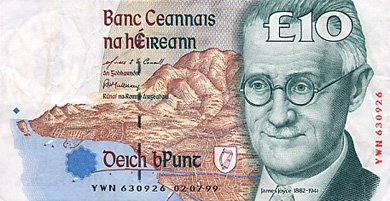
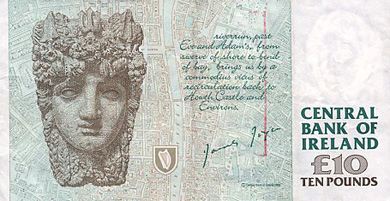
Banknotes
Budget & Public Finance
- Fiscal Year
- calendar year
- Annual Budget
- $69.4 (USD)
- Public Debt (% of GDP)
- 27.5%
- External Debt
- $1,049,000,000,000 (USD)
- Investment (% of GDP)
- 25.6%
- Current Account Balance
- -$5,190,000,000 (USD)
- Reserves of Foreign Exchange
- $2,147,483,647 (USD)
Labor, Industry & Trade
- Labor Force by Occupation
- agriculture 8%; industry 29%; services 64%
- Household Income — highest 10%
- 27.3%
- Industries
- food products, brewing, textiles, clothing; chemicals, pharmaceuticals, machinery, transportation equipment, glass and crystal; software
- Agriculture Products
- turnips, barley, potatoes, sugar beets, wheat; beef, dairy products
- Export Commodities
- machinery and equipment, computers, chemicals, pharmaceuticals; live animals, animal products
- Export Partners
- UK 23.3%, US 16.7%, Belgium 14.6%, Germany 7.3%, France 5%
- Import Commodities
- data processing equipment, other machinery and equipment, chemicals; petroleum and petroleum products, textiles, clothing
- Import Partners
- UK 41.1%, US 15.3%, Germany 6.8%
Energy
- Oil Production
- 0 bbl/day
- Oil Consumption
- 175,600 bbl/day
- Oil Reserves
- 0 bbl/day
- Natural Gas Production
- 673,000,000 cu m
- Natural Gas Consumption
- 4,298,000,000 cu m
- Natural Gas Imports
- 3,384,000,000 cu m
- Natural Gas Exports
- 0 cu m
- Natural Gas Reserves
- 19,820,000,000 cu m
Communications
- Telephone System
- general assessment: modern digital system using cable and microwave radio relay domestic: system privatized but dominated by former state monopoly operator; increasing levels of broadband access particularly in urban areas international: country code - 353; landing point for the Hibernia-Atlantic submarine cable with links to the US, Canada, and UK; satellite earth stations - 81
- Internet Country Code
- .ie
News & Weather
News & Weather
Current Weather
Latest News
New Zealand 40-21 Ireland: All Blacks punish error-strewn Irish in dominant Eden Park win - BBC
BBC · 2d ago
Ireland's World Cup play - Live Updates - Politico
Politico · 1d ago
Airline to cut Denver flights to Ireland - 9News
9News · 16h ago
E-scooters set to be banned for under-18s, hi-vis vests and helmets to be mandatory - RTE.ie
RTE.ie · 1d ago
Chris Bryant replaces Hilary Benn as Northern Ireland secretary - The Irish Times
The Irish Times · 8h ago
Australia vs. Ireland AFLW: Teams, venue, prediction and why this match could change the game - ESPN
ESPN · 9h ago
The tranquil spot in rural Ireland accused of fuelling Russia’s war - Financial Times
Financial Times · 2d ago
All-Ireland SHC Final: Limerick triumph again - Gaa.ie
Gaa.ie · 1d ago
News via Google News
Climate Overview
temperate maritime; modified by North Atlantic Current; mild winters, cool summers; consistently humid; overcast about half the time
Videos
Videos
2 curated YouTube videos.
Source: YouTube
Source: YouTube
Frequently Asked Questions
Frequently Asked Questions
What is the population of Ireland?
How do people greet each other in Ireland?
What are meals and food like in Ireland?
What should I know about Irish etiquette and social attitudes?
How should I dress in Ireland?
Are there gestures to avoid in Ireland?
What is family life like in Ireland?
What sports and recreation are popular in Ireland?
What is the capital of Ireland?
Where is Ireland located?
What is the predominant religion in Ireland?
What currency does Ireland use?
What languages are spoken in Ireland?
What is the geography of Ireland like?
What languages are spoken in Ireland?
What is Ireland known for?
Last reviewed 2026