
 English
 Español
 中文
中文 हिन्दी
 Français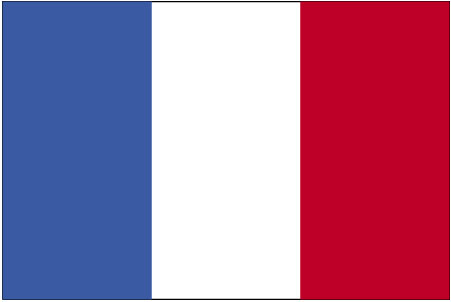
French Guiana
Guyane
Declare Your Relationship to French Guiana
CountryReports Community
- Studying1
- From French Guiana0
- French Guiana heritage0
- Visited0
- Want to visit0
Customs and Culture
Customs and Culture
Cultural Attributes
French Guiana occupies a unique cultural space that reflects its layered colonial history, indigenous heritage, and contemporary status as an overseas department of France. The territory's population of approximately 300,000 people is among the most ethnically diverse in South America, producing a cultural identity that blends European, African, Amerindian, Asian, and Caribbean influences in ways found nowhere else on the continent. The Creole people, descended largely from enslaved Africans brought during the colonial era, form the largest single cultural group and have shaped much of the territory's language, music, cuisine, and social traditions. Creole, a French-based creole language, serves as the most widely spoken vernacular, even though French remains the official language and the medium of education and government. Several Maroon communities — descendants of escaped enslaved people who established free settlements in the interior rainforest — maintain distinct cultural traditions, including intricate woodcarving, textile arts, and oral storytelling practices that have survived for centuries largely intact. The Saramaka, Aluku, and Ndjuka are among the most prominent Maroon groups. Six indigenous Amerindian peoples, including the Wayampi and Teko, inhabit the remote interior and continue to practice traditional ways of life based on subsistence agriculture, fishing, and forest knowledge. Their languages and spiritual practices remain living traditions, though increasing contact with the coastal economy has brought challenges to cultural continuity. French Guiana's coastal towns, particularly the capital Cayenne, reflect a distinctly French administrative and architectural character overlaid with Caribbean color and informality. Cuisine combines influences from all these communities — dishes such as bouillon d'awara, a rich palm fruit stew prepared during Easter celebrations, represent the Creole tradition, while roti and dhalpuri reflect the significant Hmong and South Asian communities that settled in the territory during the 20th century. Carnival in Cayenne and Saint-Laurent-du-Maroni is among the most vibrant in the French-speaking world, featuring weeks of parades, elaborate costumes, and music that draws on African rhythms and European masquerade traditions simultaneously.
The Space Port of the Equator
Greetings, Gestures & Visiting
A friendly greeting of salut! (hello) or Comment allez vous? (how are you) is common. Many children are given French names. Many girls names end in ette which means little.
People enjoy social visits and family occasions are important.
Western style of clothing is worn with women in Cayenne being quite fashion conscious following the french style of clothing adapted to a warm climate.
Diet
As a result of their ethnic backgrounds there is a wide variety of foods especially Indian and Chinese. Seafood dishes with rice are popular . The hot pepper cayenne takes its name from the French Guiana's capital. One of the more traditional meals in Guyana is The Metemgie. El The
Metemgie or Metemgee. It consists of a thick soup or stew made with
coconut, fish, meat, cassava, and sweet rolls. Also, crab soup
and homemade bread are popular in Guyana.
As a result of their ethnic backgrounds there is a wide variety of foods especially Indian and Chinese. Seafood dishes with rice are popular . The hot pepper cayenne takes its name from the French Guiana's capital. One of the more traditional meals in Guyana is The Metemgie. El The
Metemgie or Metemgee. It consists of a thick soup or stew made with
coconut, fish, meat, cassava, and sweet rolls. Also, crab soup
and homemade bread are popular in Guyana.
Family
Family ties are important due to the historic Catholic influence. Families in the cities enjoy modern conveniences while those who live in the jungles survive on the basic needs.
Recreation
Water sports are popular including fishing and swimming. A favorite past time is going to the beaches for picnics as a family. In Cayenne young people enjoy theaters and dance clubs.
Holidays
Bastille Day
7/14Other
Dates of Interest
- July 14th
How do people greet each other in FrenchGuiana?
A friendly greeting of salut! (hello) or Comment allez vous? (how are you) is common.
Good to know
- Many children are given French names
- Many girls' names end in 'ette,' meaning 'little'
What is dining like in FrenchGuiana?
Thanks to diverse ethnic backgrounds, there's a wide variety of foods, especially Indian and Chinese, with seafood and rice dishes popular.
Good to know
- Try Metemgie, a thick stew of coconut, fish, meat, cassava, and sweet rolls
- Crab soup and homemade bread are also popular
- The hot pepper cayenne takes its name from the capital
How should I dress in FrenchGuiana?
Western-style clothing is worn, with women in Cayenne being quite fashion conscious.
Good to know
- Cayenne women follow French style adapted to a warm climate
What role does family play in FrenchGuiana?
Family ties are important, influenced historically by Catholicism, and family occasions are valued.
Good to know
- City families enjoy modern conveniences, while those in the jungles live on basic needs
What do people do for fun in FrenchGuiana?
Water sports such as fishing and swimming are popular, and families enjoy going to the beach for picnics.
Good to know
- In Cayenne, young people enjoy theaters and dance clubs
Last updated: 2026-07-12 · Sources: CountryReports
Travel and Tourism
Travel and Tourism
- Travel Alert Status
- Level 1: Exercise Normal Precautions
- Currency
- euro (EUR)
- Climate
- Tropical; hot, humid; little seasonal temperature variation
- Airports
- 11
Read the full travel guide — health, safety, vaccinations, disease risk, sanitation, and transit details.
View full travel guideHistory
History
Historical Eras
Indigenous Period
10000 BCE – 1604
The territory now known as French Guiana was inhabited for millennia by Amerindian peoples including the Arawak, Carib, Teko, and Wayampi. These communities developed distinct cultures along the coast and interior rivers, subsisting through fishing, hunting, and shifting cultivation. European contact beginning in the late 15th century brought disease and disruption to these populations before formal colonization commenced.
Early Colonial Era
1604 – 1763
France established its first settlement in 1604, though the colony changed hands repeatedly among France, the Netherlands, and Portugal over the following century. The territory proved difficult to develop due to disease, hostile interior terrain, and limited agricultural success. The catastrophic Kourou colonization scheme of 1763, which killed thousands of European settlers within months of arrival, marked the definitive failure of early large-scale settlement ambitions.
Penal Colony Period
1763 – 1946
France increasingly used French Guiana as a destination for transported convicts, culminating in the formal penal colony system established in 1852 under Napoleon III. The complex of prisons collectively known as Devil's Island became internationally notorious for brutal conditions; political prisoners including Captain Alfred Dreyfus, convicted of treason in 1894, were among its most famous inmates. The penal institutions shaped the colony's economy, demographics, and global reputation for over a century.
Overseas Department
1946 – 1968
French Guiana was transformed from a colony into an overseas department of France in 1946, granting its inhabitants full French citizenship and integration into French administrative, legal, and social systems. The last convicts were repatriated and the penal settlements formally closed by 1951. This period saw gradual modernization of infrastructure but continued economic underdevelopment and significant demographic challenges as the territory adjusted to its new constitutional status.
Space Age & Modern Era
1968 – present
The establishment of the Guiana Space Centre at Kourou in 1968 transformed French Guiana into one of the world's premier launch sites, later serving the European Space Agency for missions including the first lunar mission from South American soil in 2003. The territory remains an overseas region of France and the only mainland South American land under European sovereignty. Tensions between economic modernization, Creole and Amerindian rights movements, and environmental concerns over the vast Amazon rainforest interior continue to define its contemporary politics.
Overview
Timeline of Key Events
1749
Jean Godin, French geographer became stranded in French Guiana.
Jean Godin, French geographer, left Quito, part of the Viceroyalty of Peru (later Ecuador), in an attempt to reach France to settle his family estate. He traveled by an eastern route across South America and became stranded in French Guiana for over 20 years. In 2004 Robert Whitaker authored “The Mapmaker’s Wife: A True Tale of Love, Murder, and Survival in the Amazon.” It was an account of Jean Godin (d.1792), French mapmaker, and his wife, Isabel Godin. They managed to reunite in 1770.
1894
A French spy discovered an unsigned note in a wastebasket describing secret tests.
A French spy, working as a cleaning woman at the office of the German military attache in Paris, discovered an unsigned note in a wastebasket describing secret tests of new French artillery guns. French intelligence soon accused Capt. Alfred Dreyfus, the only Jewish officer who had access to the secret information. It later was found that the note had been written by Major Ferdinand Walsin Esterhazy.
1895
French Capt. Alfred Dreyfus, convicted of treason,
French Capt. Alfred Dreyfus, convicted of treason, was publicly stripped of his rank. He was ultimately vindicated. Dreyfus, a Jew falsely accused of spying for the Germans, was imprisoned alone on Devil’s Island.
1899
French Capt. Alfred Dreyfus, convicted of treason,
French Capt. Alfred Dreyfus won a pardon after a retrial was forced by public opinion. He was soon released from Devil’s Island in French Guiana.
2003
Europe’s first mission to the moon blasted off from French Guiana.
Europe’s first mission to the moon blasted off aboard a European Ariane rocket from French Guiana. The SMART-1 probe made it to within 3,100 miles of the moon on Nov 15, 2004, and proceeded to move into an elliptical orbit. The spacecraft ended its mission Sep 3, 2006, when it crashed into the lunar surface.
2009
A French rocket carrying the largest space telescope ever was launched into space.
A French rocket carrying the largest space telescope ever was launched into space on a mission that European scientists hope will help unravel the mystery of the universe’s creation. The Ariane-5 rocket was loaded with the Herschel space telescope and the Planck spacecraft, carrying a payload of 5.3 tons (4.81 metric tons) when it launched from the city of Kourou near the jungles of French Guiana.
Read the full history profile — narrative overview, defining eras, and the complete timeline in one place.
View expanded historyInteresting Facts
Interesting Facts
The coastal town of Kourou, just north of Cayenne, is home to the European Ariane Space Program, which employs over 20,000 foreigners and launches over half of the world’s satellites.
See every fact — trivia, oddities, and curious tidbits gathered from across the country.
View all interesting factsGeography and Environment
Geography and Environment
- Terrain
- low-lying coastal plains rising to hills and small mountains
- Climate
- tropical; hot, humid; little seasonal temperature variation
- Natural Hazards
- high frequency of heavy showers and severe thunderstorms; flooding
- Current Environmental Issues
- NA
Read the full geography and environment profile — terrain, climate, natural resources, hazards, land use, and international agreements.
View full geographyPeople & Demographics
People & Demographics
Religion
Languages Spoken
French
- French
Population
- Population
- 199,509
- Nationality Noun
- French Guianese (singular and plural)
- Ethnic Groups
- Black or mulatto 66%, white 12%, East Indian, Chinese, Amerindian 12%, other 10%
Education
- Literacy Definition
- Age 15 and over can read and write
Read the full people and society profile — demographics, health, education, religion, languages, and notable people.
View full people and societyGovernment & Politics
Government & Politics
Country Identity
- Country Name
- FrenchGuiana
- Full Country Name
- Department of Guiana
- Local - Short
- Guyane
Government Structure
- Government Type
- NA
- Legal System
- French legal system
- Executive Branch
- chief of state: President Emmanuel MACRON of France (since 14 May 2017), represented by Prefect Thierry QUEFFELEC (since 2022) head of government: President of the Departmental Council Gabriel SERVILLE (since April 2021); President of the Regional Council Gabriel SERVILLE (since April 2021), who holds both roles following the merger of the two councils under French Guiana's unique institutional status as a single territorial collectivity cabinet: NA elections: French president elected by popular vote for a five-year term; prefect appointed by the French president on the advice of the French Ministry of Interior; the president of the Territorial Collectivity Assembly is elected by the members of that assembly. Note: since 2015, French Guiana has operated as a single territorial collectivity, replacing the former separate General Council and Regional Council with a unified Territorial Assembly.
- Legislative Branch
- unicameral General Council or Conseil General (19 seats; members are elected by popular vote to serve six-year terms) and a unicameral Regional Council or Conseil Regional (31 seats; members are elected by popular vote to serve six-year terms) elections: General Council - last held in March 2000 (next to be held March 2006); Regional Council - last held 21 and 28 March 2004 (next to be held in 2010) election results: General Council - percent of vote by party - NA; seats by party - PSG 5, various left-wing parties 5, independents 7, other 2; Regional Council - (second election results) percent of vote by party - PS 37.24%, UMP 31.58%, FDG/Walwari 31.18%; seats by party - PS 17, UMP 7, FDG/Walwari 7 note: one seat was elected to the French Senate on 27 September 1998 (next to be held September 2007); results - percent of vote by party - NA; seats by party - NA; 2 seats were elected to the French National Assembly on 9 June-16 June 2002 (next to be held in 2007); results - percent of vote by party - NA%; seats by party - UMP/RPR 1, Walwari Committee 1
- Judicial Branch
- Court of Appeals or Cour d'Appel (highest local court based in Martinique with jurisdiction over Martinique, Guadeloupe, and French Guiana)
- Suffrage
- 18 years of age; universal
- Constitution
- 28 September 1958 (French Constitution)
- Independence
- none (overseas department of France)
- National Holiday
- Bastille Day, 14 July (1789)
Capital City
- Capital Name
- Cayenne
Embassy / Diplomatic Mission
U.S. Embassy Paramaribo
Drs. Sophie Redmondstraat 129, Paramaribo, Suriname
Telephone: (597)-472-900
Emergency after-hours telephone: (597)-0710-1112
Facsimile: (597)-425-788
U.S. Embassy/Consular Section in Paris
4 Avenue Gabriel, 75008 Paris (Place de La Concorde, metro stop
Concorde)
Telephone: (43)-12-22-22
Emergency after-hours telephone: (42)-61-61-40
Read the full government profile — flag symbolism, national anthem, and other national symbols.
View full government detailsEconomy
Economy
French Guiana's economy is closely tied to that of mainland France through substantial subsidies, transfer payments, and imports. The Guiana Space Centre at Kourou, operated by the French space agency CNES and the European Space Agency, remains a cornerstone of the economy, accounting for roughly 15 to 20 percent of GDP and supporting thousands of direct and indirect jobs. Beyond the space sector, fishing, forestry, and gold mining are the most significant economic activities. Forest and woodland cover more than 90 percent of the territory, and the large reserves of tropical hardwoods support a sawmill industry that produces timber for both local use and export, though the resource remains underexploited. Cultivation is largely confined to the narrow coastal strip where most of the population lives; rice, manioc, sugarcane, and fruits are among the principal crops. French Guiana remains heavily dependent on imports of food, manufactured goods, and energy, with mainland France and the wider European Union as its primary trading partners. Unemployment is a persistent challenge, hovering near 13 to 15 percent overall and considerably higher among young workers, while rapid population growth and high living costs continue to strain the labor market and public services.
Snapshot
- Currency Name and Code
- Euro (EUR)
Banknotes
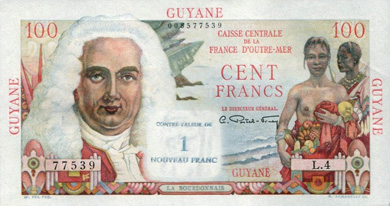
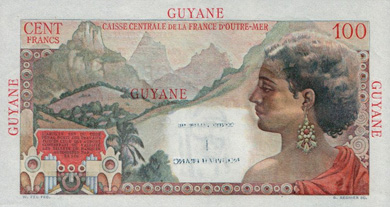
Budget & Public Finance
- Fiscal Year
- calendar year
- Annual Budget
- $135,500,000 (USD)
- External Debt
- $800,300,000 (USD)
Labor, Industry & Trade
- Labor Force by Occupation
- services; government; and commerce 60.6%; industry 21.2%; agriculture 18.2%
- Industries
- construction, shrimp processing, forestry products, rum, gold mining
- Agriculture Products
- corn, rice, manioc (tapioca), sugar, cocoa, vegetables, bananas; cattle, pigs, poultry
- Export Commodities
- shrimp, timber, gold, rum, rosewood essence, clothing
- Export Partners
- France 62%, Switzerland 7%, US 2%
- Import Commodities
- food (grains, processed meat), machinery and transport equipment, fuels and chemicals
- Import Partners
- France 63%, US, Trinidad and Tobago, Italy
Energy
- Oil Production
- 0 bbl/day
- Oil Consumption
- 6,600 bbl/day
- Oil Reserves
- 0 bbl/day
- Natural Gas Production
- 0 cu m
- Natural Gas Consumption
- 0 cu m
- Natural Gas Imports
- 0 cu m
- Natural Gas Exports
- 0 cu m
- Natural Gas Reserves
- 0 cu m
Communications
- Internet Country Code
- .gf
News & Weather
News & Weather
Current Weather
Latest News
Guyana ferry capsizes, leaving dozens dead and scores missing - France 24
France 24 · 8h ago
The Cayenne airport is getting a makeover - Voyages d'affaires
Voyages d'affaires · 19h ago
French Guiana Population 2026 - World Population Review
World Population Review · 4d ago
10 bodies recovered following Guyana ferry tragedy - Baird Maritime
Baird Maritime · 9h ago
Martinique and French Guiana strengthen Caribbean ties through CARICOM - TravelMole
TravelMole · 1d ago
More bodies found from MV Barima tragedy - Demerara Waves Online News- Guyana
Demerara Waves Online News- Guyana · 9h ago
Chikungunya in French Guiana: Marked increase in cases in past week - Outbreak News Today
Outbreak News Today · 80d ago
Martinique, French Guiana newest members of CARICOM (Video) - Miami Herald
Miami Herald · 11d ago
News via Google News
Climate Overview
Tropical; hot, humid; little seasonal temperature variation
Videos
Videos
1 curated YouTube videos.
Source: YouTube
Frequently Asked Questions
Frequently Asked Questions
What is the population of French Guiana?
How do people greet each other in FrenchGuiana?
What is dining like in FrenchGuiana?
How should I dress in FrenchGuiana?
What role does family play in FrenchGuiana?
What do people do for fun in FrenchGuiana?
What is the capital of French Guiana?
Where is French Guiana located?
What countries border French Guiana?
What is the predominant religion in French Guiana?
What currency is used in French Guiana?
What language is spoken in French Guiana?
What is the geography of French Guiana like?
What is French Guiana known for?
Last reviewed 2026